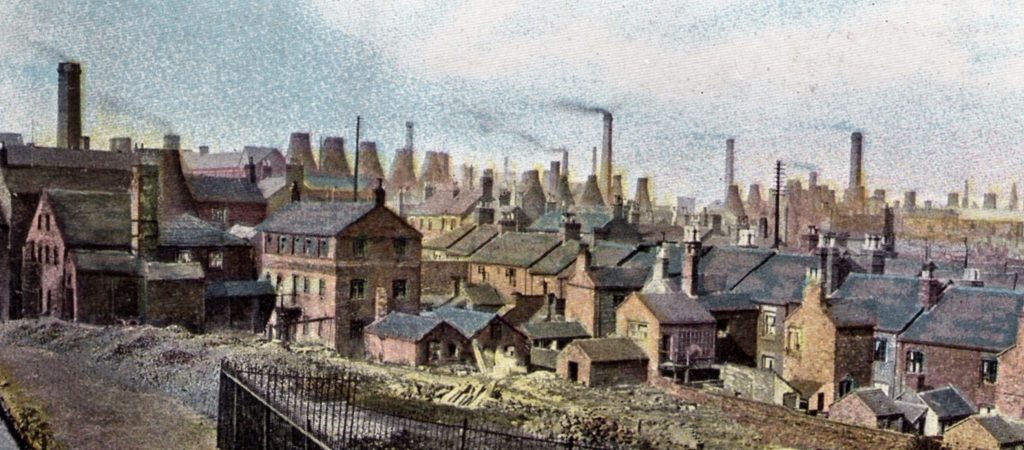

In 1898, A Man from the North, the first novel by a then unknown author named E. A. Bennett was published. It was the story of a young man who had arrived in London keen to set himself up as a writer and though readers at the time would not know it, the novel was largely autobiographical, Arnold Bennett himself had arrived in London from the Potteries and found work editing a women’s magazine and he penned the novel in hopes of breaking into the serious literary market.
In truth the book was something of a failure, but it laid the groundwork for the stories that Bennett is still best remembered for. A Man from the North is largely set in the capital, but when the protagonist takes a journey back home for a funeral, the reader is given a brief glimpse of the curious parochial industrial landscape in ‘the north’ that the hero had escaped from. The towns he mentions are Bursley (Burslem) ‘the mother town’, Turnhill (Tunstall) ‘the northern outpost’ or ‘The bailiwick of Turnhill’ and Knype (Stoke-upon-Trent) that housed the train station and boasted the paramount local football team. Though not named as such until his next novel came out four years later, this is the first glimpse we get of ‘The Five Towns’, Bennett’s fictional version of the Potteries he had grown up in.
That next novel was Anna of the Five Towns, published in 1902, in which the list of Bennett’s fictional pottery towns was expanded upon with the inclusion of Hanbridge (Hanley) ‘the Chicago of the Five Towns’ as Bennett described the commercial centre in one of his short stories, and Longshaw (Longton) the grittiest and most industrialised of the towns. Missing from this list, of course is Fenton ‘the town Arnold Bennett forgot’. In fact he did not forget Fenton, he simply felt that euphonically ‘The Five Towns’ sounded better than ‘The Six Towns’ and he adapted his topography accordingly.
As the list of novels and short stories Bennett had published grew, so too did the make-believe landscape they were set in. There were some smaller Five Towns settlements like Bleakridge (Cobridge), Shawport (Longport), Hillport (Porthill) or Sneyd (Trentham), while beyond the borders lay Oldcastle (Newcastle) and Axe (Leek). Looking inward, Burslem saw many of its streets and buildings renamed or repurposed in Bennett’s fictional Bursley. Here Swan Bank became Duck Bank, Waterloo Road became Trafalgar Road, Nile Street was changed to Aboukir Street, The Leopard Inn became The Tiger and the George Hotel was renamed The Dragon. These were just some some of the numerous thoroughfares and locations frequented by the likes of Edwin Clayhanger and Hilda Lessways, Anna Tellwright and Willie Price, Simon Fuge, Denry Machin, the Countess of Chell, Constance and Sophia Baines and a host of other local fictional characters.

In honour of the fictional landscape Bennett created, a number of buildings and sites around Burslem and elsewhere now form part of ‘The Bursley Trail’ and carry blue plaques presented by the Arnold Bennett Society, which identify their literary counterparts.
Reference: See the novels of Arnold Bennett, notably A Man from the North, Anna of the Five Towns, The Old Wives Tale, the Clayhanger Trilogy, The Card, and the short story collections Tales of the Five Towns, Grim Smile of the Five Towns, The Matador of the Five Towns.
Leave a Reply