Prior to the early 18th century, white pottery was a rare sight in Europe. What pieces there were usually arrived from China or Japan, where the production of porcelain was long established and its secrets closely guarded, or there were the tin glazed earthenwares imported from Holland, the white finish of which mimicked oriental porcelain. However, in 1709, Johann Friedrich Böttger, a would-be alchemist held prisoner by the gold-hungry Elector of Saxony, discovered the formula for a true hard-paste porcelain and within a few years the Meissen factory began producing the first European porcelain using Böttger’s formula.

The continental potters were blessed with ready supplies of the primary ingredients of porcelain, china clay and china stone and were soon producing a wide range of white wares that proved incredibly popular. In Britain, though, potters were unable to join the porcelain revolution, as at that time no deposits of china clay or stone had been discovered in the country. Instead, the English factories had advanced the potters’ art from the 1740s onwards by developing numerous soft-paste porcelain recipes. This all changed in 1768, though, when a pharmacist, William Cookworthy, discovered china clay and china stone deposits near to St Austell in Cornwall and he immediately cornered the British manufacture of porcelain by taking out a patent on the materials, setting up his first factory soon after. Three years later, Cookworthy retired and sold out to his business partner Richard Champion, who extended the patent to 1796. By 1781, though, Champion was in severe financial difficulties and sold the patent to a group of Staffordshire potters and helped set up the New Hall Pottery in Shelton, which produced the first porcelain wares in the Potteries. When the Champion patent expired in 1796, though, everyone was free to use china clay and china stone how they pleased.
One man who took immediate advantage of the access to the new materials was Josiah Spode I, who like several others had been experimenting to develop a strong white porcellanous body for fine pottery. True porcelain was a high-fired clay that needed more specialised kilns than those used in North Staffordshire. Also, though porcelain gave a brilliant white surface, the pottery produced tended to be heavier than desired, while its highly vitrified state made it prone to chipping. Experiments had been going on for decades adding various materials to china clay to offset these niggles, the most promising ingredient being bone ash. Thomas Fry of the Bow factory in London had patented the first bone ash formula in 1749 and Sèvres in France had its own recipe, but these were not entirely satisfactory and there is evidence that Spode had formulated his own mix shortly before his sudden death in 1797. When his son Josiah Spode II took charge of the works, further experimentation perfected the formula and the factory was soon marketing its new bone china pottery. These early examples of Spode’s bone china were not perfect though they carried the impressed mark ‘Stoke China’, thereby literally putting the local industry’s stamp on the new ceramic body.
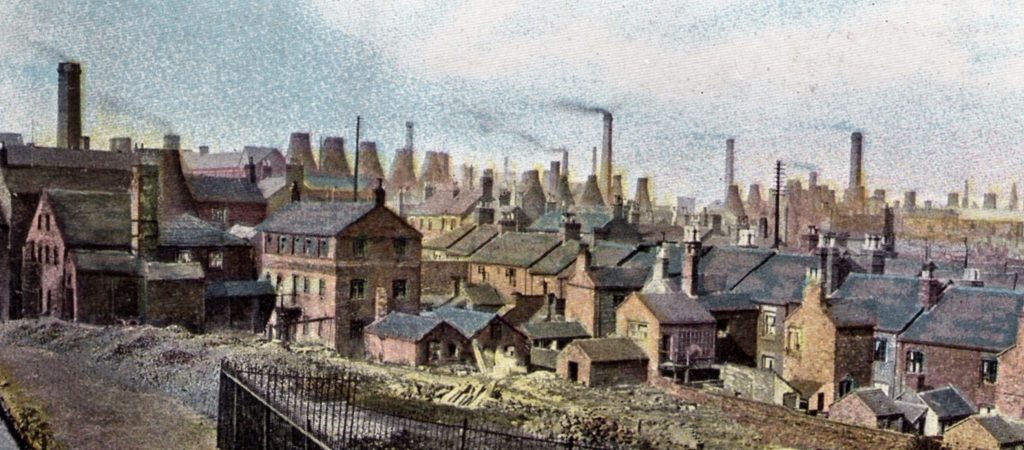
The Spode formula was finally perfected in the early 1800s and was a game-changer. Whereas with porcelain the china clay was the dominant ingredient with smaller amounts of silica and feldspar, the optimum Spode mix comprised 50% bone ash, 25% kaolin (china clay) and 25% china stone. The bone ash was a by-product of the meat industry, the dense leg bones of cattle being preferred. These were crushed in bone mills, then reduced to a fine ash in special calcining kilns, the tall slender shapes of which soon joined the numerous other bottle ovens dotting the Potteries landscape. The predominance of bone ash in the mix had a number of advantages, combining with the clay it added warmth to the starkness of true porcelain, made the resulting wares translucent and gave the clay great strength, making it perfect for the production of much lighter pottery. Moreover, bone china had a lower firing temperature than porcelain, making it it suitable for the existing kilns in the Potteries, and unlike true porcelain it could be fired in the manner preferred in the Staffordshire industry of first biscuit then glost firings. This made it much easier to introduce the new ceramic body to the local industry as the firemen in charge of operating the kilns would not need to learn new techniques or implement any radically new firing regimes.
The new bone china pottery was a big hit with customers and it soon became a staple of the local industry. In 1806, there came a royal endorsement of the new product when on 12 September that year, the Prince of Wales accompanied by his brother the Duke of Clarence, the Marquis of Stafford and a slew of other dignitaries arrived for a tour of the factory. Josiah Spode had arranged his workers in the factory in their best attire and after leading the royal party through their largest warehouse filled with masses of the pot bank’s finest wares on display, they were led onto the factory floor itself and shown how the wares were produced, all of which was a new experience for the visitors. The Prince was evidently impressed by what he saw and concluded his visit by bestowing on Spode the title of ‘Potter and English Porcelain Manufacturer to His Royal Highness’. In years to come he would order from Spode numerous wares for the Brighton pavilion and pottery for his coronation as George IV in 1821.
Reference: Robert Copeland, Spode; Staffordshire Advertiser, Saturday 20 September 1806, p.3. See also Pam Woolliscroft’s blog, Spode History at https://spodehistory.blogspot.com/
Leave a Reply