The statue of Arnold Bennett. Stoke-on-Trent’s most famous literary figure, situated outside the Potteries Museum and Art Gallery, Hanley.
In 1898, A Man from the North, the first novel by a then unknown author named E. A. Bennett was published. It was the story of a young man who had arrived in London keen to set himself up as a writer and though readers at the time would not know it, the novel was largely autobiographical, Arnold Bennett himself had arrived in London from the Potteries and found work editing a women’s magazine and he penned the novel in hopes of breaking into the serious literary market.
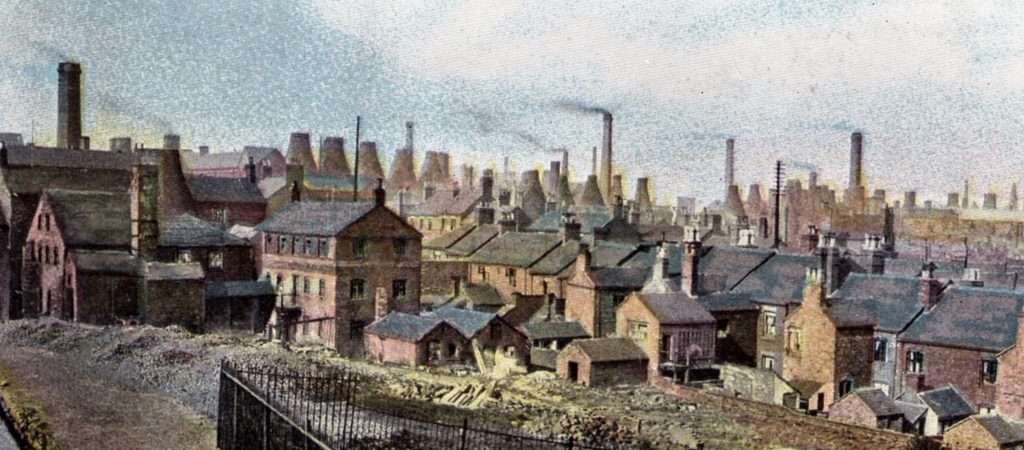
In truth the book was something of a failure, but it laid the groundwork for the stories that Bennett is still best remembered for. A Man from the North is largely set in the capital, but when the protagonist takes a journey back home for a funeral, the reader is given a brief glimpse of the curious parochial industrial landscape in ‘the north’ that the hero had escaped from. The towns he mentions are Bursley (Burslem) ‘the mother town’, Turnhill (Tunstall) ‘the northern outpost’ or ‘The bailiwick of Turnhill’ and Knype (Stoke-upon-Trent) that housed the train station and boasted the paramount local football team. Though not named as such until his next novel came out four years later, this is the first glimpse we get of ‘The Five Towns’, Bennett’s fictional version of the Potteries he had grown up in.
That next novel was Anna of the Five Towns, published in 1902, in which the list of Bennett’s fictional pottery towns was expanded upon with the inclusion of Hanbridge (Hanley) ‘the Chicago of the Five Towns’ as Bennett described the commercial centre in one of his short stories, and Longshaw (Longton) the grittiest and most industrialised of the towns. Missing from this list, of course is Fenton ‘the town Arnold Bennett forgot’. In fact he did not forget Fenton, he simply felt that euphonically ‘The Five Towns’ sounded better than ‘The Six Towns’ and he adapted his topography accordingly.
As the list of novels and short stories Bennett had published grew, so too did the make-believe landscape they were set in. There were some smaller Five Towns settlements like Bleakridge (Cobridge), Shawport (Longport), Hillport (Porthill) or Sneyd (Trentham), while beyond the borders lay Oldcastle (Newcastle) and Axe (Leek). Looking inward, Burslem saw many of its streets and buildings renamed or repurposed in Bennett’s fictional Bursley. Here Swan Bank became Duck Bank, Waterloo Road became Trafalgar Road, Nile Street was changed to Aboukir Street, The Leopard Inn became The Tiger and the George Hotel was renamed The Dragon. These were just some some of the numerous thoroughfares and locations frequented by the likes of Edwin Clayhanger and Hilda Lessways, Anna Tellwright and Willie Price, Simon Fuge, Denry Machin, the Countess of Chell, Constance and Sophia Baines and a host of other local fictional characters.
Three of the plaques on The Bursley Trail
In honour of the fictional landscape Bennett created, a number of buildings and sites around Burslem and elsewhere now form part of ‘The Bursley Trail’ and carry blue plaques presented by the Arnold Bennett Society, which identify their literary counterparts.
Reference: See the novels of Arnold Bennett, notably A Man from the North, Anna of the Five Towns, The Old Wives Tale, the Clayhanger Trilogy, The Card, and the short story collections Tales of the Five Towns, Grim Smile of the Five Towns, The Matador of the Five Towns.
In early 1888, 22 year old Herbert George ‘H. G.’ Wells was recovering from a disorder of the lungs, and went to stay with an old college friend William Burton and his wife at their terraced house in Basford for a few months, where he proved a somewhat petulant and troublesome house-guest. The future ‘father of science fiction’ had lived most of his life in rural or semi-rural districts and the Potteries was the first truly industrial landscape he had encountered. In his autobiography he noted:
‘I found the Burtons and their books and their talk, and the strange landscape of the Five Towns with its blazing iron foundries, its steaming canals, its clay whitened pot-banks and the marvellous effects of its dust and smoke-laden atmosphere, very stimulating. As I went about the place I may have jostled in the streets of Burslem against another ambitious young man of just my age who was then clerk to a solicitor, that friendly rival of my middle years, Arnold Bennett.’
Indeed, the two authors later became good friends and he wrote to Bennett, ‘the district made an immense impression on me’ and his memories of the area later found their way into his works. He added that it was ‘… at Etruria my real writing began’ and it was whilst here that he concocted a curious scientific romance, ‘The Chronic Argonauts’ that became the basis of his first novel, The Time Machine.
His stay in the Potteries allowed Wells to recuperate in comfort, but as his health improved he realised that it was time to move on. He later recalled how one afternoon in June, whilst lying in a wood full of bluebells, revelling in the sunlight and the effect of the nodding flowers around him, a curious resolution swept over him. “I have been dying for nearly two-thirds of a year,” he mused, “and I have died enough.” On returning to his lodgings he told the Burtons he would be leaving them and the next day he took the train back to London. Not one to miss an opportunity for a story, in the 1890s, Wells wrote a fictionalised account of his recovery and his moment of revelation in the Potteries was made much more picturesque. Entitled ‘How I Died’, in the story he describes how after four months lying ill and convinced that he was dying, an invalid staggered out one early spring morning to get some fresh air and take a last look at the sky before expiring, when he encountered a young girl who had got her dress caught by a bramble whilst climbing a hedge. After helping her free, the invalid stood chatting with the girl about this and that and he noted that she carried a small bunch of wood anemones that she called ‘wind-stars’. Charmed by the pretty name that the innocent youngster gave to her flowers, he suddenly realised that he was bored with the idea that he was dying and decided to put all gloomy thoughts aside and get on with his life.
This imagined encounter not only echoes Wells’ real recovery, but also bears similarities to the time traveller’s first meeting with the childlike Eloi, Weena, in The Time Machine, who presents a bunch of flowers to the time traveller for saving her life, then sits with him as he tries to communicate with her. Also in The Time Machine, a friend of the time traveller refers to a conjuror he had once seen in Burslem, while the spectacle of the Potteries at night with its numerous kilns and furnaces casting a fiery glow into the sky, is famously referenced early on in The War of the Worlds, to describe the destruction wrought by the Martian war machines.
In addition to these famous examples there were lesser tales of his that owed something to the Potteries. In 1895, the same year that The Time Machine was published and he began work on The War of the Worlds, Wells had a short macabre horror story The Cone published, which was set in a fictional forge in Etruria, and was probably based on Earl Granville’s iron works. That story was all that remained of what Wells had originally planned to be a larger dramatic novel set in the area, ‘… a vast melodrama in the setting of the Five Towns, a sort of Staffordshire Mysteries of Paris conceived partly in burlesque, it was to be a grotesque with lovely and terrible passages’, but he went on to produce another work, the slightly scandalous science fiction novel (because it championed socialism and advocated free love) In the Days of the Comet, published in 1906, which was also set in a fictional version of the Potteries.
Reference: H. G. Wells, An Experiment in Autobiography, Chapter 6, part 2.
Stoke-on-Trent’s best known connection with the Titanic disaster is of course the ship’s venerable skipper, Captain E. J. Smith, but a less well-known Potteries-born sailor who also perished in the Titanic disaster was Senior Fourth Engineer Leonard Hodgkinson. At the time of his death he was 46 years old, and like Captain Smith had spent most of his adult life at sea, albeit in a far different environment to that of his much more famous shipmate. As a member of the ship’s engineering staff, his working life was one spent for the most part in noisy, hot engine rooms, with little view of sea or sky save when he was off duty.
Leonard was born at 20 North Street, Stoke-upon-Trent, on 20 February 1866, the second son and fifth child of potter’s presser John Hodgkinson and his wife Caroline nee Steele. Educated at St Thomas’ School, Stoke, before the age of 15, Leonard was apprenticed as an engine fitter with Messrs Hartley, Arnoux and Fanning, in Stoke. Once his apprenticeship was done, Leonard left the Potteries sometime in the 1880’s and took up a position with Messrs Lairds of Birkenhead, lodging with his elder sister Rose, her husband Henry Mulligan and their children, who had settled in Liverpool sometime after their marriage in 1877. It was in Liverpool that Leonard met his wife-to-be, Sarah Clarke. The couple were married in West Derby, Liverpool on 14 February 1891 and within a few years the couple had three children.
North Street, Stoke-upon-Trent
Leonard was now a seagoing marine engineer. He served for five years with the Beaver Line, whose ships sailed from Liverpool to Quebec and Montreal. In 1894, though, the Beaver Line went into liquidation and it may have been at this point that Leonard left and joined Rankin, Gilmour and Co., Ltd, which firm he also served with for five years, earning his first class certificate in the process. He may also have served with the Saint Line of ships which were owned by Rankin and Co., most of which carried the ‘Saint -’ title. Leonard’s final position with the company was as chief engineer aboard a ship with just such a title, the Saint Jerome.
For a few years between 1901 and 1905, Leonard quit the sea and set himself up in business ashore as a mechanical engineer, but in May 1905, he returned to his old line of work, joining the White Star Line, serving first as assistant engineer on the Celtic, later earning promotion to fourth and then third engineer.
According to family lore, Leonard Hodgkinson was keen to serve on as many vessels as possible before retirement, so was doubtless pleased after what appears to have been a six year stint aboard the Celtic, to be transferred over to the glamorous new Olympic (the Titanic’s elder sister) when that ship came on-line in June 1911. Here he was briefly bumped back down to assistant engineer, but soon earned promotion to fourth engineer once again. Perhaps more troublesome for him and his family was the fact that the Olympic was to sail from Southampton. There is no indication that the whole Hodgkinson family moved to Southampton at this time, though it is a possibility, but if not, then Leonard had to put up at lodgings in between journeys and perhaps only got to see his family on a few occasions when he could make the journey back to Liverpool.
It was in early 1912, that Leonard travelled to Belfast where he joined the staff under Chief Engineer Joseph Bell, who were involved in getting the Olympic’s younger sister Titanic up and running. On 2 April he was signed onto the ship’s books for the delivery trip from Belfast to Southampton and on 6 April he was signed on once again in Southampton, now as senior fourth engineer.
A White Star engineer at work.
As senior fourth engineer, Leonard Hodgkinson was the highest ranking of the five fourth engineers aboard the Titanic, one of whom was a specialist in charge of the ship’s refrigeration equipment. Whilst at sea their duties involved checking that the adjustments and routine maintenance of the ship’s machinery were carried out. They dealt with any minor problems as they arose, answered any orders rung down via the ship’s telegraphs and ensured that everything ran as smoothly as possible. As officers it was also their duty to supervise the firemen, trimmers and greasers who worked with them down in the bowels of the ship.
How Leonard’s days passed aboard the Titanic prior to its fateful collision is unknown, as too are his deeds on the night in question, as no accounts seem to exist noting him. If the story is to be believed, though, his fate and that of the 1500 other people who perished on the Titanic was foreseen by one of his relatives back in the Potteries, none of whom had any idea that Leonard was aboard the Titanic. According to the story she later told, two days before the disaster, Leonard’s 14 year old niece, Rose May Timmis, the daughter of Leonard’s elder sister Agnes, was sleeping in the same bed as her grandmother Caroline Hodgkinson (Leonard’s mother) when she had a nightmare. Rose dreamt that she was standing by a road in Trentham Park looking out over the lake, when a large ship steamed into sight. Suddenly the ship went down at one end and she could hear screams. Rose herself woke up with a yell that frightened her grandmother awake. When the frightened girl related her dream her grandmother snapped, “No more suppers for you, lady; dreams are a pack of daft.”
After a while, Rose drifted back to sleep once more, only to find herself dreaming the same scene and as before when she heard the people screaming she did the same. She recalled that her grandmother was furious with her this time. A few days later, though, the news of the disaster broke and the family learnt that Leonard had been aboard the Titanic and that he and the other 34 engineering officers aboard had perished with the ship. Though several bodies from the engineering department were recovered in the following weeks, Leonard’s was not one of them.
Though Leonard’s body was never found, he is remembered in several memorials, most notably on the Engineers Memorial, East Park, Southampton, the Titanic and Engineers memorial, Liverpool; the Glasgow Institute of Marine Engineers memorial; and the Institute of Marine Engineers Memorial in London. There is also a brass memorial plaque in the church of St Faithful, in Crosby, Liverpool, dedicated to the memory of the Chief Engineer and his Engine Room staff.
The Titanic Engineers Memorial, Southampton
Leonard Hodgkinson was not the only member of his family to go to sea. His son Leonard Stanley also became a marine engineer with White Star and later Cunard. He served on the transatlantic run most of his career, mainly on RMS Majestic before the war and later on the Queen Mary and the Queen Elizabeth.
The oldest profession in the world had its place in soft underbelly of the Regency Potteries. Prostitutes plied a regular trade usually around the local inns where there were rich pickings when the potters and miners rolled in with their wages. A brief memoir of the period reveals that then as now many of the local working girls were ordinary women driven to extremes by circumstances, the probable cause being abject poverty. A Short Memoir of Ann Sheldon, published in 1821, tells the story of the short life of a dedicated Burslem Sunday School teacher. Constructed around entries in Ann’s diary, it reveals her to have been a noble spirited young woman, who saw it as her Christian duty to visit the sick and try to save the fallen.
Burslem town centre in the early 19th century.
In April 1813 following a class, one of her class members asked Ann if she would visit a woman who was very ill. Accompanied by a fellow teacher ‘Miss B’, she went to see the woman whom she soon discovered to be a local prostitute. They found her to be, ‘a little better and very penitent.’ Ann continued : ‘she had been a very wicked woman for years, and is now little more than 30 years of age. Her parents died when she and her sister were young. As they advanced in years they got into bad company and lost their character. Masters would not employ them and they became common prostitutes.’ The woman, exhausted and frightened by her illness, told the two teachers that if she lived she was determined to leave her ‘wicked course of life.’
After praying together they left her. The two young teachers had obviously been shocked by the interview and though the nature of the woman’s illness is never stated, the impression we are left with is that it was contracted as a result of her calling. Both came away from the house burning with a desire to save others from such a dangerous and degrading career.
The next day, Ann and Miss B set out once more and found a woman to direct them to the ‘houses of ill fame’. They visited two buildings, but met with a mixed reception, made all the more galling no doubt, by the fact that at least two of the girls they encountered were old Sunday school scholars.
In the first house ‘we found a young woman about seventeen years of age, who lived by herself, and was three years ago a Sunday scholar.’ The girl was unmoved by the teachers’ entreaties, Ann went back many times to invite her back to the school, but to no avail.
There were two women in the other house: ‘we found a woman about twenty-seven years of age; who met in class about two years ago: we both spoke as close as possible for an hour and a half; they shed many tears and confessed they had a hell upon earth. There was another woman present, a companion in sin, who appeared to take no notice: – I said to her come down on your knees, and cry to the Lord, to have mercy upon your soul, before it is too late: we all bowed the knee before God, and found much liberty in prayer.’
It is unknown whether Ann and Miss B efforts were successful. The biography remains silent on the matter. Ann herself died at a young age in 1819.
Reference: John Tregortha (publisher) A Short Memoir of Ann Sheldon, Burslem 1821