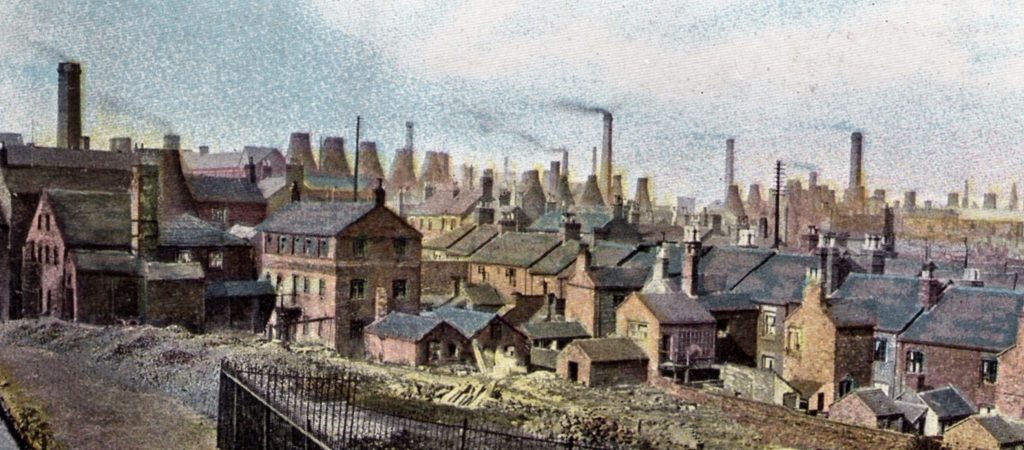
In an age when coal mining was rapidly transforming the landscape around the Potteries, the dangers of the industry extended far beyond the men who worked underground. Open pits scarred the countryside, often lying perilously close to roads and footpaths, waiting like concealed traps for the unwary traveller. Such had been the case of Ellen Hulme and her child in 1785 (see ‘A Tragic Accident’ in the post ‘Old News from the Potteries’, above) and an avoidable death a decade later provided another example of the danger. According to the Staffordshire Advertiser of 12 December 1795, an accident occurred around the end of November to a Mr Bristoe, a young man from the parish of Wolstanton, who was making his way home from Hanley when somewhere along the route he disappeared. Days passed with no sign of him and it was not until Monday 7 December, almost a fortnight after he had vanished, that his body was discovered at the bottom of a coal pit.
The newspaper’s account leaves little doubt as to the condition in which the body was found. A Coroner’s Inquest, held at Hanley the day after the discovery of the remains, examined what was described as his ‘mangled body’, confirming that he had fallen into the pit and perished there unnoticed. Yet it was not merely the circumstances of his death that stirred sympathy. He was said to be the son of a respected farmer’s widow and was on the eve of marriage. The newspaper remarked that both his intended bride and his wider circle of friends would ‘long lament his ultimate fate’. An alternative version of the story made the tragedy even more poignant. It was stated that Mr Bristoe had in fact been travelling to visit the young woman he hoped to marry and had the marriage ring in his pocket at the time he went missing.
The newspaper’s sympathy at his loss was matched by its indignation at how he had died. Rather than treating the accident as an unavoidable misfortune, the writer openly blamed those responsible for securing local collieries. Open pits, particularly those near turnpike roads and footpaths in such a densely populated district, were described as a longstanding grievance. The article demanded action, urging colliery proprietors to ensure their workings were properly guarded and suggesting that inadequately protected pits should be prosecuted as public nuisances. In effect, Bristoe’s death was presented not simply as an accident, but as the foreseeable consequence of negligence.
The inquest over, the body was returned to the earth with more dignity, but no burial matching that surname has been found locally at the relevant time. However, in St Margaret’s churchyard, Wolstanton there stands the gravestone of one Thomas Bristol, the son of Joseph and Ann Bristol, who died aged 29, on 28 November 1795, a date that fits closely with the chronology reported in the newspaper. Furthermore the parish records note that Thomas Bristol was buried on 10 December, three days after the body was found. For hygiene’s sake, at the time most people were buried within two or three days of their demise, a gap of twelve days being unusual. It seems very likely, therefore, that Thomas Bristol and the unfortunate ‘Mr Bristoe’ were one and the same.
A month later, Aris’s Birmingham Gazette carried a brief report of what may have been the same incident, though the details were perhaps garbled in the retelling. This story told of a young man who fell into a coal pit near Burslem and whose remains were not discovered until the following Friday. One detail stood out in the account, namely that when his body was recovered, some fern remained clutched in the man’s hands. It was supposed that, as he fell, he had desperately grasped at the vegetation growing around the pit’s edge in an attempt to save himself. The fragile fern had proved too weak a lifeline. Whether this was indeed Thomas Bristol/Mr Bristoe or another unfortunate victim of the unguarded local pits, the image serves up a vivid and tragic glimpse into the man’s final moments.
References: Aris’s Birmingham Gazette, 18 January 1796, p.3; Staffordshire Advertiser, 12 December 1795, p.4.
Leave a Reply