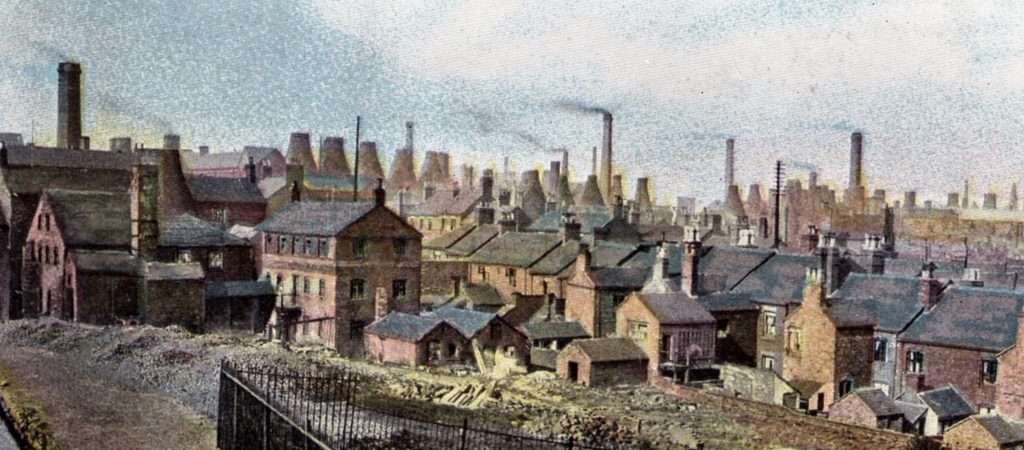
In the late 19th century, Nelson Place, a small undistinguished back street in the Wellington estate to the east of Hanley town centre, was home to a flint mill owned by a Mr George Edwards. It was a small establishment that ground flint for the pottery industry and was just one of many similar works that were dotted around the Potteries, all part of a larger infrastructure that fed into the manufacture of ceramics. There was the mill itself and its out-buildings, plus some stables where several horses belonging to a carter named George Flower were housed at the time, Mr Flower himself living further down the street at number 40 Nelson Place. The mill’s main feature, though, was a fine chimney that had been erected half a century earlier, which in size and dimensions was said to be a copy of Pompey’s Pillar, a Roman triumphal column in Alexandria, Egypt. Whether it was a true copy of the famous column – complete with square base and Corinthian capital – or was simply an 88 feet tall tubular shaft is not made clear, but it was a notable landmark in the surrounding streets, at least that is, until the night of Wednesday 8 November 1882.
It had rained heavily in Hanley all afternoon and into the evening, the rain driven in hard by a heavy gale that had caused serious damage elsewhere in the Potteries. In Stoke, the roof of the parish church had been partially torn up by the wind and dashed down onto the north side of the church. This in turn had knocked down some of the decorative masonry on the roof, which was smashed to pieces when it hit the floor, destroying a gravestone as it did so. In Burslem, it was the culmination of a couple of days of variable weather, a frost on Tuesday had given way to a fall of snow on Wednesday morning, then a hail storm in the early afternoon which transformed into a full-blown thunderstorm in the evening, with an incredible play of lightning in the sky.
This seems to have been the same storm that rolled in over Hanley late on Wednesday evening. The StaffordshireSentinel reported, ‘Such a disturbance of the elements has not been known in the town for very many years, the nearest approach to it, perhaps, being during a heavy storm which took place about forty years ago, when the Old Wind-mill was struck.’
The lightning was unusually vivid throughout the storm, particularly one flash which occurred shortly after 10 p.m., the thunderclap that came with it being likened to a short, sharp volley of artillery. People who were out of doors, were staggered by the flash, the noise and the rush of displaced air that hit them. Sergeant Jones of the Hanley Borough police, on duty at the lower end of Charles Street, was bowled over by the shock, but not physically hurt.
The cause was a massive lightning strike that hit the chimney of the flint mill and blew it apart. A mass of bricks fell straight down onto the nearby stables, crushing them and killing and burying two of the three unlucky horses housed there while seriously injuring the third. Debris was scattered over a wide area, the houses nearest to the mill taking the brunt of the damage with nearly every window broken, while a finger of the lightning had entered a house at the top of the street, struck a cupboard and destroyed its contents, consisting of crockery, which was scattered around the room. On other homes, chimney pots were gone, rain spouts and gutters were missing, and tiles were blown off the roofs. Indeed, scarcely a house in Nelson Place escaped damage. Telephone lines were brought down in the street and pieces of brick from the collapsed chimney were hurled great distances. Some smashed back windows in Hassall Street, while the cross was knocked off the west end of St Luke’s Church and holes were made in the roof. The lightning blast also seems to have done some damage to J. and R. Hammersley’s pot bank at the bottom of Hassall Road, but to what extent is unknown.
Today, such an event would garner serious press attention, but for papers in the late 19th century where news tended to be presented in a digest form, the reportage was restrained to a relatively small account the day after and a repeat of the story at the weekend. As a result it is impossible to go into any more detail on what the overall effect was on the area. The destruction to the Nelson Place mill was considerable, the once admired chimney was now just a mass of broken rubble. Estimates placed the damage at about £300 (nearly £32,000 in 2026), a hefty sum for a small business to shoulder. Thankfully, no one was killed or injured save for the horses and only on that subject was there anything further in the paper. The death of the two horses and the injuries to the third had robbed George Flower of his only source of income and a couple of days after the storm, a letter written by one Edwin J. Hammersley appeared in the Sentinel, making an appeal on Mr Flower’s behalf. Describing the carter as ‘one of the most industrious and persevering working-men in the borough’ he proposed a subscription fund to help Mr Flower in his distress. Headed by the Mayor Mr John Emery, who acted as treasurer, this soon gained legs and numerous manufacturers, neighbours and most of the workforce of Hammersley’s factory chipped in. So successful was the appeal, that by 20 November an additional letter to the paper announced that so much had been collected that George Flower was now nearly fully compensated for his losses. Certainly, nine years later in the 1891 census, he was still listed as a carter at 40 Nelson Place.
That was all that was written about the lightning strike that demolished Nelson Place’s most distinctive landmark, but what of the flint mill itself? Well, that too seems to have literally ridden out the storm, trade directories indicating that George Edwards continued to do business as a flint grinder in Nelson Place, certainly up until 1912. At some point between then and the 1940s, though, the mill ceased working and was finally demolished and the land cleared, much to the delight of the local kids, who adopted it as a playground, known simply as ‘The Mill’. One of those children was my own father, who told me many tales of life in the street, of it’s people and it’s buildings, but he seems to have been completely unaware of that dramatic night, six decades before he was born, when the sky fell in on Nelson Place.
Reference: The Staffordshire Sentinel, Thursday, 9 November 1882, p.3; Friday, 10 November 1882, p.3; Monday, 20 November 1882, p.3.
Operation Market Garden, launched on 17 September 1944, was an Allied attempt to seize a series of strategic bridges through the Netherlands to break into Nazi Germany and end the war sooner. The plan was for three giant airborne raids, consisting of thousands of paratroopers and glider borne troops, to seize and hold the bridges, while an armoured column would punch its way north through the intervening German troops and link up with the lightly armed airborne forces before they were overrun. American paratroops dropped at Eindhoven and Nijmegen succeeded in capturing and holding their positions until the armoured column arrived. However, the British 1st Airborne Division, assigned to capture the furthest target, the road bridge at Arnhem, faced difficulties from the start, with many paratroopers and gliders landing far from their target. Only one battalion, under Major John Frost, reached Arnhem, but they could not secure the bridge. The rest of the Division, including several battalions of the Paras and the 2nd Battalion South Staffordshire Regiment, all under the command of General Roy Urquhart, were stuck outside the town, facing transport and communication issues and fierce enemy resistance.
On 19 September, General Urquhart attempted to reach Frost and his men in Arnhem, but the British suffered heavy losses against German armour. Urquhart therefore pulled his men back to Oosterbeek, a suburb of Arnhem, hoping to establish a bridgehead against the river until ground forces arrived. The Paras and South Staffords created a perimeter at the edge of Oosterbeek, bringing in artillery to cover the main roads and snipe German tanks when they came. At 11:15 a.m., eight anti-tank guns from the South Staffords were moved forward, with two of their 6-pounder guns positioned at the T-junction of Benedendorpsweg and Acacialaan to take on any German armour moving in from the north-east, while other guns covered their flank and troops in trenches and nearby buildings prepared to support the gunners and confront any enemy infantry.
In charge of the two guns facing up Acacialaan was 21-year-old Lance-Sergeant John Daniel Baskeyfield of the South Staffords’ Anti-Tank Platoon. Born on 18 November 1922, ‘Jack’ Baskeyfield was the eldest of five children born to Daniel and Minnie Baskeyfield of Burslem. Educated at Burslem St John’s School and Christ Church, Cobridge, for several years he was a choirboy at Cobridge Church. Starting work as an errand boy, he later trained as a butcher and briefly managed a co-op butchers in Pittshill. He was called up for the army in February 1942 and served with the 2nd South Staffords in North Africa, Sicily, and Italy before participating in Operation Market Garden. No stranger to peril, during the North Africa campaign, a glider that Jack was aboard crashed into the sea and he spent 8 hours in the water before being picked up by a launch. Evidently a good soldier, he had achieved the rank of lance-sergeant through merit and during the ferocious battle that would take place around his guns the next day, his ability to lead and inspire those around him would prove him worthy of the rank.
The statue depicting Jack Baskeyfield at Festival Park, Etruria.
By nightfall on the 19th, British forces in Oosterbeek had been heavily pounded by artillery and mortar fire, resulting in significant losses. On the 20th, German forces attacked the eastern side of the perimeter with infantry, tanks, and self-propelled guns, aiming to overrun the weakened British position. Despite the heavy fire, the British airborne soldiers fought back fiercely, particularly Baskeyfield and his crew, who are said to have destroyed two Tiger tanks and a self-propelled gun. Their success, though, came at a heavy cost, the gun crew being either killed or badly injured in the fighting, Jack being seriously wounded in the leg. In the lull that followed the initial German attack, Jack refused to be carried off to the Regimental First Aid post and instead manned his gun alone, shouting encouragement to the men in nearby buildings and trenches. When the Germans returned with even greater ferocity, Baskeyfield fired round after round until his gun was finally put out of action.
Pulling himself away from the wreckage and under intense enemy fire, Jack crawled across the road to the other gun, Corporal Hutton’s 6-pounder, the crew of which now lay dead around it. Again, he manned the gun alone, though another soldier tried to crawl across the road to help him, but he was killed almost immediately. Undaunted, Jack carried on, engaging another enemy self-propelled gun that was moving in to attack. He managed to get off two rounds, one of which scored a direct hit on the vehicle, rendering it ineffective, but, sadly, whilst loading for a third shot, he was killed by a shell from a supporting enemy tank.
There is some question over the number or type of ‘kills’ that Jack and his men gained, but there is no disputing that the terrific stand he made inspired nearby troops and bolstered that part of the perimeter. This undoubtedly helped in preventing the Germans from cutting the 1st Airborne Division from the Rhine, across which the survivors of Urquhart’s forces escaped several days later. For by 25 September, the desperate struggle for Arnhem was over, and Major Frost’s men had been forced to surrender. Hundreds of soldiers and over 400 Dutch civilians had been killed, thousands more wounded and Arnhem and its suburbs were wrecked and littered with bodies, many mangled beyond recognition. Corporal Raymond Corneby and other captured troops were working to gather up bodies where Baskeyfield and his men had fallen, when he found just such a corpse, a battered, headless body by the wreckage of a gun, which he buried in a nearby garden. From the evidence Corneby found on the body it seems very likely that this was Jack Baskeyfield, whose remains now lie in an unknown grave. His name appears on panel 5 of the CWGC Groesbeek Memorial to the Missing.
The modern day juction of Benedendorpsweg looking up Acacialaan – which was then much more open – from where the German tanks were approaching. Baskeyfield’s final position was on the left where the ‘Jack Baskeyfield Tree’ now stands.
Source: Google Earth
Despite his body being lost, Jack’s deeds were not forgotten, and word of his bravery spread quickly. A week after the battle, war artist Bryan de Grineau drew a sketch of the action for the Illustrated London News and official reports were made on Baskeyfield’s behalf, with the recommendation that he be posthumously awarded the Victoria Cross. This was granted, and the London Gazette carried the official citation for his award five days after what would have been his 22nd birthday. This outlined the action and Jack Baskeyfield’s doggedness in carrying out his duty in defending the road junction, his determination to carry on even though badly wounded and it praised ‘his superb fighting spirit’ which inspired all who witnessed his stand. Back home, though his parents and siblings were devastated by the news of his death, they were immensely proud at the news that Jack had been awarded the Victoria Cross. At an investiture at Buckingham Palace on 17 July 1945, Daniel and Minnie Baskeyfield received their son’s medal from King George VI and soon after the war they took a trip to the Netherlands to see where their son had died. Jack Baskeyfield’s VC is today in the keeping of the Staffordshire Regiment Museum at Whittington near Lichfield.
Pride was felt across the Potteries at Jack’s incredible bravery. A memorial fund was set up, a mural was raised in his honour at one of his old schools and his name continues to be used proudly around the city in streets, buildings, an Army Reserve Centre and for a while a local school. In 1966, a local amateur film maker Bill Townley began filming a well-produced cinematic depiction of Jack’s deeds entitled ‘Baskeyfield VC’, which received it’s first public airing in 1969 and is still available to buy on DVD. Official memorials also appeared. A plaque dedicated to the town’s medal winner sits near to Burslem’s war memorial on Swan Bank, but surprisingly the most notable memorial was erected not in Burslem, but at Festival Heights in Etruria. Unveiled in 1990, the twice-life size statue of Jack Baskeyfield sculpted by Steven Whyte and Michael Talbot, has him in action, shell in hand in the act of loading his gun; a brave man, defiant to the end.
Reference: Andy Saunders (Ed.),Victoria Cross (magazine), pp.96-99; Evening Sentinel, 24 November 1944 p.1 and p.4; Evening Sentinel, 18 July 1945.
Ken Ray, a long-time researcher into the lives of local soldiers has assembled an impressive list of North Staffordshire men who served in the Napoleonic Wars, the Crimea and the numerous colonial conflicts Britain participated in during the 19th and early 20th centuries. He has very kindly given me access to some of his documents which chart the lives and careers of ordinary men from the region who might otherwise have been forgotten. This is one of those stories…
Private William Walker, 1st Battalion 4th Foot (King’s Own),
Napoleonic Wars
A soldier of the 4th (King’s Own) Regiment of Foot in the latter years of the Peninsular War. An AI rendering after a drawing by the author.
There were several men from the Potteries that we know of who served in Wellington’s army in Portugal and Spain during the Peninsular War (1808-1814), but few had quite so impressive a record as Private William Walker of the 4th King’s Own Regiment of Foot who saw action in virtually every major land battle fought by the British Army during the Napoleonic Wars. Most likely the son of John Walker and Elizabeth, nee Lawns, he was born in Burslem and baptised at Stoke-upon-Trent on 8 October 1775. William seems to have received little or no education and initially found work locally as a potter. He was probably a member of the militia in this time of war, which would explain why he was far from home in Ashford, Kent on 19 June 1799, where he enlisted for ‘unlimited service’ with the 1st Battalion 4th Foot, with which he would serve for the next two decades.
From his own records at his discharge, it is clear that Walker saw service almost immediately in an expedition to North Holland in 1799, under the Duke of York – the indecisive ‘Grand Old Duke of York’ of nursery rhyme fame. There his regiment took part in the fighting at Castricum on 6 October, a defeat where they suffered heavy casualties. Walker was one of these, receiving a gunshot wound in the left leg, but he survived, was evacuated back to Britain and spent the next few years on home service. In 1804, Walker’s battalion served under a much better commander, the visionary General Sir John Moore at Shorncliffe, where they underwent a rigorous regime of training. From there in 1805, the 1st battalion went to Hanover and later served at the Battle of Copenhagen in 1807. The battalion was back with Sir John Moore in Sweden in 1808, when he was given command of the force sent to the Iberian peninsula to support Portugal and Spain against the French. However, after some initial successes by the Spanish to oust the French invaders, the arrival of Napoleon at the head of a massive army saw the effective collapse of the Spanish forces before them and Moore and his men, including Private Walker, were forced on a 200 mile retreat to Corunna on the northern Spanish coast. It was an epic, gruelling march through mountains thick with snow and the French in close pursuit, but because of the rigorous training they had received under Moore the 4th suffered less hardship than many units. On reaching the coast, Walker with his fellows fought in the Battle of Corunna on 16 January 1809. Sir John Moore was killed in the fighting, but the battle effectively blunted the French attempts to thwart the evacuation of the British Army.
The next year, though it receives no mention in his records, Walker was probably involved in another near disaster for the British, when the 4th Foot were sent on the Walcheren Expedition in an attempt to capture Antwerp. However, sickness quickly took a hold on the army causing many deaths and the expedition had to be abandoned. The 4th Foot suffered like the other regiments, but was one of the first of the Walcheren units to be sent to join Wellington’s forces in the Peninsula, where the 1st Battalion joined the 5th Division at Torres Vedras near Lisbon in Portugal in November 1810. The following year the 4th Foot took part in the Battle of Fuentes de Onoro, but positioned on the far left of Wellington’s line they took no active part in the fighting and received no casualties, though Walker was later to carefully add the battle to his list of engagements. Instead his real baptism of fire in this new phase of the Peninsula War would come in 1812.
Having evicted the French from Portugal, two fortresses barred Wellington’s safe passage into Spain. The storming of the first of these at Cuidad Rodrigo did not involve the 4th Foot, instead they with many others were sent against Badajoz in the north. A heavily fortified town that had already endured two sieges, Badajoz now underwent a severe bombardment to breach its walls before the troops were sent in. This took place on 6 April 1812 and saw Wellington’s men put to their sternest test with four separate attacks made on the heavily defended breaches. The 5th Division of which the 4th Foot were a part, attacked the San Vincente bastion on the north-west corner of the town. Fighting their way through massed musketry, cannon fire, grenades, mines and lines of wooden poles dotted with blades and spikes, the 4th Foot were badly mauled, but managed with others to get over the wall and into the town, where they fell on the French defending the walls from other attacks and soon afterwards the town fell. The ordeal of Badajoz was not over, though, as driven into a frenzy by what they had endured the bulk of the British troops then went on a two-day rampage of looting, rape and murder through the town. Private Walker though, was not among them, as during the assault he had been shot in the neck and at some point nearby French soldiers had bayoneted him in the left arm and left leg and left him for dead. Again, he would live, but like most of the wounded Walker probably had to wait until the looting army had exhausted itself two days later before he got any medical treatment.
The final attack on Badajoz, showing British troops assailing the walls with ladders.
It is a testament to William Walker’s toughness that by July 1812, he was back in the ranks and fit enough to take part in Wellington’s long march and brilliant victory at Salamanca followed by his advance into Madrid. The following year, Walker fought in the battle of Vittoria which sounded the death-knell of the French army in Spain. Walker’s record then reads almost like a tally of the clashes that finally pushed Napoleon’s soldiers back over their own border – Palencia, San Sebastian, Bidassoa and Nive – all of which he seems to have passed through without any injury worth noting. The last action of the regiment before they swapped one war for another, was to help in the blockade of Bayonne just over the French border. Wellington’s army was still there when news reached them of Napoleon’s abdication and the war it seemed was over.
Released from the war in Europe, in May 1814, Walker’s regiment was sent across the Atlantic to take part in the War of 1812 against the United States of America. He and his comrades were witness to great success at the battle of Bladensburg, where they helped rout the Americans, but disappointment and defeat at Baltimore and again at New Orleans, but a final success in the last clash of the war with the seizure of Fort Bowyer. By this time, though, the belated news that a peace treaty had been signed finally filtered down to the combatants and the British troops withdrew. But though another war had ended, an old one was to briefly flash back into life in dramatic fashion, for in late February 1815, Napoleon escaped from the island of Elba and returned to France. Europe was thrown once more into turmoil and Britain needed its troops for the war that was sure to come.
What followed became known as ‘The Hundred Days’, Napoleon’s last throw of the dice that ended in his final defeat at the battle of Waterloo on 18 June 1815. The 4th Foot served with Wellington’s army in Belgium and fought at Waterloo, but it seems that Private William Walker was not with them. The records of the 4th Kings Own show that the regimental drum major also named William Walker received the Waterloo Medal which was awarded to all those who served in the battle, but there is no evidence that our Private Walker was a medal recipient. Evidence seems to suggest that the William Walker who later claimed four clasps to the Military General Service Medal in 1847-48 for his Peninsula War service was also the aforementioned regimental drum major.
After peace was finally declared and the occupation of France ended, the 1st Battalion 4th Foot were posted to the West Indies. Two and a half years later on 7 May 1821, at St Ann’s in Barbados, 46 year old Private William Walker was discharged from the army, the reason given that he was worn out from his long years of service and the effects of his wounds. Walker was described as being 6′ ¼” tall, light haired, grey eyed and with a fair complexion. His discharge certificate also indicates that for 4 years and five days of his 22 years and 55 days of service with the 4th Foot he had served as a corporal, but does not indicate when this was, nor why he had been reduced back to private. Whatever the case his conduct as a soldier had been ‘very good’ and the record was careful to note all the battles he had participated in and when he had received his wounds.
Walker returned to Britain on the first available vessel and his discharge was confirmed by the Chelsea commissioners later that year. What he did, where he went and what the ultimate fate of the old Peninsula veteran was after that remains unknown.
Reference: The National Archives: WO97 – Royal Hospital Chelsea: Soldiers’ Service Documents, piece 267. Information courtesy of Ken Ray.
‘The Battle of Trafalgar’ by William Clarkson Stanfield Source: Wikimedia Commons
On 21 October 1805, a British fleet of 27 ships commanded by Admiral Horatio Nelson caught up with and attacked a combined Franco-Spanish fleet of 33 ships as they made their way towards the Mediterranean. The fleets met off Cape Trafalgar between Cadiz and the Strait of Gibraltar where the British attacked (albeit at a snail’s pace due to lack of wind) in two divisions striking at right angles into the enemy line splitting it into sections and the battle then became a series of small struggles between individual ships or groups of vessels, in which superior British gunnery and seamanship carried the day. Casualties on both sides were heavy, Nelson himself being mortally wounded by a French sharpshooter. Before he died, though, he received news that his fleet had inflicted a devastating defeat on the enemy force, capturing 20 ships, thus ending any immediate threat of a French invasion of Britain. Trafalgar was also the victory that established British naval dominance for the next century.
Despite hailing from so landlocked a region, several men from the Potteries and neighbouring Newcastle were involved in this decisive sea battle. Two Royal Marines, Corporal William Taft, aged about 30 at the time of the battle, from Hanley Green (modern day Hanley town centre) and Private William Bagley aged 31 from Stoke, served aboard Nelson’s flagship HMS Victory, which led one of the two squadrons attacking the Franco-Spanish line and was in the thick of the fighting from the beginning. Bagley got through the battle uninjured, but Corporal Taft was badly wounded in the left arm, which had to be amputated near the shoulder. After the battle and the week of storms that followed it, Taft was transferred to Gibraltar, then to a hospital ship and transported with other wounded back to Britain. He survived, but was pensioned off and his fate after that is unknown. Bagley too returned to Britain early in 1806, but on 26 January he suffered a fall at Chatham and died from his injuries. His belongings were later returned to his daughter Susannah in Hanley.
At the head of the other British squadron was HMS Royal Sovereign, the flagship of Admiral Collingwood, aboard which was 24 year old Royal Marine Private Richard Beckett from Burslem. The RoyalSovereign had recently had her hull re-coppered and as a result of her clean hull was a faster ship than most and was the first to pierce the enemy line. For most of the battle the ship was engaged in a prolonged duel with a Spanish vessel and suffered heavy damage. Private Beckett, though was fortunate and escaped injury. Equally lucky and untouched that day was another locally born Royal Marine, 29 year old Private Joseph Sergeant from Clayton aboard HMS Prince, which joined the battle late and saw little action.
Only two local men that we know of, served as sailors in the British fleet that day and both survived the battle unhurt. John Bitts, a 24 year old landsman from Stoke was aboard the frigate Naiad which took no part in the fighting between the bigger ships, but joined in with the mopping up after the battle, while 28 year old ordinary seaman John Williams also from Stoke was part of the carpenter’s crew on board HMS Leviathan, which was one of the ships of the squadron that followed the Victory into the enemy line and captured a Spanish ship.
Unlike the soldiers who later fought at Waterloo, no special medal was issued for the men of Trafalgar, but all were entitled to a share of the prize money from the captured enemy vessels, plus a special Parliamentary award. In the event some, for whatever reason, did not bother to claim their shares and the monies were donated to the sailor’s hospital at Greenwich. Corporal Taft, the man in most need of the cash, though, did take his share. His prize money came to £1 17s 8d, plus the Parliamentary award of £4 12s 6d, and presumably because of his life-changing injury, Taft also received £40 from the Lloyds Patriotic Fund.
Reference: The National Archives, ADM 44 Dead Seamen’s Effects; ADM 73 Rough Entry Book of Pensioners; ADM 82 Chatham Chest: ADM 102.
Regular newspaper coverage of events in the Potteries only really started at the end of the 18th century with the advent in 1795 of the Staffordshire Advertiser paper, though as this was published in Stafford, it’s coverage of the goings on in the north of the county was limited to the most noteworthy events. Another half century would pass before more local newspapers were being produced in Hanley, Stoke and Burslem. However, histories, travellers’ journals and some other national or regional papers occasionally carried tales from the Potteries from this early period, giving us fleeting glimpses into life in the area. These range from descriptions of the growing pottery industry and the construction of the canals, to bizarre deaths, odd weather and local curios.
See a Fine Lady Upon a White Horse
Between 1697 and 1702, partly from a wish to improve her health and from an equally strong desire to see more of her native land, Lady Celia Fiennes (whom some claim was the fine lady at Banbury Cross from the children’s nursery rhyme) undertook a series of journeys around England. In the summer of 1698, her peregrinations brought her into North Staffordshire. Here, after admiring the as yet unsullied landscape, she was keen to visit the Elers Brothers’ factory at Bradwell, but as she notes in her diary she was unsuccessful; the potters had temporarily run out of clay and were not working.
‘..and then to Trentum, and passed by a great house of Mr Leveson Gore, and went on the side of a high hill below which the River Trent ran and turn’d its silver stream forward and backward into s’s which Looked very pleasant Circling about ye fine meadows in their flourishing tyme bedecked with hay almost Ripe and flowers. 6 mile more to NewCastle under Line.’
After ruminating briefly on the ‘coals to Newcastle’ adage, she continued.
‘… I went to this NewCastle in Staffordshire to see the makeing of ye fine tea potts. Cups and saucers of ye fine red Earth in imitation and as Curious as yt wch Comes from China, but was defeated in my design, they. Comeing to an End of their Clay they made use of for yt sort of ware, and therefore was remov’d to some other place where they were not settled at their work so Could not see it;’
(Reference: Celia Fiennes, Through England On a Side Saddle in the Time of William and Mary, pp.146-147.)
A Swedish Spy in the Valley of Crockery
A visitor to the mid-18th century Potteries was Reinhold Rücker Angerstein, an industrial spy in the employ of the Swedish government, who was tasked with gathering information on new or emerging technology. Between 1753 and 1755, he journeyed through England and Wales and produced a wide-ranging and comprehensive survey of the various industries and their practices. He appears to have visited the Staffordshire Potteries, which he labels rather colourfully as a ‘Valley of Crockery’, in about 1755. Here, after examining the manufacture of salt-glazed wares, describing the kilns in Hanley (including illustrations), the raw materials used, the prices of ware and various mechanisms employed in producing pottery (with still more pictures), he went on to add a few descriptions of the area that make for interesting reading.
He notes that in Hanley there were 430 makers of white ware and other types of pottery, adding ‘The kilns are everywhere in this district.’ and to prove his point he includes an illustration of the skyline of the town. There were also large numbers of potteries in Stoke and other places, ‘where mostly the same kind of ware as that enumerated is made and also some simpler crockery.’ He then adds a picturesque and slightly comical tale. ‘When as it sometimes happens, many kilns are glazing with salt at the same time, there is such a thick smoke of salt in these towns, that people in the streets cannot see 6 feet ahead, which, however does not cause any difficulties. On the contrary, the smoke is considered so healthy that people who are ill come here from far away to breathe it.’
Of the pottery itself, he writes, ‘The crockery produced is mainly sent to London or other sea ports, from which much of it is exported to America and many other foreign countries.’
(Reference: R. R. Angerstein’s Illustrated Travel Diary 1753-1755, pp. 340-342)
John Wesley preaching to a crowd
Pelted in the Potteries
On 8 March 1760, the Reverend John Wesley, the founding father of Methodism, visited Burslem for the first of many visits to the region. He described Burslem as ‘a scattered town, on the top of a hill, inhabited almost entirely by potters’, a large crowd of whom had gathered to hear him at five in the evening. He noted that great attention sat on every face, but also great ignorance which he hoped he could banish.
The next day Wesley preached a second sermon in Burslem to twice the number of the day before. ‘Some of these seemed quite innocent of thought. Five or six were laughing and talking till I had near done; and one of them threw a clod of earth, which struck me on the side of the head. But it neither disturbed me nor the congregation.’ –
(Reference: John Wesley, Journal, 8-9 March 1760)
The First Cut
After receiving the royal assent two months earlier for construction of a canal connecting the rivers Trent and Mersey, on the morning of 26 July 1766, at a site just below Brownhills, pottery manufacturer Josiah Wedgwood cut the first sod of what would in time become the Trent and Mersey canal. James Brindley, the engineer who would oversee the canal’s construction, and numerous other dignitaries were present, many of whom would also cut a piece of turf, or wheel away a barrow of earth to mark the occasion. In the afternoon a sheep was roasted in Burslem market place for the benefit of the poorer potters in the town. A bonfire was also lit in front of Wedgwood’s house and many other events took place around the Potteries by way of celebration.
(Reference: Jean Lindsay, The Trent and Mersey Canal, pp.31-32)
News from the North
Extract of a Letter from Burslem, 14 August 1766,
‘As you often give me London News, I will give you some from this Country, which has of late made a Figure. This Neighbourhood has for many Years made Pots for Europe, and will still do so, though the King of Prussia has lately clapt 28 per Cent, upon them. Our Roads were so bad that nobody came to view the Place where the Flint Ware is made, but now we have Turnpikes upon Turnpikes, and our Potteries are as well worth seeing as the Stockport Silk-Mills, or the Bridgewater Navigation, which we intend to beat hollow by Lord Gower’s, now begun in our Meadows, and advancing apace towards Harecastle, on the other Side of which Multitudes of Men are at work, and before Christmas we shall have cut through the Hill, and made another Wonder of the World. There are already 100 Men employed on our Side, and 100 more will be added as soon as Wheelbarrows can be procured for them. Saturday last we had brave Sport at Earl Gower’s, where 100,000 Spectators were present at the Prison-Bars played in Trentham Park. Among them were the Dukes of Bedford and Bridgewater. The Prizes were Ten Carline Hats, with gold Loops and Buttons, given by the Earl. The Cheshire Men were active Fellows, but unluckily their Lot was to wear Plod Drawers, to distinguish them from their Antagonists, which made the Crowd oppose their getting the Honour of the Day. During this Game, my Friend Bucknall loft his Boy, about Eight Years of Age, who was suffocated by going aslant down a Sort of a Cave into an old Coalpit, the top of which was fallen in. The Man that ventured to fetch him out, found a Number of Birds, supposed to have dropped down there by the sulphurous Stench issuing from the Pit. We have much Hay, and Cheese is plenty, and Corn without Barn-room, nor do we want Money.
P. S. I have just seen a Hen, which laid Twelve Eggs only, from which she has brought up Twelve Cock Chickens, which is looked upon as somewhat remarkable.’ –
(Reference: Derby Mercury, Friday 29 August 1766, p.2)
In Praise of Mr Brindley
Extract of a Letter from Burslem in Staffordshire. dated September 5.
“Though our Stone Ware has been universally used, yet till our Turnpikes were made few People ever saw our Manufactories. But now they are gazed at as a Novelty. The Ladies go to Warburton’s to buy the Queen’s Sets of Cream-coloured Ware; and the Gentle-men come to view our Eighth Wonder of the World, the subterraneous Navigation, which is cutting by the great Mr. Brindley, who handles Rocks as easily as you would Plumb-Pyes, and makes the four Elements subservient to his Will. He is as plain a looking Man as one of the Boors of the Peak, or one of his own Carters; but when he speaks all Ears listen, and every Mind is filled with Wonder at the Things he pronounces to be practicable. He has cut a Mile through Bogs, which he binds up, embanking them with the Stones which he gets out of the other Parts of the Navigation, besides about a Quarter of a Mile into the Hill Yeldon; on the Side of which he has a Pump, which is worked by Water, and a Stove, the Fire of which sucks through a Pipe the Damps that would annoy the Men, who are cutting towards the Centre of the Hill. The Clay he cuts out, serves for Brick to arch the subterraneous Part, which we heartily wish to see finished to Wilden Ferry, when we shall be able to send Coals and Pots to London, and to different Parts of the Globe.— Another Mile is cut on the Cheshire Side of the Hill, and the Men intend to meet in the Middle by Christmas, when they are to have an Ox roasted whole, and an Hogshead of Ale.”
(Reference: Derby Mercury – Friday 18 September 1767, p.2)
Tunnel Vision
On 1 July 1772, an anonymous correspondent writing from Burslem related what he had seen the day before when he and some companions paid a visit to the first incarnation of the Harecastle Tunnel, situated between Tunstall and Kidsgrove and then under construction as part of James Brindley’s Trent and Mersey Canal.
‘Yesterday we took a walk to the famous subterraneous canal at Harecastle, which is now opened for a mile on one side of the hill, and more than half a mile on the other, of course the whole must be compleated in a short time. As it is not yet filled with water, we entered into it, one of the party repeating the beautiful lines in Virgil, which describe the descent of Æneas into the Elysian fields. On a sudden our ears were struck with the most melodious sounds. – Lest you should imagine us to have heard the genius or goddess of the mountain singing the praises of engineer Brindly, it may be necessary to inform you, that one of the company had advanced some hundred paces before, and there favoured us with some excellent airs on the German flute. You can scarcely conceive the charming effect of this music echoed and re-echoed along a cavern near two thousand yards in length.’
(Reference: Leeds Intelligencer, Tuesday 14 July 1772, p.3)
A Fungi to Be With
No age is free of stories of novelty fruit, veg or mushrooms:
‘A few days ago, a mushroom was got at Stoke-upon-Trent, in the county of Stafford, whose diameter was 5 inches, and 30 inches in circumference, it weighed 16 ounces. The above is very authentic.’
(Reference: Leeds Intelligencer, 5 September 1775, p.3)
All in a Spin
In 1781, there was the story of a curious weather phenomenon, a whirlwind or perhaps a mini tornado:
‘The following extraordinary phenomenon was lately observed here; at the latter end of last month, a field of hay belonging to Mr. J. Clark, near Burslem, was carried off by a whirlwind; the day when it happened was exceedingly calm, scarce a breath of air to be perceived. The people who were at work in the field observed, that in one part the hay began to be agitated in a small circle, at every wheel it increased in size and velocity, continually sucking more hay into its vortex; after a considerable time it began to ascend, taking along with it a silk handkerchief which hung rather loosely about the neck of one of the men who was at work; it continued ascending till entirely out sight, and in about an hour it began to descend, and continued to so for an hour’s space, alighting at, or within a few hundred yards of the place from whence it had been carried up, so that the owner lost but a very trifling quantity of his hay.’
(Reference: Hereford Journal, 23 August 1781, p.2)
A Tragic Accident
The following melancholy tale from the Potteries is related in a letter dated August 14 1785.
‘As Ellen Hulme, a poor woman of Lane End, was returning to her habitation late last night, with her infant, six weeks old, in her arm, she unfortunately stepped into a coal-pit, which shamefully lay open close to the road, and even with the track which led to the poor creature’s house. Her husband, whom she had been to fetch from an alehouse, immediately alarmed the neighbourhood, when her distressing cries were very distinctly heard from the bottom of the dreary pit every effort was attempted by the hardy colliers to fetch her up, but the damp prevailing very much, obliged them to use means to extract it, after which was found the mother with her infant upon her arms, both dead.’
(Reference: Sussex Advertiser, 22 August 1785, p.3)
A Hard Winter
During the harsh winter of 1794-1795, the better off inhabitants of Hanley and Shelton formed a committee which started a subscription list for the temporary relief the poor who were suffering great hardship during the cold weather. By February 1795 the committee had collected an impressive £150, enough to enable them to supply nearly 500 local families with meat, potatoes, and cheese. The Wedgwood family gave a liberal amount and through them a Mrs Crewe kindly added a welcome donation of a quantity of flannel clothing. The Marquis of Stafford aided the relief fund by ordering 100 tons of coal to be at the distribution of the committee.
A month later, in an issue of the Staffordshire Advertiser that noted that thermometers in Macclesfield had measured temperatures as low as -21° F (-29.4° C), the fearsome nature of the winter was highlighted dramatically by one small but rather macabre snippet of news: ‘Through the inclemency of the night of Saturday last [i.e.,14 March] a poor man perished betwixt Hanley and Bucknall. He unfortunately lost himself in attempting to cross the fields, and was found on Sunday standing upright in a snow drift, with his hand only above the surface.’
(Reference: Staffordshire Advertiser, 7 February 1795, p.3; 21 March 1795, p.3.)
Dashed to Pieces
‘A melancholy accident happened on Wednesday last at a coal-pit near Lane Delph, in the Pottery. A poor woman employed in drawing up the coal, was by some accident unfortunately thrown into the pit, and was literally dashed to pieces.’
(Reference: Derby Mercury, 30 June 1796, p.4).
Wild Fire
In late March or early April 1799, a dreadful accident happened in a pit at Lane End, the property of John Smith, Esq. Four men were blown up, and two them terribly burnt by what the colliers of the time described as ‘the wild fire’. The explosion was loud, and the concussion so great that nearby houses shook violently. Two of the men were not expected to recover, while the other two were thrown to a considerable distance, and left badly bruised. The reporter noted that their hats were blown to the distance of 70 yards from the mouth of the pit.
(Reference: Staffordshire Advertiser, Saturday, 6 April 1799, p.4)
The 2nd Dragoon Guards open fire on the crowd in front of the Big House, Burslem. An AI recreation of the scene after a drawing by the author.
In 1842, a prolonged miner’s strike had crippled the Staffordshire Potteries. Hundreds of men were on the streets begging and intimidating passers by, while surly mobs raided police stations to free those who had been arrested. The situation in the Potteries was likened to that of a powder keg ready to explode and all that was needed was a spark to kindle all into combustion. Enter Thomas Cooper lay preacher and Chartist firebrand, whose powerful speeches finally struck that spark and plunged the Potteries into two days of rioting and mob rule. During this period dozens of buildings were looted and destroyed and order was only restored after a clash between rioters and the army, an incident popularly known as the Battle of Burslem.
Thomas Cooper
The confrontation took place on 16th August 1842. After a day and night of rioting and looting, early in the morning of the 16th crowds began to gather once more on streets of the Potteries. Of the five towns which had suffered in the previous day’s rioting, Hanley had been hit the worst. Plumes of heavy fire smoke curled up from either end of the town and the streets were filled with debris. The parsonage was a smouldering ruin and at the top of Pall Mall, Albion House home of local magistrate William Parker had been reduced to a charred and broken shell. On the streets of the town by 7 o’clock a crowd of 400 to 500 people had gathered and were being addressed by two of the local Chartist leaders, young William Ellis and John Richards, the elder statesman of Potteries Chartism. Ellis was urging the crowd not to give up the struggle until the People’s Charter became the law of the land. According to witnesses, though, it was the normally mild-mannered Richards who was more to the point. “Now my lads,” he said, “we have got the parson’s house down, we must have the churches down, for if we lose this day, we lose the day forever.” Ellis then spoke again and urged the crowd to go to Burslem to join the crowd there. They were expecting to meet up with a large crowd who were coming to the Potteries from Leek and extend the rioting even further. By 9 o’clock, with shouts of “Now lads for Burslem” and “Now to business”, the Hanley mob began marching north.
From Hanley to Burslem is a steady half hour walk for a healthy man and as they entered the town at about 9.30am, the crowd were singing a song that Thomas Cooper had taught them, “… the lion of freedom’s let loose from his den, and we’ll rally round him again and again.” On their arrival in the town a part of the mob barged into George Inn which had only ten days earlier been attacked by outraged strikers and suffered substantial damage. To try and avoid further trouble, the owner of the Inn, Mr Barlow tried to buy the rioters off by giving them a shilling each; some of this was in half crowns and a dispute arose at the door as to the division of it. By this time the greater part of the mob had arrived and they immediately rushed in and filled the house. Mr Barlow had taken the precaution to remove the bulk of his cash; there was however £14 in coppers wrapped up in parcels of five shillings, which were all taken. Numerous bottles of wine, whisky and rum was also stolen, and the taps attached to the beer kegs were left running. Prominent amongst those who conducted this raid was George ‘Cogsey Nelly’ Colclough, a local lout who had flitted from one town to another the previous day, joining in with the burning and looting wherever he went. Like a moth to the flame he had followed the trouble back to his native Hanley and now thought to export his brand of local thuggery to the Mother Town. But the invasion of the inn did not go unopposed, for while the mob had previously only faced outnumbered police constables, they now found that they were in a town containing a small but formidable force of regular soldiers. They were surprised by a sergeant of dragoons and one or two other soldiers who were billeted at the inn, who hearing the noise, rushed into the bar and lobby to confront the troublemakers. Being in their undress uniforms they only had their swords to hand, but undaunted, the sergeant immediately drew his sword and began to cutting and swatting at the looters and in a few minutes the house was cleared. On being forced back into the street, the mob vented their anger by throwing stones at the windows, and in a very short time all the newly fitted glass was smashed and the house soon presented the same dilapidated appearance as it did after the attack in the night of the 6th.
At the Leopard Inn, meantime, local magistrate Captain Thomas Powys was with Brevet-Major Power Le Poer Trench the commander of the 50 or so 2nd Dragoon Guards, who had been stationed in Burslem the week before. The two men had met shortly after the news had come in of a large crowd coming from Leek and Powys was doubtless consulting with the military as to what should be done if they tried to join the rioters. It was at this point that Thomas Lees the landlord of the inn came over with news that trouble that had broken out in Chapel Square. Captain Powys immediately asked for the Major’s assistance and Trench quickly ordered his available men to horse. Most of the men were billeted at the inn, their horses being stabled outside and the troopers now came out into the cobbled courtyard and hurriedly got themselves and their animals ready for action. A flurry of stones came flying over the gate striking at least one soldier on the helmet, but unfazed they were soon clattering out of the courtyard and through the streets. Mounted on their big bay horses, the soldiers dressed in scarlet tunics, dark blue trousers with a yellow stripe down the side and tall, crested brass helmets on their heads, they were a sight to see and doubtless provided the townsfolk with a gallant if alarming show as they rode towards the Market Place.
The Leopard Inn, Burslem.
The mood in the town had grown increasingly ugly with the arrival of the soldiers and Captain Powys knew that the crowd of people from Leek were even now on the outskirts of the town. If the two mobs joined up and went unopposed Burslem might well be utterly wrecked, so Powys decided that it was now time to restore law and order before things got completely out of hand.
Riding up to the top of St John’s Square with Trench’s dragoons posted on either side and 200 special constables behind them, Captain Powys faced the mob and began to read out the Riot Act in a loud voice. He then gave several other warnings and then read the Riot Act again, urging the crowd to disperse and go home peacefully. The crowd, however, were unmoved and milled about between the market or the Shambles, as it was called, and the Big House, Thomas Wedgwood’s former home that still stands at the junction of Moorland Road and Waterloo Road, though at that time there was a walled garden before it. Powys then called out, “Clear the streets!” Then shouted, “Charge!” and led the dragoons towards the crowd. He had hoped to scare them off and the horse soldiers beat with the flats of their swords any who were slow in getting out of their way. The ruse did not work, though, for as one portion of the crowd fell back others spilled out of the side streets and alleys, back into the main crowd. Seeing the opportunity to cause more trouble, George Colclough set about the nearest soldiers with his stick, beating at their sword arms as they attempted to swat him. After a time several of the cavalrymen were so bruised by Colclough’s attacks that they left him alone, which is said to have raised a cheer from some in the crowd.
By now it was getting towards noon and despite the best efforts of Captain Powys and the soldiers, the streets were still full of people. Some had climbed onto the roof of the Town Hall and the covered market, from where they threw stones at the troops and special constables. Powys, increasingly alarmed that the situation might escalate to the point where he might have to use the soldiers more forcefully, was repeatedly seen riding up to the crowds and calling out that the Riot Act had been read and urging people to return to their homes. He was joined in his efforts by others including an Irish naval officer, 41 year old Captain William Bunbury McClintock, who had come to town to meet his friend Major Trench, only to find himself in the eye of a storm. McClintock now rode back and forth from where the bulk of the troops were gathered by the Leopard Inn to check on what the crowds were doing. He saw ‘a vast concourse of people in the Hanley Road, and a dense mob on the Smallthorne Road – the latter were accompanied by a band of music. I returned again to the troop, and told Captain Powys there would soon be bloody work.’
Word quickly spread, to the delight of the rioters in the town that the Leek mob of between 4,000 to 5,000 people was advancing down Smallthorne Road and they began moving up Chapel Square to meet them. As McClintock had noted, at the head of the crowd marched a band playing ‘See the Conquering Hero Comes’ preceded by a large number of men and boys shouting and waving makeshift weapons overhead, all of which could be clearly seen from Market Square. Captain Powys described it as ‘the most tumultuous and violent mob which I have ever seen assembled, having seen many riots in the country and in London.’ He guessed that a clash was now inevitable and barely three minutes after McClintock had ridden back to the troop, Powys ordered Major Trench to move the troop forward to meet the crowd and he formed his dragoons up in sections diagonally across the road from the Big House to the Post office, so cutting the newcomers off from the bulk of the Potteries’ mob in the Market Square. The special constables, meantime, closed up nervously behind the cavalry, among them local manufacturer Joseph Edge and his friend Samuel Cork. They looked so alarmed at this point that a kindly lady watching the action from a nearby house sent her servant over with a glass of wine for them both, hoping that the drinks would revive their spirits.
An officer of the 2nd Dragoon Guards. The black crest was only worn on parade or for ceremonies
They needed it, for by now the fresh crowd was closing on the thin line of soldiers. Captain Powys on horseback was on the left of Major Trench, who with the other officers were in advance of the dragoons. A large crowd was assembled in the area above the Wesleyan chapel, to witness the arrival of the Leek mob. When about eighty or a hundred yards from the spot where the dragoons were stationed, the Leek party began to cheer and those in front waved their bludgeons. As the head of the procession entered the open space, the front ranks turned to the left, with the apparent intention of making their way by the Wesleyan chapel. About twenty or thirty deep of them had got so far when as Captain Powys later recalled, ‘Immediately large volleys of stones, and brick ends were thrown by this mob at myself, and also at the military, I being then in the advance. Similar stones were thrown at the same time by the mob coming in the direction from Hanley at the military, myself and also at the special constables.’
By now the situation was intolerable. Stones were being hurled from both sides of the Market Square, striking horses and men alike and rattling over the cobbles. Captain Powys had thus far been the model of restraint, giving the crowd ample opportunities for a peaceful withdrawal, but it was now obvious that they were bent on trouble. Fearing for the safety of the soldiers, special constables and himself, by his own account he felt he had no choice but to use the soldiers to full effect and turning to Major Trench, Powys asked him to get his men ready to open fire. Trench agreed that the situation was getting out of control and gave the appropriate orders. As the soldiers sheathed their swords and primed their carbines, the large crowd moved forward as far as the Big House. The dragoons advanced slightly to counter them and only at the last moment when the front of the crowd was only six or seven yards away from the soldiers did it seem that the rioters saw the line of guns being raised and levelled at them. ‘This movement on the part of the soldiers caused a strange movement amongst those in the front of the mob, and a look of terror came over their faces. Another moment and the order “fire” was given’ and the rattle of musketry echoed out loud over the town.’
The soldiers fired directly into the crowd, not over their heads as some reported, and many bullets found a mark. Standing in front of the large brick wall that then stood in front of the Big House, was a 19 year old shoemaker from Leek named Josiah Heapy. Despite glowing reports from his employer, who later extolled his gentle character and claimed he had been forced to join the crowd, Heapy appears to have been actively engaged in throwing stones at the soldiers, at least, that is, until a musket ball struck him in the temple and blew his brains out against the gate post.
As Heapy’s lifeless form slumped to the pavement, in another section of the crowd, a bricklayer named William Garrett got a ball through his back that exited through his neck and he too fell to the ground gravely wounded but he was eventually whisked off to the infirmary. According to reports others were hit, but in the confusion no one stopped to count the casualties, though it has been supposed that some of the wounded were carried off by their friends and died later. A report in the Bolton Chronicle later claimed that the true tally had been three people killed and six wounded, while reports from Leek spoke of numerous wounded being brought back into the town after the riots.
The Big House in Burslem, where the fateful clash occurred
Some in the crowd seem to have been expecting this development, for shortly after the soldiers had fired their volley someone released a number of carrier pigeons which set off in the direction of Manchester. One of these birds was later captured and found to be carrying a note reporting that the mob had been fired on by dragoons and calling for 50,000 workers to join them in the Potteries. Some witnesses also recalled seeing plumes of gun smoke coming from the crowd just before the soldiers fired, though if this was the case, none of the soldiers or special constables were injured.
Most of the mob, though, was just shocked by the gunfire. From his position behind the dragoons, special constable Joseph Edge had watched all this in fascinated horror, as his son later noted: ‘such a scene presented itself which we may pray may never be repeated in this good old town. So panic stricken was the mob that the men simply lay down in heaps in their efforts to get away from the cavalry… ‘
Having stunned the rioters, the soldiers kept moving forwards and slinging their carbines, they drew their swords and followed by the special constables they charged their horses into the head of the crowd which scattered in panic before them. Immediately, thousands of people began rushing in all directions, many falling over each other in tangled heaps, others leaping through open windows, or into any available hiding place. Apocryphal tales abound. One Joseph Pickford of Leek is said to have taken shelter in a pig sty, much to the annoyance of its porcine occupants, whose squeals threatened to reveal his hiding place. Hundreds more escaped into the adjoining fields. Another story recalled how Thomas Goldstraw, a powerfully built man from Leek and a noted drummer, dropped his drum when the soldiers charged and quickly fled from Burslem back the way he had come, unaware at first that his son who had been nearby at the time had been shot through the thigh and was lying wounded in a field just outside the town. According to the storyteller, Goldstraw junior was later placed on a cart and transported to the surgery of an obliging physician, Dr Wright at Norton-in-the-Moors, who soon had him back on his feet again.
As the military swept past into the Moorland Road, a portion of the mob from the direction of Hanley, rallied and began throwing stones at the body of special constables, who advanced to the conflict in a dense mass, playing away with their truncheons, and completely routed the mob in that quarter. After the soldiers had charged a short distance up the Smallthorne Road, they were halted and recalled: their job was done as the mob, which just before had consisted of five or six thousand people was completely dispersed and the danger to Burslem had passed.
Reference: Staffordshire Mercury, 20 August 1842; Staffordshire Advertiser, 20 August 1842, p.3; John Wilcox Edge ‘Burslem fifty years ago’, quoted in Carmel Dennison’s Burslem:People and Buildings, Buildings and People, (Stoke-on-Trent, 1996), pp. 36-37; Leek: Fifty Years Ago, (Leek, 1887), p.107 and 121.
Probably at some point in early to mid July 1934, Burslem hosted the world premier of the first film of an up-and-coming star, when, according to report, the Palladium Cinema in in Waterloo Road showed a new British comedy entitled Boots! Boots! The star of the production was George Formby Jr, the son of a notable music hall performer, who would go on to be one of the biggest home grown film stars of the early 20th century. In his most famous films, Formby was invariably cast as a gormless but cheeky character with an infectious grin and an astonishing skill with a ukulele, on which he played numerous very catchy tunes; his films still come over surprisingly well today. This early film, though, was a far cry from those later glossy productions. Apparently filmed over a fortnight on a shoestring budget in a room above a garage, the film has the feel of a review, with very little plot. George plays John Willie (a character invented by his father) a hotel boots who indulges in a number of comic encounters with the hotel manager, the chef, some of the hotel guests and a scullery maid (played by Formby’s formidable wife Beryl). Discovering John Willie’s prowess with the ukulele and the maid’s dancing skills, the manager puts them in the hotel’s cabaret.
George Formby later described Boots! Boots! as ‘a lousy film’, and certainly it seems very cheap and cheerful today, but on it’s opening it proved to be a great hit across the country and effectively launched Formby’s cinema career. By his own account he himself saw what a draw the film was when he secretly came to the Potteries to see the film open and was astonished to find that it was playing to packed houses. A Sentinel reviewer described it as ‘a distinctly happy piece of entertainment. There are plenty of laughs, an abundance of good tunes and the settings are up to standard for a film of this type.’
The reason why the exact date of the premier is unknown seems to be because the Palladium Theatre often went through periods when it did not advertise in the Sentinel, 1934 being one of these times and as a result the date is lost. The film was subsequently shown at the Roxy in Hanley for three days from 19 July and at the Regal, Newcastle on Bank Holiday, Monday, 6 August 1934, having gone on general release on 30 July.
Reference: Staffordshire Sentinel 7 August 1934, p.3; correspondence of Jonathan Baddeley and David Rayner in The Way We Were supplement to the Sentinel, partially reprinted in The North-West George Formby Newsletter 36, Vol. 3, No. 12, June 1998, p.4.
In 1796, whilst visiting Brownhills Hall, near Burslem, the home of wealthy pottery manufacturer John Wood and his family, a young apothecary named Thomas Millward Oliver, became enamoured of the Wood’s teenage daughter Maria, a noted local beauty, who returned his affections. Oliver came of a respectable Stourbridge family and as a well-educated, popular and respected medical man locally, he would seem to have been the perfect suitor for Maria Wood. Certainly Oliver himself believed this and he thought at first that Mr Wood actively encouraged him in his courtship of the young woman. In this, though Oliver was mistaken and when John Wood learned of the affair he quickly put a stop to Oliver’s visits, professional or otherwise, and had forbidden the young couple to meet. This threw Thomas Oliver into a fit of lovelorn despair that festered for some time before coming to a head early the next year in the most dramatic fashion.
Brownhills Hall, from an engraving made some years later. Source: John Ward, The Borough of Stoke-Upon Trent (1848)
At 8 a.m., on 27 January 1797, Oliver arrived unannounced at Brownhills Hall and asked to see John Wood. Mr Wood was in bed, but on hearing of his visitor and thinking that the apothecary had come to present his final bill, he went to his Compting House behind the hall and asked his foreman William Bathwell to bring Oliver down to see him. Bathwell went, but returned without Oliver, who had sent word that he would wait for Mr Wood in the parlour. So, along with his foreman, a slightly puzzled Mr Wood returned to the hall to see what his visitor wanted. Here the two men greeted each other coolly, but politely, and as expected Oliver presented his bill, but hardly had he done so than he drew two pistols that he had recently borrowed from a neighbour and pointed one at Mr Wood, asking him to take it, possibly to fight a duel. Mr Wood refused and Oliver lowered the gun for a moment. Alarmed, Bathwell started to take Oliver to task over the pistols, but the apothecary brushed his comments aside and brought one gun up and saying “I wish to die here!” fired directly at Wood, who was struck in the right breast. Oliver then raised the second pistol, probably intending to shoot himself, but Bathwell threw himself on the man, knocked the gun from his hand and pinned his arms to his sides. Others in the house, alerted by the noise, soon rushed into the room to help the struggling foreman and tend to the injured man. The wounded Mr Wood was then quickly carried upstairs to his bed and a doctor was called for, while Oliver, now apparently aghast at what he had done, was handed over to the local constables.
John Wood had been mortally wounded and died three days later, being buried in Burslem on 2 February 1797; he was only 50 years old. Oliver meanwhile was left languishing in Stafford Gaol until the Summer assizes that year. Here on a sweltering day in August, he was put on trial on a charge of murder and though many witnesses came forward to speak of his gentle nature and good deeds, or argued that the act took place due to temporary insanity, the evidence against him was overwhelming and Thomas Oliver was quickly sentenced to death.
During his time in prison, Oliver is said to have impressed everyone, prisoners and gaolers alike, with his courteous behaviour and his obedience of the rules. All were struck by the calm and dignified manner in which he accepted his fate and in which he finally met his end. On Monday 28 August 1797, he displayed this same calm manner as he mounted the scaffold above the prison gatehouse, bowing to the large crowd that had gathered below to watch. Moments later the noose was placed around his neck and the trap door opened. Apothecary Thomas Millward Oliver, aged just 28, died without a murmur.
Reference: Trial of T. Milward Oliver at Stafford Summer Assizes, 1797
French cuirassiers charge a British square at Waterloo, painting by Felix Philippoteaux. Source: Wikimedia Commons
After three days of fighting and manoeuvring between the opposing sides, on 18 June 1815, the Battle of Waterloo ended once and for all the military career of Napoleon Bonaparte. In celebration, it became the first ever action commemorated in Britain with a campaign medal that was awarded to soldiers of all ranks who survived the fighting, and there are records for over 40 men from the Potteries who later received the Waterloo Medal.
The campaign opened at dawn on 15 June, when Napoleon struck into what is today Belgium crossing the river Sambre at Charleroi with 126,000 men, and securing a pivotal ‘central position’ between Wellington’s Anglo‑Dutch‑Belgian army and Blücher’s Prussians. His plan was to defeat each army separately before they could unite against him. On 16 June, he struck the Prussians at Ligny, while Marshal Ney fought Wellington’s forces at Quatre Bras. Quatre Bras was a scrappy battle with Wellington’s forces arriving on scene in a piecemeal fashion, but they held their ground. Sergeant Sampson Midlam of the 3rd Battalion, 1st Foot, from Stoke, was wounded in the hand and evacuated to Brussels, the first local casualty of the campaign.
On the 17th, the Prussians, though battered, withdrew from Ligny in good order, marching north towards Wavre. Hearing of this and to keep in contact with them, Wellington then fell back in parallel with the Prussians, northward towards Brussels, to a position he had scouted the year before. Meantime, Napoleon sent a third of his forces under the command of Marshal Grouchy to pursue the Prussians while he shifted his main weight towards Wellington. Indeed, at one point Napoleon, riding at the head of his cavalry, led the pursuit of the Allied rear-guard as they fell back, but soon, all pursuit and fighting ground to a halt as a terrific storm broke overhead, quickly drenching both armies. They moved into position on either side of a wide shallow valley, Wellington’s men settled on the northern ridge just south of the village of Mont St Jean, while the French took the opposite heights. Here they spent a wretched night under the rain, while the Duke made his headquarters two miles further up the road at the village of Waterloo.
After dawn on that fateful Sunday 18 June, the rain eased, and the two armies faced each other across the valley. The sodden ground delayed the battle until late morning, when Napoleon opened the action with a bombardment and a diversionary attack on the fortified farmstead of Hougoumont in front of the Allied right of line. Intended to draw troops from Wellington’s centre, the fight instead became a prolonged and savage struggle that pulled in increasing numbers of French troops without success.
Present day Hougoumont Author’s collection.
Many Potteries men fought at Hougoumont. In the 2nd Battalion Coldstream Guards, Private John Harrison of Burslem, was severely wounded in the neck and left arm. Private Ralph Cartledge (or Cartlidge), also of Burslem, was wounded in the mouth. Sergeant John Simpson of Burslem was shot through the thigh early in the action, and Private John Johnson of Tunstall, previously wounded at Bergen‑op‑Zoom, suffered a serious groin wound. Two others from Burslem, Privates Thomas Grocott and William Waller, escaped without injury.
The 2nd Battalion, 3rd Foot Guards also sent many men into the fight. Private John Copeland of Burslem, formerly of the Stafford Militia, fought first in the lane to the west of the chateau complex and then in the wood, before being driven back into the château; he was badly wounded and later lost his left leg. Two older Burslem soldiers, 40 year old Private William Collier and Private John Oulcott, aged 33, were not wounded.
While the struggle for Hougoumont continued unabated, elsewhere other locals were feeling the brunt of Napoleon’s first grand attack. In the early afternoon following a fierce bombardment, a force of some 16,000 French infantrymen in three giant columns, was sent marching across the valley against the Allied left of centre. With drums beating and flags flying, their progress seemed unstoppable and when they crashed up against the forces on the ridge and opened fire it looked for a time as if the thin Allied line might give way under the pressure. Luckily, Wellington’s second-in-command the Earl of Uxbridge, was on the spot and countered by launching his two brigades of heavy cavalry in a great charge, which shattered the French attack and sent it reeling back across the fields in panic. However, many of the horsemen got out of control, and crossing the valley attacked the French guns, only to be themselves attacked by French lancers who took a heavy toll. Despite these losses, the charge had done its job and shattered Napoleon’s first gambit.
In the 2nd Life Guards were Private George Ball of Burslem, a veteran of Vittoria and Toulouse; Private James Bott, likely from Longton; Private William Henshall, a Burslem potter; and Private Joseph Walker of Stoke, a 6’2” former miller. Their regiment charged to the east of the farm of La Haye Sainte in front of the Allied centre, smashing through a force of cuirassiers, (armoured French cavalry) and then into the French infantry. Nearby in the ranks of the Royal Horse Guards, Private Philip Yates, probably from Hanley Green and also a veteran of Vittoria and Toulouse, was also involved in with the charge. His regiment, acting as reserve, joined the charge but withdrew in good order and suffered fewer casualties as a result.
As the armies paused and reorganised after these dramatic events, movement to the east revealed the arrival of Blücher’s Prussians, who had outpaced Grouchy. Napoleon ordered Ney to seize La Haye Sainte, but whilst so engaged, Ney became convinced that Wellington was retreating. He had perhaps mistaken Allied troops being moved to the rear of the ridge for shelter as the beginnings of a withdrawal, and was determined to turn this into a rout. Ney, therefore, abandoned the attack on La Haye Sainte and rode around gathering every cavalryman he could find and with an initial force of 5,000 horsemen, that would grow with each attack, he launched the first of several massive charges against the Allied ridge. Wellington, however, was not retreating, and the order now went ringing along the Allied line to prepare to receive cavalry.
The French cavalry first had to endure long‑range fire from the Allied guns spaced along the ridge. The Potteries were strongly represented in the British artillery at Waterloo. Gunner and Driver Samuel Day of Burslem, though belonging to a Royal Artillery company not present at the battle, had been seconded to Rogers’ R.A. battery to help supply small‑arms ammunition. He fought with the battery at both Quatre Bras and Waterloo, positioned in the latter action on the centre‑left near the Brussels road before moving further to the west in the afternoon. Then there was Gunner and Driver Joseph Lightfoot, from Stoke parish, serving in Sandham’s Company, which was placed roughly in the centre of the Allied artillery line on the right of the battlefield and it remained there for most of the day, enduring attack after attack.
Several local men of the Royal Artillery Drivers—non‑combatants responsible for moving guns, limbers, ammunition and spares—also received the Waterloo Medal. Although only four R.A. companies served at Waterloo (employing no more than 300 drivers), over 1,000 R.A.D. men were awarded the medal, making it unlikely that most were present. Even so, Driver Thomas Bolton of A Troop from Burslem; Driver Daniel (or David) Goostree of A Troop from Stoke; Driver William Ellis of D Troop probably from Hanley; and the likely brothers Joseph and Thomas Kirby of F Troop, both from Stoke, may have taken part.
Others served in the Royal Horse Artillery. Gunner Theophilus Harrison of F Troop, possibly from Burslem and Gunner Aaron Wedgwood of H Troop definitely from Burslem, were heavily engaged throughout the day, firing on repeated French attacks. Gunners George Barlow and Thomas Millar both from Stoke parish and Samuel Weaver of Trentham, served in G Troop, R.H.A., which saw some of the fiercest action. Their commander, Captain Mercer, refused to withdraw his men into the infantry squares during the cavalry charges, instead keeping his guns in action and blasting the French horsemen as they charged his position.
A Royal Horse Artillery Troop under attack.
When the cavalry finally crested the ridge, they found Wellington’s infantry not retreating but formed on the reverse slope into tight squares or oblongs, bristling with bayonets and backed by ranks of muskets that poured heavy fire into the attackers as they appeared. Among the men inside these squares were Private William Hilditch of the 3/1st Foot Guards, a former bricklayer from Stoke, who at some point was wounded in the thigh; Corporal William Walbank of Stoke and Private Joseph Bourne of Burslem, both of the 33rd Foot; Private Aaron Lockett of the 3/69th Foot from Stoke; Colour Sergeant Thomas Scarratt, who was wounded in the right arm, and Private Thomas Wilkinson were both of the 73rd Foot and both from Stoke parish; while further east, near to the Brussels road, a badly burnt and scarred Peninsular veteran, Private John Potts of Hanley, was hunkered down with the 3/1st Foot.
Behind the squares, Allied light cavalry waited ready to strike the French horsemen as they emerged exhausted from their attacks. The 15th Light Dragoons repeatedly charged cuirassiers, dragoons, lancers and gendarmes as they spilled out from between the infantry. Three locals rode with them: Private John Challiner possibly from Hanley, was a Peninsular veteran wounded at Vittoria; Private William Machin from Hanley; and Private John Simpson from Stoke. None appear to have been injured at Waterloo.
Napoleon, distracted by the growing Prussian threat on his right, failed to halt Ney’s increasingly futile cavalry assaults. By the time the charges ended a couple of hours later, the Prussians were fighting for the village of Plancenoit, threatening the French flank and Napoleon committed elements of the Imperial Guard to hold them off. Returning his attention to Wellington, he ordered Ney to seize La Haye Sainte, still convinced it was the key to breaking the Allied centre. With around a thousand men, Ney attacked and captured the farm, helped by the defenders’ running out of ammunition. A mass of French skirmishers then pushed up the slope toward the Allied line and opened a galling fire on the troops there. Opposite them stood the 1st Battalion, 4th Foot, which had spent most of the day in reserve near Mont‑St‑Jean. Now on the front line, they suffered heavily from this fire. One of them, Private William Tunnicliff of Burslem, a veteran of both the Peninsular and North American campaigns, was shot in the left arm. Many others also fell in the desperate struggle and seeing the damage Wellington’s line was taking, Ney called for reinforcements to attack the battered Allied centre. However, the Emperor, his mind still focused on the Prussian threat, refused to send any more troops. Wellington, meantime, used his enemy’s delay to bolster his line, piling in reinforcements, and gradually the best chance of a French victory faded away.
It was now nearly 7pm, and after stabilising the fight against the Prussians, Napoleon knew that to break Wellington’s forces before night fell he would have to gamble all on one final attack. To boost morale, Napoleon spread the false rumour that the troops they could now see to the east, were Marshal Grouchy’s men coming to join them. Buoyed up, the French army launched a general attack all along the line, but the main punch would come from the Imperial Guard, Napoleon’s toughest troops, who had never failed in an attack. Ordering forward eight battalions of the Middle and Old Guard, Napoleon personally led them to within 600 yards of the Allied ridge between La Haye Sainte and Hougoumont, before handing command to Ney for the attack. Despite facing intense artillery fire, the Guard advanced steadily in four columns towards the Allied ridge.
At the ridge, a fierce firefight erupted. Some Allied units wavered under the onslaught, but were steadied by supporting cannon fire. The westernmost French column met the 1st Foot Guards head‑on and if he had not already been wounded, Private William Hilditch mentioned earlier, would doubtless have been among those now exchanging volleys with the Guard and receiving his injury in return. The 52nd Foot then wheeled onto the French flank, pouring volley after volley into the column and though the Imperial Guardsmen fought stubbornly for a time, the sustained fire eventually broke their formation. As the 52nd advanced, the entire Allied brigade on the ridge surged forward in a bayonet charge, driving the Imperial Guard back down the slope.
The final battle with the Imperial Guard
The sight of the Guard retreating, combined with the realisation that the troops to the east were Prussians, not Grouchy come to save them, shattered French morale. Cries of “The Guard retreats!” and “We are betrayed!” rippled through the ranks. Units that had fought bravely all day, now began to break and fall back, and the panic spread rapidly. Wellington, watching from the ridge, seized the moment. Riding to a high point, he took off his hat and waved it towards the enemy, signalling a general advance. Cheers erupted along the Allied line, as thousands of infantry formed line to advance and cavalry swept down from the bloody ridge, driving the collapsing French army from the field. Two light cavalry regiments kept in reserve for most of the day—the 11th and 16th Light Dragoons—now rode over the ridge near to where the Imperial Guard had attacked and hurled themselves into the fight, eager to repay the French cannon fire that had swept over them for hours. The 11th charged a French battery, receiving its final shots before driving the gunners off, while the 16th pursued fleeing infantry. Serving with the 11th were Privates Joseph Hill, Joseph Hulme, James Jones and Samuel Tamms, all from Stoke parish; Private George Goodwin of Bucknall or Hanley, rode with the 16th. All five men came through the battle uninjured.
When the French were finally pushed from the field and in full retreat, Wellington’s exhausted army halted as darkness fell, the men bivouacking where they could amongst the thousands of dead and wounded, the pursuit being left to the vengeful Prussians, who drove the French back over the border. The next day, the British followed along behind Blücher’s army, skirmishing briefly with French border guards but taking no further significant casualties. Within days of his defeat, Napoleon had abdicated for the second time and surrendered to the Royal Navy, which soon after carried him into permanent exile on St Helena. With that, the long wars were finally over for good.
The British troops who had fought at Waterloo, soon marched into Paris as part of the army of occupation, and many of the Potteries men named above would spend the next few years there. These, of course, are the men we know of, the survivors whose records remain. For there may have been others who were not so lucky. Any soldiers from the district who were killed at Quatre Bras or Waterloo are anonymous now; the records of those who had been killed were usually destroyed as a matter of course when their names were removed from the regimental rolls. Their families would not even have the posthumous glory of a medal to their name and memory, as only living men could receive the Waterloo Medal.
Reference: The National Archives: WO 22 – Royal Hospital Chelsea: Returns of Payment of Army and Other Pensions; WO 23 – Out Pensioners: Ordnance; WO 97 – Chelsea Pensioners British Army Service Records 1760-1913; WO 100 – Cavalry, Wagon Train, Artillery and Foot Guards (Waterloo Medal list) – various entries in all categories. I am greatly indebted to Ken Ray, Ken Baddeley and Gwylim Roberts for their exhaustive original research into the local soldiers who fought at Waterloo and in other conflicts of the 19th and 20th centuries.
Gertrude Astbury, known as Gertie Gitana, captured in a charming early publicity photograph.
Of all the famous names who have hailed from the Potteries, few in their lifetime gave more honest, unalloyed pleasure than Gertrude Astbury, who as ‘Gertie Gitana’ became a darling of the music halls prior to World War One. Her talent and staying power were considerable. In her prime, her name on the bill was enough to ensure a full house, and even in the twilight years of her career, she was still able to command a large audience.
Gertrude Mary Astbury, the eldest child of pottery turner William Astbury and Lavinia nee Kilkenny, a teacher at St Peter’s R. C. School in Cobridge, was born on 28 December 1887 at 7 Shirley Street, Longport, but the family lived at various addresses after that. When in 1954 the City Council decided to rename Frederick Street, behind the Theatre Royal in Hanley, as Gitana Street in her honour, Gertie wrote a letter to The Sentinel saying that she was very proud of the honour noting that ‘Gitana-street is adjacent to the theatre stage is appropriate.’ She then added, ‘I don’t think anyone knows of it, but it may be of some slight interest to mention that I actually lived in Frederick-street; my mother had a small shop there. I was three years old when we moved there and we were there for two or three years.’ There is no official evidence to support this story, but at the time of the 1891 census, Gertie was certainly living with her grandparents in Bucknall New Road, Hanley, while her parents and brother James lived in Burslem. Perhaps the family moved to Fredrick Street after the census was taken?
From a very early age, Gertie proved to be something of a musical prodigy. Apparently as a toddler she delighted in putting on performances for her dolls and by the age of four she had been enrolled into Thomas Tomkinson’s Gypsy Children as a male impersonator, singer and comedienne and was soon earning star billing as ‘Little Gitana’ (the Spanish word for a female gypsy). The tale told of her discovery is that she was seen dancing in the street (arguably in Frederick Street, Hanley) by two girls attached to the troupe who befriended her. She then went along to one of the rehearsals and began copying the moves. Thomas Tomkinson noticed her and recognising her ability, applied to her parents to let her join the troupe. Once in the line-up and out touring with the show first around the Potteries, then through Wales, Gertie honed her skills and there was no doubting her burgeoning talent and her performances were regularly singled out for praise in press reports. In 1896, her career was given a helping hand by two music hall veterans, James and Mabel Wignall, known professionally as Jim and Belle O’Connor, who took her away from the Gypsy Children and under their wing. Though the O’Connors were apparently somewhat protective of their young charge, it was not in any sinister way and Gertie always referred to them affectionately as ‘Uncle and Auntie.’ It was thanks to them that at only eight years of age, Gertie made her music hall debut at the Tivoli in Barrow-in-Furnace, where she sang the song, ‘Dolly at Home.’ Two years later at the age of ten, she had a major billing at The Argyle in Birkenhead, and her first London appearance came in 1900.
By the age of 15, Gertie was earning over £100 per week, much more than her father earned in a year. At the age of 17, she topped the bill for the first time at The Ardwick Empire at Manchester. From late 1903 onwards, though often still appearing as Little Gitana, she was also being referred to increasingly as Gertie Gitana, the stage name she would adopt for the rest of her career. As she grew into womanhood, though, her skills and repertoire expanded and as well as singing she entertained by tap dancing, yodelling, and playing the saxophone, a relatively new instrument developed in the States and which at that time was something of a novelty in Britain. Her music hall repertoire of songs over her career included ‘All in a Row’, ‘A Schoolgirl’s Holiday’, ‘We’ve been chums for fifty years’, ‘When the Harvest Moon is Shining’, ‘Silver Bell’, ‘Queen of the Cannibal Isles’, ‘You do Look Well in Your Old Dutch Bonnet’, ‘Never Mind’, ‘When I see the Lovelight Gleaming’, and most famously ‘Nellie Dean’ which she first sang in 1907. It was a song her younger brother James had heard in the United States and was an instant success for Gertie, becoming her signature tune. Her first gramophone recordings, dating from 1911–1913 (some of which can be heard online), were made in London on the Jumbo label.
Vintage portrait of Gertie Gitana, the famous music hall performer, holding a saxophone.
During the Great War, like many music hall performers Gertie turned her talents to entertaining the war wounded in hospitals or raising funds for the injured and she gained a following with the men in the trenches as a forces sweetheart. After the war, she appeared in pantomime, most notably as the principal boy in Puss in Boots, or as Little Red Riding Hood, and Cinderella. One amusing incongruous tale from this period is that she was reputed to have said the line in Cinderella, ‘Here I sit, all alone, I think I’ll play my saxophone’, before removing the instrument from the stage chimney and bashing out a tune*. Two musical shows were specially written for her: Nellie Dean and Dear Louise, and in 1928, despite initial opposition from the O’Connors, Gertie married her leading man in the latter, dancer Don Ross. Don was as ambitious and driven as his wife and would later prove to be quite the impresario, bringing over one of the first Vaudeville strip-tease artists after a visit to the States, running a three-ring circus and organising variety shows; he later became King Rat of the Grand Order of Water Rats and founder and first president of the British Music Hall Society.
The autobiography of Gertie’s friend and fellow performer Ted Ray
After the shows had run their course, Gertie returned to the variety scene, working for some time in partnership with blackface performer G. H. Elliott and an up-and-coming comedian Ted Ray, who liked her immensely. In his autobiography, Ray described both Elliott and Gertie as charming and courteous professionals, who never let their acts devolve into smut and no matter what their moods or what else was going on in their lives, never let an audience down or turned in a sub-par performance.
However, determined to retire at 50, by her own design Gertie’s career was now winding down. Made rich by her tireless work over the years (“No gutters for Gertie.” she sometimes commented wryly on her wealth) she was able to retire in 1938, but the old trouper could not be kept down and ten years later she made a short but very successful comeback with other old music hall stars in the show Thanks for the Memory produced by her husband. The show was the centrepiece of the Royal Command Performance in 1948. Her final appearance was on 2 December 1950 at the Empress Theatre, Brixton. She retired completely after that and spent her remaining years quietly, though she increased her fortune by speculating successfully on the stock market. On her death she left just over £23,584 in her will, equivalent to £484,727.62 in 2024.
Gertrude Ross, nee Astbury, alias Gertie Gitana, died of cancer on 5 January 1957 in Hampstead, London, aged 69, and was buried in Wigston Cemetery, Wigston Magna, Leicestershire, where her husband had been born. Some lines from her most famous song, ‘Nellie Dean’ are engraved on the gravestone.
By all reports, Gertie, though no pushover after years toughing it in showbiz, was an incredibly good natured and generous woman, well-liked not only by her legion of fans, but also by her fellow performers who felt her loss. After her death her friend, comedian Ted Ray, wrote ‘She was the most gentle, loveable person I ever met… A perfect artiste in every sense of the word. I place her among the immortals.’ In his book My Old Man, former Prime Minister John Major, recalled how years later his father (who trod the boards as part of the act ‘Drum and Major’) expressed similar sentiments about Gertie. Her death made the TV and radio news of the time, papers including the Sentinel, carried glowing obituaries to the star and memorials were mooted, though the only one of note at the time was a memorial bench that was unveiled in Edinburgh. In the Potteries memorials to Gertie Gitana have for the most part been fleeting. The Gertie Gitana pub (later The Stage Door) has come and gone, likewise Gitana’s pub in Hartshill and today few save die-hard local historians or music hall enthusiasts remember her. But her name lives on in Gitana Street, an honour that never ceased to delight and surprise her. As her husband Don Ross recalled, on the day she died Gertie was fading away, but talking with him about this and that when unbidden she suddenly brightened up and said, ‘Fancy them naming that street in Hanley after me.’
Modern day Gitana Street, Hanley. Source, Google Earth.
*Comedian Roy Hudd in his foreword to Ann Oughton’s biography of Gertie Gitana, recalled asking Don Ross in later years if Gertie really had used the amusing ‘… I think I’ll play my saxophone’ line in Cinderella, but Don neither confirmed nor denied it.
Reference: Ann Oughton, Thanks for the Memory, passim;Ted Ray, Raising the Laughs, pp. 86-87; Evening Sentinel 15 February 1954 .