Colin Melbourne’s statue of R. J. Mitchell outside the Potteries Museum and Art Gallery, Hanley.
In 1911, long before he went on to design his world-beating racing planes and later the Supermarine Spitfire, 16 year old Reginald Joseph Mitchell, served a local apprenticeship. Originally from Butt Lane near Kidsgrove, but raised in Normacot, Reg was enrolled as a lowly apprentice engineer at Messrs Kerr, Stuart and Co, locomotive engineers in Fenton. Before moving on to the drawing office where he would make his name, he like the other apprentices had to spend time in the workshops getting his hands dirty working on the firm’s machines. Reg’s pragmatic father Herbert saw this as a sensible grounding for his ambitious son, but young Mitchell loathed this introduction to his profession, hating the grime-caked overalls he had to wear and the monotony of the work that kept him from what he really wanted to do. He was also less than enamoured with the workshop foreman.
One of the first jobs that Reg had when he started at Kerr, Stuart was the traditional one of tea boy, brewing up for the other apprentices and the foreman, the latter, though regularly complained that Mitchell’s tea tasted like piss. Tired of his grumbling, Reg decided that if that was what he thought, then that was what he would get. The next morning Reg arrived at work and as normal took the kettle to the wash room, but instead of filling it with water he urinated into it, then boiled the kettle and made tea. Warning his fellow apprentices not to drink, Reg served the foreman as usual. The man took a sip, then a larger gulp and said, “Bloody good cup of tea, Mitchell, why can’t you make it like this every day?”
Reference: Gordon Mitchell, R.J. Mitchell, from Schooldays to Spitfire, pp. 21- 25
To the north of Stoke-on-Trent and standing smack on the Staffordshire-Cheshire Border, the hill of Mow Cop dominates the respective skylines of both counties and is also very much a natural demarcation point. To the south, the low rolling hills of North Staffordshire leading up to the hill seem to suddenly give way to the vast flat expanse of the Cheshire plain on its northern side. Nowhere is this better appreciated than from the highest point on the hill, where a circular stone tower, low wall and archway sit perched on a great prow of millstone grit rock, part of a jagged ridge of stones that appears to erupt from the surrounding greenery.
In truth the ruggedness of the hill owes as much to centuries of quarrying as to the vagaries of nature, while the apparently ancient ruin, known to one and all as Mow Cop Castle, is in fact South Cheshire’s and North Staffordshire’s most famous folly, dating back at best to the late 1740s. Though solid documentary evidence relating to the ‘castle’s’ construction seems to have vanished over time, it’s most likely that it was actually built as Medieval-style summerhouse paid for by the wealthy Wilbraham family of Rode Hall, Cheshire, who were perhaps keen to mark the edge of their lands and make use of the spot from which to admire the spectacular views of the two counties. Construction of the tower, archway and wall seems to have been carried out by a family named Harding whose descendants then became keyholders for the tower under the Wilbrahams. However, either the Wilbrahams or the Hardings had slipped up in constructing the tower where they did, as by straddling the border it infringed upon the Staffordshire estate of the Sneyd family of Keele Hall. There are confused scraps of folklore suggesting that this fact was know from the earliest times and that the Wilbrahams and Sneyds held joint ownership and access to the site, but again there is no conclusive evidence of this and arguments as to which family actually owned Mow Cop Castle would blight its early history and lead to litigation in the mid 19th century.
The tower today is nothing more than an empty stone shell, with bars on the windows and a grill over the doorway stopping anyone from getting inside, but when it was first constructed it was much more useful, comprising a lower and upper storey with a staircase, wooden floors, a roof, windows and a stout wooden door at its entrance. Keys to the door could be obtained at times from Rode Hall itself or – for the convenience of visitors – from a cottage near to the summer-house. Indeed, it appears that from very early in its history, the Wilbrahams were quite happy to let members of the public make use of the tower for their own recreations. As a result, the castle became a favourite picnic spot and playground for the locals and despite the competing claims over the years of families and landowners as to who owned what, the castle came to belong very much to the people of Mow Cop itself and their voices would be loud in determining its fate.
A memorial stone commemorating the first camp meeting held at Mow Cop in 1807.
Primitive Methodism
The hill and castle also hold a special place in the religious history of the region as Mow Cop was very much the spiritual home to the Primitive Methodist movement that originated in North Staffordshire in the early part of the 19th century and the castle its unofficial symbol. The movement’s founders, two Potteries-born Wesleyan preachers, Hugh Bourne and William Clowes, were hoping to restore a spirit of revivalism to mainstream Methodism. Inspired by tales of American camp meetings which they felt mirrored the outdoor preaching of John Wesley and the early Methodists, the men organised the first in a series of camp meetings at Mow Cop on May 31, 1807. This drew a sizeable crowd and resulted in many converts, but despite its success the Wesleyan Church frowned on the fervent brand of evangelism employed and refused to recognise these converts, while Bourne and Clowes were reprimanded for their actions. There was probably an element of snobbishness in the censure too, as both Bourne and Clowes were uneducated working men and their brand of Methodism was decidedly working class in its following, many of Bourne’s and Clowes’s early converts being some of the roughest of working class men and women from in and around Mow Cop and the Potteries.
As Bourne and Clowes refused to stop holding further open-air meetings, both men were dismissed from the church and after failing to gain re-admittance in 1810 they took the step of founding Primitive Methodism, and in February 1812 in a meeting held at Tunstall, they took the name The Society of the Primitive Methodists. From these humble beginnings the Primitive Methodists would grow into a considerable faction of the Methodist church with a wide following across Britain and branches in the United States and around the British Empire and maintained their independence until the Methodist Union of 1932.
Kings of the Castle
The Wilbrahams left Rode Hall for Lancashire in 1800 and though some repairs were made to the castle over the years, it suffered the ravages of time, neglect and petty vandalism. The floors and wooden fittings were pilfered or destroyed, the door was taken down and put into storage, while the Wilbrahams and Sneyds still debated their claims to the site. Matters came to a head in 1847 when the Wilbrahams refitted the old door to the tower and locked it, which effectively restricted access to the Sneyds and the public at large who had previously had free access to the structure. The next year the Sneyd family’s men broke into the tower which act resulted in a court case in 1850 that sought to establish who actually owned the castle. However, faced with a baffling array of contradictory evidence, the jury in the case returned the verdict that the Wilbrahams owned the castle but the Sneyds owned the land, which left them back at square one. The judge refused to accept this fudged verdict and instead pronounced a joint ownership and that henceforth both families should hold keys to the castle, joint responsibilities for its upkeep and with a few provisos both families had to maintain public access to the hill and castle.
However, probably as a result of this apportioning of responsibility the castle gradually fell into a state of complete neglect over the next half a century and by the beginning of the 20th century had effectively been reduced to the bare stone shell seen today. Only the locals seem to have continued to appreciate the castle and as was seen when the castle passed to its last private owner they rallied to its cause.
By the late 19th century most of the quarries that had dotted Mow Cop had closed down, however, in 1918 and 1922, a local businessman, Joseph Lovatt, bought up the competing land rights from the Wilbraham and Sneyd trustees and having cleared the debris from some of the old quarries near to the castle, he began fresh diggings for building material. Though he was himself a Methodist with an interest in preserving Mow Cop Castle (which he now owned) Lovatt’s actions raised fears amongst the locals that his quarrying might undermine or damage its foundations. Moreover, Lovatt fenced off the castle, which increased local ire at being excluded from their local beauty spot and they protested and eventually broke down the walls and fencing. This prompted a second court case to determine the future of the castle, the villagers arguing that they had common rights to use the castle and its environs. The case dragged on for three years and when it finally concluded the judge pronounced that the castle was not built on common land and that the rights of the locals were more a matter of accepted custom than a matter of law. Though the old custom carried some weight, the problem was that no one was sure exactly what their right of access to the castle entailed and the local authorities on either side of the county border had made no efforts to clarify these.
Lovatt may have won the case, but it had not done his reputation any favours and he soon determined to get this troublesome parcel of land off his hands as soon as possible. To this end in 1927, he offered it to the Bourne Trust, the successors to the Primitive Methodist movement, these being an obvious choice to pass the site on to. After careful consideration, though, the Trust determined that its upkeep was beyond their means and refused to take up Lovatt’s offer. So, in 1935, Lovatt offered the castle and six acres of land including the famous local stone pillar Old Man of Mow, to the National Trust. This was accepted and on 30 May 1937, the deeds were formally handed over at a grand ceremony attended by ten thousand people.
Since then the National Trust has maintained the structure pretty much in the state that they received it. Matters of ownership and public access are a thing of the past and though the castle itself is now closed for safety’s sake and to dissuade potential vandals, people can still visit and walk around the structure, while its hilltop vantage point with its impressive views across two counties is open to all.
Looking out over Staffordshire from Mow Cop
Reference: Philip R. Leese, Mow Cop: A Working Village (2010); Mow Cop: Living on the Hill (2011)
Pioneer balloonist Charles Green was quite a celebrity when he arrived in the Potteries in early October 1826. Five years earlier, Green had become famous almost overnight when he made a special ascent into the air in his coal gas filled balloon at George IV’s coronation. Since then he had become a professional balloonist, touring the country giving displays and allowing a lucky few to take a ride up with him. Now that thrill was open to the people in North Staffordshire and to one lucky passenger would fall the chance to make local history by joining Green in the first ever flight over the district.
The first ascent was to take place from Shelton late in the afternoon of Tuesday, 3 October 1826. ‘A vast concourse of persons’ had assembled according to a reporter for the Staffordshire Advertiser. A carnival atmosphere prevailed, a band had been arranged to keep the onlookers entertained and enclosures were set up for paying guests. The most exclusive of these for ‘the most respectable inhabitants’, was rather thinly populated at first, but started to fill up after 3 p.m., allaying fears that Green would not be fully compensated for his visit to the area. Another cheaper enclosure was also pretty well filled. Most of the locals, though, opted for a free view, an immense number of whom were camped out in surrounding fields, streets and yards, perched on roofs or leaning out of windows.
Charles Green in later life
The weather was cloudy but favourable despite a brief shower which dampened those waiting for the launch. Half an hour or so before the main event a small pilot balloon was released to check on the wind direction, Green then got to work preparing the large crimson and gold striped main balloon for its trip over the Potteries. There was at this point some anxiety as to who, if anyone, would accompany Green on his historic flight. Some days earlier a suitable companion had been selected, but who this was is a mystery as the man backed out shortly before the launch and it seemed very likely that Green may have to go up alone. Indeed, the celebrated balloonist had clambered into the basket or ‘car’ as it was then called and was making his final adjustments prior to lift off, when the band suddenly struck up the popular Irish melody ‘Fly not yet’ to get his attention. A last-minute replacement had been found, the Reverend Benjamin Vale, perpetual curate of Stoke-upon-Trent, had volunteered to go. A Londoner by birth, Vale was an abrasive character with a very chequered history, which would not improve during his long career in the Potteries, but whatever his other faults he did not lack for courage and after briefly justifying his decision with his anxious friends, to the applause of the onlookers, he eagerly stepped forward to join Mr Green for this first historic trip.
With the clergyman aboard, the balloon was allowed to rise into the air to a considerable height above the gathered crowd, ropes still holding it secure while it did so. Here, Mr Green released some ballast and dropped a parachute over the side attached to a basket that carried a cat, which floated safely back down to earth. After a short while suspended thus probably to give the crowd a good view of the ‘buoyant and splendid machine’, it was drawn back down to earth, two flags were handed over which were fixed at either end of the car, the ropes were released and with the band playing and crowd applauding the balloon rose gracefully into the air. To those on the ground the balloon remained in sight for about twenty minutes before vanishing into a cloud for ten minutes, then reappearing briefly in the distance as a dark-coloured ball. The rest of the journey was instead charted by Reverend Vale who subsequently wrote an account of the historic flight, which was printed in the Staffordshire Advertiser several days later.
Reverend Vale described how after being released, their balloon was blown off first to the north and east and that he continued to answer the cries from the ground for as long as he could. Once they were out of earshot, though, he instead occupied his time watching Green work the balloon, or he looked over the side. It is perhaps a measure of his crusty character that rather than expressing delight at the experience and what he saw, he instead began musing on why anyone would strive to possess what looked like so many mud heaps below them. He tried to spot the church that he hoped to obtain the curacy to, but it had already dwindled into the distance and he could see little save a sprawling mud-heap where Hanley stood and another where Lane End lay.
A mile up, after entering a thick yellow cloud that to Vale’s mind had a curious soapy feel to it, Charles Green opened the bottom of the balloon to give the gas inside room to expand and as Vale was interested in helping he allowed him to operate the valve when needed. Meanwhile, the balloon sailed over Blythe Bridge where a fresh current of air took hold and they moved towards Cellarhead, passing over Werrington windmill where they heard voices shouting up to them, but they were up too high to make out any figures on the ground.
Charles Green’s balloon
Whilst over Consul Woods they heard the sound of several guns being fired and got a good view of the country they were now passing over. The balloon was descending a little too rapidly for Mr Green’s liking, so ballast was dropped to slow the descent. Vale peered down once more, trying to make sense of the landscape below. Straight lines he realised were roads, while an odd mushroom was a haystack and what looked like a solitary bush was in fact a small wood. There were more cries from below and a curious humming noise could also be heard as a rain shower lashed the balloon above them. They crossed the Churnet and the canal near to Belmont House, spotting the reflection of the balloon in the water.
Another wood loomed and more ballast fell and the balloon rose up into a fresh contrary zephyr that sent it south between Ipstones and Kingsley. Here the two aeronauts heard a voice crying “Come down, come down.” Far below, a woman watching the balloon had called up and thought she heard the men calling back, “Yes, yes, mistress.” and she brought out some brandy ready to greet them and celebrate, but to her disappointment, the balloon passed on by.
After forty minutes in the air they were two miles up and getting cold and Mr Green decided to tie off the end of the balloon before attempting a landing. To achieve this he boldly stood up on the edge of the car, but even at full stretch he could not reach the fabric until Reverend Vale pulling down on a rope with all his might, dragged it to within Green’s grasp. As Green tied it off they distinctly heard the sound of a horn being blown followed by the clatter of carriage wheels, which indicated that a coach was rattling its way over the hills below them.
Mr Green was now on the lookout for a safe landing spot, which became more urgent as bad weather closed in. However, nothing but fields and dry stone walls appeared before them and as they slung the grapple over the side, the two men steeled themselves for the worst that might happen. Spotting a couple of men below they yelled for assistance, but flew overhead much too quickly and it was not until their anchor had snagged and demolished parts of two walls that more locals rushed over and grabbed hold of the balloon and they finally came safely to a stop in the middle of a field. Vale estimated that they had been in the air for about an hour and had travelled over at least 25 miles.
A couple of days later, after an early attempt had to be aborted due to high winds that made flying much too risky, Mr Green took a similar balloon trip over Newcastle, accompanied this time by a member of the Wedgwood family.
Reference: Staffordshire Advertiser 7 October 1826, p.4; J. H. Y. Briggs, ‘A Staffordshire Clergyman: The Reverend Dr Benjamin Vale, L.L.D. (1787-1863)’ in Staffordshire Studies (Keele, 1987) pp. 141-153.
By the late 1700s, slavery, most notably the trade in African slaves, was being increasingly seen by many in Britain as a great moral evil. Abolitionist pamphlets and literature distributed in taverns, coffee houses, assembly rooms, reading societies and private houses up and down the country, brought home to the people of Britain the atrocities committed by the Atlantic slave trade, and attacked the entrenched attitudes and vicious practices of slave owners, and the greed of the other moneyed interests that thrived on this inhuman traffic.
The anti-slavery movement had originated with non-conformist groups in Europe and America in the late 1600s. Quakers and other dissenters objected to slavery on both moral and religious grounds, but because of their unorthodox beliefs they were regarded as social outsiders and barred from public office, and as a result their views were largely ignored save by their fellow dissenters. The movement had grown slowly in Britain during the 18th century, but it finally found a voice and a leader in 1786, when Thomas Clarkson published An Essay on the Slavery and Commerce of the Human Species. This proved to be a rallying cry for the movement, bringing Clarkson into contact with other like-minded men and the next year he and eleven others formed the Committee for the Abolition of the Slave Trade. This Committee would become a Society as it grew and would coordinate the Parliamentary campaign led by MP William Wilberforce that resulted in the end of the international trade in African slaves. That eventual success was still a couple of decades away, but the Committee made a good start, not only by being led by men of intelligence and zeal, but also by utilising what could be considered an early example of product branding, namely an easy-to-recognise logo, mass-produced by leading Staffordshire potter Josiah Wedgwood.
Josiah Wedgwood like many abolitionists was a non-conformist, being brought up as a Unitarian. He was not an immediate recruit to the cause, his early life being devoted to setting himself up as a potter and businessman. However, he was always very keenly interested in the social movements of his time and their consequences for society at large. This found its way into his paternal attitude towards his workers, whom he housed in the new model estate of Etruria that he built around his factory, and can be seen in the interest he took in the American War of Independence and the French Revolution. His involvement in the anti-slavery movement, though, seems to have come about through the influence of his business partner Thomas Bentley. Bentley had worked as a merchant in Liverpool, a circumstance that might normally have made him a supporter of slavery, but he was firmly opposed to the trade and unlike the other merchants refused to go and meet the slave ships when they came into port. Doubtless Bentley’s feelings on the matter influenced Wedgwood in this, just as his knowledge of arts and science had done earlier in their friendship. Certainly, following Bentley’s death in 1780, Wedgwood subscribed to all the tracts and pamphlets concerning the abolition of the slave trade, and used his influence to do all that he could to help the cause.
Josiah Wedgwood
Wedgwood became friends with Thomas Clarkson and in 1787 he joined the Committee for the Abolition of the Slave Trade, shortly after it was set up. As an experienced businessman Wedgwood would prove to be a valuable asset in the Committee’s arsenal. He understood the value of publicity – he after all, was the man who had pioneered the idea of the money back guarantee and the benefits of the ‘By Appointment’ status of Royal patronage – and he now came to the Committee with a brilliant idea to help promote their cause. Better still, he had the means to bring his plan to fruition and was willing to pay for it out of his own pocket.
Wedgwood proposed producing a classically inspired oval cameo based on the seal of the Committee. This showed a kneeling African slave in chains, imploring mercy or pity, with the motto ‘Am I Not a Man and a Brother?’ The idea appealed to the Committee and Wedgwood immediately got one of his best craftsmen, William Hackwood, to first model and then prepare for production what became known as the slave medallion. Hackwood used Wedgwood’s black jasper to represent the supplicant slave, set against a white or cream background in the same ceramic body, with the motto moulded in relief above and partly around the figure. Then, once the working moulds had been made, the medallion went into production. Thousands were made and Wedgwood immediately began sending them out – again out of his own pocket – to interested parties. Thomas Clarkson, writing years later, remembered receiving his first batch and recalled the instant and telling popularity the slave medallion enjoyed.
‘Mr Wedgwood made a liberal donation of these, when finished, among his friends. I received from him no less than five hundred of them myself. They, to whom they were sent, did not lay them up in their cabinets, but gave them away likewise. They were soon, like The Negro’s Complaint, in different parts of the kingdom. Some had them inlaid in gold on the lid of their snuff-boxes. Of the ladies, several wore them in bracelets, and others had them fitted up in an ornamental manner as pins for their hair. At length, the taste for wearing them became general; and thus fashion, which usually confines itself to worthless things, was seen for once in the honourable office of promoting the cause of justice, humanity, and freedom.’
Most of the medallions were distributed via the Committee, but Wedgwood sent out many more himself, most notably in 1788 when he sent a package of the cameos across the Atlantic to Benjamin Franklin, an old acquaintance from the Lunar Society and at that time the president of the Pennsylvania Society for the Abolition of Slavery. Wedgwood wrote ‘It gives me great pleasure to be embarked on this occasion in the same great and good cause with you and I ardently hope for the final completion of our wishes.’ Franklin replied, ‘I am persuaded [the medallion] may have an Effect equal to that of the best written Pamphlet in procuring favour to those oppressed people.’ Sadly for both, neither Franklin nor Wedgwood would live long enough to see those wishes fulfilled.
Wedgwood continued to actively support the anti-slavery movement right up to his death in early 1795. He bought shares in a company set up to form a colony for freed slaves in Sierra Leone; befriended and advised William Wilberforce who would lead the parliamentary fight against slavery; and he paid for the printing and distribution of an anti-slavery pamphlet that the Committee produced. Offering to pay the cost for the production of a woodcut block, he advised them to head their pamphlet not with the advertisement they had originally planned, but with the woodcut, a reproduction of the same image of the kneeling slave that had inspired his own ceramic contribution to the cause.
Reference: Thomas Clarkson, History of the Abolition of the Slave Trade, vol. II (1807).
Regular newspaper coverage of events in the Potteries only really started at the end of the 18th century with the advent in 1795 of the Staffordshire Advertiser paper, though as this was published in Stafford, it’s coverage of the goings on in the north of the county was limited to the most noteworthy events. Another half century would pass before more local newspapers were being produced in Hanley, Stoke and Burslem. However, histories, travellers’ journals and some other national or regional papers occasionally carried tales from the Potteries from this early period, giving us fleeting glimpses into life in the area. These range from descriptions of the growing pottery industry and the construction of the canals, to bizarre deaths, odd weather and local curios.
See a Fine Lady Upon a White Horse
Between 1697 and 1702, partly from a wish to improve her health and from an equally strong desire to see more of her native land, Lady Celia Fiennes (whom some claim was the fine lady at Banbury Cross from the children’s nursery rhyme) undertook a series of journeys around England. In the summer of 1698, her peregrinations brought her into North Staffordshire. Here, after admiring the as yet unsullied landscape, she was keen to visit the Elers Brothers’ factory at Bradwell, but as she notes in her diary she was unsuccessful; the potters had temporarily run out of clay and were not working.
‘..and then to Trentum, and passed by a great house of Mr Leveson Gore, and went on the side of a high hill below which the River Trent ran and turn’d its silver stream forward and backward into s’s which Looked very pleasant Circling about ye fine meadows in their flourishing tyme bedecked with hay almost Ripe and flowers. 6 mile more to NewCastle under Line.’
After ruminating briefly on the ‘coals to Newcastle’ adage, she continued.
‘… I went to this NewCastle in Staffordshire to see the makeing of ye fine tea potts. Cups and saucers of ye fine red Earth in imitation and as Curious as yt wch Comes from China, but was defeated in my design, they. Comeing to an End of their Clay they made use of for yt sort of ware, and therefore was remov’d to some other place where they were not settled at their work so Could not see it;’
(Reference: Celia Fiennes, Through England On a Side Saddle in the Time of William and Mary, pp.146-147.)
A Swedish Spy in the Valley of Crockery
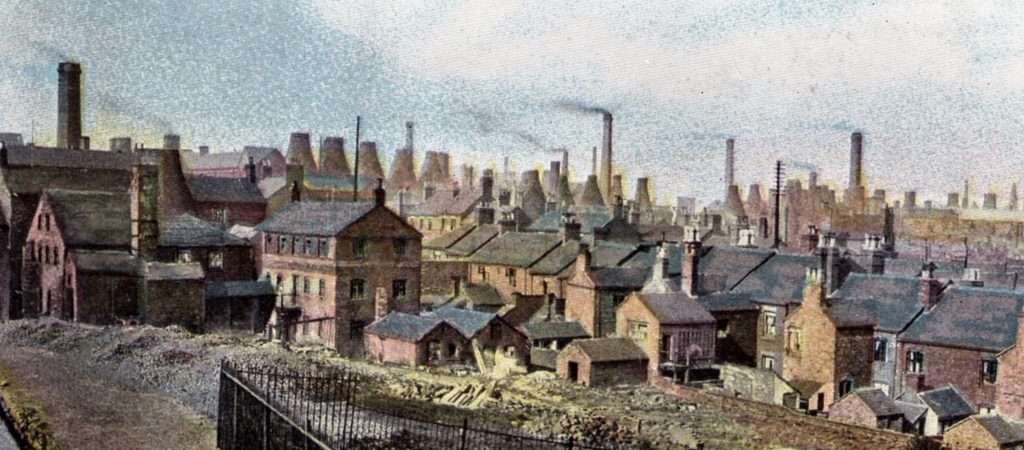
A visitor to the mid-18th century Potteries was Reinhold Rücker Angerstein, an industrial spy in the employ of the Swedish government, who was tasked with gathering information on new or emerging technology. Between 1753 and 1755, he journeyed through England and Wales and produced a wide-ranging and comprehensive survey of the various industries and their practices. He appears to have visited the Staffordshire Potteries, which he labels rather colourfully as a ‘Valley of Crockery’, in about 1755. Here, after examining the manufacture of salt-glazed wares, describing the kilns in Hanley (including illustrations), the raw materials used, the prices of ware and various mechanisms employed in producing pottery (with still more pictures), he went on to add a few descriptions of the area that make for interesting reading.
He notes that in Hanley there were 430 makers of white ware and other types of pottery, adding ‘The kilns are everywhere in this district.’ and to prove his point he includes an illustration of the skyline of the town. There were also large numbers of potteries in Stoke and other places, ‘where mostly the same kind of ware as that enumerated is made and also some simpler crockery.’ He then adds a picturesque and slightly comical tale. ‘When as it sometimes happens, many kilns are glazing with salt at the same time, there is such a thick smoke of salt in these towns, that people in the streets cannot see 6 feet ahead, which, however does not cause any difficulties. On the contrary, the smoke is considered so healthy that people who are ill come here from far away to breathe it.’
Of the pottery itself, he writes, ‘The crockery produced is mainly sent to London or other sea ports, from which much of it is exported to America and many other foreign countries.’
(Reference: R. R. Angerstein’s Illustrated Travel Diary 1753-1755, pp. 340-342)
John Wesley preaching to a crowd
Pelted in the Potteries
On 8 March 1760, the Reverend John Wesley, the founding father of Methodism, visited Burslem for the first of many visits to the region. He described Burslem as ‘a scattered town, on the top of a hill, inhabited almost entirely by potters’, a large crowd of whom had gathered to hear him at five in the evening. He noted that great attention sat on every face, but also great ignorance which he hoped he could banish.
The next day Wesley preached a second sermon in Burslem to twice the number of the day before. ‘Some of these seemed quite innocent of thought. Five or six were laughing and talking till I had near done; and one of them threw a clod of earth, which struck me on the side of the head. But it neither disturbed me nor the congregation.’ –
(Reference: John Wesley, Journal, 8-9 March 1760)
The First Cut
After receiving the royal assent two months earlier for construction of a canal connecting the rivers Trent and Mersey, on the morning of 26 July 1766, at a site just below Brownhills, pottery manufacturer Josiah Wedgwood cut the first sod of what would in time become the Trent and Mersey canal. James Brindley, the engineer who would oversee the canal’s construction, and numerous other dignitaries were present, many of whom would also cut a piece of turf, or wheel away a barrow of earth to mark the occasion. In the afternoon a sheep was roasted in Burslem market place for the benefit of the poorer potters in the town. A bonfire was also lit in front of Wedgwood’s house and many other events took place around the Potteries by way of celebration.
(Reference: Jean Lindsay, The Trent and Mersey Canal, pp.31-32)
News from the North
Extract of a Letter from Burslem, 14 August 1766,
‘As you often give me London News, I will give you some from this Country, which has of late made a Figure. This Neighbourhood has for many Years made Pots for Europe, and will still do so, though the King of Prussia has lately clapt 28 per Cent, upon them. Our Roads were so bad that nobody came to view the Place where the Flint Ware is made, but now we have Turnpikes upon Turnpikes, and our Potteries are as well worth seeing as the Stockport Silk-Mills, or the Bridgewater Navigation, which we intend to beat hollow by Lord Gower’s, now begun in our Meadows, and advancing apace towards Harecastle, on the other Side of which Multitudes of Men are at work, and before Christmas we shall have cut through the Hill, and made another Wonder of the World. There are already 100 Men employed on our Side, and 100 more will be added as soon as Wheelbarrows can be procured for them. Saturday last we had brave Sport at Earl Gower’s, where 100,000 Spectators were present at the Prison-Bars played in Trentham Park. Among them were the Dukes of Bedford and Bridgewater. The Prizes were Ten Carline Hats, with gold Loops and Buttons, given by the Earl. The Cheshire Men were active Fellows, but unluckily their Lot was to wear Plod Drawers, to distinguish them from their Antagonists, which made the Crowd oppose their getting the Honour of the Day. During this Game, my Friend Bucknall loft his Boy, about Eight Years of Age, who was suffocated by going aslant down a Sort of a Cave into an old Coalpit, the top of which was fallen in. The Man that ventured to fetch him out, found a Number of Birds, supposed to have dropped down there by the sulphurous Stench issuing from the Pit. We have much Hay, and Cheese is plenty, and Corn without Barn-room, nor do we want Money.
P. S. I have just seen a Hen, which laid Twelve Eggs only, from which she has brought up Twelve Cock Chickens, which is looked upon as somewhat remarkable.’ –
(Reference: Derby Mercury, Friday 29 August 1766, p.2)
In Praise of Mr Brindley
Extract of a Letter from Burslem in Staffordshire. dated September 5.
“Though our Stone Ware has been universally used, yet till our Turnpikes were made few People ever saw our Manufactories. But now they are gazed at as a Novelty. The Ladies go to Warburton’s to buy the Queen’s Sets of Cream-coloured Ware; and the Gentle-men come to view our Eighth Wonder of the World, the subterraneous Navigation, which is cutting by the great Mr. Brindley, who handles Rocks as easily as you would Plumb-Pyes, and makes the four Elements subservient to his Will. He is as plain a looking Man as one of the Boors of the Peak, or one of his own Carters; but when he speaks all Ears listen, and every Mind is filled with Wonder at the Things he pronounces to be practicable. He has cut a Mile through Bogs, which he binds up, embanking them with the Stones which he gets out of the other Parts of the Navigation, besides about a Quarter of a Mile into the Hill Yeldon; on the Side of which he has a Pump, which is worked by Water, and a Stove, the Fire of which sucks through a Pipe the Damps that would annoy the Men, who are cutting towards the Centre of the Hill. The Clay he cuts out, serves for Brick to arch the subterraneous Part, which we heartily wish to see finished to Wilden Ferry, when we shall be able to send Coals and Pots to London, and to different Parts of the Globe.— Another Mile is cut on the Cheshire Side of the Hill, and the Men intend to meet in the Middle by Christmas, when they are to have an Ox roasted whole, and an Hogshead of Ale.”
(Reference: Derby Mercury – Friday 18 September 1767, p.2)
Tunnel Vision
On 1 July 1772, an anonymous correspondent writing from Burslem related what he had seen the day before when he and some companions paid a visit to the first incarnation of the Harecastle Tunnel, situated between Tunstall and Kidsgrove and then under construction as part of James Brindley’s Trent and Mersey Canal.
‘Yesterday we took a walk to the famous subterraneous canal at Harecastle, which is now opened for a mile on one side of the hill, and more than half a mile on the other, of course the whole must be compleated in a short time. As it is not yet filled with water, we entered into it, one of the party repeating the beautiful lines in Virgil, which describe the descent of Æneas into the Elysian fields. On a sudden our ears were struck with the most melodious sounds. – Lest you should imagine us to have heard the genius or goddess of the mountain singing the praises of engineer Brindly, it may be necessary to inform you, that one of the company had advanced some hundred paces before, and there favoured us with some excellent airs on the German flute. You can scarcely conceive the charming effect of this music echoed and re-echoed along a cavern near two thousand yards in length.’
(Reference: Leeds Intelligencer, Tuesday 14 July 1772, p.3)
A Fungi to Be With
No age is free of stories of novelty fruit, veg or mushrooms:
‘A few days ago, a mushroom was got at Stoke-upon-Trent, in the county of Stafford, whose diameter was 5 inches, and 30 inches in circumference, it weighed 16 ounces. The above is very authentic.’
(Reference: Leeds Intelligencer, 5 September 1775, p.3)
All in a Spin
In 1781, there was the story of a curious weather phenomenon, a whirlwind or perhaps a mini tornado:
‘The following extraordinary phenomenon was lately observed here; at the latter end of last month, a field of hay belonging to Mr. J. Clark, near Burslem, was carried off by a whirlwind; the day when it happened was exceedingly calm, scarce a breath of air to be perceived. The people who were at work in the field observed, that in one part the hay began to be agitated in a small circle, at every wheel it increased in size and velocity, continually sucking more hay into its vortex; after a considerable time it began to ascend, taking along with it a silk handkerchief which hung rather loosely about the neck of one of the men who was at work; it continued ascending till entirely out sight, and in about an hour it began to descend, and continued to so for an hour’s space, alighting at, or within a few hundred yards of the place from whence it had been carried up, so that the owner lost but a very trifling quantity of his hay.’
(Reference: Hereford Journal, 23 August 1781, p.2)
A Tragic Accident
The following melancholy tale from the Potteries is related in a letter dated August 14 1785.
‘As Ellen Hulme, a poor woman of Lane End, was returning to her habitation late last night, with her infant, six weeks old, in her arm, she unfortunately stepped into a coal-pit, which shamefully lay open close to the road, and even with the track which led to the poor creature’s house. Her husband, whom she had been to fetch from an alehouse, immediately alarmed the neighbourhood, when her distressing cries were very distinctly heard from the bottom of the dreary pit every effort was attempted by the hardy colliers to fetch her up, but the damp prevailing very much, obliged them to use means to extract it, after which was found the mother with her infant upon her arms, both dead.’
(Reference: Sussex Advertiser, 22 August 1785, p.3)
A Hard Winter
During the harsh winter of 1794-1795, the better off inhabitants of Hanley and Shelton formed a committee which started a subscription list for the temporary relief the poor who were suffering great hardship during the cold weather. By February 1795 the committee had collected an impressive £150, enough to enable them to supply nearly 500 local families with meat, potatoes, and cheese. The Wedgwood family gave a liberal amount and through them a Mrs Crewe kindly added a welcome donation of a quantity of flannel clothing. The Marquis of Stafford aided the relief fund by ordering 100 tons of coal to be at the distribution of the committee.
A month later, in an issue of the Staffordshire Advertiser that noted that thermometers in Macclesfield had measured temperatures as low as -21° F (-29.4° C), the fearsome nature of the winter was highlighted dramatically by one small but rather macabre snippet of news: ‘Through the inclemency of the night of Saturday last [i.e.,14 March] a poor man perished betwixt Hanley and Bucknall. He unfortunately lost himself in attempting to cross the fields, and was found on Sunday standing upright in a snow drift, with his hand only above the surface.’
(Reference: Staffordshire Advertiser, 7 February 1795, p.3; 21 March 1795, p.3.)
Dashed to Pieces
‘A melancholy accident happened on Wednesday last at a coal-pit near Lane Delph, in the Pottery. A poor woman employed in drawing up the coal, was by some accident unfortunately thrown into the pit, and was literally dashed to pieces.’
(Reference: Derby Mercury, 30 June 1796, p.4).
Wild Fire
In late March or early April 1799, a dreadful accident happened in a pit at Lane End, the property of John Smith, Esq. Four men were blown up, and two them terribly burnt by what the colliers of the time described as ‘the wild fire’. The explosion was loud, and the concussion so great that nearby houses shook violently. Two of the men were not expected to recover, while the other two were thrown to a considerable distance, and left badly bruised. The reporter noted that their hats were blown to the distance of 70 yards from the mouth of the pit.
(Reference: Staffordshire Advertiser, Saturday, 6 April 1799, p.4)
On 1 April 1852, the writer Charles Dickens wrote a letter to his wife Kate informing her ‘We think of going on tonight from Birmingham to Stoke upon Trent.’ Despite worries about the trains, it seems that he and a travelling companion arrived in Stoke the next morning. Here after gazing with some fascination at the town before him, the famous author (who at the time was also writing up weekly instalments of his longest book, Bleak House) spent a few hours at the Spode factory which was at that period owned by W. T. Copeland.
Dickens started his tour of Copeland’s works by watching a thrower and his attendant swiftly and skilfully fashion a breakfast set for his amusement, watched jiggerers and pressers making bowls and basins and saw Parian statuettes being produced in moulds. He then explored the factory kilns, seeing the saggars being stacked prior to firing and mused on the constant cycle of heating and cooling that accompanied the manufacture of pottery. This was followed by visits to see transferers and decorators at work, producing willow pattern wares or fancier stuff, before moving on to the dipping shop for glazing and then to the placers carefully loading the ware into the appropriate saggers prior to them being loaded into the kilns he had seen earlier. Dickens seems to have enjoyed his tour and it was doubtless a thrill for the workers at the Copeland works to meet, albeit briefly, one of the biggest celebrities of the Victorian age and show him their own impressive skills. Armed with all he had seen and imbibing a good working knowledge of the history and process of pottery making, Charles Dickens moved on the next day to Stafford.
Compared to the grime and industry of the Potteries that evidently spoke to his imagination, Dickens was bored with Stafford and rather rude about the place, ‘it is as dull and dead a town as any one could desire not to see’ he wrote tartly. He lodged at the Swan Inn, which he disparagingly nicknamed ‘the Dodo’ and where he apparently seemed doomed to spend a very dull evening indeed. According to the tale he told, though, he chanced to look at the bottom of a plate and saw the name ‘COPELAND’, which set him to musing on the previous day’s events. Employing a literary conceit, he then let the plate ‘remind’ him of all he had seen at Copeland’s pot bank, telling the story outlined above as a journey through its creation. The plate’s ‘recollections’ got Dickens through the evening, so he claimed, though one might suppose that he was actually quite busy putting his recollections down on paper. His clever bit of writing, ‘A Plated Article’, was published in the magazine Household Words, on 24 April 1852.
Probably at some point in early to mid July 1934, Burslem hosted the world premier of the first film of an up-and-coming star, when, according to report, the Palladium Cinema in in Waterloo Road showed a new British comedy entitled Boots! Boots! The star of the production was George Formby Jr, the son of a notable music hall performer, who would go on to be one of the biggest home grown film stars of the early 20th century. In his most famous films, Formby was invariably cast as a gormless but cheeky character with an infectious grin and an astonishing skill with a ukulele, on which he played numerous very catchy tunes; his films still come over surprisingly well today. This early film, though, was a far cry from those later glossy productions. Apparently filmed over a fortnight on a shoestring budget in a room above a garage, the film has the feel of a review, with very little plot. George plays John Willie (a character invented by his father) a hotel boots who indulges in a number of comic encounters with the hotel manager, the chef, some of the hotel guests and a scullery maid (played by Formby’s formidable wife Beryl). Discovering John Willie’s prowess with the ukulele and the maid’s dancing skills, the manager puts them in the hotel’s cabaret.
George Formby later described Boots! Boots! as ‘a lousy film’, and certainly it seems very cheap and cheerful today, but on it’s opening it proved to be a great hit across the country and effectively launched Formby’s cinema career. By his own account he himself saw what a draw the film was when he secretly came to the Potteries to see the film open and was astonished to find that it was playing to packed houses. A Sentinel reviewer described it as ‘a distinctly happy piece of entertainment. There are plenty of laughs, an abundance of good tunes and the settings are up to standard for a film of this type.’
The reason why the exact date of the premier is unknown seems to be because the Palladium Theatre often went through periods when it did not advertise in the Sentinel, 1934 being one of these times and as a result the date is lost. The film was subsequently shown at the Roxy in Hanley for three days from 19 July and at the Regal, Newcastle on Bank Holiday, Monday, 6 August 1934, having gone on general release on 30 July.
Reference: Staffordshire Sentinel 7 August 1934, p.3; correspondence of Jonathan Baddeley and David Rayner in The Way We Were supplement to the Sentinel, partially reprinted in The North-West George Formby Newsletter 36, Vol. 3, No. 12, June 1998, p.4.
Alfred John Austin had been born in Hanley on 22 September 1899, the eldest child of George and Emily Austin, he had a younger sister named Ann. In 1911 the family emigrated to Canada, settling in Winnipeg, Manitoba, where the father George initially worked on the railway and later as a caretaker. Their settled life, though, was interrupted by World War One. It seems that young Alfred was keen to go to war as on 16 August 1915, he attested for the Canadian Army, claiming he was 19, though he was actually a month shy of his 16th birthday. Two days later his father George also attested for the army, though the two were posted to different units, Alfred joining the 79th Cameron Highlanders of Canada with whom he went to serve in France. In 1916, his father George Austin was killed in action, while Alfred for his part is said to have been wounded in the Third Battle of Ypres and his papers indicate that in 1917 he also suffered from shell shock. It was also in 1917, whilst probably visiting friends and relatives in the Potteries, that Alfred married his first wife Doris Roberts at St George’s Church, Newcastle-under-Lyme on 23 December. He returned to France, eventually rising to the rank of Company Sergeant Major, but got through his remaining service unscathed.
Hanley Stafford c.1945. Source: CBS Radio, Public Domain Source: Wikimedia Commons
Returning home to Canada with his new wife in 1919, he settled back in Winnipeg where he and Doris had a son, Graham, born in 1920. He had started acting with the Winnipeg Permanent Players on his return and through them, he got a job with a summer stock company that toured western Canada, but when the company folded he had to make a living in other ways, taking jobs working in wheat fields, hauling freight and working as an office stenographer. In search of more acting work, in 1922 he took his family to live in the USA, settling in California. Five years later on his application for US citizenship, to give himself a memorable stage name and in a nod to his place of birth, he stated that he wished to be known henceforth (in the States, at least) as Hanley Stafford. He then played in summer stock productions for eight years and then in tent shows. He was appearing in radio plays in Los Angeles by April 1932 and briefly went to Phoenix to manage a stock theatre company, but returned to Los Angeles in August to resume his stage and radio work. His career was going well, but at the expense of his marriage it seems and in 1934, he and Doris were divorced. The next year he married his second wife Bernice Bohnett.
After starring in the New York radio detective series Thatcher Colt from September 1936 to March 1937, Stafford again returned to Los Angeles and there took on a number of radio roles, providing voices for amongst others Speed Gibson and The Shadow of Fu Manchu. In December 1937, he also landed the role of Lancelot ‘Daddy’ Higgins, the oft-harassed father of mischievous Baby Snooks, a young girl played convincingly by a grown actress, Fanny Brice, originally in a series of sketches on The Good News Show and later on The Baby Snooks Show. It was the role that made his name and alongside his other work Stafford continued playing the part until the final broadcast on 22 May 1951, two days before the sudden death of star Fanny Brice. In 1939, Stafford also took on another notable role as J. C. Dithers, the boss of Dagwood Bumstead, in the popular radio comedy Blondie, again a part he would play for many years. That year, his second marriage failed and in 1940 he married Veola Vonn, who played Dimples Wilson in Blondie. They would stay married until Stafford’s death.
Between 1950 and 1963, Stafford also appeared as a guest star or in bit parts on various television series, these included The Popsicle Parade of Stars and Hollywood Premiere Theatre, episodes of Cheyenne, Maverick, Shirley Temple’s Storybook, Sugarfoot, and 77 Sunset Strip, The Brothers, The Betty Hutton Show, Angel, The Millionaire. and The Lucy Show. He also appeared in minor roles in several light-weight films such as Lullaby of Broadway starring Doris Day, A Girl in Every Port, Just This Once, Tell it to the Marines, Francis Covers the Big Town and The Affairs of Dobie Gillis. These, though seem simply to have been strings to his bow, radio being his preferred medium. In 1960 for his radio work, Hanley Stafford was awarded a star on the Hollywood Walk of Fame. This was unveiled on 2 August 1960 at 1640 Vine Street, Hollywood, California; the venue was fitting as in Stafford’s heyday, the area around the intersection of Sunset Boulevard and Vine Street was known as ‘Radio Row’ housing the four large radio stations in the city where he had worked for the past two decades.
Hanley Stafford, born Alfred John Austin, died at home from a heart attack on 9 September 1968, in Los Angeles, California, USA, aged 68. He was cremated and his ashes placed alongside those of his mother in the Columbarium of Heavenly Peace, Forest Lawn Memorial Park, Glendale, Los Angeles.
Reference: Wikipedia entry for Hanley Stafford; IMDb entry for Hanley Stafford; Find-a-Grave entry for Hanley Stafford.
In early March 1783, the local economy was in decline and people were going hungry. A poor harvest the year before plus the knock-on economic effects of the American War of Independence had caused food to become scarce and prices to rise sharply and a number of food riots broke out in Newcastle and the Potteries as a result. The most serious of these took place around the canal at Etruria and may well have been started by some of Josiah Wedgwood’s workers.
A view of Wedgwood’s Etruria works from across the canal. From The Life of Josiah Wedgwood (1865) by Eliza Meteyard.
There had been some trouble in Newcastle for several days and the rioters there seem to have joined or inspired the riot that broke out at Etruria on Friday 7 March. The trouble started when a barge carrying much-needed supplies of cheese and flour moored up at Etruria where the food was to be off-loaded before being distributed around the Potteries. However, at the last moment the barge’s owners decided to send the boat on to Manchester. Within a short time of this decision shop owners in Hanley and Shelton heard the news and they in turn informed their angry customers. They had probably heard about the barge’s departure from some of Wedgwood’s own workers, certainly that suspicion was voiced in a letter written by Josiah Wedgwood junior, son of the famous potter. Later that same day Josiah junior wrote to his father (who was then in London on business) describing how when the news spread about the departing barge, several hundred men women and children had quickly gathered and chased after it along the canal, finally catching up with it at Longport. Believing that the boat had been sent away to increase the scarcity of provisions and thus up the prices even more, the crowd were in a black mood and not to be trifled with, so when they found that the boatman would not pull the boat over one of the crowd leapt aboard to tackle him. The boatman immediately cut the tow rope and slashed at the man with his knife and voices from the crowd on the towpath called out “Put him in the canal.” A ducking may well have been the man’s fate had not another boatman come to his rescue and he had been able to escape onto another craft, albeit leaving his own barge in the hands of the mob as he did so.
The captured boat was then hauled it back to Etruria in triumph and by late afternoon was tied up alongside Wedgwood’s Etruria works where the crowd unloaded the cargo into the factory’s crate shop. Most of the rioters then went home meaning to return the next day for distribution of the goods. In the meantime a few men were set as guards. At about 7.30 that evening four of these sauntered up to Etruria Hall and asked for something to eat and drink while they were on watch. Another of the Wedgwood children, Josiah’s older brother, 17 year old John went to them and stood talking with them for a time then too did their mother Sarah Wedgwood, who also spoke with them for a while before the men went off. The nervousness of the Wedgwood household at this point is, evident in young Josiah’s hasty missive to his father, but the family were not bothered any further that evening and at breakfast the next day things were still quiet.
On the Saturday morning the crowd gathered back at the canal side and some of the goods seized the day before were sold off at what were considered by the crowd to be more reasonable prices. One of the letters states that this was at two-thirds the normal price, while sometimes the goods were given away. The meagre proceeds were then handed over to the disgruntled owners of the captive barge. The authorities meanwhile had taken steps to deal with the rioters. An express message had been sent to Lichfield asking for some companies of the Staffordshire Militia to come to their aid. Closer at hand, though, were a company of the Carmarthen Militia who that day had arrived in Newcastle on their way back to Wales. Due to the troubles in Newcastle itself and now in Etruria, the commanding officer was asked if he could help in dealing with the rioters. He agreed, and the force put itself at the disposal of the local magistrates who now had the job of quelling the disturbances.
Some justices went to meet with the mob still gathered around the captured boat, but the Militia were kept at a distance while the officials tried to settle matters peacefully. Here the letters are at odds with one another, one stating that all efforts to get the mob to disperse, including getting the master potters (whose workers formed the bulk of the mob) to try and influence them, but to no avail, while the other letter states that the magistrates’ efforts were a success and that the mob agreed to leave, providing the boat was left where it was. Judging by the fact that several days later the mob was demanding the return of the boat the latter seems the most likely state of affairs, but the details still remain confused.
Nothing of great significance seems to have happened on the Sunday, though some of the local manufacturers and officials held a crisis meeting at Newcastle to discuss how best to calm the situation down and deal with the mob. A subscription was entered into perhaps to placate the rioters, Josiah Wedgwood’s son John was present at the meeting and donated £10 to the fund. But after the quiet Sunday, Monday saw a return to the stand-off of previous days as the mob gathered at Etruria once more. This time they were in a far more bullish mood and sent messengers to the magistrates outlining their demands, namely to have the boat delivered back to them and its contents sold there.
After a quiet Sunday, Monday saw a return to the stand-off as the mob gathered once more, this time outside Billington’s (probably the premises of Richard Billington, who carted coals for Wedgwood and rented 38 acres of the Etruria estate), where there was a meeting of the master potters and several officials. These included John Wedgwood in his father’s stead, Dr Falkener of Lichfield, Mr Ing and Mr John Sneyd of Belmont (a neighbour of the Wedgwoods), who harangued the mob on their bad behaviour and the detrimental effect it would have on the price of corn, as too did John Wedgwood and Major Walter Sneyd of the Staffordshire Militia. The latter was there at the head of a detachment of the Staffordshire Militia, who stood by ready if needed. The masters and officials though still hoped that the rioters would listen to reason and a generous subscription was again raised, John Wedgwood giving £20 this time. The mob, though, did not accept this graciously remarking caustically that the money would not have been provided had they not caused trouble and made the manufacturers sit up and pay attention. They continued calling for the boat to be returned to them and the corn to be sold on fairly. Their demands became so loud and threatening that the Riot Act was read out and the mob was told that if they did not disperse to their homes in an hour’s time, that the Militia would be ordered to fire on them. The crowd, though, were defiant, jeering that the militia men dared not fire on them and that if they did then the rioters would attack and destroy Keele Hall, the ancestral home of the Sneyd family of Major Sneyd was the current heir. According to some accounts the rioters also put their women and children at the front confident that the soldiers could not fire on them.
Despite this, after the hour had passed, the chief magistrate Dr Falkener was apparently on the verge of ordering the nervous militiamen to fire, when two of the rioters accidently fell down and made him pause and consider his actions. One of the Sneyds, huzzaring as he did so, got about 30 of the men to follow him, intending perhaps to charge the mob, but his effort was thwarted by women in the crowd who called out, “Nay, nay, that wunna do, that wunna do.” and embarrassed by the mocking cries the militiamen baulked, turned back and left the crowd alone. Unable or unwilling to take firm action, the officials agreed that the corn taken in the boat should be sold on at a fair price. And for now that was that and the crowd had their way. The magistrates, though, were now determined to make the leaders of the riot pay for the trouble they had caused and to bring the disturbances to an end once and for all.
Two of the ringleaders of the mob had been quickly identified as Stephen Barlow and Joseph Boulton. According to report, Barlow was born in Hanley Green, was aged about 38 and seems to have had a chequered history prior to the riots, having apparently served in the Staffordshire Militia, but had been drummed out for bad behaviour. He may also have had previous with the law as records show that four years earlier at the Epiphany Assizes at Stafford of 1779, one Stephen Barlow was in court for some unspecified crime he had committed in Penkridge. At some point he had married and by 1783 was the father of four small children and was living in Etruria. The authorities certainly knew where to look for him and that night after the riot, magistrates and constables converged on his house. On hearing the men at the door, Barlow quit his bed naked and attempted to escape by climbing up the chimney. He probably would have got away except that in his haste he dislodged some bricks and when his pursuers came out to see what was happening they caught sight of him hiding on the roof behind the chimney stack. When he was brought down, Barlow refused to get dressed and though it was a cold night suffered himself to be transported stark naked all the way from Etruria to Newcastle. After subsequently being taken to Stafford Gaol, Stephen Barlow was held there until his trial.
So too was Joseph Boulton, but he remains a shadowy figure in this drama as nothing seems to be known of his background. Beyond noting that two ringleaders had been captured at home that night and sent to Stafford gaol, his name was not mentioned in contemporary newspapers, though John Wedgwood who was at Stafford to witness the trial wrote to his father in London and noted that the man had been acquitted by the court. Stephen Barlow, on the other hand was not so lucky. The judge in summing up at the trial on 15 March, detailed Barlow’s offence and laid out the law regarding riots in the clear and clinical manner of the Riot Act. “That all persons to the number of twelve or more, who remain in any place in a tumultuous manner after proclamation has been made for the space of one hour, subject themselves to an indictment for capital felony.” In other words, the death sentence.
The message this sent out was clear, namely those hundreds who had assembled and been involved in the rioting on 10 March, most of whom had since either fled the area or had thus far escaped detection, were just as guilty as Barlow and could expect the same treatment if caught and convicted. Barlow meanwhile was sentenced to death without a quibble and on Monday 17 March 1783, exactly a week after the riot, at Sandyford near Stafford, he was escorted to the gallows by a body of militia and there he was hung by the neck until he was dead. His body was then returned to the Potteries and buried locally two days later.
It had been a startlingly quick chain of events which did indeed have the desired effect quelling any further disturbances, but it perhaps shocked many law-abiding citizens too, disturbed by such arbitrary use of the law. Looking back from over half a century later even local historian John Ward – who as a solicitor and witness to the Pottery Riots of 1842 had very little sympathy with rioters – seems to have been taken aback by this blatant show trial. Writing about Stephen Barlow, he noted that he ‘became a victim rather to the public safety, than to the heinousness of his crime.’ According to some accounts Barlow was not the only victim, as more than one paper reported briefly that following the execution, Barlow’s wife hung herself in despair.
Reference: John Ward, The Borough of Stoke-Upon-Trent, pp. 445-446; Ann Finer and George Savage (Eds.), The Selected Letters of Josiah Wedgwood p.268: Correspondence of Josiah Wedgwood, Vol. 3, pp. 8-9; Derby Mercury, Thursday 13 March 1783, p.3; Cumberland Pacquet and Ware’s Whitehaven Advertiser, Tuesday 25 March 1783, p.3; Manchester Mercury, Tuesday 25 March 1783, p.1; Kentish Gazette, Saturday 29 March 1783, p.3; Northampton Mercury, Monday 24 March 1783, p.3; Stamford Mercury, Thursday 27 March 1783, p.2; Ipswich Journal, Saturday 22 March 1783, p.1; Hereford Journal, Thursday 3 April 1783, p.3.
Gertrude Astbury, known as Gertie Gitana, captured in a charming early publicity photograph.
Of all the famous names who have hailed from the Potteries, few in their lifetime gave more honest, unalloyed pleasure than Gertrude Astbury, who as ‘Gertie Gitana’ became a darling of the music halls prior to World War One. Her talent and staying power were considerable. In her prime, her name on the bill was enough to ensure a full house, and even in the twilight years of her career, she was still able to command a large audience.
Gertrude Mary Astbury, the eldest child of pottery turner William Astbury and Lavinia nee Kilkenny, a teacher at St Peter’s R. C. School in Cobridge, was born on 28 December 1887 at 7 Shirley Street, Longport, but the family lived at various addresses after that. When in 1954 the City Council decided to rename Frederick Street, behind the Theatre Royal in Hanley, as Gitana Street in her honour, Gertie wrote a letter to The Sentinel saying that she was very proud of the honour noting that ‘Gitana-street is adjacent to the theatre stage is appropriate.’ She then added, ‘I don’t think anyone knows of it, but it may be of some slight interest to mention that I actually lived in Frederick-street; my mother had a small shop there. I was three years old when we moved there and we were there for two or three years.’ There is no official evidence to support this story, but at the time of the 1891 census, Gertie was certainly living with her grandparents in Bucknall New Road, Hanley, while her parents and brother James lived in Burslem. Perhaps the family moved to Fredrick Street after the census was taken?
From a very early age, Gertie proved to be something of a musical prodigy. Apparently as a toddler she delighted in putting on performances for her dolls and by the age of four she had been enrolled into Thomas Tomkinson’s Gypsy Children as a male impersonator, singer and comedienne and was soon earning star billing as ‘Little Gitana’ (the Spanish word for a female gypsy). The tale told of her discovery is that she was seen dancing in the street (arguably in Frederick Street, Hanley) by two girls attached to the troupe who befriended her. She then went along to one of the rehearsals and began copying the moves. Thomas Tomkinson noticed her and recognising her ability, applied to her parents to let her join the troupe. Once in the line-up and out touring with the show first around the Potteries, then through Wales, Gertie honed her skills and there was no doubting her burgeoning talent and her performances were regularly singled out for praise in press reports. In 1896, her career was given a helping hand by two music hall veterans, James and Mabel Wignall, known professionally as Jim and Belle O’Connor, who took her away from the Gypsy Children and under their wing. Though the O’Connors were apparently somewhat protective of their young charge, it was not in any sinister way and Gertie always referred to them affectionately as ‘Uncle and Auntie.’ It was thanks to them that at only eight years of age, Gertie made her music hall debut at the Tivoli in Barrow-in-Furnace, where she sang the song, ‘Dolly at Home.’ Two years later at the age of ten, she had a major billing at The Argyle in Birkenhead, and her first London appearance came in 1900.
By the age of 15, Gertie was earning over £100 per week, much more than her father earned in a year. At the age of 17, she topped the bill for the first time at The Ardwick Empire at Manchester. From late 1903 onwards, though often still appearing as Little Gitana, she was also being referred to increasingly as Gertie Gitana, the stage name she would adopt for the rest of her career. As she grew into womanhood, though, her skills and repertoire expanded and as well as singing she entertained by tap dancing, yodelling, and playing the saxophone, a relatively new instrument developed in the States and which at that time was something of a novelty in Britain. Her music hall repertoire of songs over her career included ‘All in a Row’, ‘A Schoolgirl’s Holiday’, ‘We’ve been chums for fifty years’, ‘When the Harvest Moon is Shining’, ‘Silver Bell’, ‘Queen of the Cannibal Isles’, ‘You do Look Well in Your Old Dutch Bonnet’, ‘Never Mind’, ‘When I see the Lovelight Gleaming’, and most famously ‘Nellie Dean’ which she first sang in 1907. It was a song her younger brother James had heard in the United States and was an instant success for Gertie, becoming her signature tune. Her first gramophone recordings, dating from 1911–1913 (some of which can be heard online), were made in London on the Jumbo label.
Vintage portrait of Gertie Gitana, the famous music hall performer, holding a saxophone.
During the Great War, like many music hall performers Gertie turned her talents to entertaining the war wounded in hospitals or raising funds for the injured and she gained a following with the men in the trenches as a forces sweetheart. After the war, she appeared in pantomime, most notably as the principal boy in Puss in Boots, or as Little Red Riding Hood, and Cinderella. One amusing incongruous tale from this period is that she was reputed to have said the line in Cinderella, ‘Here I sit, all alone, I think I’ll play my saxophone’, before removing the instrument from the stage chimney and bashing out a tune*. Two musical shows were specially written for her: Nellie Dean and Dear Louise, and in 1928, despite initial opposition from the O’Connors, Gertie married her leading man in the latter, dancer Don Ross. Don was as ambitious and driven as his wife and would later prove to be quite the impresario, bringing over one of the first Vaudeville strip-tease artists after a visit to the States, running a three-ring circus and organising variety shows; he later became King Rat of the Grand Order of Water Rats and founder and first president of the British Music Hall Society.
The autobiography of Gertie’s friend and fellow performer Ted Ray
After the shows had run their course, Gertie returned to the variety scene, working for some time in partnership with blackface performer G. H. Elliott and an up-and-coming comedian Ted Ray, who liked her immensely. In his autobiography, Ray described both Elliott and Gertie as charming and courteous professionals, who never let their acts devolve into smut and no matter what their moods or what else was going on in their lives, never let an audience down or turned in a sub-par performance.
However, determined to retire at 50, by her own design Gertie’s career was now winding down. Made rich by her tireless work over the years (“No gutters for Gertie.” she sometimes commented wryly on her wealth) she was able to retire in 1938, but the old trouper could not be kept down and ten years later she made a short but very successful comeback with other old music hall stars in the show Thanks for the Memory produced by her husband. The show was the centrepiece of the Royal Command Performance in 1948. Her final appearance was on 2 December 1950 at the Empress Theatre, Brixton. She retired completely after that and spent her remaining years quietly, though she increased her fortune by speculating successfully on the stock market. On her death she left just over £23,584 in her will, equivalent to £484,727.62 in 2024.
Gertrude Ross, nee Astbury, alias Gertie Gitana, died of cancer on 5 January 1957 in Hampstead, London, aged 69, and was buried in Wigston Cemetery, Wigston Magna, Leicestershire, where her husband had been born. Some lines from her most famous song, ‘Nellie Dean’ are engraved on the gravestone.
By all reports, Gertie, though no pushover after years toughing it in showbiz, was an incredibly good natured and generous woman, well-liked not only by her legion of fans, but also by her fellow performers who felt her loss. After her death her friend, comedian Ted Ray, wrote ‘She was the most gentle, loveable person I ever met… A perfect artiste in every sense of the word. I place her among the immortals.’ In his book My Old Man, former Prime Minister John Major, recalled how years later his father (who trod the boards as part of the act ‘Drum and Major’) expressed similar sentiments about Gertie. Her death made the TV and radio news of the time, papers including the Sentinel, carried glowing obituaries to the star and memorials were mooted, though the only one of note at the time was a memorial bench that was unveiled in Edinburgh. In the Potteries memorials to Gertie Gitana have for the most part been fleeting. The Gertie Gitana pub (later The Stage Door) has come and gone, likewise Gitana’s pub in Hartshill and today few save die-hard local historians or music hall enthusiasts remember her. But her name lives on in Gitana Street, an honour that never ceased to delight and surprise her. As her husband Don Ross recalled, on the day she died Gertie was fading away, but talking with him about this and that when unbidden she suddenly brightened up and said, ‘Fancy them naming that street in Hanley after me.’
Modern day Gitana Street, Hanley. Source, Google Earth.
*Comedian Roy Hudd in his foreword to Ann Oughton’s biography of Gertie Gitana, recalled asking Don Ross in later years if Gertie really had used the amusing ‘… I think I’ll play my saxophone’ line in Cinderella, but Don neither confirmed nor denied it.
Reference: Ann Oughton, Thanks for the Memory, passim;Ted Ray, Raising the Laughs, pp. 86-87; Evening Sentinel 15 February 1954 .