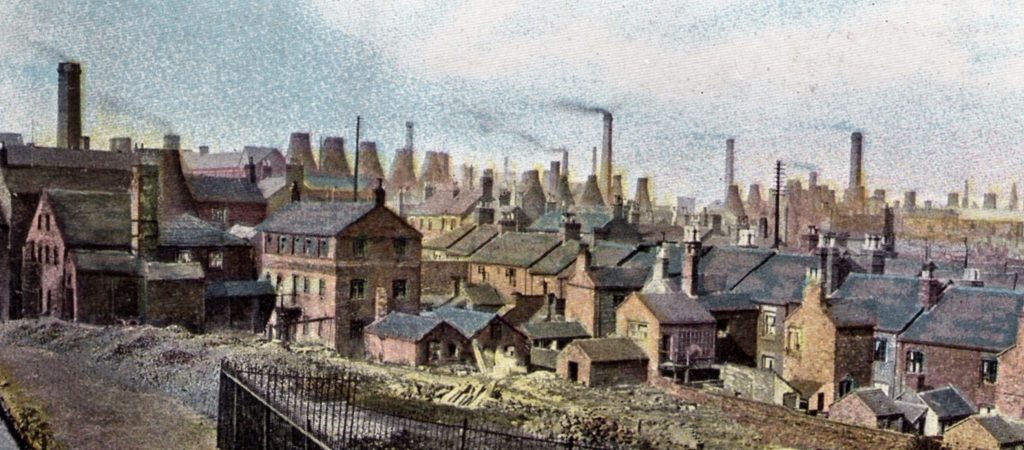
In an age when coal mining was rapidly transforming the landscape around the Potteries, the dangers of the industry extended far beyond the men who worked underground. Open pits scarred the countryside, often lying perilously close to roads and footpaths, waiting like concealed traps for the unwary traveller. Such had been the case of Ellen Hulme and her child in 1785 (see ‘A Tragic Accident’ in the post ‘Old News from the Potteries’, above) and an avoidable death a decade later provided another example of the danger. According to the Staffordshire Advertiser of 12 December 1795, an accident occurred around the end of November to a Mr Bristoe, a young man from the parish of Wolstanton, who was making his way home from Hanley when somewhere along the route he disappeared. Days passed with no sign of him and it was not until Monday 7 December, almost a fortnight after he had vanished, that his body was discovered at the bottom of a coal pit.
The newspaper’s account leaves little doubt as to the condition in which the body was found. A Coroner’s Inquest, held at Hanley the day after the discovery of the remains, examined what was described as his ‘mangled body’, confirming that he had fallen into the pit and perished there unnoticed. Yet it was not merely the circumstances of his death that stirred sympathy. He was said to be the son of a respected farmer’s widow and was on the eve of marriage. The newspaper remarked that both his intended bride and his wider circle of friends would ‘long lament his ultimate fate’. An alternative version of the story made the tragedy even more poignant. It was stated that Mr Bristoe had in fact been travelling to visit the young woman he hoped to marry and had the marriage ring in his pocket at the time he went missing.
The newspaper’s sympathy at his loss was matched by its indignation at how he had died. Rather than treating the accident as an unavoidable misfortune, the writer openly blamed those responsible for securing local collieries. Open pits, particularly those near turnpike roads and footpaths in such a densely populated district, were described as a longstanding grievance. The article demanded action, urging colliery proprietors to ensure their workings were properly guarded and suggesting that inadequately protected pits should be prosecuted as public nuisances. In effect, Bristoe’s death was presented not simply as an accident, but as the foreseeable consequence of negligence.
The inquest over, the body was returned to the earth with more dignity, but no burial matching that surname has been found locally at the relevant time. However, in St Margaret’s churchyard, Wolstanton there stands the gravestone of one Thomas Bristol, the son of Joseph and Ann Bristol, who died aged 29, on 28 November 1795, a date that fits closely with the chronology reported in the newspaper. Furthermore the parish records note that Thomas Bristol was buried on 10 December, three days after the body was found. For hygiene’s sake, at the time most people were buried within two or three days of their demise, a gap of twelve days being unusual. It seems very likely, therefore, that Thomas Bristol and the unfortunate ‘Mr Bristoe’ were one and the same.
A month later, Aris’s Birmingham Gazette carried a brief report of what may have been the same incident, though the details were perhaps garbled in the retelling. This story told of a young man who fell into a coal pit near Burslem and whose remains were not discovered until the following Friday. One detail stood out in the account, namely that when his body was recovered, some fern remained clutched in the man’s hands. It was supposed that, as he fell, he had desperately grasped at the vegetation growing around the pit’s edge in an attempt to save himself. The fragile fern had proved too weak a lifeline. Whether this was indeed Thomas Bristol/Mr Bristoe or another unfortunate victim of the unguarded local pits, the image serves up a vivid and tragic glimpse into the man’s final moments.
References: Aris’s Birmingham Gazette, 18 January 1796, p.3; Staffordshire Advertiser, 12 December 1795, p.4.
The scene of the accident shown shortly afterwards. For ‘Star Green’ read Far Green.
On 5 November 1859, an appalling accident occurred at the ‘Big Pit’ at Far Green, Hanley (i.e. Hanley Deep Pit) when a number of men and boys were being brought up in one cage and others were being lowered down the shaft in another. Through a momentary lapse of concentration, the engine man controlling the winding gear failed to stop the ascending cage as it exited the shaft, no brake was applied and the cage was wound up onto the winding gear, tipping most of the occupants out. Six men and boys, the two youngest of them being 11 years olds, fell to their deaths down the 507 feet deep shaft, while three others landed on the steel plates at the top of the shaft and were also killed. One boy clutched at the pit wheel but was hurled down the shaft by the momentum; another landed between the wheels of the winding gear and though injured he survived as did six other men and boys in the cage, though most were also badly injured, one man, Thomas Bellas, later dying from shock. The occupants of the descending cage were also seriously hurt as they suffered a heavy landing at the pit bottom, though they suffered no fatalities. The full list of the men and boys killed or injured in the accident was printed in the local press a few days later:
KILLED Edward Knowles, of Catfields, aged 14 Thomas Jones, Bucknall Road, aged 14 Henry Walklate, Crown Bank, aged 22 Eli Griffiths, Hanover Street, aged 18 Owen Williams, High Street, aged 11 William Vernall, North Street, aged 16 William Hughes, Bow Street, aged 14 William Beard, Cobridge, aged 11 Richard Yates, Catfields, aged 17 Thomas Bellas, Market Street, aged 36
INJURED Thomas Williams, broken thigh Enoch Lees, broken arm and contused back Thomas Leighton, injuries to head Thomas Jones, shock to system Arthur Cope, slightly injured
George Rhodes, was uninjured.
The above named were in the ascending cage, while the following men were injured in the heavy landing of the descending cage:
David Gould, contused back James Morris, contused back Thomas Price, contused back, severely hurt Joseph Northwood, slightly shaken William Jones, shaken a good deal John Clark, ankle injured William Lees, injuries to feet John Edwards, injuries to back and feet Henry Chorlton, foot hurt William Pierrepoint, slightly shaken Henry Davis, slightly shaken John Watkin, slightly shaken
At the subsequent inquiry it emerged that immediately before the accident, the engine man, 27 year old James Gallon, who hailed from county Durham, had been distracted, when against the colliery rules two men named Edward Williams and Samuel Tillet, had entered his cabin and spoke to him causing him to miss the indicator signalling an approaching cage, a momentary lapse of concentration that proved fatal. Though there was great sympathy for the engine man from many workers at the pit, 400 of whom immediately signed a petition supporting him, there had to be a reckoning for the lives lost. At the Stafford Assizes in March 1860, the judge at his trial expressed his own sympathy for Mr Gallon, attaching more blame to the actions of the two men who had distracted him. Moreover the prosecution, the Government Inspector and jury asked for mercy for the accused, but the law had to follow its course and Gallon was convicted of manslaughter. Because of the mitigating circumstances, though, and in light of his long service, good character and the man’s utter dejection at what had happened, he was sentenced to only six weeks hard labour in prison.
There is no indication that Williams or Tillett were punished for their actions as they had intended no harm, while James Gallon himself served his sentence and returned to work, leading a quiet life thereafter. Early the following year he married Ann Harrison with whom he would have two children. In the 1861 census for Hanley, he was still employed as an engineer, and as an engine fitter in 1871. He appears to have died before 1891.
Refence: StaffordshireSentinel, 12 November 1859, p.5; also 24 March 1860, p.4.
The Britannic, painted white for her service as a troop ship during the Boer War. Source: Bertram Hayes, Hull Down (London, 1925).
Edward John Smith, the future captain of the Titanic had been at sea for the better part of 15 years when he made the switch from the sailing ships of Andrew Gibson &Co, and joined the White Star Line. He had been seduced following a visit he made to the SS Britannic, but though he was quickly taken onto the new company’s books, he did not get his longed-for berth on that ship for a few years yet. At first he served from March 1880 to March 1882, as fourth and later third officer aboard a much smaller vessel the SS Celtic commanded by Captain Benjamin Gleadell. Though Smith had a master’s certificate, so too did many others in the White Star line and promotion to the coveted captaincy had to be earned. Steamships also demanded a different set of skills in an officer than a sailing ship and these had to be learnt. The steamers were passenger liners rather than cargo vessels. They carried mostly emigrants, but also many wealthy passengers, whose continued goodwill had to be cultivated, so good social skills needed to be honed. The first few years with White Star were in effect a second apprenticeship for Smith.
He did advance pretty quickly as it turned out. After the Celtic, from March 1882 to March 1884, he served in the Pacific on the San Francisco-Yokohama-Hong Kong run, aboard the SS Coptic as its second officer under Captain William Kidley. Then from March 1884 to July 1885, he was second officer aboard his favourite ship the Britannic under the command of Captain Hamilton Perry, before becoming first officer from July 1885 to April 1887, aboard the SS Republic under Captain Peter Irving. These were all ships he would later command.
He was by this time living permanently in Liverpool and apart from some cousins and nephews, most of his immediate family had also left the Potteries. His mother, half-sister, and brother-in-law now lived in Runcorn and Joseph Hancock would leave the sea in a few years and going into partnership he would set up as a ship’s stores dealer in Birkenhead.
Eleanor Smith and their daughter Helen Melville Smith.
Ted was also on the verge of his own settled family life for in January 1887 at Winwick parish Church near Warrington, Edward John Smith married a farmer’s daughter, Sarah Eleanor Pennington. They initially set up home nearby in Tuebrook, but soon moved to one of the wealthier parts of Liverpool to be nearer the docks. The couple seem to have maintained a good, loving relationship thereafter, despite Ted’s long periods at sea. Eleanor, as she preferred to be called, referred to her husband as ‘Ted’ or ‘Teddy’ and Smith spoke of his wife as ‘my only dear one.’
Almost as a wedding present, from April to August 1887, Smith was given temporary command of the SS Republic before being transferred back as first officer on the Britannic, staying with the ship until February 1888. That month he applied for and gained his Extra Master Mariners certificate of competency, albeit on the second attempt, having failed the navigation section on his first try, while in August he added to his qualifications by joining the Royal Naval Reserve, undergoing the required training early the next year. As a lieutenant in the Reserve he and any ship under his command could be called upon to serve in times of war and provided that enough members of the crew were also in the Reserve his ships could fly the Blue Ensign of the RNR. As a result of these feathers in his cap, from April to May 1888, Smith took on his first permanent command, the now ageing SS Baltic and so became a fully-fledged White Star line captain.
Smith went on to captain many more White Star ships over the next few years: the Adriatic; the Britannic; the Cufic; the Celtic, followed by Coptic in the Australian service; the Runic; and Germanic, the identical sister of the Britannic.
Lieutenant E.J. Smith c.1895
The 1890’s were a time of both sad and happier events in Ted Smith’s life. In 1893, his mother Catherine died in Runcorn whilst Smith was at sea, while in 1895 first his brother-in-law, William Harrington, died in the Potteries on 1 March, and on 1 May his half-brother and former captain, Joseph Hancock, collapsed and died of a heart attack in the street in Liverpool. On a happier note, it seems to have been in 1895, that Smith made a visit back to the Potteries for a school reunion in honour of his old schoolmaster Alfred Smith. Then in 1898, he and Eleanor had a baby girl, their only child, whom they named Helen Melville Smith. She like her mother later preferred to use her second name Melville, or ‘Mel’ for short. Though he was often away, Smith doted on his daughter, whom he called his ‘Gillie’ (‘girly’) or ‘Babs’ (‘baby’) sending her little notes from abroad when he was away and buying presents and organising parties for her on his brief periods ashore.
The longest single command of Captain Smith’s career was that of the SS Majestic, from July 1895 to November 1902. He would take a break to command the Germanic from December 1902 to May 1903, whilst the Majestic underwent a refit, but then returned to his former command from May 1903 to June 1904. His time aboard the Majestic coincided with the outbreak of the Second Boer War in South Africa. Because of his rank in the Royal Naval Reserve, he could be called upon to serve in times of war and he now did so. Captain Smith twice took the Majestic to South Africa, transporting troops to the seat of war and bringing wounded men home. For his work during the war, Smith like all transport captains later received the Transport Medal, which he henceforth wore proudly on his uniform.
During the years of his captaincy of the Majestic, Smith earned a fine reputation amongst both his crews and the passengers who regularly sailed the Atlantic. Despite the beard he now sported and grizzled looks, he was softly-spoken and easy going, though he was a noted stickler when it came to ship’s discipline and had been known to bark out an order that brought many an errant seaman back to his duty with a bump. Increasingly, more and more passengers chose to sail with Captain Smith rather than any other because of his affability and because he was an excellent host. Also, though he was known for pushing his ships hard through all weathers, thereby earning the nickname ‘the Storm King’, by the standards of the time he was considered to be an excellent sailor and a ‘safe captain’.
Amongst his regular passengers, he now numbered British aristocrats such as the Duke of Sutherland and the Earl and Countess of Rothes and American millionaires such as John D. Rockefeller, George Widener, John Jacob Astor and J. Pierpont Morgan, the latter becoming a good personal friend, whom he visited with during his stopovers in the States. Such stellar passenger lists became so regular a feature on his ships that by 1900 Smith had become popularly known as ‘the millionaire’s captain’. Indeed, many of the first class passengers who later sailed aboard the Titanic had travelled with Captain Smith on more than one occasion.
Smith with one of his dogs.
Smith also met or knew many other famous people of the day as they crossed the Atlantic. Rudyard Kipling and his family travelled on the Majestic, as too did Henry Morton Stanley, the man who had ‘presumed’ so famously when he found Dr Livingstone in Africa. Other notable figures who sailed with Smith included the Joseph Chamberlain, the Secretary of State for the Colonies; the Fleet Street journalist W. T. Stead, who is said to have included Smith in several of his short stories. Another notable passenger, the American writer Kate Douglas-Wiggin, the author of Rebecca of Sunnybrook Farm, described in her autobiography how during his earlier captaincy of the Britannic, Captain Smith had played the matchmaker and introduced her to her future husband.
Because of such a wide acquaintance, Smith enjoyed a lively social life ashore, especially in New York visiting his friends such as Pierpont Morgan, Kate Douglas-Wiggin and her husband, attending fetes and parties and according to one newspaper report, he was also a regular at many of New York’s clubs and societies.
On a personal level, Smith was noted as being well-read and extremely well informed on current events, which was hardly surprising given his wide and influential acquaintance. He was a smoker, preferring cigars, which he smoked through a holder and his daughter later recalled that she would only be let into the room if she promised to be good and not disturb the cloud of blue smoke that hung around her father’s head. Smith enjoyed a drink too, though never on duty. At home, he was extremely fond of his pet dogs and enjoyed many hours ashore out walking with them, though they seem to have been something of a nuisance to his wife whilst he was away at sea.
Reference: G. J. Cooper, Titanic Captain. The Life of Edward John Smith (2011) pp. 56-108.
Railways, or at least horse-drawn or gravity drawn railroads, running to or from canal wharfs, had been employed on a small scale by local collieries for a long time. By 1750, there was scarcely any important colliery that did not have its own set of rails. Mechanical railway engines, however, did not appear until the early years of the 19th century and in 1825, the world’s first line, the Stockton and Darlington Railway was opened for business.
Many entrepreneurs around the country saw the potential offered by this new form of transport, but most of the leading local potters failed to take up the cause of the railway. Thus, though many of the early lines ran tantalisingly close to the Potteries, little if any real effort was made to secure the district its own line. At first, this was no great problem. Early trains were slow and prone to breaking down, nor was there as yet a comprehensive system of railways, whereas there was a tried-and-tested network of canals. Also, during the years 1834-1837, there were the series of strikes organised by the potters union, which left manufacturers unwilling to risk their fortunes on a railway venture. From the late 1820s, however, many began to feel that the district needed to grasp the nettle and get its own railway line.
In 1833, the Grand Junction Railway obtained an Act of Parliament to construct a line from Liverpool to Birmingham. This would not run through the Potteries, the closest it came was through Madeley and Whitmore. Though transport could be laid on from the Potteries for those using the line, it still necessitated a coach journey of eight miles before passengers even saw a train. Because of this unsatisfactory situation, in 1835, the Potteries Branch Railway Committee was formed to petition for a Potteries branch to the new line. They requested George Stevenson to survey a route to the Potteries which would be presented to the Grand Junction Railway, The Grand Junction Railway, opened to great acclaim in July 1837, Crowds of people from the Potteries flocked to Madeley and Whitmore to watch the first trains pass, and it seemed only a matter of time before the Potteries were linked to the line, but by 1839 and on through to 1844, the mood of the local promoters became one of disillusionment. The trade depression of the early 1840’s, made money scarce. The G.J.R and the Manchester and Birmingham Railway Companies, made but later broke promises to the P.B.R.C., while the Potteries petitioners themselves made many mistakes. By the end of 1844, the rot was complete and several of the interested parties showed themselves to be in favour of an independent line through the Potteries. It was not until 1845, though, that the real revival of interest in Potteries’ railway schemes came to fruition with the ‘Railway Mania’, that swept the country.
The reason for the mania was an upturn in the economy. The depression ended, money became plentiful and investments in the new railways grew into a frenzy. The Potteries were seen as a growing industrial centre and as a result there was a rash of schemes for local railway connections. The competition to supply a Potteries line became so heated that the Board of Trade postponed its decision on the local proposals to allow a year’s cooling off period. During this hiatus, the Potteries’ interests finally responded with some speed and determination. A new, dynamic railway company came into being, the North Staffordshire Railway Company. This soon challenged the dominance of the Grand Junction Railway in the west midlands and north-west. The new company then took a major step towards securing parliamentary recognition by taking over its major transport rival in the district, the Trent and Mersey Canal. The N.S.R.’s petition to Parliament was well received and as a result three Acts authorising the N.S.R’s construction of a line through the Potteries came into effect in 1846.
The first section of the new railway line from Stoke to Norton Bridge, was completed in 1848. Stoke was the main terminus for the area and here the N.S.R. stamped its signature on the area by constructing what was then one of the most impressive buildings in the Potteries – Stoke Station. The Staffordshire Advertiser covered the opening of Stoke Station in detail and gave a glowing description of the building and some of its more striking features that greeted passengers.
‘The site is the tract of land known as Winton’s Wood between Stoke and Shelton. The buildings appear admirably adapted for the purposes intended… The platforms for the arrival and departure of passengers are each 500 feet in length, and 18 feet in width, floored with large flagstones, and covered with a light roofing, the greater portion glass, which projects over the line of carriages on each side, thus protecting passengers from the weather. The approach roads are so arranged that passengers arriving or departing from the north and south avoid the inconvenient and dangerous necessity of crossing the line; and the arcades attached to each of the booking offices, whilst agreeable features in the design, afford to the passengers that shelter prior to entering, the absence of which is so much to be regretted in many of the stations on other lines. These arcades are paved with encaustic tiles, manufactured by Messrs. Minton and Co., and are beautiful both in design and execution. The pattern is bolder than any other we have seen; and opposite the principal entrance to each booking office it is inlaid with a large facsimile of the company’s arms, as emblazoned on the carriages. Altogether these pavements are well worthy of the attention of those who feel an interest in the revival of a long-forgotten art. The style of the building is that of James the First, and whilst the incongruities of that age have been avoided, there is much that demands commendation, as well for its purity as for its elegance. The gabled parapets, mullioned windows and the old-fashioned brick chimneys, especially attract attention, whilst the judicious combination of brick and stone, and the chequers of red and black brick, produce a very pleasing effect.’
Stoke Station in 1849
Normally such openings would be accompanied by a civic banquet for local bigwigs and worthies, but in a break from this on 9 October 1848, a large party was held to celebrate the opening of the station, but it was held for the benefit of the poor of the district. A committee of the local gentry and tradesmen had decided to provide what the paper called an ‘entertainment for the poor’. Flags and banners flew from prominent buildings, church bells rang, bands played throughout the day and fifteen hundred children from the local workhouses and Sunday Schools were marched in procession down to the station where they were provided with cake and drinks. In the afternoon four hundred ‘poor and deserving females’ were treated to a meal, and tickets (presumably for the trains) were handed out to them. The Staffordshire Advertiser noted that ‘during the day, three quarters of a hundredweight of tea, 2cwt of lump sugar, 800 loaves of bread, 2,000 buns, and 17 gallons of wine were distributed.’ Had it not been for the state of the weather that curtailed the railway trips that had been planned for the school children, the day would have been perfect. As it was, the newspaper opined rather archly that ‘the day will be most agreeably remembered in the short and simple annals of the poor.’
From Stoke the first train to use the line was the No, 1 train Dragon, pulling a series of six-wheeled crimson carriages bearing the company logo the Staffordshire Knot, which officially inaugurated rail travel in the Potteries. Soon after, the remaining sections of the local network been laid down and from this time the North Staffordshire Railway became a force to be reckoned with.
But that was not the end of railway developments in the area. In 1847, even as the main route was being constructed, the idea for a Potteries Loop line linking the towns was been mooted, but no progress was made until 1858. That year the North Staffordshire Railway gained permission to extend Earl Granville’s private colliery line to Hanley, A freight line was opened in December 1861 and the first passenger service started in 1864. The original loop line stretched from Hanley through Etruria, Burslem, Tunstall and Kidsgrove and was later extended to Fenton. By 1873, there would be a station in Sun Street, Hanley and a service of 50 trains a day running at 15 minute intervals. The advent of the railway allowed the locals to visit other towns and cities they offered a quick and relatively cheap method of getting around the country. Thus, from the 1850’s, it became possible to catch excursion trains from Stoke Station, to places such as Chester, Birkenhead and the Isle of Man.
Stoke Station in 1863, with crowds gathered for the unveiling of the statue of Josiah Wedgwood.
References: Railways in Staffordshire – Staffordshire County Council Education Department Local History Source Book G.6; Staffordshire Advertiser, 14 October 1848, p.5.
For centuries the island of Britain was home to a mix of Celtic tribes, living at varying levels of development and with differing degrees of contact with the wider world. Their existence drew fleeting Roman interest in 55–54 BC, when Julius Caesar crossed the Channel twice on short punitive expeditions against certain south‑coast tribes that he believed were aiding their fellow Celts in Gaul. Almost a hundred years later, though, in 43 AD, Celtic control of Britain came to an abrupt end when the Romans returned for good. Establishing a firm foothold in Kent and Essex, these disciplined invaders pushed inland, defeating or overawing the native inhabitants and securing their new province with a growing network of roads that they built as they moved inland. The Roman army advanced in three battle groups, each built around a legion. Legio II moved into the south‑west towards Somerset and Devon, Legio IX marched north towards Lincoln, and Legio XIV headed into the west midlands, establishing bases at Shrewsbury and Chester by around 50 AD. It was therefore in about 48–49 AD, five years after the initial landings, that the first Roman soldiers entered what would become the county of Staffordshire.
Although South Staffordshire shows abundant evidence of Roman occupation, the north of the county was at that time a sparsely inhabited expanse of woodland and rough, hilly ground, that was largely unsuitable for farming. The Romans appear to have found little of value there and only scattered forts, small settlements and a handful of villas being constructed. North Staffordshire seems to have simply been a wild region through which military and civilian traffic passed en route to more important or profitable destinations.
The route these travellers took was the Roman trunk road that once linked Derby with Chester, a route along which some Roman sites have been discovered. Local historian John Ward in his history The Borough of Stoke-upon-Trent, lists the road as the ‘Via Devana or Rikeneld Street’ (i.e. Rykeneld Street) an identification lent support by the Street being mentioned by name as a boundary of lands in Normacot granted to Hulton Abbey in 1223. From east to west, the road entered the county at Rochester, where an auxiliary fort—possibly occupied by a cavalry regiment—and its accompanying vicus (a trading settlement or village outside the fort) were established. From there it ran just south of Uttoxeter, then cut across country towards present-day Stoke-on-Trent, passing through what are now Tean, Blythe Bridge, Meir, Normacot, part of old Longton, Fenton and on to Stoke, where it crossed the River Trent. In 1887, workmen carrying out road improvements uncovered part of the Roman roadway near Stoke church, apparently the approach to the Trent crossing. Other sections have been found in Campbell Place, Stoke, in King Street, Longton and in Honeywall. Many Roman coins have been found all along the line of this old road, some in Stoke but the majority in Longton, where in 1960 a resident of Lightwood Road was digging in his garden and found an earthenware pot containing 2,461 coins 1,739 of which were Roman coins of the 3rd century. More recently in 2015 another large cache of over 2,000 coins and other items were discovered at Barlaston, which though some miles from the line of the Roman road, is certainly within it’s catchment area. The dates of the various coin finds along the road show that it remained in use throughout the entire period of Roman occupation in Britain.
A detail of John Ward’s map of the Roman road from his The Borough of Stoke-upon-Trent (1843).
The road may then have continued to Etruria before passing through present‑day Hartshill, Basford and May Bank towards Chesterton, where, as the name suggests, another small auxiliary fort stood. Built in the early Flavian period c.70 AD, this replaced an earlier temporary fort at Trent Vale that had been abandoned. A 16th to early 17th century antiquarian, Sampson Erdeswicke, noted in his work A Survey of Staffordshire that the rubble he found on the site ‘Rubbish of Stone and Lime’, suggested that the fort had once possessed walls of ‘marvellous thickness’ hinting at stone-built walls rather than a wooden palisade, though as Robert Plot notes in his Natural History of Staffordshire if that was the case none of these seem to have survived to the early 1680s when he visited the site, the valuable dressed stone most likely having been robbed away for use in other later buildings. More modern surveys have found the remains of a clay oven and cookhouse built into the supporting rampart and the remains of a bath house have been unearthed most likely outside the fort. Not far removed from the fort the remains of a marching camp has also been discovered off Loomer Road.
Although pottery was a major industry in Roman Britain, surprisingly little seems to have been produced in North Staffordshire. Yet in 1958 the remains of a Roman updraught pottery kiln, together with evidence of a potter’s workshop beside it, were uncovered at Trent Vale. Dating to around 50 AD, the pottery was probably established to serve the military and appears to have produced a wide range of wares. These included flagons, storage jars, cinerary urns, bowls, cooking pots, lamp holders, incense burners and Samian‑style platters, along with more unusual pieces such as a so‑called ‘face vase’, a globular pot bearing a roughly moulded human face on one side. At a nearby civilian settlement at Holditch, some fragments of this ‘Trent Vale’ ware have been found, which proves that the pottery was used locally. Pottery fragments have also been found on the site of the fort at Chesterton, though none of these appear to have originated from the Trent Vale pottery. This is surprising as much of the pottery produced there was of high quality for the period, especially a group of gravel‑flecked pots that had been turned, finished and then decorated. Eight of these formed the kiln’s final load and were sealed inside when the clay roof collapsed during firing.
The potter’s workshop, a wattle‑and‑daub structure with a thatched roof, was at some point destroyed by fire. As it stood dangerously close to the kiln, the nearest post hole lying less than two feet from the stoke hole, it is highly likely that sparks or flames from the collapsing oven ignited the building. There is no evidence that anyone died in the blaze, though some personal belongings such as buttons and coins were trapped in the debris. The Roman or Romano‑British potters who worked there also seem to have enjoyed games of chance in their leisure time, as several glass‑paste gaming counters were found on the site.
The Trent Vale kiln was probably fuelled with wood from the local forests, but there is some evidence that coal was being used here in the Roman period. A number of small Roman industrial sites have been uncovered near to the River Trent in Bucknall, which were probably used for the smelting and forging of iron.
Reference: Anthony Bell, ‘Excavations at Rocester, Staffordshire, by Fiona Sturdy in 1964 and 1968’, in Staffordshire Archaeological Studies, New Series, Nº3 1986, pp.20-51; Gary Cooper, Farmers and Potters (2002) pp. 13-14; Sampson Erdswicke, A Survey of Staffordshire (1723), p.9; Robert Plot, The Natural History of Staffordshire (1686), chapter 10, paragraph 67, p.434; John Ward, The Borough of Stoke-upon-Trent (1843) pp. 8-17. See also entries for Chesterton Roman fort in The Journal of Antiquities -https://thejournalofantiquities.com/2013/08/09/chesterton-roman-fort-north-staffordshire/; and Roman Britain -https://www.roman-britain.co.uk/places/chesterton/; Staffordshire Newsletter, 13 December 2016.
Though by 1819 the gang of street thugs known as the Rough Fleet had been effectively stricken from the streets of the Potteries, trouble still abounded across the region. Groups of young men out on the town still got themselves into fights and occasionally committed worse crimes and fell foul of the law. One such incident occurred in late 1819 when Daniel Collier (aged 18), William Toft (21), William Holford (17), John Walklate (24) and John Cooper (22) were arrested and on 11 December were committed to Stafford Gaol for the rape of one Hannah Bowers at Stoke-upon-Trent. At the subsequent trial at the Stafford Assizes on 20 March 1820, evidence was presented that Bowers was hardly the most sterling character, she had been highly intoxicated on the night in question and only a few days after the alleged assault she had suggested to the men that each of them should pay her £2 which would have been ‘a sufficient compensation for the violation of her person’ – which to many hardly seemed the reaction of a genuine rape victim and more that of a prostitute. The price, (though described as ‘a trifling sum’ in one newspaper report) was far too much for the youths, who were poorly paid potters and miners and they refused to cough up and so Hannah Bowers bought the charge of rape against them. This was when things got serious, as rape if proven, was at that time a capital crime answerable with ‘a more dreadful sacrifice’ than a few pounds, namely the death penalty.
To the shock of many in the district, despite the evidence against Bowers as a loose woman, the five young men were all quickly found guilty of rape and sentenced to death. Hasty petitions were made on their behalf to the presiding judge and also to the Home Secretary in hopes of prevailing on the King for mercy. A few days later from Shrewsbury, Judge Richardson forwarded reprieves for John Cooper and William Holford, but Collier, Toft and Walklate were only granted a fortnight’s stay of execution. Then on 12 April, a letter came from the Home Secretary stating that the matter was such that it could not be referred to His Majesty and the law must follow its due course. The condemned men took the news calmly, Walklate for one had been convinced the petitions were pointless, though Collier and Toft had apparently held out hopes for a last minute reprieve.
On Friday 14 April, the men were visited by the prison Chaplain who remained there all day, preparing them for what was to come. In the afternoon, John Walklate (who seems to have been the most thoughtful and religious of the group) asked to say a few words to the other condemned prisoners and was allowed to do so. In a calm manner he urged the men to mend their ways if they were spared the gallows and to serve God and he asked them to pray for him. The Chaplain then left the three youths to whatever fitful sleep they could get that night.
The next morning at 6 o’clock, they were roused and taken to the Chapel to receive the Sacrament and stayed there until 8 when the prison bell began to toll and they were led up to the scaffold above the gatehouse. Below, a large crowd had gathered to watch and as it was a controversial sentence and there was the possibility of trouble, a party of the Sheriff’s officers on horseback with drawn swords and thirty special constables were on hand to keep the crowd in order and ensure the execution went unhindered. Toft ascended the scaffold first followed by Walklate and Collier. Whilst they were being readied by the hangman, the Chaplain, at Walklate’s request, exhorted the crowd ‘to refrain from the destructive vices of sabbath-breaking and blasphemy’ that had ultimately led them down a dark path to the gallows. During this harangue the three prisoners prayed fervently and as they were expressing the words ‘Lord remember me’ at about 8.05 a.m., they were dropped. Walklate died instantly, Toft struggled a little, while Collier writhed for some time on the rope. After hanging for an hour the bodies were cut down and were delivered to their waiting family and friends to be taken back to the Potteries for burial.
So much for the tale as related in the newspapers of the time, though Henry Allen Wedgwood expanded on the story, charting the life and fate of John Walklate, whom he erroneously names in his account as ‘William Walklate’. He describes the man as a religious convert who had however fallen back into his old vices and paid the ultimate price as a result of his relapse. As an addendum to the tale, Wedgwood also relates that on the drive back to the Potteries the carrier who transported the bodies of the three hanged men found that John Collier was still breathing and hurried on to Hanley in hopes that he might receive attention, but on arriving it was found that Collier had expired. Toft, Walklate and Collier were said to have been buried under the path to Hanley Churchyard, a great crowd turning out for their funerals.
Henry Allen Wedgwood, People of the Potteries pp. 47-52; Staffordshire Advertiser 11 December 1819, p.4; 25 March 1820, p.4; 15 April 1820, p.4; 22 April 1820. p.4; Aris’ Birmingham Gazette, 20 March 1820. p.3.
George Stevenson is shot in the backroom of the Red Lion beer house. An AI image after a drawing by the author.
On 26 January 1895, 27 year old George Stevenson, a habitual petty criminal and deserter from the British army was shot and mortally wounded in a backroom to a bar in Johannesburg, in Southern Africa, for informing on his fellow criminals after a robbery. The story made news locally as Stevenson, though born in Hixon near Stafford, had grown up in Hanley, where he had turned to a life of crime at a very early age. In December 1877, aged only nine, he was caught trying to rob a till in a second-hand clothes shop in Hope Street, Hanley, for which he received ten strokes of a birch rod and a stint at a reformatory. Little good it did him as in June 1878, he and five other boys were before the bench charged with stealing checks for Battys’ circus that was then in town, though there is no indication as to what punishment they received if any. Yet even if he got off that charge, his short inglorious career as a local ne’er-do-well was quickly brought to an end in October that year when the manager of the Stoke Conservative Club caught the scruffy kid with only one shoe, lurking behind the club bar looking for something to steal . Despite being aged only 10 years old, as he had already been imprisoned once for theft, George Stevenson was now sentenced to a four year stretch at Werrington Industrial School. This did seem to turn his life around and in 1882 he was released back to his parents and for several years Stevo, as he was known to his friends, worked in his father’s clay pits. Then in 1886 aged 18, he joined the army and the next year was posted to Pietermaritzburg in South Africa. Though he stayed in touch with his mother, Stevenson never saw his family or the Potteries again.
At first Stevo enjoyed army life, but garrison duty bored him and at the end of 1889, he deserted and fled to Johannesburg in the then independant Boer republic of the Transvaal, arriving there early in 1890. There he led a brief inglorious life as a thief being quickly caught and sentenced to a year on a chain gang and though he escaped and went on the run he was eventually recaptured and sent to finish his sentence. Shortly after his release in 1893, he fell in with a villain and fellow deserter (from both the army and the Royal Navy) named Jack McLoughlin, who went by the nickname of ‘One-armed Jack’, from having lost his lower left arm during a jailbreak. Despite their difference in appearance – Stevenson was tall, athletic and good-looking, while McLoughlin was short, disabled and plain – they were kindred spirits from similar backgrounds and at first the two men were inseperable. But only a few months passed before tattled tales between their respective lovers caused them to have a falling out and they shunned each other for a time. It was only when McLoughlin needed some more able-bodied men to help him with a robbery a few months later that they patched up their differences enough that Stevo could join the gang.
The gang robbed a safe at a railway station in Pretoria, it was a pitiful haul and their troubles started immediately after the robbery when they tried to take the train back to Johannesburg and realised the authorities were onto them. One of the gang stayed in Pretoria, while early in the journey Stevenson got cold feet and quit the train and doubled back. McLoughlin jumped through a window to escape while the train was in motion, leaving one man on the train who was arrested in Johannesburg. Stevenson and the gang member in Pretoria were also quickly caught. In custody and fearful of returning to prison, when he heard that another of the men was about to inform on them, Stevo got in first and told all to the authorities, naming McLoughlin as the ringleader. Stevenson avoided imprisonment as a result, but he knew that his life was now in danger as McLoughlin, who remained at large, was a vindictive man who hated informers.
Stevenson and his lover Sarah Fredericks fled Johannesburg for a time, but foolishly drifted back into town a few weeks later and by January 1895, they were living out of a room at the back of the Red Lion bar close to their old haunts. With no sign of McLoughlin, Stevo thought he was safe, but on the 26 January he learnt that One-armed Jack was in town looking for him. Stevo and Fredericks retreated to their room hoping he would not find them. A few hours later, though, there was a knock at the door. Expecting a visitor Fredericks opened the door, only to find that it was McLoughlin, who had tracked them down. Brushing Fredericks aside, One-armed Jack then pulled a gun and shot Stevenson who was sitting on the bed, mortally wounding him before making his escape. Pursued by an angry mob, McLoughlin then shot and killed another young man who he thought was trying to stop him and fled into the night going on the run once more. Back at the Red Lion meanwhile, Stevenson lingered for a time, but died from his wound a few days later. His last request to Fredericks was that she send his ring back to his mother in the Potteries.
Many years passed, and in 1910 Stevenson’s mother told a Sentinel reporter that ‘The only intimation of the death of her son that [she had] received was a letter written by Stevenson’s supposed wife, to Mrs. Nixon, daughter of Mrs. Stevenson, in New Hall Street, Hanley.’ Sarah Fredericks, however, told a court that Stevenson had asked her to write to his folks at 10 York Street, Hanley. There is no indication in the newspaper accounts that Stevo’s ring ever found its way back to his mother. Some official communication from the South African police to North Staffordshire is suggested by Hanley’s former Chief Constable Charles Higgins, who, fourteen years later, still recalled that the Johannesburg police had contacted him shortly after the shooting, asking if he could obtain a photograph of George Stevenson. If one was supplied it seems never to have been published, and the only surviving image of Stevenson is a simple line drawing of a young man, smart and rather dapper in a checked suit. Even his parents were perhaps unsure of their prodigal son’s appearance, for in 1910 the Sentinel told a curious tale of how Stevo’s mother had for eighteen years kept a portrait of McLoughlin hanging in their house ‘and they never knew that it was the photograph of the man who was supposed to have shot George Stevenson.’
The case was hot news again in 1910, for the year before, in far‑off Australia, One‑armed Jack McLoughlin, long a fugitive, had been arrested and transported back to South Africa—now a united territory under British rule after the Boer War—to face justice for his crimes. In court, the whole cast from the drama of fourteen years earlier reappeared to tell their sordid tales of how and why Jack and Stevo’s relationship had come to its disastrous end, while McLoughlin himself cheerfully explained how he had escaped. To the embarrassment of the local police, he had actually remained in town for some time, even strolling past the police station to show his contempt for the law. Brassiness aside, he knew he had to get away, and after pulling off another robbery with a new crew, he sailed for India hoping to forge a fresh criminal career.
Things did not go to plan. He reached India, but with no contacts and his meagre funds gone, he became a vagrant and was saved from starvation only by being picked up by the authorities, who were keen to remove the negative image such European flotsam gave to the Raj and were happy to ship him to wherever he claimed was his birthplace. Drawing on his knowledge of the colony from his time in the navy, McLoughlin convinced them he was Australian and so was sent there. Many years later, after his usual round of misadventures, he was caught there, his old crimes became known, and he was shipped back to South Africa to face justice.
Justice was now served. Though many years had passed since he had burst with murderous intent into the back room of the Red Lion beer house and later fired that second fatal shot in the street, the witnesses’ evidence and George Stevenson’s deathbed deposition put the noose firmly around McLoughlin’s neck. On 10 January 1910, that noose tightened hard at last as the scaffold trap opened and One‑armed Jack plunged to his well‑deserved death.
Reference: Charles Van Onselen, Showdown at the Red Lion: The Life and Times of Jack McLoughlin, pp. 288-342. StaffordshireSentinel, 22 December 1877; 19 June 1878, p. 3; 28 October 1878, p. 3.
In the pages of M. H. Miller’s interesting compilation, Leek: Fifty Years Ago, can be found the story of one Joseph Mottershead from Leek, who served as a Royal Marine aboard HMS Dreadnought at the battle of Trafalgar in 1805. Joseph was born in Leek in early 1778, the son of Josiah Mottershead and Ann nee Milner. He had an older brother named William and by account also had a sister. According to the story in Miller’s book, Joseph Mottershead had run away from home after falling out with his family and gone off secretly to enlist, joining a recruiting party on the Ashbourne Road. He was away from his family for the next 17 years and though Joseph wrote to them, the letters were few and far between.
The account had no doubt that Mottershead had ‘been in many a scrimmage’ from early in his career at sea, but Trafalgar would overshadow them all. By 1805, he was a serving Marine aboard HMS Dreadnought, a 98 gun second-rate ship under Captain Conn, part of Nelson’s force in full pursuit of Admiral Villeneuve’s Franco-Spanish fleet. Mottershead recalled how, ‘… when the combined fleets of France and Spain were signalled a great shout went up. On that day he [Mottershead] had nothing on but his shirt and trousers and said that he and seven others made a hasty breakfast out of one dish. Owing to the line of battle taken up by the fleet the Dreadnought was late in coming into action and so was not so hotly engaged as some of the ships, but, nevertheless, they captured one of the Spanish vessels.’
This was the San Juan Nepomuceno, whose fire-eating captain had nailed the ship’s colours to the mast and refused to surrender, despite taking a pummelling from half a dozen circling British warships. As already noted Dreadnought joined the fray late and opened fire at two o’clock then fifteen minutes later boarded the Spaniard and forced her crew to surrender after their captain had been killed in action. Dreadnought then turned in pursuit of the Spanish flagship Principe de Asturias, firing several broadsides and mortally wounding the Spanish Admiral Gravina, but was unable to catch the enemy vessel which slipped away and succeeded in reaching Cadiz. Captain Conn consoled himself with his initial prize, the San Juan Nepomuceno being one of only four captured enemy ships to survive the great storm that followed on after the battle.
HMS Dreadnought suffered 7 crew killed and 26 wounded in the fighting, but Mottershead was lucky and seems to have come away unscathed. Not that his family back in Leek were to know that and when a Mr Beadnall was passing the Mottershead’s home near Belle Vue, he spotted Joe’s sister and asked her what ship her brother was serving on. On being told it was the Dreadnought, he informed her that the ship had been in a great sea battle and the British fleet had won. The news drove the family frantic with worry, wondering if Joe had been killed and it was not until several weeks later when they received a letter from him stating that he was safe and well, that their fears were finally allayed.
Mottershead’s account of his career added a few more details of his time at sea. He had stated that his ship was once ice-bound for a long period and the men were put on short rations. When they finally got free and returned to Portsmouth, Mottershead said ‘they could almost see through each other’. He also recalled that he once saw a group of his comrades hung from the yardarm for breach of their duty. When these incidents happened, though, is not made clear.
Joseph Mottershead was discharged from the Royal Marines in either 1814 or 1815. Servicemen of the period were usually provided with the fare back to the town where they had enlisted, but otherwise had to make their own arrangements to get back to their real home. His low-key return to Leek was recounted in Miller’s book.
A replica Naval General Service Medal with the Trafalgar clasp.
‘One very wintery day about the year 1815, Gaunt’s work people had been paid for their work and were getting “a glass together” at the Cock in Derby street, when the coach from Derby drew up and a soldier got off and came into the house. He stood by the fire warming himself, and presently he asked “Is —— alive,” naming his father. One of the people, a woman of the name of Nixon, eyed him for a moment, then rapping her snuff-box and turning to one of the men (Mottershead’s brother) said, “By Jove, Will, it’s your Joe!” Yes! Joseph was come back and received a hearty welcome.’
When the 1841 census was taken, Joe was still alive at 63 and living at Mill Street, Leek, his profession given as a ‘silk doubler’ employed in the town’s notable silk and lace industry. Two other names are listed at the same address, Hannah Mottershead aged 61 and 34 year old Sarah Mottershead. At first glance we might think Joseph had settled down to a married life, but the 1851 census lists Hannah as his ‘infirm’ sister and Sarah as his daughter, though if this is the case there is no indication of who her mother was. By this time Joe had retired and was listed as a ‘Greenwich Pensioner,’ reaping the albeit meagre rewards of his service at sea all those years before. He had also received further recognition for his service a couple of years before when he applied for and was awarded the Naval General Service Medal with the ‘Trafalgar’ clasp.
Joseph Mottershead, North Staffordshire’s most notable Trafalgar veteran died on 4 December 1855 aged 77 years old and was buried four days later in St Edward’s Churchyard. His death and claim to fame was mentioned briefly in the pages of the Staffordshire Sentinel, where it was noted, ‘He fought by the side of Nelson, at the Battle [of] Trafalgar.’
Reference: M. H. Miller, Leek: Fifty Years Ago, pp.150-151. Staffordshire Sentinel, 8 December 1855, p.5.
Alfred James Caddie was born in Norbury, Derbyshire, but by 1895 he was the chief librarian of the Stoke-on-Trent Free Libraries, from which position he offered up this short amusing essay on the bizarre requests that members of the public sometimes made for reading matter.
‘It is said, that a short time ago one of those simpletons who sometimes bother the librarians of our Free Libraries made the following request: ” I don’t recollect the title of the book I want, but there was a remarkable passage in the last chapter which I should recollect if I saw it again.” Amusing as this was, it is not the only laughable request a librarian meets with. Most days peculiar customers are to be met with, who get the names of authors jumbled up in an unrecognisable mass in their efforts to convince us that they are thoroughly au fait with current literature. Only a few days ago a customer came along with the order to supply him with one of “Rye Arrocks ” books. Now not being certain whether any author had at some remote period sported so poetic a name, I questioned the young fellow as to which he thought was the best of Rye Arrocks works, and was very much astonished to hear that “King Solomon’s Mines” was about his best. How that young man managed to convert Mr Rider Haggard’s well-known name to “Rye Arrocks” it is hard to understand. But there, he did not stand alone for long, no; we soon had a brace of him, the request being for one of “Rider Haddock’s.” Whether Finnon or otherwise was not stated.
Some people seem to have a very hazy notion as to what is, and what is not, a novel; at least so it struck me when a young lady came for a book by Miss Braddon, “as her father would not allow her to read any more novels ” she added! Varied as are the requests we constantly meet with it is not often that we get called upon to supply intoxicating drinks, but once upon a time, it was a busy Saturday night, and everybody was laying in their store of reading for the week end, in came a sturdy little chap somewhere about twelve years of age, and in a voice choking with the remains of a stick of peppermint rock demanded ” two o’Scotch.” The rest of the customers looked round horror struck, and seemed quite upset, until I found out that this innocent little beggar only wanted two of Sir Walter Scott’s works.
In sending boys or girls to change their books borrowers frequently send a note, which is sometimes written on a dirty greasy bit of paper in a style that puzzles one very much to read. A piece torn from the paper in which the week’s bacon or candle has been wrapped in seems to be a popular and fashionable style of stationery for Saturday evenings, but this we don’t at all mind; our difficulties are not with the paper— oh, dear no—its the composition, spelling, and punctuation that causes the trouble. Just examine the following dainty little note: —”Have you any more shan Don Bells Book if not pleese To send me somethin Like thoese.” The capitals are not mine, no this is exactly as it was written. The lady who had composed this had evidently, at some period in her wild career through literature read William Black’s ” Shandon Bells,” and this was the only impression it made on the reader’s intellect.
The following came sailing in one day during the hot June weather, and certainly did not tend to calm our troubled feelings. You will observe from the tone of the letter that the writer knows something of English Literature, and is not to be got rid of with anything; her order is not boiled clown to a mere request for a Mrs. Wood or a Miss Braddon. No, she brings her superior intellect to bear on the important business of choosing literary tit-bits. She seems to know quite well that there are other books besides those written by the abovementioned ladies, and out she trots her little list: —-” Not a Novel (this takes a line all to itself, and makes a kind of heading to the rest), “Pies send the Widow mhakes herself at Home, all Within is lark (dark?) as Night Twopenny postman I am a Sinner Viler than you all.” There! how does that seem to affect the brain? One would like to send several widows who are in the habit of making themselves at home, if the address of those desirous of accommodating them could be found. She cordially admits being a sinner even worse than the old twopenny postmen. But there, she has a redeeming quality after all, and boldly declares that she will not have a novel. Imagine my sorrow at having to admit that our Library was in such an incomplete state that we did not possess a single copy of any of the important, and no doubt interesting, works mentioned by her. After a great deal of thought and care I took the liberty of sending a book of my own selection, with the hope that my choice would not be too much for her superior intellect.
“Pleas send Sum of Mrs. Wood or Lady Hourly” (the cannibal, does the writer of this order imagine we deal in human flesh?), “or the Granford Do Argosy authors of the Heir of Redelyffe.” This was too much for a poor sorrowing librarian. I cried, we all cried. What terrible crime had we been guilty of that this severe punishment should be cast upon us? Could this horrible mixture emanate from the pen of a human being? Nay, some foul fiend, thirsting for gore, must be at the 189 root of this. Away with it to the fire, lest we break down utterly.
As in most Free Libraries, Mrs. Henry Wood’s ” East Lynne ” is a popular book here, and the variations in title it is made to assume are, to say the least of them, sometimes troublesome. The other day a lady sent in a list of books, the first item on which was ” Eastle Inn.” But that is not quite the extent of her ability as a list maker, for it is followed up with this arrangement: —” Lady Ordley Sectret (Lady Audleys Secret) what past in the Sick Man Chamber The Mystary of the Handsome Cab any of them will do.” Certainly my dear friend, any of them ought to do. Why they are enough to paralyse the strongest intellect.
Just examine the delicious array of capitals in all these compositions. What waste, what utter waste. Think of the wear and tear on the intellect in arranging them so beautifully at most unexpected corners. They remind one of the dainty little fairy lamps that are placed round trees and shrubs for illumination. In fact we can only do justice to the manuscripts by calling them illuminated. None but an adept in the art can place them in such unusual spots, and can so utterly disregard the laws of punctuation.
But to give another instance of a strange transformation of ” East Lynne.” The paper on which it is written is evidently torn from a rent book, and bears signs of greasy finger marks; this is the inscription: “He selen.” Now, I ask you in common fairness, how was I to translate this; what did this person require? It was received in February last, and after battling with the problem for some weeks I took the liberty of asking the gentleman who had written it what it meant. When he enlightened me I indulged in a sigh of happy relief, to know that it was nothing worse.
One of the most singular notes that ever reached me was the following: —” Mazerine two plese.” It is written on the back of on old play-bill. Now when this came slamming along, my first thought was one of great joy, Ah! thought I to myself, here is a student, his study is bibliography, we must help him. Surely he wants to see a copy of the celebrated fifteenth century ” Mazarin ” Bible. I fancied I saw him deeply immersed in the study of early printed books, a craving comes upon him to see a specimen of the period. He thinks of the Library; a hasty note is written and he anxiously awaits the return of his messenger. That’s what I thought; but oh! the sad awakening to plain matter of fact. How my castles came tumbling about my head, and with what grief was I stricken to know the whole truth. All he wanted, and all he hoped for, was a magazine in two volumes known as the ” Argosy,” but sometimes pronounced ” Agresy ” by my readers.
The last of my collection of these curiosities is about the most difficult of the lot to decipher. At first sight it looks as if a fly had been crawling across the paper after a matutinal bath in the inkwell. Each letter seems to sport an air of independence, and trys to look as if the rest did not concern him in the least, and that he alone contained the whole secret of the plot. However, I got to work on this artistic puzzle, and here is the result: —” Lady Ordley secret or The days of Dick turpin or the mystr of hamstone cab or any other book.” Mark the utter disregard as to what this borrower would, or would not read; ” or any other book.” Happy thought; revenge; I’ll send him copies of all the lists I have given you and ask him to select something himself from them. It will probably kill him, but it won’t matter, he deserves whatever the result may be. Why should he worry me with his horribly dangerous mixture?’
Reference: ‘English as She is Sometimes Written’ from Staffordshire Knots, published c 1895, pp 186-190.
Commander Edward John Smith in his summer uniform in later life. The grand old skipper of the White Star line had come up the hard way from ship’s boy to senior captain.
Edward John Smith, the future captain of the ill-fated White Star liner RMS Titanic, was born at 86 Well Street, Hanley on 27 January 1850. He was the only child of pottery presser Edward Smith and Catherine, formerly Hancock nee Marsh, who had two surviving children from her previous marriage. The Smiths started out as an ordinary working-class family like most of their neighbours, but their fortunes improved somewhat when Catherine Smith opened up the family home as a small grocer’s store. As a result, young Ted Smith as he was known to family and friends, enjoyed a relatively good education at the Etruria British School. Shortly after his father’s death in 1864, he finished his schooling and for a few years worked as a steam hammer operator at the Etruria Forge. He thus seemed set for an ordinary working life in the area like his ancestors before him, but he was already feeling the pull of the sea thanks to his half-brother Joseph Hancock.
Joseph was Catherine Smith’s eldest child, seventeen years older than Ted, who in the same year that his younger half-brother was born had gone to sea and gradually worked his way up through the merchant ranks. There had been long voyages and adventures galore, but dangers too such as in 1856, when whilst he was serving as a mate on the barque Hymen, the ship had been captured by pirates off the coast of Morocco. Joseph and his crew mates had been taken ashore and held as prisoners for nearly three weeks until the Royal Navy launched a raid on the pirate camp and freed the men. This hair-raising experience did not dent Joseph’s love of his career, though, nor hinder his rise to command his own vessel and by the time young Smith was 17 years old, Joseph was the captain of the trading ship Senator Weber. Ted was keen to follow Joseph into the service, so to prevent him from running away and serving with strangers, Joseph agreed to take Smith aboard his own vessel as ship’s boy. Ted quit his job at the forge and in February 1867 with a group of friends he travelled to Liverpool, where he was signed on as an apprentice to the shipping company of Andrew Gibson and Co.
Joseph’s vessel, the Senator Weber was a 1,297 ton sailing ship then being loaded across the Mersey at Birkenhead’s West Float Dock and Ted was to be one of the crew of 26 men and boys. There were three ships boys, another of them, Thomas Foster, also came from Hanley, so perhaps Ted was not the only boy that Joseph had inspired.
This first voyage was a long one to Hong Kong, a round-the-world voyage via the Cape of Good Hope and Cape Horn. The Suez Canal would not be open for two years, so there was a long haul around Africa, past India and up through the South China Sea, braving all that nature would send their way. It, therefore, took five months to reach Hong Kong. There was a ship’s log for the voyage but there are no entries in it until the Senator Weber reached Hong Kong. Then, there are numerous entries noting desertions and bad behaviour amongst the crew. Amongst the small knot of persistent troublemakers was one named Edward Smith. This was not our Ted Smith, but an able seaman with the same name, a 20 year old man from Scarborough who annoyed Joseph so much that he eventually flogged him and then had him jailed for six weeks, by the end of which time the Senator Weber had sailed on leaving him behind.
The ship stayed in the general region for some time, possibly transporting goods short distances to earn extra revenue prior to their departure. This final leave-taking, though, suffered a delay as on the evening of 8 September 1867, a typhoon of several hours duration struck Hong Kong and did some serious damage to many of the ships moored in the harbour. The Senator Weber was one of these, being thrown together in a jumble with several other ships and suffering considerable damage as a result. The repairs required some time to carry out. Once she was back in a reasonable state, though, the Senator Weber set off on its long journey back home.
They did not retrace their journey out and instead followed the trades, sailing east to San Francisco, pausing only when a sickly passenger Henry K. Jones died mid-Pacific and was buried at sea. At San Francisco 14 men including Thomas Foster from Hanley deserted and had to be replaced. At this point, Ted was unofficially promoted to 3rd mate, probably to help existing 3rd mate to get the new crew in line. From San Francisco, the ship sailed south to Callao, the principal port of Peru. Then on to the nearby Chincha Isles, to fill its hold with guano which was its final cargo. The ship then made its way around Cape Horn and a couple of months later returned to Europe, docking in Antwerp where the crew went their separate ways. Joseph and Ted then returned to the Potteries for a few months. According to one childhood friend, ‘After that first voyage Ted returned home to thrill the youth of the town with his stories of having sailed to America, of his experience in California, where the ship on which he made his first voyage touched. And with his mind firmly made up to spend the rest of his days on the ocean.’
After Christmas and New Year at home, Ted went to Cardiff in February 1869 to join the Senator Weber for a second voyage to the far side of the world, but this time to Japan, which had only opened its ports to foreigners in 1854. Ted served as 3rd mate for this voyage which was even longer, the ship being away for 19 months, which is surprising as the Suez Canal was now open and there is little indication of where the ship went. Its final destination, though, were the Lobos de Afuera islands, another group of guano islands off the coast of Peru. Guano seems to have been a real money spinner for Andrew Gibson and Co. and it is also interesting to note that the future ‘Millionaire’s Captain’ of the glamorous White Star Line began his career aboard ships transporting ossified bird dung.
The Sailor’s Home, Liverpool.
After this voyage, Ted Smith set out on his own as an able seaman aboard a couple of other ships, the Amoy and the MadgeWildfire, sailing to North America. By now he had started lodging at the Sailors Home in Liverpool with occasional trips home to the Potteries. He and Joseph were in Well Street for the 1871 census, but this is the last time either were listed on a local census return.
In 1871, Ted Smith applied for his 2nd mate’s certificate of competency which he gained after sitting and passing the required exams and over the next two years he served in that capacity aboard the ships Record, Agra and N. Mosher. As a 2nd mate he still served as a seaman, but as a sort of qualified foreman he had his own cabin at the rear of the ship and was in charge of the starboard watch looking after the ropes on the starboard and rear of the ship. In 1873, he passed his exams for 1st mate giving him charge of the port watch in charge of the port ropes and the bow of the ship. As mate, he no longer worked in the rigging, he was instead the captain’s executive officer – he saw that the skipper’s orders were carried out. In this capacity he served for three voyages on the ship Arzilla, under Captain C. E. Durkee. Then in 1875, at the age of 25, Smith sat and passed his master’s certificate of competency. This enabled him to command his own ship. To commemorate his success, he was presented with a loving cup dedicated to ‘Captain E. J. Smith’, the first time he had ever been called by this title. He had to wait for a year though, before he got a ship of his own.
A ship of his own. Smith appears in the papers as the captain of the Lizzie Fennell.
Smith’s first command was the 1040 ton sailing ship Lizzie Fennell, which he took on a ten month trip to Callao in Peru, again returning with a cargo of guano. The voyage does not seem to have been troubled by the mass desertions suffered by the Senator Weber, though there were some deaths. An Italian crewman died off the coast of Chile and three Scandinavians all drowned off Peru in October 1876, but details of how and why they died are lacking as no ship’s log has survived.
For the next three years, Captain Smith and the crew of the Lizzie Fennell led a seemingly blameless existence transporting cotton and other assorted goods between Britain, Canada and the United States. In later life Smith seems to have had fond memories of his time aboard the Lizzie Fennell, during which time he made a number of valued acquaintances whom he still remembered many years later. But he was not blind to the fact that there were great changes happening in the shipping world where steamers were becoming more popular and profitable, and that a whole new (and much more comfortable) career could be carved out on the big passenger liners. The transatlantic passenger steamers run out of Liverpool by the prestigious White Star line had caught his attention. On seeing the White Star ship SS Britannic in dock, Smith commented to his nephew J. W. S. Harrington, who was serving in his crew, that he would happily accept a junior position to serve on such a fine vessel. A few days later Smith managed to get a tour of the Britannic, which made his mind up for him. Quitting his job as the captain of the Lizzie Fennell, he left the employ of Andrew Gibson and Co. and applied to and joined the White Star line as a junior officer determined once more to make his way to the top.
It would take years to achieve of course, but Smith was agreeable, highly intelligent, hard-working and blessed with the ability to succeed, and he would indeed rise to the peak of his career and make his fortune with White Star. However, it was also a fateful move that led ultimately to a cold, tragic night in April 1912 off the Grand Banks of Nova Scotia, when at the helm of the company’s new big ship he ventured into an ice field and sailed into history.
G. J. Cooper, Titanic Captain, the Life of Edward John Smith (Stroud, 2011), pp.9-55; Allen’s Indian Mail, 4 November 1867, p.890.