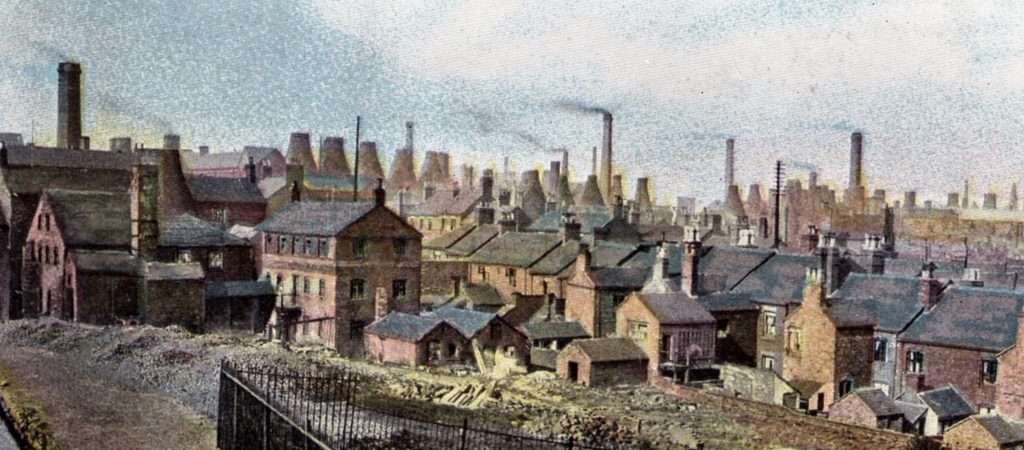

Edward John Smith, the future captain of the ill-fated White Star liner RMS Titanic, was born at 86 Well Street, Hanley on 27 January 1850. He was the only child of pottery presser Edward Smith and Catherine, formerly Hancock nee Marsh, who had two surviving children from her previous marriage. The Smiths started out as an ordinary working-class family like most of their neighbours, but their fortunes improved somewhat when Catherine Smith opened up the family home as a small grocer’s store. As a result, young Ted Smith as he was known to family and friends, enjoyed a relatively good education at the Etruria British School. Shortly after his father’s death in 1864, he finished his schooling and for a few years worked as a steam hammer operator at the Etruria Forge. He thus seemed set for an ordinary working life in the area like his ancestors before him, but he was already feeling the pull of the sea thanks to his half-brother Joseph Hancock.
Joseph was Catherine Smith’s eldest child, seventeen years older than Ted, who in the same year that his younger half-brother was born had gone to sea and gradually worked his way up through the merchant ranks. There had been long voyages and adventures galore, but dangers too such as in 1856, when whilst he was serving as a mate on the barque Hymen, the ship had been captured by pirates off the coast of Morocco. Joseph and his crew mates had been taken ashore and held as prisoners for nearly three weeks until the Royal Navy launched a raid on the pirate camp and freed the men. This hair-raising experience did not dent Joseph’s love of his career, though, nor hinder his rise to command his own vessel and by the time young Smith was 17 years old, Joseph was the captain of the trading ship Senator Weber. Ted was keen to follow Joseph into the service, so to prevent him from running away and serving with strangers, Joseph agreed to take Smith aboard his own vessel as ship’s boy. Ted quit his job at the forge and in February 1867 with a group of friends he travelled to Liverpool, where he was signed on as an apprentice to the shipping company of Andrew Gibson and Co.
Joseph’s vessel, the Senator Weber was a 1,297 ton sailing ship then being loaded across the Mersey at Birkenhead’s West Float Dock and Ted was to be one of the crew of 26 men and boys. There were three ships boys, another of them, Thomas Foster, also came from Hanley, so perhaps Ted was not the only boy that Joseph had inspired.
This first voyage was a long one to Hong Kong, a round-the-world voyage via the Cape of Good Hope and Cape Horn. The Suez Canal would not be open for two years, so there was a long haul around Africa, past India and up through the South China Sea, braving all that nature would send their way. It, therefore, took five months to reach Hong Kong. There was a ship’s log for the voyage but there are no entries in it until the Senator Weber reached Hong Kong. Then, there are numerous entries noting desertions and bad behaviour amongst the crew. Amongst the small knot of persistent troublemakers was one named Edward Smith. This was not our Ted Smith, but an able seaman with the same name, a 20 year old man from Scarborough who annoyed Joseph so much that he eventually flogged him and then had him jailed for six weeks, by the end of which time the Senator Weber had sailed on leaving him behind.
The ship stayed in the general region for some time, possibly transporting goods short distances to earn extra revenue prior to their departure. This final leave-taking, though, suffered a delay as on the evening of 8 September 1867, a typhoon of several hours duration struck Hong Kong and did some serious damage to many of the ships moored in the harbour. The Senator Weber was one of these, being thrown together in a jumble with several other ships and suffering considerable damage as a result. The repairs required some time to carry out. Once she was back in a reasonable state, though, the Senator Weber set off on its long journey back home.
They did not retrace their journey out and instead followed the trades, sailing east to San Francisco, pausing only when a sickly passenger Henry K. Jones died mid-Pacific and was buried at sea. At San Francisco 14 men including Thomas Foster from Hanley deserted and had to be replaced. At this point, Ted was unofficially promoted to 3rd mate, probably to help existing 3rd mate to get the new crew in line. From San Francisco, the ship sailed south to Callao, the principal port of Peru. Then on to the nearby Chincha Isles, to fill its hold with guano which was its final cargo. The ship then made its way around Cape Horn and a couple of months later returned to Europe, docking in Antwerp where the crew went their separate ways. Joseph and Ted then returned to the Potteries for a few months. According to one childhood friend, ‘After that first voyage Ted returned home to thrill the youth of the town with his stories of having sailed to America, of his experience in California, where the ship on which he made his first voyage touched. And with his mind firmly made up to spend the rest of his days on the ocean.’
After Christmas and New Year at home, Ted went to Cardiff in February 1869 to join the Senator Weber for a second voyage to the far side of the world, but this time to Japan, which had only opened its ports to foreigners in 1854. Ted served as 3rd mate for this voyage which was even longer, the ship being away for 19 months, which is surprising as the Suez Canal was now open and there is little indication of where the ship went. Its final destination, though, were the Lobos de Afuera islands, another group of guano islands off the coast of Peru. Guano seems to have been a real money spinner for Andrew Gibson and Co. and it is also interesting to note that the future ‘Millionaire’s Captain’ of the glamorous White Star Line began his career aboard ships transporting ossified bird dung.

After this voyage, Ted Smith set out on his own as an able seaman aboard a couple of other ships, the Amoy and the Madge Wildfire, sailing to North America. By now he had started lodging at the Sailors Home in Liverpool with occasional trips home to the Potteries. He and Joseph were in Well Street for the 1871 census, but this is the last time either were listed on a local census return.
In 1871, Ted Smith applied for his 2nd mate’s certificate of competency which he gained after sitting and passing the required exams and over the next two years he served in that capacity aboard the ships Record, Agra and N. Mosher. As a 2nd mate he still served as a seaman, but as a sort of qualified foreman he had his own cabin at the rear of the ship and was in charge of the starboard watch looking after the ropes on the starboard and rear of the ship. In 1873, he passed his exams for 1st mate giving him charge of the port watch in charge of the port ropes and the bow of the ship. As mate, he no longer worked in the rigging, he was instead the captain’s executive officer – he saw that the skipper’s orders were carried out. In this capacity he served for three voyages on the ship Arzilla, under Captain C. E. Durkee. Then in 1875, at the age of 25, Smith sat and passed his master’s certificate of competency. This enabled him to command his own ship. To commemorate his success, he was presented with a loving cup dedicated to ‘Captain E. J. Smith’, the first time he had ever been called by this title. He had to wait for a year though, before he got a ship of his own.

Smith’s first command was the 1040 ton sailing ship Lizzie Fennell, which he took on a ten month trip to Callao in Peru, again returning with a cargo of guano. The voyage does not seem to have been troubled by the mass desertions suffered by the Senator Weber, though there were some deaths. An Italian crewman died off the coast of Chile and three Scandinavians all drowned off Peru in October 1876, but details of how and why they died are lacking as no ship’s log has survived.
For the next three years, Captain Smith and the crew of the Lizzie Fennell led a seemingly blameless existence transporting cotton and other assorted goods between Britain, Canada and the United States. In later life Smith seems to have had fond memories of his time aboard the Lizzie Fennell, during which time he made a number of valued acquaintances whom he still remembered many years later. But he was not blind to the fact that there were great changes happening in the shipping world where steamers were becoming more popular and profitable, and that a whole new (and much more comfortable) career could be carved out on the big passenger liners. The transatlantic passenger steamers run out of Liverpool by the prestigious White Star line had caught his attention. On seeing the White Star ship SS Britannic in dock, Smith commented to his nephew J. W. S. Harrington, who was serving in his crew, that he would happily accept a junior position to serve on such a fine vessel. A few days later Smith managed to get a tour of the Britannic, which made his mind up for him. Quitting his job as the captain of the Lizzie Fennell, he left the employ of Andrew Gibson and Co. and applied to and joined the White Star line as a junior officer determined once more to make his way to the top.
It would take years to achieve of course, but Smith was agreeable, highly intelligent, hard-working and blessed with the ability to succeed, and he would indeed rise to the peak of his career and make his fortune with White Star. However, it was also a fateful move that led ultimately to a cold, tragic night in April 1912 off the Grand Banks of Nova Scotia, when at the helm of the company’s new big ship he ventured into an ice field and sailed into history.
G. J. Cooper, Titanic Captain, the Life of Edward John Smith (Stroud, 2011), pp.9-55; Allen’s Indian Mail, 4 November 1867, p.890.
All images, author’s collection
Leave a Reply