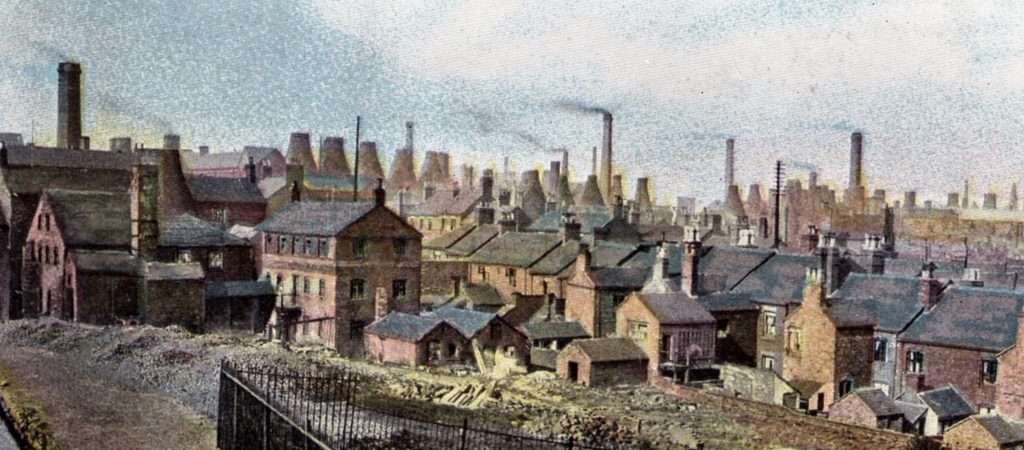
Prior to the early 18th century, white pottery was a rare sight in Europe. What pieces there were usually arrived from China or Japan, where the production of porcelain was long established and its secrets closely guarded, or there were the tin glazed earthenwares imported from Holland, the white finish of which mimicked oriental porcelain. However, in 1709, Johann Friedrich Böttger, a would-be alchemist held prisoner by the gold-hungry Elector of Saxony, discovered the formula for a true hard-paste porcelain and within a few years the Meissen factory began producing the first European porcelain using Böttger’s formula.
Josiah Spode II
The continental potters were blessed with ready supplies of the primary ingredients of porcelain, china clay and china stone and were soon producing a wide range of white wares that proved incredibly popular. In Britain, though, potters were unable to join the porcelain revolution, as at that time no deposits of china clay or stone had been discovered in the country. Instead, the English factories had advanced the potters’ art from the 1740s onwards by developing numerous soft-paste porcelain recipes. This all changed in 1768, though, when a pharmacist, William Cookworthy, discovered china clay and china stone deposits near to St Austell in Cornwall and he immediately cornered the British manufacture of porcelain by taking out a patent on the materials, setting up his first factory soon after. Three years later, Cookworthy retired and sold out to his business partner Richard Champion, who extended the patent to 1796. By 1781, though, Champion was in severe financial difficulties and sold the patent to a group of Staffordshire potters and helped set up the New Hall Pottery in Shelton, which produced the first porcelain wares in the Potteries. When the Champion patent expired in 1796, though, everyone was free to use china clay and china stone how they pleased.
One man who took immediate advantage of the access to the new materials was Josiah Spode I, who like several others had been experimenting to develop a strong white porcellanous body for fine pottery. True porcelain was a high-fired clay that needed more specialised kilns than those used in North Staffordshire. Also, though porcelain gave a brilliant white surface, the pottery produced tended to be heavier than desired, while its highly vitrified state made it prone to chipping. Experiments had been going on for decades adding various materials to china clay to offset these niggles, the most promising ingredient being bone ash. Thomas Fry of the Bow factory in London had patented the first bone ash formula in 1749 and Sèvres in France had its own recipe, but these were not entirely satisfactory and there is evidence that Spode had formulated his own mix shortly before his sudden death in 1797. When his son Josiah Spode II took charge of the works, further experimentation perfected the formula and the factory was soon marketing its new bone china pottery. These early examples of Spode’s bone china were not perfect though they carried the impressed mark ‘Stoke China’, thereby literally putting the local industry’s stamp on the new ceramic body.
The Spode formula was finally perfected in the early 1800s and was a game-changer. Whereas with porcelain the china clay was the dominant ingredient with smaller amounts of silica and feldspar, the optimum Spode mix comprised 50% bone ash, 25% kaolin (china clay) and 25% china stone. The bone ash was a by-product of the meat industry, the dense leg bones of cattle being preferred. These were crushed in bone mills, then reduced to a fine ash in special calcining kilns, the tall slender shapes of which soon joined the numerous other bottle ovens dotting the Potteries landscape. The predominance of bone ash in the mix had a number of advantages, combining with the clay it added warmth to the starkness of true porcelain, made the resulting wares translucent and gave the clay great strength, making it perfect for the production of much lighter pottery. Moreover, bone china had a lower firing temperature than porcelain, making it it suitable for the existing kilns in the Potteries, and unlike true porcelain it could be fired in the manner preferred in the Staffordshire industry of first biscuit then glost firings. This made it much easier to introduce the new ceramic body to the local industry as the firemen in charge of operating the kilns would not need to learn new techniques or implement any radically new firing regimes.
The new bone china pottery was a big hit with customers and it soon became a staple of the local industry. In 1806, there came a royal endorsement of the new product when on 12 September that year, the Prince of Wales accompanied by his brother the Duke of Clarence, the Marquis of Stafford and a slew of other dignitaries arrived for a tour of the factory. Josiah Spode had arranged his workers in the factory in their best attire and after leading the royal party through their largest warehouse filled with masses of the pot bank’s finest wares on display, they were led onto the factory floor itself and shown how the wares were produced, all of which was a new experience for the visitors. The Prince was evidently impressed by what he saw and concluded his visit by bestowing on Spode the title of ‘Potter and English Porcelain Manufacturer to His Royal Highness’. In years to come he would order from Spode numerous wares for the Brighton pavilion and pottery for his coronation as George IV in 1821.
Reference: Robert Copeland, Spode;Staffordshire Advertiser, Saturday 20 September 1806, p.3. See also Pam Woolliscroft’s blog, Spode History at https://spodehistory.blogspot.com/
By the late 1700s, slavery, most notably the trade in African slaves, was being increasingly seen by many in Britain as a great moral evil. Abolitionist pamphlets and literature distributed in taverns, coffee houses, assembly rooms, reading societies and private houses up and down the country, brought home to the people of Britain the atrocities committed by the Atlantic slave trade, and attacked the entrenched attitudes and vicious practices of slave owners, and the greed of the other moneyed interests that thrived on this inhuman traffic.
The anti-slavery movement had originated with non-conformist groups in Europe and America in the late 1600s. Quakers and other dissenters objected to slavery on both moral and religious grounds, but because of their unorthodox beliefs they were regarded as social outsiders and barred from public office, and as a result their views were largely ignored save by their fellow dissenters. The movement had grown slowly in Britain during the 18th century, but it finally found a voice and a leader in 1786, when Thomas Clarkson published An Essay on the Slavery and Commerce of the Human Species. This proved to be a rallying cry for the movement, bringing Clarkson into contact with other like-minded men and the next year he and eleven others formed the Committee for the Abolition of the Slave Trade. This Committee would become a Society as it grew and would coordinate the Parliamentary campaign led by MP William Wilberforce that resulted in the end of the international trade in African slaves. That eventual success was still a couple of decades away, but the Committee made a good start, not only by being led by men of intelligence and zeal, but also by utilising what could be considered an early example of product branding, namely an easy-to-recognise logo, mass-produced by leading Staffordshire potter Josiah Wedgwood.
Josiah Wedgwood like many abolitionists was a non-conformist, being brought up as a Unitarian. He was not an immediate recruit to the cause, his early life being devoted to setting himself up as a potter and businessman. However, he was always very keenly interested in the social movements of his time and their consequences for society at large. This found its way into his paternal attitude towards his workers, whom he housed in the new model estate of Etruria that he built around his factory, and can be seen in the interest he took in the American War of Independence and the French Revolution. His involvement in the anti-slavery movement, though, seems to have come about through the influence of his business partner Thomas Bentley. Bentley had worked as a merchant in Liverpool, a circumstance that might normally have made him a supporter of slavery, but he was firmly opposed to the trade and unlike the other merchants refused to go and meet the slave ships when they came into port. Doubtless Bentley’s feelings on the matter influenced Wedgwood in this, just as his knowledge of arts and science had done earlier in their friendship. Certainly, following Bentley’s death in 1780, Wedgwood subscribed to all the tracts and pamphlets concerning the abolition of the slave trade, and used his influence to do all that he could to help the cause.
Josiah Wedgwood
Wedgwood became friends with Thomas Clarkson and in 1787 he joined the Committee for the Abolition of the Slave Trade, shortly after it was set up. As an experienced businessman Wedgwood would prove to be a valuable asset in the Committee’s arsenal. He understood the value of publicity – he after all, was the man who had pioneered the idea of the money back guarantee and the benefits of the ‘By Appointment’ status of Royal patronage – and he now came to the Committee with a brilliant idea to help promote their cause. Better still, he had the means to bring his plan to fruition and was willing to pay for it out of his own pocket.
Wedgwood proposed producing a classically inspired oval cameo based on the seal of the Committee. This showed a kneeling African slave in chains, imploring mercy or pity, with the motto ‘Am I Not a Man and a Brother?’ The idea appealed to the Committee and Wedgwood immediately got one of his best craftsmen, William Hackwood, to first model and then prepare for production what became known as the slave medallion. Hackwood used Wedgwood’s black jasper to represent the supplicant slave, set against a white or cream background in the same ceramic body, with the motto moulded in relief above and partly around the figure. Then, once the working moulds had been made, the medallion went into production. Thousands were made and Wedgwood immediately began sending them out – again out of his own pocket – to interested parties. Thomas Clarkson, writing years later, remembered receiving his first batch and recalled the instant and telling popularity the slave medallion enjoyed.
‘Mr Wedgwood made a liberal donation of these, when finished, among his friends. I received from him no less than five hundred of them myself. They, to whom they were sent, did not lay them up in their cabinets, but gave them away likewise. They were soon, like The Negro’s Complaint, in different parts of the kingdom. Some had them inlaid in gold on the lid of their snuff-boxes. Of the ladies, several wore them in bracelets, and others had them fitted up in an ornamental manner as pins for their hair. At length, the taste for wearing them became general; and thus fashion, which usually confines itself to worthless things, was seen for once in the honourable office of promoting the cause of justice, humanity, and freedom.’
Most of the medallions were distributed via the Committee, but Wedgwood sent out many more himself, most notably in 1788 when he sent a package of the cameos across the Atlantic to Benjamin Franklin, an old acquaintance from the Lunar Society and at that time the president of the Pennsylvania Society for the Abolition of Slavery. Wedgwood wrote ‘It gives me great pleasure to be embarked on this occasion in the same great and good cause with you and I ardently hope for the final completion of our wishes.’ Franklin replied, ‘I am persuaded [the medallion] may have an Effect equal to that of the best written Pamphlet in procuring favour to those oppressed people.’ Sadly for both, neither Franklin nor Wedgwood would live long enough to see those wishes fulfilled.
Wedgwood continued to actively support the anti-slavery movement right up to his death in early 1795. He bought shares in a company set up to form a colony for freed slaves in Sierra Leone; befriended and advised William Wilberforce who would lead the parliamentary fight against slavery; and he paid for the printing and distribution of an anti-slavery pamphlet that the Committee produced. Offering to pay the cost for the production of a woodcut block, he advised them to head their pamphlet not with the advertisement they had originally planned, but with the woodcut, a reproduction of the same image of the kneeling slave that had inspired his own ceramic contribution to the cause.
Reference: Thomas Clarkson, History of the Abolition of the Slave Trade, vol. II (1807).
On 1 April 1852, the writer Charles Dickens wrote a letter to his wife Kate informing her ‘We think of going on tonight from Birmingham to Stoke upon Trent.’ Despite worries about the trains, it seems that he and a travelling companion arrived in Stoke the next morning. Here after gazing with some fascination at the town before him, the famous author (who at the time was also writing up weekly instalments of his longest book, Bleak House) spent a few hours at the Spode factory which was at that period owned by W. T. Copeland.
Dickens started his tour of Copeland’s works by watching a thrower and his attendant swiftly and skilfully fashion a breakfast set for his amusement, watched jiggerers and pressers making bowls and basins and saw Parian statuettes being produced in moulds. He then explored the factory kilns, seeing the saggars being stacked prior to firing and mused on the constant cycle of heating and cooling that accompanied the manufacture of pottery. This was followed by visits to see transferers and decorators at work, producing willow pattern wares or fancier stuff, before moving on to the dipping shop for glazing and then to the placers carefully loading the ware into the appropriate saggers prior to them being loaded into the kilns he had seen earlier. Dickens seems to have enjoyed his tour and it was doubtless a thrill for the workers at the Copeland works to meet, albeit briefly, one of the biggest celebrities of the Victorian age and show him their own impressive skills. Armed with all he had seen and imbibing a good working knowledge of the history and process of pottery making, Charles Dickens moved on the next day to Stafford.
Compared to the grime and industry of the Potteries that evidently spoke to his imagination, Dickens was bored with Stafford and rather rude about the place, ‘it is as dull and dead a town as any one could desire not to see’ he wrote tartly. He lodged at the Swan Inn, which he disparagingly nicknamed ‘the Dodo’ and where he apparently seemed doomed to spend a very dull evening indeed. According to the tale he told, though, he chanced to look at the bottom of a plate and saw the name ‘COPELAND’, which set him to musing on the previous day’s events. Employing a literary conceit, he then let the plate ‘remind’ him of all he had seen at Copeland’s pot bank, telling the story outlined above as a journey through its creation. The plate’s ‘recollections’ got Dickens through the evening, so he claimed, though one might suppose that he was actually quite busy putting his recollections down on paper. His clever bit of writing, ‘A Plated Article’, was published in the magazine Household Words, on 24 April 1852.
The sinking of the Lusitania, by marine artist Norman Wilkinson. Source: Wikimedia Commons.
On 7 May 1915, the Cunard liner Lusitania, en route from New York to Liverpool was some 11 miles off the Old Head of Kinsale, Ireland, when a lurking German U-Boat fired a torpedo that struck the ship just aft of the bridge on the starboard side. Shortly after the torpedo struck, a second explosion occurred inside the ship, dooming the vessel, which sank in only 18 minutes. There were only 763 survivors out of the 1,960 passengers and crew and about 128 of the dead were American citizens. The sinking of the Lusitania was widely condemned around the world and it became a contributing factor to America’s entry into the Great War in 1917.
As had been the case with the Titanic three years earlier, there were several people aboard the doomed liner who hailed from the Potteries, though some of them had become naturalised American or Canadian citizens, who despite the increasing dangers posed by the war in Europe, were coming to Britain to visit relatives. Most of them perished in the disaster, but three survived and had dramatic but tragic tales to tell.
When the Lusitania was first struck by the torpedo, 39 year old Martha Barker, her nine year old daughter Winifred, with their friends Elizabeth Brammer aged 32 and her five year old daughter Edith, were sitting down to lunch in the second class saloon. They had all been born in the Potteries, Martha in Stoke, her daughter in Hanley, Elizabeth in Longton and her daughter in Stoke. However, they were now US citizens, their two families having emigrated to the States in 1909, setting up home in Trenton, New Jersey, where their husbands and fathers had found work in the local pottery industry. But the ties that bind were strong and in 1915, the four of them decided to take a trip back to Britain, Mrs Barker to visit her mother who was ill and the Brammers to see relatives. They were all aware of the dangers they faced in taking the trip; indeed the Germans had recently placed warning notices in many American papers – one was even placed next to the notice announcing Lusitania’s sailing – stating that all British ships were now subject to unrestricted submarine warfare and would be legitimate targets to attack. But the journey thus far had been uneventful and the women and girls were looking forward to arriving safely at Liverpool.
That happy prospect, though, was suddenly cut short, when at about 2.10 p.m., the torpedo slammed into the Lusitania. Mrs Barker recalled that the ship seemed to stop, almost dead, shuddered and began to list to starboard. Everyone knew what had happened and there followed a scramble to get out of the saloon, but in the confusion and crush to get up on to the deck, the Barkers and Brammers were separated from one another.
Mrs Brammer and Edith, got to the main deck where a fellow passenger, a clergyman from Queenstown, put life jackets on the two of them. Martha Barker had lost track of what was going on, but she and Winifred also made it to the boat deck, where a gentleman provided the young girl with a life jacket, though Martha never managed to get one. They both climbed into a nearby lifeboat, but on the captain’s orders they and other passengers were told to get out, which was fortunate as the boat was situated on the side that went down first. The occupants were told that everything was fine, the watertight doors were closed and that after the shock of the blast, the ship was slowly righting itself.
The ship was indeed settling back onto an even keel when the second explosion occurred deep within the hull, dooming the vessel. Martha Barker held Winifred’s right hand and with nothing else to do, they simply waited for the end. Despite the peril, the little girl showed great courage and said, “Don’t worry mother darling; we shall be saved.”
But as the ship rolled over, with hundreds of others they were plunged into the water and the suction quickly pulled them under. Mrs Barker remembered being pulled down and down before she lost consciousness. When she awoke some time later, she found herself on an upturned boat onto which she had been lifted by someone, but she was horrified to find that Winifred was no longer with her.
The Brammers too had gone down with the ship, but they must have held on tight to each other. Elizabeth Brammer also lost consciousness, but when she came to she found herself safe in a lifeboat with Edith by her side. Martha Barker, meantime, was picked up by one of the collapsible lifeboats, then a fishing boat came along and took her and others on board. Some time later, she was moved once again, this time to a steam tug which transported her to Queenstown harbour, where it seems she was reunited with the Brammers.
The survivors were taken to the Queen’s Hotel in Queenstown, arriving there at about 10 p.m., some seven or eight hours after the sinking. Here, the US Consul based in Cork, came to render assistance and Martha Barker and the Brammers, were overwhelmed by the kindness of the locals, who helped in every way they could. For Martha, though, it was a heart-wrenching time, and though she waited for several days, hoping against hope to hear something about her daughter, no news ever came. Brave little Winnie Barker, was never seen again, just one of the 1,197 people lost with the Lusitania.
It soon became clear in the North Staffordshire press, that others from the Potteries had perished alongside her. Arthur John Wood, aged 39, had been born in Wolstanton, but grew up in Burslem and Tunstall. By 1915, he was a married man living in Goldenhill and he worked as a designer and representative of Messrs W. H. Grindley and Co., of Tunstall. He had been in the States on a business trip for his firm and having crossed safely on the Lusitania, he took the ship for the return, but was lost in the sinking. His body was later recovered and like many of the victims he was later buried in Queenstown.
William Henry Crutchley, aged 48, had been born in Hanley and worked in the pottery industry as a sanitary presser and caster. A married man with six surviving children, he had been in the States visiting his son who worked as a potter in East Liverpool, Ohio. William was travelling as a steerage (3rd class) passenger on the Lusitania, returning to Britain to see his wife and daughters. William was reportedly a good swimmer and his son in the States at first held out some hope that his father had survived the sinking, but William was never seen again.
Also born in Hanley was Edward Jones, sometimes referred to as Edward Carr-Jones. Aged 39, he was a pianist aboard the Lusitania. After a period working in the pottery industry, by 1911, he was listing himself in the census as a ‘professor of music’ and ‘Pianist Cunard Line.’ He had, in fact, been leading a very different life from most of the locals for several years and before going to sea he had spent several summers working in Barmouth as a member of a pierrot troupe, ‘The Royal Magnets’, wherein he played the flute. From 1912 onwards, he was working regularly on ships. Now styling himself Edward Carr-Jones (Carr was his mother’s maiden name) he had worked on the Carmania and Lusitania as a pianist. He too was lost in the sinking.
Also mentioned alongside these was Gertrude Walker, a Canadian citizen who had been born in Newcastle-under-Lyme. Aged 28 at the time of her death. She was the wife of John Walker, a native of Warwickshire, who had trained in the Potteries as a blacksmith and who later worked as a mechanical engineer for the Cobridge Sanitary Brick and Tile Works. The couple married in Newcastle in 1913 and emigrated to Canada soon after, settling in Toronto, where John found work as a fitter on the railways. In 1915, Gertrude got news that her father was ill, which prompted their journey back to Britain. Friends had tried to dissuade them from going, but to no avail, and both perished in the disaster that overtook the liner.
For the survivors, life went on, though not always in the happiest of ways. Martha Barker suffered the tragedy of losing her daughter alone at first, though she was soon joined in Liverpool by her husband Thomas and daughter Doris, and Elizabeth Brammer’s husband also came over. In July, they all returned safely to the United States aboard the American Line steamer New York. Not long after this, Thomas Barker died and Martha went on to marry one Michael Thomas Gretton. By 1940, she was a widow once more and eventually died in 1963, in Trenton, being listed as Martha Barker.
Her friend Elizabeth Brammer is something of an enigma after the sinking and her return home. It has been claimed that she died in 1983, but this has been disputed. Her daughter Edith, though, is easier to trace. She married one Arthur Fletcher in 1929, and the couple had a daughter. Edith Fletcher, born in Stoke-upon-Trent in 1907, died in Mercer County, New Jersey, in April 1985, aged 78.
Reference: Staffordshire Sentinel, 8 – 10 May 1915; Staffordshire Advertiser 15 May 1915, p.7. Peter Engberg-Klarström’s website ‘Peter’s Lusitania Page’ https://lusitaniapage.wordpress.com/ is an excellent online resource for those looking for more in-depth biographies of the passengers and crew of the Lusitania. I gratefully acknowledge his research here, notably into the life of bandsman Edward Jones. My thanks also to Ken Ray, for drawing my attention to the story
Some of the unusual and dangerous practices indulged in by teenage girls to make themselves look attractive, were highlighted in 1901 in the tragic case of 15 year old Florence Henrietta Burton of Longton, who met an untimely end in the pursuit of beauty.
Florence was the youngest of four children born in late 1885 to coal miner Samuel Burton and his wife Harriet. Her father had died a few years after Florence’s birth and her mother had remarried, though by 1901, she was again a widow living at 3 Adam Place, Longton with her 18 year old son John Thomas Burton a potter’s presser, Florence who was a potter’s gilder, and an elderly boarder. The census was the last official document to record Florence alive, as the final act of a bizarre drama was playing out in the Burton family home.
For some time, her mother Harriet had been getting increasingly worried about Florence, who had started drinking large amounts of vinegar and eating lemons. She had spoken to her daughter about it, but to no avail, the girl would scarcely eat anything without pickles or something else acidic. Florence’s friend, Julia Brain, later revealed that she knew that Florence had obtained large quantities of lemons from a local fruit shop ‘on trust’ and said that she had also seen her pour out a glass of vinegar, pour salt into it and drink it. When quizzed as to the reason for this Julia said it was to try and make her complexion ‘pale and nice’ giving her skin a translucent quality to make her more attractive; but in truth, Florence’s beauty regime was gradually killing her. The end came suddenly in June 1901, when Florence was at work and suffered chest pains that made her so ill that she had to go back home. Once there, she reportedly suffered a fit and died shortly afterwards.
As a result of her sudden death, a post-mortem was carried out by a Dr Howells, who reported to the inquest into the girl’s death, that Florence had died due to heart disease caused by her unusual diet. Her practice of consuming large amounts of vinegar, salt and lemons would, he said, “disorganise the whole system, upset digestion and cause the person to be half-starved, though well and apparently well nourished.”
The Coroner, clearly flabbergasted by what he had heard, asked the surgeon, “Why do girls do these things?” Dr Howells answered, “To make them pale and interesting-looking. They like to look transparent.” – “And it kills them?” – “It does.” The Coroner commented on the folly of such practices and the jury returned a verdict of Death from Natural Causes.
Reference: Birmingham Mail, 28 June 1901, p.4; Coventry Evening Telegraph 28 June 1901, p.2.)
In 1796, whilst visiting Brownhills Hall, near Burslem, the home of wealthy pottery manufacturer John Wood and his family, a young apothecary named Thomas Millward Oliver, became enamoured of the Wood’s teenage daughter Maria, a noted local beauty, who returned his affections. Oliver came of a respectable Stourbridge family and as a well-educated, popular and respected medical man locally, he would seem to have been the perfect suitor for Maria Wood. Certainly Oliver himself believed this and he thought at first that Mr Wood actively encouraged him in his courtship of the young woman. In this, though Oliver was mistaken and when John Wood learned of the affair he quickly put a stop to Oliver’s visits, professional or otherwise, and had forbidden the young couple to meet. This threw Thomas Oliver into a fit of lovelorn despair that festered for some time before coming to a head early the next year in the most dramatic fashion.
Brownhills Hall, from an engraving made some years later. Source: John Ward, The Borough of Stoke-Upon Trent (1848)
At 8 a.m., on 27 January 1797, Oliver arrived unannounced at Brownhills Hall and asked to see John Wood. Mr Wood was in bed, but on hearing of his visitor and thinking that the apothecary had come to present his final bill, he went to his Compting House behind the hall and asked his foreman William Bathwell to bring Oliver down to see him. Bathwell went, but returned without Oliver, who had sent word that he would wait for Mr Wood in the parlour. So, along with his foreman, a slightly puzzled Mr Wood returned to the hall to see what his visitor wanted. Here the two men greeted each other coolly, but politely, and as expected Oliver presented his bill, but hardly had he done so than he drew two pistols that he had recently borrowed from a neighbour and pointed one at Mr Wood, asking him to take it, possibly to fight a duel. Mr Wood refused and Oliver lowered the gun for a moment. Alarmed, Bathwell started to take Oliver to task over the pistols, but the apothecary brushed his comments aside and brought one gun up and saying “I wish to die here!” fired directly at Wood, who was struck in the right breast. Oliver then raised the second pistol, probably intending to shoot himself, but Bathwell threw himself on the man, knocked the gun from his hand and pinned his arms to his sides. Others in the house, alerted by the noise, soon rushed into the room to help the struggling foreman and tend to the injured man. The wounded Mr Wood was then quickly carried upstairs to his bed and a doctor was called for, while Oliver, now apparently aghast at what he had done, was handed over to the local constables.
John Wood had been mortally wounded and died three days later, being buried in Burslem on 2 February 1797; he was only 50 years old. Oliver meanwhile was left languishing in Stafford Gaol until the Summer assizes that year. Here on a sweltering day in August, he was put on trial on a charge of murder and though many witnesses came forward to speak of his gentle nature and good deeds, or argued that the act took place due to temporary insanity, the evidence against him was overwhelming and Thomas Oliver was quickly sentenced to death.
During his time in prison, Oliver is said to have impressed everyone, prisoners and gaolers alike, with his courteous behaviour and his obedience of the rules. All were struck by the calm and dignified manner in which he accepted his fate and in which he finally met his end. On Monday 28 August 1797, he displayed this same calm manner as he mounted the scaffold above the prison gatehouse, bowing to the large crowd that had gathered below to watch. Moments later the noose was placed around his neck and the trap door opened. Apothecary Thomas Millward Oliver, aged just 28, died without a murmur.
Reference: Trial of T. Milward Oliver at Stafford Summer Assizes, 1797
The Trenton basketball team 1896-97. Fred Cooper is bottom left with the ball, his friend Al Bratton is bottom right.
In 1896, Frederick Cooper, a distant American cousin of mine, earned himself a place in the history books through the simple act of accepting a fee. Several years earlier, a dynamic new game called basketball had been invented that was gaining a strong following in the various YMCAs on America’s east coast. Fred, already a keen sportsman had like many others quickly warmed to the game, becoming the star player and captain of the highly successful Trenton YMCA team that for the previous three years had dominated the emerging leagues. At first the new game had been played for fun and entertainment, but the groundswell of support soon saw seats being sold for popular teams and inevitably the money trickled back to the players that the crowds wanted to see. The result was that in 1896 Fred was the first to accept payment for a game and in doing so became the world’s first professional basketball player.
Though he would make his name in the United States, Fred Cooper was actually born at 21 Bethesda Street, Shelton on 25 March 1874, the fifth of seven children – six boys and one girl – born to Thomas Cooper and Ann, nee Simpson. Fred’s father, Thomas, had started out as a working potter but over the years had moved into small scale pottery manufacture. However, in the mid-1880s, in the wake of what was later described in Fred’s obituary as ‘some business reverses’, Thomas and Ann decided to emigrate and join their eldest child, William who was already settled in the States, working at the Greenwood Pottery in Trenton, New Jersey. The Coopers left Britain early in 1886, travelling as steerage passengers (i.e. 3rd class) aboard the SS England, arriving at New York on 27 May 1886, from where they made the relatively short journey south west across the state to Trenton. As it turned out, Thomas would only enjoy his new home in America for a few years, dying in 1891 at the age of 56, but his wife and children settled into their new lives and over time became valued members of the local community.
Trenton, New Jersey, USA
On arriving in the States, Fred and his younger brother Albert, or ‘Al’ as he became best known, had been enrolled in the Centennial School where they soon got involved in sports and stood out as skilled footballers, a game their father had taught them. Fred especially proved to be an all-round sportsman, also taking up baseball, competitive running and later becoming a fine billiards player and a good bowler. His successes, though were at first eclipsed by his older brother, Arthur, who back in Britain had been such a skilled footballer that in the early to mid 1880s he played for Stoke F.C.’s junior team, Stoke Swifts. Arthur seems to have stayed behind for a year after the rest of the family emigrated, perhaps to help the Swifts in their attempt to win the junior league cup. Once this was over though, in 1887, he too took a ship to the States, but not before being presented with a handsome medallion by his team mates and the club. Once in the States, Arthur’s success had continued, and it was not long before he was picked as a member of the All-America soccer team.
While his brother’s career blossomed, Fred left school and found work as a sanitary-ware presser at one of Trenton’s pot banks, a job he would do for the better part of three decades. He continued to pursue his love of sport in his spare time through the local YMCA, which acted as a youth club for boys and young men of religious families like the Coopers. Here he found a kindred spirit in another keen footballer named Al Bratton, with whom he seems to have formed a winning partnership, not only on the football pitch, but also when the two of them decided to try their hand at the new game of basketball that was sweeping through the YMCA branches. Only a few years had passed since Canadian-born training instructor James Naismith had dreamt up the indoor game to placate a group of YMCA trainees at the School for Christian Workers, Springfield, Massachusetts, who had been chafing at their inactivity during the long winter months. Though rough-hewn at first, with early games resembling pitched battles between oversized teams, basketball proved an immediate hit and when Naismith published an article on the game it was quickly taken up by YMCA branches along America’s east coast. Soon, matches were drawing sizeable crowds and more and more teams sprang up, one of which was Trenton YMCA.
Fred Cooper and Al Bratton first joined the Trenton YMCA basketball team for the 1893-94 season and had an immediate and lasting impact on how the game was played. In those early days, basketball was a game of individual dribblers working their way through the opposition before attempting a shot at the basket, a method that favoured heavy-set players who could push their way through the field. According to one of basketball’s early chroniclers, Cooper and Bratton changed this, creating a more fluid game by drawing on their footballing skills to develop a system of short, swift passes between them on the run, a style of play that completely unbalanced opposing teams.
‘The Trenton system of passing was definite. It meant to carry the ball to the opponent’s basket in order that a goal might be scored, and time and again I have seen Cooper and Bratton in those early days, pass the ball back and forth between them – no one else touching it – and score against all the efforts of the entire opposing team. I have seen them do this trick away from home and witnessed the spectators rise en masse and cheer the brilliant exhibition in spite of the fact that it was being done by invading players.’
For the next three seasons, the Trenton YMCA dominated the game in New Jersey and eastern Pennsylvania by which time Fred was the team captain and unofficial coach. Despite his refinements to the game, rough play characterised basketball in those free-wheeling and largely unregulated years, with physical injuries being an all too common feature of play, both on and off the court. Not only was there brawling between players, but partisan crowds took whatever opportunities came their way to try and injure or discomfort the rival team and as a result fighting between players and spectators was not unusual. Though the YMCA had quickly lauded Naismith’s new game for promoting a useful spirit of ‘muscular Christianity’ – a healthy body breeding a healthy mind – the rough-housing and unsportsmanlike behaviour drew the Association’s displeasure and increasingly basketball teams deserted the YMCA gyms, or were ousted by outraged officials and had to find other venues to play in.
Warren Street, Trenton, with the Masonic Temple nearest the camera.
Such seems to have been the case at the Trenton YMCA. Unspecified ‘trouble in the gymnasium’, followed by a string of disagreements between the branch secretary and the YMCA team saw the basketball players shifting their base to the Masonic Temple, a large building in downtown Trenton. Here the team made use of the large reception room on the top floor, where a 12 feet high mesh fence with gates at either end was built enclosing the court. This ‘cage’ was a new innovation, built to stop the ball going out of play so readily and prevent some of the troubles caused by resultant clashes with spectators. The Trenton team were the first to employ this device and though its use eventually fell out of favour, its early employment coined the term ‘cager’ as a snappy way to refer to a basketball player, a term that is apparently still in use today.
It was in this cage that Fred Cooper and his team mates made history by playing what is presumed to be the first professional basketball game on 7 November 1896, against Brooklyn YMCA. The game had been advertised in a local paper three days earlier (another first) and provisions were made for a sizeable crowd, raised seating being built around the court. Seats were priced at 25c, standing room cost 15c. Nor would the organisers be disappointed by the turn out, ‘a large and fashionable audience’ of 700 turning up to watch.
The Trenton team came out smartly dressed in red sleeveless tops, black knickerbockers and stockings and white ankle shoes. There were seven in each team, two forwards, a centre, two side centres and two defenders. This was before the days of the tall men in basketball, all of them being average sized, Fred himself was only 5 feet, 7 inches tall. In accordance with the practice of the time, the home team supplied the referee and the visitors chose the umpire.
The game started with seven minutes of ‘fierce playing’ before Newt Bugbee, one of Trenton’s side centres scored the first goal. Fred did not disappoint either, leading the scoring by gaining six points for three baskets, while a player named Simonson scored Brooklyn’s only point with a free throw three minutes before the game finished. Trenton’s team played the full 40 minutes, while Brooklyn had one substitution. The final score was a 16-1 victory for Trenton.
Following the game, Trenton’s manager hosted a supper for both teams at the Alhambra Restaurant, where the Trenton players received their historic payment. There has been some disputing the amount actually paid to the players after the various expenses were deducted, but the accepted version of events was that quoted in Fred’s obituary in 1955. ‘All the players collected $15 each, but Fred Cooper was the captain and manager (sic) and was paid off first. Thus he became the first professional basketball player in the world. He was proud of this distinction all his life.’
Many versions of the story add that Fred as the captain was also paid a dollar more than his compatriots, which if true also made him the game’s first highest paid player. Also, the ‘professional’ status is perhaps somewhat fuzzy as he still worked as a potter; semi-professional, might be more accurate. That argument aside, it started a trend that would lead to the fully professional game seen today.
As they had with the new swift style of play and Trenton’s ‘cage’, other teams quickly followed Trenton down the professional route. This in turn led to the formation in 1898 of the first professional league, the National Basketball League, which Trenton under Fred Cooper’s captaincy promptly dominated, winning the first two NBL titles. By this time the team had been joined by Fred’s younger brother, Albert. Tall and handsome and as skilled as his brother, Al Cooper proved to be an accomplished goal scorer and easily the best player in the new league.
Despite their successes, during the first few NBL seasons, Fred was growing disillusioned with the Trenton team. His brother Al and Harry Stout, Trenton’s top scorer did not get along, while the team’s co-owners had also had a falling out. Keen for a fresh start, at the beginning of the 1900-1901 season, he quit the Trenton squad to coach a new team in nearby Burlington. The result, though, was embarrassing. Though Fred was an excellent coach, his new team lacked Trenton’s pool of of talented players, the result being that Burlington lost its first eight games before Fred gave up. He was immediately snapped up to coach the Bristol team, before going on to coach at Princeton University between 1904-1906. It was not until 1910 that Fred returned to coach the struggling Trenton Eastern Basketball League team and did so successfully, winning the EBL title the following year. He was replaced as the coach the next year, but returned to coach Trenton one more time ten years later. His last stint as a team coach was at Rider College in the 1920s.
Fred and Catherine and their eldest children Thomas and Mabel. Photo courtesy of Susan Corrigan.
Alongside his sporting career, Fred enjoyed a happy family and social life. In 1901, he had married Catherine Carr and the couple had three children. Like his siblings he was an active member of the Trenton community, becoming in time a church elder, and a member of various local and national patriotic orders and Masonic lodges. As noted earlier he had worked for many years as a sanitary-ware presser at the Enterprise Pottery, which generously allowed him time off for his coaching duties, but he quit his job in 1922, when on the strength of his sporting career, he was offered a position as a director of local sports grounds, a posting that eventually led to him becoming head of the city recreation department.
Fred Cooper died in January 1955 at the age of 80, being buried in Greenwood Cemetery, Trenton. The local paper gave him a fulsome obituary, while the National Basketball Association, heir to the early leagues that Fred and others had helped to forge, did not forget its pioneering sportsman. In February 1955, the NBA presented the city of Trenton with a bronze plaque in honour of Fred and his ground-breaking professional match, which was placed on the site of Trenton’s old Masonic Temple.
The memorial plaque to the first professional match. Photo courtesy of Grace Cooper
Reference: Robert W. Peterson, Cages to Jump Shots: Pro Basketball’s Early Years (New York, 1990) pp. 32-37. Obituary, Trenton Evening Times, 7 January 1955.
Family information courtesy of Grace Cooper and Susan Corrigan.
The deck of an 18th century warship. Illustration by W. H. Overend.
Smith Child, later an admiral in the Royal Navy, who also dabbled locally in the pottery industry, was born at the family seat of Boyles Hall, Audley in early 1729, and baptised in the local church on 15 May that year. He was the eldest son of Smith Child of Audley and the wealthy heiress Mary nee Baddeley, whose family had a long Staffordshire pedigree. The Childs by contrast were originally a Worcestershire family, one branch of which had migrated to North Staffordshire, settling in Audley. They had once possessed considerable property, but most of this had been lost by the future admiral’s father, whom local historian John Ward described as ‘a man of polished manners, but wasteful in his habits’. His marriage to Mary Baddeley was therefore quite a coup by which his family inherited several of the Baddeley estates that his eldest boy, Smith, would inherit.
Enjoying the patronage of the politician Earl Gower as well as Vice-Admiral Lord George Anson, young Smith Child was entered the navy in 1747, serving aboard HMS Chester under Captain Sir Richard Spry. He was commissioned lieutenant on 7 November 1755 whilst serving in the Mediterranean aboard the Unicorn under Captain Matthew Buckle, and returned home to become a junior lieutenant aboard the ancient Nore guardship Princess Royal commanded by Captain Richard Collins. He served as a lieutenant on several more ships during the Seven Years War seeing action aboard the 3rd rate HMS Devonshire at the siege of Louisbourg in North America in 1758, then on the much smaller frigate HMS Kennington. Child is said to have also seen service the siege of Pondicherry, India, during 1760-1761.
A distant view of Newfield Hall, left.
After the war ended in 1763, like many officers Lieutenant Child returned home and from this point in his life that he settled down in the Potteries. He erected a large pottery factory in Tunstall, that between 1763-1790 produced a range of earthenware goods. The following year he married Margaret Roylance of Newfield, Staffordshire, acquiring a significant estate from her family. Initially he lived with his wife at Newcastle-Under-Lyme, but the following year he inherited his uncle’s seat, Newfield Hall, Tunstall, a large three-storey house with a five-bay entrance front and seven-bay side elevation, that enjoyed impressive views over much of the Potteries. In 1770, he moved into the hall rebuilding it and in his time on shore cultivated a keen interest in agricultural and other useful pursuits. Here the Childs lived a happy life and raised their five sons: Thomas, who as a midshipman was drowned at sea in 1782; John George whose son later became heir to the family estates; Smith who died without children; and Roylance and Baddeley, whose names recalled their most recent family history. But it was a short interlude in his naval career as at the beginning of what became the American War of Independence in 1775, Smith Child was recalled into service and early in 1777, was sent to take command of the hospital ship Nightingale in the Thames. Later that year he was promoted commander of the store ship HMS Pacific on 30 October 1777, taking the ship out to North America in the summer of 1778.
He was posted captain on 15 May 1780, taking temporary command of the Raisonnable, but in August 1780 in the most important move of his career, Captain Child was given command of the 64-gun HMS Europe and took part in two important sea battles for the control of the strategic Chesapeake Bay. His enemies here would not be American sailors (the American rebels barely possessed a navy), but the French, who had weighed in heavily on side of the Americans, effectively funding and supplying the rebellion in retaliation for the defeat and loss of Canada to Britain in the Seven Years War. As part of Admiral Marriot Arbuthnot’s fleet, Child participated in the Battle of Cape Henry on 16 March in which the British fought off a French fleet attempting to enter the Bay. Positioned in the vanguard of Arbuthnot’s fleet, Europe was one of three ships left exposed by the admiral’s poor tactics, losing eight crewmen killed and 19 wounded to the punishing French bombardment. The British won this round despite their casualties, but the vital waterway would be the scene of one more dramatic fight.
A typical third rate ship of the line like Child’s ship HMS Europe.
This was the Battle of Chesapeake Bay, also known as the Battle of the Virginia Capes, fought against a slightly larger French fleet on 5 September 1781, when HMS Europe along with the 74-gun HMS Montagu, formed the leading part of the centre division of Admiral Sir Thomas Graves’ fleet, and was heavily involved in the fighting that ensued. These two ships suffered considerable damage in the intense two-hour battle. Child’s report after the battle lists numerous masts and spars damaged or shot through, twelve shots struck the hull while there was much damage to the upper works, including splintered decking and fife rails at the base of the masts broken to bits; the rigging and shrouds were also badly cut up and three gun carriages had been damaged, one beyond repair. Europe had taken a pounding, ‘the ship strains and makes water’ Child’s report noted. There was a human cost too, nine members of her crew were killed in the action, and a further 18 wounded.
Outgunned and battered by the encounter, the British fleet eventually withdrew from the action, finally losing control of the bay and the ability to keep their ground troops supplied with food and ammunition. This sorry state of affairs soon after resulted in the Franco-American victory at Yorktown, the knock-on effect of which saw the withdrawal of British forces from the war and Britain’s eventual recognition of the newly-founded United States of America. This outcome was no discredit to Smith Child, though, who had fought well and his standing in the navy enabled him to obtain preferment for most of Europe’s officers when the ship returned home and was paid off in March 1782.
Peace was declared in 1783 and for the next six years Smith Child served at home. However, on the continent, more trouble was brewing when in 1789 the French Revolution broke out across the channel. Though confined to France, the bloody revolution would be the catalyst for a renewed bout of Anglo-French rivalry that started in 1792, when after defeating an invading Prussian led army at Valmy, the new French Republic launched an invasion of the Netherlands. The next year the deposed French King Louis XVI and his wife Marie Antoinette were executed which caused outrage amongst the royal families and governments of Europe and brought Britain into the coalition that had formed to defeat the Republic. With a new war to fight, the Royal Navy – now a much fitter beast than during the American war – was again expanding and called in many of its old officers to fill in the gaps; this included Smith Child.
After serving for some time in the Impress Service at Liverpool, in November 1795, Smith Child was given command of the HMS Commerce de Marseille, a huge French-built ship that had been surrendered to the Royal Navy in the 1793 Siege of Toulon. The ship, originally a 118-gun three-decker, at first seemed well built like most French vessels and an early report stated that she sailed as well as a frigate, but her construction gave the ship an unacceptably deep draft while her internal framing was found to be inadequate for the high seas and the hull suffered serious strain when sailing. Deemed unworthy of a major overhaul, the vessel had been quickly downgraded and remained languishing at anchor at Spithead until the autumn of 1795. She then underwent a partial repair, and was armed and equipped for sea. Shortly afterwards, however, the guns on her first and second decks were sent on shore again, the redundant gun ports were sealed up and she was converted to a store and transport ship. The ship was then loaded with 1,000 men and stores for transport, drawing a whopping 29 feet when fully laden. The ship was tasked as part of a large convoy of some 200 transports escorted by 8 ships of the line under Rear Admiral Christian, that was supposedly on a secret mission to the West Indies that would soon become much less secret after the disaster awaiting it off shore.
Child’s ship was in poor condition before sailing and she was damaged beyond repair when shortly after the fleet had set out, on 17 and 18 November the English Channel was struck by a violent storm of nigh on hurricane strength. This sent Admiral Christian and his escort squadron running to Spithead for cover while the transport fleet was scattered, some sinking, others being driven ashore and wrecked. Some two hundred bodies were washed ashore after the storm and the fleet was left so disordered that it was not ready to make another attempt until early December, which was again battered by a fearsome storm. The Commerce de Marseille, though, would not be among them, because as a result of the first storm, ‘… this castle of a store-ship was driven back to Portsmouth; and, from the rickety state of her upper-works, and the great weight of her lading, it was considered a miracle that she escaped foundering. The Commerce-de-Marseille re-landed her immense cargo, and never went out of harbour again.’
18th Century naval officers and crewmen.
Child had commanded his last ship and after such a clunker he was perhaps glad of it. He was promoted to Rear Admiral on 14 February 1799, but it was a nominal rank and he apparently saw no further sea service. Subsequently promoted to Vice Admiral on 23 April 1804, and Admiral of the Blue (the junior position in the rank of full admiral) on 31 July 1810.
At home, as well as being a noted pottery manufacturer, Admiral Child served at times as a Justice of the Peace for Staffordshire, a Deputy-Lieutenant of the county, and was a highly respected member of the local landed aristocracy. He died of gout of the stomach on 21 January 1813 at Newfield aged 84, and was buried in St. Margaret’s Church, Wolstanton, under a plain tombstone. His son and heir John had died two years previously, so Smith Child’s estate passed to his five year-old grandson who would later become the Conservative M.P, and noted philanthropist Sir Smith Child.
Reference: The Graves Papers and Other Documents Relating to the Naval Operations of the Yorktown Campaign, July to October 1781, (New York, 1916) p. 67 and p.73. William James, The Naval History of Great Britain, Vol.1 (London, 1837), p.253. John Ward, The Borough of Stoke-Upon-Trent (1843) pp. 85-86.
In 1997, Hugh Troth of Ohio, published a tribute to his grandfather, The Life and Times of Isma Troth. Isma Troth had served as a soldier in the American Civil War and he wrote several letters charting his friendship with a fellow soldier named John Livesley whom he met in hospital when he was there recovering from his wounds. Troth’s account indicated that Livesley came from Potteries and using biographical information from this book and information from other social archives, local researchers were able to piece together the life of this otherwise forgotten local who had somehow got himself involved in a foreign war.
John Livesley was born in Shelton on 12 October 1838, the son of pottery engraver and journeyman William Livesley and Sarah nee Brundrett. He enjoyed a privileged upbringing as his father was an increasingly prosperous man, who by 1851 had opened his own pottery and also ran a grocery business, all together employing 46 men, 23 women, 20 boys and 25 girls. As a result of his family’s wealth, John enjoyed a good education, attending a boy’s boarding school run by James and Harriet Grocott at Wilton House, Wrinehill near Betley on the Staffordshire border.
As the family business grew, William Livesley entered into partnership with one Edwin Powell, and his name then regularly appeared in the local press, often for his philanthropy and support for public works and by the mid-1850s, John Livesley or J. Livesley likewise puts in a few appearances, attending performances or contributing money for some good cause supported by his father. But by 1861 census John had disappeared from the area.
In fact, he had left the country and crossed the Atlantic to the United States, sailing in September 1860 aboard the RMS Persia to New York in company with 40 year old James Carr, a native of Hanley who two decades earlier had emigrated to the States and had established a successful pottery in New York. Both men give their occupation as ‘potter’ in the ship’s passenger list and it is not unreasonable to suppose that John Livesley, the son of a successful Hanley manufacturer had gone over with John Carr to work in his growing firm.
Yet, it was a bad time to be travelling to the USA as growing tensions between the northern and southern states over the expansion of slavery, came to a head the following year. The southern slave-owning states split from the Union, forming a Confederacy, an act that pushed the country into a bloody civil war.
Was John Livesley permanently settled in the States at this time, resisting the urge to join in the conflict, or just an occasional visitor to the country, criss-crossing the Atlantic and thus avoiding becoming involved? It is hard to say, but he was certainly in New York on 23 January 1864 when he was enlisted as a private in L Company 6th Regiment New York Cavalry of the Union army. Details on his enlistment are unclear, but suggestions have been made that he was drunk at the time, a not unlikely hypothesis as John seems to have had a habit of drinking to excess when he found himself in like-minded company. This is backed up by records that show that he was in hospital for the first week of his service due to “delirium”. He also seems to have enlisted under an assumed name, the enlistment records for John Livesley being struck through and replaced with the name ‘John Lindsley’. The records note that he was born in England, worked as a potter and gave a physical description: ‘gray eyes, brown hair, light complexion, 5 feet 8½ inches in height’. His term of enlistment was given to be three years.
His new home, the 6th New York Cavalry, also known as the 2nd Ira Harris Guard, was a veteran unit, it had been formed at the outbreak of the Civil War and seen much service. Only a few months earlier it had taken part in the Battle of Gettysburg and since then played its part in numerous smaller actions taken on by the Army of the Potomac to which it belonged. With the onset of winter though it had gone into cantonments and when John Livesley enlisted, was employed in guarding the country between the Union lines and the Blue Ridge Mountains.
US and Confederate cavalry in action at the Battle of Trevilian Station in 1864.
On 3 May 1864, the regiment – now with Livesley, or rather ‘Lindsley’ in its ranks – returned to action, crossing the Rapidan river and taking part in the Wilderness campaign under General Grant. The regiment was part of the Cavalry Corps, and played a role in all the operations undertaken by the corps commander General Sheridan, notably in his famous raid around the Confederate capital of Richmond. At the battle of Yellow Tavern on 11 May 1864, the 6th New York Cavalry charged down the Brook Pike and went into and entered the line of the first defences about Richmond, being the first Union regiment to get so close to the city. The regiment then saw action in the Battle of Trevilian Station, and in numerous smaller actions and it was probably during one of the latter in August 1864 that John Livesley was badly wounded eight months after joining up.
Carried from the front and admitted to the USA Post Hospital, Bolivar Heights, Harper’s Ferry on 20 August with gunshot wounds, Livesley was a wreck and had to have an arm and a leg amputated. Records show that aside from his physical injuries, he like many in the army was also suffering from chronic diarrhoea, but also that he was quickly transferred further from the seat of war, first to the Field Hospital at Sandy Hook, Maryland and finally to Rulison USA General Hospital at Annapolis Junction, Maryland on the road between Washington and Baltimore. Confined to a wheelchair, it was during his long convalescence here that he met Isma Troth, a former prisoner of war at the infamous Andersonville prison, who now worked as a clerk at the hospital, often writing letters home for the wounded, one of them being John Livesley whom he first met shortly after his arrival there. The two men developed a close friendship and Livesley’s father offered to pay for the two of them to come to England when they were discharged. The war effectively ended in April 1865 and John was mustered out of the Union army on 24 May 1865 whilst still at Annapolis Junction.
Cheered by the thought of making a new life for himself, Troth was keen to go to Britain, noting that his friend’s family were influential and he might secure a good position there, but he had some major misgivings about Livesley’s drinking habits. In a letter written in June that year, Mr Troth wrote: ‘Mr Livesley is a good, kind friend of mine and is an honest, intelligent man – but he sometimes drinks’. He noted that he had known Livesley for about a year and that the man was not a regular drinker and he never drank when they went places, but on a couple of occasions he had gone out with soldiers who did drink and had come home in quite a state. Once he went with them to a neighbouring village and came back the worse for wear, and on being mustered out of the army he had gone out ‘with some fast boys’ to celebrate his release and had come back drunk, much to Troth’s disgust. After talking of their plans to travel to Britain, Isma said: ‘If my friend associates and drinks with these rough characters I shall not go with him, for I cannot place any confidence in a drunkard.’
Despite these problems, the two friends did indeed take passage to Britain and Isma spent a year in England before travelling home. John returned to Stoke-on-Trent and was soon set up as a grocer in Lichfield Street, in Hanley, marrying a local girl Ellen Twigg from Bucknall on 18 June 1867. But tragically John Livesley died just four months later, on 23 October 1867, aged 29, his cause of death being given as epilepsy.
Despite his father’s wealth John was buried in an unmarked grave in Hanley Cemetery. However, when he learned of his grandfather’s link with John Livesley, Hugh Troth endeavoured to see John’s service recognised and in 1997 contacted the United States Government to obtain a bronze plaque, recognising Private John Livesley’s service during the American Civil War. In 2003, the plaque was put on his burial spot, being unveiled by Mr Troth.
Reference: Hugh Isma Troth, The Life and Times of Isma Troth (1997)
Through the efforts of potters such as Thomas Whieldon, Josiah Wedgwood, Josiah Spode and many others less well known, between 1750 and 1800 the local pottery industry had undergone a tremendous revolution. In 1762 when Wedgwood was just beginning his career as a major manufacturer, there were 150 potteries in the district employing over 7,000 people. By 1800, the figures for both had doubled. The improvement in trade was matched by technical developments and the use of new resources which improved the quality of the products produced. Thus the salt-glazed wares of one decade had been displaced in turn by creamwares and porcelains and by the turn of the century by bone china. All in all it had been quite an achievement in so short a time, As the words of the Wedgwood Memorial had it, these enterprising potters had ‘converted a rude and inconsiderable manufacture into an elegant art and an important branch of national commerce.’
It was an improvement noted by none other than that great observer of her age, the novelist Jane Austen. Jane never visited the Potteries and had only a vague notion of its location (she thought it was near Birmingham and may have been confusing the district with the Black Country). She was, however, part of the genteel social set that these new, finer, highly decorative wares were aimed at, for whom buying the latest thing in pottery became something of a craze.
In her letters Jane writes of visiting the Wedgwood showrooms in London and in one gleeful missive to her sister Cassandra in June 1811, she writes ‘I had the pleasure of receiving, unpacking, and approving our Wedgwood ware’ and anticipates the arrival of a new Wedgwood breakfast set for their mother, ‘I hope it will come by the waggon to-morrow; it is certainly what we want, and I long to know what it is like’.
A decade earlier, though, her enthusiasm for Staffordshire pottery found a release in one of her early novels. Though not published until after her death, Jane Austen’s Gothic conceit, Northanger Abbey, was revised and finished between 1801 and 1804. In chapter 22, there is a short witty passage that may be the first literary appreciation of the Staffordshire Potteries and their rising status amongst the ceramic capitals of the world.
‘The elegance of the breakfast set forced itself on Catherine’s notice when they were seated at table; and, luckily, it had been the general’s choice. He was enchanted by her approbation of his taste, confessed it to be neat and simple, thought it right to encourage the manufacture of his country; and for his part, to his uncritical palate, the tea was as well flavoured from the clay of Staffordshire, as from that of Dresden or Seve. But this was quite an old set, purchased two years ago. The manufacture was much improved since that time; he had seen some beautiful specimens when last in town, and had he not been perfectly without vanity of that kind, might have been tempted to order a new set.’
Though the line about a breakfast set made two years earlier being ‘quite old’ is a touch of Austen wit, it nevertheless reflects the real situation at that time, when local manufacturers were working day in, day out to keep their wealthy clients happy with newer and more exciting goods.
Reference: Letters of Jane Austen (1884); Northanger Abbey (1817)