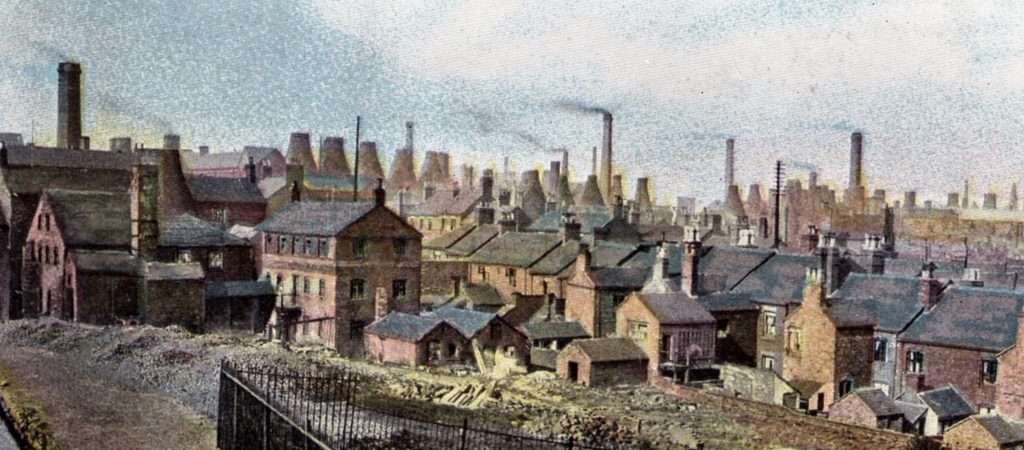

An AI image after a drawing by the author.
On 26 January 1895, 27 year old George Stevenson, a habitual petty criminal and deserter from the British army was shot and mortally wounded in a backroom to a bar in Johannesburg, in Southern Africa, for informing on his fellow criminals after a robbery. The story made news locally as Stevenson, though born in Hixon near Stafford, had grown up in Hanley, where he had turned to a life of crime at a very early age. In December 1877, aged only nine, he was caught trying to rob a till in a second-hand clothes shop in Hope Street, Hanley, for which he received ten strokes of a birch rod and a stint at a reformatory. Little good it did him as in June 1878, he and five other boys were before the bench charged with stealing checks for Battys’ circus that was then in town, though there is no indication as to what punishment they received if any. Yet even if he got off that charge, his short inglorious career as a local ne’er-do-well was quickly brought to an end in October that year when the manager of the Stoke Conservative Club caught the scruffy kid with only one shoe, lurking behind the club bar looking for something to steal . Despite being aged only 10 years old, as he had already been imprisoned once for theft, George Stevenson was now sentenced to a four year stretch at Werrington Industrial School. This did seem to turn his life around and in 1882 was released back to his parents and for several years Stevo, as he was known to his friends, worked in his father’s clay pits. Then in 1886 aged 18, he joined the army and the next year was posted to Pietermaritzburg in South Africa. Though he stayed in touch with his mother, Stevenson never saw his family or the Potteries again.
At first Stevo enjoyed army life, but garrison duty bored him and at the end of 1889, he deserted and fled to Johannesburg in the then independant Boer republic of the Transvaal, arriving there early in 1890. There he led a brief inglorious life as a thief being quickly caught and sentenced to a year on a chain gang and though he escaped and went on the run he was eventually recaptured and sent to finish his sentence. Shortly after his release in 1893, he fell in with a villain and fellow deserter (from both the army and the Royal Navy) named Jack McLoughlin, who went by the nickname of ‘One-armed Jack’, from having lost his lower left arm during a jailbreak. Despite their difference in appearance – Stevenson was tall, athletic and good-looking, while McLoughlin was short, disabled and plain – they were kindred spirits from similar backgrounds and at first the two men were inseperable. But only a few months passed before tattled tales between their respective lovers caused them to have a falling out and they shunned each other for a time. It was only when McLoughlin needed some more able-bodied men to help him with a robbery a few months later that they patched up their differences enough that Stevo could join the gang.
The gang robbed a safe at a railway station in Pretoria, it was a pitiful haul and their troubles started immediately after the robbery when they tried to take the train back to Johannesburg and realised the authorities were onto them. One of the gang stayed in Pretoria, while early in the journey Stevenson got cold feet and quit the train and doubled back. McLoughlin jumped through a window to escape while the train was in motion, leaving one man on the train who was arrested in Johannesburg. Stevenson and the gang member in Pretoria were also quickly caught. In custody and fearful of returning to prison, when he heard that another of the men was about to inform on them, Stevo got in first and told all to the authorities, naming McLoughlin as the ringleader. Stevenson avoided imprisonment as a result, but he knew that his life was now in danger as McLoughlin, who remained at large, was a vindictive man who hated informers.
Stevenson and his lover Sarah Fredericks fled Johannesburg for a time, but foolishly drifted back into town a few weeks later and by January 1895, they were living out of a room at the back of the Red Lion bar close to their old haunts. With no sign of McLoughlin, Stevo thought he was safe, but on the 26 January he learnt that One-armed Jack was in town looking for him. Stevo and Fredericks retreated to their room hoping he would not find them. A few hours later, though, there was a knock at the door. Expecting a visitor Fredericks opened the door, only to find that it was McLoughlin, who had tracked them down. Brushing Fredericks aside, One-armed Jack then pulled a gun and shot Stevenson who was sitting on the bed, mortally wounding him before making his escape. Pursued by an angry mob, McLoughlin then shot and killed another young man who he thought was trying to stop him and fled into the night going on the run once more. Back at the Red Lion meanwhile, Stevenson lingered for a time, but died from his wound a few days later. His last request to Fredericks was that she send his ring back to his mother in the Potteries.
Many years passed, and in 1910 Stevenson’s mother told a Sentinel reporter that ‘The only intimation of the death of her son that [she had] received was a letter written by Stevenson’s supposed wife, to Mrs. Nixon, daughter of Mrs. Stevenson, in New Hall Street, Hanley.’ Sarah Fredericks, however, told a court that Stevenson had asked her to write to his folks at 10 York Street, Hanley. There is no indication in the newspaper accounts that Stevo’s ring ever found its way back to his mother. Some official communication from the South African police to North Staffordshire is suggested by Hanley’s former Chief Constable Charles Higgins, who, fourteen years later, still recalled that the Johannesburg police had contacted him shortly after the shooting, asking if he could obtain a photograph of George Stevenson. If one was supplied it seems never to have been published, and the only surviving image of Stevenson is a simple line drawing of a young man, smart and rather dapper in a checked suit. Even his parents were perhaps unsure of their prodigal son’s appearance, for in 1910 the Sentinel told a curious tale of how Stevo’s mother had for eighteen years kept a portrait of McLoughlin hanging in their house ‘and they never knew that it was the photograph of the man who was supposed to have shot George Stevenson.’
The case was hot news again in 1910, for the year before, in far‑off Australia, One‑armed Jack McLoughlin, long a fugitive, had been arrested and transported back to South Africa—now a united territory under British rule after the Boer War—to face justice for his crimes. In court, the whole cast from the drama of fourteen years earlier reappeared to tell their sordid tales of how and why Jack and Stevo’s relationship had come to its disastrous end, while McLoughlin himself cheerfully explained how he had escaped. To the embarrassment of the local police, he had actually remained in town for some time, even strolling past the police station to show his contempt for the law. Brassiness aside, he knew he had to get away, and after pulling off another robbery with a new crew, he sailed for India hoping to forge a fresh criminal career.
Things did not go to plan. He reached India, but with no contacts and his meagre funds gone, he became a vagrant and was saved from starvation only by being picked up by the authorities, who were keen to remove the negative image such European flotsam gave to the Raj and were happy to ship him to wherever he claimed was his birthplace. Drawing on his knowledge of the colony from his time in the navy, McLoughlin convinced them he was Australian and so was sent there. Many years later, after his usual round of misadventures, he was caught there, his old crimes became known, and he was shipped back to South Africa to face justice.
Justice was now served. Though many years had passed since he had burst with murderous intent into the back room of the Red Lion beer house and later fired that second fatal shot in the street, the witnesses’ evidence and George Stevenson’s deathbed deposition put the noose firmly around McLoughlin’s neck. On 10 January 1910, that noose tightened hard at last as the scaffold trap opened and One‑armed Jack plunged to his well‑deserved death.
Reference: Charles Van Onselen, Showdown at the Red Lion: The Life and Times of Jack McLoughlin, pp. 288-342. Staffordshire Sentinel, 22 December 1877; 19 June 1878, p. 3; 28 October 1878, p. 3.
Leave a Reply