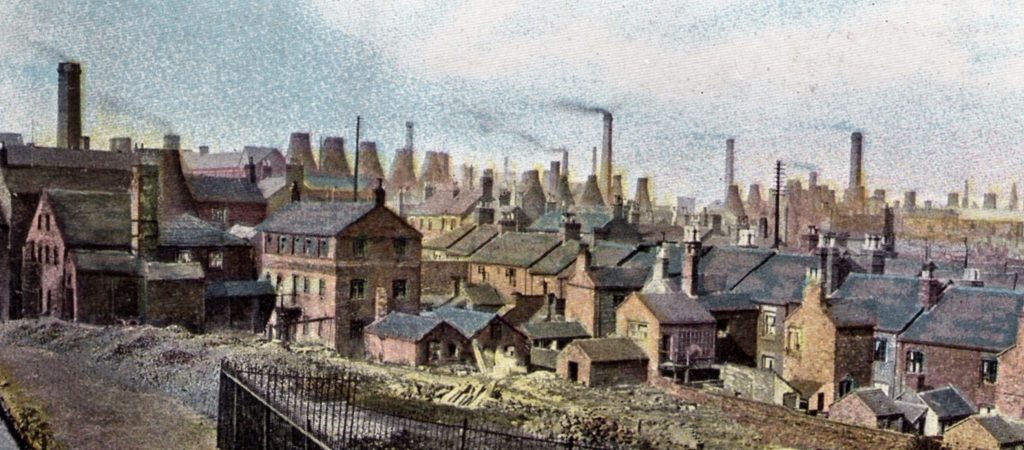
Author: Gary Cooper

  • Camp Meetings at Mow Cop

    The stone commemorating the first meeting at Mow Cop with the ‘castle’ in the background.

    Situated on the Staffordshire-Cheshire border, as noted in an earlier post the rocky hill of Mow Cop topped with its mock-ruined ‘castle’ folly, holds a special place in the religious history of the region and indeed the country. This dramatic spot was very much the birthplace of the Primitive Methodist movement that originated in North Staffordshire in the early part of the 19th century and the famous ‘castle’ came to stand as its unofficial symbol. The movement’s founders, two Potteries-born Wesleyan preachers, wheelwright Hugh Bourne and potter William Clowes, were initially simply hoping to restore a spirit of revivalism to mainstream Methodism. Inspired by tales of American camp meetings which they felt mirrored the outdoor preaching of John Wesley and the early Methodists, the men organised the first in a series of Camp Meetings at Mow Cop on 31 May, 1807, where people could gather to pray, sing and hear inspirational preachers.

    The day did not seem too promising at first with some ominous clouds and rain, but this cleared away and by mid-morning the weather was fine and sizeable crowds of people were seen coming in from the Potteries, Congleton, Macclesfield and the Cheshire plain and even far off Warrington to experience and play their part in the evangelical camp meeting. One Captain Anderson raised a makeshift flag on the hill to attract the crowds, while piles of stones were erected to serve as pulpits around the hillside and there were no lack of preachers to use them. These in a wild variety of styles – exhortations, readings, recitals of their experiences, the telling of anecdotes and even off-the-cuff poetry – kept the crowds occupied and inspired many that day. Hugh Bourne in his account of the day mentioned an abundance of preachers and praying labourers of the Old Methodist Connection from Macclesfield and Congleton. From Tunstall there came many workers who stood up to preach and there were also several preachers of the Independant Methodists who added their voices to the throng. Notable amongst them, the aforementioned Captain Anderson told the story of his life in verse, from his youth as a shepherd lad, to his life as a sailor, and an anti-slavery and temperance advocate. He had been shipwrecked, captured by French soldiers and press-ganged before being converted to an ardent evangelist whilst in Liverpool. Another was an unnamed Irish preacher who told how he had been involved in the Irish Rebellion where he lost all of his worldly goods, but the experience led to his spiritual awakening. And ‘Peg-leg’ Eleazer Hathorn of Knutsford, recalled how he had been a Deist (a believer in a god who did not meddle in human affairs), an army officer and that he had lost a leg fighting the French in Africa; he was later converted by the preaching of American evangelist Lorenzo Dow, whose example had likewise inspired Bourne and Clowes to organise the camp meeting.

    For most of the day, Mow Cop and the surrounding area was thick in people, but by six o’clock that evening, the crowds began to dwindle as folk started to drift away and make their long way back home and by this time only one preaching stand was needed for the die-hards and locals who remained. As this last gathering closed the day’s proceedings it was clear that the Camp Meeting had been a great triumph and had seemingly resulted in many converts to the Methodist cause but it would later figure large in a far more significant way, as out of the controversy that erupted in the wake this first gathering the Primitive Methodist Church eventually came into being.

    L to R: Hugh Bourne and William Clowes, the founding fathers of Primitive Methodism.

    Clearly the camp meeting filled a spiritual need that many felt lacking in mainstream religion, but despite this success it soon became clear that the Wesleyan Church frowned on the fervent brand of evangelism employed and refused to recognise these converts, while Bourne and Clowes were reprimanded for their actions. There was probably an element of snobbishness in the censure, as both Bourne and Clowes were uneducated working men and their brand of Methodism was decidedly working class in its following, many of Bourne’s and Clowes’s early converts being some of the roughest of working class men and women from in and around Mow Cop and the Potteries.

    The popularity of the first Camp Meeting, though, led to a three-day event at Mow Cop two months later, followed by a third at Norton-in-the-Moors in August. Bourne and Clowes were again taken to task by the church hierarchy but refused to stop holding further open-air meetings, so both men were dismissed from the Methodist church. After failing to gain re-admittance in 1810 they took the step of splitting from mainstream Methodism, and in February 1812 in a meeting held at Tunstall, they took the name The Society of the Primitive Methodists; ‘Primitive’ here meant ‘simple’, reflecting their belief that they were practising a purer form of Methodism uncomplicated by dogma and more in keeping with its evangelical origins. From these humble beginnings the Primitive Methodists would grow into the second largest branch of the Methodist church with a wide following across Britain and branches in the United States and around the British Empire and they maintained their independence until the Methodist Union of 1932.

    Because of its early association with the Camp Meetings, Mow Cop continued to be the spiritual home of Primitive Methodism during the life of the movement and beyond. Anniversary Camp Meetings were held there every year with special celebrations laid on for every 50th anniversary of the first gathering, in 1857, 1907 and 1957, all of which were attended by thousands of people. Today, a memorial stone stands part way down the hill from the castle commemorating the movement and its al fresco origins.

    Reference: Arthur Wilkes and Joseph Lovatt, Mow Cop and the Camp Meeting Movement: Sketches of Primitive Methodism, (Leominster, c.1942) pp. 54-62.)

  • The Prehistoric Potteries

    The Carboniferous landscape

    The geological history of Stoke-on-Trent began over 300 million years ago in the Carboniferous period of the Palaeozoic era. At that time, the geological layers that today form part of the substrata of modern Britain were part of a giant landmass, the mighty super-continent of Pangaea. Over the eons Pangaea broke apart and millions of years more of creeping continental drift  moved one of its large fragments, the future continent of Europe, into the temperate climes of the northern hemisphere that it occupies today. In the Carboniferous period, however, Britain and its near neighbours lay in the tropics, just south of the equator and the land that now forms North Staffordshire was part of an extended coastal region. Lying where it did, the surface of the land here fluctuated just above or just below sea level, a situation which produced the varied deposits that make up the modern geology of North Staffordshire. 

    The earliest of this local strata, comprising millstone grit and early sandstone, were laid down as thick oozing sediments on the prehistoric ocean floor. Occasionally, every million years or so, these accumulating layers would form into a delta, which pushed itself above sea level. Here, once a layer of earth had been laid down, peat deposits formed from vast steamy jungles of prehistoric plants that quickly colonised the swampy flood plains. Eventually, though, the sea returned, the plants died and the jungle floor silted over, entombing the lower layers in the geological record. As the aeons passed, the accumulating sediments once again clogged the shoreline, turning it in time into a swamp once more. This natural cycle, repeated itself many times during the 65 million years of the Carboniferous period and over time heat and pressure would squeeze the water out of the accumulating layers and crush them solid. Mud, silt and sand became shale, siltstone and sandstone. The layer of earth that had covered the raised delta, was transformed into seat earth, from which fireclay formed, while the millions of years worth of accumulated peat that lay above it, was over time compacted into rich seams of coal.

    About 285 million years ago, however, this cycle came to an end. Conditions changed drastically, the land rose and most of the jungles disappeared. It was during this period that the thick band of common clay, the so-called Etruria marl, which with the coal measures later assured the rise of the Staffordshire pottery industry, was laid down as a reddish sediment that filtered into the remaining coastal lagoons. The climate then grew much hotter, turning the jungles to deserts, the sands of which now form the Triassic sandstones of Staffordshire, such as may be seen at Park Hall and Trentham. Later in the Triassic period, however, the waters returned once again, covering the deserts and Staffordshire spent the bulk of the Mesozoic era, the age of the dinosaurs, at the bottom of a warm, shallow sea.

    Many millions of years later, when the seas had subsided and the land had been folded up by movements in the earth’s crust, the upper layers were periodically raked by the passage of ice sheets. The coming and going of these glaciers had a number of effects on the area. They gouged out valleys and dropped ‘erratics’ or large boulders all over the district, a notable example of which (seen here) until a few years ago used to sit outside the Staffordshire University Film Theatre in Stoke. 

    The passage of the glaciers also exposed the ancient shoreline deposits, bringing a wealth of raw materials within easy reach. These deposits have also yielded a great many fossils, revealing the variety of animal life that once walked, or swam, over the Potteries. Though no dinosaur bones have been discovered, the fossilised remains of various ancient fish, lizards and some prehistoric mammals, have been found within the confines of the City of Stoke on Trent. For instance, there are the remains of prehistoric sharks that once swam over what is now Longton and Fenton. Mammoth bones have also been unearthed. In his Natural History of Staffordshire, published in 1686, Dr Robert Plot describes the jaw and tooth of a ‘young elephant’, that was found in a marl pit on the Leverson Gower estate in Trentham. Plot, living in an age where natural history was a very patchy science, believed this to be the remains of a modern elephant that had been brought to England and perhaps kept for prestige and entertainment of a local lord, though this seems very unlikely. More bones and tusks have been discovered in Stoke Road, Shelton and in another marl pit in Fenton. In 1877, when the course of the Fowlea Brook, near Etruria Station was being altered, the skull and horn cores of a Bos taurus primogenous, or auroch, a prehistoric wild ox, much larger than a modern-day bison, was discovered. According to Josiah Wedgwood, many fossils were unearthed by James Brindley’s men when they were cutting the Grand Junction Canal, but nothing of these remains save for the briefest mention of various plant impressions and the finding of a rib from some giant unknown animal.

    Reference: Robert Plot, The Natural History of Staffordshire, chapter VII, paragraph 78; The Victoria County history of Staffordshire, various volumes, but notably Vols. I & VIII.

  • Battle Hardened

    Ken Ray, a long-time researcher into the lives of local soldiers has assembled an impressive list of North Staffordshire men who served in the Napoleonic Wars, the Crimea and the numerous colonial conflicts Britain participated in during the 19th and early 20th centuries. He has very kindly given me access to some of his documents which chart the lives and careers of ordinary men from the region who might otherwise have been forgotten. This is one of those stories…


    Private William Walker, 1st Battalion 4th Foot (King’s Own) 

    Revolutionary and Napoleonic Wars 

    A soldier of the 4th (King’s Own) Regiment of Foot in the latter years of the Peninsular War. An edited AI rendering after a drawing by the author.

    There were several men from the Potteries that we know of who served in Wellington’s army in Portugal and Spain during the Peninsular War (1808-1814), but few had quite so impressive a record as Private William Walker of the 4th King’s Own Regiment of Foot who saw action in virtually every major land battle fought by the British Army during the Napoleonic Wars. Most likely the son of John Walker and Elizabeth, nee Lawns, he was born in Burslem and baptised at Stoke-upon-Trent on 8 October 1775. William seems to have received little or no education and initially found work locally as a potter. He was probably a member of the militia in this time of war, which would explain why he was far from home in Ashford, Kent on 19 June 1799, where he enlisted for ‘unlimited service’ with the 1st Battalion 4th Foot, with which he would serve for the next two decades.

    From his own records at his discharge, it is clear that Walker saw service almost immediately in an expedition to North Holland in 1799, under the Duke of York – the indecisive ‘Grand Old Duke of York’ of nursery rhyme fame. There his regiment took part in the fighting at Castricum on 6 October, a defeat where they suffered heavy casualties. Walker was one of these, receiving a gunshot wound in the left leg, but he survived, was evacuated back to Britain and spent the next few years on home service. In 1804, Walker’s battalion served under a much better commander, the visionary General Sir John Moore at Shorncliffe, where they underwent a rigorous regime of training. From there in 1805, the 1st battalion went to Hanover and later served at the Battle of Copenhagen in 1807. The battalion was back with Sir John Moore in Sweden in 1808, when he was given command of the force sent to the Iberian peninsula to support Portugal and Spain against the French. However, after some initial successes by the Spanish to oust the French invaders, the arrival of Napoleon at the head of a massive army saw the effective collapse of the Spanish forces before them and Moore and his men, including Private Walker, were forced on a 200 mile retreat to Corunna on the northern Spanish coast. It was an epic, gruelling march through mountains thick with snow and the French in close pursuit, but because of the rigorous training they had received under Moore the 4th suffered less hardship than many units. On reaching the coast, Walker with his fellows fought in the Battle of Corunna on 16 January 1809. Sir John Moore was killed in the fighting, but the battle effectively blunted the French attempts to thwart the evacuation of the British Army.

    The next year, though it receives no mention in his records, Walker was probably involved in another near disaster for the British, when the 4th Foot were sent on the Walcheren Expedition in an attempt to capture Antwerp. However, sickness quickly took a hold on the army causing many deaths and the expedition had to be abandoned. The 4th Foot suffered like the other regiments, but was one of the first of the Walcheren units to be sent to join Wellington’s forces in the Peninsula, where the 1st Battalion joined the 5th Division at Torres Vedras near Lisbon in Portugal in November 1810. The following year the 4th Foot took part in the Battle of Fuentes de Onoro, but positioned on the far left of Wellington’s line they took no active part in the fighting and received no casualties, though Walker was later to carefully add the battle to his list of engagements. Instead his real baptism of fire in this new phase of the Peninsula War would come in 1812.

    Having evicted the French from Portugal, two fortresses barred Wellington’s safe passage into Spain. The storming of the first of these at Cuidad Rodrigo did not involve the 4th Foot, instead they with many others were sent against Badajoz in the north. A heavily fortified town that had already endured two sieges, Badajoz now underwent a severe bombardment to breach its walls before the troops were sent in. This took place on 6 April 1812 and saw Wellington’s men put to their sternest test with four separate attacks made on the heavily defended breaches. The 5th Division of which the 4th Foot were a part, attacked the San Vincente bastion on the north-west corner of the town. Fighting their way through massed musketry, cannon fire, grenades, mines and lines of wooden poles dotted with blades and spikes, the 4th Foot were badly mauled, but managed with others to get over the wall and into the town, where they fell on the French defending the walls from other attacks and soon afterwards the town fell. The ordeal of Badajoz was not over, though, as driven into a frenzy by what they had endured the bulk of the British troops then went on a two-day rampage of looting, rape and murder through the town. Private Walker though, was not among them, as during the assault he had been shot in the neck and at some point nearby French soldiers had bayoneted him in the left arm and left leg and left him for dead. Again, he would live, but like most of the wounded Walker probably had to wait until the looting army had exhausted itself two days later before he got any medical treatment.

    The final attack on Badajoz, showing British troops assailing the walls with ladders.

    It is a testament to William Walker’s toughness that by July 1812, he was back in the ranks and fit enough to take part in Wellington’s long march and brilliant victory at Salamanca followed by his advance into Madrid. The following year, Walker fought in the battle of Vittoria which sounded the death-knell of the French army in Spain. Walker’s record then reads almost like a tally of the clashes that finally pushed Napoleon’s soldiers back over their own border – Palencia, San Sebastian, Bidassoa and Nive – all of which he seems to have passed through without any injury worth noting. The last action of the regiment before they swapped one war for another, was to help in the blockade of Bayonne just over the French border. Wellington’s army was still there when news reached them of Napoleon’s abdication and the war it seemed was over.

    Released from the war in Europe, in May 1814, Walker’s regiment was sent across the Atlantic to take part in the War of 1812 against the United States of America. He and his comrades were witness to great success at the battle of Bladensburg, where they helped rout the Americans, but disappointment and defeat at Baltimore and again at New Orleans, but a final success in the last clash of the war with the seizure of Fort Bowyer. By this time, though, the belated news that a peace treaty had been signed finally filtered down to the combatants and the British troops withdrew. But though another war had ended, an old one was to briefly flash back into life in dramatic fashion, for in late February 1815, Napoleon escaped from the island of Elba and returned to France. Europe was thrown once more into turmoil and Britain needed its troops for the war that was sure to come.

    What followed became known as ‘The Hundred Days’, Napoleon’s last throw of the dice that ended in his final defeat at the battle of Waterloo on 18 June 1815. The 4th Foot served with Wellington’s army in Belgium and fought at Waterloo, but it seems that Private William Walker was not with them.  The records of the 4th Kings Own show that the regimental drum major also named William Walker received the Waterloo Medal which was awarded to all those who served in the battle, but there is no evidence that our Private Walker was a medal recipient. Evidence seems to suggest that the William Walker who later claimed four clasps to the Military General Service Medal in 1847-48 for his Peninsula War service was also the aforementioned regimental drum major.

    After peace was finally declared and the occupation of France ended, the 1st Battalion 4th Foot were posted to the West Indies. Two and a half years later on 7 May 1821, at St Ann’s in Barbados, 46 year old Private William Walker was discharged from the army, the reason given that he was worn out from his long years of service and the effects of his wounds. Walker was described as being 6′ ¼” tall, light haired, grey eyed and with a fair complexion. His discharge certificate also indicates that for 4 years and five days of his 22 years and 55 days of service with the 4th Foot he had served as a corporal, but does not indicate when this was, nor why he had been reduced back to private. Whatever the case his conduct as a soldier had been ‘very good’ and the record was careful to note all the battles he had participated in and when he had received his wounds.

    Walker returned to Britain on the first available vessel and his discharge was confirmed by the Chelsea commissioners later that year. What he did, where he went and what the ultimate fate of the old Peninsula veteran was after that remains unknown.

    Reference: The National Archives: WO97 – Royal Hospital Chelsea: Soldiers’ Service Documents, piece 267. Information courtesy of Ken Ray.

  • England Expects

    ‘The Battle of Trafalgar’ by William Clarkson Stanfield
    Source: Wikimedia Commons

    On 21 October 1805, a British fleet of 27 ships commanded by Admiral Horatio Nelson caught up with and attacked a combined Franco-Spanish fleet of 33 ships as they made their way towards the Mediterranean. The fleets met off Cape Trafalgar between Cadiz and the Strait of Gibraltar where the British attacked (albeit at a snail’s pace due to lack of wind) in two divisions striking at right angles into the enemy line splitting it into sections and the battle then became a series of small struggles between individual ships or groups of vessels, in which superior British gunnery and seamanship carried the day. Casualties on both sides were heavy, Nelson himself being mortally wounded by a French sharpshooter. Before he died, though, he received news that his fleet had inflicted a devastating defeat on the enemy force, capturing 20 ships, thus ending any immediate threat of a French invasion of Britain. Trafalgar was also the victory that established British naval dominance for the next century.

    Despite hailing from so landlocked a region, several men from the Potteries and neighbouring Newcastle were involved in this decisive sea battle. Two Royal Marines, Corporal William Taft, aged about 30 at the time of the battle, from Hanley Green (modern day Hanley town centre) and Private William Bagley aged 31 from Stoke, served aboard Nelson’s flagship HMS Victory, which led one of the two squadrons attacking the Franco-Spanish line and was in the thick of the fighting from the beginning. Bagley got through the battle uninjured, but Corporal Taft was badly wounded in the left arm, which had to be amputated near the shoulder. After the battle and the week of storms that followed it, Taft was transferred to Gibraltar, then to a hospital ship and transported with other wounded back to Britain. He survived, but was pensioned off and his fate after that is unknown. Bagley too returned to Britain early in 1806, but on 26 January he suffered a fall at Chatham and died from his injuries. His belongings were later returned to his daughter Susannah in Hanley.

    At the head of the other British squadron was HMS Royal Sovereign, the flagship of Admiral Collingwood, aboard which was 24 year old Royal Marine Private Richard Beckett from Burslem. The Royal Sovereign had recently had her hull re-coppered and as a result of her clean hull was a faster ship than most and was the first to pierce the enemy line. For most of the battle the ship was engaged in a prolonged duel with a Spanish vessel and suffered heavy damage. Private Beckett, though was fortunate and escaped injury. Equally lucky and untouched that day was another locally born Royal Marine, 29 year old Private Joseph Sergeant from Clayton aboard HMS Prince, which joined the battle late and saw little action.

    Only two local men that we know of, served as sailors in the British fleet that day and both survived the battle unhurt. John Bitts, a 24 year old landsman from Stoke was aboard the frigate Naiad which took no part in the fighting between the bigger ships, but joined in with the mopping up after the battle, while 28 year old ordinary seaman John Williams also from Stoke was part of the carpenter’s crew on board HMS Leviathan, which was one of the ships of the squadron that followed the Victory into the enemy line and captured a Spanish ship.

    Unlike the soldiers who later fought at Waterloo, no special medal was issued for the men of Trafalgar, but all were entitled to a share of the prize money from the captured enemy vessels, plus a special Parliamentary award. In the event some, for whatever reason, did not bother to claim their shares and the monies were donated to the sailor’s hospital at Greenwich. Corporal Taft, the man in most need of the cash, though, did take his share. His prize money came to £1 17s 8d, plus the Parliamentary award of £4 12s 6d, and presumably because of his life-changing injury, Taft also received £40 from the Lloyds Patriotic Fund.

    Reference: The National Archives, ADM 44 Dead Seamen’s Effects; ADM 73 Rough Entry Book of Pensioners; ADM 82 Chatham Chest: ADM 102.

  • Reg Mitchell Takes the Proverbial

    Colin Melbourne’s statue of R. J. Mitchell
    outside the Potteries Museum and Art Gallery,
    Hanley.

    In 1911, long before he went on to design his world-beating racing planes and later the Supermarine Spitfire, 16 year old Reginald Joseph Mitchell, served a local apprenticeship. Originally from Butt Lane near Kidsgrove, but raised in Normacot, Reg was enrolled as a lowly apprentice engineer at Messrs Kerr, Stuart and Co, locomotive engineers in Fenton. Before moving on to the drawing office where he would make his name, he like the other apprentices had to spend time in the workshops getting his hands dirty working on the firm’s machines. Reg’s pragmatic father Herbert saw this as a sensible grounding for his ambitious son, but young Mitchell loathed this introduction to his profession, hating the grime-caked overalls he had to wear and the monotony of the work that kept him from what he really wanted to do. He was also less than enamoured with the workshop foreman.

    One of the first jobs that Reg had when he started at Kerr, Stuart was the traditional one of tea boy, brewing up for the other apprentices and the foreman, the latter, though regularly complained that Mitchell’s tea tasted like piss. Tired of his grumbling, Reg decided that if that was what he thought, then that was what he would get. The next morning Reg arrived at work and as normal took the kettle to the wash room, but instead of filling it with water he urinated into it, then boiled the kettle and made tea. Warning his fellow apprentices not to drink, Reg served the foreman as usual. The man took a sip, then a larger gulp and said, “Bloody good cup of tea, Mitchell, why can’t you make it like this every day?” 

    Reference: Gordon Mitchell, R.J. Mitchell, from Schooldays to Spitfire, pp. 21- 25

  • A Potteries Teddy Boy, part 2

    ‘The first time we went to Manchester was after we’d talked with a bloke named Danny. I remember him saying he’d been in Manchester on a Saturday night with a couple of mates of his and they’d visited some rock and roll clubs there. Because there wasn’t all that much of it going  on around in Stoke at that time, we started going to Manchester on the train. It used to be 3s 6d return, and the trains used to run every half hour so you could catch one back early in the morning from Manchester to Stoke. We would catch the train at six o’clock on a Saturday night, arriving in Manchester three quarters of an hour later and would go the clubs until one or two o’clock in the morning. Then on the Sunday morning we would catch the mail trains back, that were coming down to deliver the papers from Manchester to Stoke and Birmingham. We went there plenty of times visiting all the different clubs in Moss Side in Manchester.

    The Teddy Boy was also a miner. L to R: Stuart Colclough, Bill Cooper and Derek Ford at Hanley Deep Pit.

    There were a  few times when we didn’t take the train and instead had a lift up there in a car. I worked at Hanley Deep pit at the time and I knew this big, tall black guy named Jim Brown who had come down from Manchester to work in the pits here as he couldn’t get any well paid jobs where he came from. He’d got an old Standard Vanguard car – he was the only bloke I knew that had got a car – and he asked us if we wanted to go with him to Manchester for a weekend. We said “Well, it’s going cost us a bit.” – “Ooh no, you can stay with my family.” he said.

    Anyway, he took us, five of us, in his Standard Vanguard, from the pit on a Friday night when we’d finished, straight to Manchester. When we got there we found that his family had a three storey house, a big old Victorian place with a stack of bedrooms! It was like being in one of the boarding houses at Blackpool. His parents were nice people and his mother especially was a right jovial woman! Jim had about five or six brothers and sisters and they all lived at home. I said, “Where are we going stay?” His mother said,” Well, there’s a lot of us here. Just grab somewhere to sleep. There are plenty of rooms. If you go in somebody’s bed you’re all right, they’ll go in another one.”

    We went out that first night, but we were all tired because we’d been at work, so we only stayed out until about two o’clock. But on the Saturday night Jim took us to a party in Moss Side,  where all the warehouses were. Going down some steps he opened an ordinary looking door and we went into a huge cellar. There were old settees scattered all around the place and tables too, a band was playing and there were records in between! It was packed, mostly with black people, but there were quite a few white folk there as well. But, bloody hell, it was five o’clock in the morning when we finally came out, from about seven at night! And talk about drunk! Well, they were selling beer out of wooden barrels on trestles and you’d just helped yourself. You just gave them the money and filled your pint; or you could have bottled beer or whisky, or whatever you fancied. It was licensed, the blacks ran their own club. We went again on the Sunday night and then went to come home the next morning, because we had to go work on Monday night. 

    We went to that place two or three times and Jim’s mother used to feed us up like mad. She had a large room and she’d had two big tables put in it, with chairs all around and then a kitchen with a serving hatch she’d had knocked in. She said, “I was fed up of carrying the stuff in, so I’ve had this knocked in so I could just pass it through to them.” 

    They’d got a big range to cook all the stuff on and two of the grown up girls used to help her. They used to have a stack of food, a quantity of food I’ve never had since. I remember going in once and she said “We’re having chicken.” She got these big bowls out and they were full of chicken legs piled high, all cooked, it was steaming hot and you just helped yourself! 

    They seemed to have plenty of money but, there were a lot of them and most of them worked. I’m not sure, but I think I remember something about a shop they’d got. Well in that area there were a lot of big shops down the main street and I think one of them was theirs. The mother didn’t work, I think it was the old man and two or three of the lads that run the shop. But, she used to come with us when we went out at night time, either that or she and the father used to come along later. She would dance as well, she wasn’t all that old, I should say she was in her late forties, but she seemed old to me because I was only sixteen or seventeen.

    Reference: Interviews with William Cooper, 2007.

  • Mow Cop Castle

    Mow Cop Castle from the Staffordshire side

    To the north of Stoke-on-Trent and standing smack on the Staffordshire-Cheshire Border, the hill of Mow Cop dominates the respective skylines of both counties and is also very much a natural demarcation point. To the south, the low rolling hills of North Staffordshire leading up to the hill seem to suddenly give way to the vast flat expanse of the Cheshire plain on its northern side. Nowhere is this better appreciated than from the highest point on the hill, where a circular stone tower, low wall and archway sit perched on a great prow of millstone grit rock, part of a jagged ridge of stones that appears to erupt from the surrounding greenery.

    In truth the ruggedness of the hill owes as much to centuries of quarrying as to the vagaries of nature, while the apparently ancient ruin, known to one and all as Mow Cop Castle, is in fact South Cheshire’s and North Staffordshire’s most famous folly, dating back at best to the late 1740s. Though solid documentary evidence relating to the ‘castle’s’ construction seems to have vanished over time, it’s most likely that it was actually built as Medieval-style summerhouse paid for by the wealthy Wilbraham family of Rode Hall, Cheshire, who were perhaps keen to mark the edge of their lands and make use of the spot from which to admire the spectacular views of the two counties. Construction of the tower, archway and wall seems to have been carried out by a family named Harding whose descendants then became keyholders for the tower under the Wilbrahams. However,  either the Wilbrahams or the Hardings had slipped up in constructing the tower where they did, as by straddling the border it infringed upon the Staffordshire estate of the Sneyd family of Keele Hall. There are confused scraps of folklore suggesting that this fact was know from the earliest times and that the Wilbrahams and Sneyds held joint ownership and access to the site, but again there is no conclusive evidence of this and arguments as to which family actually owned Mow Cop Castle would blight its early history and lead to litigation in the mid 19th century.

    The tower today is nothing more than an empty stone shell, with bars on the windows and a grill over the doorway stopping anyone from getting inside, but when it was first constructed it was much more useful, comprising a lower and upper storey with a staircase, wooden floors, a roof, windows and a stout wooden door at its entrance. Keys to the door could be obtained at times from Rode Hall itself or – for the convenience of visitors – from a cottage near to the summer-house. Indeed, it appears that from very early in its history, the Wilbrahams were quite happy to let members of the public make use of the tower for their own recreations. As a result, the castle became a favourite picnic spot and playground for the locals and despite the competing claims over the years of families and landowners as to who owned what, the castle came to belong very much to the people of Mow Cop itself and their voices would be loud in determining its fate.

    A memorial stone commemorating the first camp
    meeting held at Mow Cop in 1807.

    Primitive Methodism

    The hill and castle also hold a special place in the religious history of the region as Mow Cop was very much the spiritual home to the Primitive Methodist movement that originated in North Staffordshire in the early part of the 19th century and the castle its unofficial symbol. The movement’s founders, two Potteries-born Wesleyan preachers, Hugh Bourne and William Clowes, were hoping to restore a spirit of revivalism to mainstream Methodism. Inspired by tales of American camp meetings which they felt mirrored the  outdoor preaching of John Wesley and the early Methodists, the men organised the first in a series of camp meetings at Mow Cop on May 31, 1807. This drew a sizeable crowd and resulted in many converts, but despite its success the Wesleyan Church frowned on the fervent brand of evangelism employed and refused to recognise these converts, while Bourne and Clowes were reprimanded for their actions. There was probably an element of snobbishness in the censure too, as both Bourne and Clowes were uneducated working men and their brand of Methodism was decidedly working class in its following, many of Bourne’s and Clowes’s early converts being some of the roughest of working class men and women from in and around Mow Cop and the Potteries.

    As Bourne and Clowes refused to stop holding further open-air meetings, both men were dismissed from the church and after failing to gain re-admittance in 1810 they took the step of founding Primitive Methodism, and in February 1812 in a meeting held at Tunstall, they took the name The Society of the Primitive Methodists. From these humble beginnings the Primitive Methodists would grow into a considerable faction of the Methodist church with a wide following across Britain and branches in the United States and around the British Empire and maintained their independence until the Methodist Union of 1932.


    Kings of the Castle

    The Wilbrahams left Rode Hall for Lancashire in 1800 and though some repairs were made to the castle over the years, it suffered the ravages of time, neglect and petty vandalism. The floors and wooden fittings were pilfered or destroyed, the door was taken down and put into storage, while the Wilbrahams and Sneyds still debated their claims to the site. Matters came to a head in 1847 when the Wilbrahams refitted the old door to the tower and locked it, which effectively restricted access to the Sneyds and the public at large who had previously had free access to the structure. The next year the Sneyd family’s men broke into the tower which act resulted in a court case in 1850 that sought to establish who actually owned the castle. However, faced with a baffling array of contradictory evidence, the jury in the case returned the verdict that the Wilbrahams owned the castle but the Sneyds owned the land, which left them back at square one. The judge refused to accept this fudged verdict and instead pronounced a joint ownership and that henceforth both families should hold keys to the castle, joint responsibilities for its upkeep and with a few provisos both families had to maintain public access to the hill and castle.

    However, probably as a result of this apportioning of responsibility the castle gradually fell into a state of complete neglect over the next half a century and by the beginning of the 20th century had effectively been reduced to the bare stone shell seen today. Only the locals seem to have continued to appreciate the castle and as was seen when the castle passed to its last private owner they rallied to its cause.

    By the late 19th century most of the quarries that had dotted Mow Cop had closed down, however, in 1918 and 1922, a local businessman, Joseph Lovatt, bought up the competing land rights from the Wilbraham and Sneyd trustees and having cleared the debris from some of the old quarries near to the castle, he began fresh diggings for building material. Though he was himself a Methodist with an interest in preserving Mow Cop Castle (which he now owned) Lovatt’s actions raised fears amongst the locals that his quarrying might undermine or damage its foundations. Moreover, Lovatt fenced off the castle, which increased local ire at being excluded from their local beauty spot and they protested and eventually broke down the walls and fencing. This prompted a second court case to determine the future of the castle, the villagers arguing that they had common rights to use the castle and its environs. The case dragged on for three years and when it finally concluded the judge pronounced that the castle was not built on common land and that the rights of the locals were more a matter of accepted custom than a matter of law. Though the old custom carried some weight, the problem was that no one was sure exactly what their right of access to the castle entailed and the local authorities on either side of the county border had made no efforts to clarify these.

    Lovatt may have won the case, but it had not done his reputation any favours and he soon determined to get this troublesome parcel of land off his hands as soon as possible. To this end in 1927, he offered it to the Bourne Trust, the successors to the Primitive Methodist movement, these being an obvious choice to pass the site on to. After careful consideration, though, the Trust determined that its upkeep was beyond their means and refused to take up Lovatt’s offer. So, in 1935, Lovatt offered the castle and six acres of land including the famous local stone pillar Old Man of Mow, to the National Trust. This was accepted and on 30 May 1937, the deeds were formally handed over at a grand ceremony attended by ten thousand people.

    Since then the National Trust has maintained the structure pretty much in the state that they received it. Matters of ownership and public access are a thing of the past and though the castle itself is now closed for safety’s sake and to dissuade potential vandals, people can still visit and walk around the structure, while its hilltop vantage point with its impressive views across two counties is open to all.

    Looking out over Staffordshire from Mow Cop

    Reference: Philip R. Leese, Mow Cop: A Working Village (2010); Mow Cop: Living on the Hill (2011)

  • Slaughter of the Innocents

    At about 10.10pm on the night of 28 May 1837 in Lane Delph, Fenton, on hearing a cry of ‘Murder’, out in the street, a man from a nearby house and two others from the Canning Inn went to investigate. They found two young boys, 11 year old George Colley and nine year old Josiah Colley, running down Market Street (now part of King Street) dressed in their night gowns and drenched with blood. George had one of his ears nearly cut from his head, while Josiah had suffered a severe cut to the throat. The distressed boys cried out that their mother had attacked them and was killing their brothers and sister and they had only escaped by climbing out of a window. The three men quickly passed the boys to the care of others and rushing to the house one of them went to get a candle, and once it was lit they cautiously ventured in.

    Going up the stairs to the family bedroom the three men peered in, and in the faint flickering light of the candle they beheld a scene that none of them would ever forget. In the middle of the bare room they found the mother, Ann Colley, on her knees with her head down and blood streaming from her throat. Beside her was a black handled kitchen knife which she had used to kill or wound her children before using it on herself. Her six year old daughter Ann lay uncovered on the floor, her bloody head nearly severed from her body. On the right of the room was Charles Colley, aged about three years, lying on his back on a pile of blood soaked clothes. He too had suffered a deadly cut across the throat. Her infant son James aged about three months lay at right angles to the dead girl, his feet resting against her; he was a chubby infant and the slit across his throat was not easily seen in the folds in his skin; the dead baby had a peaceful look in its face.

    At first, the stunned men thought that Ann Colley was also dead, but when they went to lift her up there was a flicker of life and on repeatedly being asked “What have you been doing?”, the woman replied, “I am in want. I am in want.” She then asked if any of her children were alive. Surgeons were sent for and were soon on the scene, one tending the struggling, injured mother, while another treated her two surviving children. More neighbours came in to help as did the police and George Colley the father also arrived, but was quickly led away by a neighbour. By midnight the surgeons were finished sewing up the injuries and Mrs Colley and her son Josiah were both transported to the North Staffordshire Infirmary two miles away. On Monday afternoon an inquest was held at the Canning Inn, where the numerous witnesses of the night’s events described what had occurred and a picture began to form of a once respectable family that fallen on hard times with horrifying results. The tragedy of the Colley family was explained in detail at the subsequent trial of Ann Colley at the Stafford Assizes in July that year.

    The Colleys were originally from London and had arrived in the area at the beginning of the year, when the father George, who had served as a police constable in London and then in Walsall, secured a position as superintendent of police in Fenton. However, in March, he had been dismissed from his post by the inspector and was forced to make a humiliating apology for some unspecified wrong doing. The family’s formerly comfortable existence rapidly fell apart after that and they had to sell most of their belongings to live. Though fairly well-educated, Ann Colley either suffered with mental issues, or was in the grip of a severe postnatal depression that had worsened with each pregnancy. She had reportedly threatened to kill her children a few years before, but had been dissuaded by her husband. However, when George lost his job and the family sank into poverty, her depression deepened and finally tipped her over the edge.

    As a result of the evidence presented at the trial, Ann Colley was found not guilty due to temporary insanity and ordered to be detained at Her Majesty’s pleasure at Stafford. But hers was not destined to be a long incarceration as she could not escape the horror of what she had done. On Wednesday, 4 October 1837, George Colley paid Ann a visit in prison and foolishly gave his wife a locket containing hair from the three murdered children. This left Ann greatly agitated for the rest of the day and night. The next morning at about 10 o’clock, she went to the privy and hung herself from the rafters with a long silk handkerchief. Discovered shortly afterwards, she was cut down still alive, but the effect of the strangulation had put her beyond medical help and at 5 p.m. that day, she died. Ann Colley aged 36 was buried two days later in the grounds of St Mary’s Church, Stafford.

    Reference: Staffordshire Advertiser 3 June 1837; 17 June 1837; 7 October 1837; numerous other papers nationwide, June to October 1837.

  • Up, Up and Away

    Pioneer balloonist Charles Green was quite a celebrity when he arrived in the Potteries in early October 1826. Five years earlier, Green had become famous almost overnight when he made a special ascent into the air in his coal gas filled balloon at George IV’s coronation. Since then he had become a professional balloonist, touring the country giving displays and allowing a lucky few to take a ride up with him. Now that thrill was open to the people in North Staffordshire and to one lucky passenger would fall the chance to make local history by joining Green in the first ever flight over the district.

    The first ascent was to take place from Shelton late in the afternoon of Tuesday, 3 October 1826. ‘A vast concourse of persons’ had assembled according to a reporter for the Staffordshire Advertiser. A carnival atmosphere prevailed, a band had been arranged to keep the onlookers entertained and enclosures were set up for paying guests. The most exclusive of these for ‘the most respectable inhabitants’, was rather thinly populated at first, but started to fill up after 3 p.m., allaying fears that Green would not be fully compensated for his visit to the area. Another cheaper enclosure was also pretty well filled. Most of the locals, though, opted for a free view, an immense number of whom were camped out in surrounding fields, streets and yards, perched on roofs or leaning out of windows.

    Charles Green in later life

    The weather was cloudy but favourable despite a brief shower which dampened those waiting for the launch. Half an hour or so before the main event a small pilot balloon was released to check on the wind direction, Green then got to work preparing the large crimson and gold striped main balloon for its trip over the Potteries. There was at this point some anxiety as to who, if anyone, would accompany Green on his historic flight. Some days earlier a suitable companion had been selected, but who this was is a mystery as the man backed out shortly before the launch and it seemed very likely that Green may have to go up alone. Indeed, the celebrated balloonist had clambered into the basket or ‘car’ as it was then called and was making his final adjustments prior to lift off, when the band suddenly struck up the popular Irish melody ‘Fly not yet’ to get his attention. A last-minute replacement had been found, the Reverend Benjamin Vale, perpetual curate of Stoke-upon-Trent, had volunteered to go. A Londoner by birth, Vale was an abrasive character with a very chequered history, which would not improve during his long career in the Potteries, but whatever his other faults he did not lack for courage and after briefly justifying his decision with his anxious friends, to the applause of the onlookers, he eagerly stepped forward to join Mr Green for this first historic trip.

    With the clergyman aboard, the balloon was allowed to rise into the air to a considerable height above the gathered crowd, ropes still holding it secure while it did so. Here, Mr Green released some ballast and dropped a parachute over the side attached to a basket that carried a cat, which floated safely back down to earth. After a short while suspended thus probably to give the crowd a good view of the ‘buoyant and splendid machine’, it was drawn back down to earth, two flags were handed over which were fixed at either end of the car, the ropes were released and with the band playing and crowd applauding the balloon rose gracefully into the air. To those on the ground the balloon remained in sight for about twenty minutes before vanishing into a cloud for ten minutes, then reappearing briefly in the distance as a dark-coloured ball. The rest of the journey was instead charted by Reverend Vale who subsequently wrote an account of the historic flight, which was printed in the Staffordshire Advertiser several days later.

    Reverend Vale described how after being released, their balloon was blown off first to the north and east and that he continued to answer the cries from the ground for as long as he could. Once they were out of earshot, though, he instead occupied his time watching Green work the balloon, or he looked over the side. It is perhaps a measure of his crusty character that rather than expressing delight at the experience and what he saw, he instead began musing on why anyone would strive to possess what looked like so many mud heaps below them. He tried to spot the church that he hoped to obtain the curacy to, but it had already dwindled into the distance and he could see little save a sprawling mud-heap where Hanley stood and another where Lane End lay.

    A mile up, after entering a thick yellow cloud that to Vale’s mind had a curious soapy feel to it, Charles Green opened the bottom of the balloon to give the gas inside room to expand and as Vale was interested in helping he allowed him to operate the valve when needed. Meanwhile, the balloon sailed over Blythe Bridge where a fresh current of air took hold and they moved towards Cellarhead, passing over Werrington windmill where they heard voices shouting up to them, but they were up too high to make out any figures on the ground.

    Charles Green’s balloon

    Whilst over Consul Woods they heard the sound of several guns being fired and got a good view of the country they were now passing over. The balloon was descending a little too rapidly for Mr Green’s liking, so ballast was dropped to slow the descent. Vale peered down once more, trying to make sense of the landscape below. Straight lines he realised were roads, while an odd mushroom was a haystack and what looked like a solitary bush was in fact a small wood. There were more cries from below and a curious humming noise could also be heard as a rain shower lashed the balloon above them. They crossed the Churnet and the canal near to Belmont House, spotting the reflection of the balloon in the water.

    Another wood loomed and more ballast fell and the balloon rose up into a fresh contrary zephyr that sent it south between Ipstones and Kingsley. Here the two aeronauts heard a voice crying “Come down, come down.” Far below, a woman watching the balloon had called up and thought she heard the men calling back, “Yes, yes, mistress.” and she brought out some brandy ready to greet them and celebrate, but to her disappointment, the balloon passed on by.

    After forty minutes in the air they were two miles up and getting cold and Mr Green decided to tie off the end of the balloon before attempting a landing. To achieve this he boldly stood up on the edge of the car, but even at full stretch he could not reach the fabric until Reverend Vale pulling down on a rope with all his might, dragged it to within Green’s grasp. As Green tied it off they distinctly heard the sound of a horn being blown followed by the clatter of carriage wheels, which indicated that a coach was rattling its way over the hills below them.

    Mr Green was now on the lookout for a safe landing spot, which became more urgent as bad weather closed in. However, nothing but fields and dry stone walls appeared before them and as they slung the grapple over the side, the two men steeled themselves for the worst that might happen. Spotting a couple of men below they yelled for assistance, but flew overhead much too quickly and it was not until their anchor had snagged and demolished parts of two walls that more locals rushed over and grabbed hold of the balloon and they finally came safely to a stop in the middle of a field. Vale estimated that they had been in the air for about an hour and had travelled over at least 25 miles.

    A couple of days later, after an early attempt had to be aborted due to high winds that made flying much too risky, Mr Green took a similar balloon trip over Newcastle, accompanied this time by a member of the Wedgwood family.

    Reference: Staffordshire Advertiser 7 October 1826, p.4; J. H. Y. Briggs, ‘A Staffordshire Clergyman: The Reverend Dr Benjamin Vale, L.L.D. (1787-1863)’ in Staffordshire Studies (Keele, 1987) pp. 141-153.

  • Potts’ Luck

    Ken Ray, a long-time researcher into the lives of local soldiers has assembled an impressive list of North Staffordshire men who served in the Napoleonic Wars, the Crimea and the numerous colonial conflicts Britain participated in during the 19th and early 20th centuries. He has very kindly given me access to some of his documents which chart the lives and careers of ordinary men from the region who might otherwise have been forgotten. This is one of those stories…


    Private John Potts, 3rd Battalion 1st Foot (Royal Scots),

    Napoleonic Wars.

    Depending on which document you consult, John Potts was born in either Hanley or Stoke, in either 1784 or 1789, though the latter seems the most likely date as on his discharge certificate the age ’32’ is crossed out and replaced with ’27’, putting his birth in 1789. This accords with other documents which seem to agree on that date. Nothing is known of his parentage, but before joining the army he worked either as a printer or a painter in the pottery industry, though on at least one occasion he simply listed his occupation as a potter; Potts was ever fickle with his personal details.

    There is a hint that Potts may have been a member of the Staffordshire Militia before joining the regular army as when he attested for the 1st Foot at Windsor on 1 February 1808, he did so with several other men from Staffordshire who all indicated previous military service in Staffordshire. John Potts, however, did not specify how long his service had been. After several months of training, he was assigned to the 3rd Battalion 1st Foot on 25 June 1808.

    Potts went on to see service in the latter half of the Peninsular War.  One John Potts later earned two clasps for the Military General Service Medal (awarded to surviving veterans of the Napoleonic Wars in 1847-48) for the storming of  Badajoz in 1812, and the Battle of Vittoria in 1813. This may have been our man, but to further muddy the waters of his service record there were two John Potts in the 3rd Battalion 1st Foot (the other hailed from Roxburgh in Scotland) and the surviving records for both give no indication which of them this was. Our John Potts certainly suffered serious injuries during his service, with gunshot wounds to the head, right arm and leg and left knee. As the Royal Scots only suffered two casualties at Badajoz, (two wounded officers) then John may have got his wounds at Vittoria where the Royal Scots took a severe mauling. However, there is an excellent memoir of the Peninsular War written by Corporal John Douglas of the 1st Foot that mentions a Private John Potts having a miraculous escape from death, but suffering serious injuries, at the siege of San Sebastian in late 1813; and as his account indicates, this was almost certainly our man. We join the story just as the 1st Foot and other regiments are launching an attack against the southern walls of San Sebastian, which was a fortress town situated on a rocky peninsula.

    The attack on the breach at San Sebastian, illustration by Denis Dighton.
    Source: Wikimedia Commons

    ‘On the 25th July the breaches were pronounced practicable, but waiting for the tide to be sufficiently low to admit the men to reach the breach, it was daylight ere we moved out of the trenches; and having to keep close to the wall to be clear of the sea as possible; beams of timber, shells, hand grenades and every missile that could annoy or destroy life were hurled from the ramparts on the heads of the men; to shun which, if they kept further out in the tide, showers of grape and musketry swept them away by half companies. Those who scrambled onto the breach found it was wide and sufficient enough at the bottom, but at the top there was not sufficient room for one file at the curtain and from thence to the street was at least 20 feet. This was a house which was on fire close to the breach, and through which our poor fellows were forcing their way when a shell from our 10-gun battery at the passage side struck the gable and buried nearly a company in the burning ruins. One man alone escaped. The sides of the door being stone fell towards each other, and formed a letter A over him. Though his life was saved by this providential circumstance, he was, I might say, half-roasted, but survived. (I saw him in June 1817, after returning from France, near the potteries in Staffordshire, on the banks of the canal. His face then resembled a new-born infant. His name was John Potts.’

    Potts’ rejuvenated appearance was probably the result of new flesh and scar tissue covering the burns he had received in this closest of shaves.

    The uniform of the 1st Foot in 1815.

    The 1st Foot also took part in the Waterloo campaign in 1815 as part of General Picton’s division, a Private John Potts served in Captain Robert Dudgeon’s N° 8 Company, being awarded the Waterloo Medal for his service in the brief but dramatic campaign. There is evidence that the other John Potts in the ranks of the 1st Foot may have been stricken ill with eye problems on the march from Ghent to Brussels, which may perhaps have put him out of action for the duration, but again as with the Peninsula War clasps there is no clear indication as to which John Potts it was who saw action at Waterloo.

    Potts was in France with the army following Napoleon’s final overthrow and it was whilst stationed at Valenciennes that on 16 May 1816, he was discharged from the army due to being worn out by the effects of his numerous wounds. He was described at the time as being about 32 (sic) years of age, 5 feet 11 inches tall, with brown hair, grey eyes and a fresh complexion. Another document added the detail that he had a long visage. Having made his way back to Britain, on 9 August 1816 Potts was duly examined at the Royal Hospital, Chelsea to secure a soldiers’ pension. This he did, being awarded a shilling a day as an out-patient.

    John Potts disappears from the records after this, though we can presume from John Douglas’s account that he returned to the Potteries following his medical exam. There is some circumstantial evidence that he may have been the John Potts listed in the 1841 census as living in Joiners Square, Hanley. This man was was 52 years old (born in 1789 as the soldier seems to have been) and he worked as a pottery painter (one of Pott’s suggested pre-army trades). He was married, his wife Elizabeth being 45 years old, though they had no children. A decade later, though, the fuller census of 1851 revealed that the couple had suffered a serious downturn in their fortunes. John had gone blind and he and Elizabeth were listed as beggars lodging with a family in Bow Street, Northwood. By the time of the 1861 census, John Potts was 72 years old, his wife was 64 and they now had their own house at 34 Bow Street, where they lived with John’s niece. The census noted that John had been blind for 14 years. This, though, was the last census he would appear on and a John Potts was listed as having died in Stoke-on-Trent in the last quarter of 1862.

    Was this man really our old soldier fading away? We will probably never know for sure, but if so, the tale of his later years makes for a sad counterpoint to the high dramas of his youth.

    Reference: The National Archives, WO 97- Royal Hospital Chelsea: Soldiers’ Service Documents, piece 235, box 4; John Douglas, Douglas’s Tale of the Peninsula & Waterloo 1808-1815, pp. 79-80. Information courtesy of Ken Ray.