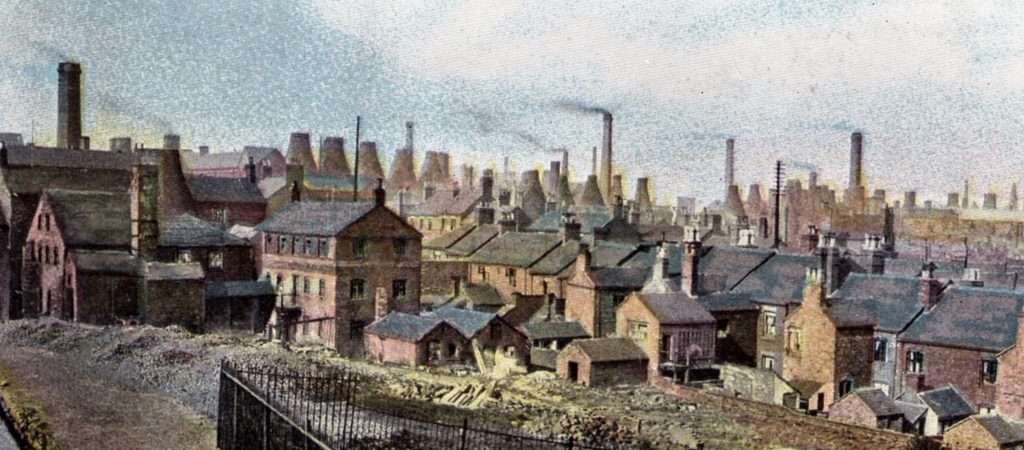
Tag: Longton

  • Old News from the Potteries

    Regular newspaper coverage of events in the Potteries only really started at the end of the 18th century with the advent in 1795 of the Staffordshire Advertiser paper, though as this was published in Stafford, it’s coverage of the goings on in the north of the county was limited to the most noteworthy events. Another half century would pass before more local newspapers were being produced in Hanley, Stoke and Burslem. However, histories, travellers’ journals and some other national or regional papers occasionally carried tales from the Potteries from this early period, giving us fleeting glimpses into life in the area. These range from descriptions of the growing pottery industry and the construction of the canals, to bizarre deaths, odd weather and local curios.


    See a Fine Lady Upon a White Horse

    Between 1697 and 1702, partly from a wish to improve her health and from an equally strong desire to see more of her native land, Lady Celia Fiennes (whom some claim was the fine lady at Banbury Cross from the children’s nursery rhyme) undertook a series of journeys around England. In the summer of 1698, her peregrinations brought her into North Staffordshire. Here, after admiring the as yet unsullied landscape, she was keen to visit the Elers Brothers’ factory at Bradwell, but as she notes in her diary she was unsuccessful; the potters had temporarily run out of clay and were not working.

    ‘..and then to Trentum, and passed by a great house of Mr Leveson Gore, and went on the side of a high hill below which the River Trent ran and turn’d its silver stream forward and backward into s’s which Looked very pleasant Circling about ye fine meadows in their flourishing tyme bedecked with hay almost Ripe and flowers. 6 mile more to NewCastle under Line.’

    After ruminating briefly on the ‘coals to Newcastle’ adage, she continued. 

    ‘… I went to this NewCastle in Staffordshire to see the makeing of ye fine tea potts. Cups and saucers of ye fine red Earth in imitation and as Curious as yt wch Comes from China, but was defeated in my design, they. Comeing to an End of their Clay they made use of for yt sort of ware, and therefore was remov’d to some other place where they were not settled at their work so Could not see it;’

    (Reference: Celia Fiennes, Through England On a Side Saddle in the Time of William and Mary, pp.146-147.)


    A Swedish Spy in the Valley of Crockery

    A visitor to the mid-18th century Potteries was Reinhold Rücker Angerstein, an industrial spy in the employ of the Swedish government, who was tasked with gathering information on new or emerging technology. Between 1753 and 1755, he journeyed through England and Wales and produced a wide-ranging and comprehensive survey of the various industries and their practices. He appears to have visited the Staffordshire Potteries, which he labels rather colourfully as a ‘Valley of Crockery’, in about 1755. Here, after examining the manufacture of salt-glazed wares, describing the kilns in Hanley (including illustrations), the raw materials used, the prices of ware and various mechanisms employed in producing pottery (with still more pictures), he went on to add a few descriptions of the area that make for interesting reading.

    He notes that in Hanley there were 430 makers of white ware and other types of pottery, adding ‘The kilns are everywhere in this district.’ and to prove his point he includes an illustration of the skyline of the town. There were also large numbers of potteries in Stoke and other places, ‘where mostly the same kind of ware as that enumerated is made and also some simpler crockery.’ He then adds a picturesque and slightly comical tale. ‘When as it sometimes happens, many kilns are glazing with salt at the same time, there is such a thick smoke of salt in these towns, that people in the streets cannot see 6 feet ahead, which, however does not cause any difficulties. On the contrary, the smoke is considered so healthy that people who are ill come here from far away to breathe it.’

    Of the pottery itself, he writes, ‘The crockery produced is mainly sent to London or other sea ports, from which much of it is exported to America and many other foreign countries.’

    (Reference: R. R. Angerstein’s Illustrated Travel Diary 1753-1755, pp. 340-342)


    John Wesley preaching to a crowd

    Pelted in the Potteries 

    On 8 March 1760, the Reverend John Wesley, the founding father of Methodism, visited Burslem for the first of many visits to the region. He described Burslem as ‘a scattered town, on the top of a hill, inhabited almost entirely by potters’, a large crowd of whom had gathered to hear him at five in the evening. He noted that great attention sat on every face, but also great ignorance which he hoped he could banish. 

    The next day Wesley preached a second sermon in Burslem to twice the number of the day before. ‘Some of these seemed quite innocent of thought. Five or six were laughing and talking till I had near done; and one of them threw a clod of earth, which struck me on the side of the head. But it neither disturbed me nor the congregation.’  –

    (Reference: John Wesley, Journal, 8-9 March 1760)


    The First Cut

    After receiving the royal assent two months earlier for construction of a canal connecting the rivers Trent and Mersey, on the morning of 26 July 1766, at a site just below Brownhills, pottery manufacturer Josiah Wedgwood cut the first sod of what would in time become the Trent and Mersey canal. James Brindley, the engineer who would oversee the canal’s construction, and numerous other dignitaries were present, many of whom would also cut a piece of turf, or wheel away a barrow of earth to mark the occasion. In the afternoon a sheep was roasted in Burslem market place for the benefit of the poorer potters in the town. A bonfire was also lit in front of Wedgwood’s house and many other events took place around the Potteries by way of celebration. 

    (Reference: Jean Lindsay, The Trent and Mersey Canal, pp.31-32)


    News from the North

    Extract of a Letter from Burslem, 14  August 1766,

    ‘As you often give me London News, I will give you some from this Country, which has of late made a Figure. This Neighbourhood has for many Years made Pots for Europe, and will still do so, though the King of Prussia has lately clapt 28 per Cent, upon them. Our Roads were so bad that nobody came to view the Place where the Flint Ware is made, but now we have Turnpikes upon Turnpikes, and our Potteries are as well worth seeing as the Stockport Silk-Mills, or the Bridgewater Navigation, which we intend to beat hollow by Lord Gower’s, now begun in our Meadows, and advancing apace towards Harecastle, on the other Side of which Multitudes of Men are at work, and before Christmas we shall have cut through the Hill, and made another Wonder of the World. There are already 100 Men employed on our Side, and 100 more will be added as soon as Wheelbarrows can be procured for them. Saturday last we had brave Sport at Earl Gower’s, where 100,000 Spectators were present at the Prison-Bars played in Trentham Park. Among them were the Dukes of Bedford and Bridgewater. The Prizes were Ten Carline Hats, with gold Loops and Buttons, given by the Earl. The Cheshire Men were active Fellows, but unluckily their Lot was to wear Plod Drawers, to distinguish them from their Antagonists, which made the Crowd oppose their getting the Honour of the Day. During this Game, my Friend Bucknall loft his Boy, about Eight Years of Age, who was suffocated by going aslant down a Sort of a Cave into an old Coalpit, the top of which was fallen in. The Man that ventured to fetch him out, found a Number of Birds, supposed to have dropped down there by the sulphurous Stench issuing from the Pit. We have much Hay, and Cheese is plenty, and Corn without Barn-room, nor do we want Money. 

    P. S. I have just seen a Hen, which laid Twelve Eggs only, from which she has brought up Twelve Cock Chickens, which is looked upon as somewhat remarkable.’  –

    (Reference: Derby Mercury, Friday 29 August 1766, p.2)


    In Praise of Mr Brindley

    Extract of a Letter from Burslem in Staffordshire. dated September 5.

    “Though our Stone Ware has been universally used, yet till our Turnpikes were made few People ever saw our Manufactories. But now they are gazed at as a Novelty. The Ladies go to Warburton’s to buy the Queen’s Sets of Cream-coloured Ware; and the Gentle-men come to view our Eighth Wonder of the World, the subterraneous Navigation, which is cutting by the great Mr. Brindley, who handles Rocks as easily as you would Plumb-Pyes, and makes the four Elements subservient to his Will. He is as plain a looking Man as one of the Boors of the Peak, or one of his own Carters; but when he speaks all Ears listen, and every Mind is filled with Wonder at the Things he pronounces to be practicable. He has cut a Mile through Bogs, which he binds up, embanking them with the Stones which he gets out of the other Parts of the Navigation, besides about a Quarter of a Mile into the Hill Yeldon; on the Side of which he has a Pump, which is worked by Water, and a Stove, the Fire of which sucks through a Pipe the Damps that would annoy the Men, who are cutting towards the Centre of the Hill. The Clay he cuts out, serves for Brick to arch the subterraneous Part, which we heartily wish to see finished to Wilden Ferry, when we shall be able to send Coals and Pots to London, and to different Parts of the Globe.— Another Mile is cut on the Cheshire Side of the Hill, and the Men intend to meet in the Middle by Christmas, when they are to have an Ox roasted whole, and an Hogshead of Ale.”

    (Reference: Derby Mercury – Friday 18 September 1767, p.2)


    Tunnel Vision

    On 1 July 1772, an anonymous correspondent writing from Burslem related what he had seen the day before when he and some companions paid a visit to the first incarnation of the Harecastle Tunnel, situated between Tunstall and Kidsgrove and then under construction as part of James Brindley’s Trent and Mersey Canal. 

    ‘Yesterday we took a walk to the famous subterraneous canal at Harecastle, which is now opened for a mile on one side of the hill, and more than half a mile on the other, of course the whole must be compleated in a short time. As it is not yet filled with water, we entered into it, one of the party repeating the beautiful lines in Virgil, which describe the descent of Æneas into the Elysian fields. On a sudden our ears were struck with the most melodious sounds. – Lest you should imagine us to have heard the genius or goddess of the mountain singing the praises of engineer Brindly, it may be necessary to inform you, that one of the company had advanced some hundred paces before, and there favoured us with some excellent airs on the German flute. You can scarcely conceive the charming effect of this music echoed and re-echoed along a cavern near two thousand yards in length.’ 

    (Reference: Leeds Intelligencer, Tuesday 14 July 1772, p.3)


    A Fungi to Be With

    No age is free of stories of novelty fruit, veg or mushrooms:

    ‘A few days ago, a mushroom was got at Stoke-upon-Trent, in the county of Stafford, whose diameter was 5 inches, and 30 inches in circumference, it weighed 16 ounces. The above is very authentic.’ 

    (Reference: Leeds Intelligencer, 5 September 1775, p.3)


    All in a Spin

    In 1781, there was the story of a curious weather phenomenon, a whirlwind or perhaps a mini tornado:

    ‘The following extraordinary phenomenon was lately observed here; at the latter end of last month, a field of hay belonging to Mr. J. Clark, near Burslem, was carried off by a whirlwind; the day when it happened was exceedingly calm, scarce a breath of air to be perceived. The people who were at work in the field observed, that in one part the hay began to be agitated in a small circle, at every wheel it increased in size and velocity, continually sucking more hay into its vortex; after a considerable time it began to ascend, taking along with it a silk handkerchief which hung rather loosely about the neck of one of the men who was at work; it continued ascending till entirely out sight, and in about an hour it began to descend, and continued to so for an hour’s space, alighting at, or within a few hundred yards of the place from whence it had been carried up, so that the owner lost but a very trifling quantity of his hay.’ 

    (Reference: Hereford Journal, 23 August 1781, p.2)


    A Tragic Accident

    The following melancholy tale from the Potteries is related in a letter dated August 14 1785. 

    ‘As Ellen Hulme, a poor woman of Lane End, was returning to her habitation late last night, with her infant, six weeks old, in her arm, she unfortunately stepped into a coal-pit, which shamefully lay open close to the road, and even with the track which led to the poor creature’s house. Her husband, whom she had been to fetch from an alehouse, immediately alarmed the neighbourhood, when her distressing cries were very distinctly heard from the bottom of the dreary pit every effort was attempted by the hardy colliers to fetch her up, but the damp prevailing very much, obliged them to use means to extract it, after which was found the mother with her infant upon her arms, both dead.’ 

    (Reference: Sussex Advertiser, 22 August 1785, p.3) 


    A Hard Winter

    During the harsh winter of 1794-1795, the better off inhabitants of Hanley and Shelton formed a committee which started a subscription list for the temporary relief the poor who were suffering great hardship during the cold weather. By February 1795 the committee had collected an impressive £150, enough to enable them  to supply nearly 500 local families with meat, potatoes, and cheese. The Wedgwood family gave a liberal amount and through them a Mrs Crewe kindly added a welcome donation of a quantity of flannel clothing. The Marquis of Stafford aided the relief fund by ordering 100 tons of coal to be at the distribution of the committee. 

    A month later, in an issue of the Staffordshire Advertiser that noted that thermometers in Macclesfield had measured temperatures as low as -21° F (-29.4° C), the fearsome nature of the winter was highlighted dramatically by one small but rather macabre snippet of news: ‘Through the inclemency of the night of Saturday last [i.e.,14 March] a poor man perished betwixt Hanley and Bucknall. He unfortunately lost himself in attempting to cross the fields, and was found on Sunday standing upright in a snow drift, with his hand only above the surface.’ 

    (Reference: Staffordshire Advertiser, 7 February 1795, p.3; 21 March 1795, p.3.)


    Dashed to Pieces

    ‘A melancholy accident happened on Wednesday last at a coal-pit near Lane Delph, in the Pottery. A poor woman employed in drawing up the coal, was by some accident unfortunately thrown into the pit, and was literally dashed to pieces.’

    (Reference: Derby Mercury, 30 June 1796, p.4).


    Wild Fire

    In late March or early April 1799, a dreadful accident happened in a pit at Lane End, the property of John Smith, Esq. Four men were blown up, and two them terribly burnt by what the colliers of the time described as ‘the wild fire’. The explosion was loud, and the concussion so great that nearby houses shook violently. Two of the men were not expected to recover, while the other two were thrown to a considerable distance, and left badly bruised. The reporter noted that their hats were blown to the distance of 70 yards from the mouth of the pit. 

    (Reference: Staffordshire Advertiser, Saturday, 6 April 1799, p.4)

  • Lost with the Lusitania

    The sinking of the Lusitania, by marine artist Norman Wilkinson.
    Source: Wikimedia Commons.

    On 7 May 1915, the Cunard liner Lusitania, en route from New York to Liverpool was some 11 miles off the Old Head of Kinsale, Ireland, when a lurking German U-Boat fired a torpedo that struck the ship just aft of the bridge on the starboard side. Shortly after the torpedo struck, a second explosion occurred inside the ship, dooming the vessel, which sank in only 18 minutes. There were only 763 survivors out of the 1,960 passengers and crew and about 128 of the dead were American citizens. The sinking of the Lusitania was widely condemned around the world and it became a contributing factor to America’s entry into the Great War in 1917. 

    As had been the case with the Titanic three years earlier, there were several people aboard the doomed liner who hailed from the Potteries, though some of them had become naturalised American or Canadian citizens, who despite the increasing dangers posed by the war in Europe, were coming to Britain to visit relatives. Most of them perished in the disaster, but three survived and had dramatic but tragic tales to tell.

    When the Lusitania was first struck by the torpedo, 39 year old Martha Barker, her nine year old daughter Winifred, with their friends Elizabeth Brammer aged 32 and her five year old daughter Edith, were sitting down to lunch in the second class saloon. They had all been born in the Potteries, Martha in Stoke, her daughter in Hanley, Elizabeth in Longton and her daughter in Stoke. However, they were now US citizens, their two families having emigrated to the States in 1909, setting up home in Trenton, New Jersey, where their husbands and fathers had found work in the local pottery industry. But the ties that bind were strong and in 1915, the four of them decided to take a trip back to Britain, Mrs Barker to visit her mother who was ill and the Brammers to see relatives. They were all aware of the dangers they faced in taking the trip; indeed the Germans had recently placed warning notices in many American papers – one was even placed next to the notice announcing Lusitania’s sailing – stating that all British ships were now subject to unrestricted submarine warfare and would be legitimate targets to attack. But the journey thus far had been uneventful and the women and girls were looking forward to arriving safely at Liverpool.

    That happy prospect, though, was suddenly cut short, when at about 2.10 p.m., the torpedo slammed into the Lusitania. Mrs Barker recalled that the ship seemed to stop, almost dead, shuddered and began to list to starboard. Everyone knew what had happened and there followed a scramble to get out of the saloon, but in the confusion and crush to get up on to the deck, the Barkers and Brammers were separated from one another.

    Mrs Brammer and Edith, got to the main deck where a fellow passenger, a clergyman from Queenstown, put life jackets on the two of them. Martha Barker had lost track of what was going on, but she and Winifred also made it to the boat deck, where a gentleman provided the young girl with a life jacket, though Martha never managed to get one. They both climbed into a nearby lifeboat, but on the captain’s orders they and other passengers were told to get out, which was fortunate as the boat was situated on the side that went down first. The occupants were told that everything was fine, the watertight doors were closed and that after the shock of the blast, the ship was slowly righting itself.

    The ship was indeed settling back onto an even keel when the second explosion occurred deep within the hull, dooming the vessel. Martha Barker held Winifred’s right hand and with nothing else to do, they simply waited for the end. Despite the peril, the little girl showed great courage and said, “Don’t worry mother darling; we shall be saved.”

    But as the ship rolled over, with hundreds of others they were plunged into the water and the suction quickly pulled them under. Mrs Barker remembered being pulled down and down before she lost consciousness. When she awoke some time later, she found herself on an upturned boat onto which she had been lifted by someone, but she was horrified to find that Winifred was no longer with her.

    The Brammers too had gone down with the ship, but they must have held on tight to each other. Elizabeth Brammer also lost consciousness, but when she came to she found herself safe in a lifeboat with Edith by her side. Martha Barker, meantime, was picked up by one of the collapsible lifeboats, then a fishing boat came along and took her and others on board. Some time later, she was moved once again, this time to a steam tug which transported her to Queenstown harbour, where it seems she was reunited with the Brammers.

    The survivors were taken to the Queen’s Hotel in Queenstown, arriving there at about 10 p.m., some seven or eight hours after the sinking. Here, the US Consul based in Cork, came to render assistance and Martha Barker and the Brammers, were overwhelmed by the kindness of the locals, who helped in every way they could. For Martha, though, it was a heart-wrenching time, and though she waited for several days, hoping against hope to hear something about her daughter, no news ever came. Brave little Winnie Barker, was never seen again, just one of the 1,197 people lost with the Lusitania.

    It soon became clear in the North Staffordshire press, that others from the Potteries had perished alongside her. Arthur John Wood, aged 39, had been born in Wolstanton, but grew up in Burslem and Tunstall. By 1915, he was a married man living in Goldenhill and he worked as a designer and representative of Messrs W. H. Grindley and Co., of Tunstall. He had been in the States on a business trip for his firm and having crossed safely on the Lusitania, he took the ship for the return, but was lost in the sinking. His body was later recovered and like many of the victims he was later buried in Queenstown.

    William Henry Crutchley, aged 48, had been born in Hanley and worked in the pottery industry as a sanitary presser and caster. A married man with six surviving children, he had been in the States visiting his son who worked as a potter in East Liverpool, Ohio. William was travelling as a steerage (3rd class) passenger on the Lusitania, returning to Britain to see his wife and daughters. William was reportedly a good swimmer and his son in the States at first held out some hope that his father had survived the sinking, but William was never seen again.

    Also born in Hanley was Edward Jones, sometimes referred to as Edward Carr-Jones. Aged 39, he was a pianist aboard the Lusitania. After a period working in the pottery industry, by 1911, he was listing himself in the census as a ‘professor of music’ and ‘Pianist Cunard Line.’ He had, in fact, been leading a very different life from most of the locals for several years and before going to sea he had spent several summers working in Barmouth as a member of a pierrot troupe, ‘The Royal Magnets’, wherein he played the flute. From 1912 onwards, he was working regularly on ships. Now styling himself Edward Carr-Jones (Carr was his mother’s maiden name) he had worked on the Carmania and Lusitania as a pianist. He too was lost in the sinking.

    Also mentioned alongside these was Gertrude Walker, a Canadian citizen who had been born in Newcastle-under-Lyme. Aged 28 at the time of her death. She was the wife of John Walker, a native of Warwickshire, who had trained in the Potteries as a blacksmith and who later worked as a mechanical engineer for the Cobridge Sanitary Brick and Tile Works. The couple married in Newcastle in 1913 and emigrated to Canada soon after, settling in Toronto, where John found work as a fitter on the railways. In 1915, Gertrude got news that her father was ill, which prompted their journey back to Britain. Friends had tried to dissuade them from going, but to no avail, and both perished in the disaster that overtook the liner.

    For the survivors, life went on, though not always in the happiest of ways. Martha Barker suffered the tragedy of losing her daughter alone at first, though she was soon joined in Liverpool by her husband Thomas and daughter Doris, and Elizabeth Brammer’s husband also came over. In July, they all returned safely to the United States aboard the American Line steamer New York. Not long after this, Thomas Barker died and Martha went on to marry one Michael Thomas Gretton. By 1940, she was a widow once more and eventually died in 1963, in Trenton, being listed as Martha Barker.

    Her friend Elizabeth Brammer is something of an enigma after the sinking and her return home. It has been claimed that she died in 1983, but this has been disputed. Her daughter Edith, though, is easier to trace. She married one Arthur Fletcher in 1929, and the couple had a daughter. Edith Fletcher, born in Stoke-upon-Trent in 1907, died in Mercer County, New Jersey, in April 1985, aged 78.

    Reference: Staffordshire Sentinel, 8 – 10 May 1915; Staffordshire Advertiser 15 May 1915, p.7. Peter Engberg-Klarström’s website ‘Peter’s Lusitania Page’ https://lusitaniapage.wordpress.com/ is an excellent online resource for those looking for more in-depth biographies of the passengers and crew of the Lusitania. I gratefully acknowledge his research here, notably into the life of bandsman Edward Jones. My thanks also to Ken Ray, for drawing my attention to the story

  • With Wellington at Waterloo

    French cuirassiers charge a British square at Waterloo, painting by Felix Philippoteaux.
    Source: Wikimedia Commons

    After three days of fighting and manoeuvring between the opposing sides, on 18 June 1815, the Battle of Waterloo ended once and for all the military career of Napoleon Bonaparte. In celebration, it became the first ever action commemorated in Britain with a campaign medal that was awarded to soldiers of all ranks who survived the fighting, and there are records for over 40 men from the Potteries who later received the Waterloo Medal.

    The campaign opened at dawn on 15 June, when Napoleon struck into what is today Belgium crossing the river Sambre at Charleroi with 126,000 men, and securing a pivotal ‘central position’ between Wellington’s Anglo‑Dutch‑Belgian army and Blücher’s Prussians. His plan was to defeat each army separately before they could unite against him. On 16 June, he struck the Prussians at Ligny, while Marshal Ney fought Wellington’s forces at Quatre Bras. Quatre Bras was a scrappy battle with Wellington’s forces arriving on scene in a piecemeal fashion, but they held their ground. Sergeant Sampson Midlam of the 3rd Battalion, 1st Foot, from Stoke, was wounded in the hand and evacuated to Brussels, the first local casualty of the campaign.

    On the 17th, the Prussians, though battered, withdrew from Ligny in good order, marching north towards Wavre. Hearing of this and to keep in contact with them, Wellington then fell back in parallel with the Prussians, northward towards Brussels, to a position he had scouted the year before. Meantime, Napoleon sent a third of his forces under the command of Marshal Grouchy to pursue the Prussians while he shifted his main weight towards Wellington. Indeed, at one point Napoleon, riding at the head of his cavalry, led the pursuit of the Allied rear-guard as they fell back, but soon, all pursuit and fighting ground to a halt as a terrific storm broke overhead, quickly drenching both armies. They moved into position on either side of a wide shallow valley, Wellington’s men settled on the northern ridge just south of the village of Mont St Jean, while the French took the opposite heights. Here they spent a wretched night under the rain, while the Duke made his headquarters two miles further up the road at the village of Waterloo.

    After dawn on that fateful Sunday 18 June, the rain eased, and the two armies faced each other across the valley. The sodden ground delayed the battle until late morning, when Napoleon opened the action with a bombardment and a diversionary attack on the fortified farmstead of Hougoumont in front of the Allied right of line. Intended to draw troops from Wellington’s centre, the fight instead became a prolonged and savage struggle that pulled in increasing numbers of French troops without success.

    Present day Hougoumont
    Author’s collection.

    Many Potteries men fought at Hougoumont. In the 2nd Battalion Coldstream Guards, Private John Harrison of Burslem, was severely wounded in the neck and left arm. Private Ralph Cartledge (or Cartlidge), also of Burslem, was wounded in the mouth. Sergeant John Simpson of Burslem was shot through the thigh early in the action, and Private John Johnson of Tunstall, previously wounded at Bergen‑op‑Zoom, suffered a serious groin wound. Two others from Burslem, Privates Thomas Grocott and William Waller, escaped without injury.

    The 2nd Battalion, 3rd Foot Guards also sent many men into the fight. Private John Copeland of Burslem, formerly of the Stafford Militia, fought first in the lane to the west of the chateau complex and then in the wood, before being driven back into the château; he was badly wounded and later lost his left leg. Two older Burslem soldiers, 40 year old Private William Collier and Private John Oulcott, aged 33, were not wounded.

    While the struggle for Hougoumont continued unabated, elsewhere other locals were feeling the brunt of Napoleon’s first grand attack. In the early afternoon following a fierce bombardment, a force of some 16,000 French infantrymen in three giant columns, was sent marching across the valley against the Allied left of centre. With drums beating and flags flying, their progress seemed unstoppable and when they crashed up against the forces on the ridge and opened fire it looked for a time as if the thin Allied line might give way under the pressure. Luckily, Wellington’s second-in-command the Earl of Uxbridge, was on the spot and countered by launching his two brigades of heavy cavalry in a great charge, which shattered the French attack and sent it reeling back across the fields in panic. However, many of the horsemen got out of control, and crossing the valley attacked the French guns, only to be themselves attacked by French lancers who took a heavy toll. Despite these losses, the charge had done its job and shattered Napoleon’s first gambit.

    In the 2nd Life Guards were Private George Ball of Burslem, a veteran of Vittoria and Toulouse; Private James Bott, likely from Longton; Private William Henshall, a Burslem potter; and Private Joseph Walker of Stoke, a 6’2” former miller. Their regiment charged to the east of the farm of La Haye Sainte in front of the Allied centre, smashing through a force of cuirassiers, (armoured French cavalry) and then into the French infantry. Nearby in the ranks of the Royal Horse Guards, Private Philip Yates, probably from Hanley Green and also a veteran of Vittoria and Toulouse, was also involved in with the charge. His regiment, acting as reserve, joined the charge but withdrew in good order and suffered fewer casualties as a result.

    As the armies paused and reorganised after these dramatic events, movement to the east revealed the arrival of Blücher’s Prussians, who had outpaced Grouchy. Napoleon ordered Ney to seize La Haye Sainte, but whilst so engaged, Ney became convinced that Wellington was retreating. He had perhaps mistaken Allied troops being moved to the rear of the ridge for shelter as the beginnings of a withdrawal, and was determined to turn this into a rout. Ney, therefore, abandoned the attack on La Haye Sainte and rode around gathering every cavalryman he could find and with an initial force of 5,000 horsemen, that would grow with each attack, he launched the first of several massive charges against the Allied ridge. Wellington, however, was not retreating, and the order now went ringing along the Allied line to prepare to receive cavalry.

    The French cavalry first had to endure long‑range fire from the Allied guns spaced along the ridge. The Potteries were strongly represented in the British artillery at Waterloo. Gunner and Driver Samuel Day of Burslem, though belonging to a Royal Artillery company not present at the battle, had been seconded to Rogers’ R.A. battery to help supply small‑arms ammunition. He fought with the battery at both Quatre Bras and Waterloo, positioned in the latter action on the centre‑left near the Brussels road before moving further to the west in the afternoon. Then there was Gunner and Driver Joseph Lightfoot, from Stoke parish, serving in Sandham’s Company, which was placed roughly in the centre of the Allied artillery line on the right of the battlefield and it remained there for most of the day, enduring attack after attack.

    Several local men of the Royal Artillery Drivers—non‑combatants responsible for moving guns, limbers, ammunition and spares—also received the Waterloo Medal. Although only four R.A. companies served at Waterloo (employing no more than 300 drivers), over 1,000 R.A.D. men were awarded the medal, making it unlikely that most were present. Even so, Driver Thomas Bolton of A Troop from Burslem; Driver Daniel (or David) Goostree of A Troop from Stoke; Driver William Ellis of D Troop probably from Hanley; and the likely brothers Joseph and Thomas Kirby of F Troop, both from Stoke, may have taken part.

    Others served in the Royal Horse Artillery. Gunner Theophilus Harrison of F Troop, possibly from Burslem and Gunner Aaron Wedgwood of H Troop definitely from Burslem, were heavily engaged throughout the day, firing on repeated French attacks. Gunners George Barlow and Thomas Millar both from Stoke parish and Samuel Weaver of Trentham, served in G Troop, R.H.A., which saw some of the fiercest action. Their commander, Captain Mercer, refused to withdraw his men into the infantry squares during the cavalry charges, instead keeping his guns in action and blasting the French horsemen as they charged his position.

    A Royal Horse Artillery Troop under attack.

    When the cavalry finally crested the ridge, they found Wellington’s infantry not retreating but formed on the reverse slope into tight squares or oblongs, bristling with bayonets and backed by ranks of muskets that poured heavy fire into the attackers as they appeared. Among the men inside these squares were Private William Hilditch of the 3/1st Foot Guards, a former bricklayer from Stoke, who at some point was wounded in the thigh; Corporal William Walbank of Stoke and Private Joseph Bourne of Burslem, both of the 33rd Foot; Private Aaron Lockett of the 3/69th Foot from Stoke; Colour Sergeant Thomas Scarratt, who was wounded in the right arm, and Private Thomas Wilkinson were both of the 73rd Foot and both from Stoke parish; while further east, near to the Brussels road, a badly burnt and scarred Peninsular veteran, Private John Potts of Hanley, was hunkered down with the 3/1st Foot.

    Behind the squares, Allied light cavalry waited ready to strike the French horsemen as they emerged exhausted from their attacks. The 15th Light Dragoons repeatedly charged cuirassiers, dragoons, lancers and gendarmes as they spilled out from between the infantry. Three locals rode with them: Private John Challiner possibly from Hanley, was a Peninsular veteran wounded at Vittoria; Private William Machin from Hanley; and Private John Simpson from Stoke. None appear to have been injured at Waterloo.

    Napoleon, distracted by the growing Prussian threat on his right, failed to halt Ney’s increasingly futile cavalry assaults. By the time the charges ended a couple of hours later, the Prussians were fighting for the village of Plancenoit, threatening the French flank and Napoleon committed elements of the Imperial Guard to hold them off. Returning his attention to Wellington, he ordered Ney to seize La Haye Sainte, still convinced it was the key to breaking the Allied centre. With around a thousand men, Ney attacked and captured the farm, helped by the defenders’ running out of ammunition. A mass of French skirmishers then pushed up the slope toward the Allied line and opened a galling fire on the troops there. Opposite them stood the 1st Battalion, 4th Foot, which had spent most of the day in reserve near Mont‑St‑Jean. Now on the front line, they suffered heavily from this fire. One of them, Private William Tunnicliff of Burslem, a veteran of both the Peninsular and North American campaigns, was shot in the left arm. Many others also fell in the desperate struggle and seeing the damage Wellington’s line was taking, Ney called for reinforcements to attack the battered Allied centre. However, the Emperor, his mind still focused on the Prussian threat, refused to send any more troops. Wellington, meantime, used his enemy’s delay to bolster his line, piling in reinforcements, and gradually the best chance of a French victory faded away.

    It was now nearly 7pm, and after stabilising the fight against the Prussians, Napoleon knew that to break Wellington’s forces before night fell he would have to gamble all on one final attack. To boost morale, Napoleon spread the false rumour that the troops they could now see to the east, were Marshal Grouchy’s men coming to join them. Buoyed up, the French army launched a general attack all along the line, but the main punch would come from the Imperial Guard, Napoleon’s toughest troops, who had never failed in an attack. Ordering forward eight battalions of the Middle and Old Guard, Napoleon personally led them to within 600 yards of the Allied ridge between La Haye Sainte and Hougoumont, before handing command to Ney for the attack. Despite facing intense artillery fire, the Guard advanced steadily in four columns towards the Allied ridge.

    At the ridge, a fierce firefight erupted. Some Allied units wavered under the onslaught, but were steadied by supporting cannon fire. The westernmost French column met the 1st Foot Guards head‑on and if he had not already been wounded, Private William Hilditch mentioned earlier, would doubtless have been among those now exchanging volleys with the Guard and receiving his injury in return. The 52nd Foot then wheeled onto the French flank, pouring volley after volley into the column and though the Imperial Guardsmen fought stubbornly for a time, the sustained fire eventually broke their formation. As the 52nd advanced, the entire Allied brigade on the ridge surged forward in a bayonet charge, driving the Imperial Guard back down the slope.

    The final battle with the Imperial Guard

    The sight of the Guard retreating, combined with the realisation that the troops to the east were Prussians, not Grouchy come to save them, shattered French morale. Cries of “The Guard retreats!” and “We are betrayed!” rippled through the ranks. Units that had fought bravely all day, now began to break and fall back, and the panic spread rapidly. Wellington, watching from the ridge, seized the moment. Riding to a high point, he took off his hat and waved it towards the enemy, signalling a general advance. Cheers erupted along the Allied line, as thousands of infantry formed line to advance and cavalry swept down from the bloody ridge, driving the collapsing French army from the field. Two light cavalry regiments kept in reserve for most of the day—the 11th and 16th Light Dragoons—now rode over the ridge near to where the Imperial Guard had attacked and hurled themselves into the fight, eager to repay the French cannon fire that had swept over them for hours. The 11th charged a French battery, receiving its final shots before driving the gunners off, while the 16th pursued fleeing infantry. Serving with the 11th were Privates Joseph Hill, Joseph Hulme, James Jones and Samuel Tamms, all from Stoke parish; Private George Goodwin of Bucknall or Hanley, rode with the 16th. All five men came through the battle uninjured.

    When the French were finally pushed from the field and in full retreat, Wellington’s exhausted army halted as darkness fell, the men bivouacking where they could amongst the thousands of dead and wounded, the pursuit being left to the vengeful Prussians, who drove the French back over the border. The next day, the British followed along behind Blücher’s army, skirmishing briefly with French border guards but taking no further significant casualties. Within days of his defeat, Napoleon had abdicated for the second time and surrendered to the Royal Navy, which soon after carried him into permanent exile on St Helena. With that, the long wars were finally over for good.

    The British troops who had fought at Waterloo, soon marched into Paris as part of the army of occupation, and many of the Potteries men named above would spend the next few years there. These, of course, are the men we know of, the survivors whose records remain. For there may have been others who were not so lucky. Any soldiers from the district who were killed at Quatre Bras or Waterloo are anonymous now; the records of those who had been killed were usually destroyed as a matter of course when their names were removed from the regimental rolls. Their families would not even have the posthumous glory of a medal to their name and memory, as only living men could receive the Waterloo Medal.

    Reference: The National Archives: WO 22 – Royal Hospital Chelsea: Returns of Payment of Army and Other Pensions; WO 23 – Out Pensioners: Ordnance; WO 97 – Chelsea Pensioners British Army Service Records 1760-1913; WO 100 – Cavalry, Wagon Train, Artillery and Foot Guards (Waterloo Medal list) – various entries in all categories. I am greatly indebted to Ken Ray, Ken Baddeley and Gwylim Roberts for their exhaustive original research into the local soldiers who fought at Waterloo and in other conflicts of the 19th and 20th centuries.

  • The World’s First Mid-Air Rescue

    On 9 July 1908, the Longton Park Fête was in full swing and as well as the numerous stalls, funfair rides and other amusements put on to beguile the crowds that flocked to the park, there was another attraction, a parachute descent was to be performed by Captain Auguste Gaudron’s team. Thrilling as this was in itself, spice would be added to the display by the descent being made not by men, but by two young women, an experienced parachutist, Elizabeth ‘Dolly’ Shepherd and a novice named Louie May. In fact, Louie May should have made her first jump the day before from a new large balloon known as the ‘Mammoth’, the biggest then in Britain. The balloon and its passengers had indeed gone up, but it had been too windy to make the jump and to console the disappointed crowd Captain Gaudron had announced that they would try again the next day. He added that they would be joined overnight by the famous Dolly Shepherd who was doing a jump elsewhere that day, but that tomorrow she and Louie would make a double descent. Sure enough, Dolly arrived in Longton later that night and though initially surprised that Louie’s jump had not gone ahead, she was happy to join her for her maiden descent. 

    Dolly Shepherd and Louie May

    This morning the day seemed perfect; the sun was out and there was no sign of the high wind that had spoilt the jump the day before. At Captain Gaudron’s request Dolly and Louie went out early and mingled with the spectators to drum up interest. This they could do without even trying. Dolly was an attractive brunette and Louie a pretty blue-eyed blonde and both of them were practically clad in – for the time – rather daring, masculine-looking blue knickerbocker suits styled loosely after a midshipman’s uniform, plus matching caps that certainly attracted a lot of attention. So too again did the Mammoth which Gaudron’s men now began filling with gas and this soon towered high over the park and stood waiting for its passengers.

    However, the weather again spoilt their plans, this time with a short but heavy downpour of rain that suddenly and rather unexpectedly caused the Mammoth to sag and then collapse. There were urgent cries from Gaudron’s team and announcements over a loudspeaker, “No smoking please. Gas is escaping.” The spectators moved back a safe distance and watched the balloon in dismay. Sensing the frustration of the onlookers, seemingly robbed of yet another chance to see the lady parachutists, Captain Gaudron now turned to Dolly and asked her if she had brought her smaller balloon with her from her previous performance. Luckily, she had left it at the train station, so a pony and trap were immediately sent to collect it while the Mammoth crumpled into an untidy heap and Gaudron’s men went in to check it over. The problem was soon identified as a faulty top valve that had been leaking and it had only needed the weight of the rain to cause its collapse. 

    All was not lost, though, for Dolly’s balloon, though much smaller in size was quite capable of lifting two people. There was no basket underneath, instead the parachute hung down beneath the balloon and the parachutist would be suspended at the bottom in a sling-like seat into which she was tied with a belt, whilst holding onto a trapeze bar. Keeping track of her altitude with an aneroid barometer on her wrist, once the correct height had been reached, the parachutist would then tug on a cord that would release the parachute via a simple mechanism. The mechanism would also cause a valve on the balloon to open, venting the gas and thus sending it back to earth. These ‘solo’ balloons were normally reserved for more advanced parachutists and it was unusual to send a first-timer up under them, maiden jumps usually being accomplished from a basket, but as that was no longer an option and with Dolly as a willing chaperone, Captain Gaudron felt confident enough to let Louie go up with her.

    When the balloon arrived it was immediately hooked up to the gas pipe and the canvas soon began to swell up into a large globular shape, the ground staff holding it down with ropes attached to the netting that covered the balloon. It was no hardship to rig it for two parachutes, one on either side to balance it up, though a second release mechanism had to be hastily improvised for Louie’s chute and this worked perfectly. Then the two women were carefully fastened into their slings and held onto their trapeze bars while the balloon was held suspended above them. With all of the delays it was now 8 p.m., and a huge crowd had gathered to watch. Captain Gaudron now gave the order, “Let go!”, the ropes were released, the two women ran forward to get under the balloon as it leapt into the air and were suddenly lifted off the ground, Dolly setting off with a jaunty wave of the silk Union Jack that she kept for such occasions.

    The plan was for the balloon to climb to a height of 4,000 feet before the two women pulled their release cords; they would then float to earth within view of the thousands of spectators. However, that height came and went and no descent was made. Instead the balloon kept on climbing higher and drifting out of sight. By this time the spectators as well as Captain Gaudron and his people, had realised that something had gone wrong. Alarmed, Gaudron soon set off in urgent pursuit of the errant balloon and its two passengers, leaving the crowds in Longton Park to slowly disperse and go home, troubled by the turn of events and anxiously awaiting news of the fate of the two female aeronauts.

    Something had indeed gone badly wrong. High in the sky above North Staffordshire away from the eyes of the assembled spectators, a scene of high drama was taking place, against which even the excitement and danger of a normal parachute drop paled into insignificance.

    Initially, the ascent to 4,000 feet had been trouble free and as Dolly later recalled, Louie had been delighted with the experience. When they did eventually reach the required height, Dolly as the more experienced parachutist called time and waited to see Louie release her chute and start her descent before she did the same. It was just as well that she did, for when Louie reached up and pulled on her release cord, nothing happened; the improvised mechanism that worked so well on the ground had jammed. Pulling herself over via a connecting rope, Dolly tried to release her companion’s parachute but to no avail and the balloon carried on ascending, passing through the cloud layer and into the clear sky above to a height of 11,000 feet. At this height the air was thin and it was getting cold and Dolly realised that the only way that they would both escape from their increasingly perilous situation would be to risk making the drop back to earth on her parachute. Using the connecting rope to pull them together once more, she now told her frightened companion what they needed to do. Painfully aware of the two mile drop below them, Dolly held them together while Louie carefully unfastened herself from her sling and the two women wrapped their arms and legs around each other tightly before letting the defective ‘chute swing away. Hoping that her own parachute release still worked, Dolly reached up and pulled the release cord and was rewarded instantly by the sight of the the balloon apparently leaping away from them as they plummeted earthward. For a few nerve-wracking seconds the parachute struggled to open, but as they exited the clouds and hit heavier air Dolly felt a familiar pull and looked up to see the parachute fully deployed above them, arresting their fall to what she hoped was a survivable speed.


    A wildly exaggerated newspaper illustration of the incident. Not only are details of the rescue incorrect but in reality Dolly and Louie’s knickerbocker suits were much more practical.

    Swinging down out of the evening sky on their single parachute, the two women now found themselves suspended over a vast tapestry of green fields, woods and little villages. The prevailing winds had taken them south-east of the Potteries in the direction of Uttoxeter. Dolly, though, was not so much concerned about where they were, but how to land safely, as with Louie restricting her movements, there was no way of steering to a softer landing spot and the ground was rushing up much faster than normal. As they neared the ground, for the first time in the entire episode Dolly felt a pang of fear and cried out in alarm, as they seemed to be heading directly for a road, the hard surface of which might prove fatal at this speed. Luck, though was on their side and moments later they thumped down into the soil of a farmer’s field,  Dolly hitting the ground first and falling backwards as Louie, still holding on tightly, landed on top of her. The impact felt like a hammer blow for both of them and Louie immediately jumped to her feet, crying that all her teeth were knocked out. In fact she was unharmed and when the initial shock had passed, the two of them burst into peals of hysterical laughter out of sheer relief at having survived such a terrifying but remarkable adventure. 

    Though Louie was fine, Dolly remained lying on her back and did not move. She felt that she had injured herself quite badly and that she needed to stay where she was until help arrived. Moments later a portly farmer appeared followed by his wife and children, then another farmer and his family, all of whom had seen the parachute coming down. They immediately offered to help Dolly to her feet but she begged them to leave her alone and call for a doctor. One of the farmers, Charles Hollins then took charge and a man was sent off to Shelton to get a doctor. The women now discovered that they had landed at Field Farm, three miles from the village of Leigh and 14 miles from Longton where they had begun their balloon ride.

    When the doctor eventually arrived he immediately appreciated that Dolly had sustained a serious back injury and had her carefully lifted into a door provided by Farmer Hollins in lieu of a stretcher. She was then transported back to the Hollins’ farmhouse where she would find herself laid up for the next 8 weeks. Here, under the doting care of the Hollins family and the watchful eyes of a couple of local physicians, who treated her with mild electrical therapy, Dolly made a remarkable recovery and to the surprise of many within a couple of months of her accident she was not only walking, but parachuting once more.

    Dolly continued with her parachuting career until 1912, when during one of her solo ascents, she claimed to have heard a voice telling her quite clearly not to come up again or she would be killed. Utterly convinced, once she had landed safely she announced to Captain Gaudron that she was giving up parachuting and immediately returned to London, where for a time she worked in her aunt’s shop. During World War One, Dolly served as an ambulance driver on the Western Front. Occasionally, she was called upon to use her driving skills to chauffeur army officers around the front; one of these she later married and finally settled down. True to her word, she never did another parachute jump.

    Decades later, though, in her twilight years, the old parachutist did mix with like-minded people once more. She was famous now not only for her pioneering achievements in parachuting, but also because she was a record holder, being officially recognised by the Guinness Book of Records, for making the world’s first mid-air rescue. As a result she was honoured by invites from the Parachute Regiment’s Red Devils and the RAF Falcons display teams and despite the ethereal warning from above not to go up again, in 1976, the elderly Dolly took advantage of her latter-day fame to take a ride up in an aeroplane with the Red Devils, to watch them perform a sky dive, but it was her last journey up into the clouds. Dolly Sedgwick, nee Shepherd, died in 1983, just a few weeks short of her 97th birthday. 

    As to what became of the other actor in that famous first mid-air rescue, Louie May, Dolly could not say. Captain Gaudron and Louie had returned to London during Dolly’s convalescence and she never saw her again. She later heard that Louie’s fiancé was livid when he discovered what she had been doing and that he had immediately spirited her away from the crazy world of parachuting and the dangerous company of Miss Dolly Shepherd.

    Reference: Dolly Shepherd, When the Chute Went Up, pp. 129-151: Uttoxeter Advertiser and Ashbourne Times 17 june 1908, p.8 and 1 July 1908, p.5.

  • Cannons from the Crimea

    Standing outside of the Brampton Museum in Newcastle-under-Lyme is a large black-painted cannon, mounted on a cast-iron limber. This was one of thousands of similar pieces of war booty brought back from the Crimea, following the fall of the Russian citadel of Sevastopol in 1855. In that city the Allied armies had discovered a large ordnance depot filled with 4,000 damaged or obsolete guns and these along with many of the guns captured during the fighting were later used as ballast on the merchantmen and troopships when they were bringing the army home. The Crimean War (1854-1856), had been a horrendous and utterly pointless conflict and perhaps as part of a wider public relations exercise to calm the national anger at the lives lost and at just how badly the war had been run, these cannon were freely distributed to towns and cities around the country.

    Newcastle’s cannon, weighing 2.8 tons is a 36 pounder made in 1840, and was presented to the Borough in 1857 by its then MP Samuel Christy. It was originally situated in Stubbs Walks, opposite the Orme Girl’s School, Newcastle, where it stood until 1965, when it was moved to its current location. Such was the fate of most of these retired instruments of war and in the latter half of the nineteenth century it was no unusual thing to find a large, defunct piece of Russian artillery decorating a municipal park or fronting some grand civic building anywhere in Britain. Today, though, they are not so common; time and necessity have seen many of the others scattered or scrapped over the years and such seems to have been the case with a couple of cannons that came to the Potteries, no trace of which now seems to exist.

    Newcastle’s impressive Russia cannon in situ. The carriage was mass-produced at the Royal Armouries in Woolwich.

    In his autobiography Past Years, Potteries-born scientist Oliver Lodge, mentioned a close encounter with a Russian cannon in his youth. Lodge recalled that at a very young age his father took him from their home in Penkhull down the steep hill to Stoke where peace celebrations marking the end of the Crimean War were taking place. A captured Russian cannon had been placed in front of the Wheatsheaf Hotel and Mr Lodge told his son to wait by the cannon until he came back for him. Looking up at the monstrous artillery piece, young Oliver wondered what they were going to do with the gun, half fearing but half hoping that they were going to fire it. However, nothing so exciting happened, instead the local dignitaries made several speeches before they all set off for lunch. Oliver’s father went with them, minus his boy, and afterwards in the evening he went home having completely forgotten about Oliver. Only after returning home and being asked by his wife where their son was did he suddenly remember and went dashing off back down the bank to find the lad still obediently standing by the gun, utterly unconcerned at being left alone for several hours after everyone else had departed. 

    The Victoria History of Staffordshire notes that a Russian cannon was presented to the town by W. T. Copeland in 1857 and erected opposite the Wheatsheaf Hotel in 1858, as per Lodge’s memoirs. In 1858, the Illustrated London News carried an interesting illustration of what was called Stoke-upon-Trent’s ‘Russian trophy’, along with some background information.


    ‘RUSSIAN TROPHY AT STOKE-UPON-TRENT.’ 

    ‘We give a representation of the Russian Trophy as mounted and in closed at Stoke-upon-Trent a few weeks ago. The gun is placed on a stone platform, as shown in the Illustration, in which the Royal arms, in Minton’s tiles, is inserted. On the stone parapet an ornamental railing of a handsome pattern is placed, and at each angle of the square of the platform a pillar in cast iron rises, to carry the wrought-iron scrollwork, which was manufactured by Mr. Haslam, of Derby, and is an excellent specimen of the old art of ironworking, now so ex­tensively superseded by the process of casting. All the ironwork is coloured in imitation of Florentine bronze, and richly gilt in the more decorative parts of the design. The whole is surmounted by a large globe lamp, which forms the principal feature of the construction, as the erection, being placed at the junction of three streets, requires a prominent and well adapted mode of lighting. The trophy was in­augurated by Mr. Alderman Copeland, one of the members for the borough, who also defrayed the expenses connected with mounting the piece. The work was designed and carried out under Mr. Edgar, architect.’

    Longton also received a gun, but even less is known about that one. There is a brief note in the Staffordshire Sentinel in 1867 that reads: ‘The same committee reported a resolution, in accordance with a suggestion from the Council, to remove the Russian cannon from the front of the Town Hall to the space within the railings at the front of the Court House… The proceedings were approved, and the recommendation adopted.’ In his Sociological History of Stoke-on-Trent, E. J. D. Warrilow includes a photograph of Longton Court House with the cannon situated behind the railings as described, but a second photo taken in 1950 shows that the gun had been removed. It was resited to Queen’s Park, Longton, where it stood in front of the clock tower. However, it has long since vanished and its current whereabouts are unknown.


    Stoke’s gun was also later moved, to a site in Hill Street by the old town hall in about 1874, but what finally happened to this and Longton’s cannon is unknown. The most likely scenario is that the valuable metal was sacrificed to the war effort early in World War Two, and ironically perhaps went on to become part of a more modern arsenal. 


    Contrast this sad end with that of the Newcastle gun which has achieved a certain status in the area. Between 1919 to 1942, during its time in Stubb’s Walks, the cannon was joined by a World War One training tank as a companion, but the tank was sent to be scrapped during World War Two. When the Crimean gun was shifted from its original site in 1965 some feared that it too was destined to be melted down and contractors arrived to find that some of the pupils from the Orme Girl’s School had hung a notice on the gun – ‘Hands off our cannon’. They need not have worried. Today, the cannon points out over the Brampton Park, providing a striking and novel photo opportunity to visitors to the town’s museum. 

    Reference: Oliver Lodge, Past Years: An Autobiography (Cambridge, 1931) pp. 22-23. E. J. D. Warrillow, A Sociological History of Stoke-on-Trent, p.385, Illustrated London News, 12 June 1858, Staffordshire Sentinel, 6 July 1867, Victoria History of Staffordshire Vol. VIII., p.180.

    Website: Crimean Cannon International Database

  • Thomas Cooper Sparks the Pottery Riots

    One of the least known literary associations with Staffordshire, is that of Charles Kingsley’s novel Alton Locke. Tailor and Poet, which was published in 1851. The story of the rise and fall of a self-taught working man who is eventually imprisoned for rioting, is based upon a real person and a real incident. The person was the Chartist leader, Thomas Cooper, who was arrested and sentenced to two years in prison, for the events he had prompted in the Staffordshire Potteries.

    Thomas Cooper was born in Leicester to a working class family and from an early age displayed a precocious intelligence, the development of which was only limited by the fact that most of his lessons were self-taught. Occasionally, he had been known to immerse himself so deeply into his studies that the sheer mental effort he put forth ended on one occasion, at least, in him being physically ill. He worked at various jobs, mostly as a teacher, lay preacher and journalist, but eventually, appalled by the conditions endured by many factory and workshop workers, he became a convinced Chartist, a member of that Victorian working class movement which supported the introduction of a People’s Charter, which called for fair representation for the working population. The Charter’s six points demanded votes for all men at 21, annual general elections, a secret ballot, constituencies regulated by size of population, the abolition of property qualifications for MP’s and the payment of MP’s. Most of these points eventually became laws of the land and form a part of the state we live in today, but none of these things came into being until the latter half of the nineteenth century, long after the Chartist movement itself had collapsed.

    There were two bodies of the Chartist movement, the physical and the moral-force Chartists, who sought to bring about social change by revolutionary or evolutionary means. In his early days, Cooper was a supporter of the former faction. He was a fire and brimstone type of preacher, who like all great orators could move people with his speeches. This power comes through in Cooper’s autobiography, which is widely regarded as one of the finest working class ‘lives’ written during the Victorian age. The book, though written in Cooper’s later years after he had become a convinced moral-force Chartist, tends to carefully skate around his fiery physical-force youth and he presents himself as a far more reasonable man than he actually was in August 1842, when he arrived in the Potteries. Only by bearing in mind, that Cooper at this time advocated revolution of sorts, do the events he inspired in the Potteries make sense. Though he says in his book that he proclaimed, ‘Peace, law and order’, the resulting riots that left one man dead, dozens wounded or injured and many buildings burnt or ransacked, indicated that he said more than he was letting on.

    Cooper arrived in the Potteries, after a tour of several major towns and cities in the Midlands, and here he was to make a number of speeches before moving on to Manchester. The area was in the grip of a wage dispute. In June, 300 Longton miners whose wages had been drastically cut had gone on strike. By July, the strike had expanded to all of the pits in north Staffordshire, and hundreds of miners were on the streets, begging for money, and with the pits being closed, the potteries through lack of coal, could not fire their kilns and were also closed. By early August, the dispute had attracted widespread attention, certainly the Chartists expressed sympathy for the miners’ action, but contrary to later claims that the subsequent riots were Chartist inspired, it was mostly miners and not Chartists who did the rioting. The Potteries were a powder keg, ready to explode and Cooper’s arrival, as he himself admitted was ‘the spark which kindled all into combustion’.

    Thomas Cooper addresses the crowd at Crown Bank.
    An AI reconstruction based on a drawing by the author

    Standing on a chair in front of the Crown Inn, a low thatched building at Crown Bank in Hanley, on Sunday, 14 August, Cooper addressed a crowd of upwards of 10,000 people, delivering a brilliant Chartist speech to his audience. He look for his text the sixth commandment, ‘Thou shalt do no murder’. Throwing his net wide, he drew on examples of kings and tyrants from history, such as Alexander, Caesar and Napoleon, who had violated this commandment against their own people, even as their own government would be prepared to do. The next day, he addressed an equally sizeable crowd and moved a motion, ‘That all labour cease until the People’s Charter becomes the law of the land’.

    What followed, Cooper later regretted. As the crowd dispersed. rioting started around the Potteries towns in all except Tunstall and the borough town of Newcastle. Police stations were attacked, magistrate’s houses ransacked and burned, as were Hanley Parsonage and Longton Rectory. By the 16th, the chaos had lasted a day and a night, but on that day, the most famous, or infamous incident of the uprising occurred, what is known locally as ‘the battle of Burslem’. Following the rioting in Stoke, Shelton, Hanley and Longton, a great crowd moved towards Burslem, there to meet a crowd coming from Leek. Here, though, the authorities played their hand, when a troop of mounted dragoons stopped the crowd from Leek. The magistrate in charge read the Riot Act, then tried to reason with the men, but when it was clear that they were bent on trouble, the soldiers were ordered to fire. One man from Leek was killed and many injured, the crowd was routed and the disturbances ended overnight, but for many weeks afterwards, the Potteries were full of troops and vengeful magistrates arresting rioters and Chartist leaders.

    Cooper, horrified at the events he had unleashed, had tried to escape, but he was arrested and eventually tried and sentenced to two years in Stafford Gaol, on charges of arson and rioting. Here, he spent his time profitably, learning Hebrew and writing his book, The Purgatory of Suicides. On leaving prison, though, his views were found to differ considerably from the new mainstrean in Chartist thought, and he became increasingly a moral-force activist and remained so for the rest of his life.

    It was in the two or three years after leaving prison, that Cooper was interviewed by the Rev. Charles Kingsley, whose Christian Socialist movement had inherited many of the Chartist beliefs. Kingsley had sought out several old Chartists and educated working men on whom he wished to base the life of the major character in the novel he was preparing. Thomas Cooper, was obviously the chief amongst these, certainly his autobiography, written many years after Kingsley had published Alton Locke, shows many striking similarities between Cooper’s life and that of his fictional alter ego. The riot that Alton inspires in the book, for which he too is committed to the prison, takes place in the countryside, amongst agricultural labourers, but behind it there is the faintest echo of the struggle in the Potteries, that one historian has considered the nearest thing to a popular revolution that the Victorian age saw.

    After 1845, Thomas Cooper turned his talents mainly to writing, but he also lectured on subjects such as history, literature and photography. In this capacity, he made a number of return visits to the Potteries, to the place where on that day many years before, he had ‘caught the spirit of the oppressed and discontented’, in seeking to establish the basis of a democratic society.

    Reference: Charles Kingsley, Alton Locke. Tailor and Poet (1851); Thomas Cooper, Life of Thomas Cooper, written by Himself, (1872).

  • The Last Bottle Oven Firing

    The kiln used for the firing at the Hudson and Middleton factory, Longton.

    On 29 August 1978, the last ever firing of pottery in a coal-fired bottle kiln began. The Clean Air Act of 1956 had made it illegal to produce masses of black smoke in urban areas, which forced the local potteries to finally switch over from the old bottle ovens to new gas and electric kilns. However, two decades later, to raise funds for the repair of its own ovens but also to document the process before all knowledge died out completely, Gladstone Pottery Museum in Longton, was given leave to carry out one last traditional firing. The kiln chosen for the job was a quick firing glost china oven at the nearby Hudson and Middleton factory and the museum produced a selection of wares including plates, bowls, character jugs and tygs for this final load. Many local factories also provided ware to be fired. The man placed in charge of the firing was 73 year old Alfred Clough a former pottery manufacturer, who was aided by other former firemen, ovenmen and placers plus numerous volunteers from Gladstone. These helped in preparing and loading the kiln and on this day at 12.45 pm, the last of the fires were lit by Mr Clough’s 11 year old grandson. The firing went without a hitch and 32 hours later the fires were extinguished and the kiln was allowed to cool for three days, being emptied on 2 September.


    Reference: Evening Sentinel, 29 August – 2 September 1978.

  • The Curious Quadrupedal Company

    For some weeks during the winter of 1852-1853, the locals in Hanley and Longton in the Potteries were treated to a number of visits from a Frenchman, Monsieur Desarais (or Desaris), with his troop of highly trained dogs and monkeys. His was one of many such travelling shows that trod the boards of the town halls or theatres up and down the country during the mid-nineteenth century. Often these shows were unsophisticated by modern tastes, but in an age where opportunities for popular entertainment were scarce, even the feeblest efforts were appreciated.

    Monsieur Desarais’ show seems to have been better than most if reports of the time are anything to go by. In one short piece a reporter described exactly the performance he witnessed. After noting his astonishment at the animals’ performances and the skill of Monsieur Desarais as an animal trainer, the reporter continued.

    ‘This curious quadrupedal company, educated to a high pitch of perfection in the histrionic arts, and costumed to suit their respective characters successfully perform many of the conventionalities of daily domestic life. The supper scene, or monkey banquet, served by a monkey gentleman-in-waiting, a brother monkey the presiding genius of the table, with all the precision of fashionable conviviality, speech excepted. This was a rare treat in itself. A variety of curious evolutions followed, the dogs and monkeys habited as ladies and gentlemen waltzing to music, playing at leap-frog. A dog ascending and descending a double-ladder, with a monkey clinging to his back; one poor fellow industriously performed the rare treat of trundling a barrel up an inclined plane, wagging his tail to his master, apparently highly pleased at his success. The balancing tricks, by two dogs; and the performance of a solo by a “Jenny Lind” of the canine species, to an accompaniment on the violin followed by a hurdle race, in which the dogs were steeds and the monkeys, in full costume, were riders, caused roars of merriment.’

    Overall, Monsieur Desarais’ sojourn in the Potteries was a great success, except, that is, for one unfortunate little incident in Shelton on Christmas Eve 1852. This was reported by the same paper, but far more glibly under the title, ‘Novel Mode of Evading Toll’.

    The report described how Monsieur Desarais was passing through the Shelton toll gate in his small close carriage, drawn by four of his favourite dogs, when Mr Dixon, the gatekeeper came out of his house and demanded the toll. Monsieur Desarais refused to pay and a heated discussion ensued as to why the toll was necessary. Becoming angry and seeing that he was getting nowhere with the irate Frenchman, Mr Dixon seized some of Monsieur Desarais’ property in lieu of the toll, but this only made matters worse. Monsieur Desarais seeing his property confiscated in such an unceremonious manner yelled, “Then I’ll pay” and opened his carriage door as if to get the cash. No sooner was the door open than out leapt a large formidable-looking monkey, who as if instinctively protecting his master looked as if he were about to attack Mr Dixon. At that moment, though, the gatekeeper’s wife who had been keeping her eye on the altercation rushed out carrying a pistol. The sight of the gun so alarmed the monkey that he threw his tail around his owner’s neck and with a ferocious grin of horror shot back into the carriage. Whether the monkey’s actions had been choreographed by Monsieur Desarais we will never know, but he did not escape the toll keeper, for as the report concluded, ‘Monsieur, with his dogs and monkeys, left the toll-gate keeper to his reflections and his umbrella as a pledge.’

    Reference: Staffordshire Potteries Telegraph, 1 January 1853.

  • Diary of a Bad Boy

    On the morning of Wednesday 8 April 1908, the curious adventures of Moses Newell a somewhat grimy but innocent-looking 13 year old boy, were related to the Magistrates Mr J. P. Pratt and Mr P. Elliott at Fenton Police Court when he was brought before them on the charge of stealing a purse containing 11s, 4½d that belonged to his mother who lived at 17 Park Lane, Fenton.

    Newell had left home on the previous Saturday and nothing had been seen of him until early that morning when he had been discovered sleeping in an ash pit behind Clarence Street, Fenton. Of the stolen money only 1s, 4d was found on him along with a small diary, some cigarettes and a few other items. The magistrates were left in no doubt as to the boy’s guilt or about what he had been doing with the money over the last four days, as the guileless youngster had been good enough to keep an account of his crime and his subsequent adventures in his diary, which were read out to the court. It was an exacting record of nothing less than a sustained eating and spending tour of the Potteries towns.

    Saturday – Left home at dinner-time, having stolen a purse containing 11s, 4½d. Went to Hanley market, and had a twopenny potato pie, a cup of tea and a penny cake. Bought a purse and then two ha’penny books. Went into another cake shop and had another cup of tea, and stopped there until the theatre was open. Went to the Theatre Royal “Fourpenny Rush,” came back to Fenton, and slept in ashpit.


    Sunday – Went to Longton and into cake shop. Had two penny herrings, a pen’orth of bread, a pint of tea. Cost me 4½d altogether. Went into icecream shop, and had a pen’orth of icecream, a ha’penny “cornet,” a penny drink, and then a wafer and another pen’orth of icecream, and a penny drink with icecream in it. On Sunday afternoon went into same cake shop, and had two-pen’orths of Yorkshire pudding and a cup of tea. Came back to the icecream shop and had some more icecream, and stayed playing. Went back to ashpit.


    Monday – Got up at a quarter to seven, walked to Hanley, bought a ha’penny book, went on car to Burslem. Bought a purse. Went into cake shop, but they had nothing ready. Walked round the stalls, and had a pen’orth of toffee. Went into cake shop. Had a cup of tea. I fetched some coal for her and she gave me a penny, and I had another cup of tea and some sandwich. Bought two ha’penny books – “Dick Turpin” and “Robin Hood.” Went to Longton again. Cost me threepence going and threepence to go to the theatre. I had a bottle of “pop,” two oranges, and I paid for another boy threepence to go in and gave him twopence. He bought some “fags” and fetched me some.


    Tuesday – Got up about seven. Got a car and went to Longton cake shop. Had two-pen’orth of meat, two-pen’orth of bread, and a pint of tea. I stopped in the cake shop until dinner-time. Had a penny bowl of soup and another pint of tea. Got a car to Hanley and thought I would go to theatre, but did not. I got a car again and went to Burslem. Went in another cake shop. Bought a penny bowl of soup, ha’porth of bread. I had a pen’orth of tea and went to Drill Hall (Poole’s entertainment), and paid twopence to go in. Bought a pen’orth of chocolate, ha’penny wafer, ha’penny glass of “beer,” and had another pen’orth of chocolate. When I came out I had a penny bottle of “burdock.” Got on the car to Hanley, and came to Fenton and got in the ashpit again.’

    On the morning of Wednesday 8 April, though, young Newell’s spending spree came to an inglorious end when he was woken by a woman throwing ashes on him. Newell told the court that at first he thought it was a cat and then he thought it ‘as a fowl pecking him.’ The woman got hold of him and pulled him out of the ashpit and gave the boy a cup of tea. The authorities soon learned of his discovery and he was subsequently arrested by PC Ford for the theft of the purse.

    After hearing the excerpts from Newell’s diary the magistrates remanded the boy for a week in order that a home might be found for him. A week later on 15 April, he was brought before Magistrates Mr Harold Wright and Mr A. Edwards at Longton on the charge of having wandered abroad without proper guardianship. His mother Fanny Williamson said that the lad was beyond control and that whenever he did something wrong he stayed away from home. The previous September and October he had disappeared for two months and could not be found. He had eventually come back, but had been away since then. On Saturday he ‘had been found in the pigeon place’, but later that day he had again absconded, this time with his mother’s purse and money. The woman was evidently at her wit’s end with the boy and the Stipendiary Magistrate Mr Wright said that the best thing to do was to send him to Werrington Industrial School until he was 16 years old. 

    Little is known of Moses Newell’s later life, though after serving his sentence he moved out of the area; at the age of 16, in the 1911 census, he was recorded as working as a servant on a farm in Ruthin, Wales. Neither the Medal Rolls nor the Commonwealth War Graves records for World War One list his name, so this artful dodger seems to have managed to slip away again.

    Reference: Staffordshire Sentinel, 8 April and 15 April 1908.