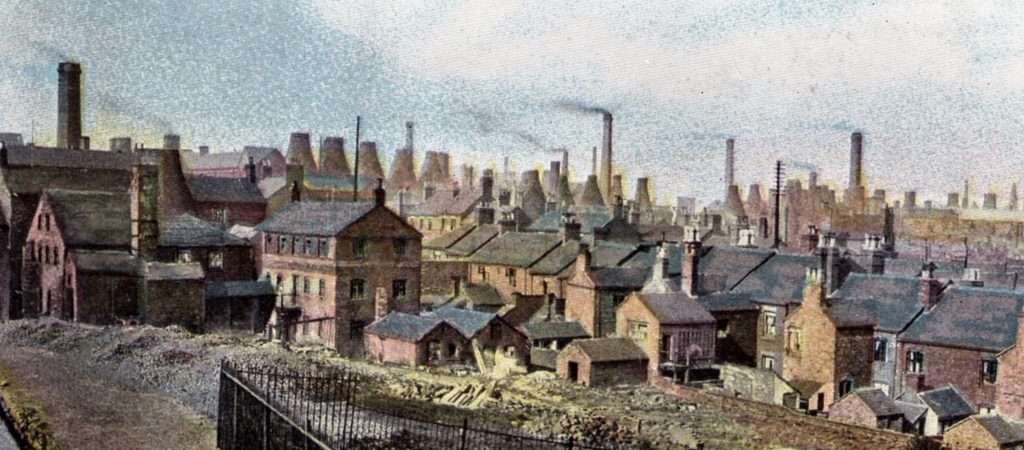
Through the efforts of potters such as Thomas Whieldon, Josiah Wedgwood, Josiah Spode and many others less well known, between 1750 and 1800 the local pottery industry had undergone a tremendous revolution. In 1762 when Wedgwood was just beginning his career as a major manufacturer, there were 150 potteries in the district employing over 7,000 people. By 1800, the figures for both had doubled. The improvement in trade was matched by technical developments and the use of new resources which improved the quality of the products produced. Thus the salt-glazed wares of one decade had been displaced in turn by creamwares and porcelains and by the turn of the century by bone china. All in all it had been quite an achievement in so short a time, As the words of the Wedgwood Memorial had it, these enterprising potters had ‘converted a rude and inconsiderable manufacture into an elegant art and an important branch of national commerce.’
It was an improvement noted by none other than that great observer of her age, the novelist Jane Austen. Jane never visited the Potteries and had only a vague notion of its location (she thought it was near Birmingham and may have been confusing the district with the Black Country). She was, however, part of the genteel social set that these new, finer, highly decorative wares were aimed at, for whom buying the latest thing in pottery became something of a craze.
In her letters Jane writes of visiting the Wedgwood showrooms in London and in one gleeful missive to her sister Cassandra in June 1811, she writes ‘I had the pleasure of receiving, unpacking, and approving our Wedgwood ware’ and anticipates the arrival of a new Wedgwood breakfast set for their mother, ‘I hope it will come by the waggon to-morrow; it is certainly what we want, and I long to know what it is like’.
A decade earlier, though, her enthusiasm for Staffordshire pottery found a release in one of her early novels. Though not published until after her death, Jane Austen’s Gothic conceit, Northanger Abbey, was revised and finished between 1801 and 1804. In chapter 22, there is a short witty passage that may be the first literary appreciation of the Staffordshire Potteries and their rising status amongst the ceramic capitals of the world.
‘The elegance of the breakfast set forced itself on Catherine’s notice when they were seated at table; and, luckily, it had been the general’s choice. He was enchanted by her approbation of his taste, confessed it to be neat and simple, thought it right to encourage the manufacture of his country; and for his part, to his uncritical palate, the tea was as well flavoured from the clay of Staffordshire, as from that of Dresden or Seve. But this was quite an old set, purchased two years ago. The manufacture was much improved since that time; he had seen some beautiful specimens when last in town, and had he not been perfectly without vanity of that kind, might have been tempted to order a new set.’
Though the line about a breakfast set made two years earlier being ‘quite old’ is a touch of Austen wit, it nevertheless reflects the real situation at that time, when local manufacturers were working day in, day out to keep their wealthy clients happy with newer and more exciting goods.
Reference: Letters of Jane Austen (1884); Northanger Abbey (1817)
Image reproduced with kind permission of The British Newspaper Archive (www.britishnewspaperarchive.co.uk)
Late in the evening of 18 January 1899, Mr Richard Smith of Stoke was walking along Bagnall Street, Hanley alongside the Victoria Hall, when he was startled by the sound of a gunshot nearby. There was no one else in sight, but he noticed that across the road, a door beside a small medical dispensary was standing part-way open. Peeking carefully through the opening into a dark passageway beyond he spotted a body lying on the floor a pistol in its hand. Alarmed, he dashed to the police office around the corner in the Town Hall and returned moments later accompanied by an inspector and several policemen. When they reached the passage they found 51 year old Dr John Craig who ran the dispensary examining the body of a woman who had clearly shot herself in the head. They could make out little more in the dark, but when the doctor announced that the woman was still breathing the police brought a stretcher and together they carried her across to the police parade room. Hardly had they got into the well-lit yard, though than Dr Craig let out a cry having recognised the woman before him. The man was visibly shocked and while a senior officer took him aside for questioning the police searched the injured woman for clues to her identity.Going through her pockets they found numerous items: some money, a few keys, a packet of arnica, a left luggage receipt from Stoke Station and several newspaper clippings, one of which carried a few lines from Tennyson’s poem, Sea Dreams.‘
……. he that wrongs his friend
Wrongs himself more, and ever bears about
A silent court of justice in his breast,’
There were also receipts for recorded letters and a cryptic inscription on a visiting card that indicated a strong connection with Dr Craig. These along with the doctor’s own faltering statement soon identified the woman as Catherine Devine, a 43 year old artist from Chelsea. The doctor explained how he knew her and what he believed had just happened here and why. The lady herself, though, did not live to give an account of her actions, dying from her wound at 10 p.m., without regaining consciousness.
Present-day Bagnall Street, Hanley.
The full story of the connection between Catherine Devine and Dr John Craig came to light two days later in front of a packed court at the coroner’s inquest into her death. Here, Dr Craig revealed that he and Catherine had known one another for about 25 years, having first met in her home city of Edinburgh. It was there that John Craig had trained as a doctor, being licensed in 1869 and shortly afterwards he had married Ellen Macintyre a native of the Potteries, before moving to the area and setting up his practice in Hanley. His wife had given him a son and daughter, but in December 1874 she died at the age of 25, leaving him a widower with two young children on his hands.
Among his late wife’s friends were Eliza and Catherine Devine of Edinburgh, daughters of a well-known and wealthy family of Scottish artists. Eliza had agreed to paint a posthumous portrait of Mrs Craig and whilst visiting their studio in 1876 to see how work progressed, Dr Craig had met and become so smitten with the younger sister Catherine, that he had been contemplating asking her to marry him. They corresponded for a time, but his marriage hopes had faded a short time later, when Catherine and several members of her family emigrated to New Zealand in 1878. Robbed of his potential bride the doctor had little choice but to get on with his life as a single parent and as the years passed he became very content with this state of affairs.
Catherine remained in New Zealand and later Australia for eleven years, carving out a moderately successful career as an artist, but in 1889 she returned to Britain. Settling in a studio flat in Glebe Street, Chelsea, her skills soon saw her supplying artwork for several London fashion magazines and eventually holding an exhibition of her works. To this she invited several old friends including Dr Craig. This restarted their acquaintance and they corresponded intermittently for a few years until Catherine was invited to spend Christmas with the Craigs at their house at Mossley near Congleton. During this visit, Dr Craig innocently noted to Catherine in conversation that prior to her departure to New Zealand he had contemplated asking her to marry him, and was surprised when she immediately asked him why he could not ask her now? The doctor replied that time had altered his circumstances, that he was content and he now had no thought of marrying anyone. Catherine seemed to accept that at the time, but the remark had struck a chord with this brilliant but lonely woman and she soon started to obsess over the matter.
Apparently oblivious to what he had started, Dr Craig extended another invitation for Catherine to stay once again a few months after this, but she soon upset the situation by again urging Dr Craig to marry her. He again refused and the next morning, whilst he was out, Catherine left the house under a cloud. Returning to find her gone, Dr Craig was left feeling very angry at her behaviour and that might have been the end of the matter, but a few months later he received a conciliatory letter from Catherine and he agreed to meet with her at her home in London when he visited the capital for Queen Victoria’s Jubilee in 1897. After watching the festivities he did indeed call on Catherine, prepared to let bygones be bygones, but when she again raised the subject of marriage he left in disgust and vowed never to visit her again.
Catherine then began to bombard Dr Craig with a series of scathing letters on his conduct that were followed more often than not by apologetic letters or telegrams asking him to reply. The doctor did reply to some to try and calm her down, especially when she began to threaten to kill herself. However, staggered by the barrage of letters he began to receive and the increasingly erratic mood swings of his would-be paramour, Dr Craig started to burn many of the letters unopened.
This state of affairs had carried on for the best part of a year, during which time Dr Craig had attempted to maintain his distance from Catherine. The death of her mother, though, in October 1898, seems to have made him sympathetically disposed towards her once more and shortly afterwards he met her again during a visit to London. He found her in a miserable state and recalled that she was in tears most of the time. Her one consolation was that she now wrung a promise from the doctor that if he would not marry her then he would marry no one else, an assurance he was happy to give. She also asked if she might be invited for Christmas once more if she avoided the question of marriage. Dr Craig told her that he and his daughter were in the process of moving into a house in Hanley adjoining his practice and would anyhow be in Northumberland visiting his mother over Christmas. He promised her, though, that once they had moved in after New Year, that she would be invited for a visit. Satisfied with this, Catherine parted amicably with Dr Craig and eagerly waited for the invitation to arrive.
Sure enough a few weeks later a letter did come, but the news it contained flung Catherine back into a rage. Dr Craig wrote to her saying that due to the work needed on the new house and because his daughter would be going abroad for a while, he did not feel that he could accommodate Catherine before his daughter’s return in March; in effect, for the time being at least, she couldn’t come. Stung by what seemed like another heartless rejection, Catherine wrote a furious reply saying that he had deceived her, adding ominously that she could not go on like this. It was a threat she had voiced before, but this time after all of the mental agonies she had suffered over the past year, it seems that Catherine had finally snapped. In the notes discovered after her death it appears that she wrote more letters to Dr Craig, but, as before, finding himself pestered beyond belief, the doctor had once again begun to burn the letters unopened. He was thus completely unaware of what she now set out to do.
Nor would he be the only one, as to most of her London friends the story of Catherine’s violent passion for Dr Craig would come as a great surprise, as she had displayed no outward signs of any great interest in men except as friends. All noted that she had been ill over the past year, stricken by a listlessness that her own physician, Dr Schorstein, put down to anaemia, but otherwise she seemed to be the same kindly, mild-mannered woman she had always been. As a result, none of them were aware – or could even have guessed – that Catherine spent early January 1899 preparing for her death, finishing a portrait of her doctor and wrapping up her affairs.
On the morning of 18 January, Catherine paid a visit to her housekeeper, Mrs Stoner, who had injured her wrist several days before and she now made sure that the elderly lady had everything she needed. Catherine told her that she would be going to Staffordshire for a few days, joking that it would give Mrs Stoner a rest from her. Back in her flat, Catherine left a package with a letter in her writing desk laying the blame for what she was about to do squarely on Dr Craig. Then she dressed well, putting on a fashionable lady’s walking-out costume, collected a nightdress she had wrapped up in brown paper (the police speculated that she brought the nightdress with her to be used as her shroud), a travelling rug, an umbrella and her purse containing money and a few notes to give the police enough clues to discover her story. She also pocketed the small, silver five-shot revolver that she kept for personal protection. Catherine then sent for a cab to Euston Station to catch the 4 p.m. train to Stoke. As she left, Catherine waved goodbye to her housekeeper and that was the last time that anyone who knew her saw her alive and conscious; it thus became the job of the police to reconstruct her last hours for the benefit of the inquest.
After a three hour journey north, the train arrived at Stoke Station at 7.14 p.m., and it appears that, after depositing most of her belongings at the left luggage office, Catherine had walked from Stoke into Hanley. Never having visited Dr Craig’s new house in Bagnall Street, she seems to have taken the better part of an hour locating it. Once she had, though, Catherine went into the gated entry where she removed her right glove to give her a better grip and taking out the pistol she placed the barrel against her right temple and pulled the trigger, inflicting the fatal wound.
Because of Catherine’s accusations against him, Dr John Craig found himself being closely questioned at the coroner’s inquest in an effort to determine if he was in any way morally responsible for what had taken place. Indeed, the doctor feared so much for his reputation that he had employed a solicitor to sit in on the inquest to represent his interests in the proceedings. However, the coroner was satisfied with the explanation that Dr Craig had given to the inquest; nor did the police see any reason to pursue the matter any further. The jury thought likewise and quickly returned the verdict that Catherine Devine had committed suicide whilst of unsound mind.
The final act in this tragic tale of missed opportunities and fatal obsession took place the day after the inquest, on Saturday 20 January, when the remains of Catherine Devine were interred at Hanley Municipal Cemetery. To avoid undue attention, the funeral took place a day earlier than advertised and the funeral cortège took a circuitous route to the cemetery for the same reason. Two of Catherine’s London friends, Miss Maud McCarthy and Dr Schorstein, who had appeared at the inquest, were the only mourners and not more than a dozen people stood around the grave in the pouring rain as the last rites were performed. As this was a suicide’s burial, there would be no headstone to mark her lonely plot, while the brass plate on the polished oak coffin bore only the simplest inscription.
Catherine Devine Died Jan. 18 1899, Aged 43 years.
Reference: Staffordshire Sentinel 19 – 23 January 1899. Numerous national and international papers January – March 1899.
A wildly exaggerated publicity image of Hannah Dale c.1889. Author’s collection.
Hannah Dale, ‘the Staffordshire Giantess’ as she became known, was born in in the village of Mow Cop on the 23rd February 1881. She was the daughter of 31 year old miner Thomas Dale and 28 year old Elizabeth Dale, nee Oakes of Dales Green, Mow Cop, and was their fourth child, Hannah having a brother and two sisters older than herself. All the family were normal average-sized folk, her father weighed 10 stone, and her mother was only 8 stone in weight and their other children were likewise quite ordinary. At the time of her birth Hannah too seemed to be a normal child, so small it was said that she could fit into a quart jug, but at the end of three months she began to develop very rapidly and this growth continued throughout her short life. Within a few years she had outstripped her older siblings in weight, and though she started out enjoying a perfectly normal childhood Hannah was growing taller and broader and soon became something of an attraction in the out-of-the-way village.
It is unclear when Hannah’s parent’s first started exhibiting their rapidly expanding child to a paying public, but she was certainly something of an attraction for the crowds when at the age of eight flyers such as the one seen here were advertising her for exhibition. Though depicted on the flyer as a veritable giant, Hannah was at this time actually only 4ft 4ins tall, but weight-wise she was prodigious, already weighing more than most grown men, so big that the family home at Oakes Bank, Dales Green had to have the doors widened. By the time she reached ten years of age, Hannah had grown to 4ft 11ins tall, had a 55-inch chest and her thighs measured 3ft around while the vaccination marks on her arms had stretched out to the size of small plates. Looking at her it was easy to forget that she was so young, but many papers were happy to point out that she was still very much a child, at her happiest playing with the other children in and around Mow Cop.
‘She is a bright, attractive, and talkative child, and plays as other children do of her own age. For her enormous weight she is very active, but if she accidentally stumbles and falls she cannot get up without assistance. Dolls are her great delight, and in making their apparel she exhibits considerable dexterity and intelligence… She has no special diet, but dines with the other members of the family, consuming as much food as a healthy man, and sleeping on an average twelve to fourteen hours each night. On the railway she travels with a half-ticket, a privilege to which she is entitled, but which often causes her father to supply his name and address to irate ticket collectors, who entertain an honest suspicion about a giantess who takes up as much space as three ordinary persons would occupy.’
South Wales Echo, 16 June 1892, p.2
For several years Hannah was exhibited around the country and by 1892 was becoming something of a celebrity. Early that year she was fulfilling an engagement at Sheffield, prior to going to America, but her fame was cut short when she fell ill with bronchitis in late May or early June of 1892. Her condition quickly worsened and she was taken home to recuperate, arriving there on Tuesday 7 June. However, it was too late and she died from the infection the next day.
At the time of her death, Hannah Dale, was 5ft 3ins tall, weighed 32st 6½lbs, and measured 5ft. 8in around the waist. Her size caused difficulties when it came to her funeral at St Thomas Church, Mow Cop, on 10 June. Her coffin was huge, its size demonstrated prior to her funeral by the undertaker, a Mr Boon, having five young men lying down sideways in it and easily closing the lid over them. Together with the corpse, this finally weighed 6cwt, (48 stone, or nearly 305 Kg) and took up a double plot. It required thirteen people to carry and then lower the little girl’s coffin into the grave.
Nearly 2,000 people, many of them friends and neighbours and other locals who had watched Hannah grow up assembled to witness the funeral. The inscription on her gravestone read:
IN LOVING MEMORY OF
HANNAH
The beloved daughter of
THOMAS & ELIZABETH DALE
Of Dales Green Mow Cop
WHO DIED JUNE 2ND (sic) 1892
AGED 11 years & 3 months.
HERE LIES MY DUST THE CHILD OF WONDER
I BID FAREWELL TO ALL BEHIND
AND NOW I DWELL JUST OVER YONDER
IN HEAVEN WITH GOD SO GOOD AND KIND
ALSO WILLIAM & WALTER their sons
WHO DIED IN INFANCY
Reference: Philip R. Leese, Mow Cop: Living on the Hill; Staffordshire Sentinel, 11 June; South Wales Echo, 16 & 22 June 1892; Daily Gazette for Middlesbrough, 22 June 1892, p.4; Hampshire Advertiser, 16 July 1892, p.7.
Hanley-born Commander Edward John Smith is best remembered as the captain of the ill-fated White Star Line steamer RMS Titanic, which sank on its maiden transatlantic voyage after colliding with an iceberg in 1912. In many ways the image of Smith presented in the disaster has coloured how we see the man, to some he is the villain of the piece, to others a tragic figure. The few earlier glimpses that exist though, paint Captain Smith in a far different light. For instance in 1911 following the successful maiden voyage of Titanic’s elder sister Olympic, Smith comes across as something of a raconteur, playfully spinning a yarn to deflect over- eager reporters.
‘Captain Smith of the Olympic was questioned in New York about the coal consumption of the world’s biggest liner on her first voyage. But Captain Smith shook his head and said:”That is a coal story I am not privileged to speak about. I’ll tell you another coal story, though, if you’d care to hear it?”
“I’d be delighted,” said the reporter. “Well,” said Captain Smith, “It’s a story about a poor sailor. He was taken down with fever on a brigantine. and, though the mate and captain dosed him well, he died. They buried him at sea. “They buried him with the usual impressive sea rites. He was sewed in a sail round which a flag was draped, and, to make him sink, the sail was weighted with a number of big lumps of coal. “A landlubber of a passenger participated in the services. He watched the well weighted corpse slip into the water. It disappeared at once, and the landlubber shook his head and said: ” ‘Well, I’ve seen many a man go below, but this is the first one I’ve seen taking his own coal down with him.’ “
Following the British invasion of the independent Zulu Kingdom in Southern Africa in January 1879, a force of over 1,700 men, mostly from the 24th Regiment of Foot, was camped at the foot of a sphinx-shaped rocky hill called Isandlwana. Here on 22 January, they were attacked by a Zulu army some 20,000 to 25,000 strong that they had supposed to be many miles away. As the Zulu warriors swarmed down from hills to the north and spread out in a wide arc to envelope them, the 24th Foot and numerous colonial units moved forward and formed a line to face the enemy and for some time – in the centre at least – they did successfully hold their ground, keeping the Zulus at bay with concentrated volley and cannon fire. In trying to keep in contact with a mounted force to the east, though, the main British line became fatally over-extended and in danger of being outflanked. Seeing this, Colonel Pulleine the officer commanding the camp ordered his forces to fall back to a more defensible position in front of the hill, but it was a fatal move. When the gunfire slackened the Zulus in the centre seized the moment and rushed forward in pursuit while those out on the plain soon outpaced and outflanked the British line to the east, rushing in on the camp and behind the retiring blocks of infantry, cutting off their escape. Chaos ensued as the British line disintegrated and the battle then degenerated into a mass of isolated fights with knots of redcoats surrounded by masses of Zulus. Some 400 men, mostly mounted troops, managed to escape the resulting slaughter before the end, but over 1,300 men perished on the British side, including nearly the entire 1/24th and a company of the 2/24th Foot. The Battle of Isandlwana became the worst defeat ever suffered by the British army at the hands of a native foe and for the time at least it effectively stopped the invasion of Zululand in its tracks.
The stained glass window and grave memorials to Private William Henry Hickin.
Several local men were killed in the action. In the ranks of the 1/24th were 25 year old Private William Henry Hickin from Hanley; the son of one Henry Hickin a local locksmith and bell hanger, William had previously worked as a writing clerk before enlisting in early 1876. Private George Glass 1/24th aged 22 from Shelton, was the son of a local school master and had briefly worked as a potter and joined the army in 1874. Private Enoch Worthington 1/24th from Kidsgrove, was 24 and had been a miner like his father before him; he enlisted in Newcastle in 1875. Private Samuel Plant 1/24th was an older man from Shelton, who had joined the 24th Foot in 1859, married in 1862 and prior to serving in Southern Africa he had served for a year on St Helena.
In the 2/24th, former potter Sergeant William Shaw from Tunstall, was about 32 years old. After joining the army in 1870 he was promoted corporal in 1873 and sergeant in 1877. He had married locally before joining the army, had four children and had served in India and Britain before being sent to Southern Africa. His wife Emma and their children had come with him on this tour of duty and were lodged in King William’s Town, Cape Colony, far away from Zululand. Private Samuel Poole, 2/24th is something of an enigma as several possible candidates of that name were born in Audley, Kidsgrove or Newcastle, but there is no clear evidence if any of these are our man, all we know is merely that a man of that name enlisted in Hanley on 27 April 1875 aged 21 years. Records state that he served in G Company 2/24th. Private David Pritchard 2/24th, was from Stoke-upon-Trent though no one of that name appears in the civil records so that may have been an alias. He claimed to have worked as a forgeman before joining up in 1865 and he went on to see service in India. Aged about 34 at the time of the Zulu War, records say he served in B Company, but that was the company left at Rorke’s Drift, so he had probably been transferred to G Company.
The most interesting of these local victims of Isandlwana from a historian’s point of view, is Sergeant William Shaw of the 2/24th, as evidence exists giving us a glimpse into his fate that day. According to the notebook of Corporal John Bassage 2/24th, now held at the Royal Regiment of Wales Museum, who was part of the force sent to bury the dead in June 1879 after the war was over, the remains of Sergeant Shaw and three private soldiers of the 2/24th were found together in a heap on the battlefield. The four men caught out in the open appeared to have formed into a small group in a last desperate attempt to try and fend off the Zulus as they poured into the camp. All seemed to have been stabbed to death with assegais.
Staffordshire Sentinel and Commercial & General Advertiser – Saturday 8 March 1879, p.5
In a report in the Sentinel noting Shaw’s death in action, it was stated that there were hopes of raising a memorial to him and all the Tunstall men killed in South Africa. This, though, never seems to have come to pass and of all the men mentioned above only one appears to have been commemorated locally. In December 1880 at St John’s Church in Hanley, a stained glass window was dedicated to the memory of 25 year old Private William Henry Hickin, whose father was a churchwarden there. Hickin was further commemorated on his grandfather and aunt’s gravestone in Hanley Cemetery. Private Hickin is in fact the only ‘other ranks’ casualty of the Battle of Isandlwana remembered with a memorial window.
A local soldier who who was initially listed as a casualty was Private Frederick Butler from Shelton and son of the proprietor of the Bell and Bear Inn. He was a soldier of the 1/24th but prior to the invasion he had been transferred to the Imperial Mounted Infantry, Though initially listed as a casualty of the battle, Butler was in fact many miles away with his new unit serving in another invasion column that saw action at the battle of Nyezane on the same day as Isandlwana. He survived the war, rejoined his own unit once the fighting was over and later returned to the Potteries.
Another local man who missed the battle, was 26 year old Private John McNally of C Company 2/24th Foot from Hanley. Described as being 5’ 5¼” tall, with brown hair, brown eyes and a fresh complexion, he was a former iron worker and had been a part-time soldier in the 3rd Staffordshire Militia before enlisting for the regular army in 1877. On 22 January 1879, he was part of a detached force that returned to the deserted battlefield of Isandlwana on the evening after the battle. Ten days later he penned a letter to his parents describing how they had returned to the camp that night and the soldiers of the 2/24th were sent in to retake it. His horror at the scenes he encountered is palpable.
‘Our tents were destroyed, our ammunition stolen, our rifles broken and taken off. Our hospital waggons were torn to pieces, the sick killed, the medicine bottles all broken, bags of flour and meal – in fact, everything – destroyed. It was a horrid sight for us. When we returned at night in the dark, we had to charge our way to camp with our bayonets. We were falling in holes and over anthills, and in camp we were falling over the dead bodies of our comrades, who had been killed, and awful as it is to relate, it is true – they were cut right down the chest and across their bellies, their bowels coming out. Some had their toes, some their ears, others their arms cut off, and some in fact – dear mother and father, I cannot describe the horrible treatment they had to suffer. The little band boys were tied to a waggon and their flesh stripped off them.’
McNally was writing home from the mission station of Rorke’s Drift which had also been attacked following the battle of Isandlwana. In his letter he then gives a pithy description of that battle that was later immortalised in the film Zulu, plus an account of one of their sick who had been left in the camp at Isandlwana, and who had a relative in the Potteries.
‘We had our company, B. Co., staying here to guard our stores. The Zulus came upon them and tried to take possession of our stores, but they were repulsed, our side losing about 12 men, the enemy about 900 or a thousand. We numbered about 100; the enemy numbered about 5,000 or 6,000. But although we have suffered this loss, we hope, please God, to have our revenge when we get some more troops out from England. We have been twelve days and have never taken our boots off, always watching day and night for the enemy making an attack, which they generally do at night. Tell McDermott that lives in Weaver-street, to write to his brother in Wolverhampton, and tell him that his son James has been killed. He went sick the morning our camp was attacked. If McDermott likes he can write to the commanding officer of his regiment, and he will give him every satisfaction respecting him.’
Unlike so many of his comrades in the 24th, McNally survived the war and stayed in the army until 1889, when he returned to the Potteries. He later married and had nine children. John McNally died in 1928, aged 75.
A panoramic view of the battlefield of Isandlwana. The British camp was situated in the middle-left of the picture. The Zulu attack came over the hill line in the distance. The white cairns in the near foreground are British burial pits.
Photo courtesy of Ken Ray
Reference: Staffordshire Sentinel, various issues March-May 1879., Pvt Mc Nally’s letter can be found in Staffordshire Sentinel, 26 March 1879, p.3. My thanks to Ken Ray for his detailed list and information on the local men killed at Isandlwana and to Alan Rouse for family and background information on Sergeant Shaw.