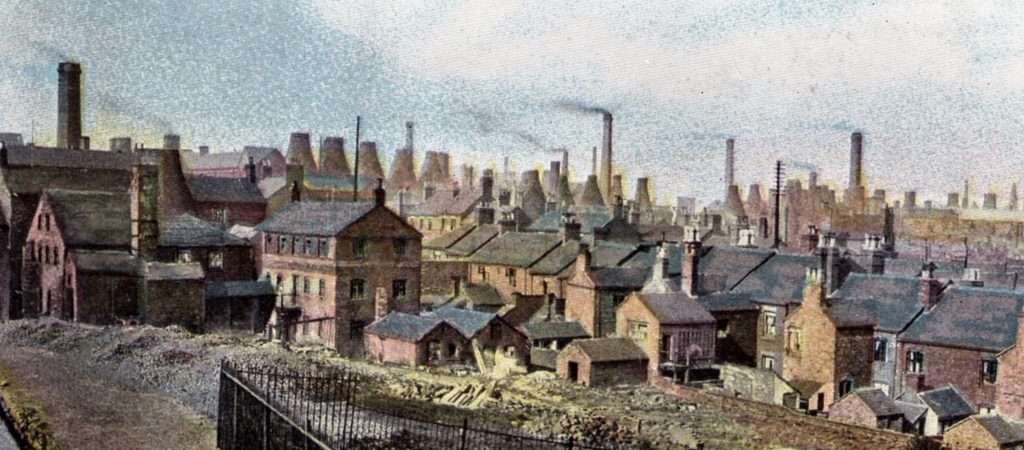

Born in Pitts Hill, Tunstall in 1878, Elizabeth Longsdale came from a musical family, her father William was a potter, but served as the choir master at Christ Church, Tunstall, and several other family members such as her brother Wilson, would make their names locally as singers. It was Elizabeth, though, who under the alliterative stage name of Lily Lonsdale, would become the most famous, carving a notable career in the music halls of Britain and abroad.
Elizabeth started her singing career as a soloist at local concerts and enjoyed a spell with the North Stafford Amateur Operatic Society before turning professional when she joined Thomas Tomkinson’s Gypsy Children. This was a local choir turned concert party that was composed of talented children and adolescents that had gained quite a following in the Potteries. The troupe served as a training ground for several local performers who later went onto greater things, most notably Gertrude Mary Astbury who as Gertie Gitana would become one of the best know stars of the music halls. Elizabeth (now billed as ‘Lily Lonsdale’) shone just as brightly, impressing audiences with her beautiful, well-modulated voice and garnering great praise. By 1897, the troupe had moved beyond the Potteries and began touring the Midlands and Wales, performing in various venues like theatres and town halls, supported by parents and helpers who assisted with logistics and costumes.

By mid 1899, Lily now in her early 20s was getting too old for child roles, and she was also romantically involved with Ernie Myers, a comedian from the troupe. However, her initial attempts for a career shift suffered a setback. After leaving the Royal Gipsy Children, she joined a rival troupe, Leon Vint’s Globe Choir, but soon had to resign due to vocal strain. This set her at odds with Vint, who after first agreeing to let her go then changed tack and took Lily and her sister Agnes to court for breech of contract. However, once in court, the judge deemed that Vint had acted unfairly and that the contract was far too heavily-weighted in his favour and as a result he ruled in Lily and her sister’s favour and they went on their way unhindered, leaving Vint with the costs for his bully-boy behaviour. Lily made a brief return to the ranks of the Royal Gypsy Children, but following the unexpected death in late January 1900 of Thomas Tomkinson the troupe’s founder, she and Ernie decided to set out on their own, securing an agent and booking early performances on the music hall circuit; they married in Liverpool in April 1901 whilst on tour. Shortly afterwards they were put on the so-called Moss and Thornton tour, taking in a series of theatres and musical halls across Ireland, northern England and Scotland.

In 1901, Lily took a short break to have their son, Jacob William, but hard economics often meant that family life came second to their performing careers. Leaving their son with Lily’s mother, they resumed a busy schedule of public performances across Britain, building their careers. They used their stage names and normally performed separately, with Ernie as a popular ‘patter’ comedian telling amusing stories and Lily as a classical soprano singer, though occasionally she took on comedy roles in sketches opposite her husband. They shared the stage with various entertainers, including conjurors, ventriloquists, impressionists, acrobats, marksmen, puppeteers, clowns, jugglers, dancers and performing animals as well as other comedians and singers. An undoubted highlight of their careers was performing on the same bill as the famous American escapologist Harry Houdini in 1905, when he was on a tour of Britain.
The demands of travel and performing were tough; they worked six nights a week, with Lily often singing multiple songs per show, and she and Ernie were constantly in search of fresh material. During winters, they performed in pantomimes together, with Ernie playing the villain in “Aladdin” and Lily as the princess.
By 1911, their careers were going well and the couple lived comfortably in Derby with their daughter Lillian May and son Jack who were cared for by Lily’s mother. In August of that year, they were invited to perform in South Africa but returned by December. Their routine continued until 1914 when they travelled back to South Africa. Sadly, Ernie fell ill and died on the ship before reaching port, leaving Lily heartbroken and reliant on support from the theatre community in Cape Town. After Ernie’s funeral she stayed on to complete her contract, then she returned to Britain to support her family amid the challenges of the Great War.

Despite wartime difficulties, Lily found work in successful and topical revues like Mind Your Own Business and My Son Sammy, and whilst on tour the theatre company would often lay on special performances for wounded soldiers in hospitals, which proved very popular. Her career flourished through the war and after, but away from the limelight her mother’s declining health was a worry. In May 1920, Lily suffered a nervous breakdown due to exhaustion and stress, and shortly afterwards her mother passed away, leading to another break from performances.

Over the next five years, Lily remained active but by her late 40s, probably as a result of her arduous lifestyle, her health began to suffer. Her career ended suddenly in August 1928 when she collapsed on stage in Wolverhampton. Although she finished her performance, she was taken to the hospital and she never really recovered. Lily died on 2 March 1929, aged 49, at the Derbyshire Royal Infirmary. There were short obituaries to the singer in the Sentinel and in a couple of Derby papers over the next couple of days, but that was the limit of the press coverage. She was buried at Derby’s Nottingham Road Cemetery four days later.
Reference: Staffordshire Sentinel, 8 March 1929.