The Timothy Trow Memorial, London Road, Stoke. Image: Google Earth
At about a quarter past four on the afternoon of 13 April 1894, a three year old girl named Jane Ridgway who lived with her parents at Steele’s Cottages alongside the Newcastle canal* in Boothen, Stoke, tumbled into the water. Nearby 21 year old Timothy Trow, a tram conductor who was in charge of the car working London Road that afternoon, was just about to signal to the driver to pull away from the West End terminus, when he heard a loud splash from the adjacent canal and saw the little girl in trouble. Without a thought for his own safety, Trow – a non-swimmer – got down from the tram, ran to the canal and jumped in. He managed to wade most of the way across the cut, the water only coming up to his waist, but then it fell away much deeper and Trow called out to his colleague the tram driver that he had cramp. The young man was in trouble and seemed to become helpless in the water. A passer by, Mr Henry Lloyd of Beresford Street, Shelton was one of several other men who rushed to the canal and he now jumped in to help Trow while another man, John Forrester of Wellesley Street, Shelton also plunged in and fished little Jane Ridgway out of the water. Timothy Trow desperately grabbed hold of Mr Lloyd who tried to pull him to the bank, but Lloyd too was struck by cramp and unable to hold onto the floundering man who threatened to pull him under had no option but to let go. Lloyd managed to scramble back to the bank where others hauled him out while John Forrester having handed Jane Ridgway to others, also tried to grab onto Trow, but to no avail. Every effort was made to catch the drowning man, but it was futile and in the struggle Timothy Trow disappeared from view and it was not until half an hour later that his body was found.
This dramatic rescue that ended in tragedy made quite an impact in the Potteries and all involved were praised for their bravery, especially Timothy Trow whose selfless act in going into the canal despite not being able to swim won him a massive amount of sympathy. As a result, his funeral three days later was a grand affair attended by dozens of mourners, his parents, family and friends as well as 30 fellow tram conductors and drivers who had been let off work for the day to attend the service as well as several company officials. Numerous wreaths decorated the hearse and hundreds of people watched from the pavements while blinds were drawn in many houses along the route that the funeral cortege took on its way from Timothy’s family home in William Street, Hanley to Hanley Borough Churchyard.
All this and the church ceremony were reported in the Sentinel which several days later announced that a memorial committee was being formed to raise funds for a permanent memorial to the young tram conductor and during the summer news came that Timothy Trow, Henry Lloyd and John Forrester were to be recognised by the Royal Humane Society. By early October a sum of £47,11s had been raised, enough to fund an 8 feet tall obelisk made of grey granite to be sited in London Road near to the scene of Trow’s deed and a marker was placed on his grave in the cemetery. The inscription picked out in gold near the base of the obelisk reads: ‘Erected by Public Subscription in Grateful Memory of TIMOTHY TROW, tram conductor aged 21 years who lost his life by drowning near this spot, in an heroic effort attempt to save that of a child April 13th 1894.’
The remaining money from the collection was divided between Messrs Lloyd and Forrester. On 22 October 1894, a large party of council officials and a crowd of onlookers were in attendance when the obelisk was unveiled, after which Henry Lloyd and John Forrester were presented with their certificates from the Royal Humane Society while the Society’s ‘In Memorium’ certificate for Timothy Trow was later presented to his parents. Despite the depredations of years in the open and the unwanted attentions of an occasional vandal, the obelisk still stands today and forms to focus of ‘Timothy Trow Day’ on 13 April each year that still draws a crowd to remember one young man’s brave deed.
* The Newcastle branch of the Trent and Mersey was a four mile long canal connecting Newcastle to Stoke. It no longer exists, having long since been filled in.
References: Staffordshire Sentinel, 21 April 1894, p.2 and 11 October 1894, p.3; Birmingham Daily Post 16 April 1894 p.8 and 23 October 1894.
Regular newspaper coverage of events in the Potteries only really started at the end of the 18th century with the advent in 1795 of the Staffordshire Advertiser paper, though as this was published in Stafford, it’s coverage of the goings on in the north of the county was limited to the most noteworthy events. Another half century would pass before more local newspapers were being produced in Hanley, Stoke and Burslem. However, histories, travellers’ journals and some other national or regional papers occasionally carried tales from the Potteries from this early period, giving us fleeting glimpses into life in the area. These range from descriptions of the growing pottery industry and the construction of the canals, to bizarre deaths, odd weather and local curios.
See a Fine Lady Upon a White Horse
Between 1697 and 1702, partly from a wish to improve her health and from an equally strong desire to see more of her native land, Lady Celia Fiennes (whom some claim was the fine lady at Banbury Cross from the children’s nursery rhyme) undertook a series of journeys around England. In the summer of 1698, her peregrinations brought her into North Staffordshire. Here, after admiring the as yet unsullied landscape, she was keen to visit the Elers Brothers’ factory at Bradwell, but as she notes in her diary she was unsuccessful; the potters had temporarily run out of clay and were not working.
‘..and then to Trentum, and passed by a great house of Mr Leveson Gore, and went on the side of a high hill below which the River Trent ran and turn’d its silver stream forward and backward into s’s which Looked very pleasant Circling about ye fine meadows in their flourishing tyme bedecked with hay almost Ripe and flowers. 6 mile more to NewCastle under Line.’
After ruminating briefly on the ‘coals to Newcastle’ adage, she continued.
‘… I went to this NewCastle in Staffordshire to see the makeing of ye fine tea potts. Cups and saucers of ye fine red Earth in imitation and as Curious as yt wch Comes from China, but was defeated in my design, they. Comeing to an End of their Clay they made use of for yt sort of ware, and therefore was remov’d to some other place where they were not settled at their work so Could not see it;’
(Reference: Celia Fiennes, Through England On a Side Saddle in the Time of William and Mary, pp.146-147.)
A Swedish Spy in the Valley of Crockery
A visitor to the mid-18th century Potteries was Reinhold Rücker Angerstein, an industrial spy in the employ of the Swedish government, who was tasked with gathering information on new or emerging technology. Between 1753 and 1755, he journeyed through England and Wales and produced a wide-ranging and comprehensive survey of the various industries and their practices. He appears to have visited the Staffordshire Potteries, which he labels rather colourfully as a ‘Valley of Crockery’, in about 1755. Here, after examining the manufacture of salt-glazed wares, describing the kilns in Hanley (including illustrations), the raw materials used, the prices of ware and various mechanisms employed in producing pottery (with still more pictures), he went on to add a few descriptions of the area that make for interesting reading.
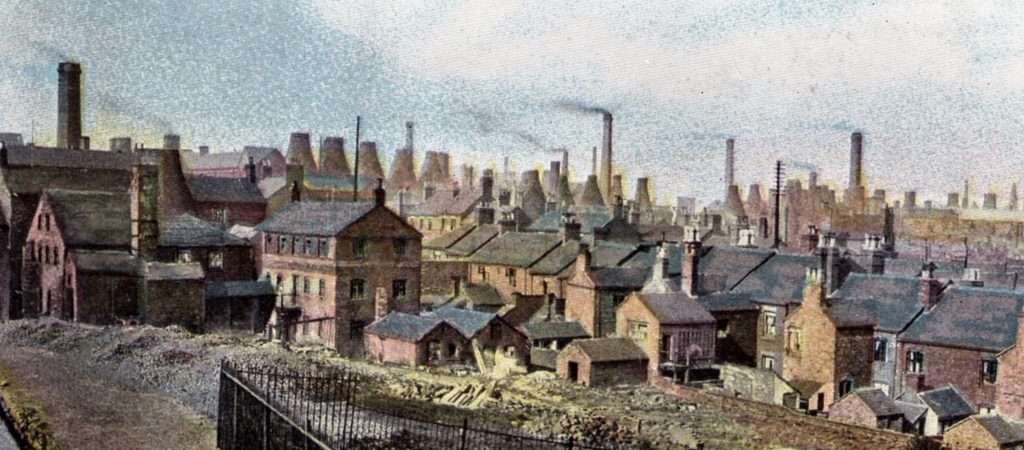
He notes that in Hanley there were 430 makers of white ware and other types of pottery, adding ‘The kilns are everywhere in this district.’ and to prove his point he includes an illustration of the skyline of the town. There were also large numbers of potteries in Stoke and other places, ‘where mostly the same kind of ware as that enumerated is made and also some simpler crockery.’ He then adds a picturesque and slightly comical tale. ‘When as it sometimes happens, many kilns are glazing with salt at the same time, there is such a thick smoke of salt in these towns, that people in the streets cannot see 6 feet ahead, which, however does not cause any difficulties. On the contrary, the smoke is considered so healthy that people who are ill come here from far away to breathe it.’
Of the pottery itself, he writes, ‘The crockery produced is mainly sent to London or other sea ports, from which much of it is exported to America and many other foreign countries.’
(Reference: R. R. Angerstein’s Illustrated Travel Diary 1753-1755, pp. 340-342)
John Wesley preaching to a crowd
Pelted in the Potteries
On 8 March 1760, the Reverend John Wesley, the founding father of Methodism, visited Burslem for the first of many visits to the region. He described Burslem as ‘a scattered town, on the top of a hill, inhabited almost entirely by potters’, a large crowd of whom had gathered to hear him at five in the evening. He noted that great attention sat on every face, but also great ignorance which he hoped he could banish.
The next day Wesley preached a second sermon in Burslem to twice the number of the day before. ‘Some of these seemed quite innocent of thought. Five or six were laughing and talking till I had near done; and one of them threw a clod of earth, which struck me on the side of the head. But it neither disturbed me nor the congregation.’ –
(Reference: John Wesley, Journal, 8-9 March 1760)
The First Cut
After receiving the royal assent two months earlier for construction of a canal connecting the rivers Trent and Mersey, on the morning of 26 July 1766, at a site just below Brownhills, pottery manufacturer Josiah Wedgwood cut the first sod of what would in time become the Trent and Mersey canal. James Brindley, the engineer who would oversee the canal’s construction, and numerous other dignitaries were present, many of whom would also cut a piece of turf, or wheel away a barrow of earth to mark the occasion. In the afternoon a sheep was roasted in Burslem market place for the benefit of the poorer potters in the town. A bonfire was also lit in front of Wedgwood’s house and many other events took place around the Potteries by way of celebration.
(Reference: Jean Lindsay, The Trent and Mersey Canal, pp.31-32)
News from the North
Extract of a Letter from Burslem, 14 August 1766,
‘As you often give me London News, I will give you some from this Country, which has of late made a Figure. This Neighbourhood has for many Years made Pots for Europe, and will still do so, though the King of Prussia has lately clapt 28 per Cent, upon them. Our Roads were so bad that nobody came to view the Place where the Flint Ware is made, but now we have Turnpikes upon Turnpikes, and our Potteries are as well worth seeing as the Stockport Silk-Mills, or the Bridgewater Navigation, which we intend to beat hollow by Lord Gower’s, now begun in our Meadows, and advancing apace towards Harecastle, on the other Side of which Multitudes of Men are at work, and before Christmas we shall have cut through the Hill, and made another Wonder of the World. There are already 100 Men employed on our Side, and 100 more will be added as soon as Wheelbarrows can be procured for them. Saturday last we had brave Sport at Earl Gower’s, where 100,000 Spectators were present at the Prison-Bars played in Trentham Park. Among them were the Dukes of Bedford and Bridgewater. The Prizes were Ten Carline Hats, with gold Loops and Buttons, given by the Earl. The Cheshire Men were active Fellows, but unluckily their Lot was to wear Plod Drawers, to distinguish them from their Antagonists, which made the Crowd oppose their getting the Honour of the Day. During this Game, my Friend Bucknall loft his Boy, about Eight Years of Age, who was suffocated by going aslant down a Sort of a Cave into an old Coalpit, the top of which was fallen in. The Man that ventured to fetch him out, found a Number of Birds, supposed to have dropped down there by the sulphurous Stench issuing from the Pit. We have much Hay, and Cheese is plenty, and Corn without Barn-room, nor do we want Money.
P. S. I have just seen a Hen, which laid Twelve Eggs only, from which she has brought up Twelve Cock Chickens, which is looked upon as somewhat remarkable.’ –
(Reference: Derby Mercury, Friday 29 August 1766, p.2)
In Praise of Mr Brindley
Extract of a Letter from Burslem in Staffordshire. dated September 5.
“Though our Stone Ware has been universally used, yet till our Turnpikes were made few People ever saw our Manufactories. But now they are gazed at as a Novelty. The Ladies go to Warburton’s to buy the Queen’s Sets of Cream-coloured Ware; and the Gentle-men come to view our Eighth Wonder of the World, the subterraneous Navigation, which is cutting by the great Mr. Brindley, who handles Rocks as easily as you would Plumb-Pyes, and makes the four Elements subservient to his Will. He is as plain a looking Man as one of the Boors of the Peak, or one of his own Carters; but when he speaks all Ears listen, and every Mind is filled with Wonder at the Things he pronounces to be practicable. He has cut a Mile through Bogs, which he binds up, embanking them with the Stones which he gets out of the other Parts of the Navigation, besides about a Quarter of a Mile into the Hill Yeldon; on the Side of which he has a Pump, which is worked by Water, and a Stove, the Fire of which sucks through a Pipe the Damps that would annoy the Men, who are cutting towards the Centre of the Hill. The Clay he cuts out, serves for Brick to arch the subterraneous Part, which we heartily wish to see finished to Wilden Ferry, when we shall be able to send Coals and Pots to London, and to different Parts of the Globe.— Another Mile is cut on the Cheshire Side of the Hill, and the Men intend to meet in the Middle by Christmas, when they are to have an Ox roasted whole, and an Hogshead of Ale.”
(Reference: Derby Mercury – Friday 18 September 1767, p.2)
Tunnel Vision
On 1 July 1772, an anonymous correspondent writing from Burslem related what he had seen the day before when he and some companions paid a visit to the first incarnation of the Harecastle Tunnel, situated between Tunstall and Kidsgrove and then under construction as part of James Brindley’s Trent and Mersey Canal.
‘Yesterday we took a walk to the famous subterraneous canal at Harecastle, which is now opened for a mile on one side of the hill, and more than half a mile on the other, of course the whole must be compleated in a short time. As it is not yet filled with water, we entered into it, one of the party repeating the beautiful lines in Virgil, which describe the descent of Æneas into the Elysian fields. On a sudden our ears were struck with the most melodious sounds. – Lest you should imagine us to have heard the genius or goddess of the mountain singing the praises of engineer Brindly, it may be necessary to inform you, that one of the company had advanced some hundred paces before, and there favoured us with some excellent airs on the German flute. You can scarcely conceive the charming effect of this music echoed and re-echoed along a cavern near two thousand yards in length.’
(Reference: Leeds Intelligencer, Tuesday 14 July 1772, p.3)
A Fungi to Be With
No age is free of stories of novelty fruit, veg or mushrooms:
‘A few days ago, a mushroom was got at Stoke-upon-Trent, in the county of Stafford, whose diameter was 5 inches, and 30 inches in circumference, it weighed 16 ounces. The above is very authentic.’
(Reference: Leeds Intelligencer, 5 September 1775, p.3)
All in a Spin
In 1781, there was the story of a curious weather phenomenon, a whirlwind or perhaps a mini tornado:
‘The following extraordinary phenomenon was lately observed here; at the latter end of last month, a field of hay belonging to Mr. J. Clark, near Burslem, was carried off by a whirlwind; the day when it happened was exceedingly calm, scarce a breath of air to be perceived. The people who were at work in the field observed, that in one part the hay began to be agitated in a small circle, at every wheel it increased in size and velocity, continually sucking more hay into its vortex; after a considerable time it began to ascend, taking along with it a silk handkerchief which hung rather loosely about the neck of one of the men who was at work; it continued ascending till entirely out sight, and in about an hour it began to descend, and continued to so for an hour’s space, alighting at, or within a few hundred yards of the place from whence it had been carried up, so that the owner lost but a very trifling quantity of his hay.’
(Reference: Hereford Journal, 23 August 1781, p.2)
A Tragic Accident
The following melancholy tale from the Potteries is related in a letter dated August 14 1785.
‘As Ellen Hulme, a poor woman of Lane End, was returning to her habitation late last night, with her infant, six weeks old, in her arm, she unfortunately stepped into a coal-pit, which shamefully lay open close to the road, and even with the track which led to the poor creature’s house. Her husband, whom she had been to fetch from an alehouse, immediately alarmed the neighbourhood, when her distressing cries were very distinctly heard from the bottom of the dreary pit every effort was attempted by the hardy colliers to fetch her up, but the damp prevailing very much, obliged them to use means to extract it, after which was found the mother with her infant upon her arms, both dead.’
(Reference: Sussex Advertiser, 22 August 1785, p.3)
A Hard Winter
During the harsh winter of 1794-1795, the better off inhabitants of Hanley and Shelton formed a committee which started a subscription list for the temporary relief the poor who were suffering great hardship during the cold weather. By February 1795 the committee had collected an impressive £150, enough to enable them to supply nearly 500 local families with meat, potatoes, and cheese. The Wedgwood family gave a liberal amount and through them a Mrs Crewe kindly added a welcome donation of a quantity of flannel clothing. The Marquis of Stafford aided the relief fund by ordering 100 tons of coal to be at the distribution of the committee.
A month later, in an issue of the Staffordshire Advertiser that noted that thermometers in Macclesfield had measured temperatures as low as -21° F (-29.4° C), the fearsome nature of the winter was highlighted dramatically by one small but rather macabre snippet of news: ‘Through the inclemency of the night of Saturday last [i.e.,14 March] a poor man perished betwixt Hanley and Bucknall. He unfortunately lost himself in attempting to cross the fields, and was found on Sunday standing upright in a snow drift, with his hand only above the surface.’
(Reference: Staffordshire Advertiser, 7 February 1795, p.3; 21 March 1795, p.3.)
Dashed to Pieces
‘A melancholy accident happened on Wednesday last at a coal-pit near Lane Delph, in the Pottery. A poor woman employed in drawing up the coal, was by some accident unfortunately thrown into the pit, and was literally dashed to pieces.’
(Reference: Derby Mercury, 30 June 1796, p.4).
Wild Fire
In late March or early April 1799, a dreadful accident happened in a pit at Lane End, the property of John Smith, Esq. Four men were blown up, and two them terribly burnt by what the colliers of the time described as ‘the wild fire’. The explosion was loud, and the concussion so great that nearby houses shook violently. Two of the men were not expected to recover, while the other two were thrown to a considerable distance, and left badly bruised. The reporter noted that their hats were blown to the distance of 70 yards from the mouth of the pit.
(Reference: Staffordshire Advertiser, Saturday, 6 April 1799, p.4)
On 1 September 1939, Tom Rolt and his wife Angela were travelling along the Trent and Mersey canal aboard their narrowboat, Cressy. Arriving at Trentham Bridge to take on some fuel they were hailed by a boatman at the tiller of a passing barge, who told them that Germany had invaded Poland. That day they passed through the Potteries, and the Harecastle Tunnel on into Cheshire, where two days later they heard the announcement that war had been declared.
Rolt, a future campaigner for preservation of Britain’s neglected canal system and one of the founders of the Inland Waterways Association, later wrote a lyrical account of their journey entitled Narrow Boat, which sparked a post-war resurgence of interest in this by-then woefully neglected transport network. A traditionalist at heart, Rolt was dismissive of many of the towns and cities they passed through, but devoted two short chapters to their brief passage through the Potteries. His appreciation of the area and its people stemmed from the fact that he had some years earlier partially served his engineering apprenticeship at Messrs Kerr, Stuart and Co, locomotive engineers in Stoke.
Reference: L.T.C. Rolt, Narrow Boat pp. 115-129; Landscape With Canals, p.3.