On 11 June 1956, 46 year old Arnold Machin and his 34 year old wife Pat of number 15 The Villas, Stoke, took a stand against the encroachment of post-war brutalist architecture and what they saw as the insidious spread of ‘subtopia’ near their home. When they heard that morning that a gang of workmen were coming later that day to remove an old Victorian lamp-post from the centre of their estate and replace it with a modern streamlined concrete electric lamp-post, they were appalled that such a fine bit of street furniture was being usurped simply in the name of progress. So, the Machins decided to make a stand and promptly sat themselves in front of the lamp for the next six hours. It was a hot day, so they hunkered down under an umbrella and tellingly sat reading The Seven Lamps of Architecture by John Ruskin, (an essay that outlined the principal demands of good architecture) and waited to see what transpired.
Arnold Machin was no mean intellect when it came to the subject of form and beauty. Born in 1911 at Oak Hill, he had begun his working life as a china painter at Mintons, but moved on to study sculpture at the Art School in Stoke, followed by a stint at Derby Art School and then the Royal Academy in London. He was later retained as a designer for Wedgwood and worked a teacher at the Burslem School of Art and in the same year that he made his stand over the lamp-post, he was elected as a member of the Royal Academy and a Fellow of the Royal Society of British Sculptors. And as his record showed, like many a seemingly straight-laced academic, he had a strong rebellious streak and was prepared to stand up for his beliefs come what may. Sixteen years earlier Arnold Machin had done just that and served time in prison during World War Two for being a conscientious objector. Now, when the workmen turned up he stuck to his principles once more, saying: ” I forbid you, as a token protest on my part, to remove this ornamental gas-lamp centrepiece.”
Faced by the prickly couple and not sure what to do, the workmen politely withdrew and put in a call to the city surveyor, Mr D. F. Brewster who soon arrived on scene. In response to the official, Mr Machin merely turned to Chapter IV “The Lamp of Beauty.” of Ruskin’s work and carried on reading. When shortly after this a police inspector and a sergeant also appeared, seeing what was afoot Machin put down his book, threw his arms around the lamp-post and his wife slipped a chain around his wrists and padlocked him in place. Mr Machin then proclaimed to the police: “This is my protest against the destruction of all the beautiful things which is going on in this country.”
The officials paused to have a quick conference then offered Mr Machin a compromise, saying that he could have the lamp-post to have in his garden. He was satisfied with the suggestion, so Pat unlocked him. A crane arrived a short time later, pulled the lamp out of the ground, carried it 40 yards to the Machins’ house and dropped it neatly outside their front gate. Undaunted by the large post with a sizeable block of concrete at the bottom, the Machins said they were going to mount a commemorative plaque on it, find somewhere to put it in their garden and surround it with flowers.
On 1 April 1852, the writer Charles Dickens wrote a letter to his wife Kate informing her ‘We think of going on tonight from Birmingham to Stoke upon Trent.’ Despite worries about the trains, it seems that he and a travelling companion arrived in Stoke the next morning. Here after gazing with some fascination at the town before him, the famous author (who at the time was also writing up weekly instalments of his longest book, Bleak House) spent a few hours at the Spode factory which was at that period owned by W. T. Copeland.
Dickens started his tour of Copeland’s works by watching a thrower and his attendant swiftly and skilfully fashion a breakfast set for his amusement, watched jiggerers and pressers making bowls and basins and saw Parian statuettes being produced in moulds. He then explored the factory kilns, seeing the saggars being stacked prior to firing and mused on the constant cycle of heating and cooling that accompanied the manufacture of pottery. This was followed by visits to see transferers and decorators at work, producing willow pattern wares or fancier stuff, before moving on to the dipping shop for glazing and then to the placers carefully loading the ware into the appropriate saggers prior to them being loaded into the kilns he had seen earlier. Dickens seems to have enjoyed his tour and it was doubtless a thrill for the workers at the Copeland works to meet, albeit briefly, one of the biggest celebrities of the Victorian age and show him their own impressive skills. Armed with all he had seen and imbibing a good working knowledge of the history and process of pottery making, Charles Dickens moved on the next day to Stafford.
Compared to the grime and industry of the Potteries that evidently spoke to his imagination, Dickens was bored with Stafford and rather rude about the place, ‘it is as dull and dead a town as any one could desire not to see’ he wrote tartly. He lodged at the Swan Inn, which he disparagingly nicknamed ‘the Dodo’ and where he apparently seemed doomed to spend a very dull evening indeed. According to the tale he told, though, he chanced to look at the bottom of a plate and saw the name ‘COPELAND’, which set him to musing on the previous day’s events. Employing a literary conceit, he then let the plate ‘remind’ him of all he had seen at Copeland’s pot bank, telling the story outlined above as a journey through its creation. The plate’s ‘recollections’ got Dickens through the evening, so he claimed, though one might suppose that he was actually quite busy putting his recollections down on paper. His clever bit of writing, ‘A Plated Article’, was published in the magazine Household Words, on 24 April 1852.
In early 1888, 22 year old Herbert George ‘H. G.’ Wells was recovering from a disorder of the lungs, and went to stay with an old college friend William Burton and his wife at their terraced house in Basford for a few months, where he proved a somewhat petulant and troublesome house-guest. The future ‘father of science fiction’ had lived most of his life in rural or semi-rural districts and the Potteries was the first truly industrial landscape he had encountered. In his autobiography he noted:
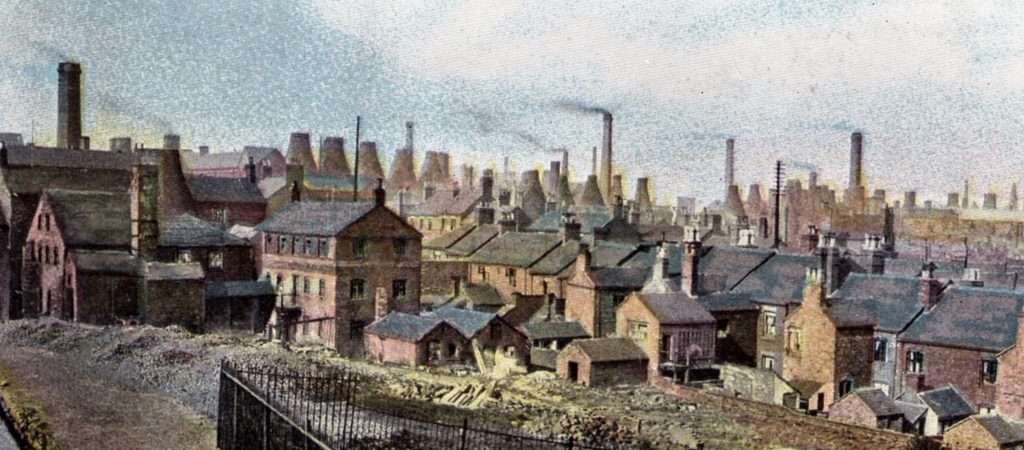
‘I found the Burtons and their books and their talk, and the strange landscape of the Five Towns with its blazing iron foundries, its steaming canals, its clay whitened pot-banks and the marvellous effects of its dust and smoke-laden atmosphere, very stimulating. As I went about the place I may have jostled in the streets of Burslem against another ambitious young man of just my age who was then clerk to a solicitor, that friendly rival of my middle years, Arnold Bennett.’
Indeed, the two authors later became good friends and he wrote to Bennett, ‘the district made an immense impression on me’ and his memories of the area later found their way into his works. He added that it was ‘… at Etruria my real writing began’ and it was whilst here that he concocted a curious scientific romance, ‘The Chronic Argonauts’ that became the basis of his first novel, The Time Machine.
His stay in the Potteries allowed Wells to recuperate in comfort, but as his health improved he realised that it was time to move on. He later recalled how one afternoon in June, whilst lying in a wood full of bluebells, revelling in the sunlight and the effect of the nodding flowers around him, a curious resolution swept over him. “I have been dying for nearly two-thirds of a year,” he mused, “and I have died enough.” On returning to his lodgings he told the Burtons he would be leaving them and the next day he took the train back to London. Not one to miss an opportunity for a story, in the 1890s, Wells wrote a fictionalised account of his recovery and his moment of revelation in the Potteries was made much more picturesque. Entitled ‘How I Died’, in the story he describes how after four months lying ill and convinced that he was dying, an invalid staggered out one early spring morning to get some fresh air and take a last look at the sky before expiring, when he encountered a young girl who had got her dress caught by a bramble whilst climbing a hedge. After helping her free, the invalid stood chatting with the girl about this and that and he noted that she carried a small bunch of wood anemones that she called ‘wind-stars’. Charmed by the pretty name that the innocent youngster gave to her flowers, he suddenly realised that he was bored with the idea that he was dying and decided to put all gloomy thoughts aside and get on with his life.
This imagined encounter not only echoes Wells’ real recovery, but also bears similarities to the time traveller’s first meeting with the childlike Eloi, Weena, in The Time Machine, who presents a bunch of flowers to the time traveller for saving her life, then sits with him as he tries to communicate with her. Also in The Time Machine, a friend of the time traveller refers to a conjuror he had once seen in Burslem, while the spectacle of the Potteries at night with its numerous kilns and furnaces casting a fiery glow into the sky, is famously referenced early on in The War of the Worlds, to describe the destruction wrought by the Martian war machines.
In addition to these famous examples there were lesser tales of his that owed something to the Potteries. In 1895, the same year that The Time Machine was published and he began work on The War of the Worlds, Wells had a short macabre horror story The Cone published, which was set in a fictional forge in Etruria, and was probably based on Earl Granville’s iron works. That story was all that remained of what Wells had originally planned to be a larger dramatic novel set in the area, ‘… a vast melodrama in the setting of the Five Towns, a sort of Staffordshire Mysteries of Paris conceived partly in burlesque, it was to be a grotesque with lovely and terrible passages’, but he went on to produce another work, the slightly scandalous science fiction novel (because it championed socialism and advocated free love) In the Days of the Comet, published in 1906, which was also set in a fictional version of the Potteries.
Reference: H. G. Wells, An Experiment in Autobiography, Chapter 6, part 2.
In 1997, Hugh Troth of Ohio, published a tribute to his grandfather, The Life and Times of Isma Troth. Isma Troth had served as a soldier in the American Civil War and he wrote several letters charting his friendship with a fellow soldier named John Livesley whom he met in hospital when he was there recovering from his wounds. Troth’s account indicated that Livesley came from Potteries and using biographical information from this book and information from other social archives, local researchers were able to piece together the life of this otherwise forgotten local who had somehow got himself involved in a foreign war.
John Livesley was born in Shelton on 12 October 1838, the son of pottery engraver and journeyman William Livesley and Sarah nee Brundrett. He enjoyed a privileged upbringing as his father was an increasingly prosperous man, who by 1851 had opened his own pottery and also ran a grocery business, all together employing 46 men, 23 women, 20 boys and 25 girls. As a result of his family’s wealth, John enjoyed a good education, attending a boy’s boarding school run by James and Harriet Grocott at Wilton House, Wrinehill near Betley on the Staffordshire border.
As the family business grew, William Livesley entered into partnership with one Edwin Powell, and his name then regularly appeared in the local press, often for his philanthropy and support for public works and by the mid-1850s, John Livesley or J. Livesley likewise puts in a few appearances, attending performances or contributing money for some good cause supported by his father. But by 1861 census John had disappeared from the area.
In fact, he had left the country and crossed the Atlantic to the United States, sailing in September 1860 aboard the RMS Persia to New York in company with 40 year old James Carr, a native of Hanley who two decades earlier had emigrated to the States and had established a successful pottery in New York. Both men give their occupation as ‘potter’ in the ship’s passenger list and it is not unreasonable to suppose that John Livesley, the son of a successful Hanley manufacturer had gone over with John Carr to work in his growing firm.
Yet, it was a bad time to be travelling to the USA as growing tensions between the northern and southern states over the expansion of slavery, came to a head the following year. The southern slave-owning states split from the Union, forming a Confederacy, an act that pushed the country into a bloody civil war.
Was John Livesley permanently settled in the States at this time, resisting the urge to join in the conflict, or just an occasional visitor to the country, criss-crossing the Atlantic and thus avoiding becoming involved? It is hard to say, but he was certainly in New York on 23 January 1864 when he was enlisted as a private in L Company 6th Regiment New York Cavalry of the Union army. Details on his enlistment are unclear, but suggestions have been made that he was drunk at the time, a not unlikely hypothesis as John seems to have had a habit of drinking to excess when he found himself in like-minded company. This is backed up by records that show that he was in hospital for the first week of his service due to “delirium”. He also seems to have enlisted under an assumed name, the enlistment records for John Livesley being struck through and replaced with the name ‘John Lindsley’. The records note that he was born in England, worked as a potter and gave a physical description: ‘gray eyes, brown hair, light complexion, 5 feet 8½ inches in height’. His term of enlistment was given to be three years.
His new home, the 6th New York Cavalry, also known as the 2nd Ira Harris Guard, was a veteran unit, it had been formed at the outbreak of the Civil War and seen much service. Only a few months earlier it had taken part in the Battle of Gettysburg and since then played its part in numerous smaller actions taken on by the Army of the Potomac to which it belonged. With the onset of winter though it had gone into cantonments and when John Livesley enlisted, was employed in guarding the country between the Union lines and the Blue Ridge Mountains.
US and Confederate cavalry in action at the Battle of Trevilian Station in 1864.
On 3 May 1864, the regiment – now with Livesley, or rather ‘Lindsley’ in its ranks – returned to action, crossing the Rapidan river and taking part in the Wilderness campaign under General Grant. The regiment was part of the Cavalry Corps, and played a role in all the operations undertaken by the corps commander General Sheridan, notably in his famous raid around the Confederate capital of Richmond. At the battle of Yellow Tavern on 11 May 1864, the 6th New York Cavalry charged down the Brook Pike and went into and entered the line of the first defences about Richmond, being the first Union regiment to get so close to the city. The regiment then saw action in the Battle of Trevilian Station, and in numerous smaller actions and it was probably during one of the latter in August 1864 that John Livesley was badly wounded eight months after joining up.
Carried from the front and admitted to the USA Post Hospital, Bolivar Heights, Harper’s Ferry on 20 August with gunshot wounds, Livesley was a wreck and had to have an arm and a leg amputated. Records show that aside from his physical injuries, he like many in the army was also suffering from chronic diarrhoea, but also that he was quickly transferred further from the seat of war, first to the Field Hospital at Sandy Hook, Maryland and finally to Rulison USA General Hospital at Annapolis Junction, Maryland on the road between Washington and Baltimore. Confined to a wheelchair, it was during his long convalescence here that he met Isma Troth, a former prisoner of war at the infamous Andersonville prison, who now worked as a clerk at the hospital, often writing letters home for the wounded, one of them being John Livesley whom he first met shortly after his arrival there. The two men developed a close friendship and Livesley’s father offered to pay for the two of them to come to England when they were discharged. The war effectively ended in April 1865 and John was mustered out of the Union army on 24 May 1865 whilst still at Annapolis Junction.
Cheered by the thought of making a new life for himself, Troth was keen to go to Britain, noting that his friend’s family were influential and he might secure a good position there, but he had some major misgivings about Livesley’s drinking habits. In a letter written in June that year, Mr Troth wrote: ‘Mr Livesley is a good, kind friend of mine and is an honest, intelligent man – but he sometimes drinks’. He noted that he had known Livesley for about a year and that the man was not a regular drinker and he never drank when they went places, but on a couple of occasions he had gone out with soldiers who did drink and had come home in quite a state. Once he went with them to a neighbouring village and came back the worse for wear, and on being mustered out of the army he had gone out ‘with some fast boys’ to celebrate his release and had come back drunk, much to Troth’s disgust. After talking of their plans to travel to Britain, Isma said: ‘If my friend associates and drinks with these rough characters I shall not go with him, for I cannot place any confidence in a drunkard.’
Despite these problems, the two friends did indeed take passage to Britain and Isma spent a year in England before travelling home. John returned to Stoke-on-Trent and was soon set up as a grocer in Lichfield Street, in Hanley, marrying a local girl Ellen Twigg from Bucknall on 18 June 1867. But tragically John Livesley died just four months later, on 23 October 1867, aged 29, his cause of death being given as epilepsy.
Despite his father’s wealth John was buried in an unmarked grave in Hanley Cemetery. However, when he learned of his grandfather’s link with John Livesley, Hugh Troth endeavoured to see John’s service recognised and in 1997 contacted the United States Government to obtain a bronze plaque, recognising Private John Livesley’s service during the American Civil War. In 2003, the plaque was put on his burial spot, being unveiled by Mr Troth.
Reference: Hugh Isma Troth, The Life and Times of Isma Troth (1997)
On 1 September 1939, Tom Rolt and his wife Angela were travelling along the Trent and Mersey canal aboard their narrowboat, Cressy. Arriving at Trentham Bridge to take on some fuel they were hailed by a boatman at the tiller of a passing barge, who told them that Germany had invaded Poland. That day they passed through the Potteries, and the Harecastle Tunnel on into Cheshire, where two days later they heard the announcement that war had been declared.
Rolt, a future campaigner for preservation of Britain’s neglected canal system and one of the founders of the Inland Waterways Association, later wrote a lyrical account of their journey entitled Narrow Boat, which sparked a post-war resurgence of interest in this by-then woefully neglected transport network. A traditionalist at heart, Rolt was dismissive of many of the towns and cities they passed through, but devoted two short chapters to their brief passage through the Potteries. His appreciation of the area and its people stemmed from the fact that he had some years earlier partially served his engineering apprenticeship at Messrs Kerr, Stuart and Co, locomotive engineers in Stoke.
Reference: L.T.C. Rolt, Narrow Boat pp. 115-129; Landscape With Canals, p.3.