Tag: Stoke-on-Trent

  • The Curious Case of the Dwarf and the Bulldog

    Brummy and Physic battle it out. From James Greenwood’s Low Life Deeps (1876).

    In a detailed and lurid article published on 6 July 1874 in the Daily Telegraph, investigative journalist James Greenwood claimed that several days earlier on 24 June, during a brief stopover in the Potteries, he had hoped to find evidence of illegal organised dog fighting, but that he and a large crowd of onlookers had instead witnessed a brutal fight in a cellar in Shelton between a grizzled, muscular dwarf named Brummy and a ferocious bulldog named Physic, a battle that the man had barely won. The national scandal that resulted from this shocking article seriously embarrassed the area for a time and questions were even asked in Parliament.

    However, all was not quite as it seemed and once the initial furore had died down the tables were quickly turned on Mr Greenwood, as subsequent investigations by the police, the local authority, other newspapers and the RSPCA, not only highlighted the numerous glaring discrepancies in Greenwood’s tale, but more tellingly found no absolutely evidence whatsoever that such a fight had taken place. Rather than sticking rigidly to the story he had spun, Greenwood then started to back-peddle, changing or mitigating parts of the tale to excuse himself and explain why there was no proof to be found, all of which excited a great deal of derision from other papers. The upshot of it all was that within a few weeks it was widely concluded that Greenwood had simply made the story up, or adapted a dubious scrap of Staffordshire folklore that he may have heard during his stay in the area. Following the RSPCA’s investigation and the report they sent in to the government, the Home Secretary of the time came to the same conclusion and on 20 July wrote a reply to the Hanley Watch Committee, which stated that he was satisfied that the story of the fight was false.

    Greenwood had thus been called a liar at the highest level and Hanley’s good name was restored, but mud sticks, and the tale rankled with the people of the Potteries for a good while after. In 1907, Local author Arnold Bennett summed up the lingering ill-will towards the reporter and his tall tale in his short story ‘The Death of Simon Fuge’.

    ‘The only man who stands a chance of getting his teeth knocked down his throat here is the ingenious person who started the celebrated legend of the man-and-dog fight at Hanbridge. It’s a long time ago, a very long time ago; but his grey hairs wont save him from horrible tortures if we catch him. We don’t mind being called immoral, we’re above a bit flattered when London newspapers come out with shocking details of debauchery in the Five Towns, but we pride ourselves on our manners.’

    Reference: James Greenwood, Low Life Deeps; Staffordshire Sentinel, July 1874; numerous national newspapers and magazines July 1874.
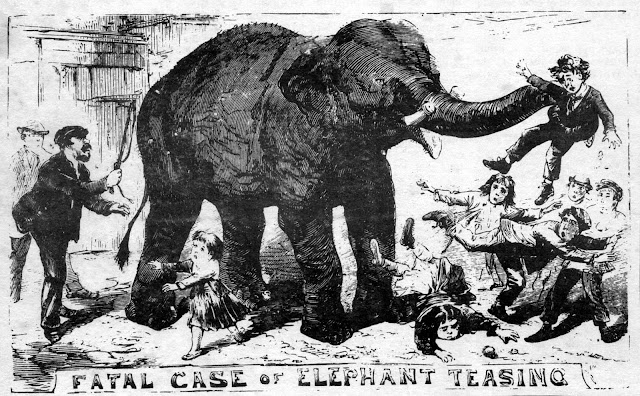
  • A Fatal Case of Elephant Teasing

    The incident as depicted in The Police Illustrated News.

    In the past it was common practice for the animals of travelling circuses to be lodged at local inns if the stables were large enough to accommodate them. In April 1872, Bostock and Wombwell’s circus was at Hanley for the Wakes and on the morning of Saturday 13th, a small group of children were feeding bread and nuts to one of the circus elephants in a passage leading to the Angel Inn. Its keeper, Thomas Hurley, was standing a few yards from the young female elephant, waiting for the key to the stable. He had driven the children away several times but they kept coming back and now while Hurley was distracted, one of the children, George Stanton, decided rather unwisely to play a prank on the elephant by feeding her a stone. Immediately and without warning, the elephant – normally a very gentle creature – went mad and lifting the boy in her trunk she crushed him against a wall with her head and tusks. Mr Hurley turned on hearing the screams from the children and shouted out, at which the elephant dropped the boy and he was carried away. George Stanton suffered wounds to his head and back and had been badly squeezed by the elephant. He died from his injuries on Sunday evening.

    Reference: Staffordshire Bugle, February 1993.

  • The Curious Quadrupedal Company

    For some weeks during the winter of 1852-1853, the locals in Hanley and Longton in the Potteries were treated to a number of visits from a Frenchman, Monsieur Desarais (or Desaris), with his troop of highly trained dogs and monkeys. His was one of many such travelling shows that trod the boards of the town halls or theatres up and down the country during the mid-nineteenth century. Often these shows were unsophisticated by modern tastes, but in an age where opportunities for popular entertainment were scarce, even the feeblest efforts were appreciated.

    Monsieur Desarais’ show seems to have been better than most if reports of the time are anything to go by. In one short piece a reporter described exactly the performance he witnessed. After noting his astonishment at the animals’ performances and the skill of Monsieur Desarais as an animal trainer, the reporter continued.

    ‘This curious quadrupedal company, educated to a high pitch of perfection in the histrionic arts, and costumed to suit their respective characters successfully perform many of the conventionalities of daily domestic life. The supper scene, or monkey banquet, served by a monkey gentleman-in-waiting, a brother monkey the presiding genius of the table, with all the precision of fashionable conviviality, speech excepted. This was a rare treat in itself. A variety of curious evolutions followed, the dogs and monkeys habited as ladies and gentlemen waltzing to music, playing at leap-frog. A dog ascending and descending a double-ladder, with a monkey clinging to his back; one poor fellow industriously performed the rare treat of trundling a barrel up an inclined plane, wagging his tail to his master, apparently highly pleased at his success. The balancing tricks, by two dogs; and the performance of a solo by a “Jenny Lind” of the canine species, to an accompaniment on the violin followed by a hurdle race, in which the dogs were steeds and the monkeys, in full costume, were riders, caused roars of merriment.’

    Overall, Monsieur Desarais’ sojourn in the Potteries was a great success, except, that is, for one unfortunate little incident in Shelton on Christmas Eve 1852. This was reported by the same paper, but far more glibly under the title, ‘Novel Mode of Evading Toll’.

    The report described how Monsieur Desarais was passing through the Shelton toll gate in his small close carriage, drawn by four of his favourite dogs, when Mr Dixon, the gatekeeper came out of his house and demanded the toll. Monsieur Desarais refused to pay and a heated discussion ensued as to why the toll was necessary. Becoming angry and seeing that he was getting nowhere with the irate Frenchman, Mr Dixon seized some of Monsieur Desarais’ property in lieu of the toll, but this only made matters worse. Monsieur Desarais seeing his property confiscated in such an unceremonious manner yelled, “Then I’ll pay” and opened his carriage door as if to get the cash. No sooner was the door open than out leapt a large formidable-looking monkey, who as if instinctively protecting his master looked as if he were about to attack Mr Dixon. At that moment, though, the gatekeeper’s wife who had been keeping her eye on the altercation rushed out carrying a pistol. The sight of the gun so alarmed the monkey that he threw his tail around his owner’s neck and with a ferocious grin of horror shot back into the carriage. Whether the monkey’s actions had been choreographed by Monsieur Desarais we will never know, but he did not escape the toll keeper, for as the report concluded, ‘Monsieur, with his dogs and monkeys, left the toll-gate keeper to his reflections and his umbrella as a pledge.’

    Reference: Staffordshire Potteries Telegraph, 1 January 1853.

  • Diary of a Bad Boy

    On the morning of Wednesday 8 April 1908, the curious adventures of Moses Newell a somewhat grimy but innocent-looking 13 year old boy, were related to the Magistrates Mr J. P. Pratt and Mr P. Elliott at Fenton Police Court when he was brought before them on the charge of stealing a purse containing 11s, 4½d that belonged to his mother who lived at 17 Park Lane, Fenton.

    Newell had left home on the previous Saturday and nothing had been seen of him until early that morning when he had been discovered sleeping in an ash pit behind Clarence Street, Fenton. Of the stolen money only 1s, 4d was found on him along with a small diary, some cigarettes and a few other items. The magistrates were left in no doubt as to the boy’s guilt or about what he had been doing with the money over the last four days, as the guileless youngster had been good enough to keep an account of his crime and his subsequent adventures in his diary, which were read out to the court. It was an exacting record of nothing less than a sustained eating and spending tour of the Potteries towns.

    Saturday – Left home at dinner-time, having stolen a purse containing 11s, 4½d. Went to Hanley market, and had a twopenny potato pie, a cup of tea and a penny cake. Bought a purse and then two ha’penny books. Went into another cake shop and had another cup of tea, and stopped there until the theatre was open. Went to the Theatre Royal “Fourpenny Rush,” came back to Fenton, and slept in ashpit.


    Sunday – Went to Longton and into cake shop. Had two penny herrings, a pen’orth of bread, a pint of tea. Cost me 4½d altogether. Went into icecream shop, and had a pen’orth of icecream, a ha’penny “cornet,” a penny drink, and then a wafer and another pen’orth of icecream, and a penny drink with icecream in it. On Sunday afternoon went into same cake shop, and had two-pen’orths of Yorkshire pudding and a cup of tea. Came back to the icecream shop and had some more icecream, and stayed playing. Went back to ashpit.


    Monday – Got up at a quarter to seven, walked to Hanley, bought a ha’penny book, went on car to Burslem. Bought a purse. Went into cake shop, but they had nothing ready. Walked round the stalls, and had a pen’orth of toffee. Went into cake shop. Had a cup of tea. I fetched some coal for her and she gave me a penny, and I had another cup of tea and some sandwich. Bought two ha’penny books – “Dick Turpin” and “Robin Hood.” Went to Longton again. Cost me threepence going and threepence to go to the theatre. I had a bottle of “pop,” two oranges, and I paid for another boy threepence to go in and gave him twopence. He bought some “fags” and fetched me some.


    Tuesday – Got up about seven. Got a car and went to Longton cake shop. Had two-pen’orth of meat, two-pen’orth of bread, and a pint of tea. I stopped in the cake shop until dinner-time. Had a penny bowl of soup and another pint of tea. Got a car to Hanley and thought I would go to theatre, but did not. I got a car again and went to Burslem. Went in another cake shop. Bought a penny bowl of soup, ha’porth of bread. I had a pen’orth of tea and went to Drill Hall (Poole’s entertainment), and paid twopence to go in. Bought a pen’orth of chocolate, ha’penny wafer, ha’penny glass of “beer,” and had another pen’orth of chocolate. When I came out I had a penny bottle of “burdock.” Got on the car to Hanley, and came to Fenton and got in the ashpit again.’

    On the morning of Wednesday 8 April, though, young Newell’s spending spree came to an inglorious end when he was woken by a woman throwing ashes on him. Newell told the court that at first he thought it was a cat and then he thought it ‘as a fowl pecking him.’ The woman got hold of him and pulled him out of the ashpit and gave the boy a cup of tea. The authorities soon learned of his discovery and he was subsequently arrested by PC Ford for the theft of the purse.

    After hearing the excerpts from Newell’s diary the magistrates remanded the boy for a week in order that a home might be found for him. A week later on 15 April, he was brought before Magistrates Mr Harold Wright and Mr A. Edwards at Longton on the charge of having wandered abroad without proper guardianship. His mother Fanny Williamson said that the lad was beyond control and that whenever he did something wrong he stayed away from home. The previous September and October he had disappeared for two months and could not be found. He had eventually come back, but had been away since then. On Saturday he ‘had been found in the pigeon place’, but later that day he had again absconded, this time with his mother’s purse and money. The woman was evidently at her wit’s end with the boy and the Stipendiary Magistrate Mr Wright said that the best thing to do was to send him to Werrington Industrial School until he was 16 years old. 

    Little is known of Moses Newell’s later life, though after serving his sentence he moved out of the area; at the age of 16, in the 1911 census, he was recorded as working as a servant on a farm in Ruthin, Wales. Neither the Medal Rolls nor the Commonwealth War Graves records for World War One list his name, so this artful dodger seems to have managed to slip away again.

    Reference: Staffordshire Sentinel, 8 April and 15 April 1908.