Tag: personalities

  • Little Gypsy Girl

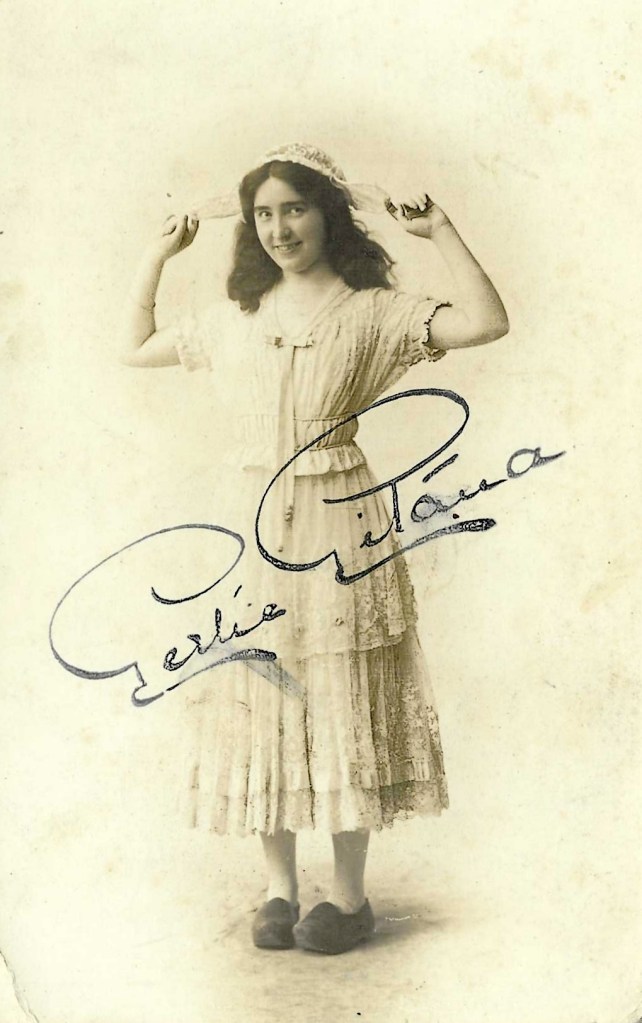
    A vintage black and white photograph of a young girl with dark hair, wearing a light-colored dress and holding a hat or scarf above her head, smiling at the camera. Her name, 'Gertie Gitana,' is beautifully signed below her image.
    Gertrude Astbury, known as Gertie Gitana, captured in a charming early publicity photograph.

    Of all the famous names who have hailed from the Potteries, few in their lifetime gave more honest, unalloyed pleasure than Gertrude Astbury, who as ‘Gertie Gitana’ became a darling of the music halls prior to World War One. Her talent and staying power were considerable. In her prime, her name on the bill was enough to ensure a full house, and even in the twilight years of her career, she was still able to command a large audience.

    Gertrude Mary Astbury, the eldest child of pottery turner William Astbury and Lavinia nee Kilkenny, a teacher at St Peter’s R. C. School in Cobridge, was born on 28 December 1887 at 7 Shirley Street, Longport, but the family lived at various addresses after that. When in 1954 the City Council decided to rename Frederick Street, behind the Theatre Royal in Hanley, as Gitana Street in her honour, Gertie wrote a letter to The Sentinel saying that she was very proud of the honour noting that ‘Gitana-street is adjacent to the theatre stage is appropriate.’ She then added, ‘I don’t think anyone knows of it, but it may be of some slight interest to mention that I actually lived in Frederick-street; my mother had a small shop there. I was three years old when we moved there and we were there for two or three years.’ There is no official evidence to support this story, but at the time of the 1891 census, Gertie was certainly living with her grandparents in Bucknall New Road, Hanley, while her parents and brother James lived in Burslem. Perhaps the family moved to Fredrick Street after the census was taken?

    From a very early age, Gertie proved to be something of a musical prodigy. Apparently as a toddler she delighted in putting on performances for her dolls and by the age of four she had been enrolled into Thomas Tomkinson’s Gypsy Children as a male impersonator, singer and comedienne and was soon earning star billing as ‘Little Gitana’ (the Spanish word for a female gypsy). The tale told of her discovery is that she was seen dancing in the street (arguably in Frederick Street, Hanley) by two girls attached to the troupe who befriended her. She then went along to one of the rehearsals and began copying the moves. Thomas Tomkinson noticed her and recognising her ability, applied to her parents to let her join the troupe. Once in the line-up and out touring with the show first around the Potteries, then through Wales, Gertie honed her skills and there was no doubting her burgeoning talent and her performances were regularly singled out for praise in press reports. In 1896, her career was given a helping hand by two music hall veterans, James and Mabel Wignall, known professionally as Jim and Belle O’Connor, who took her away from the Gypsy Children and under their wing. Though the O’Connors were apparently somewhat protective of their young charge, it was not in any sinister way and Gertie always referred to them affectionately as ‘Uncle and Auntie.’ It was thanks to them that at only eight years of age, Gertie made her music hall debut at the Tivoli in Barrow-in-Furnace, where she sang the song, ‘Dolly at Home.’ Two years later at the age of ten, she had a major billing at The Argyle in Birkenhead, and her first London appearance came in 1900. 

    By the age of 15, Gertie was earning over £100 per week, much more than her father earned in a year. At the age of 17, she topped the bill for the first time at The Ardwick Empire at Manchester. From late 1903 onwards, though often still appearing as Little Gitana, she was also being referred to increasingly as Gertie Gitana, the stage name she would adopt for the rest of her career. As she grew into womanhood, though, her skills and repertoire expanded and as well as singing she entertained by tap dancing, yodelling, and playing the saxophone, a relatively new instrument developed in the States and which at that time was something of a novelty in Britain. Her music hall repertoire of songs over her career included ‘All in a Row’, ‘A Schoolgirl’s Holiday’, ‘We’ve been chums for fifty years’, ‘When the Harvest Moon is Shining’, ‘Silver Bell’,  ‘Queen of the Cannibal Isles’, ‘You do Look Well in Your Old Dutch Bonnet’, ‘Never Mind’, ‘When I see the Lovelight Gleaming’, and most famously ‘Nellie Dean’ which she first sang in 1907. It was a song her younger brother James had heard in the United States and was an instant success for Gertie, becoming her signature tune. Her first gramophone recordings, dating from 1911–1913 (some of which can be heard online), were made in London on the Jumbo label.

    Vintage portrait of Gertie Gitana, the famous music hall performer, holding a saxophone.

    During the Great War, like many music hall performers Gertie turned her talents to entertaining the war wounded in hospitals or raising funds for the injured and she gained a following with the men in the trenches as a forces sweetheart. After the war, she appeared in pantomime, most notably as the principal boy in Puss in Boots, or as Little Red Riding Hood, and Cinderella. One amusing incongruous tale from this period is that she was reputed to have said the line in Cinderella, ‘Here I sit, all alone, I think I’ll play my saxophone’, before removing the instrument from the stage chimney and bashing out a tune*. Two musical shows were specially written for her: Nellie Dean and Dear Louise, and in 1928, despite initial opposition from the O’Connors, Gertie married her leading man in the latter, dancer Don Ross. Don was as ambitious and driven as his wife and would later prove to be quite the impresario, bringing over one of the first Vaudeville strip-tease artists after a visit to the States, running a three-ring circus and organising variety shows; he later became King Rat of the Grand Order of Water Rats and founder and first president of the British Music Hall Society.

    The autobiography of Gertie’s friend and fellow performer Ted Ray

    After the shows had run their course, Gertie returned to the variety scene, working for some time in partnership with blackface performer G. H. Elliott and an up-and-coming comedian Ted Ray, who liked her immensely. In his autobiography, Ray described both Elliott and Gertie as charming and courteous professionals, who never let their acts devolve into smut and no matter what their moods or what else was going on in their lives, never let an audience down or turned in a sub-par performance. 

    However, determined to retire at 50, by her own design Gertie’s career was now winding down. Made rich by her tireless work over the years (“No gutters for Gertie.” she sometimes commented wryly on her wealth) she was able to retire in 1938, but the old trouper could not be kept down and ten years later she made a short but very successful comeback with other old music hall stars in the show Thanks for the Memory produced by her husband. The show was the centrepiece of the Royal Command Performance in 1948. Her final appearance was on 2 December 1950 at the Empress Theatre, Brixton. She retired completely after that and spent her remaining years quietly, though she increased her fortune by speculating successfully on the stock market. On her death she left just over £23,584 in her will, equivalent to £484,727.62 in 2024.

    Gertrude Ross, nee Astbury, alias Gertie Gitana, died of cancer on 5 January 1957 in Hampstead, London, aged 69, and was buried in Wigston Cemetery, Wigston Magna, Leicestershire, where her husband had been born. Some lines from her most famous song, ‘Nellie Dean’ are engraved on the gravestone.

    By all reports, Gertie, though no pushover after years toughing it in showbiz, was an incredibly good natured and generous woman, well-liked not only by her legion of fans, but also by her fellow performers who felt her loss. After her death her friend, comedian Ted Ray, wrote ‘She was the most gentle, loveable person I ever met… A perfect artiste in every sense of the word. I place her among the immortals.’ In his book My Old Man, former Prime Minister John Major, recalled how years later his father (who trod the boards as part of the act ‘Drum and Major’) expressed similar sentiments about Gertie. Her death made the TV and radio news of the time, papers including the Sentinel, carried glowing obituaries to the star and memorials were mooted, though the only one of note at the time was a memorial bench that was unveiled in Edinburgh. In the Potteries memorials to Gertie Gitana have for the most part been fleeting. The Gertie Gitana pub (later The Stage Door) has come and gone, likewise Gitana’s pub in Hartshill and today few save die-hard local historians or music hall enthusiasts remember her. But her name lives on in Gitana Street, an honour that never ceased to delight and surprise her. As her husband Don Ross recalled, on the day she died Gertie was fading away, but talking with him about this and that when unbidden she suddenly brightened up and said, ‘Fancy them naming that street in Hanley after me.’

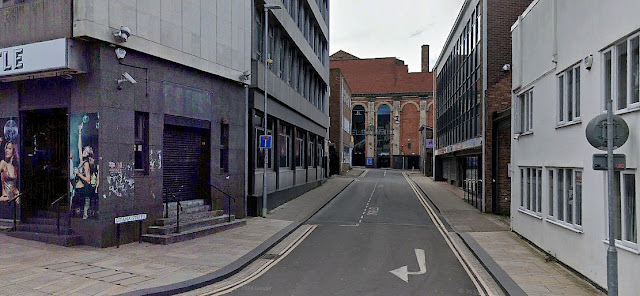
    Modern day Gitana Street, Hanley.
    Source, Google Earth.

    *Comedian Roy Hudd in his foreword to Ann Oughton’s biography of Gertie Gitana, recalled asking Don Ross in later years if Gertie really had used the amusing ‘… I think I’ll play my saxophone’ line in Cinderella, but Don neither confirmed nor denied it.

    Reference: Ann Oughton, Thanks for the Memory, passim;Ted Ray, Raising the Laughs, pp. 86-87; Evening Sentinel 15 February 1954 . 

  • Cannons from the Crimea

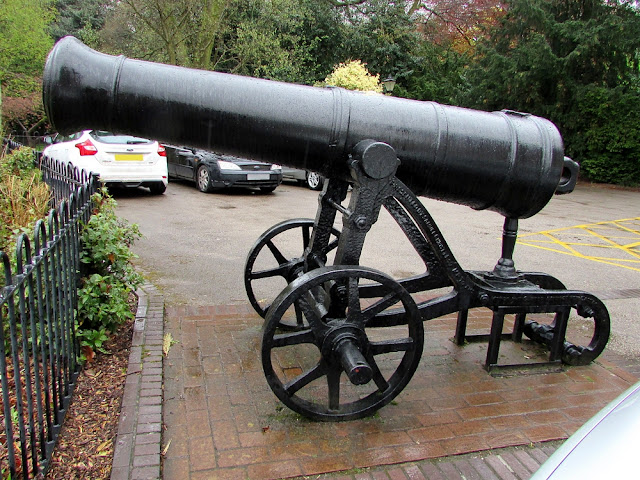
    Standing outside of the Brampton Museum in Newcastle-under-Lyme is a large black-painted cannon, mounted on a cast-iron limber. This was one of thousands of similar pieces of war booty brought back from the Crimea, following the fall of the Russian citadel of Sevastopol in 1855. In that city the Allied armies had discovered a large ordnance depot filled with 4,000 damaged or obsolete guns and these along with many of the guns captured during the fighting were later used as ballast on the merchantmen and troopships when they were bringing the army home. The Crimean War (1854-1856), had been a horrendous and utterly pointless conflict and perhaps as part of a wider public relations exercise to calm the national anger at the lives lost and at just how badly the war had been run, these cannon were freely distributed to towns and cities around the country.

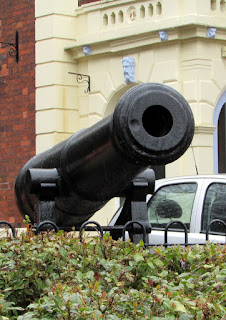
    Newcastle’s cannon, weighing 2.8 tons is a 36 pounder made in 1840, and was presented to the Borough in 1857 by its then MP Samuel Christy. It was originally situated in Stubbs Walks, opposite the Orme Girl’s School, Newcastle, where it stood until 1965, when it was moved to its current location. Such was the fate of most of these retired instruments of war and in the latter half of the nineteenth century it was no unusual thing to find a large, defunct piece of Russian artillery decorating a municipal park or fronting some grand civic building anywhere in Britain. Today, though, they are not so common; time and necessity have seen many of the others scattered or scrapped over the years and such seems to have been the case with a couple of cannons that came to the Potteries, no trace of which now seems to exist.

    Newcastle’s impressive Russia cannon in situ. The carriage was mass-produced at the Royal Armouries in Woolwich.

    In his autobiography Past Years, Potteries-born scientist Oliver Lodge, mentioned a close encounter with a Russian cannon in his youth. Lodge recalled that at a very young age his father took him from their home in Penkhull down the steep hill to Stoke where peace celebrations marking the end of the Crimean War were taking place. A captured Russian cannon had been placed in front of the Wheatsheaf Hotel and Mr Lodge told his son to wait by the cannon until he came back for him. Looking up at the monstrous artillery piece, young Oliver wondered what they were going to do with the gun, half fearing but half hoping that they were going to fire it. However, nothing so exciting happened, instead the local dignitaries made several speeches before they all set off for lunch. Oliver’s father went with them, minus his boy, and afterwards in the evening he went home having completely forgotten about Oliver. Only after returning home and being asked by his wife where their son was did he suddenly remember and went dashing off back down the bank to find the lad still obediently standing by the gun, utterly unconcerned at being left alone for several hours after everyone else had departed. 

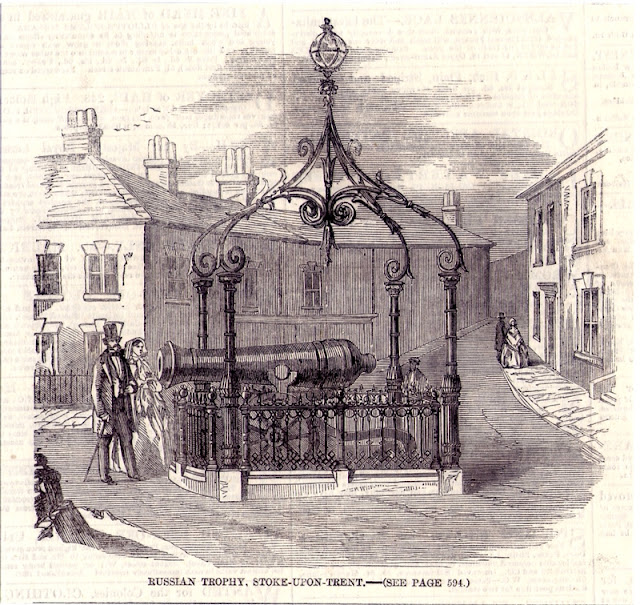
    The Victoria History of Staffordshire notes that a Russian cannon was presented to the town by W. T. Copeland in 1857 and erected opposite the Wheatsheaf Hotel in 1858, as per Lodge’s memoirs. In 1858, the Illustrated London News carried an interesting illustration of what was called Stoke-upon-Trent’s ‘Russian trophy’, along with some background information.


    ‘RUSSIAN TROPHY AT STOKE-UPON-TRENT.’ 

    ‘We give a representation of the Russian Trophy as mounted and in closed at Stoke-upon-Trent a few weeks ago. The gun is placed on a stone platform, as shown in the Illustration, in which the Royal arms, in Minton’s tiles, is inserted. On the stone parapet an ornamental railing of a handsome pattern is placed, and at each angle of the square of the platform a pillar in cast iron rises, to carry the wrought-iron scrollwork, which was manufactured by Mr. Haslam, of Derby, and is an excellent specimen of the old art of ironworking, now so ex­tensively superseded by the process of casting. All the ironwork is coloured in imitation of Florentine bronze, and richly gilt in the more decorative parts of the design. The whole is surmounted by a large globe lamp, which forms the principal feature of the construction, as the erection, being placed at the junction of three streets, requires a prominent and well adapted mode of lighting. The trophy was in­augurated by Mr. Alderman Copeland, one of the members for the borough, who also defrayed the expenses connected with mounting the piece. The work was designed and carried out under Mr. Edgar, architect.’

    Longton also received a gun, but even less is known about that one. There is a brief note in the Staffordshire Sentinel in 1867 that reads: ‘The same committee reported a resolution, in accordance with a suggestion from the Council, to remove the Russian cannon from the front of the Town Hall to the space within the railings at the front of the Court House… The proceedings were approved, and the recommendation adopted.’ In his Sociological History of Stoke-on-Trent, E. J. D. Warrilow includes a photograph of Longton Court House with the cannon situated behind the railings as described, but a second photo taken in 1950 shows that the gun had been removed. It was resited to Queen’s Park, Longton, where it stood in front of the clock tower. However, it has long since vanished and its current whereabouts are unknown.


    Stoke’s gun was also later moved, to a site in Hill Street by the old town hall in about 1874, but what finally happened to this and Longton’s cannon is unknown. The most likely scenario is that the valuable metal was sacrificed to the war effort early in World War Two, and ironically perhaps went on to become part of a more modern arsenal. 


    Contrast this sad end with that of the Newcastle gun which has achieved a certain status in the area. Between 1919 to 1942, during its time in Stubb’s Walks, the cannon was joined by a World War One training tank as a companion, but the tank was sent to be scrapped during World War Two. When the Crimean gun was shifted from its original site in 1965 some feared that it too was destined to be melted down and contractors arrived to find that some of the pupils from the Orme Girl’s School had hung a notice on the gun – ‘Hands off our cannon’. They need not have worried. Today, the cannon points out over the Brampton Park, providing a striking and novel photo opportunity to visitors to the town’s museum. 

    Reference: Oliver Lodge, Past Years: An Autobiography (Cambridge, 1931) pp. 22-23. E. J. D. Warrillow, A Sociological History of Stoke-on-Trent, p.385, Illustrated London News, 12 June 1858, Staffordshire Sentinel, 6 July 1867, Victoria History of Staffordshire Vol. VIII., p.180.

    Website: Crimean Cannon International Database

  • Soprano: The Musical Career of Lily Lonsdale

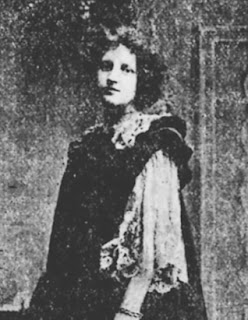
    Elizabeth Longsdale, alias Lily Lonsdale

    Born in Pitts Hill, Tunstall in 1878, Elizabeth Longsdale came from a musical family, her father William was a potter, but served as the choir master at Christ Church, Tunstall, and several other family members such as her brother Wilson, would make their names locally as singers. It was Elizabeth, though, who under the alliterative stage name of Lily Lonsdale, would become the most famous, carving a notable career in the music halls of Britain and abroad.

    Elizabeth started her singing career as a soloist at local concerts and enjoyed a spell with the North Stafford Amateur Operatic Society before turning professional when she joined Thomas Tomkinson’s Gypsy Children. This was a local choir turned concert party that was composed of talented children and adolescents that had gained quite a following in the Potteries. The troupe served as a training ground for several local performers who later went onto greater things, most notably Gertrude Mary Astbury who as Gertie Gitana would become one of the best know stars of the music halls. Elizabeth (now billed as ‘Lily Lonsdale’) shone just as brightly, impressing audiences with her beautiful, well-modulated voice and garnering great praise. By 1897, the troupe had moved beyond the Potteries and began touring the Midlands and Wales, performing in various venues like theatres and town halls, supported by parents and helpers who assisted with logistics and costumes.

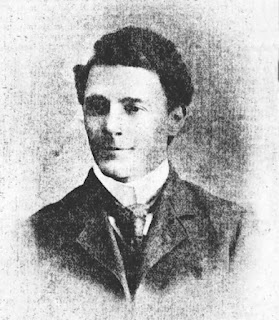
    Ernie Myers

    By mid 1899, Lily now in her early 20s was getting too old for child roles, and she was also romantically involved with Ernie Myers, a comedian from the troupe. However, her initial attempts for a career shift suffered a setback. After leaving the Royal Gipsy Children, she joined a rival troupe, Leon Vint’s Globe Choir, but soon had to resign due to vocal strain. This set her at odds with Vint, who after first agreeing to let her go then changed tack and took Lily and her sister Agnes to court for breech of contract. However, once in court, the judge deemed that Vint had acted unfairly and that the contract was far too heavily-weighted in his favour and as a result he ruled in Lily and her sister’s favour and they went on their way unhindered, leaving Vint with the costs for his bully-boy behaviour. Lily made a brief return to the ranks of the Royal Gypsy Children, but following the unexpected death in late January 1900 of Thomas Tomkinson the troupe’s founder, she and Ernie decided to set out on their own, securing an agent and booking early performances on the music hall circuit; they married in Liverpool in April 1901 whilst on tour. Shortly afterwards they were put on the so-called Moss and Thornton tour, taking in a series of theatres and musical halls across Ireland, northern England and Scotland.

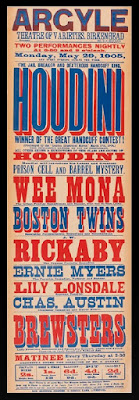
    In 1901, Lily took a short break to have their son, Jacob William, but hard economics often meant that family life came second to their performing careers. Leaving their son with Lily’s mother, they resumed a busy schedule of public performances across Britain, building their careers. They used their stage names and normally performed separately, with Ernie as a popular ‘patter’ comedian telling amusing stories and Lily as a classical soprano singer, though occasionally she took on comedy roles in sketches opposite her husband. They shared the stage with various entertainers, including conjurors, ventriloquists, impressionists, acrobats, marksmen, puppeteers, clowns, jugglers, dancers and performing animals as well as other comedians and singers. An undoubted highlight of their careers was performing on the same bill as the famous American escapologist Harry Houdini in 1905, when he was on a tour of Britain.

    The demands of travel and performing were tough; they worked six nights a week, with Lily often singing multiple songs per show, and she and Ernie were constantly in search of fresh material. During winters, they performed in pantomimes together, with Ernie playing the villain in “Aladdin” and Lily as the princess.

    By 1911, their careers were going well and the couple lived comfortably in Derby with their daughter Lillian May and son Jack who were cared for by Lily’s mother. In August of that year, they were invited to perform in South Africa but returned by December. Their routine continued until 1914 when they travelled back to South Africa. Sadly, Ernie fell ill and died on the ship before reaching port, leaving Lily heartbroken and reliant on support from the theatre community in Cape Town. After Ernie’s funeral she stayed on to complete her contract, then she returned to Britain to support her family amid the challenges of the Great War.

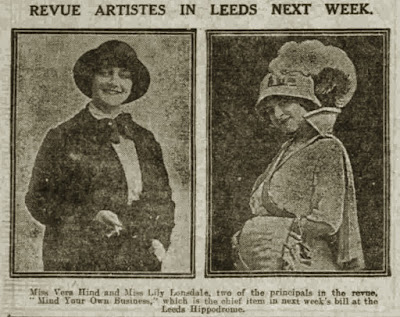
    Despite wartime difficulties, Lily found work in successful and topical revues like Mind Your Own Business and My Son Sammy, and whilst on tour the theatre company would often lay on special performances for wounded soldiers in hospitals, which proved very popular. Her career flourished through the war and after, but away from the limelight her mother’s declining health was a worry. In May 1920, Lily suffered a nervous breakdown due to exhaustion and stress, and shortly afterwards her mother passed away, leading to another break from performances.

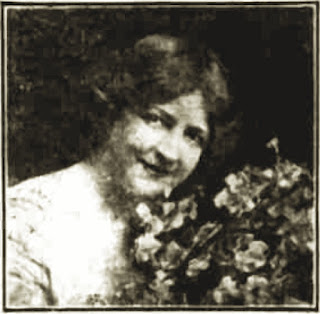
    Lily pictured in her obituary

    Over the next five years, Lily remained active but by her late 40s, probably as a result of her arduous lifestyle, her health began to suffer. Her career ended suddenly in August 1928 when she collapsed on stage in Wolverhampton. Although she finished her performance, she was taken to the hospital and she never really recovered. Lily died on 2 March 1929, aged 49, at the Derbyshire Royal Infirmary. There were short obituaries to the singer in the Sentinel and in a couple of Derby papers over the next couple of days, but that was the limit of the press coverage. She was buried at Derby’s Nottingham Road Cemetery four days later.

    Reference: Staffordshire Sentinel, 8 March 1929.

  • A Titanic Engineer

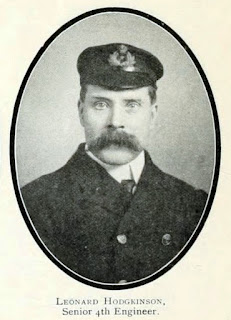
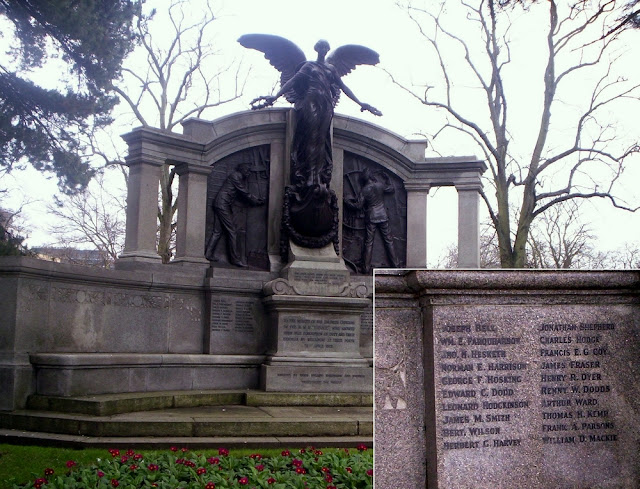
    Stoke-on-Trent’s best known connection with the Titanic disaster is of course the ship’s venerable skipper, Captain E. J. Smith, but a less well-known Potteries-born sailor who also perished in the Titanic disaster was Senior Fourth Engineer Leonard Hodgkinson. At the time of his death he was 46 years old, and like Captain Smith had spent most of his adult life at sea, albeit in a far different environment to that of his much more famous shipmate. As a member of the ship’s engineering staff, his working life was one spent for the most part in noisy, hot engine rooms, with little view of sea or sky save when he was off duty.

    Leonard was born at 20 North Street, Stoke-upon-Trent, on 20 February 1866, the second son and fifth child of potter’s presser John Hodgkinson and his wife Caroline nee Steele. Educated at St Thomas’ School, Stoke, before the age of 15, Leonard was apprenticed as an engine fitter with Messrs Hartley, Arnoux and Fanning, in Stoke. Once his apprenticeship was done, Leonard left the Potteries sometime in the 1880’s and took up a position with Messrs Lairds of Birkenhead, lodging with his elder sister Rose, her husband Henry Mulligan and their children, who had settled in Liverpool sometime after their marriage in 1877. It was in Liverpool that Leonard met his wife-to-be, Sarah Clarke. The couple were married in West Derby, Liverpool on 14 February 1891 and within a few years the couple had three children.

    North Street, Stoke-upon-Trent

    Leonard was now a seagoing marine engineer. He served for five years with the Beaver Line, whose ships sailed from Liverpool to Quebec and Montreal. In 1894, though, the Beaver Line went into liquidation and it may have been at this point that Leonard left and joined Rankin, Gilmour and Co., Ltd, which firm he also served with for five years, earning his first class certificate in the process. He may also have served with the Saint Line of ships which were owned by Rankin and Co., most of which carried the ‘Saint -’ title. Leonard’s final position with the company was as chief engineer aboard a ship with just such a title, the Saint Jerome.

    For a few years between 1901 and 1905, Leonard quit the sea and set himself up in business ashore as a mechanical engineer, but in May 1905, he returned to his old line of work, joining the White Star Line, serving first as assistant engineer on the Celtic, later earning promotion to fourth and then third engineer.

    According to family lore, Leonard Hodgkinson was keen to serve on as many vessels as possible before retirement, so was doubtless pleased after what appears to have been a six year stint aboard the Celtic, to be transferred over to the glamorous new Olympic (the Titanic’s elder sister) when that ship came on-line in June 1911. Here he was briefly bumped back down to assistant engineer, but soon earned promotion to fourth engineer once again. Perhaps more troublesome for him and his family was the fact that the Olympic was to sail from Southampton. There is no indication that the whole Hodgkinson family moved to Southampton at this time, though it is a possibility, but if not, then Leonard had to put up at lodgings in between journeys and perhaps only got to see his family on a few occasions when he could make the journey back to Liverpool.

    It was in early 1912, that Leonard travelled to Belfast where he joined the staff under Chief Engineer Joseph Bell, who were involved in getting the Olympic’s younger sister Titanic up and running. On 2 April he was signed onto the ship’s books for the delivery trip from Belfast to Southampton and on 6 April he was signed on once again in Southampton, now as senior fourth engineer.

    A White Star engineer at work.

    As senior fourth engineer, Leonard Hodgkinson was the highest ranking of the five fourth engineers aboard the Titanic, one of whom was a specialist in charge of the ship’s refrigeration equipment. Whilst at sea their duties involved checking that the adjustments and routine maintenance of the ship’s machinery were carried out. They dealt with any minor problems as they arose, answered any orders rung down via the ship’s telegraphs and ensured that everything ran as smoothly as possible. As officers it was also their duty to supervise the firemen, trimmers and greasers who worked with them down in the bowels of the ship.

    How Leonard’s days passed aboard the Titanic prior to its fateful collision is unknown, as too are his deeds on the night in question, as no accounts seem to exist noting him. If the story is to be believed, though, his fate and that of the 1500 other people who perished on the Titanic was foreseen by one of his relatives back in the Potteries, none of whom had any idea that Leonard was aboard the Titanic. According to the story she later told, two days before the disaster, Leonard’s 14 year old niece, Rose May Timmis, the daughter of Leonard’s elder sister Agnes, was sleeping in the same bed as her grandmother Caroline Hodgkinson (Leonard’s mother) when she had a nightmare. Rose dreamt that she was standing by a road in Trentham Park looking out over the lake, when a large ship steamed into sight. Suddenly the ship went down at one end and she could hear screams. Rose herself woke up with a yell that frightened her grandmother awake. When the frightened girl related her dream her grandmother snapped, “No more suppers for you, lady; dreams are a pack of daft.”

    After a while, Rose drifted back to sleep once more, only to find herself dreaming the same scene and as before when she heard the people screaming she did the same. She recalled that her grandmother was furious with her this time. A few days later, though, the news of the disaster broke and the family learnt that Leonard had been aboard the Titanic and that he and the other 34 engineering officers aboard had perished with the ship. Though several bodies from the engineering department were recovered in the following weeks, Leonard’s was not one of them.

    Though Leonard’s body was never found, he is remembered in several memorials, most notably on the Engineers Memorial, East Park, Southampton, the Titanic and Engineers memorial, Liverpool; the Glasgow Institute of Marine Engineers memorial; and the Institute of Marine Engineers Memorial in London. There is also a brass memorial plaque in the church of St Faithful, in Crosby, Liverpool, dedicated to the memory of the Chief Engineer and his Engine Room staff.

    The Titanic Engineers Memorial, Southampton

    Leonard Hodgkinson was not the only member of his family to go to sea. His son Leonard Stanley also became a marine engineer with White Star and later Cunard. He served on the transatlantic run most of his career, mainly on RMS Majestic before the war and later on the Queen Mary and the Queen Elizabeth.


    Website: Encyclopedia Titanica

  • Thomas Cooper Sparks the Pottery Riots

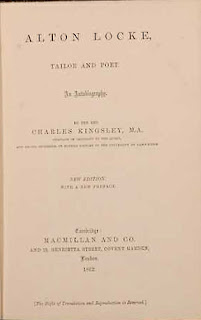
    One of the least known literary associations with Staffordshire, is that of Charles Kingsley’s novel Alton Locke. Tailor and Poet, which was published in 1851. The story of the rise and fall of a self-taught working man who is eventually imprisoned for rioting, is based upon a real person and a real incident. The person was the Chartist leader, Thomas Cooper, who was arrested and sentenced to two years in prison, for the events he had prompted in the Staffordshire Potteries.

    Thomas Cooper was born in Leicester to a working class family and from an early age displayed a precocious intelligence, the development of which was only limited by the fact that most of his lessons were self-taught. Occasionally, he had been known to immerse himself so deeply into his studies that the sheer mental effort he put forth ended on one occasion, at least, in him being physically ill. He worked at various jobs, mostly as a teacher, lay preacher and journalist, but eventually, appalled by the conditions endured by many factory and workshop workers, he became a convinced Chartist, a member of that Victorian working class movement which supported the introduction of a People’s Charter, which called for fair representation for the working population. The Charter’s six points demanded votes for all men at 21, annual general elections, a secret ballot, constituencies regulated by size of population, the abolition of property qualifications for MP’s and the payment of MP’s. Most of these points eventually became laws of the land and form a part of the state we live in today, but none of these things came into being until the latter half of the nineteenth century, long after the Chartist movement itself had collapsed.

    There were two bodies of the Chartist movement, the physical and the moral-force Chartists, who sought to bring about social change by revolutionary or evolutionary means. In his early days, Cooper was a supporter of the former faction. He was a fire and brimstone type of preacher, who like all great orators could move people with his speeches. This power comes through in Cooper’s autobiography, which is widely regarded as one of the finest working class ‘lives’ written during the Victorian age. The book, though written in Cooper’s later years after he had become a convinced moral-force Chartist, tends to carefully skate around his fiery physical-force youth and he presents himself as a far more reasonable man than he actually was in August 1842, when he arrived in the Potteries. Only by bearing in mind, that Cooper at this time advocated revolution of sorts, do the events he inspired in the Potteries make sense. Though he says in his book that he proclaimed, ‘Peace, law and order’, the resulting riots that left one man dead, dozens wounded or injured and many buildings burnt or ransacked, indicated that he said more than he was letting on.

    Cooper arrived in the Potteries, after a tour of several major towns and cities in the Midlands, and here he was to make a number of speeches before moving on to Manchester. The area was in the grip of a wage dispute. In June, 300 Longton miners whose wages had been drastically cut had gone on strike. By July, the strike had expanded to all of the pits in north Staffordshire, and hundreds of miners were on the streets, begging for money, and with the pits being closed, the potteries through lack of coal, could not fire their kilns and were also closed. By early August, the dispute had attracted widespread attention, certainly the Chartists expressed sympathy for the miners’ action, but contrary to later claims that the subsequent riots were Chartist inspired, it was mostly miners and not Chartists who did the rioting. The Potteries were a powder keg, ready to explode and Cooper’s arrival, as he himself admitted was ‘the spark which kindled all into combustion’.

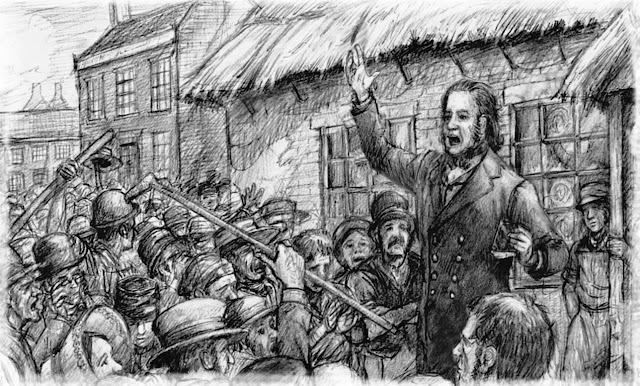
    Thomas Cooper addresses the crowd at Crown Bank, Hanley

    Standing on a chair in front of the Crown Inn, a low thatched building at Crown Bank in Hanley, on Sunday, 14 August, Cooper addressed a crowd of upwards of 10,000 people, delivering a brilliant Chartist speech to his audience. He look for his text the sixth commandment, ‘Thou shalt do no murder’. Throwing his net wide, he drew on examples of kings and tyrants from history, such as Alexander, Caesar and Napoleon, who had violated this commandment against their own people, even as their own government would be prepared to do. The next day, he addressed an equally sizeable crowd and moved a motion, ‘That all labour cease until the People’s Charter becomes the law of the land’.

    What followed, Cooper later regretted. As the crowd dispersed. rioting started around the Potteries towns in all except Tunstall and the borough town of Newcastle. Police stations were attacked, magistrate’s houses ransacked and burned, as were Hanley Parsonage and Longton Rectory. By the 16th, the chaos had lasted a day and a night, but on that day, the most famous, or infamous incident of the uprising occurred, what is known locally as ‘the battle of Burslem’. Following the rioting in Stoke, Shelton, Hanley and Longton, a great crowd moved towards Burslem, there to meet a crowd coming from Leek. Here, though, the authorities played their hand, when a troop of mounted dragoons stopped the crowd from Leek. The magistrate in charge read the Riot Act, then tried to reason with the men, but when it was clear that they were bent on trouble, the soldiers were ordered to fire. One man from Leek was killed and many injured, the crowd was routed and the disturbances ended overnight, but for many weeks afterwards, the Potteries were full of troops and vengeful magistrates arresting rioters and Chartist leaders.

    Cooper, horrified at the events he had unleashed, had tried to escape, but he was arrested and eventually tried and sentenced to two years in Stafford Gaol, on charges of arson and rioting. Here, he spent his time profitably, learning Hebrew and writing his book, The Purgatory of Suicides. On leaving prison, though, his views were found to differ considerably from the new mainstrean in Chartist thought, and he became increasingly a moral-force activist and remained so for the rest of his life.

    It was in the two or three years after leaving prison, that Cooper was interviewed by the Rev. Charles Kingsley, whose Christian Socialist movement had inherited many of the Chartist beliefs. Kingsley had sought out several old Chartists and educated working men on whom he wished to base the life of the major character in the novel he was preparing. Thomas Cooper, was obviously the chief amongst these, certainly his autobiography, written many years after Kingsley had published Alton Locke, shows many striking similarities between Cooper’s life and that of his fictional alter ego. The riot that Alton inspires in the book, for which he too is committed to the prison, takes place in the countryside, amongst agricultural labourers, but behind it there is the faintest echo of the struggle in the Potteries, that one historian has considered the nearest thing to a popular revolution that the Victorian age saw.

    After 1845, Thomas Cooper turned his talents mainly to writing, but he also lectured on subjects such as history, literature and photography. In this capacity, he made a number of return visits to the Potteries, to the place where on that day many years before, he had ‘caught the spirit of the oppressed and discontented’, in seeking to establish the basis of a democratic society.

    Reference: Charles Kingsley, Alton Locke. Tailor and Poet (1851); Thomas Cooper, Life of Thomas Cooper, written by Himself, (1872).

  • Hannah Dale – The Child of Wonder

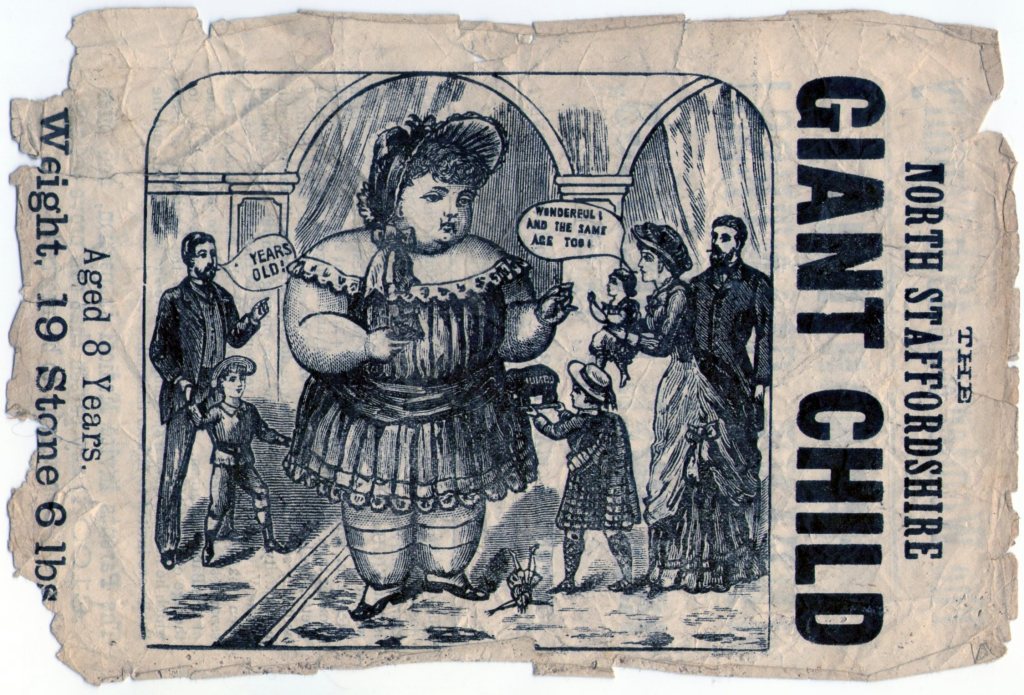
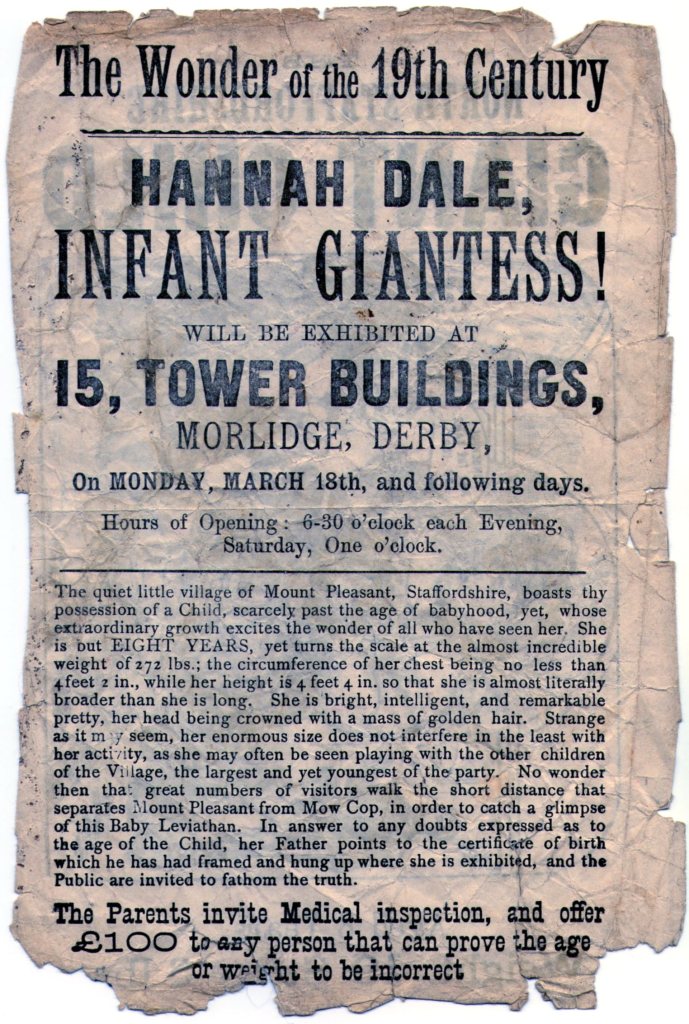
    A wildly exaggerated publicity image of Hannah Dale c.1889.
    Author’s collection.

    Hannah Dale, ‘the Staffordshire Giantess’ as she became known, was born in in the village of Mow Cop on the 23rd February 1881. She was the daughter of 31 year old miner Thomas Dale and 28 year old Elizabeth Dale, nee Oakes of Dales Green, Mow Cop, and was their fourth child, Hannah having a brother and two sisters older than herself. All the family were normal average-sized folk, her father weighed 10 stone, and her mother was only 8 stone in weight and their other children were likewise quite ordinary. At the time of her birth Hannah too seemed to be a normal child, so small it was said that she could fit into a quart jug, but at the end of three months she began to develop very rapidly and this growth continued throughout her short life. Within a few years she had outstripped her older siblings in weight, and though she started out enjoying a perfectly normal childhood Hannah was growing taller and broader and soon became something of an attraction in the out-of-the-way village.

    It is unclear when Hannah’s parent’s first started exhibiting their rapidly expanding child to a paying public, but she was certainly something of an attraction for the crowds when at the age of eight flyers such as the one seen here were advertising her for exhibition. Though depicted on the flyer as a veritable giant, Hannah was at this time actually only 4ft 4ins tall, but weight-wise she was prodigious, already weighing more than most grown men, so big that the family home at Oakes Bank, Dales Green had to have the doors widened. By the time she reached ten years of age, Hannah had grown to 4ft 11ins tall, had a 55-inch chest and her thighs measured 3ft around while the vaccination marks on her arms had stretched out to the size of small plates. Looking at her it was easy to forget that she was so young, but many papers were happy to point out that she was still very much a child, at her happiest playing with the other children in and around Mow Cop.

    ‘She is a bright, attractive, and talkative child, and plays as other children do of her own age. For her enormous weight she is very active, but if she accidentally stumbles and falls she cannot get up without assistance. Dolls are her great delight, and in making their apparel she exhibits considerable dexterity and intelligence… She has no special diet, but dines with the other members of the family, consuming as much food as a healthy man, and sleeping on an average twelve to fourteen hours each night. On the railway she travels with a half-ticket, a privilege to which she is entitled, but which often causes her father to supply his name and address to irate ticket collectors, who entertain an honest suspicion about a giantess who takes up as much space as three ordinary persons would occupy.’

    South Wales Echo, 16 June 1892, p.2

    For several years Hannah was exhibited around the country and by 1892 was becoming something of a celebrity. Early that year she was fulfilling an engagement at Sheffield, prior to going to America, but her fame was cut short when she fell ill with bronchitis in late May or early June of 1892. Her condition quickly worsened and she was taken home to recuperate, arriving there on Tuesday 7 June. However, it was too late and she died from the infection the next day.

    At the time of her death, Hannah Dale, was 5ft 3ins tall, weighed 32st 6½lbs, and measured 5ft. 8in around the waist. Her size caused difficulties when it came to her funeral at St Thomas Church, Mow Cop, on 10 June. Her coffin was huge, its size demonstrated prior to her funeral by the undertaker, a Mr Boon, having five young men lying down sideways in it and easily closing the lid over them. Together with the corpse, this finally weighed 6cwt, (48 stone, or nearly 305 Kg) and took up a double plot. It required thirteen people to carry and then lower the little girl’s coffin into the grave.

    Nearly 2,000 people, many of them friends and neighbours and other locals who had watched Hannah grow up assembled to witness the funeral. The inscription on her gravestone read:

    IN LOVING MEMORY OF

    HANNAH

    The beloved daughter of

    THOMAS & ELIZABETH DALE

    Of Dales Green Mow Cop

    WHO DIED JUNE 2ND (sic) 1892

    AGED 11 years & 3 months.

    HERE LIES MY DUST THE CHILD OF WONDER

    I BID FAREWELL TO ALL BEHIND

    AND NOW I DWELL JUST OVER YONDER

    IN HEAVEN WITH GOD SO GOOD AND KIND

    ALSO WILLIAM & WALTER their sons

    WHO DIED IN INFANCY

    Reference: Philip R. Leese, Mow Cop: Living on the Hill; Staffordshire Sentinel, 11 June; South Wales Echo, 16 & 22 June 1892; Daily Gazette for Middlesbrough, 22 June 1892, p.4; Hampshire Advertiser, 16 July 1892, p.7.

    Website: http://www.mowcop.info/htm/thumbs/tn060.htm

  • Captain Smith Tells a Tale

    Hanley-born Commander Edward John Smith is best remembered as the captain of the ill-fated White Star Line steamer RMS Titanic, which sank on its maiden transatlantic voyage after colliding with an iceberg in 1912. In many ways the image of Smith presented in the disaster has coloured how we see the man, to some he is the villain of the piece, to others a tragic figure. The few earlier glimpses that exist though, paint Captain Smith in a far different light. For instance in 1911 following the successful maiden voyage of Titanic’s elder sister Olympic, Smith comes across as something of a raconteur, playfully spinning a yarn to deflect over- eager reporters.

    ‘Captain Smith of the Olympic was questioned in New York about the coal consumption of the world’s biggest liner on her first voyage. But Captain Smith shook his head and said:”That is a coal story I am not privileged to speak about. I’ll tell you another coal story, though, if you’d care to hear it?”

    I’d be delighted,” said the reporter. “Well,” said Captain Smith, “It’s a story about a poor sailor. He was taken down with fever on a brigantine. and, though the mate and captain dosed him well, he died. They buried him at sea. “They buried him with the usual impressive sea rites. He was sewed in a sail round which a flag was draped, and, to make him sink, the sail was weighted with a number of big lumps of coal. “A landlubber of a passenger participated in the services. He watched the well weighted corpse slip into the water. It disappeared at once, and the landlubber shook his head and said: ” ‘Well, I’ve seen many a man go below, but this is the first one I’ve seen taking his own coal down with him.’ “


    Reference: San Francisco Call, 29 August 1911