Tag: Longton

  • The World’s First Mid-Air Rescue

    On 9 July 1908, the Longton Park Fête was in full swing and as well as the numerous stalls, funfair rides and other amusements put on to beguile the crowds that flocked to the park, there was another attraction, a parachute descent was to be performed by Captain Auguste Gaudron’s team. Thrilling as this was in itself, spice would be added to the display by the descent being made not by men, but by two young women, an experienced parachutist, Elizabeth ‘Dolly’ Shepherd and a novice named Louie May. In fact, Louie May should have made her first jump the day before from a new large balloon known as the ‘Mammoth’, the biggest then in Britain. The balloon and its passengers had indeed gone up, but it had been too windy to make the jump and to console the disappointed crowd Captain Gaudron had announced that they would try again the next day. He added that they would be joined overnight by the famous Dolly Shepherd who was doing a jump elsewhere that day, but that tomorrow she and Louie would make a double descent. Sure enough, Dolly arrived in Longton later that night and though initially surprised that Louie’s jump had not gone ahead, she was happy to join her for her maiden descent. 

    Dolly Shepherd and Louie May

    This morning the day seemed perfect; the sun was out and there was no sign of the high wind that had spoilt the jump the day before. At Captain Gaudron’s request Dolly and Louie went out early and mingled with the spectators to drum up interest. This they could do without even trying. Dolly was an attractive brunette and Louie a pretty blue-eyed blonde and both of them were practically clad in – for the time – rather daring, masculine-looking blue knickerbocker suits styled loosely after a midshipman’s uniform, plus matching caps that certainly attracted a lot of attention. So too again did the Mammoth which Gaudron’s men now began filling with gas and this soon towered high over the park and stood waiting for its passengers.

    However, the weather again spoilt their plans, this time with a short but heavy downpour of rain that suddenly and rather unexpectedly caused the Mammoth to sag and then collapse. There were urgent cries from Gaudron’s team and announcements over a loudspeaker, “No smoking please. Gas is escaping.” The spectators moved back a safe distance and watched the balloon in dismay. Sensing the frustration of the onlookers, seemingly robbed of yet another chance to see the lady parachutists, Captain Gaudron now turned to Dolly and asked her if she had brought her smaller balloon with her from her previous performance. Luckily, she had left it at the train station, so a pony and trap were immediately sent to collect it while the Mammoth crumpled into an untidy heap and Gaudron’s men went in to check it over. The problem was soon identified as a faulty top valve that had been leaking and it had only needed the weight of the rain to cause its collapse. 

    All was not lost, though, for Dolly’s balloon, though much smaller in size was quite capable of lifting two people. There was no basket underneath, instead the parachute hung down beneath the balloon and the parachutist would be suspended at the bottom in a sling-like seat into which she was tied with a belt, whilst holding onto a trapeze bar. Keeping track of her altitude with an aneroid barometer on her wrist, once the correct height had been reached, the parachutist would then tug on a cord that would release the parachute via a simple mechanism. The mechanism would also cause a valve on the balloon to open, venting the gas and thus sending it back to earth. These ‘solo’ balloons were normally reserved for more advanced parachutists and it was unusual to send a first-timer up under them, maiden jumps usually being accomplished from a basket, but as that was no longer an option and with Dolly as a willing chaperone, Captain Gaudron felt confident enough to let Louie go up with her.

    When the balloon arrived it was immediately hooked up to the gas pipe and the canvas soon began to swell up into a large globular shape, the ground staff holding it down with ropes attached to the netting that covered the balloon. It was no hardship to rig it for two parachutes, one on either side to balance it up, though a second release mechanism had to be hastily improvised for Louie’s chute and this worked perfectly. Then the two women were carefully fastened into their slings and held onto their trapeze bars while the balloon was held suspended above them. With all of the delays it was now 8 p.m., and a huge crowd had gathered to watch. Captain Gaudron now gave the order, “Let go!”, the ropes were released, the two women ran forward to get under the balloon as it leapt into the air and were suddenly lifted off the ground, Dolly setting off with a jaunty wave of the silk Union Jack that she kept for such occasions.

    The plan was for the balloon to climb to a height of 4,000 feet before the two women pulled their release cords; they would then float to earth within view of the thousands of spectators. However, that height came and went and no descent was made. Instead the balloon kept on climbing higher and drifting out of sight. By this time the spectators as well as Captain Gaudron and his people, had realised that something had gone wrong. Alarmed, Gaudron soon set off in urgent pursuit of the errant balloon and its two passengers, leaving the crowds in Longton Park to slowly disperse and go home, troubled by the turn of events and anxiously awaiting news of the fate of the two female aeronauts.

    Something had indeed gone badly wrong. High in the sky above North Staffordshire away from the eyes of the assembled spectators, a scene of high drama was taking place, against which even the excitement and danger of a normal parachute drop paled into insignificance.

    Initially, the ascent to 4,000 feet had been trouble free and as Dolly later recalled, Louie had been delighted with the experience. When they did eventually reach the required height, Dolly as the more experienced parachutist called time and waited to see Louie release her chute and start her descent before she did the same. It was just as well that she did, for when Louie reached up and pulled on her release cord, nothing happened; the improvised mechanism that worked so well on the ground had jammed. Pulling herself over via a connecting rope, Dolly tried to release her companion’s parachute but to no avail and the balloon carried on ascending, passing through the cloud layer and into the clear sky above to a height of 11,000 feet. At this height the air was thin and it was getting cold and Dolly realised that the only way that they would both escape from their increasingly perilous situation would be to risk making the drop back to earth on her parachute. Using the connecting rope to pull them together once more, she now told her frightened companion what they needed to do. Painfully aware of the two mile drop below them, Dolly held them together while Louie carefully unfastened herself from her sling and the two women wrapped their arms and legs around each other tightly before letting the defective ‘chute swing away. Hoping that her own parachute release still worked, Dolly reached up and pulled the release cord and was rewarded instantly by the sight of the the balloon apparently leaping away from them as they plummeted earthward. For a few nerve-wracking seconds the parachute struggled to open, but as they exited the clouds and hit heavier air Dolly felt a familiar pull and looked up to see the parachute fully deployed above them, arresting their fall to what she hoped was a survivable speed.


    A wildly exaggerated newspaper illustration of the incident. Not only are details of the rescue incorrect but in reality Dolly and Louie’s knickerbocker suits were much more practical.

    Swinging down out of the evening sky on their single parachute, the two women now found themselves suspended over a vast tapestry of green fields, woods and little villages. The prevailing winds had taken them south-east of the Potteries in the direction of Uttoxeter. Dolly, though, was not so much concerned about where they were, but how to land safely, as with Louie restricting her movements, there was no way of steering to a softer landing spot and the ground was rushing up much faster than normal. As they neared the ground, for the first time in the entire episode Dolly felt a pang of fear and cried out in alarm, as they seemed to be heading directly for a road, the hard surface of which might prove fatal at this speed. Luck, though was on their side and moments later they thumped down into the soil of a farmer’s field,  Dolly hitting the ground first and falling backwards as Louie, still holding on tightly, landed on top of her. The impact felt like a hammer blow for both of them and Louie immediately jumped to her feet, crying that all her teeth were knocked out. In fact she was unharmed and when the initial shock had passed, the two of them burst into peals of hysterical laughter out of sheer relief at having survived such a terrifying but remarkable adventure. 

    Though Louie was fine, Dolly remained lying on her back and did not move. She felt that she had injured herself quite badly and that she needed to stay where she was until help arrived. Moments later a portly farmer appeared followed by his wife and children, then another farmer and his family, all of whom had seen the parachute coming down. They immediately offered to help Dolly to her feet but she begged them to leave her alone and call for a doctor. One of the farmers, Charles Hollins then took charge and a man was sent off to Shelton to get a doctor. The women now discovered that they had landed at Field Farm, three miles from the village of Leigh and 14 miles from Longton where they had begun their balloon ride.

    When the doctor eventually arrived he immediately appreciated that Dolly had sustained a serious back injury and had her carefully lifted into a door provided by Farmer Hollins in lieu of a stretcher. She was then transported back to the Hollins’ farmhouse where she would find herself laid up for the next 8 weeks. Here, under the doting care of the Hollins family and the watchful eyes of a couple of local physicians, who treated her with mild electrical therapy, Dolly made a remarkable recovery and to the surprise of many within a couple of months of her accident she was not only walking, but parachuting once more.

    Dolly continued with her parachuting career until 1912, when during one of her solo ascents, she claimed to have heard a voice telling her quite clearly not to come up again or she would be killed. Utterly convinced, once she had landed safely she announced to Captain Gaudron that she was giving up parachuting and immediately returned to London, where for a time she worked in her aunt’s shop. During World War One, Dolly served as an ambulance driver on the Western Front. Occasionally, she was called upon to use her driving skills to chauffeur army officers around the front; one of these she later married and finally settled down. True to her word, she never did another parachute jump.

    Decades later, though, in her twilight years, the old parachutist did mix with like-minded people once more. She was famous now not only for her pioneering achievements in parachuting, but also because she was a record holder, being officially recognised by the Guinness Book of Records, for making the world’s first mid-air rescue. As a result she was honoured by invites from the Parachute Regiment’s Red Devils and the RAF Falcons display teams and despite the ethereal warning from above not to go up again, in 1976, the elderly Dolly took advantage of her latter-day fame to take a ride up in an aeroplane with the Red Devils, to watch them perform a sky dive, but it was her last journey up into the clouds. Dolly Sedgwick, nee Shepherd, died in 1983, just a few weeks short of her 97th birthday. 

    As to what became of the other actor in that famous first mid-air rescue, Louie May, Dolly could not say. Captain Gaudron and Louie had returned to London during Dolly’s convalescence and she never saw her again. She later heard that Louie’s fiancé was livid when he discovered what she had been doing and that he had immediately spirited her away from the crazy world of parachuting and the dangerous company of Miss Dolly Shepherd.

    Reference: Dolly Shepherd, When the Chute Went Up, pp. 129-151: Uttoxeter Advertiser and Ashbourne Times 17 june 1908, p.8 and 1 July 1908, p.5.

  • Cannons from the Crimea

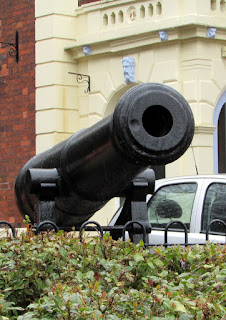
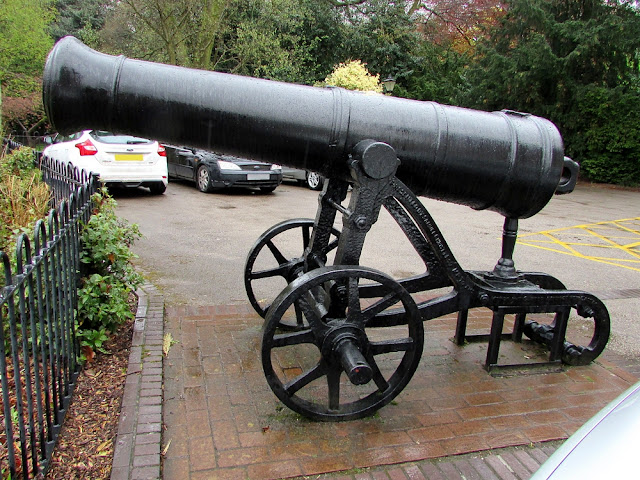
    Standing outside of the Brampton Museum in Newcastle-under-Lyme is a large black-painted cannon, mounted on a cast-iron limber. This was one of thousands of similar pieces of war booty brought back from the Crimea, following the fall of the Russian citadel of Sevastopol in 1855. In that city the Allied armies had discovered a large ordnance depot filled with 4,000 damaged or obsolete guns and these along with many of the guns captured during the fighting were later used as ballast on the merchantmen and troopships when they were bringing the army home. The Crimean War (1854-1856), had been a horrendous and utterly pointless conflict and perhaps as part of a wider public relations exercise to calm the national anger at the lives lost and at just how badly the war had been run, these cannon were freely distributed to towns and cities around the country.

    Newcastle’s cannon, weighing 2.8 tons is a 36 pounder made in 1840, and was presented to the Borough in 1857 by its then MP Samuel Christy. It was originally situated in Stubbs Walks, opposite the Orme Girl’s School, Newcastle, where it stood until 1965, when it was moved to its current location. Such was the fate of most of these retired instruments of war and in the latter half of the nineteenth century it was no unusual thing to find a large, defunct piece of Russian artillery decorating a municipal park or fronting some grand civic building anywhere in Britain. Today, though, they are not so common; time and necessity have seen many of the others scattered or scrapped over the years and such seems to have been the case with a couple of cannons that came to the Potteries, no trace of which now seems to exist.

    Newcastle’s impressive Russia cannon in situ. The carriage was mass-produced at the Royal Armouries in Woolwich.

    In his autobiography Past Years, Potteries-born scientist Oliver Lodge, mentioned a close encounter with a Russian cannon in his youth. Lodge recalled that at a very young age his father took him from their home in Penkhull down the steep hill to Stoke where peace celebrations marking the end of the Crimean War were taking place. A captured Russian cannon had been placed in front of the Wheatsheaf Hotel and Mr Lodge told his son to wait by the cannon until he came back for him. Looking up at the monstrous artillery piece, young Oliver wondered what they were going to do with the gun, half fearing but half hoping that they were going to fire it. However, nothing so exciting happened, instead the local dignitaries made several speeches before they all set off for lunch. Oliver’s father went with them, minus his boy, and afterwards in the evening he went home having completely forgotten about Oliver. Only after returning home and being asked by his wife where their son was did he suddenly remember and went dashing off back down the bank to find the lad still obediently standing by the gun, utterly unconcerned at being left alone for several hours after everyone else had departed. 

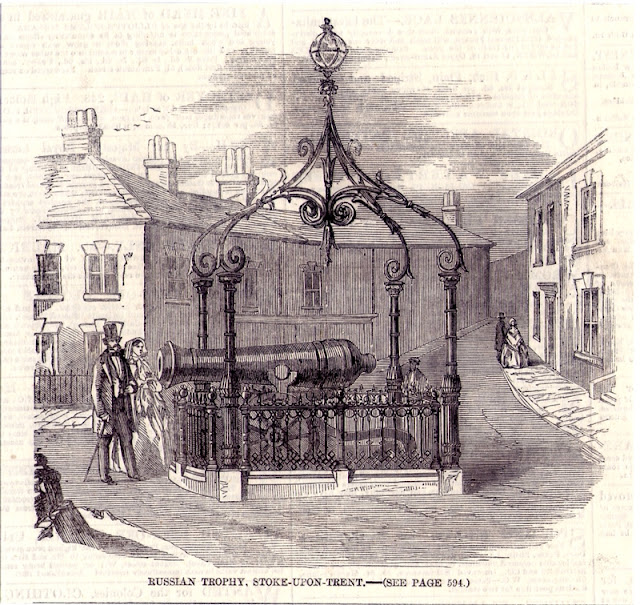
    The Victoria History of Staffordshire notes that a Russian cannon was presented to the town by W. T. Copeland in 1857 and erected opposite the Wheatsheaf Hotel in 1858, as per Lodge’s memoirs. In 1858, the Illustrated London News carried an interesting illustration of what was called Stoke-upon-Trent’s ‘Russian trophy’, along with some background information.


    ‘RUSSIAN TROPHY AT STOKE-UPON-TRENT.’ 

    ‘We give a representation of the Russian Trophy as mounted and in closed at Stoke-upon-Trent a few weeks ago. The gun is placed on a stone platform, as shown in the Illustration, in which the Royal arms, in Minton’s tiles, is inserted. On the stone parapet an ornamental railing of a handsome pattern is placed, and at each angle of the square of the platform a pillar in cast iron rises, to carry the wrought-iron scrollwork, which was manufactured by Mr. Haslam, of Derby, and is an excellent specimen of the old art of ironworking, now so ex­tensively superseded by the process of casting. All the ironwork is coloured in imitation of Florentine bronze, and richly gilt in the more decorative parts of the design. The whole is surmounted by a large globe lamp, which forms the principal feature of the construction, as the erection, being placed at the junction of three streets, requires a prominent and well adapted mode of lighting. The trophy was in­augurated by Mr. Alderman Copeland, one of the members for the borough, who also defrayed the expenses connected with mounting the piece. The work was designed and carried out under Mr. Edgar, architect.’

    Longton also received a gun, but even less is known about that one. There is a brief note in the Staffordshire Sentinel in 1867 that reads: ‘The same committee reported a resolution, in accordance with a suggestion from the Council, to remove the Russian cannon from the front of the Town Hall to the space within the railings at the front of the Court House… The proceedings were approved, and the recommendation adopted.’ In his Sociological History of Stoke-on-Trent, E. J. D. Warrilow includes a photograph of Longton Court House with the cannon situated behind the railings as described, but a second photo taken in 1950 shows that the gun had been removed. It was resited to Queen’s Park, Longton, where it stood in front of the clock tower. However, it has long since vanished and its current whereabouts are unknown.


    Stoke’s gun was also later moved, to a site in Hill Street by the old town hall in about 1874, but what finally happened to this and Longton’s cannon is unknown. The most likely scenario is that the valuable metal was sacrificed to the war effort early in World War Two, and ironically perhaps went on to become part of a more modern arsenal. 


    Contrast this sad end with that of the Newcastle gun which has achieved a certain status in the area. Between 1919 to 1942, during its time in Stubb’s Walks, the cannon was joined by a World War One training tank as a companion, but the tank was sent to be scrapped during World War Two. When the Crimean gun was shifted from its original site in 1965 some feared that it too was destined to be melted down and contractors arrived to find that some of the pupils from the Orme Girl’s School had hung a notice on the gun – ‘Hands off our cannon’. They need not have worried. Today, the cannon points out over the Brampton Park, providing a striking and novel photo opportunity to visitors to the town’s museum. 

    Reference: Oliver Lodge, Past Years: An Autobiography (Cambridge, 1931) pp. 22-23. E. J. D. Warrillow, A Sociological History of Stoke-on-Trent, p.385, Illustrated London News, 12 June 1858, Staffordshire Sentinel, 6 July 1867, Victoria History of Staffordshire Vol. VIII., p.180.

    Website: Crimean Cannon International Database

  • Thomas Cooper Sparks the Pottery Riots

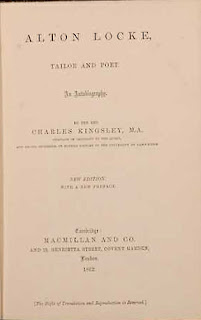
    One of the least known literary associations with Staffordshire, is that of Charles Kingsley’s novel Alton Locke. Tailor and Poet, which was published in 1851. The story of the rise and fall of a self-taught working man who is eventually imprisoned for rioting, is based upon a real person and a real incident. The person was the Chartist leader, Thomas Cooper, who was arrested and sentenced to two years in prison, for the events he had prompted in the Staffordshire Potteries.

    Thomas Cooper was born in Leicester to a working class family and from an early age displayed a precocious intelligence, the development of which was only limited by the fact that most of his lessons were self-taught. Occasionally, he had been known to immerse himself so deeply into his studies that the sheer mental effort he put forth ended on one occasion, at least, in him being physically ill. He worked at various jobs, mostly as a teacher, lay preacher and journalist, but eventually, appalled by the conditions endured by many factory and workshop workers, he became a convinced Chartist, a member of that Victorian working class movement which supported the introduction of a People’s Charter, which called for fair representation for the working population. The Charter’s six points demanded votes for all men at 21, annual general elections, a secret ballot, constituencies regulated by size of population, the abolition of property qualifications for MP’s and the payment of MP’s. Most of these points eventually became laws of the land and form a part of the state we live in today, but none of these things came into being until the latter half of the nineteenth century, long after the Chartist movement itself had collapsed.

    There were two bodies of the Chartist movement, the physical and the moral-force Chartists, who sought to bring about social change by revolutionary or evolutionary means. In his early days, Cooper was a supporter of the former faction. He was a fire and brimstone type of preacher, who like all great orators could move people with his speeches. This power comes through in Cooper’s autobiography, which is widely regarded as one of the finest working class ‘lives’ written during the Victorian age. The book, though written in Cooper’s later years after he had become a convinced moral-force Chartist, tends to carefully skate around his fiery physical-force youth and he presents himself as a far more reasonable man than he actually was in August 1842, when he arrived in the Potteries. Only by bearing in mind, that Cooper at this time advocated revolution of sorts, do the events he inspired in the Potteries make sense. Though he says in his book that he proclaimed, ‘Peace, law and order’, the resulting riots that left one man dead, dozens wounded or injured and many buildings burnt or ransacked, indicated that he said more than he was letting on.

    Cooper arrived in the Potteries, after a tour of several major towns and cities in the Midlands, and here he was to make a number of speeches before moving on to Manchester. The area was in the grip of a wage dispute. In June, 300 Longton miners whose wages had been drastically cut had gone on strike. By July, the strike had expanded to all of the pits in north Staffordshire, and hundreds of miners were on the streets, begging for money, and with the pits being closed, the potteries through lack of coal, could not fire their kilns and were also closed. By early August, the dispute had attracted widespread attention, certainly the Chartists expressed sympathy for the miners’ action, but contrary to later claims that the subsequent riots were Chartist inspired, it was mostly miners and not Chartists who did the rioting. The Potteries were a powder keg, ready to explode and Cooper’s arrival, as he himself admitted was ‘the spark which kindled all into combustion’.

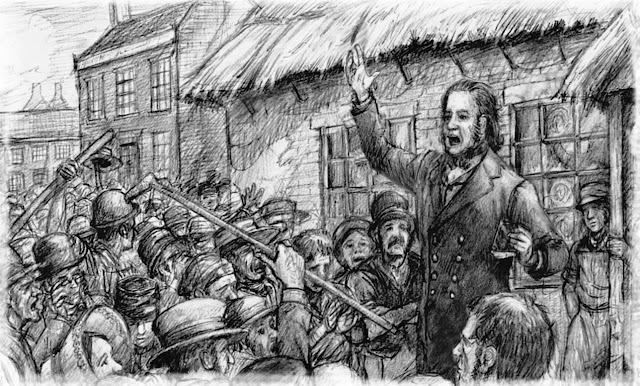
    Thomas Cooper addresses the crowd at Crown Bank, Hanley

    Standing on a chair in front of the Crown Inn, a low thatched building at Crown Bank in Hanley, on Sunday, 14 August, Cooper addressed a crowd of upwards of 10,000 people, delivering a brilliant Chartist speech to his audience. He look for his text the sixth commandment, ‘Thou shalt do no murder’. Throwing his net wide, he drew on examples of kings and tyrants from history, such as Alexander, Caesar and Napoleon, who had violated this commandment against their own people, even as their own government would be prepared to do. The next day, he addressed an equally sizeable crowd and moved a motion, ‘That all labour cease until the People’s Charter becomes the law of the land’.

    What followed, Cooper later regretted. As the crowd dispersed. rioting started around the Potteries towns in all except Tunstall and the borough town of Newcastle. Police stations were attacked, magistrate’s houses ransacked and burned, as were Hanley Parsonage and Longton Rectory. By the 16th, the chaos had lasted a day and a night, but on that day, the most famous, or infamous incident of the uprising occurred, what is known locally as ‘the battle of Burslem’. Following the rioting in Stoke, Shelton, Hanley and Longton, a great crowd moved towards Burslem, there to meet a crowd coming from Leek. Here, though, the authorities played their hand, when a troop of mounted dragoons stopped the crowd from Leek. The magistrate in charge read the Riot Act, then tried to reason with the men, but when it was clear that they were bent on trouble, the soldiers were ordered to fire. One man from Leek was killed and many injured, the crowd was routed and the disturbances ended overnight, but for many weeks afterwards, the Potteries were full of troops and vengeful magistrates arresting rioters and Chartist leaders.

    Cooper, horrified at the events he had unleashed, had tried to escape, but he was arrested and eventually tried and sentenced to two years in Stafford Gaol, on charges of arson and rioting. Here, he spent his time profitably, learning Hebrew and writing his book, The Purgatory of Suicides. On leaving prison, though, his views were found to differ considerably from the new mainstrean in Chartist thought, and he became increasingly a moral-force activist and remained so for the rest of his life.

    It was in the two or three years after leaving prison, that Cooper was interviewed by the Rev. Charles Kingsley, whose Christian Socialist movement had inherited many of the Chartist beliefs. Kingsley had sought out several old Chartists and educated working men on whom he wished to base the life of the major character in the novel he was preparing. Thomas Cooper, was obviously the chief amongst these, certainly his autobiography, written many years after Kingsley had published Alton Locke, shows many striking similarities between Cooper’s life and that of his fictional alter ego. The riot that Alton inspires in the book, for which he too is committed to the prison, takes place in the countryside, amongst agricultural labourers, but behind it there is the faintest echo of the struggle in the Potteries, that one historian has considered the nearest thing to a popular revolution that the Victorian age saw.

    After 1845, Thomas Cooper turned his talents mainly to writing, but he also lectured on subjects such as history, literature and photography. In this capacity, he made a number of return visits to the Potteries, to the place where on that day many years before, he had ‘caught the spirit of the oppressed and discontented’, in seeking to establish the basis of a democratic society.

    Reference: Charles Kingsley, Alton Locke. Tailor and Poet (1851); Thomas Cooper, Life of Thomas Cooper, written by Himself, (1872).

  • The Last Bottle Oven Firing

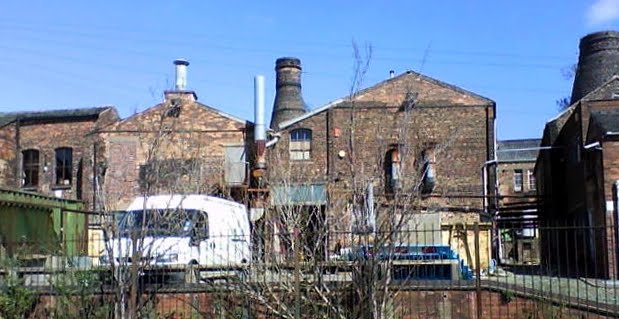
    The kiln used for the firing at the Hudson and Middleton factory, Longton.

    On 29 August 1978, the last ever firing of pottery in a coal-fired bottle kiln began. The Clean Air Act of 1956 had made it illegal to produce masses of black smoke in urban areas, which forced the local potteries to finally switch over from the old bottle ovens to new gas and electric kilns. However, two decades later, to raise funds for the repair of its own ovens but also to document the process before all knowledge died out completely, Gladstone Pottery Museum in Longton, was given leave to carry out one last traditional firing. The kiln chosen for the job was a quick firing glost china oven at the nearby Hudson and Middleton factory and the museum produced a selection of wares including plates, bowls, character jugs and tygs for this final load. Many local factories also provided ware to be fired. The man placed in charge of the firing was 73 year old Alfred Clough a former pottery manufacturer, who was aided by other former firemen, ovenmen and placers plus numerous volunteers from Gladstone. These helped in preparing and loading the kiln and on this day at 12.45 pm, the last of the fires were lit by Mr Clough’s 11 year old grandson. The firing went without a hitch and 32 hours later the fires were extinguished and the kiln was allowed to cool for three days, being emptied on 2 September.


    Reference: Evening Sentinel, 29 August – 2 September 1978.

  • The Curious Quadrupedal Company

    For some weeks during the winter of 1852-1853, the locals in Hanley and Longton in the Potteries were treated to a number of visits from a Frenchman, Monsieur Desarais (or Desaris), with his troop of highly trained dogs and monkeys. His was one of many such travelling shows that trod the boards of the town halls or theatres up and down the country during the mid-nineteenth century. Often these shows were unsophisticated by modern tastes, but in an age where opportunities for popular entertainment were scarce, even the feeblest efforts were appreciated.

    Monsieur Desarais’ show seems to have been better than most if reports of the time are anything to go by. In one short piece a reporter described exactly the performance he witnessed. After noting his astonishment at the animals’ performances and the skill of Monsieur Desarais as an animal trainer, the reporter continued.

    ‘This curious quadrupedal company, educated to a high pitch of perfection in the histrionic arts, and costumed to suit their respective characters successfully perform many of the conventionalities of daily domestic life. The supper scene, or monkey banquet, served by a monkey gentleman-in-waiting, a brother monkey the presiding genius of the table, with all the precision of fashionable conviviality, speech excepted. This was a rare treat in itself. A variety of curious evolutions followed, the dogs and monkeys habited as ladies and gentlemen waltzing to music, playing at leap-frog. A dog ascending and descending a double-ladder, with a monkey clinging to his back; one poor fellow industriously performed the rare treat of trundling a barrel up an inclined plane, wagging his tail to his master, apparently highly pleased at his success. The balancing tricks, by two dogs; and the performance of a solo by a “Jenny Lind” of the canine species, to an accompaniment on the violin followed by a hurdle race, in which the dogs were steeds and the monkeys, in full costume, were riders, caused roars of merriment.’

    Overall, Monsieur Desarais’ sojourn in the Potteries was a great success, except, that is, for one unfortunate little incident in Shelton on Christmas Eve 1852. This was reported by the same paper, but far more glibly under the title, ‘Novel Mode of Evading Toll’.

    The report described how Monsieur Desarais was passing through the Shelton toll gate in his small close carriage, drawn by four of his favourite dogs, when Mr Dixon, the gatekeeper came out of his house and demanded the toll. Monsieur Desarais refused to pay and a heated discussion ensued as to why the toll was necessary. Becoming angry and seeing that he was getting nowhere with the irate Frenchman, Mr Dixon seized some of Monsieur Desarais’ property in lieu of the toll, but this only made matters worse. Monsieur Desarais seeing his property confiscated in such an unceremonious manner yelled, “Then I’ll pay” and opened his carriage door as if to get the cash. No sooner was the door open than out leapt a large formidable-looking monkey, who as if instinctively protecting his master looked as if he were about to attack Mr Dixon. At that moment, though, the gatekeeper’s wife who had been keeping her eye on the altercation rushed out carrying a pistol. The sight of the gun so alarmed the monkey that he threw his tail around his owner’s neck and with a ferocious grin of horror shot back into the carriage. Whether the monkey’s actions had been choreographed by Monsieur Desarais we will never know, but he did not escape the toll keeper, for as the report concluded, ‘Monsieur, with his dogs and monkeys, left the toll-gate keeper to his reflections and his umbrella as a pledge.’

    Reference: Staffordshire Potteries Telegraph, 1 January 1853.

  • Diary of a Bad Boy

    On the morning of Wednesday 8 April 1908, the curious adventures of Moses Newell a somewhat grimy but innocent-looking 13 year old boy, were related to the Magistrates Mr J. P. Pratt and Mr P. Elliott at Fenton Police Court when he was brought before them on the charge of stealing a purse containing 11s, 4½d that belonged to his mother who lived at 17 Park Lane, Fenton.

    Newell had left home on the previous Saturday and nothing had been seen of him until early that morning when he had been discovered sleeping in an ash pit behind Clarence Street, Fenton. Of the stolen money only 1s, 4d was found on him along with a small diary, some cigarettes and a few other items. The magistrates were left in no doubt as to the boy’s guilt or about what he had been doing with the money over the last four days, as the guileless youngster had been good enough to keep an account of his crime and his subsequent adventures in his diary, which were read out to the court. It was an exacting record of nothing less than a sustained eating and spending tour of the Potteries towns.

    Saturday – Left home at dinner-time, having stolen a purse containing 11s, 4½d. Went to Hanley market, and had a twopenny potato pie, a cup of tea and a penny cake. Bought a purse and then two ha’penny books. Went into another cake shop and had another cup of tea, and stopped there until the theatre was open. Went to the Theatre Royal “Fourpenny Rush,” came back to Fenton, and slept in ashpit.


    Sunday – Went to Longton and into cake shop. Had two penny herrings, a pen’orth of bread, a pint of tea. Cost me 4½d altogether. Went into icecream shop, and had a pen’orth of icecream, a ha’penny “cornet,” a penny drink, and then a wafer and another pen’orth of icecream, and a penny drink with icecream in it. On Sunday afternoon went into same cake shop, and had two-pen’orths of Yorkshire pudding and a cup of tea. Came back to the icecream shop and had some more icecream, and stayed playing. Went back to ashpit.


    Monday – Got up at a quarter to seven, walked to Hanley, bought a ha’penny book, went on car to Burslem. Bought a purse. Went into cake shop, but they had nothing ready. Walked round the stalls, and had a pen’orth of toffee. Went into cake shop. Had a cup of tea. I fetched some coal for her and she gave me a penny, and I had another cup of tea and some sandwich. Bought two ha’penny books – “Dick Turpin” and “Robin Hood.” Went to Longton again. Cost me threepence going and threepence to go to the theatre. I had a bottle of “pop,” two oranges, and I paid for another boy threepence to go in and gave him twopence. He bought some “fags” and fetched me some.


    Tuesday – Got up about seven. Got a car and went to Longton cake shop. Had two-pen’orth of meat, two-pen’orth of bread, and a pint of tea. I stopped in the cake shop until dinner-time. Had a penny bowl of soup and another pint of tea. Got a car to Hanley and thought I would go to theatre, but did not. I got a car again and went to Burslem. Went in another cake shop. Bought a penny bowl of soup, ha’porth of bread. I had a pen’orth of tea and went to Drill Hall (Poole’s entertainment), and paid twopence to go in. Bought a pen’orth of chocolate, ha’penny wafer, ha’penny glass of “beer,” and had another pen’orth of chocolate. When I came out I had a penny bottle of “burdock.” Got on the car to Hanley, and came to Fenton and got in the ashpit again.’

    On the morning of Wednesday 8 April, though, young Newell’s spending spree came to an inglorious end when he was woken by a woman throwing ashes on him. Newell told the court that at first he thought it was a cat and then he thought it ‘as a fowl pecking him.’ The woman got hold of him and pulled him out of the ashpit and gave the boy a cup of tea. The authorities soon learned of his discovery and he was subsequently arrested by PC Ford for the theft of the purse.

    After hearing the excerpts from Newell’s diary the magistrates remanded the boy for a week in order that a home might be found for him. A week later on 15 April, he was brought before Magistrates Mr Harold Wright and Mr A. Edwards at Longton on the charge of having wandered abroad without proper guardianship. His mother Fanny Williamson said that the lad was beyond control and that whenever he did something wrong he stayed away from home. The previous September and October he had disappeared for two months and could not be found. He had eventually come back, but had been away since then. On Saturday he ‘had been found in the pigeon place’, but later that day he had again absconded, this time with his mother’s purse and money. The woman was evidently at her wit’s end with the boy and the Stipendiary Magistrate Mr Wright said that the best thing to do was to send him to Werrington Industrial School until he was 16 years old. 

    Little is known of Moses Newell’s later life, though after serving his sentence he moved out of the area; at the age of 16, in the 1911 census, he was recorded as working as a servant on a farm in Ruthin, Wales. Neither the Medal Rolls nor the Commonwealth War Graves records for World War One list his name, so this artful dodger seems to have managed to slip away again.

    Reference: Staffordshire Sentinel, 8 April and 15 April 1908.