Tag: Hanley

  • Last Stand at Isandlwana

    The Battle of Isandhlwana by Charles Edwin Fripp

    Following the British invasion of the independent Zulu Kingdom in Southern Africa in January 1879, a force of over 1,700 men, mostly from the 24th Regiment of Foot, was camped at the foot of a sphinx-shaped rocky hill called Isandlwana. Here on 22 January, they were attacked by a Zulu army some 20,000 to 25,000 strong that they had supposed to be many miles away. As the Zulu warriors swarmed down from hills to the north and spread out in a wide arc to envelope them, the 24th Foot and numerous colonial units moved forward and formed a line to face the enemy and for some time – in the centre at least – they did successfully hold their ground, keeping the Zulus at bay with concentrated volley and cannon fire. In trying to keep in contact with a mounted force to the east, though, the main British line became fatally over-extended and in danger of being outflanked. Seeing this, Colonel Pulleine the officer commanding the camp ordered his forces to fall back to a more defensible position in front of the hill, but it was a fatal move. When the gunfire slackened the Zulus in the centre seized the moment and rushed forward in pursuit while those out on the plain soon outpaced and outflanked the British line to the east, rushing in on the camp and behind the retiring blocks of infantry, cutting off their escape. Chaos ensued as the British line disintegrated and the battle then degenerated into a mass of isolated fights with knots of redcoats surrounded by masses of Zulus. Some 400 men, mostly mounted troops, managed to escape the resulting slaughter before the end, but over 1,300 men perished on the British side, including nearly the entire 1/24th and a company of the 2/24th Foot. The Battle of Isandlwana became the worst defeat ever suffered by the British army at the hands of a native foe and for the time at least it effectively stopped the invasion of Zululand in its tracks.
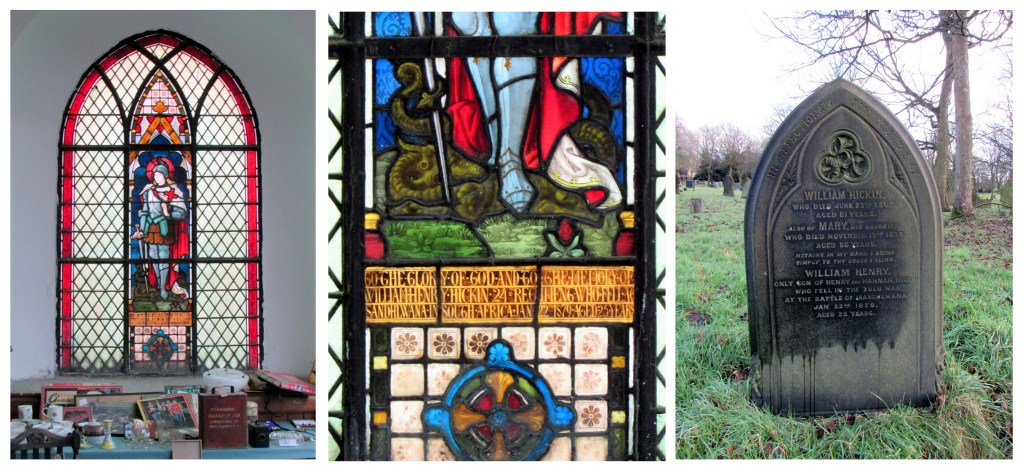
    The stained glass window and grave memorialising Private William Hickin.
    The stained glass window and grave memorials to Private William Henry Hickin.

    Several local men were killed in the action. In the ranks of the 1/24th were 25 year old Private William Henry Hickin from Hanley; the son of one Henry Hickin a local locksmith and bell hanger, William had previously worked as a writing clerk before enlisting in early 1876. Private George Glass 1/24th aged 22 from Shelton, was the son of a local school master and had briefly worked as a potter and joined the army in 1874. Private Enoch Worthington 1/24th from Kidsgrove, was 24 and had been a miner like his father before him; he enlisted in Newcastle in 1875. Private Samuel Plant 1/24th was an older man from Shelton, who had joined the 24th Foot in 1859, married in 1862 and prior to serving in Southern Africa he had served for a year on St Helena.

    In the 2/24th, former potter Sergeant William Shaw from Tunstall, was about 32 years old. After joining the army in 1870 he was promoted corporal in 1873 and sergeant in 1877. He had married locally before joining the army, had four children and had served in India and Britain before being sent to Southern Africa. His wife Emma and their children had come with him on this tour of duty and were lodged in King William’s Town, Cape Colony, far away from Zululand. Private Samuel Poole, 2/24th is something of an enigma as several possible candidates of that name were born in Audley, Kidsgrove or Newcastle, but there is no clear evidence if any of these are our man, all we know is merely that a man of that name enlisted in Hanley on 27 April 1875 aged 21 years. Records state that he served in G Company 2/24th. Private David Pritchard 2/24th, was from Stoke-upon-Trent though no one of that name appears in the civil records so that may have been an alias. He claimed to have worked as a forgeman before joining up in 1865 and he went on to see service in India. Aged about 34 at the time of the Zulu War, records say he served in B Company, but that was the company left at Rorke’s Drift, so he had probably been transferred to G Company.

    The most interesting of these local victims of Isandlwana from a historian’s point of view, is Sergeant William Shaw of the 2/24th, as evidence exists giving us a glimpse into his fate that day. According to the notebook of Corporal John Bassage 2/24th, now held at the Royal Regiment of Wales Museum, who was part of the force sent to bury the dead in June 1879 after the war was over, the remains of Sergeant Shaw and three private soldiers of the 2/24th were found together in a heap on the battlefield. The four men caught out in the open appeared to have formed into a small group in a last desperate attempt to try and fend off the Zulus as they poured into the camp. All seemed to have been stabbed to death with assegais.
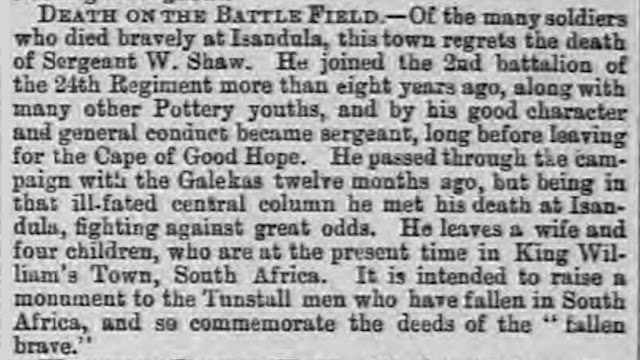
    Staffordshire Sentinel and Commercial & General Advertiser – Saturday 8 March 1879, p.5

    In a report in the Sentinel noting Shaw’s death in action, it was stated that there were hopes of raising a memorial to him and all the Tunstall men killed in South Africa. This, though, never seems to have come to pass and of all the men mentioned above only one appears to have been commemorated locally. In December 1880 at St John’s Church in Hanley, a stained glass window was dedicated to the memory of 25 year old Private William Henry Hickin, whose father was a churchwarden there. Hickin was further commemorated on his grandfather and aunt’s gravestone in Hanley Cemetery. Private Hickin is in fact the only ‘other ranks’ casualty of the Battle of Isandlwana remembered with a memorial window.

    One other local soldier who who was initially listed as a casualty was Private Frederick Butler from Shelton and son of the proprietor of the Bell and Bear Inn. He was a soldier of the 1/24th but prior to the invasion he had been transferred to the Imperial Mounted Infantry, Though initially listed as a casualty of the battle, Butler was in fact many miles away with his new unit serving in another invasion column that saw action at the battle of Nyezane on the same day as Isandlwana. He survived the war, rejoined his own unit once the fighting was over and later returned to the Potteries.


    Reference: Staffordshire Sentinel, various issues March-May 1879. My thanks to Ken Ray for his detailed list and information on the local men killed at Isandlwana and to Alan Rouse for family and background information on Sergeant Shaw.
  • Turkey Attacks Artist

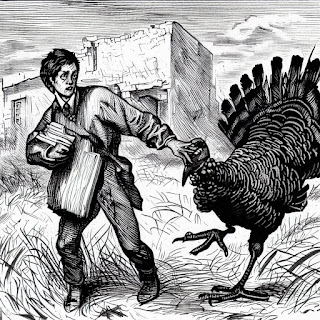
    On 22 April 1910, an unnamed but ‘well known’ Staffordshire artist was sketching some ruins near Hanley on this Friday afternoon, when he was attacked by a large turkey and endured a running battle with the bird that lasted a quarter of an hour. The turkey approached the artist perhaps more out of curiosity at first, but when the man tried to simply shoo the bird away it attacked him. Using his sketch block the artist aimed a blow at the bird’s head, but missed and after using his stool and artist’s palette with no greater success, he sought refuge behind a tree. The turkey pursued him and the man was forced to try and fight the bird off by kicking at it, shouting for help as he did so. Eventually a party of golfers and a farmhand heard his cries and came to the rescue, driving the turkey off. Though badly shaken and exhausted by the encounter, the artist was not severely injured. 

    Reference: Staffordshire Sentinel, 26 April 1910.

  • A Fatal Case of Elephant Teasing

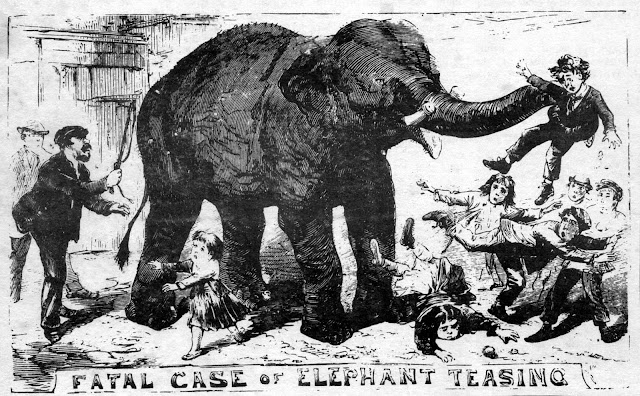
    The incident as depicted in The Police Illustrated News.

    In the past it was common practice for the animals of travelling circuses to be lodged at local inns if the stables were large enough to accommodate them. In April 1872, Bostock and Wombwell’s circus was at Hanley for the Wakes and on the morning of Saturday 13th, a small group of children were feeding bread and nuts to one of the circus elephants in a passage leading to the Angel Inn. Its keeper, Thomas Hurley, was standing a few yards from the young female elephant, waiting for the key to the stable. He had driven the children away several times but they kept coming back and now while Hurley was distracted, one of the children, George Stanton, decided rather unwisely to play a prank on the elephant by feeding her a stone. Immediately and without warning, the elephant – normally a very gentle creature – went mad and lifting the boy in her trunk she crushed him against a wall with her head and tusks. Mr Hurley turned on hearing the screams from the children and shouted out, at which the elephant dropped the boy and he was carried away. George Stanton suffered wounds to his head and back and had been badly squeezed by the elephant. He died from his injuries on Sunday evening.

    Reference: Staffordshire Bugle, February 1993.

  • The Curious Quadrupedal Company

    For some weeks during the winter of 1852-1853, the locals in Hanley and Longton in the Potteries were treated to a number of visits from a Frenchman, Monsieur Desarais (or Desaris), with his troop of highly trained dogs and monkeys. His was one of many such travelling shows that trod the boards of the town halls or theatres up and down the country during the mid-nineteenth century. Often these shows were unsophisticated by modern tastes, but in an age where opportunities for popular entertainment were scarce, even the feeblest efforts were appreciated.

    Monsieur Desarais’ show seems to have been better than most if reports of the time are anything to go by. In one short piece a reporter described exactly the performance he witnessed. After noting his astonishment at the animals’ performances and the skill of Monsieur Desarais as an animal trainer, the reporter continued.

    ‘This curious quadrupedal company, educated to a high pitch of perfection in the histrionic arts, and costumed to suit their respective characters successfully perform many of the conventionalities of daily domestic life. The supper scene, or monkey banquet, served by a monkey gentleman-in-waiting, a brother monkey the presiding genius of the table, with all the precision of fashionable conviviality, speech excepted. This was a rare treat in itself. A variety of curious evolutions followed, the dogs and monkeys habited as ladies and gentlemen waltzing to music, playing at leap-frog. A dog ascending and descending a double-ladder, with a monkey clinging to his back; one poor fellow industriously performed the rare treat of trundling a barrel up an inclined plane, wagging his tail to his master, apparently highly pleased at his success. The balancing tricks, by two dogs; and the performance of a solo by a “Jenny Lind” of the canine species, to an accompaniment on the violin followed by a hurdle race, in which the dogs were steeds and the monkeys, in full costume, were riders, caused roars of merriment.’

    Overall, Monsieur Desarais’ sojourn in the Potteries was a great success, except, that is, for one unfortunate little incident in Shelton on Christmas Eve 1852. This was reported by the same paper, but far more glibly under the title, ‘Novel Mode of Evading Toll’.

    The report described how Monsieur Desarais was passing through the Shelton toll gate in his small close carriage, drawn by four of his favourite dogs, when Mr Dixon, the gatekeeper came out of his house and demanded the toll. Monsieur Desarais refused to pay and a heated discussion ensued as to why the toll was necessary. Becoming angry and seeing that he was getting nowhere with the irate Frenchman, Mr Dixon seized some of Monsieur Desarais’ property in lieu of the toll, but this only made matters worse. Monsieur Desarais seeing his property confiscated in such an unceremonious manner yelled, “Then I’ll pay” and opened his carriage door as if to get the cash. No sooner was the door open than out leapt a large formidable-looking monkey, who as if instinctively protecting his master looked as if he were about to attack Mr Dixon. At that moment, though, the gatekeeper’s wife who had been keeping her eye on the altercation rushed out carrying a pistol. The sight of the gun so alarmed the monkey that he threw his tail around his owner’s neck and with a ferocious grin of horror shot back into the carriage. Whether the monkey’s actions had been choreographed by Monsieur Desarais we will never know, but he did not escape the toll keeper, for as the report concluded, ‘Monsieur, with his dogs and monkeys, left the toll-gate keeper to his reflections and his umbrella as a pledge.’

    Reference: Staffordshire Potteries Telegraph, 1 January 1853.