The Rough Fleet, an amorphous gang of street thugs under the leadership of John ‘Mad Jack’ Wilson were a terror to the locals, notably in and around Hanley, for many years at the very beginning of the 19th century. Born in 1787, Wilson was the eldest surviving son of David Wilson, a respectable pottery manufacturer who ran the Church Works, Hanley, which stood on ground between St John’s Church and what later became Hanley Deep pit, ground now given over to the swirl of roads and traffic islands where Town Road coming out of Hanley joins the Potteries Way. John Wilson was also the man who accidentally killed his brother and niece when he was firing off cannons to celebrate the Hanley Wakes in 1807 (see ‘An Awful and Melancholy Accident’ above). Maybe this family tragedy had in some way adversely affected him and set him on the criminal path he henceforth followed, but it is easy to look for excuses for bad behaviour and there is too little information on John Wilson’s early days to know for sure what started him on his criminal career; perhaps he had always been a bad lot who just got worse over time.
The approximate site of the Church Works just outside of the centre of Hanley Source: Google Earth
Concrete information on the early origins of the gang is likewise thin on the ground. Writing in the early 1840s and thus well within living memory of events, John Ward in his history The Borough of Stoke-upon-Trent, noted that ‘In the years 1808 and 1809 a gang of reckless young men, some of whom were respectably connected, carried on a system of nocturnal outrage, rather from a wanton and mischievous spirit, than for the sake of plunder, which greatly annoyed and terrified the peaceable community. They obtained the name of The Rough Fleet, from their daring and buccaneering-like exploits’. This may have been when they started their reign of terror, but if so it seems that they continued causing trouble and dodging any real justice for the better part of a decade before the gang’s chief members were finally brought to book.
Between 1816 and 1818, The Staffordshire Advertiser noted that the gang or its individual members were involved in several brushes with the courts for assaults, riotous behaviour and attempted shootings. At the Swan Inn in Hanley’s Market Square in early 1816, John Wilson was confronted in the bar by one outraged local, potter John Sheridan of Cobridge, who accused him of threatening his life and shooting at him, describing Wilson as ‘the terror of the neighbourhood’ and ‘the Captain of the banditti’. Wilson took Sheridan to court for slander when the latter accused Mad Jack of murdering his own brother, but he lost the case perhaps as a result of the growing ill-feeling towards him and his confederates. Incidents continued to be reported through to early 1818, while in the same paper John Wilson’s financial fall was also chronicled. His father David Wilson had died suddenly in 1816 and as John was his heir, the Church Works and family business had passed to him. Little good he did with it, though, being more interested it seems with his incessant drinking, partying with his gang and trouble-making and by July 1817 he was declared bankrupt and as numerous notices in the papers showed, his pot bank and other properties quickly passed out of his hands.
The end for the gang followed shortly after this in early 1818, when as Ward put it, ‘several of them were ultimately prosecuted at the Sessions, and convicted of various misdemeanors, which at length broke up the lawless confederacy.’ It came about as the result of an attack on a local constable Ralph Barton, who was left wounded by the encounter. Eight members of the Rough Fleet including John Wilson, were arraigned on a charge of riot and assault at the March Assizes at Stafford, being committed to Stafford gaol in June with the case being deferred until October; and it was there, doubtless much to the relief of the locals, that they finally got their comeuppance.
‘John Wilson, Samuel Shelley, Thomas Shufflebottom, John Clews, Henry Brereton, John Wallbank, Wallace Lockett, and Samuel Earnest, were convicted of riot, and of assaulting a constable in the execution of his office at Hanley. These prisoners are part of a corps too well known in the Potteries by the name of the Rough Fleet. Wilson (the Captain) was sentenced to eighteen months’ imprisonment; Shelley (Lieutenant) to ten months; and the other six to four months; each of them to find security for a year longer. The three first-named pleaded guilty.’
Following this conviction as Ward noted, the Rough Fleet seems to have been broken and it disappeared from the streets of the Potteries. Certainly that infamous title does not seem to crop up in any further stories in the contemporary press, save as a bad memory and the fates of its former members remain unknown.
Reference: John Ward, The Borough of Stoke-upon-Trent (1843) p. 369; Staffordshire Advertiser 16 March 1816, p.4; 5 July 1817, p.4; 18 October 1817, p.4; 31 January 1818, p.4; 21 March 1818, p.4; 13 June 1818, p.4; 24 October 1818, p.4.
An appalling family tragedy occurred in Hanley on Saturday 1 August 1807, when Robert, John and James Wilson, three sons of David Wilson, a respectable local pottery manufacturer in the town, prepared for the forthcoming Hanley Wakes by setting up three small cannon in Robert’s garden. There was a general gathering of friends and family there for the celebration, one of these was a friend of Robert Wilson named William Jervis, who nine years later described how the incident had unfolded. The whole group it seems were in high spirits, perhaps they had been drinking as they were certainly in a reckless mood. Jervis for instance, at one point went up to John Wilson, who would be setting off the cannons and said that he wanted to place his own child astride one of the barrels when it was fired, but John refused to let him do so and likewise refused to set the cannon off while his brother Robert and infant niece were so near. The first two cannons were loaded with powder and cabbages while the third was loaded with powder and an old sack for wadding which was provided by Robert himself.
Along with Jervis, Robert Wilson with his infant daughter in his arms then retired a safe distance to a nearby arbour to watch the show, but Robert was still feeling full of bravado and now made a terrible decision. Turning to Jervis he asked him whether he dared to pass in front of one of the cannons while it was firing? Jervis understandably refused to do so. Meanwhile, John Wilson, oblivious to this conversation fired off the first cannon, then the second, which with loud bangs sent gouts of smoke and showers of shredded cabbage leaves blasting out across the garden to the delight of those watching. As he was applying the match to the third, though, Robert came out of nowhere and ran in front of it with the child in his arms. The cannon went off as he did so and both were caught in the blast and it killed them. Robert Wilson got the worst of it, the sack wadding took the back part of his head off, and he died instantly. His daughter survived the initial blast but died of her injuries 20 minutes later. Their mangled remains were said to be a horror to behold and if it could be any worse, all of this occurred in front of a large group of family and friends including the little girl’s mother and grandmother; the grief and horror they all experienced can easily be imagined.
The authorities were alerted to the tragedy and a coroner’s inquest was convened on the following Monday. This quickly returned a verdict of accidental death and the two were buried on 5 August in the same coffin in the family tomb, their funeral being watched by many spectators. Newspapers of the time reported that the deaths cast a gloom over the Potteries that the amusements of the following week were unable to fully dispel.
In his book People of the Potteries, local historian Henry Allen Wedgwood attributed this accident to the mischievous folly of John Wilson who fired the cannons. John, despite his respectable background, later became notorious as ‘Mad Jack’ Wilson, the leader of the Rough Fleet, a gang of drunks, gamblers, street thugs and ne’er-do-wells, who for several years terrorised the Potteries. There are some significant differences in the story that Wedgwood relates, he says that the accident occurred after 1817, that there was only one cannon and that only Jack’s brother was killed when the gun went off. His act of folly, Wedgwood claimed, left ‘Mad Jack’ a broken man who then turned to the bottle for solace. However, despite his undoubted criminal career, if we believe William Jervis’ account the accident was actually due to the macho stupidity of Robert Wilson (it seems to have been a family trait) and John was the sensible one that day. John Wilson wasn’t broken by the tragedy, though it could be argued that coupled with subsequent events it perhaps unhinged him and turned him bad. Certainly it remained a very ‘tender point’ with him and nearly a decade later he took a man to court for slander after he had supposedly accused ‘Mad Jack’ of murdering his own brother that day. It seems however, that by 1816, John Wilson received little in the way of sympathy from the townsfolk, his thuggish reputation was against him as he lost the case, the jury easily finding for the defendant.
There may have been more immediate tragic sequels to this sad story when just over a month after the accident, and within only a few days of one another in late September and early October, the following death notifications appeared in the Staffordshire Advertiser. The first on 26 September 1807, seems to record the death of Robert and John’s mother, ‘On Wednesday last, at Hanley, in the Potteries, in her 46th year of her age, after a lingering illness which she bore with exemplary fortitude, Mrs Wilson, wife of Mr. David Wilson, at that place.’ Then, the following week, there was one apparently noting the death of Robert’s wife.
‘DIED… On Sunday evening last at her house in Newcastle-under-Lyme after a few days illness, Mrs. Wilson, relict of Mr. Robert Wilson late an eminent manufacturer at Hanley in the Potteries; – in her life and conduct was exemplified every virtue which dignifies the christian character; a sincere lover of and a liberal benefactor to the cause of truth; an affectionate relative; a true friend to the poor and distressed, and a promoter (so far as Providence had enabled her) of every benevolent institution within her sphere of action.’
As there is a lack of documentation regarding the Wilson family at this period, it is difficult to say conclusively that these were the mother and wife of the dead man, but if so it is not too great a leap to suppose that the two women had been crushed by the loss of their son, husband and daughter through Robert’s signal act of foolishness, that their mental and physical health had suffered and they had wasted away as a result.
Reference:Staffordshire Advertiser 8 August 1807, p.4; 26 September 1807, p.4; 3 October 1807, p.4; 16 March 1816, p.4; Henry Allen Wedgwood, People of the Potteries pp. 65-72. Local press coverage was thin on the ground at this time, only the Staffordshire Advertiser being available. Likewise, church records that might have added more details are lacking, due to the near wholesale destruction of St John’s records during the Pottery Riots of 1842. These (save for a single baptismal register) were lost when Hanley Parsonage was burnt to the ground.
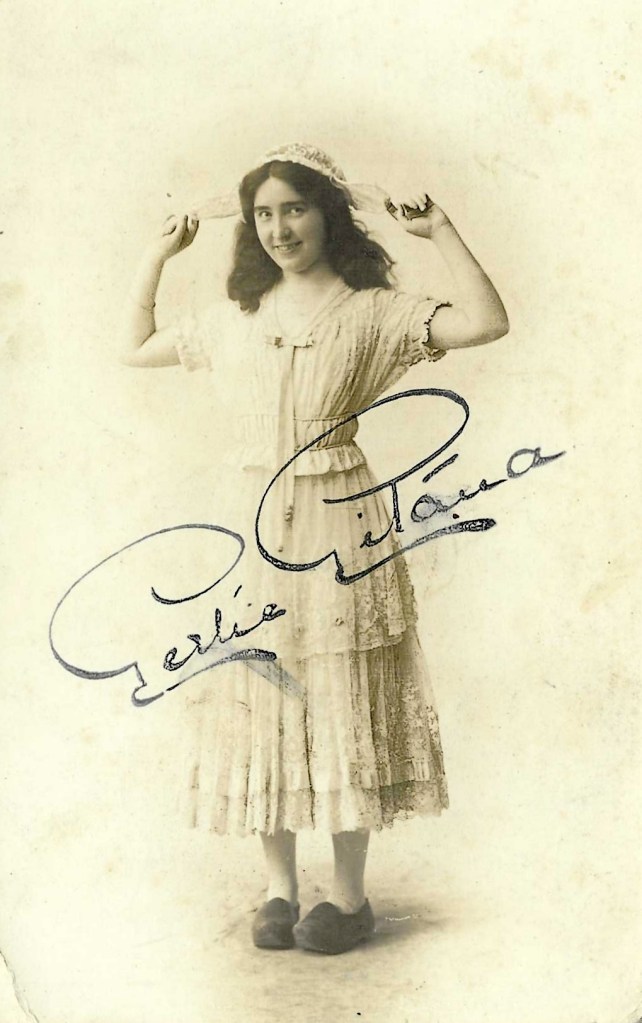
Gertrude Astbury, known as Gertie Gitana, captured in a charming early publicity photograph.
Of all the famous names who have hailed from the Potteries, few in their lifetime gave more honest, unalloyed pleasure than Gertrude Astbury, who as ‘Gertie Gitana’ became a darling of the music halls prior to World War One. Her talent and staying power were considerable. In her prime, her name on the bill was enough to ensure a full house, and even in the twilight years of her career, she was still able to command a large audience.
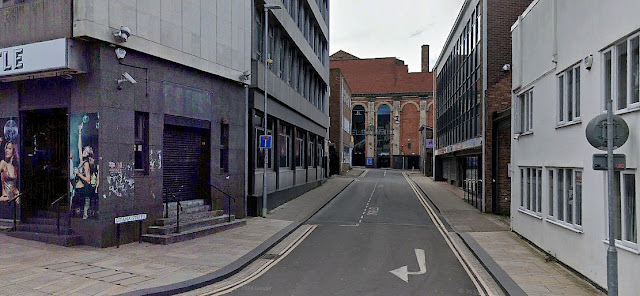
Gertrude Mary Astbury, the eldest child of pottery turner William Astbury and Lavinia nee Kilkenny, a teacher at St Peter’s R. C. School in Cobridge, was born on 28 December 1887 at 7 Shirley Street, Longport, but the family lived at various addresses after that. When in 1954 the City Council decided to rename Frederick Street, behind the Theatre Royal in Hanley, as Gitana Street in her honour, Gertie wrote a letter to The Sentinel saying that she was very proud of the honour noting that ‘Gitana-street is adjacent to the theatre stage is appropriate.’ She then added, ‘I don’t think anyone knows of it, but it may be of some slight interest to mention that I actually lived in Frederick-street; my mother had a small shop there. I was three years old when we moved there and we were there for two or three years.’ There is no official evidence to support this story, but at the time of the 1891 census, Gertie was certainly living with her grandparents in Bucknall New Road, Hanley, while her parents and brother James lived in Burslem. Perhaps the family moved to Fredrick Street after the census was taken?
From a very early age, Gertie proved to be something of a musical prodigy. Apparently as a toddler she delighted in putting on performances for her dolls and by the age of four she had been enrolled into Thomas Tomkinson’s Gypsy Children as a male impersonator, singer and comedienne and was soon earning star billing as ‘Little Gitana’ (the Spanish word for a female gypsy). The tale told of her discovery is that she was seen dancing in the street (arguably in Frederick Street, Hanley) by two girls attached to the troupe who befriended her. She then went along to one of the rehearsals and began copying the moves. Thomas Tomkinson noticed her and recognising her ability, applied to her parents to let her join the troupe. Once in the line-up and out touring with the show first around the Potteries, then through Wales, Gertie honed her skills and there was no doubting her burgeoning talent and her performances were regularly singled out for praise in press reports. In 1896, her career was given a helping hand by two music hall veterans, James and Mabel Wignall, known professionally as Jim and Belle O’Connor, who took her away from the Gypsy Children and under their wing. Though the O’Connors were apparently somewhat protective of their young charge, it was not in any sinister way and Gertie always referred to them affectionately as ‘Uncle and Auntie.’ It was thanks to them that at only eight years of age, Gertie made her music hall debut at the Tivoli in Barrow-in-Furnace, where she sang the song, ‘Dolly at Home.’ Two years later at the age of ten, she had a major billing at The Argyle in Birkenhead, and her first London appearance came in 1900.
By the age of 15, Gertie was earning over £100 per week, much more than her father earned in a year. At the age of 17, she topped the bill for the first time at The Ardwick Empire at Manchester. From late 1903 onwards, though often still appearing as Little Gitana, she was also being referred to increasingly as Gertie Gitana, the stage name she would adopt for the rest of her career. As she grew into womanhood, though, her skills and repertoire expanded and as well as singing she entertained by tap dancing, yodelling, and playing the saxophone, a relatively new instrument developed in the States and which at that time was something of a novelty in Britain. Her music hall repertoire of songs over her career included ‘All in a Row’, ‘A Schoolgirl’s Holiday’, ‘We’ve been chums for fifty years’, ‘When the Harvest Moon is Shining’, ‘Silver Bell’, ‘Queen of the Cannibal Isles’, ‘You do Look Well in Your Old Dutch Bonnet’, ‘Never Mind’, ‘When I see the Lovelight Gleaming’, and most famously ‘Nellie Dean’ which she first sang in 1907. It was a song her younger brother James had heard in the United States and was an instant success for Gertie, becoming her signature tune. Her first gramophone recordings, dating from 1911–1913 (some of which can be heard online), were made in London on the Jumbo label.
Vintage portrait of Gertie Gitana, the famous music hall performer, holding a saxophone.
During the Great War, like many music hall performers Gertie turned her talents to entertaining the war wounded in hospitals or raising funds for the injured and she gained a following with the men in the trenches as a forces sweetheart. After the war, she appeared in pantomime, most notably as the principal boy in Puss in Boots, or as Little Red Riding Hood, and Cinderella. One amusing incongruous tale from this period is that she was reputed to have said the line in Cinderella, ‘Here I sit, all alone, I think I’ll play my saxophone’, before removing the instrument from the stage chimney and bashing out a tune*. Two musical shows were specially written for her: Nellie Dean and Dear Louise, and in 1928, despite initial opposition from the O’Connors, Gertie married her leading man in the latter, dancer Don Ross. Don was as ambitious and driven as his wife and would later prove to be quite the impresario, bringing over one of the first Vaudeville strip-tease artists after a visit to the States, running a three-ring circus and organising variety shows; he later became King Rat of the Grand Order of Water Rats and founder and first president of the British Music Hall Society.
The autobiography of Gertie’s friend and fellow performer Ted Ray
After the shows had run their course, Gertie returned to the variety scene, working for some time in partnership with blackface performer G. H. Elliott and an up-and-coming comedian Ted Ray, who liked her immensely. In his autobiography, Ray described both Elliott and Gertie as charming and courteous professionals, who never let their acts devolve into smut and no matter what their moods or what else was going on in their lives, never let an audience down or turned in a sub-par performance.
However, determined to retire at 50, by her own design Gertie’s career was now winding down. Made rich by her tireless work over the years (“No gutters for Gertie.” she sometimes commented wryly on her wealth) she was able to retire in 1938, but the old trouper could not be kept down and ten years later she made a short but very successful comeback with other old music hall stars in the show Thanks for the Memory produced by her husband. The show was the centrepiece of the Royal Command Performance in 1948. Her final appearance was on 2 December 1950 at the Empress Theatre, Brixton. She retired completely after that and spent her remaining years quietly, though she increased her fortune by speculating successfully on the stock market. On her death she left just over £23,584 in her will, equivalent to £484,727.62 in 2024.
Gertrude Ross, nee Astbury, alias Gertie Gitana, died of cancer on 5 January 1957 in Hampstead, London, aged 69, and was buried in Wigston Cemetery, Wigston Magna, Leicestershire, where her husband had been born. Some lines from her most famous song, ‘Nellie Dean’ are engraved on the gravestone.
By all reports, Gertie, though no pushover after years toughing it in showbiz, was an incredibly good natured and generous woman, well-liked not only by her legion of fans, but also by her fellow performers who felt her loss. After her death her friend, comedian Ted Ray, wrote ‘She was the most gentle, loveable person I ever met… A perfect artiste in every sense of the word. I place her among the immortals.’ In his book My Old Man, former Prime Minister John Major, recalled how years later his father (who trod the boards as part of the act ‘Drum and Major’) expressed similar sentiments about Gertie. Her death made the TV and radio news of the time, papers including the Sentinel, carried glowing obituaries to the star and memorials were mooted, though the only one of note at the time was a memorial bench that was unveiled in Edinburgh. In the Potteries memorials to Gertie Gitana have for the most part been fleeting. The Gertie Gitana pub (later The Stage Door) has come and gone, likewise Gitana’s pub in Hartshill and today few save die-hard local historians or music hall enthusiasts remember her. But her name lives on in Gitana Street, an honour that never ceased to delight and surprise her. As her husband Don Ross recalled, on the day she died Gertie was fading away, but talking with him about this and that when unbidden she suddenly brightened up and said, ‘Fancy them naming that street in Hanley after me.’
Modern day Gitana Street, Hanley. Source, Google Earth.
*Comedian Roy Hudd in his foreword to Ann Oughton’s biography of Gertie Gitana, recalled asking Don Ross in later years if Gertie really had used the amusing ‘… I think I’ll play my saxophone’ line in Cinderella, but Don neither confirmed nor denied it.
Reference: Ann Oughton, Thanks for the Memory, passim;Ted Ray, Raising the Laughs, pp. 86-87; Evening Sentinel 15 February 1954 .
Being situated in such a hilly region, widespread flooding is a rarity in Stoke-on-Trent, but occasionally chance extremes of weather have briefly put parts of the area under water. One startling weather event occurred on the afternoon of Sunday, 7 July 1872, when what the Staffordshire Advertiser described as ‘a thunderstorm of great severity’, struck the Potteries. Though it only lasted an hour and a half, it was so fierce that it left in its wake many dozens of flooded or damaged properties and a somewhat shell-shocked populace. Considering the violence of the storm and the damage it caused, remarkably few people were injured, though it seems there were many close calls.
It had been cloudy all day, but in the afternoon the sky began to grow much darker presaging a storm, the light becoming so dim that newspapers could only be read near to windows or by candle or gas light. The dark clouds then gave way to ones with a strange yellow tint to them and it was then that it started to rain, not in drops, but as a veritable deluge driven in by a fierce wind and accompanied by loud claps of thunder and multiple bolts of lightning. In Hanley there was one very alarming event when a bolt of lightning passed through the Primitive Methodist school room in Frederick Street (now Gitana Street), entering by one window and out through another. The only damage was a scorched paint board on the front of the building, but the room had been full of children when the lightning shot through and these now fled the room in panic. They had to descend a flight of stairs to get out of the building and while none had been injured by the lightning, several now fell and were trampled underfoot and bruised in the crush, though none of them seriously.
During a service at Shelton Church, it rained so heavily that water forced its way through the roof and poured down into the building in streams. Buckets had to be brought to catch the water and the noise produced during the saying of the litany is said to have made for a very curious sound. Elsewhere in town, the lobbies of Bethesda Chapel in Old Hall Street were flooded, so too were numerous houses in town, notably in Nelson Place where part of the road nearby carrying a tramway was washed away. In Hanover Street, the downpour lifted stones up out of the road and deposited them at the bottom of Hope Street, where a heap big enough to fill two barrows was collected. The bottom end of Hope Street itself flooded, filling the cellars with up to a foot of water, floating heavy beer barrels in a brewery and boxes of live chickens in one house. The damage done to yards and gardens was tremendous. Nor were the local pot banks immune. The Cauldon Place works were flooded, though no serious damage was caused. Hanley’s satellite villages were likewise hard hit. At Basford a lightning bolt shot down a chimney and blew away a portion of a mantle shelf in one of the rooms; Etruria saw dozens of properties flooded, as too did Bucknall, where the water rushing down the roads and through the houses quickly threw the Trent into spate, causing it to overflow. This caused enormous damage on the low-lying ground of the neighbouring Finney Gardens where Bucknall Park now stands, some of the walks, plants and flowers being washed away by the sudden inundation.
Probably in no other part of the Potteries were the effects the storm so severe than in Burslem. Reporters on the scene shortly afterwards noted that even the oldest inhabitants had never before witnessed such a tempest, one stating that the rain ‘came down in bucketfuls’. The rain here was particularly heavy and for more than an hour the thunder and lightning was incessant and at one point the wind rose to a terrible pitch causing major damage in several places. On the Recreation Ground (where the old Queens Theatre now stands), Snape’s Theatre, a temporary structure of wood and canvas which had been constructed for the town’s wakes week, was in a matter of minutes blasted to smithereens. A number of the thickest supports were splintered like matchwood and many of the rafters and seats were destroyed, while the canvas roof was torn to shreds as the wind hit it. Mr Snape was a veteran travelling showman, well liked in the district and there was a great deal of local sympathy for him over his losses. In the aftermath of the storm a fund was set up, subscriptions to which would hopefully help him in repairing the serious losses he had sustained.
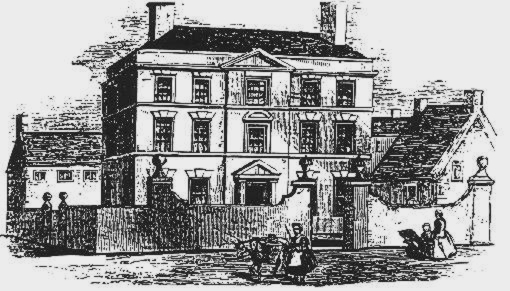
The Big House, Burslem
Just down the road from where Snape’s Theatre was taking a battering, part of an eight-foot tall wall between a timber Yard and the Big House was knocked down by the wind and rain, the accumulated flood water then rushed through the ground floor of the Big House with great force, blowing the front door open and then pouring in a stream down the turnpike road.
At the Roebuck Inn in Wedgwood Place, the violence of the rainstorm split some of the roof tiles, causing a mass of water to cascade into the upper rooms, then down the stairs and out through the front doors. The Town Hall too received a soaking, the basement of which was flooded to a depth of three feet, which caused no end of problems for the hall keeper and his wife who had the job of clearing it all out. Likewise the row of houses in Martin’s Hole – literally a hole or hollow near the Newcastle Road, where the roofs of the houses were on a level with the road – ‘presented a truly pitiable appearance’, the buildings being flooded to a depth of four and a half feet, ruining food stores and furniture and forcing the luckless inhabitants to seek shelter on the upper floor.
Almost everywhere else it was the same story with only slight variations. Longport received a severe visitation with most of the houses flooded to several feet. At Middleport the canal overflowed adding to the chaos. At Tunstall, water poured into the police station and several houses doing much damage. In Smallthorne numerous houses were flooded and smaller items of furniture were flushed out of the doors and sent floating down the street. At Dresden as well as the numerous flooded properties, the road at the lower end of the village was split apart by the storm, leaving it looking for all the world as if it had been heavily ploughed, which made it impassable to traffic and men had to be brought in to make repairs. In Stoke, Fenton and Dresden as in Burslem, many householders were forced briefly to live upstairs as their ground floors filled up, sometimes as high as the ceiling. Longton too suffered torrential rain and likewise had some flooding, but saw much less material damage, though at one pot bank the downpour extinguished the fires in their kilns.
Then the storm passed, leaving the Potteries in a battered state that it would take several days to recover from. That evening another storm broke overhead, but this turned out to be a much less severe event and caused no more serious problems.
Reference: Birmingham Daily Post, Tuesday 9 July 1872, p.5; Staffordshire Advertiser, Saturday 13 July 1872, p.5.
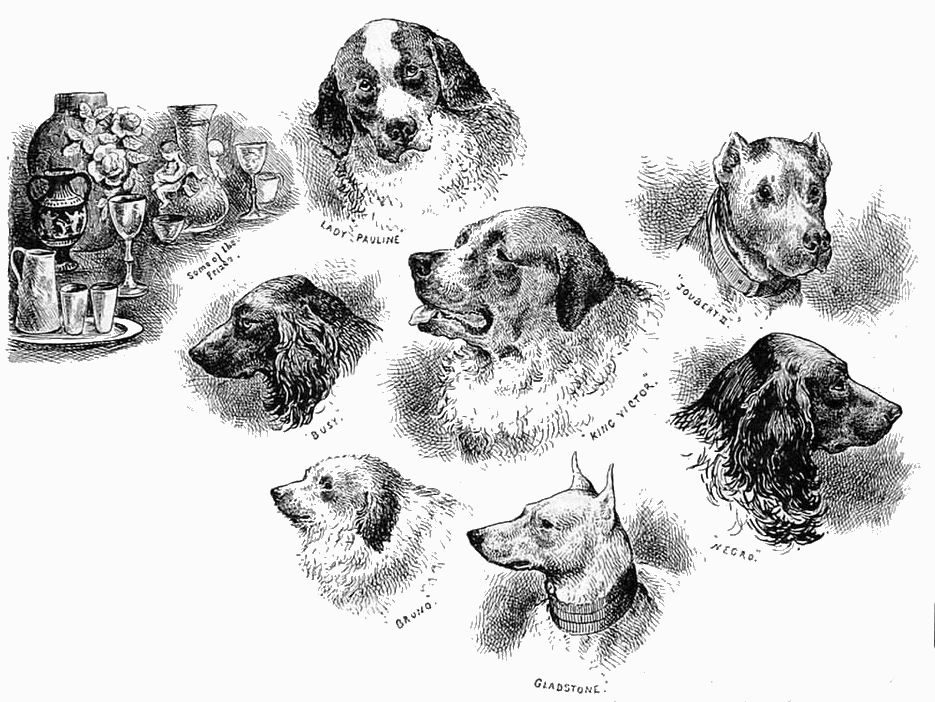
Some of the prize winning animals at the 1885 Hanley dog show.
When he paid a visit to the Potteries in the summer of 1874, journalist James Greenwood noted that Hanley was a town full of dogs:
‘Tykes of all ages, sizes, and complexions sprawl over the pavements, and lounge at the thresholds of doors, and sit at the windows, quite at their ease, with their heads reposing on the window-sill, hob-and-nob with their biped “pal,” who cuddles his four-footed friend lovingly round the neck with one arm, while his as yet unwashed mining face, black and white in patches as the dog’s is, beams with that satisfaction which content and pleasant companionship alone can give.’
How accurate a portrait of the town this was is open to debate as Greenwood immediately went on to write the infamous story of the ‘man and dog fight’ that scandalised the area, a tale that ultimately backfired on him when it became pretty obvious that he had concocted the whole story. Yet there is plenty of evidence to suggest at least in the comment above that Greenwood was not being untruthful and the locals were indeed keen pet owners and dog fanciers. A dog and poultry show was regularly held in Hanley from 1865 into the 1870s and in October 1883 Hanley hosted a major dog show organised by the North Staffordshire Kennel Club. This proved so successful that in February 1885 a second exhibition took place. This was larger and much more widely reviewed by the press, attracting not only local but national and even international attention.
Held over two days 24th and 25th February in the old covered market in Hanley, there were 774 entries for the show and there could have been more but for a lack of space. Most of the major show breeds were present in large numbers. There were 170 fox terriers; 74 St Bernards; 27 mastiffs; 22 pointers; 18 setters; 88 collies; 34 bull dogs; 20 bull terriers; 48 dachshunds; 18 pugs; and six bloodhounds. Add to this the more obscure dogs and hounds, some from abroad, plus some champion dogs including five mastiffs who had secured honours at the prestigious Crystal Palace shows, and you had you had a major treat for dog lovers from across Britain. Anticipating a good turnout both the North Staffordshire and London and North Western Railways issued cheap tickets for those wanting to attend the show.
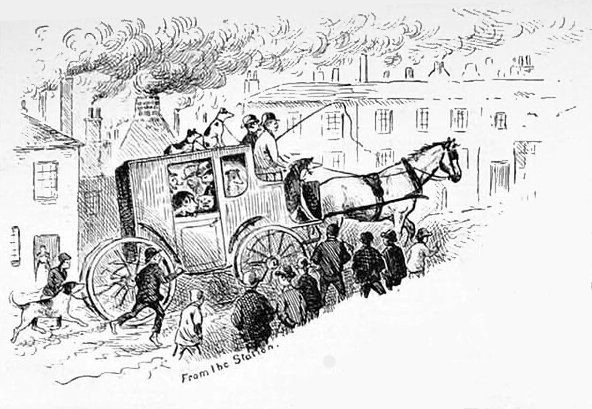
Providing a series of illustrations for The Illustrated Sporting and Dramatic News, was Louis Wain, the artist who in later life went mad and spent his latter years painting numerous pictures of sinister anthropomorphic cats. At the time of the Hanley dog show, however, he was still quite sane and penned a series of fine dog portraits and whimsical side illustrations. The most amusing sketch showed a carriage trundling its way up the bank from Stoke Station up into Hanley, bringing with it a fine collection of prize pooches, large and small, riding in or on top, or running behind the coach, evidently much to the astonishment of onlookers.
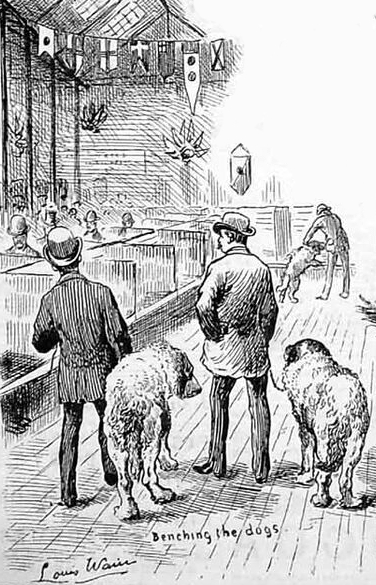
Another of Wain’s illustrations showed that once in the market hall the various dogs were housed in a series of pens ready for the viewing of the general public and while they waited on the judges to do their rounds. There were a few problems. A reviewer in the same paper that carried Wain’s illustrations noted that quite a few of the dogs on show still bore evidence of a mange epidemic that had recently swept the country. Most were over the disease and the worst effects they showed were rather patchy coats, but a few displayed signs that their condition was still ‘alive’, much to the reviewer’s alarm. The entry of such obviously infected dogs he put down to the laxness of the ‘honorary veterinary surgeon’ and the inconsiderate nature of some owners. This was all the more surprising as one of the Kennel Club’s rules stated quite forcefully that no dog suffering from mange or any other infectious disease would be allowed to compete or be entitled to receive a prize.
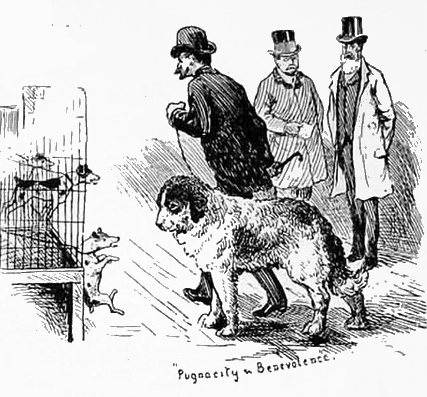
The writer also suggested that the chains holding the dogs in their pens were in many cases far too long. Some of the dogs were fierce or excitable and in their frenzy apt to fall over the edge of their bench and with the smaller dogs in danger of hanging themselves. Wain illustrated the point with a picture showing a placid St Bernard face to face with a group of irate terriers, one of whom had taken just such a tumble and was in danger of throttling itself. The long chains also allowed more mischief as some of the animals were able to get around the partitions and engage in scraps with their surprised neighbours.
In the long run, though, these were minor issues in what turned out to be a very successful and well organised show. And as can be seen from Louis Wain’s fine illustrations, despite the ravages of the mange epidemic there were still many handsome dogs on hand to pick up the numerous prizes. So popular did the exhibition prove that another show was organised early the next year and the competition carried on through the latter years of the 19th century expanding into a dog and cat show by the late 1890s.
References: The Illustrated Sporting and Dramatic News, 7 March 1885 pp. 607, 617, 623. James Greenwood, Low Life Deeps, pp. 16-17
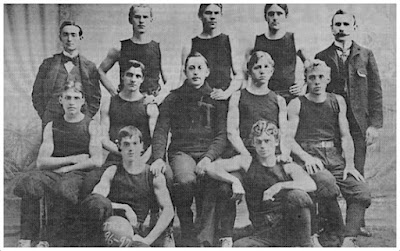
The Trenton basketball team 1896-97. Fred Cooper is bottom left with the ball, his friend Al Bratton is bottom right.
In 1896, Frederick Cooper, a distant American cousin of mine, earned himself a place in the history books through the simple act of accepting a fee. Several years earlier, a dynamic new game called basketball had been invented that was gaining a strong following in the various YMCAs on America’s east coast. Fred, already a keen sportsman had like many others quickly warmed to the game, becoming the star player and captain of the highly successful Trenton YMCA team that for the previous three years had dominated the emerging leagues. At first the new game had been played for fun and entertainment, but the groundswell of support soon saw seats being sold for popular teams and inevitably the money trickled back to the players that the crowds wanted to see. The result was that in 1896 Fred was the first to accept payment for a game and in doing so became the world’s first professional basketball player.
Though he would make his name in the United States, Fred Cooper was actually born at 21 Bethesda Street, Shelton on 25 March 1874, the fifth of seven children – six boys and one girl – born to Thomas Cooper and Ann, nee Simpson. Fred’s father, Thomas, had started out as a working potter but over the years had moved into small scale pottery manufacture. However, in the mid-1880s, in the wake of what was later described in Fred’s obituary as ‘some business reverses’, Thomas and Ann decided to emigrate and join their eldest child, William who was already settled in the States, working at the Greenwood Pottery in Trenton, New Jersey. The Coopers left Britain early in 1886, travelling as steerage passengers (i.e. 3rd class) aboard the SS England, arriving at New York on 27 May 1886, from where they made the relatively short journey south west across the state to Trenton. As it turned out, Thomas would only enjoy his new home in America for a few years, dying in 1891 at the age of 56, but his wife and children settled into their new lives and over time became valued members of the local community.
Trenton, New Jersey, USA
On arriving in the States, Fred and his younger brother Albert, or ‘Al’ as he became best known, had been enrolled in the Centennial School where they soon got involved in sports and stood out as skilled footballers, a game their father had taught them. Fred especially proved to be an all-round sportsman, also taking up baseball, competitive running and later becoming a fine billiards player and a good bowler. His successes, though were at first eclipsed by his older brother, Arthur, who back in Britain had been such a skilled footballer that in the early to mid 1880s he played for Stoke F.C.’s junior team, Stoke Swifts. Arthur seems to have stayed behind for a year after the rest of the family emigrated, perhaps to help the Swifts in their attempt to win the junior league cup. Once this was over though, in 1887, he too took a ship to the States, but not before being presented with a handsome medallion by his team mates and the club. Once in the States, Arthur’s success had continued, and it was not long before he was picked as a member of the All-America soccer team.
While his brother’s career blossomed, Fred left school and found work as a sanitary-ware presser at one of Trenton’s pot banks, a job he would do for the better part of three decades. He continued to pursue his love of sport in his spare time through the local YMCA, which acted as a youth club for boys and young men of religious families like the Coopers. Here he found a kindred spirit in another keen footballer named Al Bratton, with whom he seems to have formed a winning partnership, not only on the football pitch, but also when the two of them decided to try their hand at the new game of basketball that was sweeping through the YMCA branches. Only a few years had passed since Canadian-born training instructor James Naismith had dreamt up the indoor game to placate a group of YMCA trainees at the School for Christian Workers, Springfield, Massachusetts, who had been chafing at their inactivity during the long winter months. Though rough-hewn at first, with early games resembling pitched battles between oversized teams, basketball proved an immediate hit and when Naismith published an article on the game it was quickly taken up by YMCA branches along America’s east coast. Soon, matches were drawing sizeable crowds and more and more teams sprang up, one of which was Trenton YMCA.
Fred Cooper and Al Bratton first joined the Trenton YMCA basketball team for the 1893-94 season and had an immediate and lasting impact on how the game was played. In those early days, basketball was a game of individual dribblers working their way through the opposition before attempting a shot at the basket, a method that favoured heavy-set players who could push their way through the field. According to one of basketball’s early chroniclers, Cooper and Bratton changed this, creating a more fluid game by drawing on their footballing skills to develop a system of short, swift passes between them on the run, a style of play that completely unbalanced opposing teams.
‘The Trenton system of passing was definite. It meant to carry the ball to the opponent’s basket in order that a goal might be scored, and time and again I have seen Cooper and Bratton in those early days, pass the ball back and forth between them – no one else touching it – and score against all the efforts of the entire opposing team. I have seen them do this trick away from home and witnessed the spectators rise en masse and cheer the brilliant exhibition in spite of the fact that it was being done by invading players.’
For the next three seasons, the Trenton YMCA dominated the game in New Jersey and eastern Pennsylvania by which time Fred was the team captain and unofficial coach. Despite his refinements to the game, rough play characterised basketball in those free-wheeling and largely unregulated years, with physical injuries being an all too common feature of play, both on and off the court. Not only was there brawling between players, but partisan crowds took whatever opportunities came their way to try and injure or discomfort the rival team and as a result fighting between players and spectators was not unusual. Though the YMCA had quickly lauded Naismith’s new game for promoting a useful spirit of ‘muscular Christianity’ – a healthy body breeding a healthy mind – the rough-housing and unsportsmanlike behaviour drew the Association’s displeasure and increasingly basketball teams deserted the YMCA gyms, or were ousted by outraged officials and had to find other venues to play in.
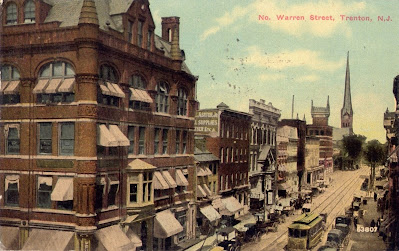
Warren Street, Trenton, with the Masonic Temple nearest the camera.
Such seems to have been the case at the Trenton YMCA. Unspecified ‘trouble in the gymnasium’, followed by a string of disagreements between the branch secretary and the YMCA team saw the basketball players shifting their base to the Masonic Temple, a large building in downtown Trenton. Here the team made use of the large reception room on the top floor, where a 12 feet high mesh fence with gates at either end was built enclosing the court. This ‘cage’ was a new innovation, built to stop the ball going out of play so readily and prevent some of the troubles caused by resultant clashes with spectators. The Trenton team were the first to employ this device and though its use eventually fell out of favour, its early employment coined the term ‘cager’ as a snappy way to refer to a basketball player, a term that is apparently still in use today.
It was in this cage that Fred Cooper and his team mates made history by playing what is presumed to be the first professional basketball game on 7 November 1896, against Brooklyn YMCA. The game had been advertised in a local paper three days earlier (another first) and provisions were made for a sizeable crowd, raised seating being built around the court. Seats were priced at 25c, standing room cost 15c. Nor would the organisers be disappointed by the turn out, ‘a large and fashionable audience’ of 700 turning up to watch.
The Trenton team came out smartly dressed in red sleeveless tops, black knickerbockers and stockings and white ankle shoes. There were seven in each team, two forwards, a centre, two side centres and two defenders. This was before the days of the tall men in basketball, all of them being average sized, Fred himself was only 5 feet, 7 inches tall. In accordance with the practice of the time, the home team supplied the referee and the visitors chose the umpire.
The game started with seven minutes of ‘fierce playing’ before Newt Bugbee, one of Trenton’s side centres scored the first goal. Fred did not disappoint either, leading the scoring by gaining six points for three baskets, while a player named Simonson scored Brooklyn’s only point with a free throw three minutes before the game finished. Trenton’s team played the full 40 minutes, while Brooklyn had one substitution. The final score was a 16-1 victory for Trenton.
Following the game, Trenton’s manager hosted a supper for both teams at the Alhambra Restaurant, where the Trenton players received their historic payment. There has been some disputing the amount actually paid to the players after the various expenses were deducted, but the accepted version of events was that quoted in Fred’s obituary in 1955. ‘All the players collected $15 each, but Fred Cooper was the captain and manager (sic) and was paid off first. Thus he became the first professional basketball player in the world. He was proud of this distinction all his life.’
Many versions of the story add that Fred as the captain was also paid a dollar more than his compatriots, which if true also made him the game’s first highest paid player. Also, the ‘professional’ status is perhaps somewhat fuzzy as he still worked as a potter; semi-professional, might be more accurate. That argument aside, it started a trend that would lead to the fully professional game seen today.
As they had with the new swift style of play and Trenton’s ‘cage’, other teams quickly followed Trenton down the professional route. This in turn led to the formation in 1898 of the first professional league, the National Basketball League, which Trenton under Fred Cooper’s captaincy promptly dominated, winning the first two NBL titles. By this time the team had been joined by Fred’s younger brother, Albert. Tall and handsome and as skilled as his brother, Al Cooper proved to be an accomplished goal scorer and easily the best player in the new league.
Despite their successes, during the first few NBL seasons, Fred was growing disillusioned with the Trenton team. His brother Al and Harry Stout, Trenton’s top scorer did not get along, while the team’s co-owners had also had a falling out. Keen for a fresh start, at the beginning of the 1900-1901 season, he quit the Trenton squad to coach a new team in nearby Burlington. The result, though, was embarrassing. Though Fred was an excellent coach, his new team lacked Trenton’s pool of of talented players, the result being that Burlington lost its first eight games before Fred gave up. He was immediately snapped up to coach the Bristol team, before going on to coach at Princeton University between 1904-1906. It was not until 1910 that Fred returned to coach the struggling Trenton Eastern Basketball League team and did so successfully, winning the EBL title the following year. He was replaced as the coach the next year, but returned to coach Trenton one more time ten years later. His last stint as a team coach was at Rider College in the 1920s.
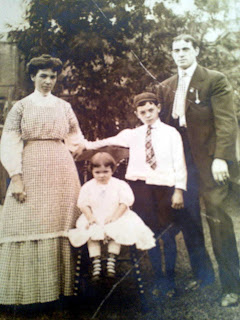
Fred and Catherine and their eldest children Thomas and Mabel. Photo courtesy of Susan Corrigan.
Alongside his sporting career, Fred enjoyed a happy family and social life. In 1901, he had married Catherine Carr and the couple had three children. Like his siblings he was an active member of the Trenton community, becoming in time a church elder, and a member of various local and national patriotic orders and Masonic lodges. As noted earlier he had worked for many years as a sanitary-ware presser at the Enterprise Pottery, which generously allowed him time off for his coaching duties, but he quit his job in 1922, when on the strength of his sporting career, he was offered a position as a director of local sports grounds, a posting that eventually led to him becoming head of the city recreation department.
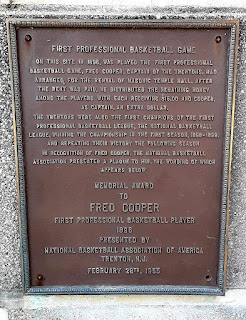
Fred Cooper died in January 1955 at the age of 80, being buried in Greenwood Cemetery, Trenton. The local paper gave him a fulsome obituary, while the National Basketball Association, heir to the early leagues that Fred and others had helped to forge, did not forget its pioneering sportsman. In February 1955, the NBA presented the city of Trenton with a bronze plaque in honour of Fred and his ground-breaking professional match, which was placed on the site of Trenton’s old Masonic Temple.
The memorial plaque to the first professional match. Photo courtesy of Grace Cooper
Reference: Robert W. Peterson, Cages to Jump Shots: Pro Basketball’s Early Years (New York, 1990) pp. 32-37. Obituary, Trenton Evening Times, 7 January 1955.
Family information courtesy of Grace Cooper and Susan Corrigan.
In 1997, Hugh Troth of Ohio, published a tribute to his grandfather, The Life and Times of Isma Troth. Isma Troth had served as a soldier in the American Civil War and he wrote several letters charting his friendship with a fellow soldier named John Livesley whom he met in hospital when he was there recovering from his wounds. Troth’s account indicated that Livesley came from Potteries and using biographical information from this book and information from other social archives, local researchers were able to piece together the life of this otherwise forgotten local who had somehow got himself involved in a foreign war.
John Livesley was born in Shelton on 12 October 1838, the son of pottery engraver and journeyman William Livesley and Sarah nee Brundrett. He enjoyed a privileged upbringing as his father was an increasingly prosperous man, who by 1851 had opened his own pottery and also ran a grocery business, all together employing 46 men, 23 women, 20 boys and 25 girls. As a result of his family’s wealth, John enjoyed a good education, attending a boy’s boarding school run by James and Harriet Grocott at Wilton House, Wrinehill near Betley on the Staffordshire border.
As the family business grew, William Livesley entered into partnership with one Edwin Powell, and his name then regularly appeared in the local press, often for his philanthropy and support for public works and by the mid-1850s, John Livesley or J. Livesley likewise puts in a few appearances, attending performances or contributing money for some good cause supported by his father. But by 1861 census John had disappeared from the area.
In fact, he had left the country and crossed the Atlantic to the United States, sailing in September 1860 aboard the RMS Persia to New York in company with 40 year old James Carr, a native of Hanley who two decades earlier had emigrated to the States and had established a successful pottery in New York. Both men give their occupation as ‘potter’ in the ship’s passenger list and it is not unreasonable to suppose that John Livesley, the son of a successful Hanley manufacturer had gone over with John Carr to work in his growing firm.
Yet, it was a bad time to be travelling to the USA as growing tensions between the northern and southern states over the expansion of slavery, came to a head the following year. The southern slave-owning states split from the Union, forming a Confederacy, an act that pushed the country into a bloody civil war.
Was John Livesley permanently settled in the States at this time, resisting the urge to join in the conflict, or just an occasional visitor to the country, criss-crossing the Atlantic and thus avoiding becoming involved? It is hard to say, but he was certainly in New York on 23 January 1864 when he was enlisted as a private in L Company 6th Regiment New York Cavalry of the Union army. Details on his enlistment are unclear, but suggestions have been made that he was drunk at the time, a not unlikely hypothesis as John seems to have had a habit of drinking to excess when he found himself in like-minded company. This is backed up by records that show that he was in hospital for the first week of his service due to “delirium”. He also seems to have enlisted under an assumed name, the enlistment records for John Livesley being struck through and replaced with the name ‘John Lindsley’. The records note that he was born in England, worked as a potter and gave a physical description: ‘gray eyes, brown hair, light complexion, 5 feet 8½ inches in height’. His term of enlistment was given to be three years.
His new home, the 6th New York Cavalry, also known as the 2nd Ira Harris Guard, was a veteran unit, it had been formed at the outbreak of the Civil War and seen much service. Only a few months earlier it had taken part in the Battle of Gettysburg and since then played its part in numerous smaller actions taken on by the Army of the Potomac to which it belonged. With the onset of winter though it had gone into cantonments and when John Livesley enlisted, was employed in guarding the country between the Union lines and the Blue Ridge Mountains.
US and Confederate cavalry in action at the Battle of Trevilian Station in 1864.
On 3 May 1864, the regiment – now with Livesley, or rather ‘Lindsley’ in its ranks – returned to action, crossing the Rapidan river and taking part in the Wilderness campaign under General Grant. The regiment was part of the Cavalry Corps, and played a role in all the operations undertaken by the corps commander General Sheridan, notably in his famous raid around the Confederate capital of Richmond. At the battle of Yellow Tavern on 11 May 1864, the 6th New York Cavalry charged down the Brook Pike and went into and entered the line of the first defences about Richmond, being the first Union regiment to get so close to the city. The regiment then saw action in the Battle of Trevilian Station, and in numerous smaller actions and it was probably during one of the latter in August 1864 that John Livesley was badly wounded eight months after joining up.
Carried from the front and admitted to the USA Post Hospital, Bolivar Heights, Harper’s Ferry on 20 August with gunshot wounds, Livesley was a wreck and had to have an arm and a leg amputated. Records show that aside from his physical injuries, he like many in the army was also suffering from chronic diarrhoea, but also that he was quickly transferred further from the seat of war, first to the Field Hospital at Sandy Hook, Maryland and finally to Rulison USA General Hospital at Annapolis Junction, Maryland on the road between Washington and Baltimore. Confined to a wheelchair, it was during his long convalescence here that he met Isma Troth, a former prisoner of war at the infamous Andersonville prison, who now worked as a clerk at the hospital, often writing letters home for the wounded, one of them being John Livesley whom he first met shortly after his arrival there. The two men developed a close friendship and Livesley’s father offered to pay for the two of them to come to England when they were discharged. The war effectively ended in April 1865 and John was mustered out of the Union army on 24 May 1865 whilst still at Annapolis Junction.
Cheered by the thought of making a new life for himself, Troth was keen to go to Britain, noting that his friend’s family were influential and he might secure a good position there, but he had some major misgivings about Livesley’s drinking habits. In a letter written in June that year, Mr Troth wrote: ‘Mr Livesley is a good, kind friend of mine and is an honest, intelligent man – but he sometimes drinks’. He noted that he had known Livesley for about a year and that the man was not a regular drinker and he never drank when they went places, but on a couple of occasions he had gone out with soldiers who did drink and had come home in quite a state. Once he went with them to a neighbouring village and came back the worse for wear, and on being mustered out of the army he had gone out ‘with some fast boys’ to celebrate his release and had come back drunk, much to Troth’s disgust. After talking of their plans to travel to Britain, Isma said: ‘If my friend associates and drinks with these rough characters I shall not go with him, for I cannot place any confidence in a drunkard.’
Despite these problems, the two friends did indeed take passage to Britain and Isma spent a year in England before travelling home. John returned to Stoke-on-Trent and was soon set up as a grocer in Lichfield Street, in Hanley, marrying a local girl Ellen Twigg from Bucknall on 18 June 1867. But tragically John Livesley died just four months later, on 23 October 1867, aged 29, his cause of death being given as epilepsy.
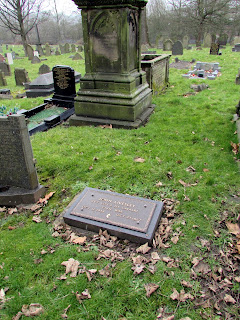
Despite his father’s wealth John was buried in an unmarked grave in Hanley Cemetery. However, when he learned of his grandfather’s link with John Livesley, Hugh Troth endeavoured to see John’s service recognised and in 1997 contacted the United States Government to obtain a bronze plaque, recognising Private John Livesley’s service during the American Civil War. In 2003, the plaque was put on his burial spot, being unveiled by Mr Troth.
Reference: Hugh Isma Troth, The Life and Times of Isma Troth (1997)
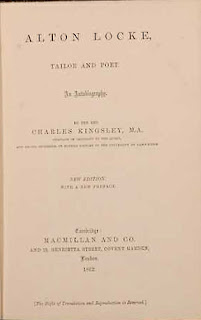
One of the least known literary associations with Staffordshire, is that of Charles Kingsley’s novel Alton Locke. Tailor and Poet, which was published in 1851. The story of the rise and fall of a self-taught working man who is eventually imprisoned for rioting, is based upon a real person and a real incident. The person was the Chartist leader, Thomas Cooper, who was arrested and sentenced to two years in prison, for the events he had prompted in the Staffordshire Potteries.
Thomas Cooper was born in Leicester to a working class family and from an early age displayed a precocious intelligence, the development of which was only limited by the fact that most of his lessons were self-taught. Occasionally, he had been known to immerse himself so deeply into his studies that the sheer mental effort he put forth ended on one occasion, at least, in him being physically ill. He worked at various jobs, mostly as a teacher, lay preacher and journalist, but eventually, appalled by the conditions endured by many factory and workshop workers, he became a convinced Chartist, a member of that Victorian working class movement which supported the introduction of a People’s Charter, which called for fair representation for the working population. The Charter’s six points demanded votes for all men at 21, annual general elections, a secret ballot, constituencies regulated by size of population, the abolition of property qualifications for MP’s and the payment of MP’s. Most of these points eventually became laws of the land and form a part of the state we live in today, but none of these things came into being until the latter half of the nineteenth century, long after the Chartist movement itself had collapsed.
There were two bodies of the Chartist movement, the physical and the moral-force Chartists, who sought to bring about social change by revolutionary or evolutionary means. In his early days, Cooper was a supporter of the former faction. He was a fire and brimstone type of preacher, who like all great orators could move people with his speeches. This power comes through in Cooper’s autobiography, which is widely regarded as one of the finest working class ‘lives’ written during the Victorian age. The book, though written in Cooper’s later years after he had become a convinced moral-force Chartist, tends to carefully skate around his fiery physical-force youth and he presents himself as a far more reasonable man than he actually was in August 1842, when he arrived in the Potteries. Only by bearing in mind, that Cooper at this time advocated revolution of sorts, do the events he inspired in the Potteries make sense. Though he says in his book that he proclaimed, ‘Peace, law and order’, the resulting riots that left one man dead, dozens wounded or injured and many buildings burnt or ransacked, indicated that he said more than he was letting on.
Cooper arrived in the Potteries, after a tour of several major towns and cities in the Midlands, and here he was to make a number of speeches before moving on to Manchester. The area was in the grip of a wage dispute. In June, 300 Longton miners whose wages had been drastically cut had gone on strike. By July, the strike had expanded to all of the pits in north Staffordshire, and hundreds of miners were on the streets, begging for money, and with the pits being closed, the potteries through lack of coal, could not fire their kilns and were also closed. By early August, the dispute had attracted widespread attention, certainly the Chartists expressed sympathy for the miners’ action, but contrary to later claims that the subsequent riots were Chartist inspired, it was mostly miners and not Chartists who did the rioting. The Potteries were a powder keg, ready to explode and Cooper’s arrival, as he himself admitted was ‘the spark which kindled all into combustion’.
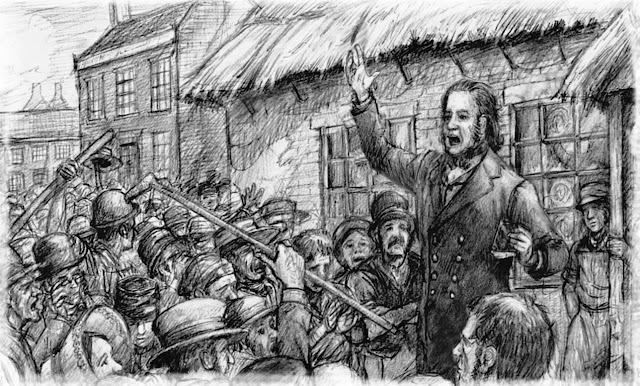
Thomas Cooper addresses the crowd at Crown Bank, Hanley
Standing on a chair in front of the Crown Inn, a low thatched building at Crown Bank in Hanley, on Sunday, 14 August, Cooper addressed a crowd of upwards of 10,000 people, delivering a brilliant Chartist speech to his audience. He look for his text the sixth commandment, ‘Thou shalt do no murder’. Throwing his net wide, he drew on examples of kings and tyrants from history, such as Alexander, Caesar and Napoleon, who had violated this commandment against their own people, even as their own government would be prepared to do. The next day, he addressed an equally sizeable crowd and moved a motion, ‘That all labour cease until the People’s Charter becomes the law of the land’.
What followed, Cooper later regretted. As the crowd dispersed. rioting started around the Potteries towns in all except Tunstall and the borough town of Newcastle. Police stations were attacked, magistrate’s houses ransacked and burned, as were Hanley Parsonage and Longton Rectory. By the 16th, the chaos had lasted a day and a night, but on that day, the most famous, or infamous incident of the uprising occurred, what is known locally as ‘the battle of Burslem’. Following the rioting in Stoke, Shelton, Hanley and Longton, a great crowd moved towards Burslem, there to meet a crowd coming from Leek. Here, though, the authorities played their hand, when a troop of mounted dragoons stopped the crowd from Leek. The magistrate in charge read the Riot Act, then tried to reason with the men, but when it was clear that they were bent on trouble, the soldiers were ordered to fire. One man from Leek was killed and many injured, the crowd was routed and the disturbances ended overnight, but for many weeks afterwards, the Potteries were full of troops and vengeful magistrates arresting rioters and Chartist leaders.
Cooper, horrified at the events he had unleashed, had tried to escape, but he was arrested and eventually tried and sentenced to two years in Stafford Gaol, on charges of arson and rioting. Here, he spent his time profitably, learning Hebrew and writing his book, The Purgatory of Suicides. On leaving prison, though, his views were found to differ considerably from the new mainstrean in Chartist thought, and he became increasingly a moral-force activist and remained so for the rest of his life.
It was in the two or three years after leaving prison, that Cooper was interviewed by the Rev. Charles Kingsley, whose Christian Socialist movement had inherited many of the Chartist beliefs. Kingsley had sought out several old Chartists and educated working men on whom he wished to base the life of the major character in the novel he was preparing. Thomas Cooper, was obviously the chief amongst these, certainly his autobiography, written many years after Kingsley had published Alton Locke, shows many striking similarities between Cooper’s life and that of his fictional alter ego. The riot that Alton inspires in the book, for which he too is committed to the prison, takes place in the countryside, amongst agricultural labourers, but behind it there is the faintest echo of the struggle in the Potteries, that one historian has considered the nearest thing to a popular revolution that the Victorian age saw.
After 1845, Thomas Cooper turned his talents mainly to writing, but he also lectured on subjects such as history, literature and photography. In this capacity, he made a number of return visits to the Potteries, to the place where on that day many years before, he had ‘caught the spirit of the oppressed and discontented’, in seeking to establish the basis of a democratic society.
Reference: Charles Kingsley, Alton Locke. Tailor and Poet (1851); Thomas Cooper, Life of Thomas Cooper, written by Himself, (1872).
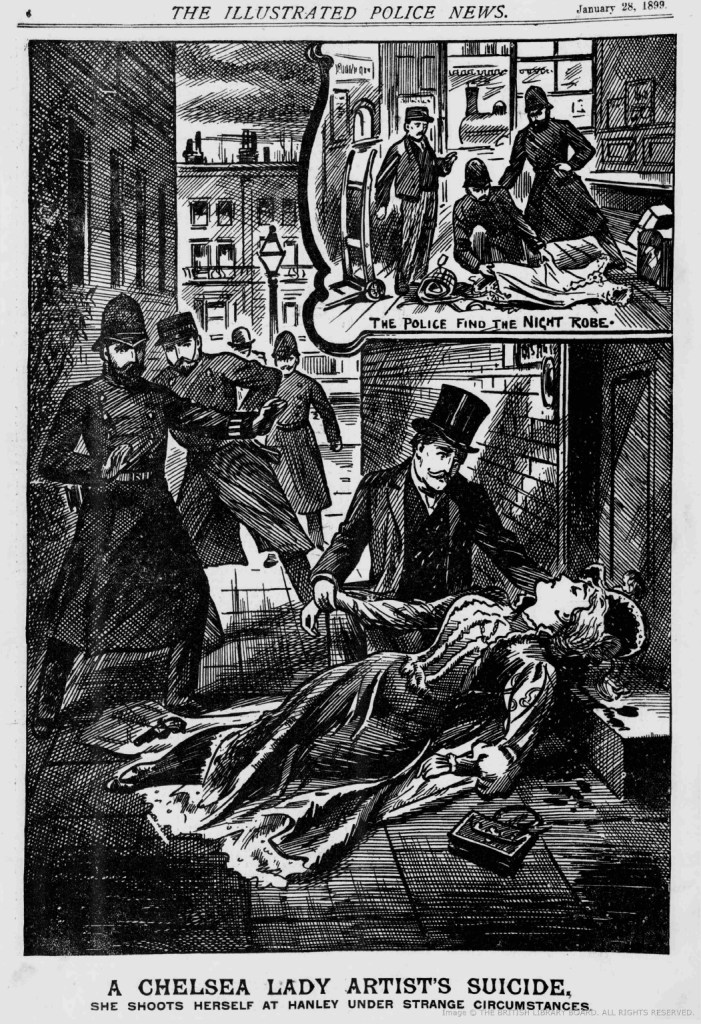
Image reproduced with kind permission of The British Newspaper Archive (www.britishnewspaperarchive.co.uk)
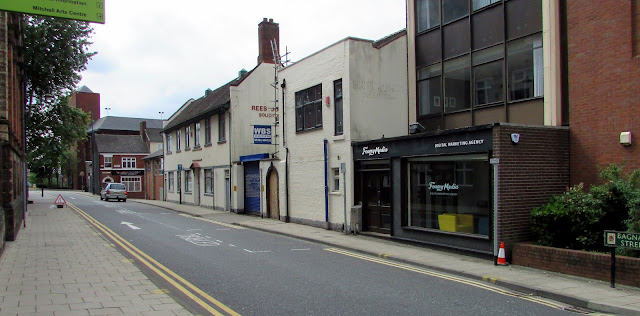
Late in the evening of 18 January 1899, Mr Richard Smith of Stoke was walking along Bagnall Street, Hanley alongside the Victoria Hall, when he was startled by the sound of a gunshot nearby. There was no one else in sight, but he noticed that across the road, a door beside a small medical dispensary was standing part-way open. Peeking carefully through the opening into a dark passageway beyond he spotted a body lying on the floor a pistol in its hand. Alarmed, he dashed to the police office around the corner in the Town Hall and returned moments later accompanied by an inspector and several policemen. When they reached the passage they found 51 year old Dr John Craig who ran the dispensary examining the body of a woman who had clearly shot herself in the head. They could make out little more in the dark, but when the doctor announced that the woman was still breathing the police brought a stretcher and together they carried her across to the police parade room. Hardly had they got into the well-lit yard, though than Dr Craig let out a cry having recognised the woman before him. The man was visibly shocked and while a senior officer took him aside for questioning the police searched the injured woman for clues to her identity.Going through her pockets they found numerous items: some money, a few keys, a packet of arnica, a left luggage receipt from Stoke Station and several newspaper clippings, one of which carried a few lines from Tennyson’s poem, Sea Dreams.‘
……. he that wrongs his friend
Wrongs himself more, and ever bears about
A silent court of justice in his breast,’
There were also receipts for recorded letters and a cryptic inscription on a visiting card that indicated a strong connection with Dr Craig. These along with the doctor’s own faltering statement soon identified the woman as Catherine Devine, a 43 year old artist from Chelsea. The doctor explained how he knew her and what he believed had just happened here and why. The lady herself, though, did not live to give an account of her actions, dying from her wound at 10 p.m., without regaining consciousness.
Present-day Bagnall Street, Hanley.
The full story of the connection between Catherine Devine and Dr John Craig came to light two days later in front of a packed court at the coroner’s inquest into her death. Here, Dr Craig revealed that he and Catherine had known one another for about 25 years, having first met in her home city of Edinburgh. It was there that John Craig had trained as a doctor, being licensed in 1869 and shortly afterwards he had married Ellen Macintyre a native of the Potteries, before moving to the area and setting up his practice in Hanley. His wife had given him a son and daughter, but in December 1874 she died at the age of 25, leaving him a widower with two young children on his hands.
Among his late wife’s friends were Eliza and Catherine Devine of Edinburgh, daughters of a well-known and wealthy family of Scottish artists. Eliza had agreed to paint a posthumous portrait of Mrs Craig and whilst visiting their studio in 1876 to see how work progressed, Dr Craig had met and become so smitten with the younger sister Catherine, that he had been contemplating asking her to marry him. They corresponded for a time, but his marriage hopes had faded a short time later, when Catherine and several members of her family emigrated to New Zealand in 1878. Robbed of his potential bride the doctor had little choice but to get on with his life as a single parent and as the years passed he became very content with this state of affairs.
Catherine remained in New Zealand and later Australia for eleven years, carving out a moderately successful career as an artist, but in 1889 she returned to Britain. Settling in a studio flat in Glebe Street, Chelsea, her skills soon saw her supplying artwork for several London fashion magazines and eventually holding an exhibition of her works. To this she invited several old friends including Dr Craig. This restarted their acquaintance and they corresponded intermittently for a few years until Catherine was invited to spend Christmas with the Craigs at their house at Mossley near Congleton. During this visit, Dr Craig innocently noted to Catherine in conversation that prior to her departure to New Zealand he had contemplated asking her to marry him, and was surprised when she immediately asked him why he could not ask her now? The doctor replied that time had altered his circumstances, that he was content and he now had no thought of marrying anyone. Catherine seemed to accept that at the time, but the remark had struck a chord with this brilliant but lonely woman and she soon started to obsess over the matter.
Apparently oblivious to what he had started, Dr Craig extended another invitation for Catherine to stay once again a few months after this, but she soon upset the situation by again urging Dr Craig to marry her. He again refused and the next morning, whilst he was out, Catherine left the house under a cloud. Returning to find her gone, Dr Craig was left feeling very angry at her behaviour and that might have been the end of the matter, but a few months later he received a conciliatory letter from Catherine and he agreed to meet with her at her home in London when he visited the capital for Queen Victoria’s Jubilee in 1897. After watching the festivities he did indeed call on Catherine, prepared to let bygones be bygones, but when she again raised the subject of marriage he left in disgust and vowed never to visit her again.
Catherine then began to bombard Dr Craig with a series of scathing letters on his conduct that were followed more often than not by apologetic letters or telegrams asking him to reply. The doctor did reply to some to try and calm her down, especially when she began to threaten to kill herself. However, staggered by the barrage of letters he began to receive and the increasingly erratic mood swings of his would-be paramour, Dr Craig started to burn many of the letters unopened.
This state of affairs had carried on for the best part of a year, during which time Dr Craig had attempted to maintain his distance from Catherine. The death of her mother, though, in October 1898, seems to have made him sympathetically disposed towards her once more and shortly afterwards he met her again during a visit to London. He found her in a miserable state and recalled that she was in tears most of the time. Her one consolation was that she now wrung a promise from the doctor that if he would not marry her then he would marry no one else, an assurance he was happy to give. She also asked if she might be invited for Christmas once more if she avoided the question of marriage. Dr Craig told her that he and his daughter were in the process of moving into a house in Hanley adjoining his practice and would anyhow be in Northumberland visiting his mother over Christmas. He promised her, though, that once they had moved in after New Year, that she would be invited for a visit. Satisfied with this, Catherine parted amicably with Dr Craig and eagerly waited for the invitation to arrive.
Sure enough a few weeks later a letter did come, but the news it contained flung Catherine back into a rage. Dr Craig wrote to her saying that due to the work needed on the new house and because his daughter would be going abroad for a while, he did not feel that he could accommodate Catherine before his daughter’s return in March; in effect, for the time being at least, she couldn’t come. Stung by what seemed like another heartless rejection, Catherine wrote a furious reply saying that he had deceived her, adding ominously that she could not go on like this. It was a threat she had voiced before, but this time after all of the mental agonies she had suffered over the past year, it seems that Catherine had finally snapped. In the notes discovered after her death it appears that she wrote more letters to Dr Craig, but, as before, finding himself pestered beyond belief, the doctor had once again begun to burn the letters unopened. He was thus completely unaware of what she now set out to do.
Nor would he be the only one, as to most of her London friends the story of Catherine’s violent passion for Dr Craig would come as a great surprise, as she had displayed no outward signs of any great interest in men except as friends. All noted that she had been ill over the past year, stricken by a listlessness that her own physician, Dr Schorstein, put down to anaemia, but otherwise she seemed to be the same kindly, mild-mannered woman she had always been. As a result, none of them were aware – or could even have guessed – that Catherine spent early January 1899 preparing for her death, finishing a portrait of her doctor and wrapping up her affairs.
On the morning of 18 January, Catherine paid a visit to her housekeeper, Mrs Stoner, who had injured her wrist several days before and she now made sure that the elderly lady had everything she needed. Catherine told her that she would be going to Staffordshire for a few days, joking that it would give Mrs Stoner a rest from her. Back in her flat, Catherine left a package with a letter in her writing desk laying the blame for what she was about to do squarely on Dr Craig. Then she dressed well, putting on a fashionable lady’s walking-out costume, collected a nightdress she had wrapped up in brown paper (the police speculated that she brought the nightdress with her to be used as her shroud), a travelling rug, an umbrella and her purse containing money and a few notes to give the police enough clues to discover her story. She also pocketed the small, silver five-shot revolver that she kept for personal protection. Catherine then sent for a cab to Euston Station to catch the 4 p.m. train to Stoke. As she left, Catherine waved goodbye to her housekeeper and that was the last time that anyone who knew her saw her alive and conscious; it thus became the job of the police to reconstruct her last hours for the benefit of the inquest.
After a three hour journey north, the train arrived at Stoke Station at 7.14 p.m., and it appears that, after depositing most of her belongings at the left luggage office, Catherine had walked from Stoke into Hanley. Never having visited Dr Craig’s new house in Bagnall Street, she seems to have taken the better part of an hour locating it. Once she had, though, Catherine went into the gated entry where she removed her right glove to give her a better grip and taking out the pistol she placed the barrel against her right temple and pulled the trigger, inflicting the fatal wound.
Because of Catherine’s accusations against him, Dr John Craig found himself being closely questioned at the coroner’s inquest in an effort to determine if he was in any way morally responsible for what had taken place. Indeed, the doctor feared so much for his reputation that he had employed a solicitor to sit in on the inquest to represent his interests in the proceedings. However, the coroner was satisfied with the explanation that Dr Craig had given to the inquest; nor did the police see any reason to pursue the matter any further. The jury thought likewise and quickly returned the verdict that Catherine Devine had committed suicide whilst of unsound mind.
The final act in this tragic tale of missed opportunities and fatal obsession took place the day after the inquest, on Saturday 20 January, when the remains of Catherine Devine were interred at Hanley Municipal Cemetery. To avoid undue attention, the funeral took place a day earlier than advertised and the funeral cortège took a circuitous route to the cemetery for the same reason. Two of Catherine’s London friends, Miss Maud McCarthy and Dr Schorstein, who had appeared at the inquest, were the only mourners and not more than a dozen people stood around the grave in the pouring rain as the last rites were performed. As this was a suicide’s burial, there would be no headstone to mark her lonely plot, while the brass plate on the polished oak coffin bore only the simplest inscription.
Catherine Devine Died Jan. 18 1899, Aged 43 years.
Reference: Staffordshire Sentinel 19 – 23 January 1899. Numerous national and international papers January – March 1899.
Hanley-born Commander Edward John Smith is best remembered as the captain of the ill-fated White Star Line steamer RMS Titanic, which sank on its maiden transatlantic voyage after colliding with an iceberg in 1912. In many ways the image of Smith presented in the disaster has coloured how we see the man, to some he is the villain of the piece, to others a tragic figure. The few earlier glimpses that exist though, paint Captain Smith in a far different light. For instance in 1911 following the successful maiden voyage of Titanic’s elder sister Olympic, Smith comes across as something of a raconteur, playfully spinning a yarn to deflect over- eager reporters.
‘Captain Smith of the Olympic was questioned in New York about the coal consumption of the world’s biggest liner on her first voyage. But Captain Smith shook his head and said:”That is a coal story I am not privileged to speak about. I’ll tell you another coal story, though, if you’d care to hear it?”
“I’d be delighted,” said the reporter. “Well,” said Captain Smith, “It’s a story about a poor sailor. He was taken down with fever on a brigantine. and, though the mate and captain dosed him well, he died. They buried him at sea. “They buried him with the usual impressive sea rites. He was sewed in a sail round which a flag was draped, and, to make him sink, the sail was weighted with a number of big lumps of coal. “A landlubber of a passenger participated in the services. He watched the well weighted corpse slip into the water. It disappeared at once, and the landlubber shook his head and said: ” ‘Well, I’ve seen many a man go below, but this is the first one I’ve seen taking his own coal down with him.’ “









 Potted Histories