Tag: entertainment

  • Little Gypsy Girl

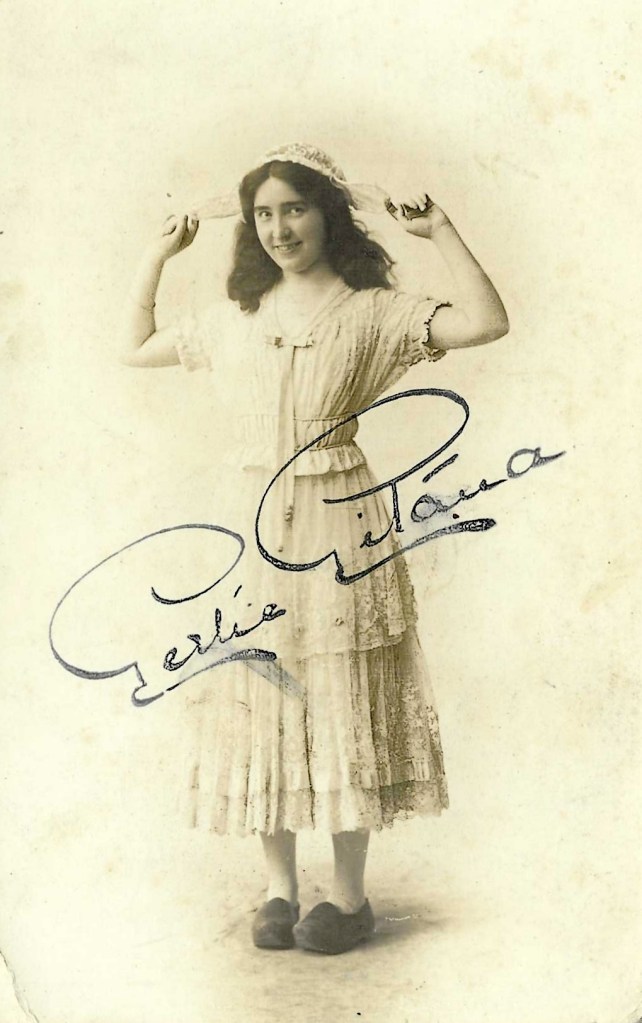
    A vintage black and white photograph of a young girl with dark hair, wearing a light-colored dress and holding a hat or scarf above her head, smiling at the camera. Her name, 'Gertie Gitana,' is beautifully signed below her image.
    Gertrude Astbury, known as Gertie Gitana, captured in a charming early publicity photograph.

    Of all the famous names who have hailed from the Potteries, few in their lifetime gave more honest, unalloyed pleasure than Gertrude Astbury, who as ‘Gertie Gitana’ became a darling of the music halls prior to World War One. Her talent and staying power were considerable. In her prime, her name on the bill was enough to ensure a full house, and even in the twilight years of her career, she was still able to command a large audience.

    Gertrude Mary Astbury, the eldest child of pottery turner William Astbury and Lavinia nee Kilkenny, a teacher at St Peter’s R. C. School in Cobridge, was born on 28 December 1887 at 7 Shirley Street, Longport, but the family lived at various addresses after that. When in 1954 the City Council decided to rename Frederick Street, behind the Theatre Royal in Hanley, as Gitana Street in her honour, Gertie wrote a letter to The Sentinel saying that she was very proud of the honour noting that ‘Gitana-street is adjacent to the theatre stage is appropriate.’ She then added, ‘I don’t think anyone knows of it, but it may be of some slight interest to mention that I actually lived in Frederick-street; my mother had a small shop there. I was three years old when we moved there and we were there for two or three years.’ There is no official evidence to support this story, but at the time of the 1891 census, Gertie was certainly living with her grandparents in Bucknall New Road, Hanley, while her parents and brother James lived in Burslem. Perhaps the family moved to Fredrick Street after the census was taken?

    From a very early age, Gertie proved to be something of a musical prodigy. Apparently as a toddler she delighted in putting on performances for her dolls and by the age of four she had been enrolled into Thomas Tomkinson’s Gypsy Children as a male impersonator, singer and comedienne and was soon earning star billing as ‘Little Gitana’ (the Spanish word for a female gypsy). The tale told of her discovery is that she was seen dancing in the street (arguably in Frederick Street, Hanley) by two girls attached to the troupe who befriended her. She then went along to one of the rehearsals and began copying the moves. Thomas Tomkinson noticed her and recognising her ability, applied to her parents to let her join the troupe. Once in the line-up and out touring with the show first around the Potteries, then through Wales, Gertie honed her skills and there was no doubting her burgeoning talent and her performances were regularly singled out for praise in press reports. In 1896, her career was given a helping hand by two music hall veterans, James and Mabel Wignall, known professionally as Jim and Belle O’Connor, who took her away from the Gypsy Children and under their wing. Though the O’Connors were apparently somewhat protective of their young charge, it was not in any sinister way and Gertie always referred to them affectionately as ‘Uncle and Auntie.’ It was thanks to them that at only eight years of age, Gertie made her music hall debut at the Tivoli in Barrow-in-Furnace, where she sang the song, ‘Dolly at Home.’ Two years later at the age of ten, she had a major billing at The Argyle in Birkenhead, and her first London appearance came in 1900. 

    By the age of 15, Gertie was earning over £100 per week, much more than her father earned in a year. At the age of 17, she topped the bill for the first time at The Ardwick Empire at Manchester. From late 1903 onwards, though often still appearing as Little Gitana, she was also being referred to increasingly as Gertie Gitana, the stage name she would adopt for the rest of her career. As she grew into womanhood, though, her skills and repertoire expanded and as well as singing she entertained by tap dancing, yodelling, and playing the saxophone, a relatively new instrument developed in the States and which at that time was something of a novelty in Britain. Her music hall repertoire of songs over her career included ‘All in a Row’, ‘A Schoolgirl’s Holiday’, ‘We’ve been chums for fifty years’, ‘When the Harvest Moon is Shining’, ‘Silver Bell’,  ‘Queen of the Cannibal Isles’, ‘You do Look Well in Your Old Dutch Bonnet’, ‘Never Mind’, ‘When I see the Lovelight Gleaming’, and most famously ‘Nellie Dean’ which she first sang in 1907. It was a song her younger brother James had heard in the United States and was an instant success for Gertie, becoming her signature tune. Her first gramophone recordings, dating from 1911–1913 (some of which can be heard online), were made in London on the Jumbo label.

    Vintage portrait of Gertie Gitana, the famous music hall performer, holding a saxophone.

    During the Great War, like many music hall performers Gertie turned her talents to entertaining the war wounded in hospitals or raising funds for the injured and she gained a following with the men in the trenches as a forces sweetheart. After the war, she appeared in pantomime, most notably as the principal boy in Puss in Boots, or as Little Red Riding Hood, and Cinderella. One amusing incongruous tale from this period is that she was reputed to have said the line in Cinderella, ‘Here I sit, all alone, I think I’ll play my saxophone’, before removing the instrument from the stage chimney and bashing out a tune*. Two musical shows were specially written for her: Nellie Dean and Dear Louise, and in 1928, despite initial opposition from the O’Connors, Gertie married her leading man in the latter, dancer Don Ross. Don was as ambitious and driven as his wife and would later prove to be quite the impresario, bringing over one of the first Vaudeville strip-tease artists after a visit to the States, running a three-ring circus and organising variety shows; he later became King Rat of the Grand Order of Water Rats and founder and first president of the British Music Hall Society.

    The autobiography of Gertie’s friend and fellow performer Ted Ray

    After the shows had run their course, Gertie returned to the variety scene, working for some time in partnership with blackface performer G. H. Elliott and an up-and-coming comedian Ted Ray, who liked her immensely. In his autobiography, Ray described both Elliott and Gertie as charming and courteous professionals, who never let their acts devolve into smut and no matter what their moods or what else was going on in their lives, never let an audience down or turned in a sub-par performance. 

    However, determined to retire at 50, by her own design Gertie’s career was now winding down. Made rich by her tireless work over the years (“No gutters for Gertie.” she sometimes commented wryly on her wealth) she was able to retire in 1938, but the old trouper could not be kept down and ten years later she made a short but very successful comeback with other old music hall stars in the show Thanks for the Memory produced by her husband. The show was the centrepiece of the Royal Command Performance in 1948. Her final appearance was on 2 December 1950 at the Empress Theatre, Brixton. She retired completely after that and spent her remaining years quietly, though she increased her fortune by speculating successfully on the stock market. On her death she left just over £23,584 in her will, equivalent to £484,727.62 in 2024.

    Gertrude Ross, nee Astbury, alias Gertie Gitana, died of cancer on 5 January 1957 in Hampstead, London, aged 69, and was buried in Wigston Cemetery, Wigston Magna, Leicestershire, where her husband had been born. Some lines from her most famous song, ‘Nellie Dean’ are engraved on the gravestone.

    By all reports, Gertie, though no pushover after years toughing it in showbiz, was an incredibly good natured and generous woman, well-liked not only by her legion of fans, but also by her fellow performers who felt her loss. After her death her friend, comedian Ted Ray, wrote ‘She was the most gentle, loveable person I ever met… A perfect artiste in every sense of the word. I place her among the immortals.’ In his book My Old Man, former Prime Minister John Major, recalled how years later his father (who trod the boards as part of the act ‘Drum and Major’) expressed similar sentiments about Gertie. Her death made the TV and radio news of the time, papers including the Sentinel, carried glowing obituaries to the star and memorials were mooted, though the only one of note at the time was a memorial bench that was unveiled in Edinburgh. In the Potteries memorials to Gertie Gitana have for the most part been fleeting. The Gertie Gitana pub (later The Stage Door) has come and gone, likewise Gitana’s pub in Hartshill and today few save die-hard local historians or music hall enthusiasts remember her. But her name lives on in Gitana Street, an honour that never ceased to delight and surprise her. As her husband Don Ross recalled, on the day she died Gertie was fading away, but talking with him about this and that when unbidden she suddenly brightened up and said, ‘Fancy them naming that street in Hanley after me.’
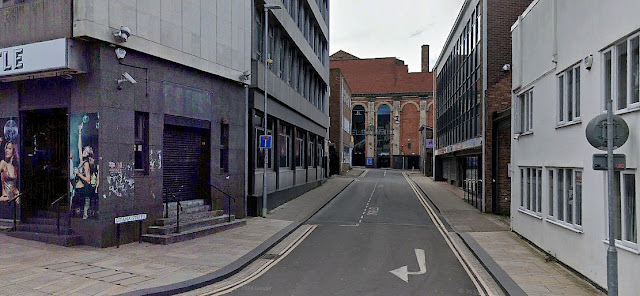
    Modern day Gitana Street, Hanley.
    Source, Google Earth.

    *Comedian Roy Hudd in his foreword to Ann Oughton’s biography of Gertie Gitana, recalled asking Don Ross in later years if Gertie really had used the amusing ‘… I think I’ll play my saxophone’ line in Cinderella, but Don neither confirmed nor denied it.

    Reference: Ann Oughton, Thanks for the Memory, passim;Ted Ray, Raising the Laughs, pp. 86-87; Evening Sentinel 15 February 1954 . 
  • Dandy Dogs and the Mad Cat Artist

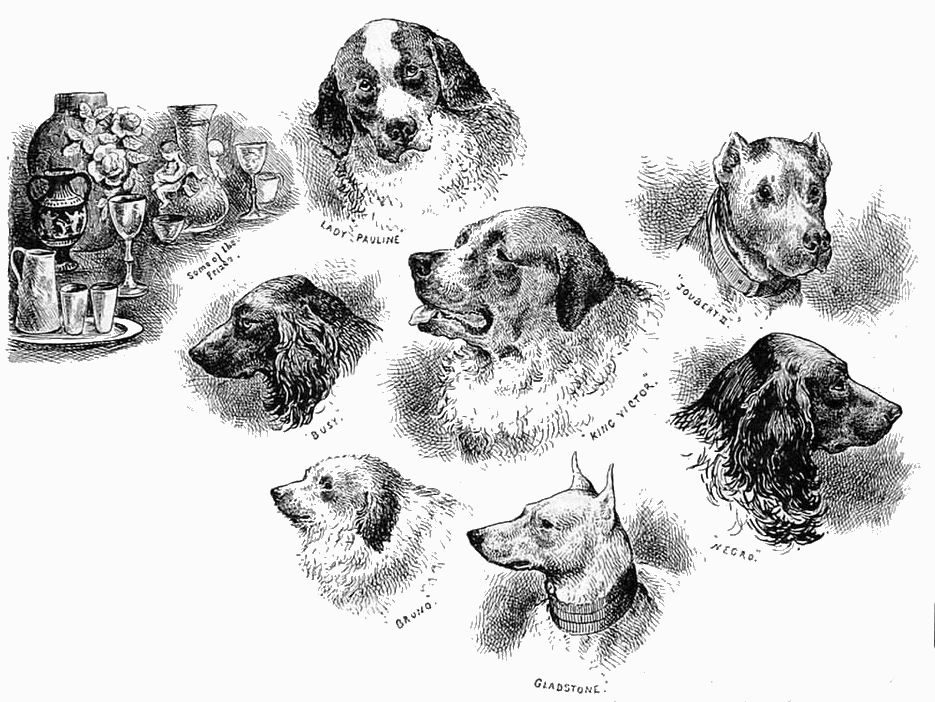
    Some of the prize winning animals at the 1885 Hanley dog show.

    When he paid a visit to the Potteries in the summer of 1874, journalist James Greenwood noted that Hanley was a town full of dogs:


    ‘Tykes of all ages, sizes, and complexions sprawl over the pavements, and lounge at the thresholds of doors, and sit at the windows, quite at their ease, with their heads reposing on the window-sill, hob-and-nob with their biped “pal,” who cuddles his four-footed friend lovingly round the neck with one arm, while his as yet unwashed mining face, black and white in patches as the dog’s is, beams with that satisfaction which con­tent and pleasant companionship alone can give.’

    How accurate a portrait of the town this was is open to debate as Greenwood immediately went on to write the infamous story of the ‘man and dog fight’ that scandalised the area, a tale that ultimately backfired on him when it became pretty obvious that he had concocted the whole story. Yet there is plenty of evidence to suggest at least in the comment above that Greenwood was not being untruthful and the locals were indeed keen pet owners and dog fanciers. A dog and poultry show was regularly held in Hanley from 1865 into the 1870s and in October 1883 Hanley hosted a major dog show organised by the North Staffordshire Kennel Club. This proved so successful that in February 1885 a second exhibition took place. This was larger and much more widely reviewed by the press, attracting not only local but national and even international attention.

    Held over two days 24th and 25th February in the old covered market in Hanley, there were 774 entries for the show and there could have been more but for a lack of space. Most of the major show breeds were present in large numbers. There were 170 fox terriers; 74 St Bernards; 27 mastiffs; 22 pointers; 18 setters; 88 collies; 34 bull dogs; 20 bull terriers; 48 dachshunds; 18 pugs; and six bloodhounds. Add to this the more obscure dogs and hounds, some from abroad, plus some champion dogs including five mastiffs who had secured honours at the prestigious Crystal Palace shows, and you had you had a major treat for dog lovers from across Britain. Anticipating a good turnout both the North Staffordshire and London and North Western Railways issued cheap tickets for those wanting to attend the show.


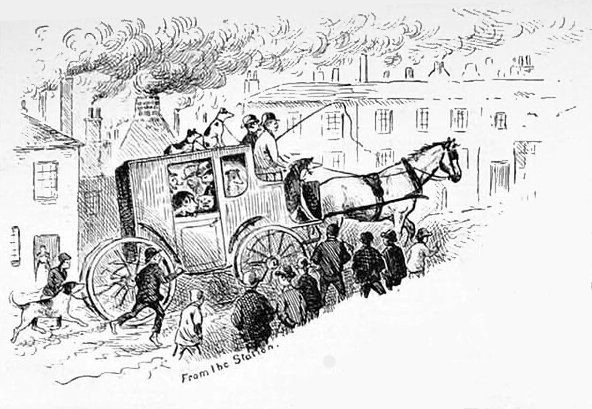
    Providing a series of illustrations for The Illustrated Sporting and Dramatic News, was Louis Wain, the artist who in later life went mad and spent his latter years painting numerous pictures of sinister anthropomorphic cats. At the time of the Hanley dog show, however, he was still quite sane and penned a series of fine dog portraits and whimsical side illustrations. The most amusing sketch showed a carriage trundling its way up the bank from Stoke Station up into Hanley, bringing with it a fine collection of prize pooches, large and small, riding in or on top, or running behind the coach, evidently much to the astonishment of onlookers.

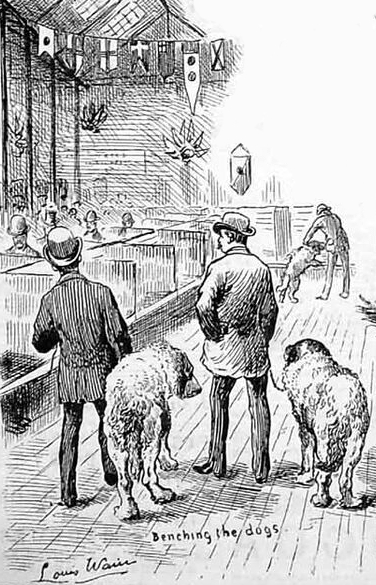
    Another of Wain’s illustrations showed that once in the market hall the various dogs were housed in a series of pens ready for the viewing of the general public and while they waited on the judges to do their rounds. There were a few problems. A reviewer in the same paper that carried Wain’s illustrations noted that quite a few of the dogs on show still bore evidence of a mange epidemic that had recently swept the country. Most were over the disease and the worst effects they showed were rather patchy coats, but a few displayed signs that their condition was still ‘alive’, much to the reviewer’s alarm. The entry of such obviously infected dogs he put down to the laxness of the ‘honorary veterinary surgeon’ and the inconsiderate nature of some owners. This was all the more surprising as one of the Kennel Club’s rules stated quite forcefully that no dog suffering from mange or any other infectious disease would be allowed to compete or be entitled to receive a prize.

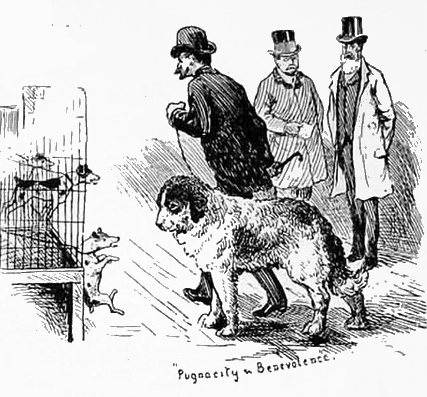
    The writer also suggested that the chains holding the dogs in their pens were in many cases far too long. Some of the dogs were fierce or excitable and in their frenzy apt to fall over the edge of their bench and with the smaller dogs in danger of hanging themselves. Wain illustrated the point with a picture showing a placid St Bernard face to face with a group of irate terriers, one of whom had taken just such a tumble and was in danger of throttling itself. The long chains also allowed more mischief as some of the animals were able to get around the partitions and engage in scraps with their surprised neighbours.

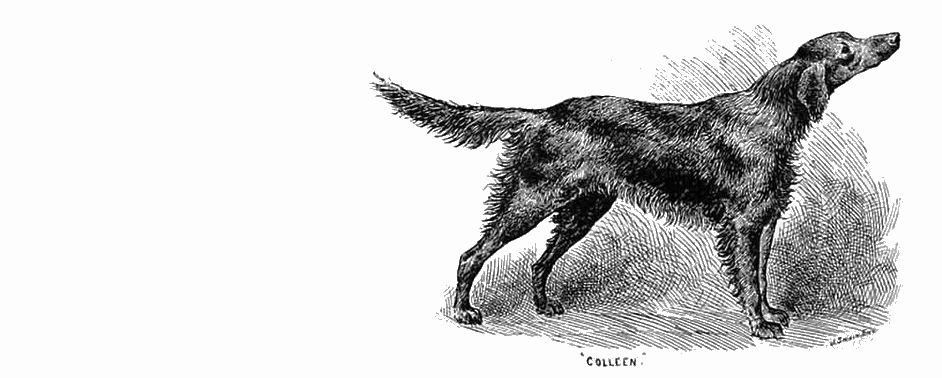
    In the long run, though, these were minor issues in what turned out to be a very successful and well organised show. And as can be seen from Louis Wain’s fine illustrations, despite the ravages of the mange epidemic there were still many handsome dogs on hand to pick up the numerous prizes. So popular did the exhibition prove that another show was organised early the next year and the competition carried on through the latter years of the 19th century expanding into a dog and cat show by the late 1890s.

    References: The Illustrated Sporting and Dramatic News, 7 March 1885 pp. 607, 617, 623.  James Greenwood, Low Life Deeps, pp. 16-17


    Pictures: Author’s collection.

  • The World’s First Mid-Air Rescue

    On 9 July 1908, the Longton Park Fête was in full swing and as well as the numerous stalls, funfair rides and other amusements put on to beguile the crowds that flocked to the park, there was another attraction, a parachute descent was to be performed by Captain Auguste Gaudron’s team. Thrilling as this was in itself, spice would be added to the display by the descent being made not by men, but by two young women, an experienced parachutist, Elizabeth ‘Dolly’ Shepherd and a novice named Louie May. In fact, Louie May should have made her first jump the day before from a new large balloon known as the ‘Mammoth’, the biggest then in Britain. The balloon and its passengers had indeed gone up, but it had been too windy to make the jump and to console the disappointed crowd Captain Gaudron had announced that they would try again the next day. He added that they would be joined overnight by the famous Dolly Shepherd who was doing a jump elsewhere that day, but that tomorrow she and Louie would make a double descent. Sure enough, Dolly arrived in Longton later that night and though initially surprised that Louie’s jump had not gone ahead, she was happy to join her for her maiden descent. 

    Dolly Shepherd and Louie May

    This morning the day seemed perfect; the sun was out and there was no sign of the high wind that had spoilt the jump the day before. At Captain Gaudron’s request Dolly and Louie went out early and mingled with the spectators to drum up interest. This they could do without even trying. Dolly was an attractive brunette and Louie a pretty blue-eyed blonde and both of them were practically clad in – for the time – rather daring, masculine-looking blue knickerbocker suits styled loosely after a midshipman’s uniform, plus matching caps that certainly attracted a lot of attention. So too again did the Mammoth which Gaudron’s men now began filling with gas and this soon towered high over the park and stood waiting for its passengers.

    However, the weather again spoilt their plans, this time with a short but heavy downpour of rain that suddenly and rather unexpectedly caused the Mammoth to sag and then collapse. There were urgent cries from Gaudron’s team and announcements over a loudspeaker, “No smoking please. Gas is escaping.” The spectators moved back a safe distance and watched the balloon in dismay. Sensing the frustration of the onlookers, seemingly robbed of yet another chance to see the lady parachutists, Captain Gaudron now turned to Dolly and asked her if she had brought her smaller balloon with her from her previous performance. Luckily, she had left it at the train station, so a pony and trap were immediately sent to collect it while the Mammoth crumpled into an untidy heap and Gaudron’s men went in to check it over. The problem was soon identified as a faulty top valve that had been leaking and it had only needed the weight of the rain to cause its collapse. 

    All was not lost, though, for Dolly’s balloon, though much smaller in size was quite capable of lifting two people. There was no basket underneath, instead the parachute hung down beneath the balloon and the parachutist would be suspended at the bottom in a sling-like seat into which she was tied with a belt, whilst holding onto a trapeze bar. Keeping track of her altitude with an aneroid barometer on her wrist, once the correct height had been reached, the parachutist would then tug on a cord that would release the parachute via a simple mechanism. The mechanism would also cause a valve on the balloon to open, venting the gas and thus sending it back to earth. These ‘solo’ balloons were normally reserved for more advanced parachutists and it was unusual to send a first-timer up under them, maiden jumps usually being accomplished from a basket, but as that was no longer an option and with Dolly as a willing chaperone, Captain Gaudron felt confident enough to let Louie go up with her.

    When the balloon arrived it was immediately hooked up to the gas pipe and the canvas soon began to swell up into a large globular shape, the ground staff holding it down with ropes attached to the netting that covered the balloon. It was no hardship to rig it for two parachutes, one on either side to balance it up, though a second release mechanism had to be hastily improvised for Louie’s chute and this worked perfectly. Then the two women were carefully fastened into their slings and held onto their trapeze bars while the balloon was held suspended above them. With all of the delays it was now 8 p.m., and a huge crowd had gathered to watch. Captain Gaudron now gave the order, “Let go!”, the ropes were released, the two women ran forward to get under the balloon as it leapt into the air and were suddenly lifted off the ground, Dolly setting off with a jaunty wave of the silk Union Jack that she kept for such occasions.

    The plan was for the balloon to climb to a height of 4,000 feet before the two women pulled their release cords; they would then float to earth within view of the thousands of spectators. However, that height came and went and no descent was made. Instead the balloon kept on climbing higher and drifting out of sight. By this time the spectators as well as Captain Gaudron and his people, had realised that something had gone wrong. Alarmed, Gaudron soon set off in urgent pursuit of the errant balloon and its two passengers, leaving the crowds in Longton Park to slowly disperse and go home, troubled by the turn of events and anxiously awaiting news of the fate of the two female aeronauts.

    Something had indeed gone badly wrong. High in the sky above North Staffordshire away from the eyes of the assembled spectators, a scene of high drama was taking place, against which even the excitement and danger of a normal parachute drop paled into insignificance.

    Initially, the ascent to 4,000 feet had been trouble free and as Dolly later recalled, Louie had been delighted with the experience. When they did eventually reach the required height, Dolly as the more experienced parachutist called time and waited to see Louie release her chute and start her descent before she did the same. It was just as well that she did, for when Louie reached up and pulled on her release cord, nothing happened; the improvised mechanism that worked so well on the ground had jammed. Pulling herself over via a connecting rope, Dolly tried to release her companion’s parachute but to no avail and the balloon carried on ascending, passing through the cloud layer and into the clear sky above to a height of 11,000 feet. At this height the air was thin and it was getting cold and Dolly realised that the only way that they would both escape from their increasingly perilous situation would be to risk making the drop back to earth on her parachute. Using the connecting rope to pull them together once more, she now told her frightened companion what they needed to do. Painfully aware of the two mile drop below them, Dolly held them together while Louie carefully unfastened herself from her sling and the two women wrapped their arms and legs around each other tightly before letting the defective ‘chute swing away. Hoping that her own parachute release still worked, Dolly reached up and pulled the release cord and was rewarded instantly by the sight of the the balloon apparently leaping away from them as they plummeted earthward. For a few nerve-wracking seconds the parachute struggled to open, but as they exited the clouds and hit heavier air Dolly felt a familiar pull and looked up to see the parachute fully deployed above them, arresting their fall to what she hoped was a survivable speed.


    A wildly exaggerated newspaper illustration of the incident. Not only are details of the rescue incorrect but in reality Dolly and Louie’s knickerbocker suits were much more practical.

    Swinging down out of the evening sky on their single parachute, the two women now found themselves suspended over a vast tapestry of green fields, woods and little villages. The prevailing winds had taken them south-east of the Potteries in the direction of Uttoxeter. Dolly, though, was not so much concerned about where they were, but how to land safely, as with Louie restricting her movements, there was no way of steering to a softer landing spot and the ground was rushing up much faster than normal. As they neared the ground, for the first time in the entire episode Dolly felt a pang of fear and cried out in alarm, as they seemed to be heading directly for a road, the hard surface of which might prove fatal at this speed. Luck, though was on their side and moments later they thumped down into the soil of a farmer’s field,  Dolly hitting the ground first and falling backwards as Louie, still holding on tightly, landed on top of her. The impact felt like a hammer blow for both of them and Louie immediately jumped to her feet, crying that all her teeth were knocked out. In fact she was unharmed and when the initial shock had passed, the two of them burst into peals of hysterical laughter out of sheer relief at having survived such a terrifying but remarkable adventure. 

    Though Louie was fine, Dolly remained lying on her back and did not move. She felt that she had injured herself quite badly and that she needed to stay where she was until help arrived. Moments later a portly farmer appeared followed by his wife and children, then another farmer and his family, all of whom had seen the parachute coming down. They immediately offered to help Dolly to her feet but she begged them to leave her alone and call for a doctor. One of the farmers, Charles Hollins then took charge and a man was sent off to Shelton to get a doctor. The women now discovered that they had landed at Field Farm, three miles from the village of Leigh and 14 miles from Longton where they had begun their balloon ride.

    When the doctor eventually arrived he immediately appreciated that Dolly had sustained a serious back injury and had her carefully lifted into a door provided by Farmer Hollins in lieu of a stretcher. She was then transported back to the Hollins’ farmhouse where she would find herself laid up for the next 8 weeks. Here, under the doting care of the Hollins family and the watchful eyes of a couple of local physicians, who treated her with mild electrical therapy, Dolly made a remarkable recovery and to the surprise of many within a couple of months of her accident she was not only walking, but parachuting once more.

    Dolly continued with her parachuting career until 1912, when during one of her solo ascents, she claimed to have heard a voice telling her quite clearly not to come up again or she would be killed. Utterly convinced, once she had landed safely she announced to Captain Gaudron that she was giving up parachuting and immediately returned to London, where for a time she worked in her aunt’s shop. During World War One, Dolly served as an ambulance driver on the Western Front. Occasionally, she was called upon to use her driving skills to chauffeur army officers around the front; one of these she later married and finally settled down. True to her word, she never did another parachute jump.

    Decades later, though, in her twilight years, the old parachutist did mix with like-minded people once more. She was famous now not only for her pioneering achievements in parachuting, but also because she was a record holder, being officially recognised by the Guinness Book of Records, for making the world’s first mid-air rescue. As a result she was honoured by invites from the Parachute Regiment’s Red Devils and the RAF Falcons display teams and despite the ethereal warning from above not to go up again, in 1976, the elderly Dolly took advantage of her latter-day fame to take a ride up in an aeroplane with the Red Devils, to watch them perform a sky dive, but it was her last journey up into the clouds. Dolly Sedgwick, nee Shepherd, died in 1983, just a few weeks short of her 97th birthday. 

    As to what became of the other actor in that famous first mid-air rescue, Louie May, Dolly could not say. Captain Gaudron and Louie had returned to London during Dolly’s convalescence and she never saw her again. She later heard that Louie’s fiancé was livid when he discovered what she had been doing and that he had immediately spirited her away from the crazy world of parachuting and the dangerous company of Miss Dolly Shepherd.

    Reference: Dolly Shepherd, When the Chute Went Up, pp. 129-151: Uttoxeter Advertiser and Ashbourne Times 17 june 1908, p.8 and 1 July 1908, p.5.

  • Soprano: The Musical Career of Lily Lonsdale

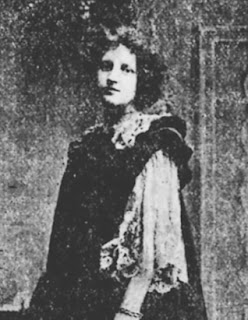
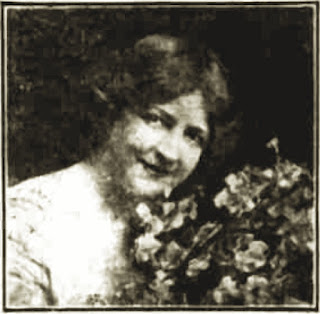
    Elizabeth Longsdale, alias Lily Lonsdale

    Born in Pitts Hill, Tunstall in 1878, Elizabeth Longsdale came from a musical family, her father William was a potter, but served as the choir master at Christ Church, Tunstall, and several other family members such as her brother Wilson, would make their names locally as singers. It was Elizabeth, though, who under the alliterative stage name of Lily Lonsdale, would become the most famous, carving a notable career in the music halls of Britain and abroad.

    Elizabeth started her singing career as a soloist at local concerts and enjoyed a spell with the North Stafford Amateur Operatic Society before turning professional when she joined Thomas Tomkinson’s Gypsy Children. This was a local choir turned concert party that was composed of talented children and adolescents that had gained quite a following in the Potteries. The troupe served as a training ground for several local performers who later went onto greater things, most notably Gertrude Mary Astbury who as Gertie Gitana would become one of the best know stars of the music halls. Elizabeth (now billed as ‘Lily Lonsdale’) shone just as brightly, impressing audiences with her beautiful, well-modulated voice and garnering great praise. By 1897, the troupe had moved beyond the Potteries and began touring the Midlands and Wales, performing in various venues like theatres and town halls, supported by parents and helpers who assisted with logistics and costumes.

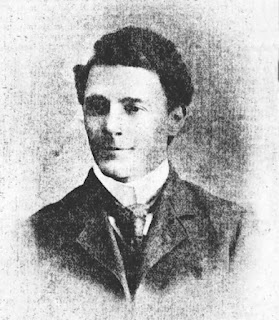
    Ernie Myers

    By mid 1899, Lily now in her early 20s was getting too old for child roles, and she was also romantically involved with Ernie Myers, a comedian from the troupe. However, her initial attempts for a career shift suffered a setback. After leaving the Royal Gipsy Children, she joined a rival troupe, Leon Vint’s Globe Choir, but soon had to resign due to vocal strain. This set her at odds with Vint, who after first agreeing to let her go then changed tack and took Lily and her sister Agnes to court for breech of contract. However, once in court, the judge deemed that Vint had acted unfairly and that the contract was far too heavily-weighted in his favour and as a result he ruled in Lily and her sister’s favour and they went on their way unhindered, leaving Vint with the costs for his bully-boy behaviour. Lily made a brief return to the ranks of the Royal Gypsy Children, but following the unexpected death in late January 1900 of Thomas Tomkinson the troupe’s founder, she and Ernie decided to set out on their own, securing an agent and booking early performances on the music hall circuit; they married in Liverpool in April 1901 whilst on tour. Shortly afterwards they were put on the so-called Moss and Thornton tour, taking in a series of theatres and musical halls across Ireland, northern England and Scotland.

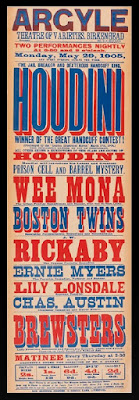
    In 1901, Lily took a short break to have their son, Jacob William, but hard economics often meant that family life came second to their performing careers. Leaving their son with Lily’s mother, they resumed a busy schedule of public performances across Britain, building their careers. They used their stage names and normally performed separately, with Ernie as a popular ‘patter’ comedian telling amusing stories and Lily as a classical soprano singer, though occasionally she took on comedy roles in sketches opposite her husband. They shared the stage with various entertainers, including conjurors, ventriloquists, impressionists, acrobats, marksmen, puppeteers, clowns, jugglers, dancers and performing animals as well as other comedians and singers. An undoubted highlight of their careers was performing on the same bill as the famous American escapologist Harry Houdini in 1905, when he was on a tour of Britain.

    The demands of travel and performing were tough; they worked six nights a week, with Lily often singing multiple songs per show, and she and Ernie were constantly in search of fresh material. During winters, they performed in pantomimes together, with Ernie playing the villain in “Aladdin” and Lily as the princess.

    By 1911, their careers were going well and the couple lived comfortably in Derby with their daughter Lillian May and son Jack who were cared for by Lily’s mother. In August of that year, they were invited to perform in South Africa but returned by December. Their routine continued until 1914 when they travelled back to South Africa. Sadly, Ernie fell ill and died on the ship before reaching port, leaving Lily heartbroken and reliant on support from the theatre community in Cape Town. After Ernie’s funeral she stayed on to complete her contract, then she returned to Britain to support her family amid the challenges of the Great War.

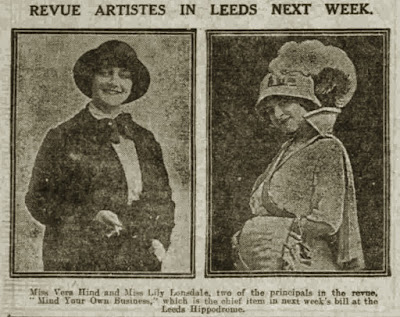
    Despite wartime difficulties, Lily found work in successful and topical revues like Mind Your Own Business and My Son Sammy, and whilst on tour the theatre company would often lay on special performances for wounded soldiers in hospitals, which proved very popular. Her career flourished through the war and after, but away from the limelight her mother’s declining health was a worry. In May 1920, Lily suffered a nervous breakdown due to exhaustion and stress, and shortly afterwards her mother passed away, leading to another break from performances.

    Lily pictured in her obituary

    Over the next five years, Lily remained active but by her late 40s, probably as a result of her arduous lifestyle, her health began to suffer. Her career ended suddenly in August 1928 when she collapsed on stage in Wolverhampton. Although she finished her performance, she was taken to the hospital and she never really recovered. Lily died on 2 March 1929, aged 49, at the Derbyshire Royal Infirmary. There were short obituaries to the singer in the Sentinel and in a couple of Derby papers over the next couple of days, but that was the limit of the press coverage. She was buried at Derby’s Nottingham Road Cemetery four days later.

    Reference: Staffordshire Sentinel, 8 March 1929.

  • The Curious Quadrupedal Company

    For some weeks during the winter of 1852-1853, the locals in Hanley and Longton in the Potteries were treated to a number of visits from a Frenchman, Monsieur Desarais (or Desaris), with his troop of highly trained dogs and monkeys. His was one of many such travelling shows that trod the boards of the town halls or theatres up and down the country during the mid-nineteenth century. Often these shows were unsophisticated by modern tastes, but in an age where opportunities for popular entertainment were scarce, even the feeblest efforts were appreciated.

    Monsieur Desarais’ show seems to have been better than most if reports of the time are anything to go by. In one short piece a reporter described exactly the performance he witnessed. After noting his astonishment at the animals’ performances and the skill of Monsieur Desarais as an animal trainer, the reporter continued.

    ‘This curious quadrupedal company, educated to a high pitch of perfection in the histrionic arts, and costumed to suit their respective characters successfully perform many of the conventionalities of daily domestic life. The supper scene, or monkey banquet, served by a monkey gentleman-in-waiting, a brother monkey the presiding genius of the table, with all the precision of fashionable conviviality, speech excepted. This was a rare treat in itself. A variety of curious evolutions followed, the dogs and monkeys habited as ladies and gentlemen waltzing to music, playing at leap-frog. A dog ascending and descending a double-ladder, with a monkey clinging to his back; one poor fellow industriously performed the rare treat of trundling a barrel up an inclined plane, wagging his tail to his master, apparently highly pleased at his success. The balancing tricks, by two dogs; and the performance of a solo by a “Jenny Lind” of the canine species, to an accompaniment on the violin followed by a hurdle race, in which the dogs were steeds and the monkeys, in full costume, were riders, caused roars of merriment.’

    Overall, Monsieur Desarais’ sojourn in the Potteries was a great success, except, that is, for one unfortunate little incident in Shelton on Christmas Eve 1852. This was reported by the same paper, but far more glibly under the title, ‘Novel Mode of Evading Toll’.

    The report described how Monsieur Desarais was passing through the Shelton toll gate in his small close carriage, drawn by four of his favourite dogs, when Mr Dixon, the gatekeeper came out of his house and demanded the toll. Monsieur Desarais refused to pay and a heated discussion ensued as to why the toll was necessary. Becoming angry and seeing that he was getting nowhere with the irate Frenchman, Mr Dixon seized some of Monsieur Desarais’ property in lieu of the toll, but this only made matters worse. Monsieur Desarais seeing his property confiscated in such an unceremonious manner yelled, “Then I’ll pay” and opened his carriage door as if to get the cash. No sooner was the door open than out leapt a large formidable-looking monkey, who as if instinctively protecting his master looked as if he were about to attack Mr Dixon. At that moment, though, the gatekeeper’s wife who had been keeping her eye on the altercation rushed out carrying a pistol. The sight of the gun so alarmed the monkey that he threw his tail around his owner’s neck and with a ferocious grin of horror shot back into the carriage. Whether the monkey’s actions had been choreographed by Monsieur Desarais we will never know, but he did not escape the toll keeper, for as the report concluded, ‘Monsieur, with his dogs and monkeys, left the toll-gate keeper to his reflections and his umbrella as a pledge.’

    Reference: Staffordshire Potteries Telegraph, 1 January 1853.