Tag: disasters

  • A Titanic Engineer

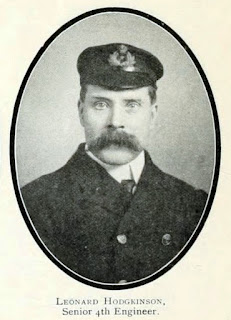
    Stoke-on-Trent’s best known connection with the Titanic disaster is of course the ship’s venerable skipper, Captain E. J. Smith, but a less well-known Potteries-born sailor who also perished in the Titanic disaster was Senior Fourth Engineer Leonard Hodgkinson. At the time of his death he was 46 years old, and like Captain Smith had spent most of his adult life at sea, albeit in a far different environment to that of his much more famous shipmate. As a member of the ship’s engineering staff, his working life was one spent for the most part in noisy, hot engine rooms, with little view of sea or sky save when he was off duty.

    Leonard was born at 20 North Street, Stoke-upon-Trent, on 20 February 1866, the second son and fifth child of potter’s presser John Hodgkinson and his wife Caroline nee Steele. Educated at St Thomas’ School, Stoke, before the age of 15, Leonard was apprenticed as an engine fitter with Messrs Hartley, Arnoux and Fanning, in Stoke. Once his apprenticeship was done, Leonard left the Potteries sometime in the 1880’s and took up a position with Messrs Lairds of Birkenhead, lodging with his elder sister Rose, her husband Henry Mulligan and their children, who had settled in Liverpool sometime after their marriage in 1877. It was in Liverpool that Leonard met his wife-to-be, Sarah Clarke. The couple were married in West Derby, Liverpool on 14 February 1891 and within a few years the couple had three children.

    North Street, Stoke-upon-Trent

    Leonard was now a seagoing marine engineer. He served for five years with the Beaver Line, whose ships sailed from Liverpool to Quebec and Montreal. In 1894, though, the Beaver Line went into liquidation and it may have been at this point that Leonard left and joined Rankin, Gilmour and Co., Ltd, which firm he also served with for five years, earning his first class certificate in the process. He may also have served with the Saint Line of ships which were owned by Rankin and Co., most of which carried the ‘Saint -’ title. Leonard’s final position with the company was as chief engineer aboard a ship with just such a title, the Saint Jerome.

    For a few years between 1901 and 1905, Leonard quit the sea and set himself up in business ashore as a mechanical engineer, but in May 1905, he returned to his old line of work, joining the White Star Line, serving first as assistant engineer on the Celtic, later earning promotion to fourth and then third engineer.

    According to family lore, Leonard Hodgkinson was keen to serve on as many vessels as possible before retirement, so was doubtless pleased after what appears to have been a six year stint aboard the Celtic, to be transferred over to the glamorous new Olympic (the Titanic’s elder sister) when that ship came on-line in June 1911. Here he was briefly bumped back down to assistant engineer, but soon earned promotion to fourth engineer once again. Perhaps more troublesome for him and his family was the fact that the Olympic was to sail from Southampton. There is no indication that the whole Hodgkinson family moved to Southampton at this time, though it is a possibility, but if not, then Leonard had to put up at lodgings in between journeys and perhaps only got to see his family on a few occasions when he could make the journey back to Liverpool.

    It was in early 1912, that Leonard travelled to Belfast where he joined the staff under Chief Engineer Joseph Bell, who were involved in getting the Olympic’s younger sister Titanic up and running. On 2 April he was signed onto the ship’s books for the delivery trip from Belfast to Southampton and on 6 April he was signed on once again in Southampton, now as senior fourth engineer.

    A White Star engineer at work.

    As senior fourth engineer, Leonard Hodgkinson was the highest ranking of the five fourth engineers aboard the Titanic, one of whom was a specialist in charge of the ship’s refrigeration equipment. Whilst at sea their duties involved checking that the adjustments and routine maintenance of the ship’s machinery were carried out. They dealt with any minor problems as they arose, answered any orders rung down via the ship’s telegraphs and ensured that everything ran as smoothly as possible. As officers it was also their duty to supervise the firemen, trimmers and greasers who worked with them down in the bowels of the ship.

    How Leonard’s days passed aboard the Titanic prior to its fateful collision is unknown, as too are his deeds on the night in question, as no accounts seem to exist noting him. If the story is to be believed, though, his fate and that of the 1500 other people who perished on the Titanic was foreseen by one of his relatives back in the Potteries, none of whom had any idea that Leonard was aboard the Titanic. According to the story she later told, two days before the disaster, Leonard’s 14 year old niece, Rose May Timmis, the daughter of Leonard’s elder sister Agnes, was sleeping in the same bed as her grandmother Caroline Hodgkinson (Leonard’s mother) when she had a nightmare. Rose dreamt that she was standing by a road in Trentham Park looking out over the lake, when a large ship steamed into sight. Suddenly the ship went down at one end and she could hear screams. Rose herself woke up with a yell that frightened her grandmother awake. When the frightened girl related her dream her grandmother snapped, “No more suppers for you, lady; dreams are a pack of daft.”

    After a while, Rose drifted back to sleep once more, only to find herself dreaming the same scene and as before when she heard the people screaming she did the same. She recalled that her grandmother was furious with her this time. A few days later, though, the news of the disaster broke and the family learnt that Leonard had been aboard the Titanic and that he and the other 34 engineering officers aboard had perished with the ship. Though several bodies from the engineering department were recovered in the following weeks, Leonard’s was not one of them.

    Though Leonard’s body was never found, he is remembered in several memorials, most notably on the Engineers Memorial, East Park, Southampton, the Titanic and Engineers memorial, Liverpool; the Glasgow Institute of Marine Engineers memorial; and the Institute of Marine Engineers Memorial in London. There is also a brass memorial plaque in the church of St Faithful, in Crosby, Liverpool, dedicated to the memory of the Chief Engineer and his Engine Room staff.
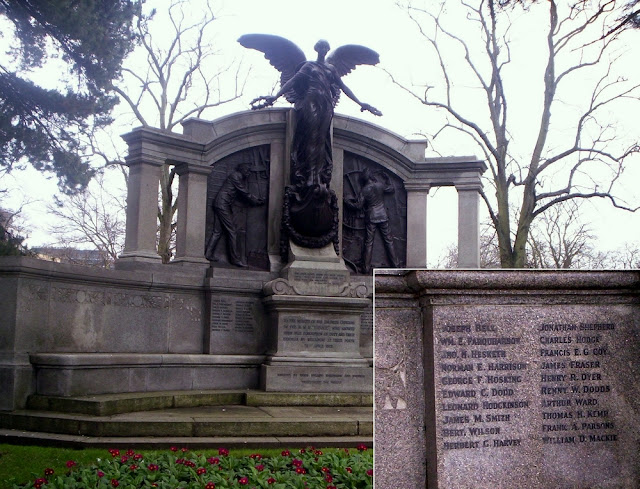
    The Titanic Engineers Memorial, Southampton

    Leonard Hodgkinson was not the only member of his family to go to sea. His son Leonard Stanley also became a marine engineer with White Star and later Cunard. He served on the transatlantic run most of his career, mainly on RMS Majestic before the war and later on the Queen Mary and the Queen Elizabeth.


    Website: Encyclopedia Titanica
  • The Sneyd Colliery Disaster

    At 7.50 am, on 1 January 1942, a devastating explosion took place 800 yards below ground at No 4 pit of Sneyd Colliery, Smallthorne. In normal times the pit would not have been working on New Years Day, the miners considering it unlucky, but because of the demand for coal during the war, work had gone on as normal and a full shift was on duty at the mine when the explosion occurred. The blast was contained to one coalface in the 7-foot Banbury Seam of No. 4 pit. All other workings were unaffected by the explosion, but the thump was felt throughout the mine, some men in the pit noted that the flow of air changed direction, while on the surface people felt a bump and all the lights flickered. Everyone knew something major had happened and when a frantic telephone call from the pit bottom informed them that an explosion had occurred, for the safety of all, work was stopped and the miners were quickly evacuated from the unaffected parts of No. 4 pit as well as from the neighbouring No. 2 pit.

    The Sneyd Mines Rescue Team sprang into action immediately after the blast and venturing down they rescued a handful of men from the pit bottom, but also found the first bodies. Teams were soon arriving from other local collieries including Chatterley Whitfield, Black Bull, Hanley Deep and Shelton; in total nine local mines rescue teams became involved in what soon turned from a rescue to a recovery effort. Beyond the mine, news of the explosion soon spread by word of mouth through the local community. Families and friends horrified by the reports they were hearing dashed up to the colliery to wait at the Hot Lane gate for news of their loved ones, but for many it would be the worst news. The bodies of 16 men were brought out that first day, but the rescue operations had to be postponed due to the presence of afterdamp and it was announced at that point that there was now no hope of finding anyone else alive. Up top, everyone came in to help, first aid staff were on duty at the ambulance room, the mine managers directed the rescue operation and the Inspectorate of Mines soon had staff on site to help out and assess the damage. Other staff did their bit too, the pit’s chief telephonist Mabel Caine was reported to have stayed at her post almost continuously for five days and nights, fielding thousands of phone calls and refusing all attempts to get her to take a long break.

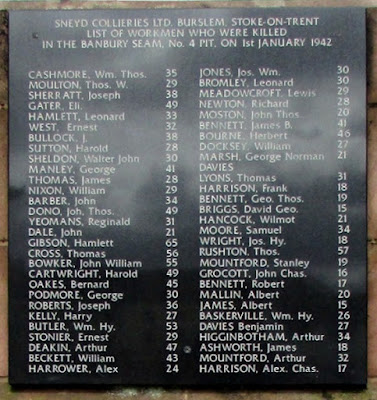
    On 5 January even before all the bodies had been recovered, nearly 80% of the workforce got back to work, but it was not until 10 January that the last bodies were recovered. The list of the dead was sobering, as of the 61 men and boys working on the face that morning, 57 had lost their lives in the blast, most being killed in the initial explosion, while two later died in hospital. The two youngest, David George Briggs from Stanfields and Albert James from Burslem were both aged 15, while the oldest Hamlett Gibson, from Cobridge was 65. There were many sad stories to be told of those who were lost. A Mrs Bennett of Moorland Road, Burslem, suffered a double bereavement, losing her 41 year old husband James and 17 year old son Robert, both of whom had been working on haulage; the family had only recently moved down from Scotland. Mr and Mrs W. F. Harrison of Cobridge lost two teenage sons, Frank aged 18 and Alexander Charles aged 17. Joseph Sherratt aged 38 from Porthill was one of two firemen who were missing. Married with two children and a third on the way, only hours before he had been enjoying a party with his children and some of their friends and had laid on a puppet show of ‘Sinbad the Sailor’ to amuse them. He had not been superstitious about working on New Year, but his wife had and handed him a silver three penny piece for luck. Another haulage worker from Burslem, William Docksey aged 27, had been at the pit for 10 years, He had a brother working elsewhere in the mine who immediately joined the rescue team in an effort to find William. And David Briggs one of the youngsters mentioned earlier, had enjoyed a brief moment of local fame only a short while before, when he was photographed with the Minister of Food, Lord Woolton, eating one of the first sandwiches to be served by the new central depot for providing sandwiches for the miners of North Staffordshire.

     Four survivors had been pulled out of the pit, who by sheer luck or their more sheltered position in the mine, had escaped serious injury or death. One was Ernest Stone of Burslem in charge of the telephone at the pit bottom, whose call had alerted those up top to what had happened. He had been seated in a recessed area off the main road when the explosion occurred and thus avoided the worst of the blast. When the first rescuers arrived, though very dazed, he stayed at his post for three hours refusing to go up until he was finally overcome with dizziness. Another equally lucky was George Read of Burslem, the chief hooker in charge of loading and unloading tubs into the cages at the pit bottom. Like Mr Stone he was in an area off the main roadway and likewise escaped the worst of the blast. After a day at home getting over the shock of what had happened, he returned to the pit to help in the recovery effort. Thomas Gibbons from Burslem aged 64, was not so lucky. He was working near to the pit bottom operating a compressed air machine that drew tubs from the Banbury seam when the explosion occurred. Hit by a tremendous blast of hot air, he was hurled against a wall and fainted. Coming to a short while later in complete darkness and covered in dust only his intimate knowledge of the mine saved him. Working out where he was, Thomas crawled along the passage to where it branched off from the Bambury seam to the return of the Holly Lane branch. After crawling along for another 200 yards he was discovered by some Holly Lane miners who gave him some water and got him transported to the surface, from where he went to hospital. The fourth ‘survivor’ had not actually been in that part of the pit, but had initially been listed with the missing. Mr J. Bailey from Hanley, had only started at the pit the day before and swapped his heavy hand lamp for a helmet lamp with another man that morning. This was later discovered by the rescue teams who presumed Mr Bailey was a victim, though he had already been evacuated from the mine with the other 600 men. The mix-up was only discovered when he later wandered into the Burslem Miner’s Hall to correct the mistake after finding that he had been listed as a victim.

    In the immediate aftermath of the disaster a fund was set up to which many members of the public, collieries and companies gave money, while the proceeds of many local performances were also donated and money came in from abroad, even from as far away as soldiers serving in Iceland; over £17.000 was eventually collected and shared out amongst those who had lost a relative, the shares being determined by how many dependents the victims left behind. Families had been devastated by the disaster, many losing their main or only breadwinner. The disaster left 32 widows and 35 fatherless children, while of the 24 unmarried men 13 left grieving mothers and fathers and 8 left mothers who were already widowed.

    The question everyone wanted answered, was what had caused this appalling accident? The subsequent inquiry headed by Sir Henry Walker, concluded that the most likely cause was that tubs used to move the coal out of the mine had derailed and damaged an electric cable. Sparks from the cable had then ignited coal dust in the air and caused an explosion. Some writers have since disagreed with this explanation, and have advanced other perfectly valid theories, though after all this time any kind of definitive explanation of what happened is not possible as the mine is no more and all the witnesses are long dead.

    Sneyd Colliery continued working through the war, but from the late 1950s onwards it was slowly swallowed up by a larger neighbour. Major reconstruction work at Wolstanton Colliery saw an underground connection made to Sneyd and from that point on coal gradually started being brought to the surface at Wolstanton. Coal ceased being raised at Sneyd in July 1962 and though for a time the shafts there were still used for sending miners down, eventually all the men were transferred to Wolstanton Colliery. The No. 4 shaft, however, remained open as a spare entry for the northern area of the expanded colliery until the final closure of Wolstanton in 1985.

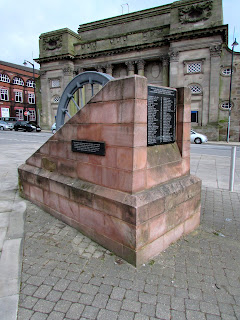
    The Sneyd Colliery explosion has the dubious honour of being the last major pit disaster in the Potteries and it cast a long shadow in the city’s collective memory. A memorial comprising a pit wheel set in bricks was unveiled in Burslem town centre in 2007. It lists all 57 names of the dead on a plaque and carries another praising the mines rescue teams that worked so hard to bring out the bodies.

    Reference: Evening Sentinel, 1 January 1942, p. 1; 2 January, p.1; 5 January, p.1; 10 January, p.1.

  • Captain Smith Tells a Tale

    Hanley-born Commander Edward John Smith is best remembered as the captain of the ill-fated White Star Line steamer RMS Titanic, which sank on its maiden transatlantic voyage after colliding with an iceberg in 1912. In many ways the image of Smith presented in the disaster has coloured how we see the man, to some he is the villain of the piece, to others a tragic figure. The few earlier glimpses that exist though, paint Captain Smith in a far different light. For instance in 1911 following the successful maiden voyage of Titanic’s elder sister Olympic, Smith comes across as something of a raconteur, playfully spinning a yarn to deflect over- eager reporters.

    ‘Captain Smith of the Olympic was questioned in New York about the coal consumption of the world’s biggest liner on her first voyage. But Captain Smith shook his head and said:”That is a coal story I am not privileged to speak about. I’ll tell you another coal story, though, if you’d care to hear it?”

    I’d be delighted,” said the reporter. “Well,” said Captain Smith, “It’s a story about a poor sailor. He was taken down with fever on a brigantine. and, though the mate and captain dosed him well, he died. They buried him at sea. “They buried him with the usual impressive sea rites. He was sewed in a sail round which a flag was draped, and, to make him sink, the sail was weighted with a number of big lumps of coal. “A landlubber of a passenger participated in the services. He watched the well weighted corpse slip into the water. It disappeared at once, and the landlubber shook his head and said: ” ‘Well, I’ve seen many a man go below, but this is the first one I’ve seen taking his own coal down with him.’ “


    Reference: San Francisco Call, 29 August 1911 

  • Last Stand at Isandlwana

    The Battle of Isandhlwana by Charles Edwin Fripp

    Following the British invasion of the independent Zulu Kingdom in Southern Africa in January 1879, a force of over 1,700 men, mostly from the 24th Regiment of Foot, was camped at the foot of a sphinx-shaped rocky hill called Isandlwana. Here on 22 January, they were attacked by a Zulu army some 20,000 to 25,000 strong that they had supposed to be many miles away. As the Zulu warriors swarmed down from hills to the north and spread out in a wide arc to envelope them, the 24th Foot and numerous colonial units moved forward and formed a line to face the enemy and for some time – in the centre at least – they did successfully hold their ground, keeping the Zulus at bay with concentrated volley and cannon fire. In trying to keep in contact with a mounted force to the east, though, the main British line became fatally over-extended and in danger of being outflanked. Seeing this, Colonel Pulleine the officer commanding the camp ordered his forces to fall back to a more defensible position in front of the hill, but it was a fatal move. When the gunfire slackened the Zulus in the centre seized the moment and rushed forward in pursuit while those out on the plain soon outpaced and outflanked the British line to the east, rushing in on the camp and behind the retiring blocks of infantry, cutting off their escape. Chaos ensued as the British line disintegrated and the battle then degenerated into a mass of isolated fights with knots of redcoats surrounded by masses of Zulus. Some 400 men, mostly mounted troops, managed to escape the resulting slaughter before the end, but over 1,300 men perished on the British side, including nearly the entire 1/24th and a company of the 2/24th Foot. The Battle of Isandlwana became the worst defeat ever suffered by the British army at the hands of a native foe and for the time at least it effectively stopped the invasion of Zululand in its tracks.

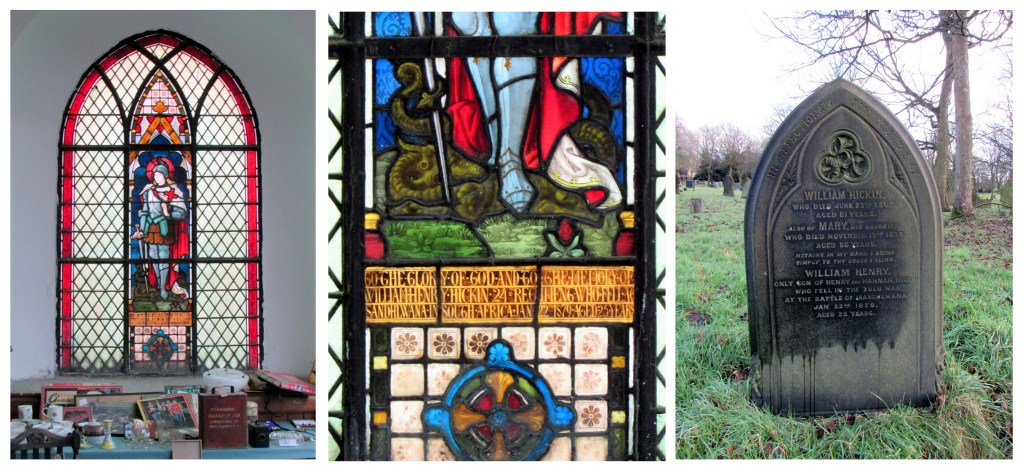
    The stained glass window and grave memorialising Private William Hickin.
    The stained glass window and grave memorials to Private William Henry Hickin.

    Several local men were killed in the action. In the ranks of the 1/24th were 25 year old Private William Henry Hickin from Hanley; the son of one Henry Hickin a local locksmith and bell hanger, William had previously worked as a writing clerk before enlisting in early 1876. Private George Glass 1/24th aged 22 from Shelton, was the son of a local school master and had briefly worked as a potter and joined the army in 1874. Private Enoch Worthington 1/24th from Kidsgrove, was 24 and had been a miner like his father before him; he enlisted in Newcastle in 1875. Private Samuel Plant 1/24th was an older man from Shelton, who had joined the 24th Foot in 1859, married in 1862 and prior to serving in Southern Africa he had served for a year on St Helena.

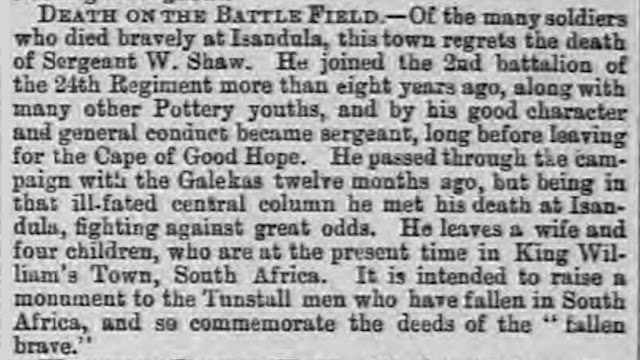
    In the 2/24th, former potter Sergeant William Shaw from Tunstall, was about 32 years old. After joining the army in 1870 he was promoted corporal in 1873 and sergeant in 1877. He had married locally before joining the army, had four children and had served in India and Britain before being sent to Southern Africa. His wife Emma and their children had come with him on this tour of duty and were lodged in King William’s Town, Cape Colony, far away from Zululand. Private Samuel Poole, 2/24th is something of an enigma as several possible candidates of that name were born in Audley, Kidsgrove or Newcastle, but there is no clear evidence if any of these are our man, all we know is merely that a man of that name enlisted in Hanley on 27 April 1875 aged 21 years. Records state that he served in G Company 2/24th. Private David Pritchard 2/24th, was from Stoke-upon-Trent though no one of that name appears in the civil records so that may have been an alias. He claimed to have worked as a forgeman before joining up in 1865 and he went on to see service in India. Aged about 34 at the time of the Zulu War, records say he served in B Company, but that was the company left at Rorke’s Drift, so he had probably been transferred to G Company.

    The most interesting of these local victims of Isandlwana from a historian’s point of view, is Sergeant William Shaw of the 2/24th, as evidence exists giving us a glimpse into his fate that day. According to the notebook of Corporal John Bassage 2/24th, now held at the Royal Regiment of Wales Museum, who was part of the force sent to bury the dead in June 1879 after the war was over, the remains of Sergeant Shaw and three private soldiers of the 2/24th were found together in a heap on the battlefield. The four men caught out in the open appeared to have formed into a small group in a last desperate attempt to try and fend off the Zulus as they poured into the camp. All seemed to have been stabbed to death with assegais.

    Staffordshire Sentinel and Commercial & General Advertiser – Saturday 8 March 1879, p.5

    In a report in the Sentinel noting Shaw’s death in action, it was stated that there were hopes of raising a memorial to him and all the Tunstall men killed in South Africa. This, though, never seems to have come to pass and of all the men mentioned above only one appears to have been commemorated locally. In December 1880 at St John’s Church in Hanley, a stained glass window was dedicated to the memory of 25 year old Private William Henry Hickin, whose father was a churchwarden there. Hickin was further commemorated on his grandfather and aunt’s gravestone in Hanley Cemetery. Private Hickin is in fact the only ‘other ranks’ casualty of the Battle of Isandlwana remembered with a memorial window.

    One other local soldier who who was initially listed as a casualty was Private Frederick Butler from Shelton and son of the proprietor of the Bell and Bear Inn. He was a soldier of the 1/24th but prior to the invasion he had been transferred to the Imperial Mounted Infantry, Though initially listed as a casualty of the battle, Butler was in fact many miles away with his new unit serving in another invasion column that saw action at the battle of Nyezane on the same day as Isandlwana. He survived the war, rejoined his own unit once the fighting was over and later returned to the Potteries.


    Reference: Staffordshire Sentinel, various issues March-May 1879. My thanks to Ken Ray for his detailed list and information on the local men killed at Isandlwana and to Alan Rouse for family and background information on Sergeant Shaw.