Tag: curios

  • Dandy Dogs and the Mad Cat Artist

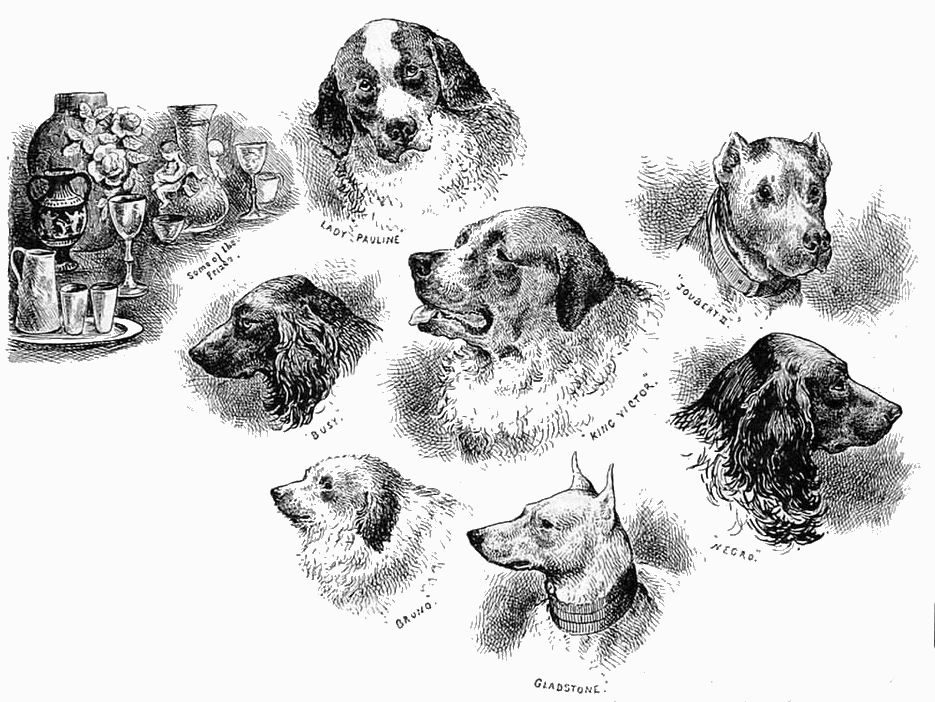
    Some of the prize winning animals at the 1885 Hanley dog show.

    When he paid a visit to the Potteries in the summer of 1874, journalist James Greenwood noted that Hanley was a town full of dogs:


    ‘Tykes of all ages, sizes, and complexions sprawl over the pavements, and lounge at the thresholds of doors, and sit at the windows, quite at their ease, with their heads reposing on the window-sill, hob-and-nob with their biped “pal,” who cuddles his four-footed friend lovingly round the neck with one arm, while his as yet unwashed mining face, black and white in patches as the dog’s is, beams with that satisfaction which con­tent and pleasant companionship alone can give.’

    How accurate a portrait of the town this was is open to debate as Greenwood immediately went on to write the infamous story of the ‘man and dog fight’ that scandalised the area, a tale that ultimately backfired on him when it became pretty obvious that he had concocted the whole story. Yet there is plenty of evidence to suggest at least in the comment above that Greenwood was not being untruthful and the locals were indeed keen pet owners and dog fanciers. A dog and poultry show was regularly held in Hanley from 1865 into the 1870s and in October 1883 Hanley hosted a major dog show organised by the North Staffordshire Kennel Club. This proved so successful that in February 1885 a second exhibition took place. This was larger and much more widely reviewed by the press, attracting not only local but national and even international attention.

    Held over two days 24th and 25th February in the old covered market in Hanley, there were 774 entries for the show and there could have been more but for a lack of space. Most of the major show breeds were present in large numbers. There were 170 fox terriers; 74 St Bernards; 27 mastiffs; 22 pointers; 18 setters; 88 collies; 34 bull dogs; 20 bull terriers; 48 dachshunds; 18 pugs; and six bloodhounds. Add to this the more obscure dogs and hounds, some from abroad, plus some champion dogs including five mastiffs who had secured honours at the prestigious Crystal Palace shows, and you had you had a major treat for dog lovers from across Britain. Anticipating a good turnout both the North Staffordshire and London and North Western Railways issued cheap tickets for those wanting to attend the show.
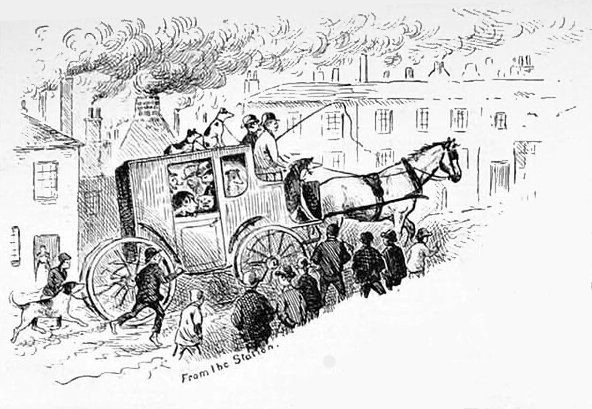

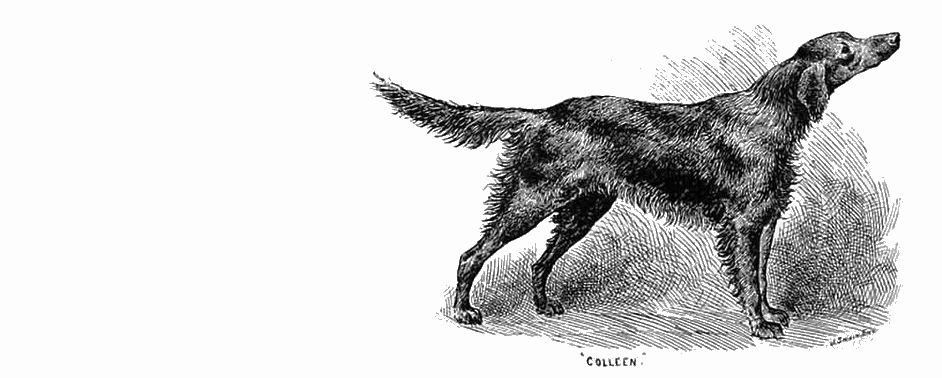
    Providing a series of illustrations for The Illustrated Sporting and Dramatic News, was Louis Wain, the artist who in later life went mad and spent his latter years painting numerous pictures of sinister anthropomorphic cats. At the time of the Hanley dog show, however, he was still quite sane and penned a series of fine dog portraits and whimsical side illustrations. The most amusing sketch showed a carriage trundling its way up the bank from Stoke Station up into Hanley, bringing with it a fine collection of prize pooches, large and small, riding in or on top, or running behind the coach, evidently much to the astonishment of onlookers.
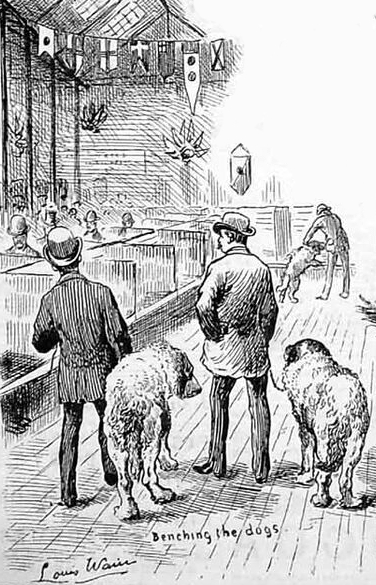
    Another of Wain’s illustrations showed that once in the market hall the various dogs were housed in a series of pens ready for the viewing of the general public and while they waited on the judges to do their rounds. There were a few problems. A reviewer in the same paper that carried Wain’s illustrations noted that quite a few of the dogs on show still bore evidence of a mange epidemic that had recently swept the country. Most were over the disease and the worst effects they showed were rather patchy coats, but a few displayed signs that their condition was still ‘alive’, much to the reviewer’s alarm. The entry of such obviously infected dogs he put down to the laxness of the ‘honorary veterinary surgeon’ and the inconsiderate nature of some owners. This was all the more surprising as one of the Kennel Club’s rules stated quite forcefully that no dog suffering from mange or any other infectious disease would be allowed to compete or be entitled to receive a prize.
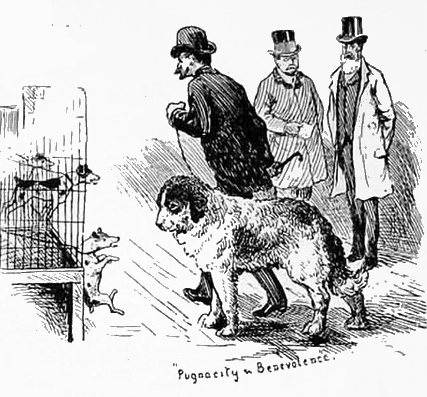
    The writer also suggested that the chains holding the dogs in their pens were in many cases far too long. Some of the dogs were fierce or excitable and in their frenzy apt to fall over the edge of their bench and with the smaller dogs in danger of hanging themselves. Wain illustrated the point with a picture showing a placid St Bernard face to face with a group of irate terriers, one of whom had taken just such a tumble and was in danger of throttling itself. The long chains also allowed more mischief as some of the animals were able to get around the partitions and engage in scraps with their surprised neighbours.

    In the long run, though, these were minor issues in what turned out to be a very successful and well organised show. And as can be seen from Louis Wain’s fine illustrations, despite the ravages of the mange epidemic there were still many handsome dogs on hand to pick up the numerous prizes. So popular did the exhibition prove that another show was organised early the next year and the competition carried on through the latter years of the 19th century expanding into a dog and cat show by the late 1890s.
    References: The Illustrated Sporting and Dramatic News, 7 March 1885 pp. 607, 617, 623.  James Greenwood, Low Life Deeps, pp. 16-17


    Pictures: Author’s collection.
  • Cannons from the Crimea

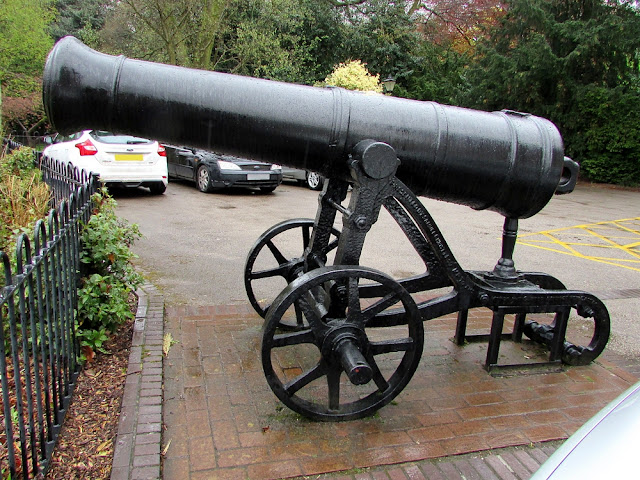
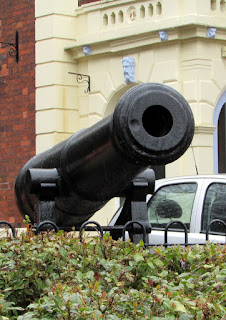
    Standing outside of the Brampton Museum in Newcastle-under-Lyme is a large black-painted cannon, mounted on a cast-iron limber. This was one of thousands of similar pieces of war booty brought back from the Crimea, following the fall of the Russian citadel of Sevastopol in 1855. In that city the Allied armies had discovered a large ordnance depot filled with 4,000 damaged or obsolete guns and these along with many of the guns captured during the fighting were later used as ballast on the merchantmen and troopships when they were bringing the army home. The Crimean War (1854-1856), had been a horrendous and utterly pointless conflict and perhaps as part of a wider public relations exercise to calm the national anger at the lives lost and at just how badly the war had been run, these cannon were freely distributed to towns and cities around the country.

    Newcastle’s cannon, weighing 2.8 tons is a 36 pounder made in 1840, and was presented to the Borough in 1857 by its then MP Samuel Christy. It was originally situated in Stubbs Walks, opposite the Orme Girl’s School, Newcastle, where it stood until 1965, when it was moved to its current location. Such was the fate of most of these retired instruments of war and in the latter half of the nineteenth century it was no unusual thing to find a large, defunct piece of Russian artillery decorating a municipal park or fronting some grand civic building anywhere in Britain. Today, though, they are not so common; time and necessity have seen many of the others scattered or scrapped over the years and such seems to have been the case with a couple of cannons that came to the Potteries, no trace of which now seems to exist.

    Newcastle’s impressive Russia cannon in situ. The carriage was mass-produced at the Royal Armouries in Woolwich.

    In his autobiography Past Years, Potteries-born scientist Oliver Lodge, mentioned a close encounter with a Russian cannon in his youth. Lodge recalled that at a very young age his father took him from their home in Penkhull down the steep hill to Stoke where peace celebrations marking the end of the Crimean War were taking place. A captured Russian cannon had been placed in front of the Wheatsheaf Hotel and Mr Lodge told his son to wait by the cannon until he came back for him. Looking up at the monstrous artillery piece, young Oliver wondered what they were going to do with the gun, half fearing but half hoping that they were going to fire it. However, nothing so exciting happened, instead the local dignitaries made several speeches before they all set off for lunch. Oliver’s father went with them, minus his boy, and afterwards in the evening he went home having completely forgotten about Oliver. Only after returning home and being asked by his wife where their son was did he suddenly remember and went dashing off back down the bank to find the lad still obediently standing by the gun, utterly unconcerned at being left alone for several hours after everyone else had departed. 

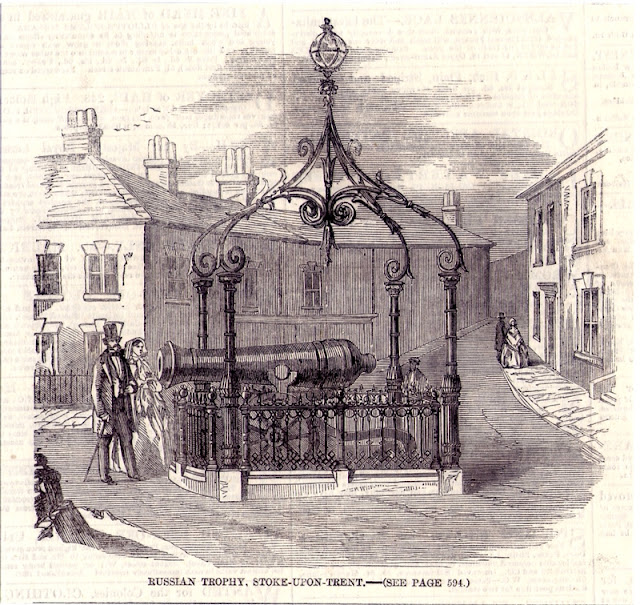
    The Victoria History of Staffordshire notes that a Russian cannon was presented to the town by W. T. Copeland in 1857 and erected opposite the Wheatsheaf Hotel in 1858, as per Lodge’s memoirs. In 1858, the Illustrated London News carried an interesting illustration of what was called Stoke-upon-Trent’s ‘Russian trophy’, along with some background information.


    ‘RUSSIAN TROPHY AT STOKE-UPON-TRENT.’ 

    ‘We give a representation of the Russian Trophy as mounted and in closed at Stoke-upon-Trent a few weeks ago. The gun is placed on a stone platform, as shown in the Illustration, in which the Royal arms, in Minton’s tiles, is inserted. On the stone parapet an ornamental railing of a handsome pattern is placed, and at each angle of the square of the platform a pillar in cast iron rises, to carry the wrought-iron scrollwork, which was manufactured by Mr. Haslam, of Derby, and is an excellent specimen of the old art of ironworking, now so ex­tensively superseded by the process of casting. All the ironwork is coloured in imitation of Florentine bronze, and richly gilt in the more decorative parts of the design. The whole is surmounted by a large globe lamp, which forms the principal feature of the construction, as the erection, being placed at the junction of three streets, requires a prominent and well adapted mode of lighting. The trophy was in­augurated by Mr. Alderman Copeland, one of the members for the borough, who also defrayed the expenses connected with mounting the piece. The work was designed and carried out under Mr. Edgar, architect.’

    Longton also received a gun, but even less is known about that one. There is a brief note in the Staffordshire Sentinel in 1867 that reads: ‘The same committee reported a resolution, in accordance with a suggestion from the Council, to remove the Russian cannon from the front of the Town Hall to the space within the railings at the front of the Court House… The proceedings were approved, and the recommendation adopted.’ In his Sociological History of Stoke-on-Trent, E. J. D. Warrilow includes a photograph of Longton Court House with the cannon situated behind the railings as described, but a second photo taken in 1950 shows that the gun had been removed. It was resited to Queen’s Park, Longton, where it stood in front of the clock tower. However, it has long since vanished and its current whereabouts are unknown.


    Stoke’s gun was also later moved, to a site in Hill Street by the old town hall in about 1874, but what finally happened to this and Longton’s cannon is unknown. The most likely scenario is that the valuable metal was sacrificed to the war effort early in World War Two, and ironically perhaps went on to become part of a more modern arsenal. 


    Contrast this sad end with that of the Newcastle gun which has achieved a certain status in the area. Between 1919 to 1942, during its time in Stubb’s Walks, the cannon was joined by a World War One training tank as a companion, but the tank was sent to be scrapped during World War Two. When the Crimean gun was shifted from its original site in 1965 some feared that it too was destined to be melted down and contractors arrived to find that some of the pupils from the Orme Girl’s School had hung a notice on the gun – ‘Hands off our cannon’. They need not have worried. Today, the cannon points out over the Brampton Park, providing a striking and novel photo opportunity to visitors to the town’s museum. 

    Reference: Oliver Lodge, Past Years: An Autobiography (Cambridge, 1931) pp. 22-23. E. J. D. Warrillow, A Sociological History of Stoke-on-Trent, p.385, Illustrated London News, 12 June 1858, Staffordshire Sentinel, 6 July 1867, Victoria History of Staffordshire Vol. VIII., p.180.

    Website: Crimean Cannon International Database

  • Hannah Dale – The Child of Wonder

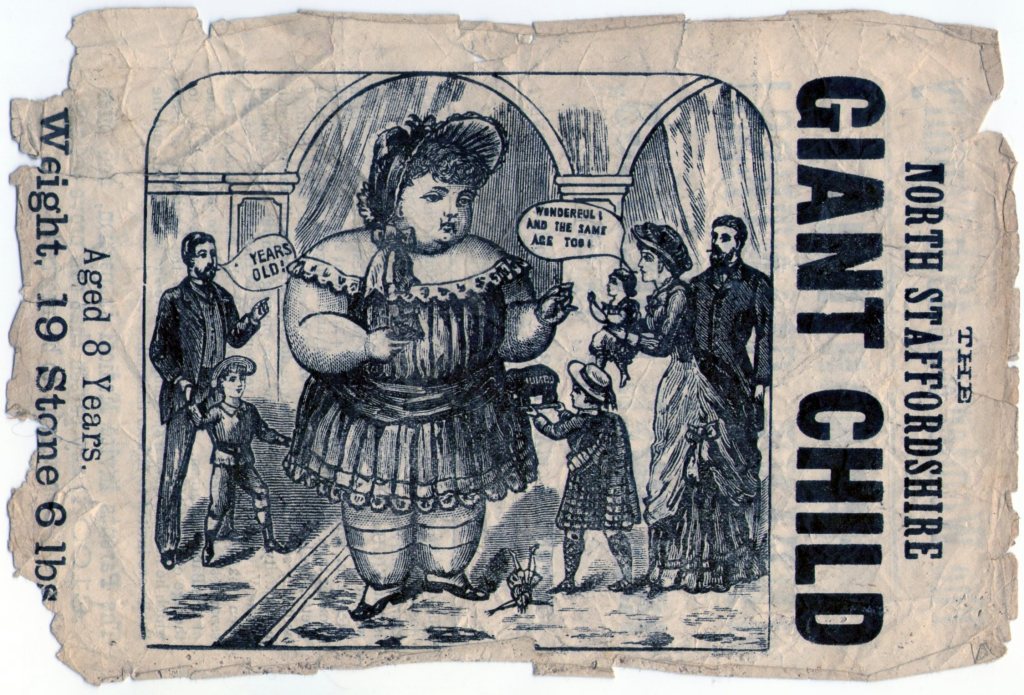
    A wildly exaggerated publicity image of Hannah Dale c.1889.
    Author’s collection.

    Hannah Dale, ‘the Staffordshire Giantess’ as she became known, was born in in the village of Mow Cop on the 23rd February 1881. She was the daughter of 31 year old miner Thomas Dale and 28 year old Elizabeth Dale, nee Oakes of Dales Green, Mow Cop, and was their fourth child, Hannah having a brother and two sisters older than herself. All the family were normal average-sized folk, her father weighed 10 stone, and her mother was only 8 stone in weight and their other children were likewise quite ordinary. At the time of her birth Hannah too seemed to be a normal child, so small it was said that she could fit into a quart jug, but at the end of three months she began to develop very rapidly and this growth continued throughout her short life. Within a few years she had outstripped her older siblings in weight, and though she started out enjoying a perfectly normal childhood Hannah was growing taller and broader and soon became something of an attraction in the out-of-the-way village.

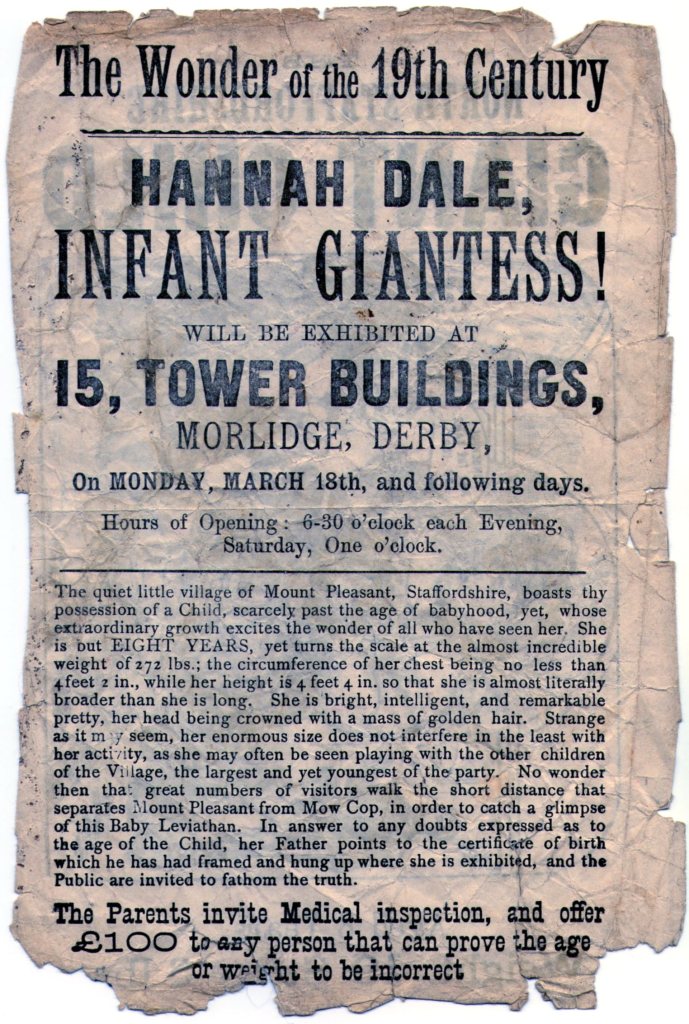
    It is unclear when Hannah’s parent’s first started exhibiting their rapidly expanding child to a paying public, but she was certainly something of an attraction for the crowds when at the age of eight flyers such as the one seen here were advertising her for exhibition. Though depicted on the flyer as a veritable giant, Hannah was at this time actually only 4ft 4ins tall, but weight-wise she was prodigious, already weighing more than most grown men, so big that the family home at Oakes Bank, Dales Green had to have the doors widened. By the time she reached ten years of age, Hannah had grown to 4ft 11ins tall, had a 55-inch chest and her thighs measured 3ft around while the vaccination marks on her arms had stretched out to the size of small plates. Looking at her it was easy to forget that she was so young, but many papers were happy to point out that she was still very much a child, at her happiest playing with the other children in and around Mow Cop.

    ‘She is a bright, attractive, and talkative child, and plays as other children do of her own age. For her enormous weight she is very active, but if she accidentally stumbles and falls she cannot get up without assistance. Dolls are her great delight, and in making their apparel she exhibits considerable dexterity and intelligence… She has no special diet, but dines with the other members of the family, consuming as much food as a healthy man, and sleeping on an average twelve to fourteen hours each night. On the railway she travels with a half-ticket, a privilege to which she is entitled, but which often causes her father to supply his name and address to irate ticket collectors, who entertain an honest suspicion about a giantess who takes up as much space as three ordinary persons would occupy.’

    South Wales Echo, 16 June 1892, p.2

    For several years Hannah was exhibited around the country and by 1892 was becoming something of a celebrity. Early that year she was fulfilling an engagement at Sheffield, prior to going to America, but her fame was cut short when she fell ill with bronchitis in late May or early June of 1892. Her condition quickly worsened and she was taken home to recuperate, arriving there on Tuesday 7 June. However, it was too late and she died from the infection the next day.

    At the time of her death, Hannah Dale, was 5ft 3ins tall, weighed 32st 6½lbs, and measured 5ft. 8in around the waist. Her size caused difficulties when it came to her funeral at St Thomas Church, Mow Cop, on 10 June. Her coffin was huge, its size demonstrated prior to her funeral by the undertaker, a Mr Boon, having five young men lying down sideways in it and easily closing the lid over them. Together with the corpse, this finally weighed 6cwt, (48 stone, or nearly 305 Kg) and took up a double plot. It required thirteen people to carry and then lower the little girl’s coffin into the grave.

    Nearly 2,000 people, many of them friends and neighbours and other locals who had watched Hannah grow up assembled to witness the funeral. The inscription on her gravestone read:

    IN LOVING MEMORY OF

    HANNAH

    The beloved daughter of

    THOMAS & ELIZABETH DALE

    Of Dales Green Mow Cop

    WHO DIED JUNE 2ND (sic) 1892

    AGED 11 years & 3 months.

    HERE LIES MY DUST THE CHILD OF WONDER

    I BID FAREWELL TO ALL BEHIND

    AND NOW I DWELL JUST OVER YONDER

    IN HEAVEN WITH GOD SO GOOD AND KIND

    ALSO WILLIAM & WALTER their sons

    WHO DIED IN INFANCY

    Reference: Philip R. Leese, Mow Cop: Living on the Hill; Staffordshire Sentinel, 11 June; South Wales Echo, 16 & 22 June 1892; Daily Gazette for Middlesbrough, 22 June 1892, p.4; Hampshire Advertiser, 16 July 1892, p.7.

    Website: http://www.mowcop.info/htm/thumbs/tn060.htm

  • The Curious Case of the Dwarf and the Bulldog

    Brummy and Physic battle it out. From James Greenwood’s Low Life Deeps (1876).

    In a detailed and lurid article published on 6 July 1874 in the Daily Telegraph, investigative journalist James Greenwood claimed that several days earlier on 24 June, during a brief stopover in the Potteries, he had hoped to find evidence of illegal organised dog fighting, but that he and a large crowd of onlookers had instead witnessed a brutal fight in a cellar in Shelton between a grizzled, muscular dwarf named Brummy and a ferocious bulldog named Physic, a battle that the man had barely won. The national scandal that resulted from this shocking article seriously embarrassed the area for a time and questions were even asked in Parliament.

    However, all was not quite as it seemed and once the initial furore had died down the tables were quickly turned on Mr Greenwood, as subsequent investigations by the police, the local authority, other newspapers and the RSPCA, not only highlighted the numerous glaring discrepancies in Greenwood’s tale, but more tellingly found no absolutely evidence whatsoever that such a fight had taken place. Rather than sticking rigidly to the story he had spun, Greenwood then started to back-peddle, changing or mitigating parts of the tale to excuse himself and explain why there was no proof to be found, all of which excited a great deal of derision from other papers. The upshot of it all was that within a few weeks it was widely concluded that Greenwood had simply made the story up, or adapted a dubious scrap of Staffordshire folklore that he may have heard during his stay in the area. Following the RSPCA’s investigation and the report they sent in to the government, the Home Secretary of the time came to the same conclusion and on 20 July wrote a reply to the Hanley Watch Committee, which stated that he was satisfied that the story of the fight was false.

    Greenwood had thus been called a liar at the highest level and Hanley’s good name was restored, but mud sticks, and the tale rankled with the people of the Potteries for a good while after. In 1907, Local author Arnold Bennett summed up the lingering ill-will towards the reporter and his tall tale in his short story ‘The Death of Simon Fuge’.

    ‘The only man who stands a chance of getting his teeth knocked down his throat here is the ingenious person who started the celebrated legend of the man-and-dog fight at Hanbridge. It’s a long time ago, a very long time ago; but his grey hairs wont save him from horrible tortures if we catch him. We don’t mind being called immoral, we’re above a bit flattered when London newspapers come out with shocking details of debauchery in the Five Towns, but we pride ourselves on our manners.’

    Reference: James Greenwood, Low Life Deeps; Staffordshire Sentinel, July 1874; numerous national newspapers and magazines July 1874.

  • Turkey Attacks Artist

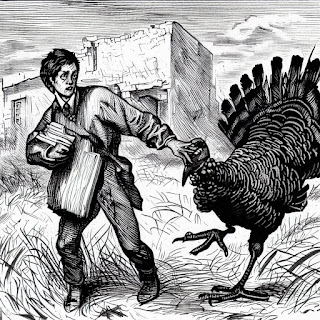
    On 22 April 1910, an unnamed but ‘well known’ Staffordshire artist was sketching some ruins near Hanley on this Friday afternoon, when he was attacked by a large turkey and endured a running battle with the bird that lasted a quarter of an hour. The turkey approached the artist perhaps more out of curiosity at first, but when the man tried to simply shoo the bird away it attacked him. Using his sketch block the artist aimed a blow at the bird’s head, but missed and after using his stool and artist’s palette with no greater success, he sought refuge behind a tree. The turkey pursued him and the man was forced to try and fight the bird off by kicking at it, shouting for help as he did so. Eventually a party of golfers and a farmhand heard his cries and came to the rescue, driving the turkey off. Though badly shaken and exhausted by the encounter, the artist was not severely injured. 

    Reference: Staffordshire Sentinel, 26 April 1910.