Author: Gary Cooper

  • Smith Child – Admiral of the Blue

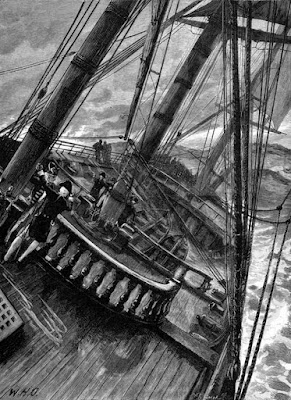
    The deck of an 18th century warship.
    Illustration by W. H. Overend.

    Smith Child, later an admiral in the Royal Navy, who also dabbled locally in the pottery industry, was born at the family seat of Boyles Hall, Audley in early 1729, and baptised in the local church on 15 May that year. He was the eldest son of Smith Child of Audley and the wealthy heiress Mary nee Baddeley, whose family had a long Staffordshire pedigree. The Childs by contrast were originally a Worcestershire family, one branch of which had migrated to North Staffordshire, settling in Audley. They had once possessed considerable property, but most of this had been lost by the future admiral’s father, whom local historian John Ward described as ‘a man of polished manners, but wasteful in his habits’. His marriage to Mary Baddeley was therefore quite a coup by which his family inherited several of the Baddeley estates that his eldest boy, Smith, would inherit.

    Enjoying the patronage of the politician Earl Gower as well as Vice-Admiral Lord George Anson, young Smith Child was entered the navy in 1747, serving aboard HMS Chester under Captain Sir Richard Spry. He was commissioned lieutenant on 7 November 1755 whilst serving in the Mediterranean aboard the Unicorn under Captain Matthew Buckle, and returned home to become a junior lieutenant aboard the ancient Nore guardship Princess Royal commanded by Captain Richard Collins. He served as a lieutenant on several more ships during the Seven Years War seeing action aboard the 3rd rate HMS Devonshire at the siege of Louisbourg in North America in 1758, then on the much smaller frigate HMS Kennington. Child is said to have also seen service the siege of Pondicherry, India, during 1760-1761.
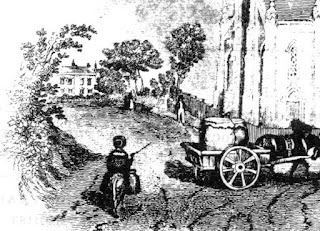
    A distant view of  Newfield Hall, left.

    After the war ended in 1763, like many officers Lieutenant Child returned home and from this point in his life that he settled down in the Potteries. He erected a large pottery factory in Tunstall, that between 1763-1790 produced a range of earthenware goods. The following year he married Margaret Roylance of Newfield, Staffordshire, acquiring a significant estate from her family. Initially he lived with his wife at Newcastle-Under-Lyme, but the following year he inherited his uncle’s seat, Newfield Hall, Tunstall, a large three-storey house with a five-bay entrance front and seven-bay side elevation, that enjoyed impressive views over much of the Potteries. In 1770, he moved into the hall rebuilding it and in his time on shore cultivated a keen interest in agricultural and other useful pursuits. Here the Childs lived a happy life and raised their five sons: Thomas, who as a midshipman was drowned at sea in 1782; John George whose son later became heir to the family estates; Smith who died without children; and Roylance and Baddeley, whose names recalled their most recent family history. But it was a short interlude in his naval career as at the beginning of what became the American War of Independence in 1775, Smith Child was recalled into service and early in 1777, was sent to take command of the hospital ship Nightingale in the Thames. Later that year he was promoted commander of the store ship HMS Pacific on 30 October 1777, taking the ship out to North America in the summer of 1778.

    He was posted captain on 15 May 1780, taking temporary command of the Raisonnable, but in August 1780 in the most important move of his career, Captain Child was given command of the 64-gun HMS Europe and took part in two important sea battles for the control of the strategic Chesapeake Bay. His enemies here would not be American sailors (the American rebels barely possessed a navy), but the French, who had weighed in heavily on side of the Americans, effectively funding and supplying the rebellion in retaliation for the defeat and loss of Canada to Britain in the Seven Years War. As part of Admiral Marriot Arbuthnot’s fleet, Child participated in the Battle of Cape Henry on 16 March in which the British fought off a French fleet attempting to enter the Bay. Positioned in the vanguard of Arbuthnot’s fleet, Europe was one of three ships left exposed by the admiral’s poor tactics, losing eight crewmen killed and 19 wounded to the punishing French bombardment. The British won this round despite their casualties, but the vital waterway would be the scene of one more dramatic fight. 
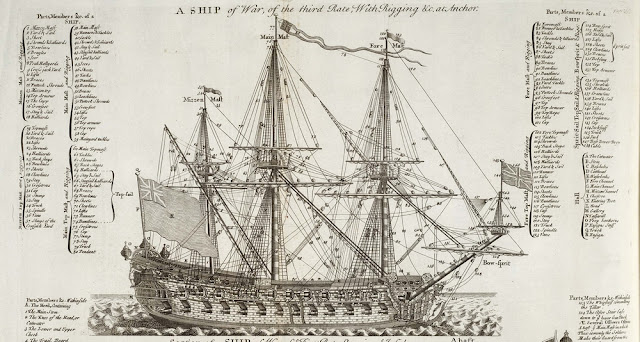
    A typical third rate ship of the line like Child’s ship HMS Europe.

    This was the Battle of Chesapeake Bay, also known as the Battle of the Virginia Capes, fought against a slightly larger French fleet on 5 September 1781, when HMS Europe along with the 74-gun HMS Montagu, formed the leading part of the centre division of Admiral Sir Thomas Graves’ fleet, and was heavily involved in the fighting that ensued. These two ships suffered considerable damage in the intense two-hour battle. Child’s report after the battle lists numerous masts and spars damaged or shot through, twelve shots struck the hull while there was much damage to the upper works, including splintered decking and fife rails at the base of the masts broken to bits; the rigging and shrouds were also badly cut up and three gun carriages had been damaged, one beyond repair. Europe had taken a pounding, ‘the ship strains and makes water’ Child’s report noted. There was a human cost too, nine members of her crew were killed in the action, and a further 18 wounded.

    Outgunned and battered by the encounter, the British fleet eventually withdrew from the action, finally losing control of the bay and the ability to keep their ground troops supplied with food and ammunition. This sorry state of affairs soon after resulted in the Franco-American victory at Yorktown, the knock-on effect of which saw the withdrawal of British forces from the war and Britain’s eventual recognition of the newly-founded United States of America. This outcome was no discredit to Smith Child, though, who had fought well and his standing in the navy enabled him to obtain preferment for most of Europe’s officers when the ship returned home and was paid off in March 1782.

    Peace was declared in 1783 and for the next six years Smith Child served at home. However, on the continent, more trouble was brewing when in 1789 the French Revolution broke out across the channel. Though confined to France, the bloody revolution would be the catalyst for a renewed bout of Anglo-French rivalry that started in 1792, when after defeating an invading Prussian led army at Valmy, the new French Republic launched an invasion of the Netherlands. The next year the deposed French King Louis XVI and his wife Marie Antoinette were executed which caused outrage amongst the royal families and governments of Europe and brought Britain into the coalition that had formed to defeat the Republic. With a new war to fight, the Royal Navy – now a much fitter beast than during the American war – was again expanding and called in many of its old officers to fill in the gaps; this included Smith Child.

    After serving for some time in the Impress Service at Liverpool, in November 1795, Smith Child was given command of the HMS Commerce de Marseille, a huge French-built ship that had been surrendered to the Royal Navy in the 1793 Siege of Toulon. The ship, originally a 118-gun three-decker, at first seemed well built like most French vessels and an early report stated that she sailed as well as a frigate, but her construction gave the ship an unacceptably deep draft while her internal framing was found to be inadequate for the high seas and the hull suffered serious strain when sailing. Deemed unworthy of a major overhaul, the vessel had been quickly downgraded and remained languishing at anchor at Spithead until the autumn of 1795. She then underwent a partial repair, and was armed and equipped for sea. Shortly afterwards, however, the guns on her first and second decks were sent on shore again, the redundant gun ports were sealed up and she was converted to a store and transport ship. The ship was then loaded with 1,000 men and stores for transport, drawing a whopping 29 feet when fully laden. The ship was tasked as part of a large convoy of some 200 transports escorted by 8 ships of the line under Rear Admiral Christian, that was supposedly on a secret mission to the West Indies that would soon become much less secret after the disaster awaiting it off shore.

    Child’s ship was in poor condition before sailing and she was damaged beyond repair when shortly after the fleet had set out, on 17 and 18 November the English Channel was struck by a violent storm of nigh on hurricane strength. This sent Admiral Christian and his escort squadron running to Spithead for cover while the transport fleet was scattered, some sinking, others being driven ashore and wrecked. Some two hundred bodies were washed ashore after the storm and the fleet was left so disordered that it was not ready to make another attempt until early December, which was again battered by a fearsome storm. The Commerce de Marseille, though, would not be among them, because as a result of the first storm, ‘… this castle of a store-ship was driven back to Portsmouth; and, from the rickety state of her upper-works, and the great weight of her lading, it was considered a miracle that she escaped foundering. The Commerce-de-Marseille re-landed her immense cargo, and never went out of harbour again.’
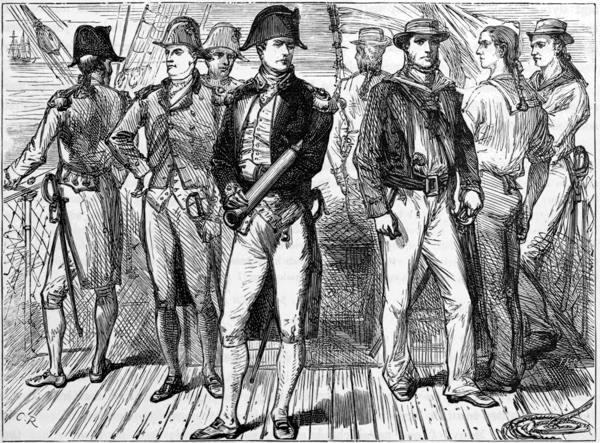
    18th Century naval officers and crewmen.

    Child had commanded his last ship and after such a clunker he was perhaps glad of it. He was promoted to Rear Admiral on 14 February 1799, but it was a nominal rank and he apparently saw no further sea service. Subsequently promoted to Vice Admiral on 23 April 1804, and Admiral of the Blue (the junior position in the rank of full admiral) on 31 July 1810.

    At home, as well as being a noted pottery manufacturer, Admiral Child served at times as a Justice of the Peace for Staffordshire, a Deputy-Lieutenant of the county, and was a highly respected member of the local landed aristocracy. He died of gout of the stomach on 21 January 1813 at Newfield aged 84, and was buried in St. Margaret’s Church, Wolstanton, under a plain tombstone. His son and heir John had died two years previously, so Smith Child’s estate passed to his five year-old grandson who would later become the Conservative M.P, and noted philanthropist Sir Smith Child.

    Reference: The Graves Papers and Other Documents Relating to the Naval Operations of the Yorktown Campaign, July to October 1781, (New York, 1916) p. 67 and p.73. William James, The Naval History of Great Britain, Vol.1 (London, 1837), p.253. John Ward, The Borough of Stoke-Upon-Trent (1843) pp. 85-86.
  • A Soldier of the U.S. Cavalry

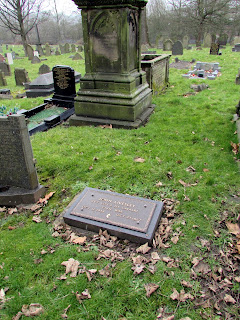
    John Livesley’s grave marker in Hanley Cemetery.

    In 1997, Hugh Troth of Ohio, published a tribute to his grandfather, The Life and Times of Isma Troth. Isma Troth had served as a soldier in the American Civil War and he wrote several letters charting his friendship with a fellow soldier named John Livesley whom he met in hospital when he was there recovering from his wounds. Troth’s account indicated that Livesley came from Potteries and using biographical information from this book and information from other social archives, local researchers were able to piece together the life of this otherwise forgotten local who had somehow got himself involved in a foreign war.

    John Livesley was born in Shelton on 12 October 1838, the son of pottery engraver and journeyman William Livesley and Sarah nee Brundrett. He enjoyed a privileged upbringing as his father was an increasingly prosperous man, who by 1851 had opened his own pottery and also ran a grocery business, all together employing 46 men, 23 women, 20 boys and 25 girls. As a result of his family’s wealth, John enjoyed a good education, attending a boy’s boarding school run by James and Harriet Grocott at Wilton House, Wrinehill near Betley on the Staffordshire border.

    As the family business grew, William Livesley entered into partnership with one Edwin Powell, and his name then regularly appeared in the local press, often for his philanthropy and support for public works and by the mid-1850s, John Livesley or J. Livesley likewise puts in a few appearances, attending performances or contributing money for some good cause supported by his father. But by 1861 census John had disappeared from the area.

    In fact, he had left the country and crossed the Atlantic to the United States, sailing in September 1860 aboard the RMS Persia to New York in company with 40 year old James Carr, a native of Hanley who two decades earlier had emigrated to the States and had established a successful pottery in New York. Both men give their occupation as ‘potter’ in the ship’s passenger list and it is not unreasonable to suppose that John Livesley, the son of a successful Hanley manufacturer had gone over with John Carr to work in his growing firm.

    Yet, it was a bad time to be travelling to the USA as growing tensions between the northern and southern states over the expansion of slavery, came to a head the following year. The southern slave-owning states split from the Union, forming a Confederacy, an act that pushed the country into a bloody civil war.

    Was John Livesley permanently settled in the States at this time, resisting the urge to join in the conflict, or just an occasional visitor to the country, criss-crossing the Atlantic and thus avoiding becoming involved? It is hard to say, but he was certainly in New York on 23 January 1864 when he was enlisted as a private in L Company 6th Regiment New York Cavalry of the Union army. Details on his enlistment are unclear, but suggestions have been made that he was drunk at the time, a not unlikely hypothesis as John seems to have had a habit of drinking to excess when he found himself in like-minded company. This is backed up by records that show that he was in hospital for the first week of his service due to “delirium”. He also seems to have enlisted under an assumed name, the enlistment records for John Livesley being struck through and replaced with the name ‘John Lindsley’. The records note that he was born in England, worked as a potter and gave a physical description: ‘gray eyes, brown hair, light complexion, 5 feet 8½ inches in height’. His term of enlistment was given to be three years.

    His new home, the 6th New York Cavalry, also known as the 2nd Ira Harris Guard, was a veteran unit, it had been formed at the outbreak of the Civil War and seen much service. Only a few months earlier it had taken part in the Battle of Gettysburg and since then played its part in numerous smaller actions taken on by the Army of the Potomac to which it belonged. With the onset of winter though it had gone into cantonments and when John Livesley enlisted, was employed in guarding the country between the Union lines and the Blue Ridge Mountains.

    US and Confederate cavalry in action at the Battle of Trevilian Station in 1864.

    On 3 May 1864, the regiment – now with Livesley, or rather ‘Lindsley’ in its ranks – returned to action, crossing the Rapidan river and taking part in the Wilderness campaign under General Grant. The regiment was part of the Cavalry Corps, and played a role in all the operations undertaken by the corps commander General Sheridan, notably in his famous raid around the Confederate capital of Richmond. At the battle of Yellow Tavern on 11 May 1864, the 6th New York Cavalry charged down the Brook Pike and went into and entered the line of the first defences about Richmond, being the first Union regiment to get so close to the city. The regiment then saw action in the Battle of Trevilian Station, and in numerous smaller actions and it was probably during one of the latter in August 1864 that John Livesley was badly wounded eight months after joining up.

    Carried from the front and admitted to the USA Post Hospital, Bolivar Heights, Harper’s Ferry on 20 August with gunshot wounds, Livesley was a wreck and had to have an arm and a leg amputated. Records show that aside from his physical injuries, he like many in the army was also suffering from chronic diarrhoea, but also that he was quickly transferred further from the seat of war, first to the Field Hospital at Sandy Hook, Maryland and finally to Rulison USA General Hospital at Annapolis Junction, Maryland on the road between Washington and Baltimore. Confined to a wheelchair, it was during his long convalescence here that he met Isma Troth, a former prisoner of war at the infamous Andersonville prison, who now worked as a clerk at the hospital, often writing letters home for the wounded, one of them being John Livesley whom he first met shortly after his arrival there. The two men developed a close friendship and Livesley’s father offered to pay for the two of them to come to England when they were discharged. The war effectively ended in April 1865 and John was mustered out of the Union army on 24 May 1865 whilst still at Annapolis Junction.

    Cheered by the thought of making a new life for himself, Troth was keen to go to Britain, noting that his friend’s family were influential and he might secure a good position there, but he had some major misgivings about Livesley’s drinking habits. In a letter written in June that year, Mr Troth wrote: ‘Mr Livesley is a good, kind friend of mine and is an honest, intelligent man – but he sometimes drinks’. He noted that he had known Livesley for about a year and that the man was not a regular drinker and he never drank when they went places, but on a couple of occasions he had gone out with soldiers who did drink and had come home in quite a state. Once he went with them to a neighbouring village and came back the worse for wear, and on being mustered out of the army he had gone out ‘with some fast boys’ to celebrate his release and had come back drunk, much to Troth’s disgust. After talking of their plans to travel to Britain, Isma said: ‘If my friend associates and drinks with these rough characters I shall not go with him, for I cannot place any confidence in a drunkard.’

    Despite these problems, the two friends did indeed take passage to Britain and Isma spent a year in England before travelling home. John returned to Stoke-on-Trent and was soon set up as a grocer in Lichfield Street, in Hanley, marrying a local girl Ellen Twigg from Bucknall on 18 June 1867. But tragically John Livesley died just four months later, on 23 October 1867, aged 29, his cause of death being given as epilepsy.

    Despite his father’s wealth John was buried in an unmarked grave in Hanley Cemetery. However, when he learned of his grandfather’s link with John Livesley, Hugh Troth endeavoured to see John’s service recognised and in 1997 contacted the United States Government to obtain a bronze plaque, recognising Private John Livesley’s service during the American Civil War. In 2003, the plaque was put on his burial spot, being unveiled by Mr Troth.

    Reference: Hugh Isma Troth, The Life and Times of Isma Troth (1997)

  • A Titanic Engineer

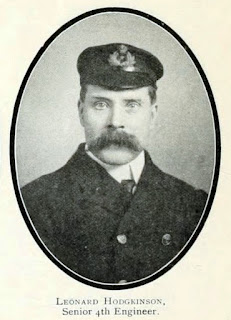
    Stoke-on-Trent’s best known connection with the Titanic disaster is of course the ship’s venerable skipper, Captain E. J. Smith, but a less well-known Potteries-born sailor who also perished in the Titanic disaster was Senior Fourth Engineer Leonard Hodgkinson. At the time of his death he was 46 years old, and like Captain Smith had spent most of his adult life at sea, albeit in a far different environment to that of his much more famous shipmate. As a member of the ship’s engineering staff, his working life was one spent for the most part in noisy, hot engine rooms, with little view of sea or sky save when he was off duty.

    Leonard was born at 20 North Street, Stoke-upon-Trent, on 20 February 1866, the second son and fifth child of potter’s presser John Hodgkinson and his wife Caroline nee Steele. Educated at St Thomas’ School, Stoke, before the age of 15, Leonard was apprenticed as an engine fitter with Messrs Hartley, Arnoux and Fanning, in Stoke. Once his apprenticeship was done, Leonard left the Potteries sometime in the 1880’s and took up a position with Messrs Lairds of Birkenhead, lodging with his elder sister Rose, her husband Henry Mulligan and their children, who had settled in Liverpool sometime after their marriage in 1877. It was in Liverpool that Leonard met his wife-to-be, Sarah Clarke. The couple were married in West Derby, Liverpool on 14 February 1891 and within a few years the couple had three children.

    North Street, Stoke-upon-Trent

    Leonard was now a seagoing marine engineer. He served for five years with the Beaver Line, whose ships sailed from Liverpool to Quebec and Montreal. In 1894, though, the Beaver Line went into liquidation and it may have been at this point that Leonard left and joined Rankin, Gilmour and Co., Ltd, which firm he also served with for five years, earning his first class certificate in the process. He may also have served with the Saint Line of ships which were owned by Rankin and Co., most of which carried the ‘Saint -’ title. Leonard’s final position with the company was as chief engineer aboard a ship with just such a title, the Saint Jerome.

    For a few years between 1901 and 1905, Leonard quit the sea and set himself up in business ashore as a mechanical engineer, but in May 1905, he returned to his old line of work, joining the White Star Line, serving first as assistant engineer on the Celtic, later earning promotion to fourth and then third engineer.

    According to family lore, Leonard Hodgkinson was keen to serve on as many vessels as possible before retirement, so was doubtless pleased after what appears to have been a six year stint aboard the Celtic, to be transferred over to the glamorous new Olympic (the Titanic’s elder sister) when that ship came on-line in June 1911. Here he was briefly bumped back down to assistant engineer, but soon earned promotion to fourth engineer once again. Perhaps more troublesome for him and his family was the fact that the Olympic was to sail from Southampton. There is no indication that the whole Hodgkinson family moved to Southampton at this time, though it is a possibility, but if not, then Leonard had to put up at lodgings in between journeys and perhaps only got to see his family on a few occasions when he could make the journey back to Liverpool.

    It was in early 1912, that Leonard travelled to Belfast where he joined the staff under Chief Engineer Joseph Bell, who were involved in getting the Olympic’s younger sister Titanic up and running. On 2 April he was signed onto the ship’s books for the delivery trip from Belfast to Southampton and on 6 April he was signed on once again in Southampton, now as senior fourth engineer.

    A White Star engineer at work.

    As senior fourth engineer, Leonard Hodgkinson was the highest ranking of the five fourth engineers aboard the Titanic, one of whom was a specialist in charge of the ship’s refrigeration equipment. Whilst at sea their duties involved checking that the adjustments and routine maintenance of the ship’s machinery were carried out. They dealt with any minor problems as they arose, answered any orders rung down via the ship’s telegraphs and ensured that everything ran as smoothly as possible. As officers it was also their duty to supervise the firemen, trimmers and greasers who worked with them down in the bowels of the ship.

    How Leonard’s days passed aboard the Titanic prior to its fateful collision is unknown, as too are his deeds on the night in question, as no accounts seem to exist noting him. If the story is to be believed, though, his fate and that of the 1500 other people who perished on the Titanic was foreseen by one of his relatives back in the Potteries, none of whom had any idea that Leonard was aboard the Titanic. According to the story she later told, two days before the disaster, Leonard’s 14 year old niece, Rose May Timmis, the daughter of Leonard’s elder sister Agnes, was sleeping in the same bed as her grandmother Caroline Hodgkinson (Leonard’s mother) when she had a nightmare. Rose dreamt that she was standing by a road in Trentham Park looking out over the lake, when a large ship steamed into sight. Suddenly the ship went down at one end and she could hear screams. Rose herself woke up with a yell that frightened her grandmother awake. When the frightened girl related her dream her grandmother snapped, “No more suppers for you, lady; dreams are a pack of daft.”

    After a while, Rose drifted back to sleep once more, only to find herself dreaming the same scene and as before when she heard the people screaming she did the same. She recalled that her grandmother was furious with her this time. A few days later, though, the news of the disaster broke and the family learnt that Leonard had been aboard the Titanic and that he and the other 34 engineering officers aboard had perished with the ship. Though several bodies from the engineering department were recovered in the following weeks, Leonard’s was not one of them.

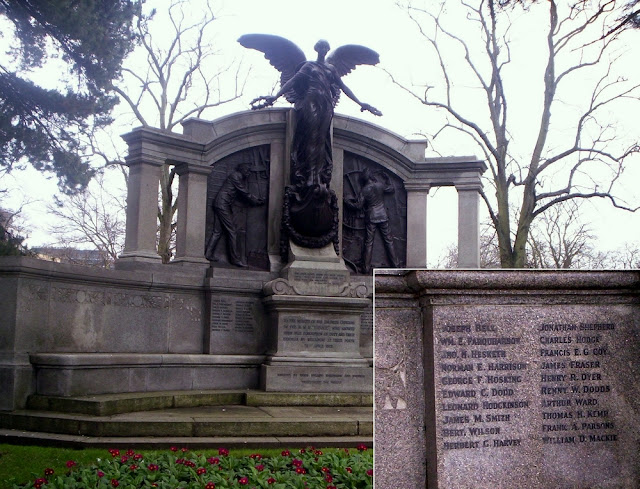
    Though Leonard’s body was never found, he is remembered in several memorials, most notably on the Engineers Memorial, East Park, Southampton, the Titanic and Engineers memorial, Liverpool; the Glasgow Institute of Marine Engineers memorial; and the Institute of Marine Engineers Memorial in London. There is also a brass memorial plaque in the church of St Faithful, in Crosby, Liverpool, dedicated to the memory of the Chief Engineer and his Engine Room staff.

    The Titanic Engineers Memorial, Southampton

    Leonard Hodgkinson was not the only member of his family to go to sea. His son Leonard Stanley also became a marine engineer with White Star and later Cunard. He served on the transatlantic run most of his career, mainly on RMS Majestic before the war and later on the Queen Mary and the Queen Elizabeth.


    Website: Encyclopedia Titanica

  • A War Horse and the Man Who Refused to Die

    John Edward Kitson was born at Coseley, near Dudley, Staffordshire in 1897, the eldest of two children born to Edward and Florence Kitson. His father was a police constable at first in the Dudley and Handsworth regions, but it seems that promotion to sergeant saw him move north to the Potteries, perhaps before John was 10 years old. Here the family prospered and his father would eventually rise to the rank of Chief Inspector at Burslem Police Station. In the 1911 census, the family was living in Shelton New Road, Newcastle and barring service in World War One, John Kitson would remain in the area for the rest of his life.


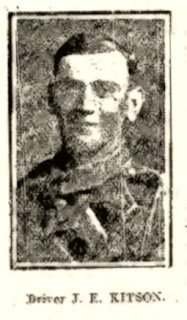
    The Great War started late in 1914 and by early 1915 John Edward Kitson had joined the army. As 31331 Gunner J. E. Kitson, Royal Field Artillery, he arrived in France in March 1915 and from April 1916, he served as a driver for X/9 Medium Trench Mortar Battery, part of  the divisional artillery attached to the 9th Scottish Division. Though never promoted, he proved a brave soldier, being wounded in action at least four times, seeing service on the Somme and at the Battle of Passchendaele. Gunner Kitson finished his war by winning the Military Medal in 1918 for gallantry in the field.  Hospitalised in Britain after his final wound, he did not return to the front to see out the war, being discharged from the army on 8 July 1918.


    After the war he married a local woman, Doris Hudson, they settled in Sneyd Green where they brought up five children. Kitson worked as a civil servant for the Ministry of Labour, but this seems to have been an anti climax after his wartime adventures which prompted him to leave an interesting anecdote of his service during the war and a record of how his injuries had affected his life afterwards. The stories were colourful enough to warrant syndication on papers as far afield as Australia and New Zealand.

    ‘A WAR HORSE’ ‘ALMOST  HUMAN.’

    ‘Mr. J. E. Kitson. of Hanley, Staffordshire, in England, sent to the “Daily Mail” the following remarkable stories of his war horse: – During 1916 and 1917 I had a charger named Tommy. He was nothing short of human, and many an entertainment was given by him to the troops. Once, when we were being shelled he got loose from his peg, and coming to me, gripped my shoulder In his mouth and “led” me away. A minute later a shell fell at the very spot where I had been standing. His favourite trick was to wait until I had given him a thorough grooming, then sit down like a dog. open his mouth, and “laugh” and roll. This usually happened when the Inspecting officer was just coming round the lines. Luckily, the officer knew Tommy. Another time, when I was riding him at a gallop my tin hat fell off. Tommy at once stopped, turn­ed. and picked it up and “handed” It to me. Just as I had put the hat on a piece of shrapnel struck it a glancing blow. He brought me in when I was badly gassed, I was unconscious on his back. A few weeks later he also entered hospital, and was sent into retirement.’

    The Mercury (Hobart, Tasmania) 2 July 1931, p.12

    ‘MAN WHO REFUSES TO DIE’

    ‘Mr J. E. Kitson, of Hanley Road, Sneyd Green, Hanley, Stoke-on-Trent, is known to his family and friends as the man who refuses to die. Doctors have repeatedly told him he has only a few years to live – but he fools them all. It all started during the war, when a piece of shell pierced his neck and killed a comrade behind him. Mr Kitson recovered, but doctors gave him just five years of life.

    The five years went by; then two years later he collapsed at work. This time he was given just seven months more. But after five months he got fed up with being a sick man and returned to work.

    Two years ago he collapsed again, was rushed to hospital and put on the danger list. Two hours later he was normal again and walked out of the hospital the next day.

    Doctors are perplexed about Mr Kitson, but he doesn’t mind. He says he will live to be 100.’

    Cairns Post (Queensland, Aus.) 15 March 1939, p.9

    John Edward Kitson certainly defied his doctors by many years, but did not carry on going as long as he predicted and he died on 13 July 1953 in Stoke-on-Trent, Staffordshire, when he was 56 years old. 

  • The Sneyd Colliery Disaster

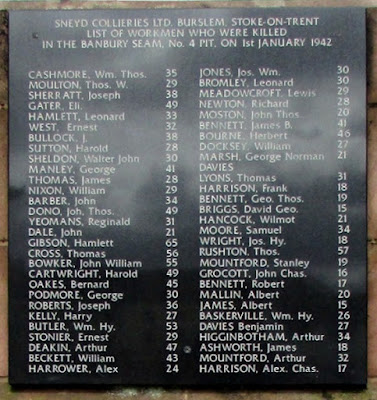
    At 7.50 am, on 1 January 1942, a devastating explosion took place 800 yards below ground at No 4 pit of Sneyd Colliery, Smallthorne. In normal times the pit would not have been working on New Years Day, the miners considering it unlucky, but because of the demand for coal during the war, work had gone on as normal and a full shift was on duty at the mine when the explosion occurred. The blast was contained to one coalface in the 7-foot Banbury Seam of No. 4 pit. All other workings were unaffected by the explosion, but the thump was felt throughout the mine, some men in the pit noted that the flow of air changed direction, while on the surface people felt a bump and all the lights flickered. Everyone knew something major had happened and when a frantic telephone call from the pit bottom informed them that an explosion had occurred, for the safety of all, work was stopped and the miners were quickly evacuated from the unaffected parts of No. 4 pit as well as from the neighbouring No. 2 pit.

    The Sneyd Mines Rescue Team sprang into action immediately after the blast and venturing down they rescued a handful of men from the pit bottom, but also found the first bodies. Teams were soon arriving from other local collieries including Chatterley Whitfield, Black Bull, Hanley Deep and Shelton; in total nine local mines rescue teams became involved in what soon turned from a rescue to a recovery effort. Beyond the mine, news of the explosion soon spread by word of mouth through the local community. Families and friends horrified by the reports they were hearing dashed up to the colliery to wait at the Hot Lane gate for news of their loved ones, but for many it would be the worst news. The bodies of 16 men were brought out that first day, but the rescue operations had to be postponed due to the presence of afterdamp and it was announced at that point that there was now no hope of finding anyone else alive. Up top, everyone came in to help, first aid staff were on duty at the ambulance room, the mine managers directed the rescue operation and the Inspectorate of Mines soon had staff on site to help out and assess the damage. Other staff did their bit too, the pit’s chief telephonist Mabel Caine was reported to have stayed at her post almost continuously for five days and nights, fielding thousands of phone calls and refusing all attempts to get her to take a long break.

    On 5 January even before all the bodies had been recovered, nearly 80% of the workforce got back to work, but it was not until 10 January that the last bodies were recovered. The list of the dead was sobering, as of the 61 men and boys working on the face that morning, 57 had lost their lives in the blast, most being killed in the initial explosion, while two later died in hospital. The two youngest, David George Briggs from Stanfields and Albert James from Burslem were both aged 15, while the oldest Hamlett Gibson, from Cobridge was 65. There were many sad stories to be told of those who were lost. A Mrs Bennett of Moorland Road, Burslem, suffered a double bereavement, losing her 41 year old husband James and 17 year old son Robert, both of whom had been working on haulage; the family had only recently moved down from Scotland. Mr and Mrs W. F. Harrison of Cobridge lost two teenage sons, Frank aged 18 and Alexander Charles aged 17. Joseph Sherratt aged 38 from Porthill was one of two firemen who were missing. Married with two children and a third on the way, only hours before he had been enjoying a party with his children and some of their friends and had laid on a puppet show of ‘Sinbad the Sailor’ to amuse them. He had not been superstitious about working on New Year, but his wife had and handed him a silver three penny piece for luck. Another haulage worker from Burslem, William Docksey aged 27, had been at the pit for 10 years, He had a brother working elsewhere in the mine who immediately joined the rescue team in an effort to find William. And David Briggs one of the youngsters mentioned earlier, had enjoyed a brief moment of local fame only a short while before, when he was photographed with the Minister of Food, Lord Woolton, eating one of the first sandwiches to be served by the new central depot for providing sandwiches for the miners of North Staffordshire.

     Four survivors had been pulled out of the pit, who by sheer luck or their more sheltered position in the mine, had escaped serious injury or death. One was Ernest Stone of Burslem in charge of the telephone at the pit bottom, whose call had alerted those up top to what had happened. He had been seated in a recessed area off the main road when the explosion occurred and thus avoided the worst of the blast. When the first rescuers arrived, though very dazed, he stayed at his post for three hours refusing to go up until he was finally overcome with dizziness. Another equally lucky was George Read of Burslem, the chief hooker in charge of loading and unloading tubs into the cages at the pit bottom. Like Mr Stone he was in an area off the main roadway and likewise escaped the worst of the blast. After a day at home getting over the shock of what had happened, he returned to the pit to help in the recovery effort. Thomas Gibbons from Burslem aged 64, was not so lucky. He was working near to the pit bottom operating a compressed air machine that drew tubs from the Banbury seam when the explosion occurred. Hit by a tremendous blast of hot air, he was hurled against a wall and fainted. Coming to a short while later in complete darkness and covered in dust only his intimate knowledge of the mine saved him. Working out where he was, Thomas crawled along the passage to where it branched off from the Bambury seam to the return of the Holly Lane branch. After crawling along for another 200 yards he was discovered by some Holly Lane miners who gave him some water and got him transported to the surface, from where he went to hospital. The fourth ‘survivor’ had not actually been in that part of the pit, but had initially been listed with the missing. Mr J. Bailey from Hanley, had only started at the pit the day before and swapped his heavy hand lamp for a helmet lamp with another man that morning. This was later discovered by the rescue teams who presumed Mr Bailey was a victim, though he had already been evacuated from the mine with the other 600 men. The mix-up was only discovered when he later wandered into the Burslem Miner’s Hall to correct the mistake after finding that he had been listed as a victim.

    In the immediate aftermath of the disaster a fund was set up to which many members of the public, collieries and companies gave money, while the proceeds of many local performances were also donated and money came in from abroad, even from as far away as soldiers serving in Iceland; over £17.000 was eventually collected and shared out amongst those who had lost a relative, the shares being determined by how many dependents the victims left behind. Families had been devastated by the disaster, many losing their main or only breadwinner. The disaster left 32 widows and 35 fatherless children, while of the 24 unmarried men 13 left grieving mothers and fathers and 8 left mothers who were already widowed.

    The question everyone wanted answered, was what had caused this appalling accident? The subsequent inquiry headed by Sir Henry Walker, concluded that the most likely cause was that tubs used to move the coal out of the mine had derailed and damaged an electric cable. Sparks from the cable had then ignited coal dust in the air and caused an explosion. Some writers have since disagreed with this explanation, and have advanced other perfectly valid theories, though after all this time any kind of definitive explanation of what happened is not possible as the mine is no more and all the witnesses are long dead.

    Sneyd Colliery continued working through the war, but from the late 1950s onwards it was slowly swallowed up by a larger neighbour. Major reconstruction work at Wolstanton Colliery saw an underground connection made to Sneyd and from that point on coal gradually started being brought to the surface at Wolstanton. Coal ceased being raised at Sneyd in July 1962 and though for a time the shafts there were still used for sending miners down, eventually all the men were transferred to Wolstanton Colliery. The No. 4 shaft, however, remained open as a spare entry for the northern area of the expanded colliery until the final closure of Wolstanton in 1985.

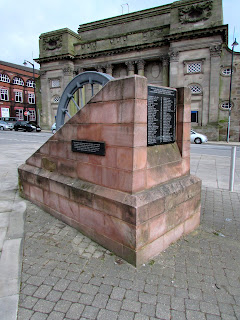
    The Sneyd Colliery explosion has the dubious honour of being the last major pit disaster in the Potteries and it cast a long shadow in the city’s collective memory. A memorial comprising a pit wheel set in bricks was unveiled in Burslem town centre in 2007. It lists all 57 names of the dead on a plaque and carries another praising the mines rescue teams that worked so hard to bring out the bodies.

    Reference: Evening Sentinel, 1 January 1942, p. 1; 2 January, p.1; 5 January, p.1; 10 January, p.1.

  • Visiting Burslem’s Houses of Ill Fame

    The oldest profession in the world had its place in soft underbelly of the Regency Potteries. Prostitutes plied a regular trade usually around the local inns where there were rich pickings when the potters and miners rolled in with their wages. A brief memoir of the period reveals that then as now many of the local working girls were ordinary women driven to extremes by circumstances, the probable cause being abject poverty. A Short Memoir of Ann Sheldon, published in 1821, tells the story of the short life of a dedicated Burslem Sunday School teacher. Constructed around entries in Ann’s diary, it reveals her to have been a noble spirited young woman, who saw it as her Christian duty to visit the sick and try to save the fallen.

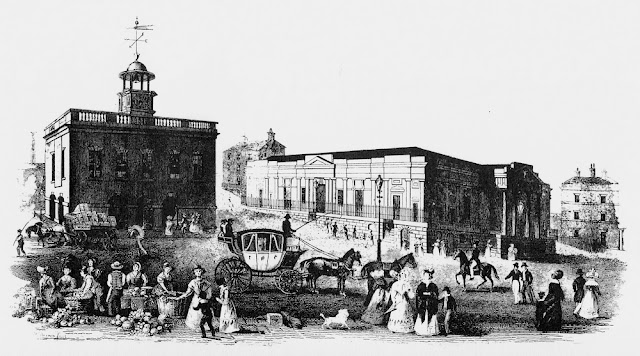
    Burslem town centre in the early 19th century.

    In April 1813 following a class, one of her class members asked Ann if she would visit a woman who was very ill. Accompanied by a fellow teacher ‘Miss B’, she went to see the woman whom she soon discovered to be a local prostitute. They found her to be, ‘a little better and very penitent.’ Ann continued : ‘she had been a very wicked woman for years, and is now little more than 30 years of age. Her parents died when she and her sister were young. As they advanced in years they got into bad company and lost their character. Masters would not employ them and they became common prostitutes.’ The woman, exhausted and frightened by her illness, told the two teachers that if she lived she was determined to leave her ‘wicked course of life.’

    After praying together they left her. The two young teachers had obviously been shocked by the interview and though the nature of the woman’s illness is never stated, the impression we are left with is that it was contracted as a result of her calling. Both came away from the house burning with a desire to save others from such a dangerous and degrading career.

    The next day, Ann and Miss B set out once more and found a woman to direct them to the ‘houses of ill fame’. They visited two buildings, but met with a mixed reception, made all the more galling no doubt, by the fact that at least two of the girls they encountered were old Sunday school scholars.

    In the first house ‘we found a young woman about seventeen years of age, who lived by herself, and was three years ago a Sunday scholar.’ The girl was unmoved by the teachers’ entreaties, Ann went back many times to invite her back to the school, but to no avail.

    There were two women in the other house: ‘we found a woman about twenty-seven years of age; who met in class about two years ago: we both spoke as close as possible for an hour and a half; they shed many tears and confessed they had a hell upon earth. There was another woman present, a companion in sin, who appeared to take no notice: – I said to her come down on your knees, and cry to the Lord, to have mercy upon your soul, before it is too late: we all bowed the knee before God, and found much liberty in prayer.’

    It is unknown whether Ann and Miss B efforts were successful. The biography remains silent on the matter. Ann herself died at a young age in 1819.

    Reference: John Tregortha (publisher) A Short Memoir of Ann Sheldon, Burslem 1821

  • The Learned Ease of Elijah Fenton

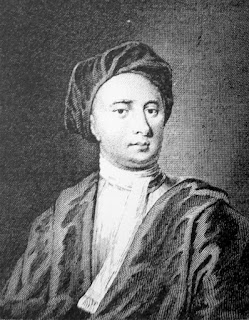
    Elijah Fenton

    Elijah Fenton, poet, biographer and translator, was born at Shelton on 25 May 1683. His father John Fenton, an attorney at law, and one of the coroners for the county of Stafford, was of an ancient family and possessed of a sizeable estate, while his mother Catherine Meare claimed direct descent from an officer in the army of William the Conqueror. Elijah was the youngest of their twelve children, and not being likely to inherit any of the family estate he was destined from an early age to be placed into some form of employment. He was an intelligent child and the church was therefore chosen as his future profession. Accordingly, after being educated locally, on 1 July 1700 he was admitted as a pensioner of Jesus college, Cambridge, where he earned a reputation as a diligent student. He gained his B.A., in 1704, but being an adherent of the old Stuart dynasty he denied himself the chance of taking holy orders by declining to take the required oaths of allegiance to the Crown.

    Seeking out alternative employment, Fenton became first an usher in the school of a Mr Bonwick, in Headley in Surrey, but was soon afterwards patronised by the representative of the noble Boyle family. He was subsequently appointed as secretary to Charles, 4th Earl of Orrery and later tutor to his son Lord Boyle. The Boyles were residing in Flanders and it was during his time there that Fenton produced some of his early poetry.

    On returning to England, he opened a grammar school at Sevenoaks in Kent. Though this added to his growing reputation as an able tutor to the gentry, the school was not a success and Fenton turned to publishing a series of verses. These received some favourable notices and he attracted the patronage of Henry St. John (later 1st Viscount Bolingbroke) and resigned his teaching post in 1710. This connexion, together with his abilities and amiable manners, brought him to the attention and earned him the friendship of the great and learned of his day, most notably one of the great British poets of the 18th century, Alexander Pope, who became a lifelong friend. 

    Fenton’s friendship with Pope seems to have energised him and over the next few yeas he produced a series of poems. Pope also managed to get his friend additional patrons, first as private secretary to the politician James Craggs and after the latter’s death he secured him the patronage of Lady Trumbull, who appointed Fenton as tutor to her eldest son. He was to enjoy the lady’s patronage until his death nine years later.

    During this period he produced further poems and a tragedy Mariamne, which though deemed unfit for performance by the then poet laureate, went on to earn Fenton over £1,000. There was also a profitable collaboration with Alexander Pope, who asked Fenton if he would assist in a translation of The Odyssey. Fenton duly translated books 1, 4, 19, and 20, his style apparently being so similar to Pope’s that it is difficult to tell them apart. Fenton also wrote the Life of John Milton, a biography that continued to be reprinted into the 19th century. His last significant work was an edition of the poems of Edmund Waller.

    Though seen today as a minor 18th century poet, at the time Fenton’s skills were highly regarded by his contemporaries and may indeed have improved were it not for by his habitual idleness. One of Fenton’s early biographers, none other than Dr Samuel Johnson of dictionary fame, touched on this in an amusing pen portrait of his fellow Staffordshireman.

    ‘Fenton was tall and bulky, inclined to corpulence, which he did not lessen by much exercise; for he was very sluggish and sedentary, rose late, and when he had risen sat down to his book or papers. A woman, that once waited on him in a lodging, told him, as she said, that he would “lie a-bed, and be fed with a spoon.” This, however, was not the worst that might have been prognosticated, for Pope says, in his Letters, that “he died of indolence;” but his immediate distemper was the gout.’

    But, Johnson notes further, Fenton’s faults were outweighed by his intelligence and the kindliness of his character.

    ‘Of his morals and his conversation the account is uniform: he was never named but with praise and fondness, as a man in the highest degree amiable and excellent. Such was the character given him by the earl of Orrery, his pupil; such is the testimony of Pope; and such were the suffrages of all who could boast of his acquaintance.

    By a former writer of his Life a story is told, which ought not to be forgotten. He used, in the latter part of his time, to pay his relations in the country an yearly visit. At an entertainment made for the family by his elder brother he observed that one of his sisters, who had married unfortunately, was absent, and found upon enquiry that distress had made her thought unworthy of invitation. As she was at no great distance he refused to sit at table till she was called, and, when she had taken her place, was careful to shew her particular attention.’

    Fenton died at the age of 47 on 16 July 1730, in Easthampstead, Berkshire, most likely from health problems related to gout and is buried in the churchyard of St Michael and St Mary Magdalene’s Church, Easthampstead, with an epitaph by his friend Alexander Pope. It reads:-

    This modest stone what few vain marbles can

    May truly say, here lies an honest man

    A poet blest beyond the poets fate

    Whom heav’n left sacred from the proud and great

    Foe to loud praise and friend to learned ease

    Content with science in the vale of peace

    Calmly he look’d on either life & here

    Saw nothing to regret, or there to fear

    From natur’s temp’rate feast rose satisfy’d

    Thank’d heav’n that he had liv’d and that he dy’d.

    A. POPE

    Reference: John Ward, The Borough of Stoke-Upon-Trent (1843); Samuel Johnson: Lives of the English Poets (1779-81); ed., Hill (1905), 2:257-66


    Illustrations: John Ward, The Borough of Stoke-Upon-Trent (1843)

  • Thomas Cooper Sparks the Pottery Riots

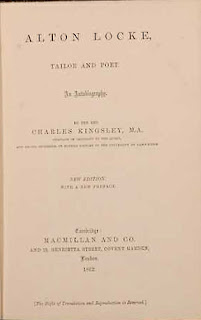
    One of the least known literary associations with Staffordshire, is that of Charles Kingsley’s novel Alton Locke. Tailor and Poet, which was published in 1851. The story of the rise and fall of a self-taught working man who is eventually imprisoned for rioting, is based upon a real person and a real incident. The person was the Chartist leader, Thomas Cooper, who was arrested and sentenced to two years in prison, for the events he had prompted in the Staffordshire Potteries.

    Thomas Cooper was born in Leicester to a working class family and from an early age displayed a precocious intelligence, the development of which was only limited by the fact that most of his lessons were self-taught. Occasionally, he had been known to immerse himself so deeply into his studies that the sheer mental effort he put forth ended on one occasion, at least, in him being physically ill. He worked at various jobs, mostly as a teacher, lay preacher and journalist, but eventually, appalled by the conditions endured by many factory and workshop workers, he became a convinced Chartist, a member of that Victorian working class movement which supported the introduction of a People’s Charter, which called for fair representation for the working population. The Charter’s six points demanded votes for all men at 21, annual general elections, a secret ballot, constituencies regulated by size of population, the abolition of property qualifications for MP’s and the payment of MP’s. Most of these points eventually became laws of the land and form a part of the state we live in today, but none of these things came into being until the latter half of the nineteenth century, long after the Chartist movement itself had collapsed.

    There were two bodies of the Chartist movement, the physical and the moral-force Chartists, who sought to bring about social change by revolutionary or evolutionary means. In his early days, Cooper was a supporter of the former faction. He was a fire and brimstone type of preacher, who like all great orators could move people with his speeches. This power comes through in Cooper’s autobiography, which is widely regarded as one of the finest working class ‘lives’ written during the Victorian age. The book, though written in Cooper’s later years after he had become a convinced moral-force Chartist, tends to carefully skate around his fiery physical-force youth and he presents himself as a far more reasonable man than he actually was in August 1842, when he arrived in the Potteries. Only by bearing in mind, that Cooper at this time advocated revolution of sorts, do the events he inspired in the Potteries make sense. Though he says in his book that he proclaimed, ‘Peace, law and order’, the resulting riots that left one man dead, dozens wounded or injured and many buildings burnt or ransacked, indicated that he said more than he was letting on.

    Cooper arrived in the Potteries, after a tour of several major towns and cities in the Midlands, and here he was to make a number of speeches before moving on to Manchester. The area was in the grip of a wage dispute. In June, 300 Longton miners whose wages had been drastically cut had gone on strike. By July, the strike had expanded to all of the pits in north Staffordshire, and hundreds of miners were on the streets, begging for money, and with the pits being closed, the potteries through lack of coal, could not fire their kilns and were also closed. By early August, the dispute had attracted widespread attention, certainly the Chartists expressed sympathy for the miners’ action, but contrary to later claims that the subsequent riots were Chartist inspired, it was mostly miners and not Chartists who did the rioting. The Potteries were a powder keg, ready to explode and Cooper’s arrival, as he himself admitted was ‘the spark which kindled all into combustion’.

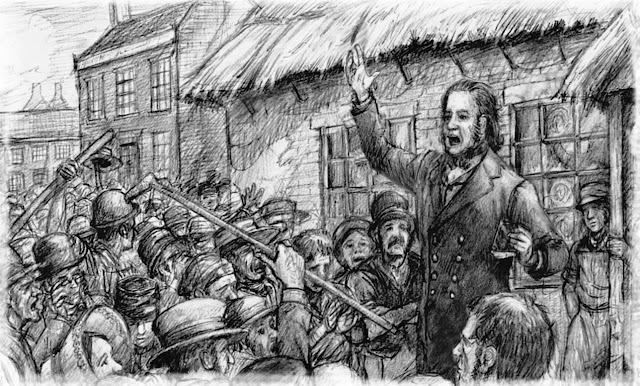
    Thomas Cooper addresses the crowd at Crown Bank, Hanley

    Standing on a chair in front of the Crown Inn, a low thatched building at Crown Bank in Hanley, on Sunday, 14 August, Cooper addressed a crowd of upwards of 10,000 people, delivering a brilliant Chartist speech to his audience. He look for his text the sixth commandment, ‘Thou shalt do no murder’. Throwing his net wide, he drew on examples of kings and tyrants from history, such as Alexander, Caesar and Napoleon, who had violated this commandment against their own people, even as their own government would be prepared to do. The next day, he addressed an equally sizeable crowd and moved a motion, ‘That all labour cease until the People’s Charter becomes the law of the land’.

    What followed, Cooper later regretted. As the crowd dispersed. rioting started around the Potteries towns in all except Tunstall and the borough town of Newcastle. Police stations were attacked, magistrate’s houses ransacked and burned, as were Hanley Parsonage and Longton Rectory. By the 16th, the chaos had lasted a day and a night, but on that day, the most famous, or infamous incident of the uprising occurred, what is known locally as ‘the battle of Burslem’. Following the rioting in Stoke, Shelton, Hanley and Longton, a great crowd moved towards Burslem, there to meet a crowd coming from Leek. Here, though, the authorities played their hand, when a troop of mounted dragoons stopped the crowd from Leek. The magistrate in charge read the Riot Act, then tried to reason with the men, but when it was clear that they were bent on trouble, the soldiers were ordered to fire. One man from Leek was killed and many injured, the crowd was routed and the disturbances ended overnight, but for many weeks afterwards, the Potteries were full of troops and vengeful magistrates arresting rioters and Chartist leaders.

    Cooper, horrified at the events he had unleashed, had tried to escape, but he was arrested and eventually tried and sentenced to two years in Stafford Gaol, on charges of arson and rioting. Here, he spent his time profitably, learning Hebrew and writing his book, The Purgatory of Suicides. On leaving prison, though, his views were found to differ considerably from the new mainstrean in Chartist thought, and he became increasingly a moral-force activist and remained so for the rest of his life.

    It was in the two or three years after leaving prison, that Cooper was interviewed by the Rev. Charles Kingsley, whose Christian Socialist movement had inherited many of the Chartist beliefs. Kingsley had sought out several old Chartists and educated working men on whom he wished to base the life of the major character in the novel he was preparing. Thomas Cooper, was obviously the chief amongst these, certainly his autobiography, written many years after Kingsley had published Alton Locke, shows many striking similarities between Cooper’s life and that of his fictional alter ego. The riot that Alton inspires in the book, for which he too is committed to the prison, takes place in the countryside, amongst agricultural labourers, but behind it there is the faintest echo of the struggle in the Potteries, that one historian has considered the nearest thing to a popular revolution that the Victorian age saw.

    After 1845, Thomas Cooper turned his talents mainly to writing, but he also lectured on subjects such as history, literature and photography. In this capacity, he made a number of return visits to the Potteries, to the place where on that day many years before, he had ‘caught the spirit of the oppressed and discontented’, in seeking to establish the basis of a democratic society.

    Reference: Charles Kingsley, Alton Locke. Tailor and Poet (1851); Thomas Cooper, Life of Thomas Cooper, written by Himself, (1872).

  • Zeppelins Over the Potteries

    During the First World War, the action for the most part took place along a line of trenches stretching from the. Belgian coast, down to the Swiss border, where massed armies, huddled in their trenches, were launched in pointless attacks in the face of merciless machine gun and cannon fire. For the civilians back home the war was distant, though those left at home may have had relatives in the trenches, the Great War was an impersonal thing. True, foodstuffs were in short supply, and women took a great leap forward in society by going to work in the factories and on the farms, but the prospect of imminent death from enemy bombers, was still a generation away, or so it seemed. Then there came the Zeppelins. In a bold move, the Germans attempted to disrupt British life and industry, by sending over fleets of hydrogen-filled airships to drop bombs on anything they thought worthy of being destroyed. Two of these airships, at least, made it as far as North Staffordshire, and though the damage they did was insignificant, the authorities fell that they were such a threat to British morale, that the circumstances of the raids were not fully reported until a month after the war had ended.

    The first raiders came on the night of the 31 January 1916, Several cities throughout the Midlands were surprised to find airships over them, since few had thought that the area was within the radius of such craft. This was in the days before the blackout, and the major manufactories of the Midlands were a blaze of lights and fires, and in North Staffordshire, the glow was particularly noticeable from the pot banks and steel-works of Stoke on Trent, which were obscured only by a slight ground mist.

    A squadron of Zeppelins had crossed the coast that night. One attacked Walsall at 8.10 p.m., and later at 12,30 a.m. There, the Mayoress, Mrs. S. M. Slater, was fatally injured in a bomb blast. The Wednesbury Road Congregational Chapel was demolished by a bomb and other unspecified damage was done. At 8.30, another airship suddenly loomed out of the dark over Burton on Trent, and dropped a cluster of bombs, one of which fell on a mission house, where a clergyman’s wife was holding a service, and in the blast three of the congregation were killed and a forth fatally injured.

    Not long after the Zeppelin over Burton had begun its attack, engines were heard moving towards Trentham and the Potteries, and presently, the Zeppelin appeared, cruising slowly overhead. Its obvious target could be seen miles away, the light from the Stafford Coal and Iron Company’s blast furnaces. The raider circled the foundry like a vulture and dropped half a dozen bombs in close succession. However, these fell on the spoil banks between the colliery and the furnaces, where they made several large holes, but did no serious damage.

    German airship designer Count Zeppelin

    After that the elusive raider sneaked off. Its course was only a matter of speculation, though engines were heard over Hanley, then Wolstanton and as far west as Madeley, where it dropped a flare over open country. It’s raid, though it must have injected some excitement into the area, caused no harm and it must have used up its stock of bombs, or been searching for a secondary target.

    The second Zeppelin raid, though, was more dramatic, and took place during the night of 27 to 28 November 1916. It was a clear, dry night over the Midlands, there was the nip of an autumn frost in the air, perfect weather for an air raid. So, perhaps, at 10.45 p.m.. when the warning was received in the Potteries that Zeppelins had been sighted, few were surprised. The whole district was blacked out. and air raid precautions were put in place the special constabulary, the fire brigade and doctors and nurses were all alerted and went to their stations. Positive information was soon received that a raider was making for North Staffordshire, and at a few minutes before 1 a.m, the steady drone of aero engines was heard and the Zeppelin was sighted over Biddulph, slowly making towards the Kidsgrove-Goldenhill-Tunstall area of the Potteries. Then the bombs came crashing down.

    One unnamed witness, had been up late and was just going to bed at about 1 a.m., when he heard a ‘deep rumbling, long-sustained explosion’ and thought that there had been a serious colliery accident nearby. He went into another bedroom to ask if anyone else had heard the noise, when there were further explosions, two short sharp blasts, then another ‘accompanied by a rending sound’, then a series of four or five blasts in succession. The witness looked out of a bedroom window and caught sight of flashes off towards the Chesterton area, followed by the thudding boom of the detonations. The bombardment went on for about half an hour until the Zeppelin drew nearer to the witness’ house and dropped another bomb about half a mile away ‘that shook every brick and window in the house’, before it moved. The witness had counted 21 explosions.

    The first bomb blew a hole in a spoil bank at Birchenwood Colliery, Kidsgrove, while the second two landed not far off from the Goldendale Iron Works. The forth landed in Tunstall, impacting in the back yard of No. 6 Sun Street, and the explosion destroyed the sculleries and outhouses of Nos. 2, 4, 6 and 8, but shards hit other houses, as well as a nearby Roman Catholic church. Luckily, no one was killed and only one person was injured, a Mr Cantliffe of No. 8 Sun Street, who was hit in the chest by shrapnel, but he later made a full recovery in the North Staffordshire Infirmary. Had the raider circled in that area for a time, there is little doubt that there would have been a great deal of destruction and many more casualties, but the Zeppelin moved on, leaving Sun Street battered and bruised and in such a state that it would for days attract a horde of sightseers.

    The Zeppelin cruised over Tunstall and out across Bradwell Wood, where the burning mine hearths seem to have attracted the raider away from the areas of population. This area was just a mass of calcinating ironstone left to smoulder out in the open, but which obviously seemed to have given the impression of being an ironworks of some description. Certainly the Germans thought so, and the area was heavily bombed, watched from a distance by our nameless witness. Explosion after explosion reverberated over Chesterton, but the only damage done was to a shed that was knocked over and the closest that any other bomb got to the public, was when one of the last of these landed behind Bradwell Lane, Wolstanton. A later report summed it up succinctly as a ‘particularly futile’ attack on the area.

    As it had circled over Bradwell Wood and the area around Chesterton and Wolstanton for some time, illuminated in the flashes from the bombs, many locals had spotted the airship. But finally, spent of its bomb load, the raider turned south-east and was last sighted passing low over Blurton Farm coming from the direction of Hartshill. This was at 1.35 a.m., the Zeppelin then vanished into the dark at a ‘moderate speed’.

    There had been a number of bombing raids over Britain that night and many came to a grim end. Certainly the North Staffs raider never made it back to Germany. Lord French, reporting the fate of several of these Zeppelins in a communique, made special reference to the airship that had bombed the Tunstall area. It appeared that after leaving the North Midlands, the airship hail taken a direct route towards East Anglia, from where there was but a short stretch of sea separating her crew from their homeland. However, before she even reached the coast, the Zeppelin had been repeatedly attacked by aeroplanes of the Royal Flying Corps and by ground-based artillery. Perhaps she was damaged, since Lord French’s report noted that the last part of her journey was made at a very slow speed and the airship was unable to reach the coast before day was breaking. By the time she reached Norfolk, however, it seemed that the crew had managed to make repairs, and after running a gauntlet of coastal batteries, one of which claimed a hit, the Zeppelin was seen making off to the cast at a high speed and at an altitude of about 8,000 feet. But more planes came at her. About nine miles out at sea, the Zeppelin was attacked by four machines of the Royal Navy Air Service and further fire came from an armed trawler. Worried like a bear with terriers at her heels, the airship struggled on until gunfire ripped into her hydrogen filled body and she went crashing down in flames into the sea at about 6.45 a.m. No survivors were noted.

    Reference: Staffordshire Sentinel, Friday, 27 December 1918, p.4

  • Jane Austen and the Clay of Staffordshire

    Jane Austen and the Clay of Staffordshire

    Through the efforts of potters such as Thomas Whieldon, Josiah Wedgwood, Josiah Spode and many others less well known, between 1750 and 1800 the local pottery industry had undergone a tremendous revolution. In 1762 when Wedgwood was just beginning his career as a major manufacturer, there were 150 potteries in the district employing over 7,000 people. By 1800, the figures for both had doubled. The improvement in trade was matched by technical developments and the use of new resources which improved the quality of the products produced. Thus the salt-glazed wares of one decade had been displaced in turn by creamwares and porcelains and by the turn of the century by bone china. All in all it had been quite an achievement in so short a time, As the words of the Wedgwood Memorial had it, these enterprising potters had ‘converted a rude and inconsiderable manufacture into an elegant art and an important branch of national commerce.’

    It was an improvement noted by none other than that great observer of her age, the novelist Jane Austen. Jane never visited the Potteries and had only a vague notion of its location (she thought it was near Birmingham and may have been confusing the district with the Black Country). She was, however, part of the genteel social set that these new, finer, highly decorative wares were aimed at, for whom buying the latest thing in pottery became something of a craze.

    In her letters Jane writes of visiting the Wedgwood showrooms in London and in one gleeful missive to her sister Cassandra in June 1811, she writes ‘I had the pleasure of receiving, unpacking, and approving our Wedgwood ware’ and anticipates the arrival of a new Wedgwood breakfast set for their mother, ‘I hope it will come by the waggon to-morrow; it is certainly what we want, and I long to know what it is like’.

    A decade earlier, though, her enthusiasm for Staffordshire pottery found a release in one of her early novels. Though not published until after her death, Jane Austen’s Gothic conceit, Northanger Abbey, was revised and finished between 1801 and 1804. In chapter 22, there is a short witty passage that may be the first literary appreciation of the Staffordshire Potteries and their rising status amongst the ceramic capitals of the world.

    ‘The elegance of the breakfast set forced itself on Catherine’s notice when they were seated at table; and, luckily, it had been the general’s choice. He was enchanted by her approbation of his taste, confessed it to be neat and simple, thought it right to encourage the manufacture of his country; and for his part, to his uncritical palate, the tea was as well flavoured from the clay of Staffordshire, as from that of Dresden or Seve. But this was quite an old set, purchased two years ago. The manufacture was much improved since that time; he had seen some beautiful specimens when last in town, and had he not been perfectly without vanity of that kind, might have been tempted to order a new set.’

    Though the line about a breakfast set made two years earlier being ‘quite old’ is a touch of Austen wit, it nevertheless reflects the real situation at that time, when local manufacturers were working day in, day out to keep their wealthy clients happy with newer and more exciting goods.

    Reference: Letters of Jane Austen (1884); Northanger Abbey (1817)