

Following the British invasion of the independent Zulu Kingdom in Southern Africa in January 1879, a force of over 1,700 men, mostly from the 24th Regiment of Foot, was camped at the foot of a sphinx-shaped rocky hill called Isandlwana. Here on 22 January, they were attacked by a Zulu army some 20,000 to 25,000 strong that they had supposed to be many miles away. As the Zulu warriors swarmed down from hills to the north and spread out in a wide arc to envelope them, the 24th Foot and numerous colonial units moved forward and formed a line to face the enemy and for some time – in the centre at least – they did successfully hold their ground, keeping the Zulus at bay with concentrated volley and cannon fire. In trying to keep in contact with a mounted force to the east, though, the main British line became fatally over-extended and in danger of being outflanked. Seeing this, Colonel Pulleine the officer commanding the camp ordered his forces to fall back to a more defensible position in front of the hill, but it was a fatal move. When the gunfire slackened the Zulus in the centre seized the moment and rushed forward in pursuit while those out on the plain soon outpaced and outflanked the British line to the east, rushing in on the camp and behind the retiring blocks of infantry, cutting off their escape. Chaos ensued as the British line disintegrated and the battle then degenerated into a mass of isolated fights with knots of redcoats surrounded by masses of Zulus. Some 400 men, mostly mounted troops, managed to escape the resulting slaughter before the end, but over 1,300 men perished on the British side, including nearly the entire 1/24th and a company of the 2/24th Foot. The Battle of Isandlwana became the worst defeat ever suffered by the British army at the hands of a native foe and for the time at least it effectively stopped the invasion of Zululand in its tracks.
Several local men were killed in the action. In the ranks of the 1/24th were 25 year old Private William Henry Hickin from Hanley; the son of one Henry Hickin a local locksmith and bell hanger, William had previously worked as a writing clerk before enlisting in early 1876. Private George Glass 1/24th aged 22 from Shelton, was the son of a local school master and had briefly worked as a potter and joined the army in 1874. Private Enoch Worthington 1/24th from Kidsgrove, was 24 and had been a miner like his father before him; he enlisted in Newcastle in 1875. Private Samuel Plant 1/24th was an older man from Shelton, who had joined the 24th Foot in 1859, married in 1862 and prior to serving in Southern Africa he had served for a year on St Helena.
In the 2/24th, former potter Sergeant William Shaw from Tunstall, was about 32 years old. After joining the army in 1870 he was promoted corporal in 1873 and sergeant in 1877. He had married locally before joining the army, had four children and had served in India and Britain before being sent to Southern Africa. His wife Emma and their children had come with him on this tour of duty and were lodged in King William’s Town, Cape Colony, far away from Zululand. Private Samuel Poole, 2/24th is something of an enigma as several possible candidates of that name were born in Audley, Kidsgrove or Newcastle, but there is no clear evidence if any of these are our man, all we know is merely that a man of that name enlisted in Hanley on 27 April 1875 aged 21 years. Records state that he served in G Company 2/24th. Private David Pritchard 2/24th, was from Stoke-upon-Trent though no one of that name appears in the civil records so that may have been an alias. He claimed to have worked as a forgeman before joining up in 1865 and he went on to see service in India. Aged about 34 at the time of the Zulu War, records say he served in B Company, but that was the company left at Rorke’s Drift, so he had probably been transferred to G Company.
The most interesting of these local victims of Isandlwana from a historian’s point of view, is Sergeant William Shaw of the 2/24th, as evidence exists giving us a glimpse into his fate that day. According to the notebook of Corporal John Bassage 2/24th, now held at the Royal Regiment of Wales Museum, who was part of the force sent to bury the dead in June 1879 after the war was over, the remains of Sergeant Shaw and three private soldiers of the 2/24th were found together in a heap on the battlefield. The four men caught out in the open appeared to have formed into a small group in a last desperate attempt to try and fend off the Zulus as they poured into the camp. All seemed to have been stabbed to death with assegais.
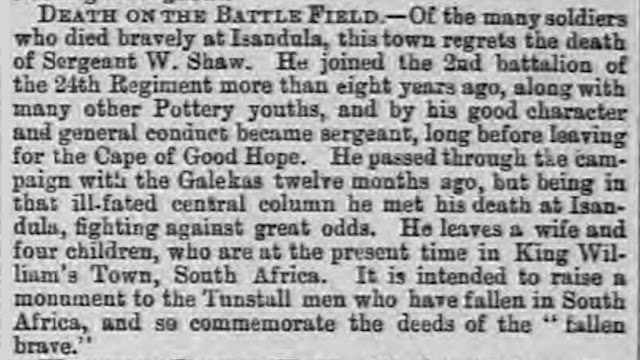
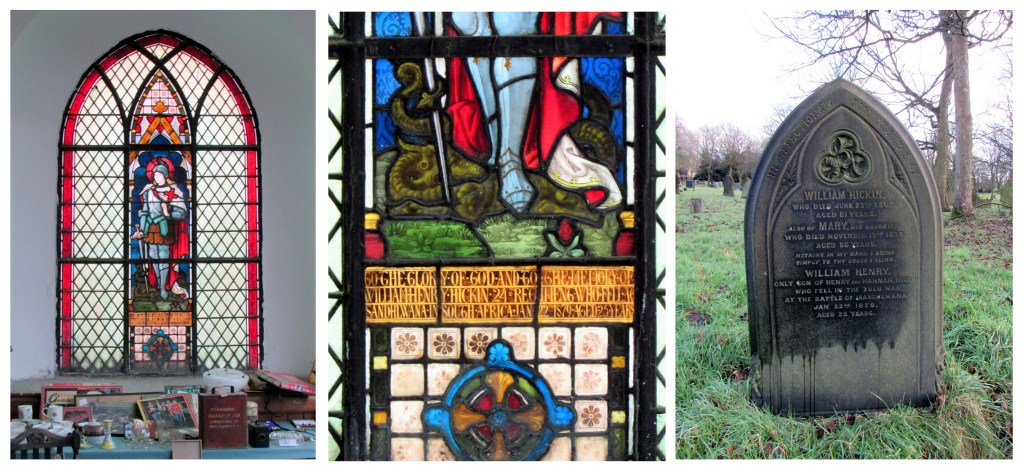
In a report in the Sentinel noting Shaw’s death in action, it was stated that there were hopes of raising a memorial to him and all the Tunstall men killed in South Africa. This, though, never seems to have come to pass and of all the men mentioned above only one appears to have been commemorated locally. In December 1880 at St John’s Church in Hanley, a stained glass window was dedicated to the memory of 25 year old Private William Henry Hickin, whose father was a churchwarden there. Hickin was further commemorated on his grandfather and aunt’s gravestone in Hanley Cemetery. Private Hickin is in fact the only ‘other ranks’ casualty of the Battle of Isandlwana remembered with a memorial window.
One other local soldier who who was initially listed as a casualty was Private Frederick Butler from Shelton and son of the proprietor of the Bell and Bear Inn. He was a soldier of the 1/24th but prior to the invasion he had been transferred to the Imperial Mounted Infantry, Though initially listed as a casualty of the battle, Butler was in fact many miles away with his new unit serving in another invasion column that saw action at the battle of Nyezane on the same day as Isandlwana. He survived the war, rejoined his own unit once the fighting was over and later returned to the Potteries.
Reference: Staffordshire Sentinel, various issues March-May 1879. My thanks to Ken Ray for his detailed list and information on the local men killed at Isandlwana and to Alan Rouse for family and background information on Sergeant Shaw.
 Potted Histories
Leave a comment