Tag: soldiers

  • Into the Valley of Death

    In 1975, a small article appeared in the Evening Sentinel noting that at the battle of Balaclava during the Crimean War, 1358 Private George Turner* of the 11th Hussars, born in Burslem, had been mortally wounded during the Charge of the Light Brigade. According to his records, Turner was indeed from Burslem, and had worked locally as a crate maker until at the age of 18 he had enlisted in the 11th Hussars at Coventry on 24th September 1847. As the paper noted, he was probably the only man from the Potteries to have taken part in that famous but suicidal military action, when on 25th October 1854, a force of nearly 670 light cavalrymen were mistakenly launched in a frontal attack on an extended line of Russian cannon, infantry and cavalry at the end of a valley, that were further supported by other batteries on either side. The results of this colossal blunder were predictable, with some 110 British soldiers being killed and 160 wounded in the attack, a 40 percent casualty rate, while over 300 horses were killed. 

    Richard Caton Woodville’s famous painting of the Charge of the Light Brigade. Lord Cardigan on the far left of picture is dressed as the commander of the 11th Hussars.
    Source: Wikimedia Commons

    The 11th Hussars, resplendent in their black fur shakos, blue and gold braided jackets and crimson trousers, formed half of the second rank of the Light Brigade, though that did not spare them and they took a severe mauling from the Russian cannons as the Brigade closed on the enemy line. Private Turner was one of those struck down well before they got there, hit on the left arm by a cannonball, his injury being witnessed by Sergeant Major George Loy Smith of his company, who was riding nearby. Loy Smith later wrote ‘… before we had gone many hundred yards Private Turner’s arm was struck off close to the shoulder and Private Ward was struck full in the chest.’ Another Private named Young had received a similar injury to Turner and Loy Smith told him to turn his horse around and go back to their own lines, ‘… I had hardly done speaking to him, when Private Turner fell back, calling out to me for help. I told him too, to go back to the rear.’

    The rest of the brigade rode on down the valley and through the line of cannons where they briefly caused havoc in the rear of the Russian line before exhaustion, the decimation of their ranks and Russian reinforcements forced them to retreat. Turner meantime, must have ridden, or been carried back down the valley to the British lines, bandaged up and with others was then placed aboard a transport ship bound for the military hospital at Scutari in Turkey. However, he never made it, his wound was too severe; Private George Turner aged 25 years old died aboard ship on 28th October and was probably buried at sea. 

    There was no mention of the fate of Private Turner in the local papers at the time and it took 120 years for his story to finally make the pages of the Sentinel. It was related by Mr W. R. Baker of Endon, who added, ‘I ask your readers to spare a moment’s thought to his memory now when tradition has little meaning and patriotism is an outmoded word I make no apology for thinking that he should not be entirely forgotten.’ 

    There existed, though, another poignant addendum to Turner’s sad tale. Seven months after the battle of Balaclava, the Light Brigade had passed again over the same ground, now deserted of enemy troops and here the upper part of a sabre scabbard, all twisted and mangled, was picked up by Sergeant Major Loy Smith and it became part of his collection of memorabilia. When the collection was put on display in Sheffield in 1981, a card attached to the scabbard’s remains read, ‘This belonged to Private Turner, K.I.A.’

    *Despite my best efforts, I have yet to find a trace of a George Turner in the local civil records who fits the available data, raising the possibility that the name is an alias.

    Reference: Evening Sentinel, 25 October 1975, p.4; George Loy Smith, A Victorian RSM: From India to the Crimea, p. 132.

    My thanks to Mr Philip Boys for kindly providing me with background information on Private Turner contained in ‘Lives of the Light Brigade: The E. J. Boys Archive’. 
  • A Soldier of the U.S. Cavalry

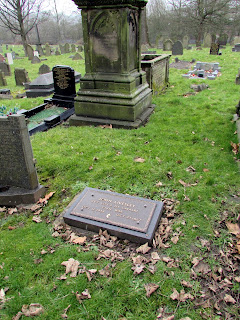
    John Livesley’s grave marker in Hanley Cemetery.

    In 1997, Hugh Troth of Ohio, published a tribute to his grandfather, The Life and Times of Isma Troth. Isma Troth had served as a soldier in the American Civil War and he wrote several letters charting his friendship with a fellow soldier named John Livesley whom he met in hospital when he was there recovering from his wounds. Troth’s account indicated that Livesley came from Potteries and using biographical information from this book and information from other social archives, local researchers were able to piece together the life of this otherwise forgotten local who had somehow got himself involved in a foreign war.

    John Livesley was born in Shelton on 12 October 1838, the son of pottery engraver and journeyman William Livesley and Sarah nee Brundrett. He enjoyed a privileged upbringing as his father was an increasingly prosperous man, who by 1851 had opened his own pottery and also ran a grocery business, all together employing 46 men, 23 women, 20 boys and 25 girls. As a result of his family’s wealth, John enjoyed a good education, attending a boy’s boarding school run by James and Harriet Grocott at Wilton House, Wrinehill near Betley on the Staffordshire border.

    As the family business grew, William Livesley entered into partnership with one Edwin Powell, and his name then regularly appeared in the local press, often for his philanthropy and support for public works and by the mid-1850s, John Livesley or J. Livesley likewise puts in a few appearances, attending performances or contributing money for some good cause supported by his father. But by 1861 census John had disappeared from the area.

    In fact, he had left the country and crossed the Atlantic to the United States, sailing in September 1860 aboard the RMS Persia to New York in company with 40 year old James Carr, a native of Hanley who two decades earlier had emigrated to the States and had established a successful pottery in New York. Both men give their occupation as ‘potter’ in the ship’s passenger list and it is not unreasonable to suppose that John Livesley, the son of a successful Hanley manufacturer had gone over with John Carr to work in his growing firm.

    Yet, it was a bad time to be travelling to the USA as growing tensions between the northern and southern states over the expansion of slavery, came to a head the following year. The southern slave-owning states split from the Union, forming a Confederacy, an act that pushed the country into a bloody civil war.

    Was John Livesley permanently settled in the States at this time, resisting the urge to join in the conflict, or just an occasional visitor to the country, criss-crossing the Atlantic and thus avoiding becoming involved? It is hard to say, but he was certainly in New York on 23 January 1864 when he was enlisted as a private in L Company 6th Regiment New York Cavalry of the Union army. Details on his enlistment are unclear, but suggestions have been made that he was drunk at the time, a not unlikely hypothesis as John seems to have had a habit of drinking to excess when he found himself in like-minded company. This is backed up by records that show that he was in hospital for the first week of his service due to “delirium”. He also seems to have enlisted under an assumed name, the enlistment records for John Livesley being struck through and replaced with the name ‘John Lindsley’. The records note that he was born in England, worked as a potter and gave a physical description: ‘gray eyes, brown hair, light complexion, 5 feet 8½ inches in height’. His term of enlistment was given to be three years.

    His new home, the 6th New York Cavalry, also known as the 2nd Ira Harris Guard, was a veteran unit, it had been formed at the outbreak of the Civil War and seen much service. Only a few months earlier it had taken part in the Battle of Gettysburg and since then played its part in numerous smaller actions taken on by the Army of the Potomac to which it belonged. With the onset of winter though it had gone into cantonments and when John Livesley enlisted, was employed in guarding the country between the Union lines and the Blue Ridge Mountains.

    US and Confederate cavalry in action at the Battle of Trevilian Station in 1864.

    On 3 May 1864, the regiment – now with Livesley, or rather ‘Lindsley’ in its ranks – returned to action, crossing the Rapidan river and taking part in the Wilderness campaign under General Grant. The regiment was part of the Cavalry Corps, and played a role in all the operations undertaken by the corps commander General Sheridan, notably in his famous raid around the Confederate capital of Richmond. At the battle of Yellow Tavern on 11 May 1864, the 6th New York Cavalry charged down the Brook Pike and went into and entered the line of the first defences about Richmond, being the first Union regiment to get so close to the city. The regiment then saw action in the Battle of Trevilian Station, and in numerous smaller actions and it was probably during one of the latter in August 1864 that John Livesley was badly wounded eight months after joining up.

    Carried from the front and admitted to the USA Post Hospital, Bolivar Heights, Harper’s Ferry on 20 August with gunshot wounds, Livesley was a wreck and had to have an arm and a leg amputated. Records show that aside from his physical injuries, he like many in the army was also suffering from chronic diarrhoea, but also that he was quickly transferred further from the seat of war, first to the Field Hospital at Sandy Hook, Maryland and finally to Rulison USA General Hospital at Annapolis Junction, Maryland on the road between Washington and Baltimore. Confined to a wheelchair, it was during his long convalescence here that he met Isma Troth, a former prisoner of war at the infamous Andersonville prison, who now worked as a clerk at the hospital, often writing letters home for the wounded, one of them being John Livesley whom he first met shortly after his arrival there. The two men developed a close friendship and Livesley’s father offered to pay for the two of them to come to England when they were discharged. The war effectively ended in April 1865 and John was mustered out of the Union army on 24 May 1865 whilst still at Annapolis Junction.

    Cheered by the thought of making a new life for himself, Troth was keen to go to Britain, noting that his friend’s family were influential and he might secure a good position there, but he had some major misgivings about Livesley’s drinking habits. In a letter written in June that year, Mr Troth wrote: ‘Mr Livesley is a good, kind friend of mine and is an honest, intelligent man – but he sometimes drinks’. He noted that he had known Livesley for about a year and that the man was not a regular drinker and he never drank when they went places, but on a couple of occasions he had gone out with soldiers who did drink and had come home in quite a state. Once he went with them to a neighbouring village and came back the worse for wear, and on being mustered out of the army he had gone out ‘with some fast boys’ to celebrate his release and had come back drunk, much to Troth’s disgust. After talking of their plans to travel to Britain, Isma said: ‘If my friend associates and drinks with these rough characters I shall not go with him, for I cannot place any confidence in a drunkard.’

    Despite these problems, the two friends did indeed take passage to Britain and Isma spent a year in England before travelling home. John returned to Stoke-on-Trent and was soon set up as a grocer in Lichfield Street, in Hanley, marrying a local girl Ellen Twigg from Bucknall on 18 June 1867. But tragically John Livesley died just four months later, on 23 October 1867, aged 29, his cause of death being given as epilepsy.

    Despite his father’s wealth John was buried in an unmarked grave in Hanley Cemetery. However, when he learned of his grandfather’s link with John Livesley, Hugh Troth endeavoured to see John’s service recognised and in 1997 contacted the United States Government to obtain a bronze plaque, recognising Private John Livesley’s service during the American Civil War. In 2003, the plaque was put on his burial spot, being unveiled by Mr Troth.

    Reference: Hugh Isma Troth, The Life and Times of Isma Troth (1997)

  • A War Horse and the Man Who Refused to Die

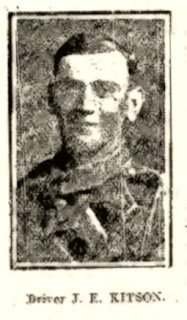
    John Edward Kitson was born at Coseley, near Dudley, Staffordshire in 1897, the eldest of two children born to Edward and Florence Kitson. His father was a police constable at first in the Dudley and Handsworth regions, but it seems that promotion to sergeant saw him move north to the Potteries, perhaps before John was 10 years old. Here the family prospered and his father would eventually rise to the rank of Chief Inspector at Burslem Police Station. In the 1911 census, the family was living in Shelton New Road, Newcastle and barring service in World War One, John Kitson would remain in the area for the rest of his life.


    The Great War started late in 1914 and by early 1915 John Edward Kitson had joined the army. As 31331 Gunner J. E. Kitson, Royal Field Artillery, he arrived in France in March 1915 and from April 1916, he served as a driver for X/9 Medium Trench Mortar Battery, part of  the divisional artillery attached to the 9th Scottish Division. Though never promoted, he proved a brave soldier, being wounded in action at least four times, seeing service on the Somme and at the Battle of Passchendaele. Gunner Kitson finished his war by winning the Military Medal in 1918 for gallantry in the field.  Hospitalised in Britain after his final wound, he did not return to the front to see out the war, being discharged from the army on 8 July 1918.


    After the war he married a local woman, Doris Hudson, they settled in Sneyd Green where they brought up five children. Kitson worked as a civil servant for the Ministry of Labour, but this seems to have been an anti climax after his wartime adventures which prompted him to leave an interesting anecdote of his service during the war and a record of how his injuries had affected his life afterwards. The stories were colourful enough to warrant syndication on papers as far afield as Australia and New Zealand.

    ‘A WAR HORSE’ ‘ALMOST  HUMAN.’

    ‘Mr. J. E. Kitson. of Hanley, Staffordshire, in England, sent to the “Daily Mail” the following remarkable stories of his war horse: – During 1916 and 1917 I had a charger named Tommy. He was nothing short of human, and many an entertainment was given by him to the troops. Once, when we were being shelled he got loose from his peg, and coming to me, gripped my shoulder In his mouth and “led” me away. A minute later a shell fell at the very spot where I had been standing. His favourite trick was to wait until I had given him a thorough grooming, then sit down like a dog. open his mouth, and “laugh” and roll. This usually happened when the Inspecting officer was just coming round the lines. Luckily, the officer knew Tommy. Another time, when I was riding him at a gallop my tin hat fell off. Tommy at once stopped, turn­ed. and picked it up and “handed” It to me. Just as I had put the hat on a piece of shrapnel struck it a glancing blow. He brought me in when I was badly gassed, I was unconscious on his back. A few weeks later he also entered hospital, and was sent into retirement.’

    The Mercury (Hobart, Tasmania) 2 July 1931, p.12

    ‘MAN WHO REFUSES TO DIE’

    ‘Mr J. E. Kitson, of Hanley Road, Sneyd Green, Hanley, Stoke-on-Trent, is known to his family and friends as the man who refuses to die. Doctors have repeatedly told him he has only a few years to live – but he fools them all. It all started during the war, when a piece of shell pierced his neck and killed a comrade behind him. Mr Kitson recovered, but doctors gave him just five years of life.

    The five years went by; then two years later he collapsed at work. This time he was given just seven months more. But after five months he got fed up with being a sick man and returned to work.

    Two years ago he collapsed again, was rushed to hospital and put on the danger list. Two hours later he was normal again and walked out of the hospital the next day.

    Doctors are perplexed about Mr Kitson, but he doesn’t mind. He says he will live to be 100.’

    Cairns Post (Queensland, Aus.) 15 March 1939, p.9

    John Edward Kitson certainly defied his doctors by many years, but did not carry on going as long as he predicted and he died on 13 July 1953 in Stoke-on-Trent, Staffordshire, when he was 56 years old. 

  • Thomas Cooper Sparks the Pottery Riots

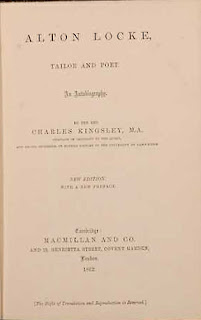
    One of the least known literary associations with Staffordshire, is that of Charles Kingsley’s novel Alton Locke. Tailor and Poet, which was published in 1851. The story of the rise and fall of a self-taught working man who is eventually imprisoned for rioting, is based upon a real person and a real incident. The person was the Chartist leader, Thomas Cooper, who was arrested and sentenced to two years in prison, for the events he had prompted in the Staffordshire Potteries.

    Thomas Cooper was born in Leicester to a working class family and from an early age displayed a precocious intelligence, the development of which was only limited by the fact that most of his lessons were self-taught. Occasionally, he had been known to immerse himself so deeply into his studies that the sheer mental effort he put forth ended on one occasion, at least, in him being physically ill. He worked at various jobs, mostly as a teacher, lay preacher and journalist, but eventually, appalled by the conditions endured by many factory and workshop workers, he became a convinced Chartist, a member of that Victorian working class movement which supported the introduction of a People’s Charter, which called for fair representation for the working population. The Charter’s six points demanded votes for all men at 21, annual general elections, a secret ballot, constituencies regulated by size of population, the abolition of property qualifications for MP’s and the payment of MP’s. Most of these points eventually became laws of the land and form a part of the state we live in today, but none of these things came into being until the latter half of the nineteenth century, long after the Chartist movement itself had collapsed.

    There were two bodies of the Chartist movement, the physical and the moral-force Chartists, who sought to bring about social change by revolutionary or evolutionary means. In his early days, Cooper was a supporter of the former faction. He was a fire and brimstone type of preacher, who like all great orators could move people with his speeches. This power comes through in Cooper’s autobiography, which is widely regarded as one of the finest working class ‘lives’ written during the Victorian age. The book, though written in Cooper’s later years after he had become a convinced moral-force Chartist, tends to carefully skate around his fiery physical-force youth and he presents himself as a far more reasonable man than he actually was in August 1842, when he arrived in the Potteries. Only by bearing in mind, that Cooper at this time advocated revolution of sorts, do the events he inspired in the Potteries make sense. Though he says in his book that he proclaimed, ‘Peace, law and order’, the resulting riots that left one man dead, dozens wounded or injured and many buildings burnt or ransacked, indicated that he said more than he was letting on.

    Cooper arrived in the Potteries, after a tour of several major towns and cities in the Midlands, and here he was to make a number of speeches before moving on to Manchester. The area was in the grip of a wage dispute. In June, 300 Longton miners whose wages had been drastically cut had gone on strike. By July, the strike had expanded to all of the pits in north Staffordshire, and hundreds of miners were on the streets, begging for money, and with the pits being closed, the potteries through lack of coal, could not fire their kilns and were also closed. By early August, the dispute had attracted widespread attention, certainly the Chartists expressed sympathy for the miners’ action, but contrary to later claims that the subsequent riots were Chartist inspired, it was mostly miners and not Chartists who did the rioting. The Potteries were a powder keg, ready to explode and Cooper’s arrival, as he himself admitted was ‘the spark which kindled all into combustion’.

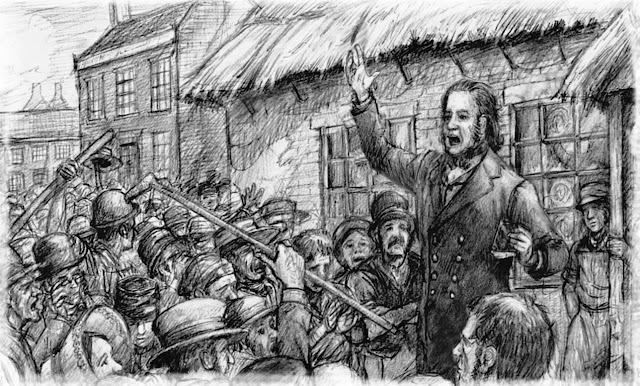
    Thomas Cooper addresses the crowd at Crown Bank, Hanley

    Standing on a chair in front of the Crown Inn, a low thatched building at Crown Bank in Hanley, on Sunday, 14 August, Cooper addressed a crowd of upwards of 10,000 people, delivering a brilliant Chartist speech to his audience. He look for his text the sixth commandment, ‘Thou shalt do no murder’. Throwing his net wide, he drew on examples of kings and tyrants from history, such as Alexander, Caesar and Napoleon, who had violated this commandment against their own people, even as their own government would be prepared to do. The next day, he addressed an equally sizeable crowd and moved a motion, ‘That all labour cease until the People’s Charter becomes the law of the land’.

    What followed, Cooper later regretted. As the crowd dispersed. rioting started around the Potteries towns in all except Tunstall and the borough town of Newcastle. Police stations were attacked, magistrate’s houses ransacked and burned, as were Hanley Parsonage and Longton Rectory. By the 16th, the chaos had lasted a day and a night, but on that day, the most famous, or infamous incident of the uprising occurred, what is known locally as ‘the battle of Burslem’. Following the rioting in Stoke, Shelton, Hanley and Longton, a great crowd moved towards Burslem, there to meet a crowd coming from Leek. Here, though, the authorities played their hand, when a troop of mounted dragoons stopped the crowd from Leek. The magistrate in charge read the Riot Act, then tried to reason with the men, but when it was clear that they were bent on trouble, the soldiers were ordered to fire. One man from Leek was killed and many injured, the crowd was routed and the disturbances ended overnight, but for many weeks afterwards, the Potteries were full of troops and vengeful magistrates arresting rioters and Chartist leaders.

    Cooper, horrified at the events he had unleashed, had tried to escape, but he was arrested and eventually tried and sentenced to two years in Stafford Gaol, on charges of arson and rioting. Here, he spent his time profitably, learning Hebrew and writing his book, The Purgatory of Suicides. On leaving prison, though, his views were found to differ considerably from the new mainstrean in Chartist thought, and he became increasingly a moral-force activist and remained so for the rest of his life.

    It was in the two or three years after leaving prison, that Cooper was interviewed by the Rev. Charles Kingsley, whose Christian Socialist movement had inherited many of the Chartist beliefs. Kingsley had sought out several old Chartists and educated working men on whom he wished to base the life of the major character in the novel he was preparing. Thomas Cooper, was obviously the chief amongst these, certainly his autobiography, written many years after Kingsley had published Alton Locke, shows many striking similarities between Cooper’s life and that of his fictional alter ego. The riot that Alton inspires in the book, for which he too is committed to the prison, takes place in the countryside, amongst agricultural labourers, but behind it there is the faintest echo of the struggle in the Potteries, that one historian has considered the nearest thing to a popular revolution that the Victorian age saw.

    After 1845, Thomas Cooper turned his talents mainly to writing, but he also lectured on subjects such as history, literature and photography. In this capacity, he made a number of return visits to the Potteries, to the place where on that day many years before, he had ‘caught the spirit of the oppressed and discontented’, in seeking to establish the basis of a democratic society.

    Reference: Charles Kingsley, Alton Locke. Tailor and Poet (1851); Thomas Cooper, Life of Thomas Cooper, written by Himself, (1872).

  • Last Stand at Isandlwana

    The Battle of Isandhlwana by Charles Edwin Fripp

    Following the British invasion of the independent Zulu Kingdom in Southern Africa in January 1879, a force of over 1,700 men, mostly from the 24th Regiment of Foot, was camped at the foot of a sphinx-shaped rocky hill called Isandlwana. Here on 22 January, they were attacked by a Zulu army some 20,000 to 25,000 strong that they had supposed to be many miles away. As the Zulu warriors swarmed down from hills to the north and spread out in a wide arc to envelope them, the 24th Foot and numerous colonial units moved forward and formed a line to face the enemy and for some time – in the centre at least – they did successfully hold their ground, keeping the Zulus at bay with concentrated volley and cannon fire. In trying to keep in contact with a mounted force to the east, though, the main British line became fatally over-extended and in danger of being outflanked. Seeing this, Colonel Pulleine the officer commanding the camp ordered his forces to fall back to a more defensible position in front of the hill, but it was a fatal move. When the gunfire slackened the Zulus in the centre seized the moment and rushed forward in pursuit while those out on the plain soon outpaced and outflanked the British line to the east, rushing in on the camp and behind the retiring blocks of infantry, cutting off their escape. Chaos ensued as the British line disintegrated and the battle then degenerated into a mass of isolated fights with knots of redcoats surrounded by masses of Zulus. Some 400 men, mostly mounted troops, managed to escape the resulting slaughter before the end, but over 1,300 men perished on the British side, including nearly the entire 1/24th and a company of the 2/24th Foot. The Battle of Isandlwana became the worst defeat ever suffered by the British army at the hands of a native foe and for the time at least it effectively stopped the invasion of Zululand in its tracks.

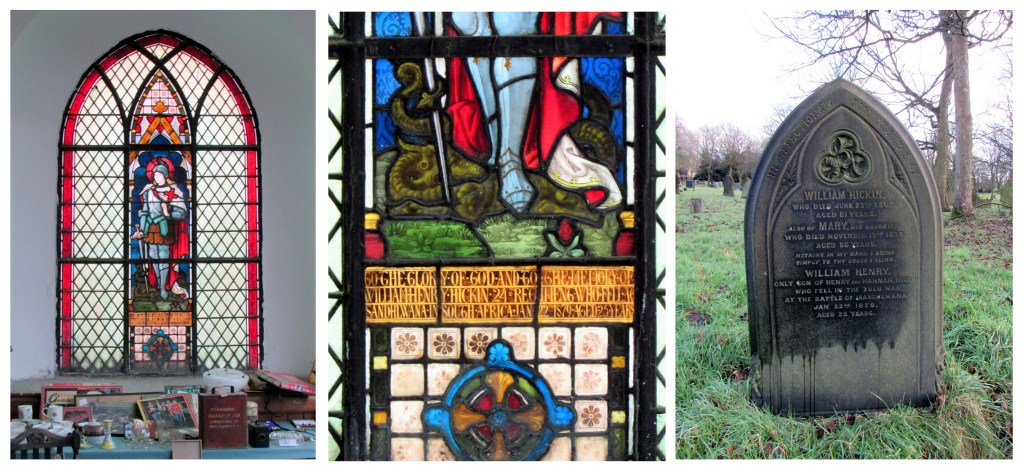
    The stained glass window and grave memorialising Private William Hickin.
    The stained glass window and grave memorials to Private William Henry Hickin.

    Several local men were killed in the action. In the ranks of the 1/24th were 25 year old Private William Henry Hickin from Hanley; the son of one Henry Hickin a local locksmith and bell hanger, William had previously worked as a writing clerk before enlisting in early 1876. Private George Glass 1/24th aged 22 from Shelton, was the son of a local school master and had briefly worked as a potter and joined the army in 1874. Private Enoch Worthington 1/24th from Kidsgrove, was 24 and had been a miner like his father before him; he enlisted in Newcastle in 1875. Private Samuel Plant 1/24th was an older man from Shelton, who had joined the 24th Foot in 1859, married in 1862 and prior to serving in Southern Africa he had served for a year on St Helena.

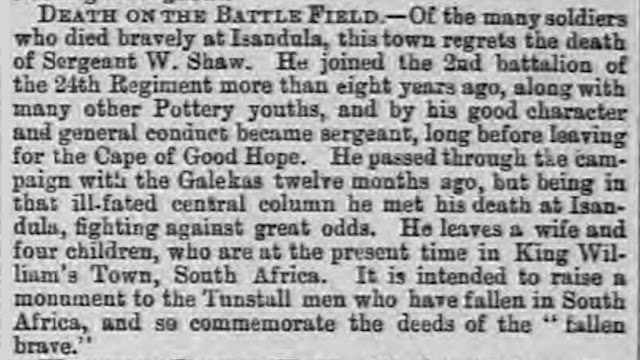
    In the 2/24th, former potter Sergeant William Shaw from Tunstall, was about 32 years old. After joining the army in 1870 he was promoted corporal in 1873 and sergeant in 1877. He had married locally before joining the army, had four children and had served in India and Britain before being sent to Southern Africa. His wife Emma and their children had come with him on this tour of duty and were lodged in King William’s Town, Cape Colony, far away from Zululand. Private Samuel Poole, 2/24th is something of an enigma as several possible candidates of that name were born in Audley, Kidsgrove or Newcastle, but there is no clear evidence if any of these are our man, all we know is merely that a man of that name enlisted in Hanley on 27 April 1875 aged 21 years. Records state that he served in G Company 2/24th. Private David Pritchard 2/24th, was from Stoke-upon-Trent though no one of that name appears in the civil records so that may have been an alias. He claimed to have worked as a forgeman before joining up in 1865 and he went on to see service in India. Aged about 34 at the time of the Zulu War, records say he served in B Company, but that was the company left at Rorke’s Drift, so he had probably been transferred to G Company.

    The most interesting of these local victims of Isandlwana from a historian’s point of view, is Sergeant William Shaw of the 2/24th, as evidence exists giving us a glimpse into his fate that day. According to the notebook of Corporal John Bassage 2/24th, now held at the Royal Regiment of Wales Museum, who was part of the force sent to bury the dead in June 1879 after the war was over, the remains of Sergeant Shaw and three private soldiers of the 2/24th were found together in a heap on the battlefield. The four men caught out in the open appeared to have formed into a small group in a last desperate attempt to try and fend off the Zulus as they poured into the camp. All seemed to have been stabbed to death with assegais.

    Staffordshire Sentinel and Commercial & General Advertiser – Saturday 8 March 1879, p.5

    In a report in the Sentinel noting Shaw’s death in action, it was stated that there were hopes of raising a memorial to him and all the Tunstall men killed in South Africa. This, though, never seems to have come to pass and of all the men mentioned above only one appears to have been commemorated locally. In December 1880 at St John’s Church in Hanley, a stained glass window was dedicated to the memory of 25 year old Private William Henry Hickin, whose father was a churchwarden there. Hickin was further commemorated on his grandfather and aunt’s gravestone in Hanley Cemetery. Private Hickin is in fact the only ‘other ranks’ casualty of the Battle of Isandlwana remembered with a memorial window.

    One other local soldier who who was initially listed as a casualty was Private Frederick Butler from Shelton and son of the proprietor of the Bell and Bear Inn. He was a soldier of the 1/24th but prior to the invasion he had been transferred to the Imperial Mounted Infantry, Though initially listed as a casualty of the battle, Butler was in fact many miles away with his new unit serving in another invasion column that saw action at the battle of Nyezane on the same day as Isandlwana. He survived the war, rejoined his own unit once the fighting was over and later returned to the Potteries.


    Reference: Staffordshire Sentinel, various issues March-May 1879. My thanks to Ken Ray for his detailed list and information on the local men killed at Isandlwana and to Alan Rouse for family and background information on Sergeant Shaw.