Tag: Shelton

  • The Great Storm of 1872

    Being situated in such a hilly region, widespread flooding is a rarity in Stoke-on-Trent, but occasionally chance extremes of weather have briefly put parts of the area under water. One startling weather event occurred on the afternoon of Sunday, 7 July 1872, when what the Staffordshire Advertiser described as ‘a thunderstorm of great severity’, struck the Potteries. Though it only lasted an hour and a half, it was so fierce that it left in its wake many dozens of flooded or damaged properties and a somewhat shell-shocked populace. Considering the violence of the storm and the damage it caused, remarkably few people were injured, though it seems there were many close calls.

    It had been cloudy all day, but in the afternoon the sky began to grow much darker presaging a storm, the light becoming so dim that newspapers could only be read near to windows or by candle or gas light. The dark clouds then gave way to ones with a strange yellow tint to them and it was then that it started to rain, not in drops, but as a veritable deluge driven in by a fierce wind and accompanied by loud claps of thunder and multiple bolts of lightning. In Hanley there was one very alarming event when a bolt of lightning passed through the Primitive Methodist school room in Frederick Street (now Gitana Street), entering by one window and out through another. The only damage was a scorched paint board on the front of the building, but the room had been full of children when the lightning shot through and these now fled the room in panic. They had to descend a flight of stairs to get out of the building and while none had been injured by the lightning, several now fell and were trampled underfoot and bruised in the crush, though none of them seriously. 

    During a service at Shelton Church, it rained so heavily that water forced its way through the roof and poured down into the building in streams. Buckets had to be brought to catch the water and the noise produced during the saying of the litany is said to have made for a very curious sound. Elsewhere in town, the lobbies of Bethesda Chapel in Old Hall Street were flooded, so too were numerous houses in town, notably in Nelson Place where part of the road nearby carrying a tramway was washed away. In Hanover Street, the downpour lifted stones up out of the road and deposited them at the bottom of Hope Street, where a heap big enough to fill two barrows was collected. The bottom end of Hope Street itself flooded, filling the cellars with up to a foot of water, floating heavy beer barrels in a brewery and boxes of live chickens in one house. The damage done to yards and gardens was tremendous. Nor were the local pot banks immune. The Cauldon Place works were flooded, though no serious damage was caused. Hanley’s satellite villages were likewise hard hit. At Basford a lightning bolt shot down a chimney and blew away a portion of a mantle shelf in one of the rooms; Etruria saw dozens of properties flooded, as too did Bucknall, where the water rushing down the roads and through the houses quickly threw the Trent into spate, causing it to overflow. This caused enormous damage on the low-lying ground of the neighbouring Finney Gardens where Bucknall Park now stands, some of the walks, plants and flowers being washed away by the sudden inundation. 

    Probably in no other part of the Potteries were the effects the storm so severe than in Burslem. Reporters on the scene shortly afterwards noted that even the oldest inhabitants had never before witnessed such a tempest, one stating that the rain ‘came down in bucketfuls’. The rain here was particularly heavy and for more than an hour the thunder and lightning was incessant and at one point the wind rose to a terrible pitch causing major damage in several places. On the Recreation Ground (where the old Queens Theatre now stands), Snape’s Theatre, a temporary structure of wood and canvas which had been constructed for the town’s wakes week, was in a matter of minutes blasted to smithereens. A number of the thickest supports were splintered like matchwood and many of the rafters and seats were destroyed, while the canvas roof was torn to shreds as the wind hit it. Mr Snape was a veteran travelling showman, well liked in the district and there was a great deal of local sympathy for him over his losses. In the aftermath of the storm a fund was set up, subscriptions to which would hopefully help him in repairing the serious losses he had sustained. 
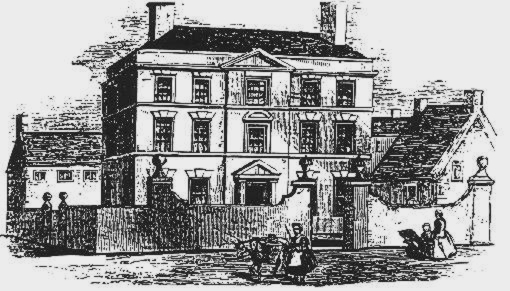
    The Big House, Burslem

    Just down the road from where Snape’s Theatre was taking a battering, part of an eight-foot tall wall between a timber Yard and the Big House was knocked down by the wind and rain, the accumulated flood water then rushed through the ground floor of the Big House with great force, blowing the front door open and then pouring in a stream down the turnpike road. 

    At the Roebuck Inn in Wedgwood Place, the violence of the rainstorm split some of the roof tiles, causing a mass of water to cascade into the upper rooms, then down the stairs and out through the front doors. The Town Hall too received a soaking, the basement of which was flooded to a depth of three feet, which caused no end of problems for the hall keeper and his wife who had the job of clearing it all out. Likewise the row of houses in Martin’s Hole – literally a hole or hollow near the Newcastle Road, where the roofs of the houses were on a level with the road – ‘presented a truly pitiable appearance’, the buildings being flooded to a depth of four and a half feet, ruining food stores and furniture and forcing the luckless inhabitants to seek shelter on the upper floor. 

    Almost everywhere else it was the same story with only slight variations. Longport received a severe visitation with most of the houses flooded to several feet. At Middleport the canal overflowed adding to the chaos. At Tunstall, water poured into the police station and several houses doing much damage. In Smallthorne numerous houses were flooded and smaller items of furniture were flushed out of the doors and sent floating down the street. At Dresden as well as the numerous flooded properties, the road at the lower end of the village was split apart by the storm, leaving it looking for all the world as if it had been heavily ploughed, which made it impassable to traffic and men had to be brought in to make repairs. In Stoke, Fenton and Dresden as in Burslem, many householders were forced briefly to live upstairs as their ground floors filled up, sometimes as high as the ceiling. Longton too suffered torrential rain and likewise had some flooding, but saw much less material damage, though at one pot bank the downpour extinguished the fires in their kilns. 

    Then the storm passed, leaving the Potteries in a battered state that it would take several days to recover from. That evening another storm broke overhead, but this turned out to be a much less severe event and caused no more serious problems.

    Reference: Birmingham Daily Post, Tuesday 9 July 1872, p.5; Staffordshire Advertiser, Saturday 13 July 1872, p.5.
  • The Learned Ease of Elijah Fenton

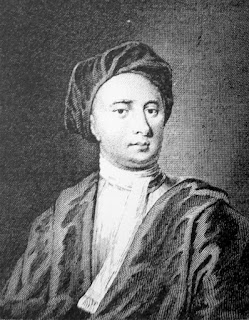
    Elijah Fenton

    Elijah Fenton, poet, biographer and translator, was born at Shelton on 25 May 1683. His father John Fenton, an attorney at law, and one of the coroners for the county of Stafford, was of an ancient family and possessed of a sizeable estate, while his mother Catherine Meare claimed direct descent from an officer in the army of William the Conqueror. Elijah was the youngest of their twelve children, and not being likely to inherit any of the family estate he was destined from an early age to be placed into some form of employment. He was an intelligent child and the church was therefore chosen as his future profession. Accordingly, after being educated locally, on 1 July 1700 he was admitted as a pensioner of Jesus college, Cambridge, where he earned a reputation as a diligent student. He gained his B.A., in 1704, but being an adherent of the old Stuart dynasty he denied himself the chance of taking holy orders by declining to take the required oaths of allegiance to the Crown.

    Seeking out alternative employment, Fenton became first an usher in the school of a Mr Bonwick, in Headley in Surrey, but was soon afterwards patronised by the representative of the noble Boyle family. He was subsequently appointed as secretary to Charles, 4th Earl of Orrery and later tutor to his son Lord Boyle. The Boyles were residing in Flanders and it was during his time there that Fenton produced some of his early poetry.

    On returning to England, he opened a grammar school at Sevenoaks in Kent. Though this added to his growing reputation as an able tutor to the gentry, the school was not a success and Fenton turned to publishing a series of verses. These received some favourable notices and he attracted the patronage of Henry St. John (later 1st Viscount Bolingbroke) and resigned his teaching post in 1710. This connexion, together with his abilities and amiable manners, brought him to the attention and earned him the friendship of the great and learned of his day, most notably one of the great British poets of the 18th century, Alexander Pope, who became a lifelong friend. 

    Fenton’s friendship with Pope seems to have energised him and over the next few yeas he produced a series of poems. Pope also managed to get his friend additional patrons, first as private secretary to the politician James Craggs and after the latter’s death he secured him the patronage of Lady Trumbull, who appointed Fenton as tutor to her eldest son. He was to enjoy the lady’s patronage until his death nine years later.

    During this period he produced further poems and a tragedy Mariamne, which though deemed unfit for performance by the then poet laureate, went on to earn Fenton over £1,000. There was also a profitable collaboration with Alexander Pope, who asked Fenton if he would assist in a translation of The Odyssey. Fenton duly translated books 1, 4, 19, and 20, his style apparently being so similar to Pope’s that it is difficult to tell them apart. Fenton also wrote the Life of John Milton, a biography that continued to be reprinted into the 19th century. His last significant work was an edition of the poems of Edmund Waller.

    Though seen today as a minor 18th century poet, at the time Fenton’s skills were highly regarded by his contemporaries and may indeed have improved were it not for by his habitual idleness. One of Fenton’s early biographers, none other than Dr Samuel Johnson of dictionary fame, touched on this in an amusing pen portrait of his fellow Staffordshireman.

    ‘Fenton was tall and bulky, inclined to corpulence, which he did not lessen by much exercise; for he was very sluggish and sedentary, rose late, and when he had risen sat down to his book or papers. A woman, that once waited on him in a lodging, told him, as she said, that he would “lie a-bed, and be fed with a spoon.” This, however, was not the worst that might have been prognosticated, for Pope says, in his Letters, that “he died of indolence;” but his immediate distemper was the gout.’

    But, Johnson notes further, Fenton’s faults were outweighed by his intelligence and the kindliness of his character.

    ‘Of his morals and his conversation the account is uniform: he was never named but with praise and fondness, as a man in the highest degree amiable and excellent. Such was the character given him by the earl of Orrery, his pupil; such is the testimony of Pope; and such were the suffrages of all who could boast of his acquaintance.

    By a former writer of his Life a story is told, which ought not to be forgotten. He used, in the latter part of his time, to pay his relations in the country an yearly visit. At an entertainment made for the family by his elder brother he observed that one of his sisters, who had married unfortunately, was absent, and found upon enquiry that distress had made her thought unworthy of invitation. As she was at no great distance he refused to sit at table till she was called, and, when she had taken her place, was careful to shew her particular attention.’

    Fenton died at the age of 47 on 16 July 1730, in Easthampstead, Berkshire, most likely from health problems related to gout and is buried in the churchyard of St Michael and St Mary Magdalene’s Church, Easthampstead, with an epitaph by his friend Alexander Pope. It reads:-

    This modest stone what few vain marbles can

    May truly say, here lies an honest man

    A poet blest beyond the poets fate

    Whom heav’n left sacred from the proud and great

    Foe to loud praise and friend to learned ease

    Content with science in the vale of peace

    Calmly he look’d on either life & here

    Saw nothing to regret, or there to fear

    From natur’s temp’rate feast rose satisfy’d

    Thank’d heav’n that he had liv’d and that he dy’d.

    A. POPE

    Reference: John Ward, The Borough of Stoke-Upon-Trent (1843); Samuel Johnson: Lives of the English Poets (1779-81); ed., Hill (1905), 2:257-66


    Illustrations: John Ward, The Borough of Stoke-Upon-Trent (1843)

  • Thomas Cooper Sparks the Pottery Riots

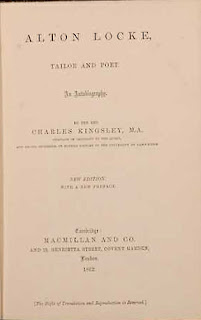
    One of the least known literary associations with Staffordshire, is that of Charles Kingsley’s novel Alton Locke. Tailor and Poet, which was published in 1851. The story of the rise and fall of a self-taught working man who is eventually imprisoned for rioting, is based upon a real person and a real incident. The person was the Chartist leader, Thomas Cooper, who was arrested and sentenced to two years in prison, for the events he had prompted in the Staffordshire Potteries.

    Thomas Cooper was born in Leicester to a working class family and from an early age displayed a precocious intelligence, the development of which was only limited by the fact that most of his lessons were self-taught. Occasionally, he had been known to immerse himself so deeply into his studies that the sheer mental effort he put forth ended on one occasion, at least, in him being physically ill. He worked at various jobs, mostly as a teacher, lay preacher and journalist, but eventually, appalled by the conditions endured by many factory and workshop workers, he became a convinced Chartist, a member of that Victorian working class movement which supported the introduction of a People’s Charter, which called for fair representation for the working population. The Charter’s six points demanded votes for all men at 21, annual general elections, a secret ballot, constituencies regulated by size of population, the abolition of property qualifications for MP’s and the payment of MP’s. Most of these points eventually became laws of the land and form a part of the state we live in today, but none of these things came into being until the latter half of the nineteenth century, long after the Chartist movement itself had collapsed.

    There were two bodies of the Chartist movement, the physical and the moral-force Chartists, who sought to bring about social change by revolutionary or evolutionary means. In his early days, Cooper was a supporter of the former faction. He was a fire and brimstone type of preacher, who like all great orators could move people with his speeches. This power comes through in Cooper’s autobiography, which is widely regarded as one of the finest working class ‘lives’ written during the Victorian age. The book, though written in Cooper’s later years after he had become a convinced moral-force Chartist, tends to carefully skate around his fiery physical-force youth and he presents himself as a far more reasonable man than he actually was in August 1842, when he arrived in the Potteries. Only by bearing in mind, that Cooper at this time advocated revolution of sorts, do the events he inspired in the Potteries make sense. Though he says in his book that he proclaimed, ‘Peace, law and order’, the resulting riots that left one man dead, dozens wounded or injured and many buildings burnt or ransacked, indicated that he said more than he was letting on.

    Cooper arrived in the Potteries, after a tour of several major towns and cities in the Midlands, and here he was to make a number of speeches before moving on to Manchester. The area was in the grip of a wage dispute. In June, 300 Longton miners whose wages had been drastically cut had gone on strike. By July, the strike had expanded to all of the pits in north Staffordshire, and hundreds of miners were on the streets, begging for money, and with the pits being closed, the potteries through lack of coal, could not fire their kilns and were also closed. By early August, the dispute had attracted widespread attention, certainly the Chartists expressed sympathy for the miners’ action, but contrary to later claims that the subsequent riots were Chartist inspired, it was mostly miners and not Chartists who did the rioting. The Potteries were a powder keg, ready to explode and Cooper’s arrival, as he himself admitted was ‘the spark which kindled all into combustion’.

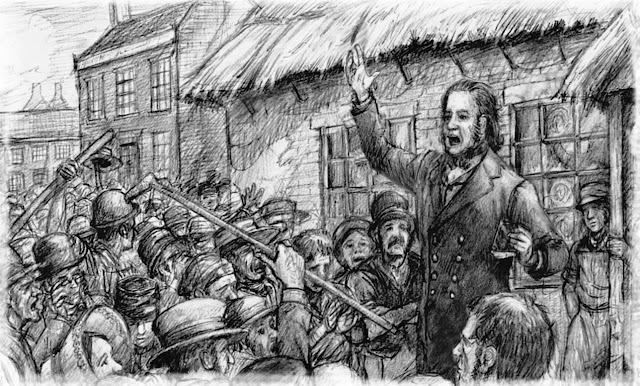
    Thomas Cooper addresses the crowd at Crown Bank, Hanley

    Standing on a chair in front of the Crown Inn, a low thatched building at Crown Bank in Hanley, on Sunday, 14 August, Cooper addressed a crowd of upwards of 10,000 people, delivering a brilliant Chartist speech to his audience. He look for his text the sixth commandment, ‘Thou shalt do no murder’. Throwing his net wide, he drew on examples of kings and tyrants from history, such as Alexander, Caesar and Napoleon, who had violated this commandment against their own people, even as their own government would be prepared to do. The next day, he addressed an equally sizeable crowd and moved a motion, ‘That all labour cease until the People’s Charter becomes the law of the land’.

    What followed, Cooper later regretted. As the crowd dispersed. rioting started around the Potteries towns in all except Tunstall and the borough town of Newcastle. Police stations were attacked, magistrate’s houses ransacked and burned, as were Hanley Parsonage and Longton Rectory. By the 16th, the chaos had lasted a day and a night, but on that day, the most famous, or infamous incident of the uprising occurred, what is known locally as ‘the battle of Burslem’. Following the rioting in Stoke, Shelton, Hanley and Longton, a great crowd moved towards Burslem, there to meet a crowd coming from Leek. Here, though, the authorities played their hand, when a troop of mounted dragoons stopped the crowd from Leek. The magistrate in charge read the Riot Act, then tried to reason with the men, but when it was clear that they were bent on trouble, the soldiers were ordered to fire. One man from Leek was killed and many injured, the crowd was routed and the disturbances ended overnight, but for many weeks afterwards, the Potteries were full of troops and vengeful magistrates arresting rioters and Chartist leaders.

    Cooper, horrified at the events he had unleashed, had tried to escape, but he was arrested and eventually tried and sentenced to two years in Stafford Gaol, on charges of arson and rioting. Here, he spent his time profitably, learning Hebrew and writing his book, The Purgatory of Suicides. On leaving prison, though, his views were found to differ considerably from the new mainstrean in Chartist thought, and he became increasingly a moral-force activist and remained so for the rest of his life.

    It was in the two or three years after leaving prison, that Cooper was interviewed by the Rev. Charles Kingsley, whose Christian Socialist movement had inherited many of the Chartist beliefs. Kingsley had sought out several old Chartists and educated working men on whom he wished to base the life of the major character in the novel he was preparing. Thomas Cooper, was obviously the chief amongst these, certainly his autobiography, written many years after Kingsley had published Alton Locke, shows many striking similarities between Cooper’s life and that of his fictional alter ego. The riot that Alton inspires in the book, for which he too is committed to the prison, takes place in the countryside, amongst agricultural labourers, but behind it there is the faintest echo of the struggle in the Potteries, that one historian has considered the nearest thing to a popular revolution that the Victorian age saw.

    After 1845, Thomas Cooper turned his talents mainly to writing, but he also lectured on subjects such as history, literature and photography. In this capacity, he made a number of return visits to the Potteries, to the place where on that day many years before, he had ‘caught the spirit of the oppressed and discontented’, in seeking to establish the basis of a democratic society.

    Reference: Charles Kingsley, Alton Locke. Tailor and Poet (1851); Thomas Cooper, Life of Thomas Cooper, written by Himself, (1872).

  • The Curious Case of the Dwarf and the Bulldog

    Brummy and Physic battle it out. From James Greenwood’s Low Life Deeps (1876).

    In a detailed and lurid article published on 6 July 1874 in the Daily Telegraph, investigative journalist James Greenwood claimed that several days earlier on 24 June, during a brief stopover in the Potteries, he had hoped to find evidence of illegal organised dog fighting, but that he and a large crowd of onlookers had instead witnessed a brutal fight in a cellar in Shelton between a grizzled, muscular dwarf named Brummy and a ferocious bulldog named Physic, a battle that the man had barely won. The national scandal that resulted from this shocking article seriously embarrassed the area for a time and questions were even asked in Parliament.

    However, all was not quite as it seemed and once the initial furore had died down the tables were quickly turned on Mr Greenwood, as subsequent investigations by the police, the local authority, other newspapers and the RSPCA, not only highlighted the numerous glaring discrepancies in Greenwood’s tale, but more tellingly found no absolutely evidence whatsoever that such a fight had taken place. Rather than sticking rigidly to the story he had spun, Greenwood then started to back-peddle, changing or mitigating parts of the tale to excuse himself and explain why there was no proof to be found, all of which excited a great deal of derision from other papers. The upshot of it all was that within a few weeks it was widely concluded that Greenwood had simply made the story up, or adapted a dubious scrap of Staffordshire folklore that he may have heard during his stay in the area. Following the RSPCA’s investigation and the report they sent in to the government, the Home Secretary of the time came to the same conclusion and on 20 July wrote a reply to the Hanley Watch Committee, which stated that he was satisfied that the story of the fight was false.

    Greenwood had thus been called a liar at the highest level and Hanley’s good name was restored, but mud sticks, and the tale rankled with the people of the Potteries for a good while after. In 1907, Local author Arnold Bennett summed up the lingering ill-will towards the reporter and his tall tale in his short story ‘The Death of Simon Fuge’.

    ‘The only man who stands a chance of getting his teeth knocked down his throat here is the ingenious person who started the celebrated legend of the man-and-dog fight at Hanbridge. It’s a long time ago, a very long time ago; but his grey hairs wont save him from horrible tortures if we catch him. We don’t mind being called immoral, we’re above a bit flattered when London newspapers come out with shocking details of debauchery in the Five Towns, but we pride ourselves on our manners.’

    Reference: James Greenwood, Low Life Deeps; Staffordshire Sentinel, July 1874; numerous national newspapers and magazines July 1874.

  • Last Stand at Isandlwana

    The Battle of Isandhlwana by Charles Edwin Fripp

    Following the British invasion of the independent Zulu Kingdom in Southern Africa in January 1879, a force of over 1,700 men, mostly from the 24th Regiment of Foot, was camped at the foot of a sphinx-shaped rocky hill called Isandlwana. Here on 22 January, they were attacked by a Zulu army some 20,000 to 25,000 strong that they had supposed to be many miles away. As the Zulu warriors swarmed down from hills to the north and spread out in a wide arc to envelope them, the 24th Foot and numerous colonial units moved forward and formed a line to face the enemy and for some time – in the centre at least – they did successfully hold their ground, keeping the Zulus at bay with concentrated volley and cannon fire. In trying to keep in contact with a mounted force to the east, though, the main British line became fatally over-extended and in danger of being outflanked. Seeing this, Colonel Pulleine the officer commanding the camp ordered his forces to fall back to a more defensible position in front of the hill, but it was a fatal move. When the gunfire slackened the Zulus in the centre seized the moment and rushed forward in pursuit while those out on the plain soon outpaced and outflanked the British line to the east, rushing in on the camp and behind the retiring blocks of infantry, cutting off their escape. Chaos ensued as the British line disintegrated and the battle then degenerated into a mass of isolated fights with knots of redcoats surrounded by masses of Zulus. Some 400 men, mostly mounted troops, managed to escape the resulting slaughter before the end, but over 1,300 men perished on the British side, including nearly the entire 1/24th and a company of the 2/24th Foot. The Battle of Isandlwana became the worst defeat ever suffered by the British army at the hands of a native foe and for the time at least it effectively stopped the invasion of Zululand in its tracks.

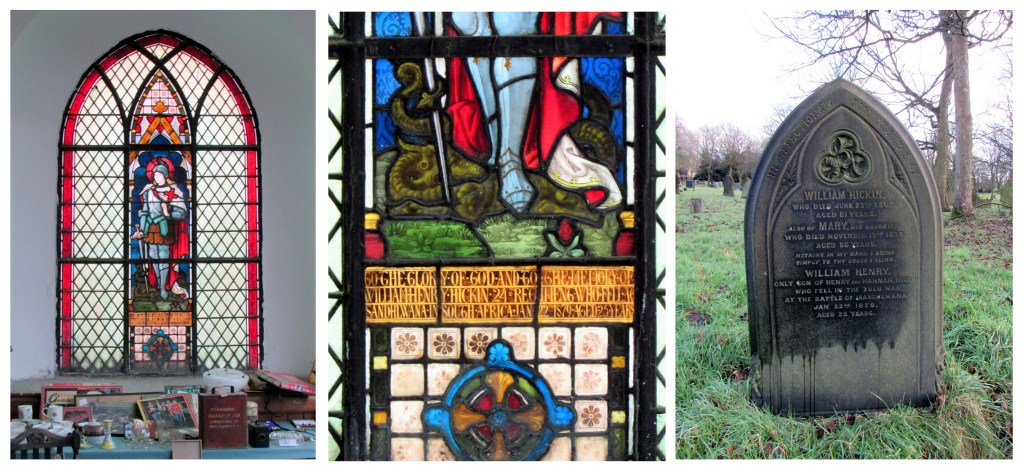
    The stained glass window and grave memorialising Private William Hickin.
    The stained glass window and grave memorials to Private William Henry Hickin.

    Several local men were killed in the action. In the ranks of the 1/24th were 25 year old Private William Henry Hickin from Hanley; the son of one Henry Hickin a local locksmith and bell hanger, William had previously worked as a writing clerk before enlisting in early 1876. Private George Glass 1/24th aged 22 from Shelton, was the son of a local school master and had briefly worked as a potter and joined the army in 1874. Private Enoch Worthington 1/24th from Kidsgrove, was 24 and had been a miner like his father before him; he enlisted in Newcastle in 1875. Private Samuel Plant 1/24th was an older man from Shelton, who had joined the 24th Foot in 1859, married in 1862 and prior to serving in Southern Africa he had served for a year on St Helena.

    In the 2/24th, former potter Sergeant William Shaw from Tunstall, was about 32 years old. After joining the army in 1870 he was promoted corporal in 1873 and sergeant in 1877. He had married locally before joining the army, had four children and had served in India and Britain before being sent to Southern Africa. His wife Emma and their children had come with him on this tour of duty and were lodged in King William’s Town, Cape Colony, far away from Zululand. Private Samuel Poole, 2/24th is something of an enigma as several possible candidates of that name were born in Audley, Kidsgrove or Newcastle, but there is no clear evidence if any of these are our man, all we know is merely that a man of that name enlisted in Hanley on 27 April 1875 aged 21 years. Records state that he served in G Company 2/24th. Private David Pritchard 2/24th, was from Stoke-upon-Trent though no one of that name appears in the civil records so that may have been an alias. He claimed to have worked as a forgeman before joining up in 1865 and he went on to see service in India. Aged about 34 at the time of the Zulu War, records say he served in B Company, but that was the company left at Rorke’s Drift, so he had probably been transferred to G Company.

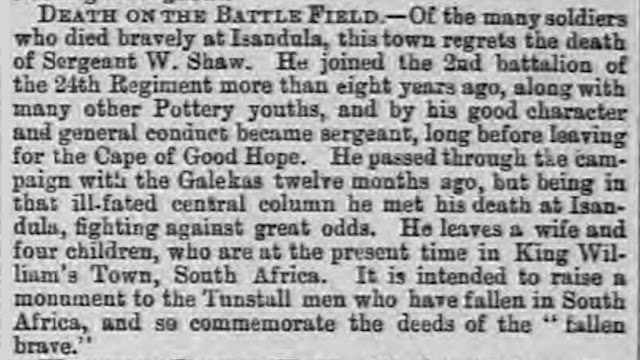
    The most interesting of these local victims of Isandlwana from a historian’s point of view, is Sergeant William Shaw of the 2/24th, as evidence exists giving us a glimpse into his fate that day. According to the notebook of Corporal John Bassage 2/24th, now held at the Royal Regiment of Wales Museum, who was part of the force sent to bury the dead in June 1879 after the war was over, the remains of Sergeant Shaw and three private soldiers of the 2/24th were found together in a heap on the battlefield. The four men caught out in the open appeared to have formed into a small group in a last desperate attempt to try and fend off the Zulus as they poured into the camp. All seemed to have been stabbed to death with assegais.

    Staffordshire Sentinel and Commercial & General Advertiser – Saturday 8 March 1879, p.5

    In a report in the Sentinel noting Shaw’s death in action, it was stated that there were hopes of raising a memorial to him and all the Tunstall men killed in South Africa. This, though, never seems to have come to pass and of all the men mentioned above only one appears to have been commemorated locally. In December 1880 at St John’s Church in Hanley, a stained glass window was dedicated to the memory of 25 year old Private William Henry Hickin, whose father was a churchwarden there. Hickin was further commemorated on his grandfather and aunt’s gravestone in Hanley Cemetery. Private Hickin is in fact the only ‘other ranks’ casualty of the Battle of Isandlwana remembered with a memorial window.

    One other local soldier who who was initially listed as a casualty was Private Frederick Butler from Shelton and son of the proprietor of the Bell and Bear Inn. He was a soldier of the 1/24th but prior to the invasion he had been transferred to the Imperial Mounted Infantry, Though initially listed as a casualty of the battle, Butler was in fact many miles away with his new unit serving in another invasion column that saw action at the battle of Nyezane on the same day as Isandlwana. He survived the war, rejoined his own unit once the fighting was over and later returned to the Potteries.


    Reference: Staffordshire Sentinel, various issues March-May 1879. My thanks to Ken Ray for his detailed list and information on the local men killed at Isandlwana and to Alan Rouse for family and background information on Sergeant Shaw.