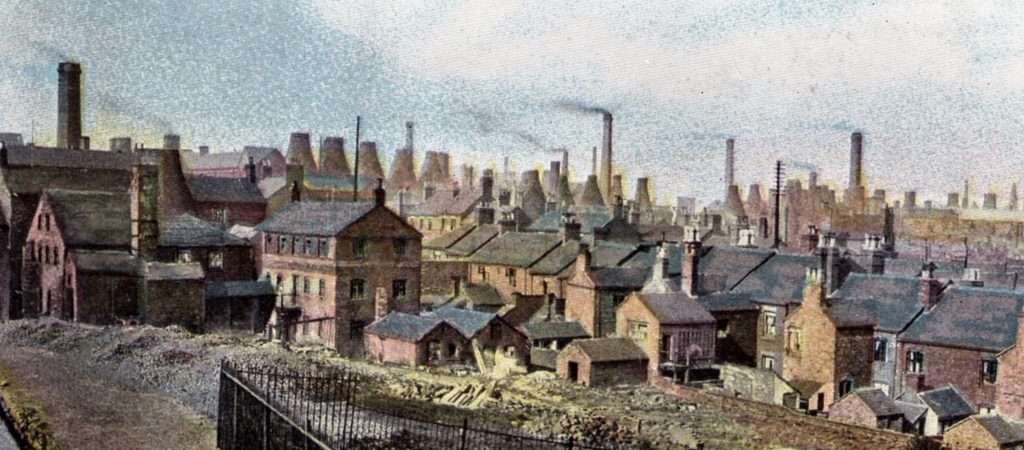

An AI recreation of the scene after a drawing by the author.
In 1842, a prolonged miner’s strike had crippled the Staffordshire Potteries. Hundreds of men were on the streets begging and intimidating passers by, while surly mobs raided police stations to free those who had been arrested. The situation in the Potteries was likened to that of a powder keg ready to explode and all that was needed was a spark to kindle all into combustion. Enter Thomas Cooper lay preacher and Chartist firebrand, whose powerful speeches finally struck that spark and plunged the Potteries into two days of rioting and mob rule. During this period dozens of buildings were looted and destroyed and order was only restored after a clash between rioters and the army, an incident popularly known as the Battle of Burslem.

The confrontation took place on 16th August 1842. After a day and night of rioting and looting, early in the morning of the 16th crowds began to gather once more on streets of the Potteries. Of the five towns which had suffered in the previous day’s rioting, Hanley had been hit the worst. Plumes of heavy fire smoke curled up from either end of the town and the streets were filled with debris. The parsonage was a smouldering ruin and at the top of Pall Mall, Albion House home of local magistrate William Parker had been reduced to a charred and broken shell. On the streets of the town by 7 o’clock a crowd of 400 to 500 people had gathered and were being addressed by two of the local Chartist leaders, young William Ellis and John Richards, the elder statesman of Potteries Chartism. Ellis was urging the crowd not to give up the struggle until the People’s Charter became the law of the land. According to witnesses, though, it was the normally mild-mannered Richards who was more to the point. “Now my lads,” he said, “we have got the parson’s house down, we must have the churches down, for if we lose this day, we lose the day forever.” Ellis then spoke again and urged the crowd to go to Burslem to join the crowd there. They were expecting to meet up with a large crowd who were coming to the Potteries from Leek and extend the rioting even further. By 9 o’clock, with shouts of “Now lads for Burslem” and “Now to business”, the Hanley mob began marching north.
From Hanley to Burslem is a steady half hour walk for a healthy man and as they entered the town at about 9.30am, the crowd were singing a song that Thomas Cooper had taught them, “… the lion of freedom’s let loose from his den, and we’ll rally round him again and again.” On their arrival in the town a part of the mob barged into George Inn which had only ten days earlier been attacked by outraged strikers and suffered substantial damage. To try and avoid further trouble, the owner of the Inn, Mr Barlow tried to buy the rioters off by giving them a shilling each; some of this was in half crowns and a dispute arose at the door as to the division of it. By this time the greater part of the mob had arrived and they immediately rushed in and filled the house. Mr Barlow had taken the precaution to remove the bulk of his cash; there was however £14 in coppers wrapped up in parcels of five shillings, which were all taken. Numerous bottles of wine, whisky and rum was also stolen, and the taps attached to the beer kegs were left running. Prominent amongst those who conducted this raid was George ‘Cogsey Nelly’ Colclough, a local lout who had flitted from one town to another the previous day, joining in with the burning and looting wherever he went. Like a moth to the flame he had followed the trouble back to his native Hanley and now thought to export his brand of local thuggery to the Mother Town. But the invasion of the inn did not go unopposed, for while the mob had previously only faced outnumbered police constables, they now found that they were in a town containing a small but formidable force of regular soldiers. They were surprised by a sergeant of dragoons and one or two other soldiers who were billeted at the inn, who hearing the noise, rushed into the bar and lobby to confront the troublemakers. Being in their undress uniforms they only had their swords to hand, but undaunted, the sergeant immediately drew his sword and began to cutting and swatting at the looters and in a few minutes the house was cleared. On being forced back into the street, the mob vented their anger by throwing stones at the windows, and in a very short time all the newly fitted glass was smashed and the house soon presented the same dilapidated appearance as it did after the attack in the night of the 6th.
At the Leopard Inn, meantime, local magistrate Captain Thomas Powys was with Brevet-Major Power Le Poer Trench the commander of the 50 or so 2nd Dragoon Guards, who had been stationed in Burslem the week before. The two men had met shortly after the news had come in of a large crowd coming from Leek and Powys was doubtless consulting with the military as to what should be done if they tried to join the rioters. It was at this point that Thomas Lees the landlord of the inn came over with news that trouble that had broken out in Chapel Square. Captain Powys immediately asked for the Major’s assistance and Trench quickly ordered his available men to horse. Most of the men were billeted at the inn, their horses being stabled outside and the troopers now came out into the cobbled courtyard and hurriedly got themselves and their animals ready for action. A flurry of stones came flying over the gate striking at least one soldier on the helmet, but unfazed they were soon clattering out of the courtyard and through the streets. Mounted on their big bay horses, the soldiers dressed in scarlet tunics, dark blue trousers with a yellow stripe down the side and tall, crested brass helmets on their heads, they were a sight to see and doubtless provided the townsfolk with a gallant if alarming show as they rode towards the Market Place.

The mood in the town had grown increasingly ugly with the arrival of the soldiers and Captain Powys knew that the crowd of people from Leek were even now on the outskirts of the town. If the two mobs joined up and went unopposed Burslem might well be utterly wrecked, so Powys decided that it was now time to restore law and order before things got completely out of hand.
Riding up to the top of St John’s Square with Trench’s dragoons posted on either side and 200 special constables behind them, Captain Powys faced the mob and began to read out the Riot Act in a loud voice. He then gave several other warnings and then read the Riot Act again, urging the crowd to disperse and go home peacefully. The crowd, however, were unmoved and milled about between the market or the Shambles, as it was called, and the Big House, Thomas Wedgwood’s former home that still stands at the junction of Moorland Road and Waterloo Road, though at that time there was a walled garden before it. Powys then called out, “Clear the streets!” Then shouted, “Charge!” and led the dragoons towards the crowd. He had hoped to scare them off and the horse soldiers beat with the flats of their swords any who were slow in getting out of their way. The ruse did not work, though, for as one portion of the crowd fell back others spilled out of the side streets and alleys, back into the main crowd. Seeing the opportunity to cause more trouble, George Colclough set about the nearest soldiers with his stick, beating at their sword arms as they attempted to swat him. After a time several of the cavalrymen were so bruised by Colclough’s attacks that they left him alone, which is said to have raised a cheer from some in the crowd.
By now it was getting towards noon and despite the best efforts of Captain Powys and the soldiers, the streets were still full of people. Some had climbed onto the roof of the Town Hall and the covered market, from where they threw stones at the troops and special constables. Powys, increasingly alarmed that the situation might escalate to the point where he might have to use the soldiers more forcefully, was repeatedly seen riding up to the crowds and calling out that the Riot Act had been read and urging people to return to their homes. He was joined in his efforts by others including an Irish naval officer, 41 year old Captain William Bunbury McClintock, who had come to town to meet his friend Major Trench, only to find himself in the eye of a storm. McClintock now rode back and forth from where the bulk of the troops were gathered by the Leopard Inn to check on what the crowds were doing. He saw ‘a vast concourse of people in the Hanley Road, and a dense mob on the Smallthorne Road – the latter were accompanied by a band of music. I returned again to the troop, and told Captain Powys there would soon be bloody work.’
Word quickly spread, to the delight of the rioters in the town that the Leek mob of between 4,000 to 5,000 people was advancing down Smallthorne Road and they began moving up Chapel Square to meet them. As McClintock had noted, at the head of the crowd marched a band playing ‘See the Conquering Hero Comes’ preceded by a large number of men and boys shouting and waving makeshift weapons overhead, all of which could be clearly seen from Market Square. Captain Powys described it as ‘the most tumultuous and violent mob which I have ever seen assembled, having seen many riots in the country and in London.’ He guessed that a clash was now inevitable and barely three minutes after McClintock had ridden back to the troop, Powys ordered Major Trench to move the troop forward to meet the crowd and he formed his dragoons up in sections diagonally across the road from the Big House to the Post office, so cutting the newcomers off from the bulk of the Potteries’ mob in the Market Square. The special constables, meantime, closed up nervously behind the cavalry, among them local manufacturer Joseph Edge and his friend Samuel Cork. They looked so alarmed at this point that a kindly lady watching the action from a nearby house sent her servant over with a glass of wine for them both, hoping that the drinks would revive their spirits.

They needed it, for by now the fresh crowd was closing on the thin line of soldiers. Captain Powys on horseback was on the left of Major Trench, who with the other officers were in advance of the dragoons. A large crowd was assembled in the area above the Wesleyan chapel, to witness the arrival of the Leek mob. When about eighty or a hundred yards from the spot where the dragoons were stationed, the Leek party began to cheer and those in front waved their bludgeons. As the head of the procession entered the open space, the front ranks turned to the left, with the apparent intention of making their way by the Wesleyan chapel. About twenty or thirty deep of them had got so far when as Captain Powys later recalled, ‘Immediately large volleys of stones, and brick ends were thrown by this mob at myself, and also at the military, I being then in the advance. Similar stones were thrown at the same time by the mob coming in the direction from Hanley at the military, myself and also at the special constables.’
By now the situation was intolerable. Stones were being hurled from both sides of the Market Square, striking horses and men alike and rattling over the cobbles. Captain Powys had thus far been the model of restraint, giving the crowd ample opportunities for a peaceful withdrawal, but it was now obvious that they were bent on trouble. Fearing for the safety of the soldiers, special constables and himself, by his own account he felt he had no choice but to use the soldiers to full effect and turning to Major Trench, Powys asked him to get his men ready to open fire. Trench agreed that the situation was getting out of control and gave the appropriate orders. As the soldiers sheathed their swords and primed their carbines, the large crowd moved forward as far as the Big House. The dragoons advanced slightly to counter them and only at the last moment when the front of the crowd was only six or seven yards away from the soldiers did it seem that the rioters saw the line of guns being raised and levelled at them. ‘This movement on the part of the soldiers caused a strange movement amongst those in the front of the mob, and a look of terror came over their faces. Another moment and the order “fire” was given’ and the rattle of musketry echoed out loud over the town.’
The soldiers fired directly into the crowd, not over their heads as some reported, and many bullets found a mark. Standing in front of the large brick wall that then stood in front of the Big House, was a 19 year old shoemaker from Leek named Josiah Heapy. Despite glowing reports from his employer, who later extolled his gentle character and claimed he had been forced to join the crowd, Heapy appears to have been actively engaged in throwing stones at the soldiers, at least, that is, until a musket ball struck him in the temple and blew his brains out against the gate post.
As Heapy’s lifeless form slumped to the pavement, in another section of the crowd, a bricklayer named William Garrett got a ball through his back that exited through his neck and he too fell to the ground gravely wounded but he was eventually whisked off to the infirmary. According to reports others were hit, but in the confusion no one stopped to count the casualties, though it has been supposed that some of the wounded were carried off by their friends and died later. A report in the Bolton Chronicle later claimed that the true tally had been three people killed and six wounded, while reports from Leek spoke of numerous wounded being brought back into the town after the riots.

Some in the crowd seem to have been expecting this development, for shortly after the soldiers had fired their volley someone released a number of carrier pigeons which set off in the direction of Manchester. One of these birds was later captured and found to be carrying a note reporting that the mob had been fired on by dragoons and calling for 50,000 workers to join them in the Potteries. Some witnesses also recalled seeing plumes of gun smoke coming from the crowd just before the soldiers fired, though if this was the case, none of the soldiers or special constables were injured.
Most of the mob, though, was just shocked by the gunfire. From his position behind the dragoons, special constable Joseph Edge had watched all this in fascinated horror, as his son later noted: ‘such a scene presented itself which we may pray may never be repeated in this good old town. So panic stricken was the mob that the men simply lay down in heaps in their efforts to get away from the cavalry… ‘
Having stunned the rioters, the soldiers kept moving forwards and slinging their carbines, they drew their swords and followed by the special constables they charged their horses into the head of the crowd which scattered in panic before them. Immediately, thousands of people began rushing in all directions, many falling over each other in tangled heaps, others leaping through open windows, or into any available hiding place. Apocryphal tales abound. One Joseph Pickford of Leek is said to have taken shelter in a pig sty, much to the annoyance of its porcine occupants, whose squeals threatened to reveal his hiding place. Hundreds more escaped into the adjoining fields. Another story recalled how Thomas Goldstraw, a powerfully built man from Leek and a noted drummer, dropped his drum when the soldiers charged and quickly fled from Burslem back the way he had come, unaware at first that his son who had been nearby at the time had been shot through the thigh and was lying wounded in a field just outside the town. According to the storyteller, Goldstraw junior was later placed on a cart and transported to the surgery of an obliging physician, Dr Wright at Norton-in-the-Moors, who soon had him back on his feet again.
As the military swept past into the Moorland Road, a portion of the mob from the direction of Hanley, rallied and began throwing stones at the body of special constables, who advanced to the conflict in a dense mass, playing away with their truncheons, and completely routed the mob in that quarter. After the soldiers had charged a short distance up the Smallthorne Road, they were halted and recalled: their job was done as the mob, which just before had consisted of five or six thousand people was completely dispersed and the danger to Burslem had passed.
Reference: Staffordshire Mercury, 20 August 1842; Staffordshire Advertiser, 20 August 1842, p.3; John Wilcox Edge ‘Burslem fifty years ago’, quoted in Carmel Dennison’s Burslem:People and Buildings, Buildings and People, (Stoke-on-Trent, 1996), pp. 36-37; Leek: Fifty Years Ago, (Leek, 1887), p.107 and 121.

