Tag: police

  • Thomas Cooper Sparks the Pottery Riots

    One of the least known literary associations with Staffordshire, is that of Charles Kingsley’s novel Alton Locke. Tailor and Poet, which was published in 1851. The story of the rise and fall of a self-taught working man who is eventually imprisoned for rioting, is based upon a real person and a real incident. The person was the Chartist leader, Thomas Cooper, who was arrested and sentenced to two years in prison, for the events he had prompted in the Staffordshire Potteries.
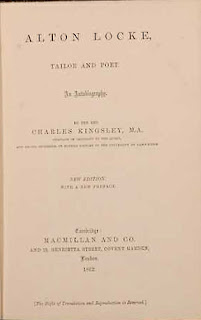
    Thomas Cooper was born in Leicester to a working class family and from an early age displayed a precocious intelligence, the development of which was only limited by the fact that most of his lessons were self-taught. Occasionally, he had been known to immerse himself so deeply into his studies that the sheer mental effort he put forth ended on one occasion, at least, in him being physically ill. He worked at various jobs, mostly as a teacher, lay preacher and journalist, but eventually, appalled by the conditions endured by many factory and workshop workers, he became a convinced Chartist, a member of that Victorian working class movement which supported the introduction of a People’s Charter, which called for fair representation for the working population. The Charter’s six points demanded votes for all men at 21, annual general elections, a secret ballot, constituencies regulated by size of population, the abolition of property qualifications for MP’s and the payment of MP’s. Most of these points eventually became laws of the land and form a part of the state we live in today, but none of these things came into being until the latter half of the nineteenth century, long after the Chartist movement itself had collapsed.

    There were two bodies of the Chartist movement, the physical and the moral-force Chartists, who sought to bring about social change by revolutionary or evolutionary means. In his early days, Cooper was a supporter of the former faction. He was a fire and brimstone type of preacher, who like all great orators could move people with his speeches. This power comes through in Cooper’s autobiography, which is widely regarded as one of the finest working class ‘lives’ written during the Victorian age. The book, though written in Cooper’s later years after he had become a convinced moral-force Chartist, tends to carefully skate around his fiery physical-force youth and he presents himself as a far more reasonable man than he actually was in August 1842, when he arrived in the Potteries. Only by bearing in mind, that Cooper at this time advocated revolution of sorts, do the events he inspired in the Potteries make sense. Though he says in his book that he proclaimed, ‘Peace, law and order’, the resulting riots that left one man dead, dozens wounded or injured and many buildings burnt or ransacked, indicated that he said more than he was letting on.

    Cooper arrived in the Potteries, after a tour of several major towns and cities in the Midlands, and here he was to make a number of speeches before moving on to Manchester. The area was in the grip of a wage dispute. In June, 300 Longton miners whose wages had been drastically cut had gone on strike. By July, the strike had expanded to all of the pits in north Staffordshire, and hundreds of miners were on the streets, begging for money, and with the pits being closed, the potteries through lack of coal, could not fire their kilns and were also closed. By early August, the dispute had attracted widespread attention, certainly the Chartists expressed sympathy for the miners’ action, but contrary to later claims that the subsequent riots were Chartist inspired, it was mostly miners and not Chartists who did the rioting. The Potteries were a powder keg, ready to explode and Cooper’s arrival, as he himself admitted was ‘the spark which kindled all into combustion’.
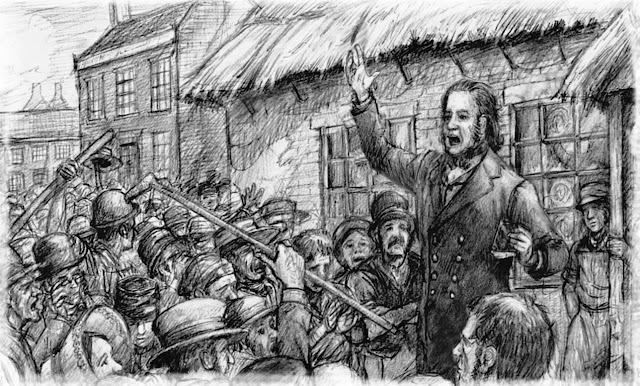
    Thomas Cooper addresses the crowd at Crown Bank, Hanley

    Standing on a chair in front of the Crown Inn, a low thatched building at Crown Bank in Hanley, on Sunday, 14 August, Cooper addressed a crowd of upwards of 10,000 people, delivering a brilliant Chartist speech to his audience. He look for his text the sixth commandment, ‘Thou shalt do no murder’. Throwing his net wide, he drew on examples of kings and tyrants from history, such as Alexander, Caesar and Napoleon, who had violated this commandment against their own people, even as their own government would be prepared to do. The next day, he addressed an equally sizeable crowd and moved a motion, ‘That all labour cease until the People’s Charter becomes the law of the land’.

    What followed, Cooper later regretted. As the crowd dispersed. rioting started around the Potteries towns in all except Tunstall and the borough town of Newcastle. Police stations were attacked, magistrate’s houses ransacked and burned, as were Hanley Parsonage and Longton Rectory. By the 16th, the chaos had lasted a day and a night, but on that day, the most famous, or infamous incident of the uprising occurred, what is known locally as ‘the battle of Burslem’. Following the rioting in Stoke, Shelton, Hanley and Longton, a great crowd moved towards Burslem, there to meet a crowd coming from Leek. Here, though, the authorities played their hand, when a troop of mounted dragoons stopped the crowd from Leek. The magistrate in charge read the Riot Act, then tried to reason with the men, but when it was clear that they were bent on trouble, the soldiers were ordered to fire. One man from Leek was killed and many injured, the crowd was routed and the disturbances ended overnight, but for many weeks afterwards, the Potteries were full of troops and vengeful magistrates arresting rioters and Chartist leaders.

    Cooper, horrified at the events he had unleashed, had tried to escape, but he was arrested and eventually tried and sentenced to two years in Stafford Gaol, on charges of arson and rioting. Here, he spent his time profitably, learning Hebrew and writing his book, The Purgatory of Suicides. On leaving prison, though, his views were found to differ considerably from the new mainstrean in Chartist thought, and he became increasingly a moral-force activist and remained so for the rest of his life.

    It was in the two or three years after leaving prison, that Cooper was interviewed by the Rev. Charles Kingsley, whose Christian Socialist movement had inherited many of the Chartist beliefs. Kingsley had sought out several old Chartists and educated working men on whom he wished to base the life of the major character in the novel he was preparing. Thomas Cooper, was obviously the chief amongst these, certainly his autobiography, written many years after Kingsley had published Alton Locke, shows many striking similarities between Cooper’s life and that of his fictional alter ego. The riot that Alton inspires in the book, for which he too is committed to the prison, takes place in the countryside, amongst agricultural labourers, but behind it there is the faintest echo of the struggle in the Potteries, that one historian has considered the nearest thing to a popular revolution that the Victorian age saw.

    After 1845, Thomas Cooper turned his talents mainly to writing, but he also lectured on subjects such as history, literature and photography. In this capacity, he made a number of return visits to the Potteries, to the place where on that day many years before, he had ‘caught the spirit of the oppressed and discontented’, in seeking to establish the basis of a democratic society.

    Reference: Charles Kingsley, Alton Locke. Tailor and Poet (1851); Thomas Cooper, Life of Thomas Cooper, written by Himself, (1872).
  • Death of a Lady Artist

    Image reproduced with kind permission of The British
    Newspaper Archive (www.britishnewspaperarchive.co.uk)

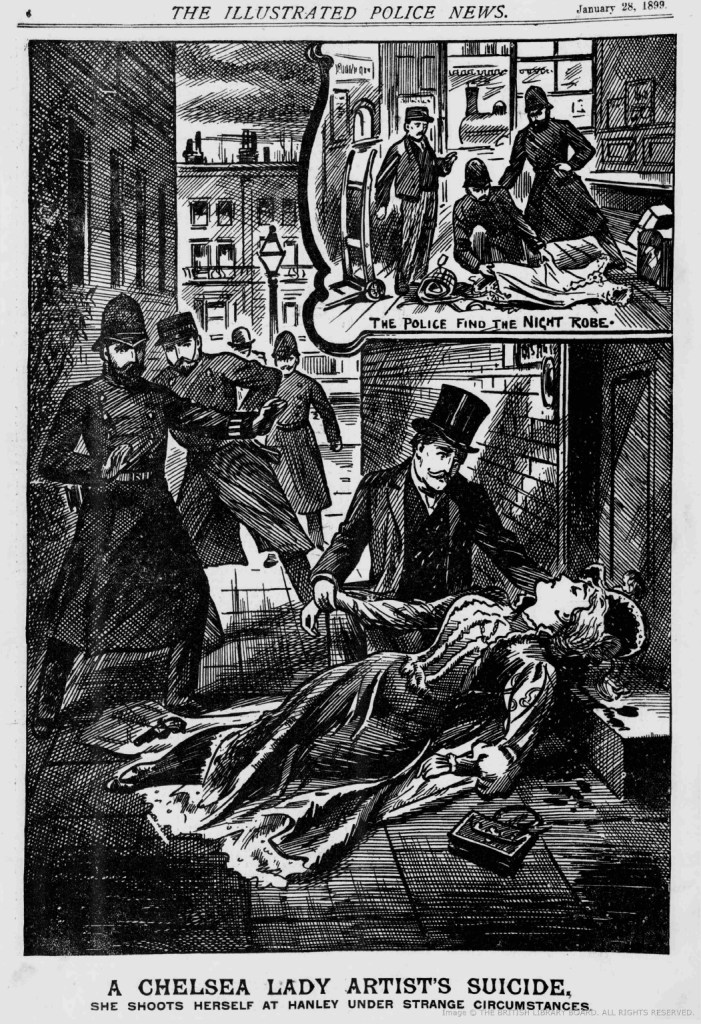
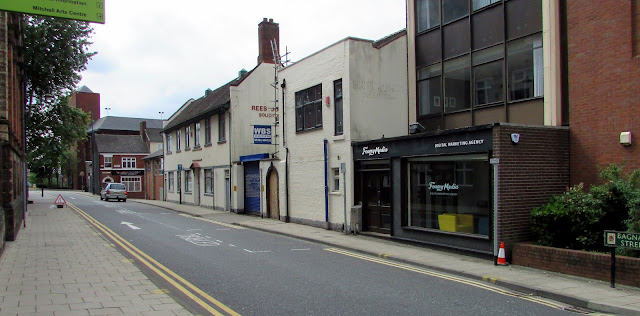
    Late in the evening of 18 January 1899, Mr Richard Smith of Stoke was walking along Bagnall Street, Hanley alongside the Victoria Hall, when he was startled by the sound of a gunshot nearby. There was no one else in sight, but he noticed that across the road, a door beside a small medical dispensary was standing part-way open. Peeking carefully through the opening into a dark passageway beyond he spotted a body lying on the floor a pistol in its hand. Alarmed, he dashed to the police office around the corner in the Town Hall and returned moments later accompanied by an inspector and several policemen. When they reached the passage they found 51 year old Dr John Craig who ran the dispensary examining the body of a woman who had clearly shot herself in the head. They could make out little more in the dark, but when the doctor announced that the woman was still breathing the police brought a stretcher and together they carried her across to the police parade room. Hardly had they got into the well-lit yard, though than Dr Craig let out a cry having recognised the woman before him. The man was visibly shocked and while a senior officer took him aside for questioning the police searched the injured woman for clues to her identity.Going through her pockets they found numerous items: some money, a few keys, a packet of arnica, a left luggage receipt from Stoke Station and several newspaper clippings, one of which carried a few lines from Tennyson’s poem, Sea Dreams.

    ……. he that wrongs his friend

    Wrongs himself more, and ever bears about

    A silent court of justice in his breast,’

    There were also receipts for recorded letters and a cryptic inscription on a visiting card that indicated a strong connection with Dr Craig. These along with the doctor’s own faltering statement soon identified the woman as Catherine Devine, a 43 year old artist from Chelsea. The doctor explained how he knew her and what he believed had just happened here and why. The lady herself, though, did not live to give an account of her actions, dying from her wound at 10 p.m., without regaining consciousness.

    Present-day Bagnall Street, Hanley.

    The full story of the connection between Catherine Devine and Dr John Craig came to light two days later in front of a packed court at the coroner’s inquest into her death. Here, Dr Craig revealed that he and Catherine had known one another for about 25 years, having first met in her home city of Edinburgh. It was there that John Craig had trained as a doctor, being licensed in 1869 and shortly afterwards he had married Ellen Macintyre a native of the Potteries, before moving to the area and setting up his practice in Hanley. His wife had given him a son and daughter, but in December 1874 she died at the age of 25, leaving him a widower with two young children on his hands.

    Among his late wife’s friends were Eliza and Catherine Devine of Edinburgh, daughters of a well-known and wealthy family of Scottish artists. Eliza had agreed to paint a posthumous portrait of Mrs Craig and whilst visiting their studio in 1876 to see how work progressed, Dr Craig had met and become so smitten with the younger sister Catherine, that he had been contemplating asking her to marry him. They corresponded for a time, but his marriage hopes had faded a short time later, when Catherine and several members of her family emigrated to New Zealand in 1878. Robbed of his potential bride the doctor had little choice but to get on with his life as a single parent and as the years passed he became very content with this state of affairs.

    Catherine remained in New Zealand and later Australia for eleven years, carving out a moderately successful career as an artist, but in 1889 she returned to Britain. Settling in a studio flat in Glebe Street, Chelsea, her skills soon saw her supplying artwork for several London fashion magazines and eventually holding an exhibition of her works. To this she invited several old friends including Dr Craig. This restarted their acquaintance and they corresponded intermittently for a few years until Catherine was invited to spend Christmas with the Craigs at their house at Mossley near Congleton. During this visit, Dr Craig innocently noted to Catherine in conversation that prior to her departure to New Zealand he had contemplated asking her to marry him, and was surprised when she immediately asked him why he could not ask her now? The doctor replied that time had altered his circumstances, that he was content and he now had no thought of marrying anyone. Catherine seemed to accept that at the time, but the remark had struck a chord with this brilliant but lonely woman and she soon started to obsess over the matter.

    Apparently oblivious to what he had started, Dr Craig extended another invitation for Catherine to stay once again a few months after this, but she soon upset the situation by again urging Dr Craig to marry her. He again refused and the next morning, whilst he was out, Catherine left the house under a cloud. Returning to find her gone, Dr Craig was left feeling very angry at her behaviour and that might have been the end of the matter, but a few months later he received a conciliatory letter from Catherine and he agreed to meet with her at her home in London when he visited the capital for Queen Victoria’s Jubilee in 1897. After watching the festivities he did indeed call on Catherine, prepared to let bygones be bygones, but when she again raised the subject of marriage he left in disgust and vowed never to visit her again.

    Catherine then began to bombard Dr Craig with a series of scathing letters on his conduct that were followed more often than not by apologetic letters or telegrams asking him to reply. The doctor did reply to some to try and calm her down, especially when she began to threaten to kill herself. However, staggered by the barrage of letters he began to receive and the increasingly erratic mood swings of his would-be paramour, Dr Craig started to burn many of the letters unopened.

    This state of affairs had carried on for the best part of a year, during which time Dr Craig had attempted to maintain his distance from Catherine. The death of her mother, though, in October 1898, seems to have made him sympathetically disposed towards her once more and shortly afterwards he met her again during a visit to London. He found her in a miserable state and recalled that she was in tears most of the time. Her one consolation was that she now wrung a promise from the doctor that if he would not marry her then he would marry no one else, an assurance he was happy to give. She also asked if she might be invited for Christmas once more if she avoided the question of marriage. Dr Craig told her that he and his daughter were in the process of moving into a house in Hanley adjoining his practice and would anyhow be in Northumberland visiting his mother over Christmas. He promised her, though, that once they had moved in after New Year, that she would be invited for a visit. Satisfied with this, Catherine parted amicably with Dr Craig and eagerly waited for the invitation to arrive.

    Sure enough a few weeks later a letter did come, but the news it contained flung Catherine back into a rage. Dr Craig wrote to her saying that due to the work needed on the new house and because his daughter would be going abroad for a while, he did not feel that he could accommodate Catherine before his daughter’s return in March; in effect, for the time being at least, she couldn’t come. Stung by what seemed like another heartless rejection, Catherine wrote a furious reply saying that he had deceived her, adding ominously that she could not go on like this. It was a threat she had voiced before, but this time after all of the mental agonies she had suffered over the past year, it seems that Catherine had finally snapped. In the notes discovered after her death it appears that she wrote more letters to Dr Craig, but, as before, finding himself pestered beyond belief, the doctor had once again begun to burn the letters unopened. He was thus completely unaware of what she now set out to do.

    Nor would he be the only one, as to most of her London friends the story of Catherine’s violent passion for Dr Craig would come as a great surprise, as she had displayed no outward signs of any great interest in men except as friends. All noted that she had been ill over the past year, stricken by a listlessness that her own physician, Dr Schorstein, put down to anaemia, but otherwise she seemed to be the same kindly, mild-mannered woman she had always been. As a result, none of them were aware – or could even have guessed – that Catherine spent early January 1899 preparing for her death, finishing a portrait of her doctor and wrapping up her affairs.

    On the morning of 18 January, Catherine paid a visit to her housekeeper, Mrs Stoner, who had injured her wrist several days before and she now made sure that the elderly lady had everything she needed. Catherine told her that she would be going to Staffordshire for a few days, joking that it would give Mrs Stoner a rest from her. Back in her flat, Catherine left a package with a letter in her writing desk laying the blame for what she was about to do squarely on Dr Craig. Then she dressed well, putting on a fashionable lady’s walking-out costume, collected a nightdress she had wrapped up in brown paper (the police speculated that she brought the nightdress with her to be used as her shroud), a travelling rug, an umbrella and her purse containing money and a few notes to give the police enough clues to discover her story. She also pocketed the small, silver five-shot revolver that she kept for personal protection. Catherine then sent for a cab to Euston Station to catch the 4 p.m. train to Stoke. As she left, Catherine waved goodbye to her housekeeper and that was the last time that anyone who knew her saw her alive and conscious; it thus became the job of the police to reconstruct her last hours for the benefit of the inquest.

    After a three hour journey north, the train arrived at Stoke Station at 7.14 p.m., and it appears that, after depositing most of her belongings at the left luggage office, Catherine had walked from Stoke into Hanley. Never having visited Dr Craig’s new house in Bagnall Street, she seems to have taken the better part of an hour locating it. Once she had, though, Catherine went into the gated entry where she removed her right glove to give her a better grip and taking out the pistol she placed the barrel against her right temple and pulled the trigger, inflicting the fatal wound.

    Because of Catherine’s accusations against him, Dr John Craig found himself being closely questioned at the coroner’s inquest in an effort to determine if he was in any way morally responsible for what had taken place. Indeed, the doctor feared so much for his reputation that he had employed a solicitor to sit in on the inquest to represent his interests in the proceedings. However, the coroner was satisfied with the explanation that Dr Craig had given to the inquest; nor did the police see any reason to pursue the matter any further. The jury thought likewise and quickly returned the verdict that Catherine Devine had committed suicide whilst of unsound mind.

    The final act in this tragic tale of missed opportunities and fatal obsession took place the day after the inquest, on Saturday 20 January, when the remains of Catherine Devine were interred at Hanley Municipal Cemetery. To avoid undue attention, the funeral took place a day earlier than advertised and the funeral cortège took a circuitous route to the cemetery for the same reason. Two of Catherine’s London friends, Miss Maud McCarthy and Dr Schorstein, who had appeared at the inquest, were the only mourners and not more than a dozen people stood around the grave in the pouring rain as the last rites were performed. As this was a suicide’s burial, there would be no headstone to mark her lonely plot, while the brass plate on the polished oak coffin bore only the simplest inscription.

    Catherine Devine
    Died Jan. 18 1899,
    Aged 43 years.

    Reference: Staffordshire Sentinel 19 – 23 January 1899. Numerous national and international papers January – March 1899.