Tag: personal accounts

  • A War Horse and the Man Who Refused to Die

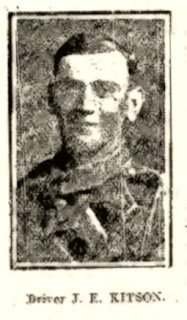
    John Edward Kitson was born at Coseley, near Dudley, Staffordshire in 1897, the eldest of two children born to Edward and Florence Kitson. His father was a police constable at first in the Dudley and Handsworth regions, but it seems that promotion to sergeant saw him move north to the Potteries, perhaps before John was 10 years old. Here the family prospered and his father would eventually rise to the rank of Chief Inspector at Burslem Police Station. In the 1911 census, the family was living in Shelton New Road, Newcastle and barring service in World War One, John Kitson would remain in the area for the rest of his life.


    The Great War started late in 1914 and by early 1915 John Edward Kitson had joined the army. As 31331 Gunner J. E. Kitson, Royal Field Artillery, he arrived in France in March 1915 and from April 1916, he served as a driver for X/9 Medium Trench Mortar Battery, part of  the divisional artillery attached to the 9th Scottish Division. Though never promoted, he proved a brave soldier, being wounded in action at least four times, seeing service on the Somme and at the Battle of Passchendaele. Gunner Kitson finished his war by winning the Military Medal in 1918 for gallantry in the field.  Hospitalised in Britain after his final wound, he did not return to the front to see out the war, being discharged from the army on 8 July 1918.


    After the war he married a local woman, Doris Hudson, they settled in Sneyd Green where they brought up five children. Kitson worked as a civil servant for the Ministry of Labour, but this seems to have been an anti climax after his wartime adventures which prompted him to leave an interesting anecdote of his service during the war and a record of how his injuries had affected his life afterwards. The stories were colourful enough to warrant syndication on papers as far afield as Australia and New Zealand.

    ‘A WAR HORSE’ ‘ALMOST  HUMAN.’

    ‘Mr. J. E. Kitson. of Hanley, Staffordshire, in England, sent to the “Daily Mail” the following remarkable stories of his war horse: – During 1916 and 1917 I had a charger named Tommy. He was nothing short of human, and many an entertainment was given by him to the troops. Once, when we were being shelled he got loose from his peg, and coming to me, gripped my shoulder In his mouth and “led” me away. A minute later a shell fell at the very spot where I had been standing. His favourite trick was to wait until I had given him a thorough grooming, then sit down like a dog. open his mouth, and “laugh” and roll. This usually happened when the Inspecting officer was just coming round the lines. Luckily, the officer knew Tommy. Another time, when I was riding him at a gallop my tin hat fell off. Tommy at once stopped, turn­ed. and picked it up and “handed” It to me. Just as I had put the hat on a piece of shrapnel struck it a glancing blow. He brought me in when I was badly gassed, I was unconscious on his back. A few weeks later he also entered hospital, and was sent into retirement.’

    The Mercury (Hobart, Tasmania) 2 July 1931, p.12

    ‘MAN WHO REFUSES TO DIE’

    ‘Mr J. E. Kitson, of Hanley Road, Sneyd Green, Hanley, Stoke-on-Trent, is known to his family and friends as the man who refuses to die. Doctors have repeatedly told him he has only a few years to live – but he fools them all. It all started during the war, when a piece of shell pierced his neck and killed a comrade behind him. Mr Kitson recovered, but doctors gave him just five years of life.

    The five years went by; then two years later he collapsed at work. This time he was given just seven months more. But after five months he got fed up with being a sick man and returned to work.

    Two years ago he collapsed again, was rushed to hospital and put on the danger list. Two hours later he was normal again and walked out of the hospital the next day.

    Doctors are perplexed about Mr Kitson, but he doesn’t mind. He says he will live to be 100.’

    Cairns Post (Queensland, Aus.) 15 March 1939, p.9

    John Edward Kitson certainly defied his doctors by many years, but did not carry on going as long as he predicted and he died on 13 July 1953 in Stoke-on-Trent, Staffordshire, when he was 56 years old. 
  • Visiting Burslem’s Houses of Ill Fame

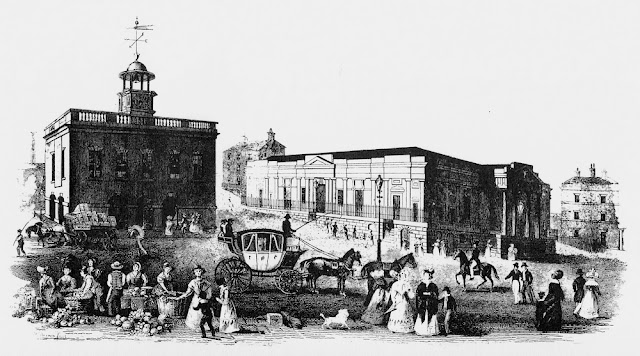
    The oldest profession in the world had its place in soft underbelly of the Regency Potteries. Prostitutes plied a regular trade usually around the local inns where there were rich pickings when the potters and miners rolled in with their wages. A brief memoir of the period reveals that then as now many of the local working girls were ordinary women driven to extremes by circumstances, the probable cause being abject poverty. A Short Memoir of Ann Sheldon, published in 1821, tells the story of the short life of a dedicated Burslem Sunday School teacher. Constructed around entries in Ann’s diary, it reveals her to have been a noble spirited young woman, who saw it as her Christian duty to visit the sick and try to save the fallen.

    Burslem town centre in the early 19th century.

    In April 1813 following a class, one of her class members asked Ann if she would visit a woman who was very ill. Accompanied by a fellow teacher ‘Miss B’, she went to see the woman whom she soon discovered to be a local prostitute. They found her to be, ‘a little better and very penitent.’ Ann continued : ‘she had been a very wicked woman for years, and is now little more than 30 years of age. Her parents died when she and her sister were young. As they advanced in years they got into bad company and lost their character. Masters would not employ them and they became common prostitutes.’ The woman, exhausted and frightened by her illness, told the two teachers that if she lived she was determined to leave her ‘wicked course of life.’

    After praying together they left her. The two young teachers had obviously been shocked by the interview and though the nature of the woman’s illness is never stated, the impression we are left with is that it was contracted as a result of her calling. Both came away from the house burning with a desire to save others from such a dangerous and degrading career.

    The next day, Ann and Miss B set out once more and found a woman to direct them to the ‘houses of ill fame’. They visited two buildings, but met with a mixed reception, made all the more galling no doubt, by the fact that at least two of the girls they encountered were old Sunday school scholars.

    In the first house ‘we found a young woman about seventeen years of age, who lived by herself, and was three years ago a Sunday scholar.’ The girl was unmoved by the teachers’ entreaties, Ann went back many times to invite her back to the school, but to no avail.

    There were two women in the other house: ‘we found a woman about twenty-seven years of age; who met in class about two years ago: we both spoke as close as possible for an hour and a half; they shed many tears and confessed they had a hell upon earth. There was another woman present, a companion in sin, who appeared to take no notice: – I said to her come down on your knees, and cry to the Lord, to have mercy upon your soul, before it is too late: we all bowed the knee before God, and found much liberty in prayer.’

    It is unknown whether Ann and Miss B efforts were successful. The biography remains silent on the matter. Ann herself died at a young age in 1819.

    Reference: John Tregortha (publisher) A Short Memoir of Ann Sheldon, Burslem 1821

  • Last Stand at Isandlwana

    The Battle of Isandhlwana by Charles Edwin Fripp

    Following the British invasion of the independent Zulu Kingdom in Southern Africa in January 1879, a force of over 1,700 men, mostly from the 24th Regiment of Foot, was camped at the foot of a sphinx-shaped rocky hill called Isandlwana. Here on 22 January, they were attacked by a Zulu army some 20,000 to 25,000 strong that they had supposed to be many miles away. As the Zulu warriors swarmed down from hills to the north and spread out in a wide arc to envelope them, the 24th Foot and numerous colonial units moved forward and formed a line to face the enemy and for some time – in the centre at least – they did successfully hold their ground, keeping the Zulus at bay with concentrated volley and cannon fire. In trying to keep in contact with a mounted force to the east, though, the main British line became fatally over-extended and in danger of being outflanked. Seeing this, Colonel Pulleine the officer commanding the camp ordered his forces to fall back to a more defensible position in front of the hill, but it was a fatal move. When the gunfire slackened the Zulus in the centre seized the moment and rushed forward in pursuit while those out on the plain soon outpaced and outflanked the British line to the east, rushing in on the camp and behind the retiring blocks of infantry, cutting off their escape. Chaos ensued as the British line disintegrated and the battle then degenerated into a mass of isolated fights with knots of redcoats surrounded by masses of Zulus. Some 400 men, mostly mounted troops, managed to escape the resulting slaughter before the end, but over 1,300 men perished on the British side, including nearly the entire 1/24th and a company of the 2/24th Foot. The Battle of Isandlwana became the worst defeat ever suffered by the British army at the hands of a native foe and for the time at least it effectively stopped the invasion of Zululand in its tracks.

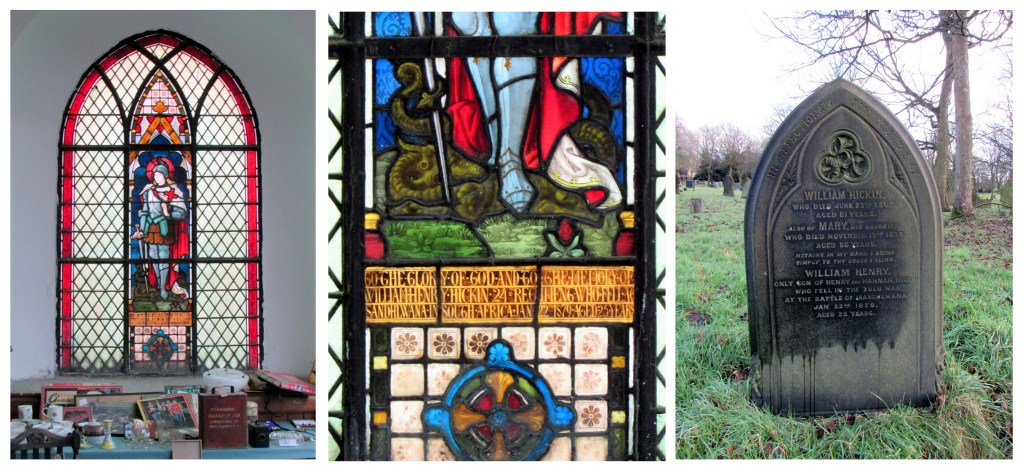
    The stained glass window and grave memorialising Private William Hickin.
    The stained glass window and grave memorials to Private William Henry Hickin.

    Several local men were killed in the action. In the ranks of the 1/24th were 25 year old Private William Henry Hickin from Hanley; the son of one Henry Hickin a local locksmith and bell hanger, William had previously worked as a writing clerk before enlisting in early 1876. Private George Glass 1/24th aged 22 from Shelton, was the son of a local school master and had briefly worked as a potter and joined the army in 1874. Private Enoch Worthington 1/24th from Kidsgrove, was 24 and had been a miner like his father before him; he enlisted in Newcastle in 1875. Private Samuel Plant 1/24th was an older man from Shelton, who had joined the 24th Foot in 1859, married in 1862 and prior to serving in Southern Africa he had served for a year on St Helena.

    In the 2/24th, former potter Sergeant William Shaw from Tunstall, was about 32 years old. After joining the army in 1870 he was promoted corporal in 1873 and sergeant in 1877. He had married locally before joining the army, had four children and had served in India and Britain before being sent to Southern Africa. His wife Emma and their children had come with him on this tour of duty and were lodged in King William’s Town, Cape Colony, far away from Zululand. Private Samuel Poole, 2/24th is something of an enigma as several possible candidates of that name were born in Audley, Kidsgrove or Newcastle, but there is no clear evidence if any of these are our man, all we know is merely that a man of that name enlisted in Hanley on 27 April 1875 aged 21 years. Records state that he served in G Company 2/24th. Private David Pritchard 2/24th, was from Stoke-upon-Trent though no one of that name appears in the civil records so that may have been an alias. He claimed to have worked as a forgeman before joining up in 1865 and he went on to see service in India. Aged about 34 at the time of the Zulu War, records say he served in B Company, but that was the company left at Rorke’s Drift, so he had probably been transferred to G Company.

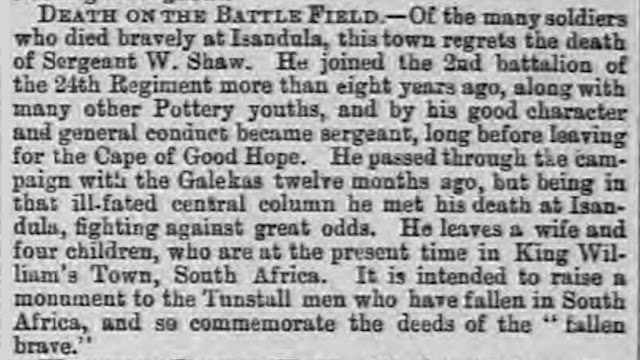
    The most interesting of these local victims of Isandlwana from a historian’s point of view, is Sergeant William Shaw of the 2/24th, as evidence exists giving us a glimpse into his fate that day. According to the notebook of Corporal John Bassage 2/24th, now held at the Royal Regiment of Wales Museum, who was part of the force sent to bury the dead in June 1879 after the war was over, the remains of Sergeant Shaw and three private soldiers of the 2/24th were found together in a heap on the battlefield. The four men caught out in the open appeared to have formed into a small group in a last desperate attempt to try and fend off the Zulus as they poured into the camp. All seemed to have been stabbed to death with assegais.

    Staffordshire Sentinel and Commercial & General Advertiser – Saturday 8 March 1879, p.5

    In a report in the Sentinel noting Shaw’s death in action, it was stated that there were hopes of raising a memorial to him and all the Tunstall men killed in South Africa. This, though, never seems to have come to pass and of all the men mentioned above only one appears to have been commemorated locally. In December 1880 at St John’s Church in Hanley, a stained glass window was dedicated to the memory of 25 year old Private William Henry Hickin, whose father was a churchwarden there. Hickin was further commemorated on his grandfather and aunt’s gravestone in Hanley Cemetery. Private Hickin is in fact the only ‘other ranks’ casualty of the Battle of Isandlwana remembered with a memorial window.

    One other local soldier who who was initially listed as a casualty was Private Frederick Butler from Shelton and son of the proprietor of the Bell and Bear Inn. He was a soldier of the 1/24th but prior to the invasion he had been transferred to the Imperial Mounted Infantry, Though initially listed as a casualty of the battle, Butler was in fact many miles away with his new unit serving in another invasion column that saw action at the battle of Nyezane on the same day as Isandlwana. He survived the war, rejoined his own unit once the fighting was over and later returned to the Potteries.


    Reference: Staffordshire Sentinel, various issues March-May 1879. My thanks to Ken Ray for his detailed list and information on the local men killed at Isandlwana and to Alan Rouse for family and background information on Sergeant Shaw.