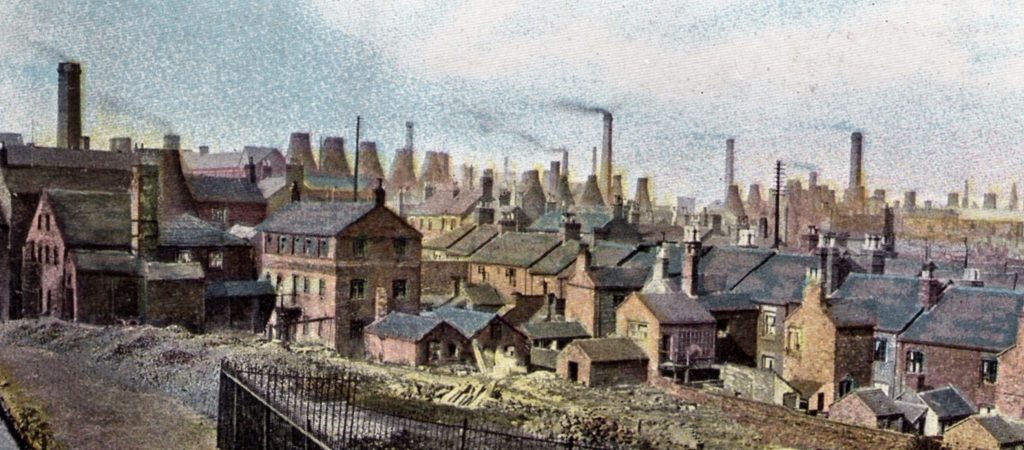
Tag: NOrth Staffordshire history

  • A Tale of Trafalgar

    A private of the Royal Marines
    Source: Wikimedia Commons

    In the pages of M. H. Miller’s interesting compilation, Leek: Fifty Years Ago, can be found the story of one Joseph Mottershead from Leek, who served as a Royal Marine aboard HMS Dreadnought at the battle of Trafalgar in 1805. Joseph was born in Leek in early 1778, the son of Josiah Mottershead and Ann nee Milner. He had an older brother named William and by account also had a sister. According to the story in Miller’s book, Joseph Mottershead had run away from home after falling out with his family and gone off secretly to enlist, joining a recruiting party on the Ashbourne Road. He was away from his family for the next 17 years and though Joseph wrote to them, the letters were few and far between.

    The account had no doubt that Mottershead had ‘been in many a scrimmage’ from early in his career at sea, but Trafalgar would overshadow them all. By 1805, he was a serving Marine aboard HMS Dreadnought, a 98 gun second-rate ship under Captain Conn, part of Nelson’s force in full pursuit of Admiral Villeneuve’s Franco-Spanish fleet. Mottershead recalled how, ‘… when the combined fleets of France and Spain were signalled a great shout went up. On that day he [Mottershead] had nothing on but his shirt and trousers and said that he and seven others made a hasty breakfast out of one dish. Owing to the line of battle taken up by the fleet the Dreadnought was late in coming into action and so was not so hotly engaged as some of the ships, but, nevertheless, they captured one of the Spanish vessels.’

    This was the San Juan Nepomuceno, whose fire-eating captain had nailed the ship’s colours to the mast and refused to surrender, despite taking a pummelling from half a dozen circling British warships. As already noted Dreadnought joined the fray late and opened fire at two o’clock then fifteen minutes later boarded the Spaniard and forced her crew to surrender after their captain had been killed in action. Dreadnought then turned in pursuit of the Spanish flagship Principe de Asturias, firing several broadsides and mortally wounding the Spanish Admiral Gravina, but was unable to catch the enemy vessel which slipped away and succeeded in reaching Cadiz. Captain Conn consoled himself with his initial prize, the San Juan Nepomuceno being one of only four captured enemy ships to survive the great storm that followed on after the battle. 

    HMS Dreadnought suffered 7 crew killed and 26 wounded in the fighting, but Mottershead was lucky and seems to have come away unscathed. Not that his family back in Leek were to know that and when a Mr Beadnall was passing the Mottershead’s home near Belle Vue, he spotted Joe’s sister and asked her what ship her brother was serving on. On being told it was the Dreadnought, he informed her that the ship had been in a great sea battle and the British fleet had won. The news drove the family frantic with worry, wondering if Joe had been killed and it was not until several weeks later when they received a letter from him stating that he was safe and well, that their fears were finally allayed.

    Mottershead’s account of his career added a few more details of his time at sea. He had stated that his ship was once ice-bound for a long period and the men were put on short rations. When they finally got free and returned to Portsmouth, Mottershead said ‘they could almost see through each other’. He also recalled that he once saw a group of his comrades hung from the yardarm for breach of their duty. When these incidents happened, though, is not made clear.

    Joseph Mottershead was discharged from the Royal Marines in either 1814 or 1815. Servicemen of the period were usually provided with the fare back to the town where they had enlisted, but otherwise had to make their own arrangements to get back to their real home. His low-key return to Leek was recounted in Miller’s book.

    A replica Naval General Service Medal with the Trafalgar clasp.

    ‘One very wintery day about the year 1815, Gaunt’s work people had been paid for their work and were getting “a glass together” at the Cock in Derby street, when the coach from Derby drew up and a soldier got off and came into the house. He stood by the fire warming himself, and presently he asked “Is —— alive,” naming his father. One of the people, a woman of the name of Nixon, eyed him for a moment, then rapping her snuff-box and turning to one of the men (Mottershead’s brother) said, “By Jove, Will, it’s your Joe!” Yes! Joseph was come back and received a hearty welcome.’

    When the 1841 census was taken, Joe was still alive at 63 and living at Mill Street, Leek, his profession given as a ‘silk doubler’ employed in the town’s notable silk and lace industry. Two other names are listed at the same address, Hannah Mottershead aged 61 and 34 year old Sarah Mottershead. At first glance we might think Joseph had settled down to a married life, but the 1851 census lists Hannah as his ‘infirm’ sister and Sarah as his daughter, though if this is the case there is no indication of who her mother was. By this time Joe had retired and was listed as a ‘Greenwich Pensioner,’ reaping the albeit meagre rewards of his service at sea all those years before. He had also received further recognition for his service a couple of years before when he applied for and was awarded the Naval General Service Medal with the ‘Trafalgar’ clasp.

    Joseph Mottershead, North Staffordshire’s most notable Trafalgar veteran died on 4 December 1855 aged 77 years old and was buried four days later in St Edward’s Churchyard. His death and claim to fame was mentioned briefly in the pages of the Staffordshire Sentinel,  where it was noted, ‘He fought by the side of Nelson, at the Battle [of] Trafalgar.’

    Reference: M. H. Miller, Leek: Fifty Years Ago, pp.150-151. Staffordshire Sentinel, 8 December 1855, p.5.

  • Mow Cop Castle

    Mow Cop Castle from the Staffordshire side

    To the north of Stoke-on-Trent and standing smack on the Staffordshire-Cheshire Border, the hill of Mow Cop dominates the respective skylines of both counties and is also very much a natural demarcation point. To the south, the low rolling hills of North Staffordshire leading up to the hill seem to suddenly give way to the vast flat expanse of the Cheshire plain on its northern side. Nowhere is this better appreciated than from the highest point on the hill, where a circular stone tower, low wall and archway sit perched on a great prow of millstone grit rock, part of a jagged ridge of stones that appears to erupt from the surrounding greenery.

    In truth the ruggedness of the hill owes as much to centuries of quarrying as to the vagaries of nature, while the apparently ancient ruin, known to one and all as Mow Cop Castle, is in fact South Cheshire’s and North Staffordshire’s most famous folly, dating back at best to the late 1740s. Though solid documentary evidence relating to the ‘castle’s’ construction seems to have vanished over time, it’s most likely that it was actually built as Medieval-style summerhouse paid for by the wealthy Wilbraham family of Rode Hall, Cheshire, who were perhaps keen to mark the edge of their lands and make use of the spot from which to admire the spectacular views of the two counties. Construction of the tower, archway and wall seems to have been carried out by a family named Harding whose descendants then became keyholders for the tower under the Wilbrahams. However,  either the Wilbrahams or the Hardings had slipped up in constructing the tower where they did, as by straddling the border it infringed upon the Staffordshire estate of the Sneyd family of Keele Hall. There are confused scraps of folklore suggesting that this fact was know from the earliest times and that the Wilbrahams and Sneyds held joint ownership and access to the site, but again there is no conclusive evidence of this and arguments as to which family actually owned Mow Cop Castle would blight its early history and lead to litigation in the mid 19th century.

    The tower today is nothing more than an empty stone shell, with bars on the windows and a grill over the doorway stopping anyone from getting inside, but when it was first constructed it was much more useful, comprising a lower and upper storey with a staircase, wooden floors, a roof, windows and a stout wooden door at its entrance. Keys to the door could be obtained at times from Rode Hall itself or – for the convenience of visitors – from a cottage near to the summer-house. Indeed, it appears that from very early in its history, the Wilbrahams were quite happy to let members of the public make use of the tower for their own recreations. As a result, the castle became a favourite picnic spot and playground for the locals and despite the competing claims over the years of families and landowners as to who owned what, the castle came to belong very much to the people of Mow Cop itself and their voices would be loud in determining its fate.

    A memorial stone commemorating the first camp
    meeting held at Mow Cop in 1807.

    Primitive Methodism

    The hill and castle also hold a special place in the religious history of the region as Mow Cop was very much the spiritual home to the Primitive Methodist movement that originated in North Staffordshire in the early part of the 19th century and the castle its unofficial symbol. The movement’s founders, two Potteries-born Wesleyan preachers, Hugh Bourne and William Clowes, were hoping to restore a spirit of revivalism to mainstream Methodism. Inspired by tales of American camp meetings which they felt mirrored the  outdoor preaching of John Wesley and the early Methodists, the men organised the first in a series of camp meetings at Mow Cop on May 31, 1807. This drew a sizeable crowd and resulted in many converts, but despite its success the Wesleyan Church frowned on the fervent brand of evangelism employed and refused to recognise these converts, while Bourne and Clowes were reprimanded for their actions. There was probably an element of snobbishness in the censure too, as both Bourne and Clowes were uneducated working men and their brand of Methodism was decidedly working class in its following, many of Bourne’s and Clowes’s early converts being some of the roughest of working class men and women from in and around Mow Cop and the Potteries.

    As Bourne and Clowes refused to stop holding further open-air meetings, both men were dismissed from the church and after failing to gain re-admittance in 1810 they took the step of founding Primitive Methodism, and in February 1812 in a meeting held at Tunstall, they took the name The Society of the Primitive Methodists. From these humble beginnings the Primitive Methodists would grow into a considerable faction of the Methodist church with a wide following across Britain and branches in the United States and around the British Empire and maintained their independence until the Methodist Union of 1932.


    Kings of the Castle

    The Wilbrahams left Rode Hall for Lancashire in 1800 and though some repairs were made to the castle over the years, it suffered the ravages of time, neglect and petty vandalism. The floors and wooden fittings were pilfered or destroyed, the door was taken down and put into storage, while the Wilbrahams and Sneyds still debated their claims to the site. Matters came to a head in 1847 when the Wilbrahams refitted the old door to the tower and locked it, which effectively restricted access to the Sneyds and the public at large who had previously had free access to the structure. The next year the Sneyd family’s men broke into the tower which act resulted in a court case in 1850 that sought to establish who actually owned the castle. However, faced with a baffling array of contradictory evidence, the jury in the case returned the verdict that the Wilbrahams owned the castle but the Sneyds owned the land, which left them back at square one. The judge refused to accept this fudged verdict and instead pronounced a joint ownership and that henceforth both families should hold keys to the castle, joint responsibilities for its upkeep and with a few provisos both families had to maintain public access to the hill and castle.

    However, probably as a result of this apportioning of responsibility the castle gradually fell into a state of complete neglect over the next half a century and by the beginning of the 20th century had effectively been reduced to the bare stone shell seen today. Only the locals seem to have continued to appreciate the castle and as was seen when the castle passed to its last private owner they rallied to its cause.

    By the late 19th century most of the quarries that had dotted Mow Cop had closed down, however, in 1918 and 1922, a local businessman, Joseph Lovatt, bought up the competing land rights from the Wilbraham and Sneyd trustees and having cleared the debris from some of the old quarries near to the castle, he began fresh diggings for building material. Though he was himself a Methodist with an interest in preserving Mow Cop Castle (which he now owned) Lovatt’s actions raised fears amongst the locals that his quarrying might undermine or damage its foundations. Moreover, Lovatt fenced off the castle, which increased local ire at being excluded from their local beauty spot and they protested and eventually broke down the walls and fencing. This prompted a second court case to determine the future of the castle, the villagers arguing that they had common rights to use the castle and its environs. The case dragged on for three years and when it finally concluded the judge pronounced that the castle was not built on common land and that the rights of the locals were more a matter of accepted custom than a matter of law. Though the old custom carried some weight, the problem was that no one was sure exactly what their right of access to the castle entailed and the local authorities on either side of the county border had made no efforts to clarify these.

    Lovatt may have won the case, but it had not done his reputation any favours and he soon determined to get this troublesome parcel of land off his hands as soon as possible. To this end in 1927, he offered it to the Bourne Trust, the successors to the Primitive Methodist movement, these being an obvious choice to pass the site on to. After careful consideration, though, the Trust determined that its upkeep was beyond their means and refused to take up Lovatt’s offer. So, in 1935, Lovatt offered the castle and six acres of land including the famous local stone pillar Old Man of Mow, to the National Trust. This was accepted and on 30 May 1937, the deeds were formally handed over at a grand ceremony attended by ten thousand people.

    Since then the National Trust has maintained the structure pretty much in the state that they received it. Matters of ownership and public access are a thing of the past and though the castle itself is now closed for safety’s sake and to dissuade potential vandals, people can still visit and walk around the structure, while its hilltop vantage point with its impressive views across two counties is open to all.

    Looking out over Staffordshire from Mow Cop

    Reference: Philip R. Leese, Mow Cop: A Working Village (2010); Mow Cop: Living on the Hill (2011)