Colin Melbourne’s statue of R. J. Mitchell outside the Potteries Museum and Art Gallery, Hanley.
In 1911, long before he went on to design his world-beating racing planes and later the Supermarine Spitfire, 16 year old Reginald Joseph Mitchell, served a local apprenticeship. Originally from Butt Lane near Kidsgrove, but raised in Normacot, Reg was enrolled as a lowly apprentice engineer at Messrs Kerr, Stuart and Co, locomotive engineers in Fenton. Before moving on to the drawing office where he would make his name, he like the other apprentices had to spend time in the workshops getting his hands dirty working on the firm’s machines. Reg’s pragmatic father Herbert saw this as a sensible grounding for his ambitious son, but young Mitchell loathed this introduction to his profession, hating the grime-caked overalls he had to wear and the monotony of the work that kept him from what he really wanted to do. He was also less than enamoured with the workshop foreman.
One of the first jobs that Reg had when he started at Kerr, Stuart was the traditional one of tea boy, brewing up for the other apprentices and the foreman, the latter, though regularly complained that Mitchell’s tea tasted like piss. Tired of his grumbling, Reg decided that if that was what he thought, then that was what he would get. The next morning Reg arrived at work and as normal took the kettle to the wash room, but instead of filling it with water he urinated into it, then boiled the kettle and made tea. Warning his fellow apprentices not to drink, Reg served the foreman as usual. The man took a sip, then a larger gulp and said, “Bloody good cup of tea, Mitchell, why can’t you make it like this every day?”
Reference: Gordon Mitchell, R.J. Mitchell, from Schooldays to Spitfire, pp. 21- 25
To the north of Stoke-on-Trent and standing smack on the Staffordshire-Cheshire Border, the hill of Mow Cop dominates the respective skylines of both counties and is also very much a natural demarcation point. To the south, the low rolling hills of North Staffordshire leading up to the hill seem to suddenly give way to the vast flat expanse of the Cheshire plain on its northern side. Nowhere is this better appreciated than from the highest point on the hill, where a circular stone tower, low wall and archway sit perched on a great prow of millstone grit rock, part of a jagged ridge of stones that appears to erupt from the surrounding greenery.
In truth the ruggedness of the hill owes as much to centuries of quarrying as to the vagaries of nature, while the apparently ancient ruin, known to one and all as Mow Cop Castle, is in fact South Cheshire’s and North Staffordshire’s most famous folly, dating back at best to the late 1740s. Though solid documentary evidence relating to the ‘castle’s’ construction seems to have vanished over time, it’s most likely that it was actually built as Medieval-style summerhouse paid for by the wealthy Wilbraham family of Rode Hall, Cheshire, who were perhaps keen to mark the edge of their lands and make use of the spot from which to admire the spectacular views of the two counties. Construction of the tower, archway and wall seems to have been carried out by a family named Harding whose descendants then became keyholders for the tower under the Wilbrahams. However, either the Wilbrahams or the Hardings had slipped up in constructing the tower where they did, as by straddling the border it infringed upon the Staffordshire estate of the Sneyd family of Keele Hall. There are confused scraps of folklore suggesting that this fact was know from the earliest times and that the Wilbrahams and Sneyds held joint ownership and access to the site, but again there is no conclusive evidence of this and arguments as to which family actually owned Mow Cop Castle would blight its early history and lead to litigation in the mid 19th century.
The tower today is nothing more than an empty stone shell, with bars on the windows and a grill over the doorway stopping anyone from getting inside, but when it was first constructed it was much more useful, comprising a lower and upper storey with a staircase, wooden floors, a roof, windows and a stout wooden door at its entrance. Keys to the door could be obtained at times from Rode Hall itself or – for the convenience of visitors – from a cottage near to the summer-house. Indeed, it appears that from very early in its history, the Wilbrahams were quite happy to let members of the public make use of the tower for their own recreations. As a result, the castle became a favourite picnic spot and playground for the locals and despite the competing claims over the years of families and landowners as to who owned what, the castle came to belong very much to the people of Mow Cop itself and their voices would be loud in determining its fate.
A memorial stone commemorating the first camp meeting held at Mow Cop in 1807.
Primitive Methodism
The hill and castle also hold a special place in the religious history of the region as Mow Cop was very much the spiritual home to the Primitive Methodist movement that originated in North Staffordshire in the early part of the 19th century and the castle its unofficial symbol. The movement’s founders, two Potteries-born Wesleyan preachers, Hugh Bourne and William Clowes, were hoping to restore a spirit of revivalism to mainstream Methodism. Inspired by tales of American camp meetings which they felt mirrored the outdoor preaching of John Wesley and the early Methodists, the men organised the first in a series of camp meetings at Mow Cop on May 31, 1807. This drew a sizeable crowd and resulted in many converts, but despite its success the Wesleyan Church frowned on the fervent brand of evangelism employed and refused to recognise these converts, while Bourne and Clowes were reprimanded for their actions. There was probably an element of snobbishness in the censure too, as both Bourne and Clowes were uneducated working men and their brand of Methodism was decidedly working class in its following, many of Bourne’s and Clowes’s early converts being some of the roughest of working class men and women from in and around Mow Cop and the Potteries.
As Bourne and Clowes refused to stop holding further open-air meetings, both men were dismissed from the church and after failing to gain re-admittance in 1810 they took the step of founding Primitive Methodism, and in February 1812 in a meeting held at Tunstall, they took the name The Society of the Primitive Methodists. From these humble beginnings the Primitive Methodists would grow into a considerable faction of the Methodist church with a wide following across Britain and branches in the United States and around the British Empire and maintained their independence until the Methodist Union of 1932.
Kings of the Castle
The Wilbrahams left Rode Hall for Lancashire in 1800 and though some repairs were made to the castle over the years, it suffered the ravages of time, neglect and petty vandalism. The floors and wooden fittings were pilfered or destroyed, the door was taken down and put into storage, while the Wilbrahams and Sneyds still debated their claims to the site. Matters came to a head in 1847 when the Wilbrahams refitted the old door to the tower and locked it, which effectively restricted access to the Sneyds and the public at large who had previously had free access to the structure. The next year the Sneyd family’s men broke into the tower which act resulted in a court case in 1850 that sought to establish who actually owned the castle. However, faced with a baffling array of contradictory evidence, the jury in the case returned the verdict that the Wilbrahams owned the castle but the Sneyds owned the land, which left them back at square one. The judge refused to accept this fudged verdict and instead pronounced a joint ownership and that henceforth both families should hold keys to the castle, joint responsibilities for its upkeep and with a few provisos both families had to maintain public access to the hill and castle.
However, probably as a result of this apportioning of responsibility the castle gradually fell into a state of complete neglect over the next half a century and by the beginning of the 20th century had effectively been reduced to the bare stone shell seen today. Only the locals seem to have continued to appreciate the castle and as was seen when the castle passed to its last private owner they rallied to its cause.
By the late 19th century most of the quarries that had dotted Mow Cop had closed down, however, in 1918 and 1922, a local businessman, Joseph Lovatt, bought up the competing land rights from the Wilbraham and Sneyd trustees and having cleared the debris from some of the old quarries near to the castle, he began fresh diggings for building material. Though he was himself a Methodist with an interest in preserving Mow Cop Castle (which he now owned) Lovatt’s actions raised fears amongst the locals that his quarrying might undermine or damage its foundations. Moreover, Lovatt fenced off the castle, which increased local ire at being excluded from their local beauty spot and they protested and eventually broke down the walls and fencing. This prompted a second court case to determine the future of the castle, the villagers arguing that they had common rights to use the castle and its environs. The case dragged on for three years and when it finally concluded the judge pronounced that the castle was not built on common land and that the rights of the locals were more a matter of accepted custom than a matter of law. Though the old custom carried some weight, the problem was that no one was sure exactly what their right of access to the castle entailed and the local authorities on either side of the county border had made no efforts to clarify these.
Lovatt may have won the case, but it had not done his reputation any favours and he soon determined to get this troublesome parcel of land off his hands as soon as possible. To this end in 1927, he offered it to the Bourne Trust, the successors to the Primitive Methodist movement, these being an obvious choice to pass the site on to. After careful consideration, though, the Trust determined that its upkeep was beyond their means and refused to take up Lovatt’s offer. So, in 1935, Lovatt offered the castle and six acres of land including the famous local stone pillar Old Man of Mow, to the National Trust. This was accepted and on 30 May 1937, the deeds were formally handed over at a grand ceremony attended by ten thousand people.
Since then the National Trust has maintained the structure pretty much in the state that they received it. Matters of ownership and public access are a thing of the past and though the castle itself is now closed for safety’s sake and to dissuade potential vandals, people can still visit and walk around the structure, while its hilltop vantage point with its impressive views across two counties is open to all.
Looking out over Staffordshire from Mow Cop
Reference: Philip R. Leese, Mow Cop: A Working Village (2010); Mow Cop: Living on the Hill (2011)
Regular newspaper coverage of events in the Potteries only really started at the end of the 18th century with the advent in 1795 of the Staffordshire Advertiser paper, though as this was published in Stafford, it’s coverage of the goings on in the north of the county was limited to the most noteworthy events. Another half century would pass before more local newspapers were being produced in Hanley, Stoke and Burslem. However, histories, travellers’ journals and some other national or regional papers occasionally carried tales from the Potteries from this early period, giving us fleeting glimpses into life in the area. These range from descriptions of the growing pottery industry and the construction of the canals, to bizarre deaths, odd weather and local curios.
See a Fine Lady Upon a White Horse
Between 1697 and 1702, partly from a wish to improve her health and from an equally strong desire to see more of her native land, Lady Celia Fiennes (whom some claim was the fine lady at Banbury Cross from the children’s nursery rhyme) undertook a series of journeys around England. In the summer of 1698, her peregrinations brought her into North Staffordshire. Here, after admiring the as yet unsullied landscape, she was keen to visit the Elers Brothers’ factory at Bradwell, but as she notes in her diary she was unsuccessful; the potters had temporarily run out of clay and were not working.
‘..and then to Trentum, and passed by a great house of Mr Leveson Gore, and went on the side of a high hill below which the River Trent ran and turn’d its silver stream forward and backward into s’s which Looked very pleasant Circling about ye fine meadows in their flourishing tyme bedecked with hay almost Ripe and flowers. 6 mile more to NewCastle under Line.’
After ruminating briefly on the ‘coals to Newcastle’ adage, she continued.
‘… I went to this NewCastle in Staffordshire to see the makeing of ye fine tea potts. Cups and saucers of ye fine red Earth in imitation and as Curious as yt wch Comes from China, but was defeated in my design, they. Comeing to an End of their Clay they made use of for yt sort of ware, and therefore was remov’d to some other place where they were not settled at their work so Could not see it;’
(Reference: Celia Fiennes, Through England On a Side Saddle in the Time of William and Mary, pp.146-147.)
A Swedish Spy in the Valley of Crockery
A visitor to the mid-18th century Potteries was Reinhold Rücker Angerstein, an industrial spy in the employ of the Swedish government, who was tasked with gathering information on new or emerging technology. Between 1753 and 1755, he journeyed through England and Wales and produced a wide-ranging and comprehensive survey of the various industries and their practices. He appears to have visited the Staffordshire Potteries, which he labels rather colourfully as a ‘Valley of Crockery’, in about 1755. Here, after examining the manufacture of salt-glazed wares, describing the kilns in Hanley (including illustrations), the raw materials used, the prices of ware and various mechanisms employed in producing pottery (with still more pictures), he went on to add a few descriptions of the area that make for interesting reading.
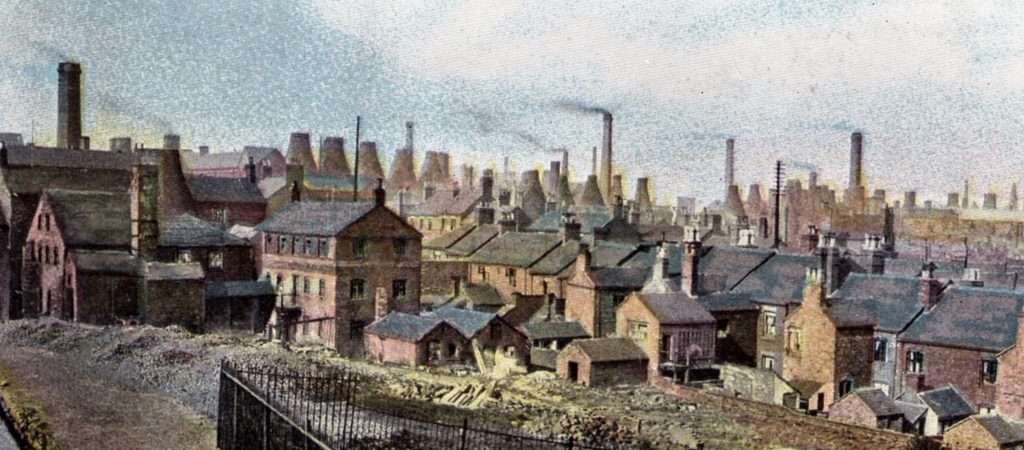
He notes that in Hanley there were 430 makers of white ware and other types of pottery, adding ‘The kilns are everywhere in this district.’ and to prove his point he includes an illustration of the skyline of the town. There were also large numbers of potteries in Stoke and other places, ‘where mostly the same kind of ware as that enumerated is made and also some simpler crockery.’ He then adds a picturesque and slightly comical tale. ‘When as it sometimes happens, many kilns are glazing with salt at the same time, there is such a thick smoke of salt in these towns, that people in the streets cannot see 6 feet ahead, which, however does not cause any difficulties. On the contrary, the smoke is considered so healthy that people who are ill come here from far away to breathe it.’
Of the pottery itself, he writes, ‘The crockery produced is mainly sent to London or other sea ports, from which much of it is exported to America and many other foreign countries.’
(Reference: R. R. Angerstein’s Illustrated Travel Diary 1753-1755, pp. 340-342)
John Wesley preaching to a crowd
Pelted in the Potteries
On 8 March 1760, the Reverend John Wesley, the founding father of Methodism, visited Burslem for the first of many visits to the region. He described Burslem as ‘a scattered town, on the top of a hill, inhabited almost entirely by potters’, a large crowd of whom had gathered to hear him at five in the evening. He noted that great attention sat on every face, but also great ignorance which he hoped he could banish.
The next day Wesley preached a second sermon in Burslem to twice the number of the day before. ‘Some of these seemed quite innocent of thought. Five or six were laughing and talking till I had near done; and one of them threw a clod of earth, which struck me on the side of the head. But it neither disturbed me nor the congregation.’ –
(Reference: John Wesley, Journal, 8-9 March 1760)
The First Cut
After receiving the royal assent two months earlier for construction of a canal connecting the rivers Trent and Mersey, on the morning of 26 July 1766, at a site just below Brownhills, pottery manufacturer Josiah Wedgwood cut the first sod of what would in time become the Trent and Mersey canal. James Brindley, the engineer who would oversee the canal’s construction, and numerous other dignitaries were present, many of whom would also cut a piece of turf, or wheel away a barrow of earth to mark the occasion. In the afternoon a sheep was roasted in Burslem market place for the benefit of the poorer potters in the town. A bonfire was also lit in front of Wedgwood’s house and many other events took place around the Potteries by way of celebration.
(Reference: Jean Lindsay, The Trent and Mersey Canal, pp.31-32)
News from the North
Extract of a Letter from Burslem, 14 August 1766,
‘As you often give me London News, I will give you some from this Country, which has of late made a Figure. This Neighbourhood has for many Years made Pots for Europe, and will still do so, though the King of Prussia has lately clapt 28 per Cent, upon them. Our Roads were so bad that nobody came to view the Place where the Flint Ware is made, but now we have Turnpikes upon Turnpikes, and our Potteries are as well worth seeing as the Stockport Silk-Mills, or the Bridgewater Navigation, which we intend to beat hollow by Lord Gower’s, now begun in our Meadows, and advancing apace towards Harecastle, on the other Side of which Multitudes of Men are at work, and before Christmas we shall have cut through the Hill, and made another Wonder of the World. There are already 100 Men employed on our Side, and 100 more will be added as soon as Wheelbarrows can be procured for them. Saturday last we had brave Sport at Earl Gower’s, where 100,000 Spectators were present at the Prison-Bars played in Trentham Park. Among them were the Dukes of Bedford and Bridgewater. The Prizes were Ten Carline Hats, with gold Loops and Buttons, given by the Earl. The Cheshire Men were active Fellows, but unluckily their Lot was to wear Plod Drawers, to distinguish them from their Antagonists, which made the Crowd oppose their getting the Honour of the Day. During this Game, my Friend Bucknall loft his Boy, about Eight Years of Age, who was suffocated by going aslant down a Sort of a Cave into an old Coalpit, the top of which was fallen in. The Man that ventured to fetch him out, found a Number of Birds, supposed to have dropped down there by the sulphurous Stench issuing from the Pit. We have much Hay, and Cheese is plenty, and Corn without Barn-room, nor do we want Money.
P. S. I have just seen a Hen, which laid Twelve Eggs only, from which she has brought up Twelve Cock Chickens, which is looked upon as somewhat remarkable.’ –
(Reference: Derby Mercury, Friday 29 August 1766, p.2)
In Praise of Mr Brindley
Extract of a Letter from Burslem in Staffordshire. dated September 5.
“Though our Stone Ware has been universally used, yet till our Turnpikes were made few People ever saw our Manufactories. But now they are gazed at as a Novelty. The Ladies go to Warburton’s to buy the Queen’s Sets of Cream-coloured Ware; and the Gentle-men come to view our Eighth Wonder of the World, the subterraneous Navigation, which is cutting by the great Mr. Brindley, who handles Rocks as easily as you would Plumb-Pyes, and makes the four Elements subservient to his Will. He is as plain a looking Man as one of the Boors of the Peak, or one of his own Carters; but when he speaks all Ears listen, and every Mind is filled with Wonder at the Things he pronounces to be practicable. He has cut a Mile through Bogs, which he binds up, embanking them with the Stones which he gets out of the other Parts of the Navigation, besides about a Quarter of a Mile into the Hill Yeldon; on the Side of which he has a Pump, which is worked by Water, and a Stove, the Fire of which sucks through a Pipe the Damps that would annoy the Men, who are cutting towards the Centre of the Hill. The Clay he cuts out, serves for Brick to arch the subterraneous Part, which we heartily wish to see finished to Wilden Ferry, when we shall be able to send Coals and Pots to London, and to different Parts of the Globe.— Another Mile is cut on the Cheshire Side of the Hill, and the Men intend to meet in the Middle by Christmas, when they are to have an Ox roasted whole, and an Hogshead of Ale.”
(Reference: Derby Mercury – Friday 18 September 1767, p.2)
Tunnel Vision
On 1 July 1772, an anonymous correspondent writing from Burslem related what he had seen the day before when he and some companions paid a visit to the first incarnation of the Harecastle Tunnel, situated between Tunstall and Kidsgrove and then under construction as part of James Brindley’s Trent and Mersey Canal.
‘Yesterday we took a walk to the famous subterraneous canal at Harecastle, which is now opened for a mile on one side of the hill, and more than half a mile on the other, of course the whole must be compleated in a short time. As it is not yet filled with water, we entered into it, one of the party repeating the beautiful lines in Virgil, which describe the descent of Æneas into the Elysian fields. On a sudden our ears were struck with the most melodious sounds. – Lest you should imagine us to have heard the genius or goddess of the mountain singing the praises of engineer Brindly, it may be necessary to inform you, that one of the company had advanced some hundred paces before, and there favoured us with some excellent airs on the German flute. You can scarcely conceive the charming effect of this music echoed and re-echoed along a cavern near two thousand yards in length.’
(Reference: Leeds Intelligencer, Tuesday 14 July 1772, p.3)
A Fungi to Be With
No age is free of stories of novelty fruit, veg or mushrooms:
‘A few days ago, a mushroom was got at Stoke-upon-Trent, in the county of Stafford, whose diameter was 5 inches, and 30 inches in circumference, it weighed 16 ounces. The above is very authentic.’
(Reference: Leeds Intelligencer, 5 September 1775, p.3)
All in a Spin
In 1781, there was the story of a curious weather phenomenon, a whirlwind or perhaps a mini tornado:
‘The following extraordinary phenomenon was lately observed here; at the latter end of last month, a field of hay belonging to Mr. J. Clark, near Burslem, was carried off by a whirlwind; the day when it happened was exceedingly calm, scarce a breath of air to be perceived. The people who were at work in the field observed, that in one part the hay began to be agitated in a small circle, at every wheel it increased in size and velocity, continually sucking more hay into its vortex; after a considerable time it began to ascend, taking along with it a silk handkerchief which hung rather loosely about the neck of one of the men who was at work; it continued ascending till entirely out sight, and in about an hour it began to descend, and continued to so for an hour’s space, alighting at, or within a few hundred yards of the place from whence it had been carried up, so that the owner lost but a very trifling quantity of his hay.’
(Reference: Hereford Journal, 23 August 1781, p.2)
A Tragic Accident
The following melancholy tale from the Potteries is related in a letter dated August 14 1785.
‘As Ellen Hulme, a poor woman of Lane End, was returning to her habitation late last night, with her infant, six weeks old, in her arm, she unfortunately stepped into a coal-pit, which shamefully lay open close to the road, and even with the track which led to the poor creature’s house. Her husband, whom she had been to fetch from an alehouse, immediately alarmed the neighbourhood, when her distressing cries were very distinctly heard from the bottom of the dreary pit every effort was attempted by the hardy colliers to fetch her up, but the damp prevailing very much, obliged them to use means to extract it, after which was found the mother with her infant upon her arms, both dead.’
(Reference: Sussex Advertiser, 22 August 1785, p.3)
A Hard Winter
During the harsh winter of 1794-1795, the better off inhabitants of Hanley and Shelton formed a committee which started a subscription list for the temporary relief the poor who were suffering great hardship during the cold weather. By February 1795 the committee had collected an impressive £150, enough to enable them to supply nearly 500 local families with meat, potatoes, and cheese. The Wedgwood family gave a liberal amount and through them a Mrs Crewe kindly added a welcome donation of a quantity of flannel clothing. The Marquis of Stafford aided the relief fund by ordering 100 tons of coal to be at the distribution of the committee.
A month later, in an issue of the Staffordshire Advertiser that noted that thermometers in Macclesfield had measured temperatures as low as -21° F (-29.4° C), the fearsome nature of the winter was highlighted dramatically by one small but rather macabre snippet of news: ‘Through the inclemency of the night of Saturday last [i.e.,14 March] a poor man perished betwixt Hanley and Bucknall. He unfortunately lost himself in attempting to cross the fields, and was found on Sunday standing upright in a snow drift, with his hand only above the surface.’
(Reference: Staffordshire Advertiser, 7 February 1795, p.3; 21 March 1795, p.3.)
Dashed to Pieces
‘A melancholy accident happened on Wednesday last at a coal-pit near Lane Delph, in the Pottery. A poor woman employed in drawing up the coal, was by some accident unfortunately thrown into the pit, and was literally dashed to pieces.’
(Reference: Derby Mercury, 30 June 1796, p.4).
Wild Fire
In late March or early April 1799, a dreadful accident happened in a pit at Lane End, the property of John Smith, Esq. Four men were blown up, and two them terribly burnt by what the colliers of the time described as ‘the wild fire’. The explosion was loud, and the concussion so great that nearby houses shook violently. Two of the men were not expected to recover, while the other two were thrown to a considerable distance, and left badly bruised. The reporter noted that their hats were blown to the distance of 70 yards from the mouth of the pit.
(Reference: Staffordshire Advertiser, Saturday, 6 April 1799, p.4)
During the First World War, the action for the most part took place along a line of trenches stretching from the. Belgian coast, down to the Swiss border, where massed armies, huddled in their trenches, were launched in pointless attacks in the face of merciless machine gun and cannon fire. For the civilians back home the war was distant, though those left at home may have had relatives in the trenches, the Great War was an impersonal thing. True, foodstuffs were in short supply, and women took a great leap forward in society by going to work in the factories and on the farms, but the prospect of imminent death from enemy bombers, was still a generation away, or so it seemed. Then there came the Zeppelins. In a bold move, the Germans attempted to disrupt British life and industry, by sending over fleets of hydrogen-filled airships to drop bombs on anything they thought worthy of being destroyed. Two of these airships, at least, made it as far as North Staffordshire, and though the damage they did was insignificant, the authorities fell that they were such a threat to British morale, that the circumstances of the raids were not fully reported until a month after the war had ended.
The first raiders came on the night of the 31 January 1916, Several cities throughout the Midlands were surprised to find airships over them, since few had thought that the area was within the radius of such craft. This was in the days before the blackout, and the major manufactories of the Midlands were a blaze of lights and fires, and in North Staffordshire, the glow was particularly noticeable from the pot banks and steel-works of Stoke on Trent, which were obscured only by a slight ground mist.
A squadron of Zeppelins had crossed the coast that night. One attacked Walsall at 8.10 p.m., and later at 12,30 a.m. There, the Mayoress, Mrs. S. M. Slater, was fatally injured in a bomb blast. The Wednesbury Road Congregational Chapel was demolished by a bomb and other unspecified damage was done. At 8.30, another airship suddenly loomed out of the dark over Burton on Trent, and dropped a cluster of bombs, one of which fell on a mission house, where a clergyman’s wife was holding a service, and in the blast three of the congregation were killed and a forth fatally injured.
Not long after the Zeppelin over Burton had begun its attack, engines were heard moving towards Trentham and the Potteries, and presently, the Zeppelin appeared, cruising slowly overhead. Its obvious target could be seen miles away, the light from the Stafford Coal and Iron Company’s blast furnaces. The raider circled the foundry like a vulture and dropped half a dozen bombs in close succession. However, these fell on the spoil banks between the colliery and the furnaces, where they made several large holes, but did no serious damage.
German airship designer Count Zeppelin
After that the elusive raider sneaked off. Its course was only a matter of speculation, though engines were heard over Hanley, then Wolstanton and as far west as Madeley, where it dropped a flare over open country. It’s raid, though it must have injected some excitement into the area, caused no harm and it must have used up its stock of bombs, or been searching for a secondary target.
The second Zeppelin raid, though, was more dramatic, and took place during the night of 27 to 28 November 1916. It was a clear, dry night over the Midlands, there was the nip of an autumn frost in the air, perfect weather for an air raid. So, perhaps, at 10.45 p.m.. when the warning was received in the Potteries that Zeppelins had been sighted, few were surprised. The whole district was blacked out. and air raid precautions were put in place the special constabulary, the fire brigade and doctors and nurses were all alerted and went to their stations. Positive information was soon received that a raider was making for North Staffordshire, and at a few minutes before 1 a.m, the steady drone of aero engines was heard and the Zeppelin was sighted over Biddulph, slowly making towards the Kidsgrove-Goldenhill-Tunstall area of the Potteries. Then the bombs came crashing down.
One unnamed witness, had been up late and was just going to bed at about 1 a.m., when he heard a ‘deep rumbling, long-sustained explosion’ and thought that there had been a serious colliery accident nearby. He went into another bedroom to ask if anyone else had heard the noise, when there were further explosions, two short sharp blasts, then another ‘accompanied by a rending sound’, then a series of four or five blasts in succession. The witness looked out of a bedroom window and caught sight of flashes off towards the Chesterton area, followed by the thudding boom of the detonations. The bombardment went on for about half an hour until the Zeppelin drew nearer to the witness’ house and dropped another bomb about half a mile away ‘that shook every brick and window in the house’, before it moved. The witness had counted 21 explosions.
The first bomb blew a hole in a spoil bank at Birchenwood Colliery, Kidsgrove, while the second two landed not far off from the Goldendale Iron Works. The forth landed in Tunstall, impacting in the back yard of No. 6 Sun Street, and the explosion destroyed the sculleries and outhouses of Nos. 2, 4, 6 and 8, but shards hit other houses, as well as a nearby Roman Catholic church. Luckily, no one was killed and only one person was injured, a Mr Cantliffe of No. 8 Sun Street, who was hit in the chest by shrapnel, but he later made a full recovery in the North Staffordshire Infirmary. Had the raider circled in that area for a time, there is little doubt that there would have been a great deal of destruction and many more casualties, but the Zeppelin moved on, leaving Sun Street battered and bruised and in such a state that it would for days attract a horde of sightseers.
The Zeppelin cruised over Tunstall and out across Bradwell Wood, where the burning mine hearths seem to have attracted the raider away from the areas of population. This area was just a mass of calcinating ironstone left to smoulder out in the open, but which obviously seemed to have given the impression of being an ironworks of some description. Certainly the Germans thought so, and the area was heavily bombed, watched from a distance by our nameless witness. Explosion after explosion reverberated over Chesterton, but the only damage done was to a shed that was knocked over and the closest that any other bomb got to the public, was when one of the last of these landed behind Bradwell Lane, Wolstanton. A later report summed it up succinctly as a ‘particularly futile’ attack on the area.
As it had circled over Bradwell Wood and the area around Chesterton and Wolstanton for some time, illuminated in the flashes from the bombs, many locals had spotted the airship. But finally, spent of its bomb load, the raider turned south-east and was last sighted passing low over Blurton Farm coming from the direction of Hartshill. This was at 1.35 a.m., the Zeppelin then vanished into the dark at a ‘moderate speed’.
There had been a number of bombing raids over Britain that night and many came to a grim end. Certainly the North Staffs raider never made it back to Germany. Lord French, reporting the fate of several of these Zeppelins in a communique, made special reference to the airship that had bombed the Tunstall area. It appeared that after leaving the North Midlands, the airship hail taken a direct route towards East Anglia, from where there was but a short stretch of sea separating her crew from their homeland. However, before she even reached the coast, the Zeppelin had been repeatedly attacked by aeroplanes of the Royal Flying Corps and by ground-based artillery. Perhaps she was damaged, since Lord French’s report noted that the last part of her journey was made at a very slow speed and the airship was unable to reach the coast before day was breaking. By the time she reached Norfolk, however, it seemed that the crew had managed to make repairs, and after running a gauntlet of coastal batteries, one of which claimed a hit, the Zeppelin was seen making off to the cast at a high speed and at an altitude of about 8,000 feet. But more planes came at her. About nine miles out at sea, the Zeppelin was attacked by four machines of the Royal Navy Air Service and further fire came from an armed trawler. Worried like a bear with terriers at her heels, the airship struggled on until gunfire ripped into her hydrogen filled body and she went crashing down in flames into the sea at about 6.45 a.m. No survivors were noted.
Reference: Staffordshire Sentinel, Friday, 27 December 1918, p.4