Buffalo Bill Cody with some of the Red Indians of his Wild West Show. Source: Wikimedia Commons
On 17 August 1891, former hunter and US army scout turned impresario, William Cody, better known as Buffalo Bill, opened his ‘Wild West Show’ for the first of six days of performances in the Potteries. The show was making a tour of Britain and had arrived from Sheffield several days earlier in three trains comprising 76 carriages, bearing 250 performers, several hundred horses and dozens of bison. Cody and his company also brought enough scaffolding with them to build a pavilion that could seat 15,000 spectators, which was quickly constructed not far from the train station in Stoke by local workers. A Red Indian village was also built nearby for the many native American performers and their families, which became a great attraction during their stay. In the main pavilion there were two shows a day at 3pm and 6pm and though it rained on the first day the weather improved as the week went on. Sure enough, as elsewhere, thousands of local people turned up to watch the shows, one of which a reporter for the Sentinel described briefly for their readers:
‘Notwithstanding a persistent downpour, an audience assembled in numbers large enough to crowd the popular parts of the stands, and though with more favourable weather a better display might have been expected, the full programme was given and all seemed intensely delighted. The shooting feats of Miss Annie Oakley, Mr. C. L. Daley, Johnnie Baker, and General Cody [sic] himself, created a great deal of enthusiasm, whilst the antics of the bucking horses, and the agility of the cowboys, caused considerable interest, as well as amusement. The attack on the Deadwood coach was performed in a manner quite realistic, and the concluding tableau, an attack by Indians on a frontier man’s cabin, gave all present a very true idea of what a pioneer’s life was like a few years ago on the Far West. During the afternoon the Indian encampment was visited by thousands of interested spectators.
For the evening performance the ground was lit up by Wells’ patent lights. Unfortunately, the wet and boisterous weather prevented the public from gaining an accurate idea as to the capabilities, and must have rendered the performance, especially the shooting, a matter of some considerable difficulty. Nevertheless, there was a large attendance of spectators, and the programme was gone through without a hitch. General Cody was loudly cheered when he made his parting bow.’
Thirteen years later on 21 October 1904, the people of the Potteries witnessed the last ever performance by ‘Buffalo Bill’s Wild West Show’ to be held in Britain. The season had started here earlier that year on 25 April, most of the animals and some of the cowboys and stable hands having overwintered at Etruria, while the bulk of the company had gone home. Now after their last tour of the country, the show made a final return to the area prior to departing for the Continent. They signed off with two final performances held on this day at the Agricultural Show Fields at Birches Head. The evening performance attracted a crowd of 12,500 people and at the end of the show the performers were bid goodbye by the audience spontaneously singing Auld Lang Syne.
Reference: StaffordshireSentinel, 22 August 1891, p.3; 25 April 1904; 22 October 1904.
By the late 1700s, slavery, most notably the trade in African slaves, was being increasingly seen by many in Britain as a great moral evil. Abolitionist pamphlets and literature distributed in taverns, coffee houses, assembly rooms, reading societies and private houses up and down the country, brought home to the people of Britain the atrocities committed by the Atlantic slave trade, and attacked the entrenched attitudes and vicious practices of slave owners, and the greed of the other moneyed interests that thrived on this inhuman traffic.
The anti-slavery movement had originated with non-conformist groups in Europe and America in the late 1600s. Quakers and other dissenters objected to slavery on both moral and religious grounds, but because of their unorthodox beliefs they were regarded as social outsiders and barred from public office, and as a result their views were largely ignored save by their fellow dissenters. The movement had grown slowly in Britain during the 18th century, but it finally found a voice and a leader in 1786, when Thomas Clarkson published An Essay on the Slavery and Commerce of the Human Species. This proved to be a rallying cry for the movement, bringing Clarkson into contact with other like-minded men and the next year he and eleven others formed the Committee for the Abolition of the Slave Trade. This Committee would become a Society as it grew and would coordinate the Parliamentary campaign led by MP William Wilberforce that resulted in the end of the international trade in African slaves. That eventual success was still a couple of decades away, but the Committee made a good start, not only by being led by men of intelligence and zeal, but also by utilising what could be considered an early example of product branding, namely an easy-to-recognise logo, mass-produced by leading Staffordshire potter Josiah Wedgwood.
Josiah Wedgwood like many abolitionists was a non-conformist, being brought up as a Unitarian. He was not an immediate recruit to the cause, his early life being devoted to setting himself up as a potter and businessman. However, he was always very keenly interested in the social movements of his time and their consequences for society at large. This found its way into his paternal attitude towards his workers, whom he housed in the new model estate of Etruria that he built around his factory, and can be seen in the interest he took in the American War of Independence and the French Revolution. His involvement in the anti-slavery movement, though, seems to have come about through the influence of his business partner Thomas Bentley. Bentley had worked as a merchant in Liverpool, a circumstance that might normally have made him a supporter of slavery, but he was firmly opposed to the trade and unlike the other merchants refused to go and meet the slave ships when they came into port. Doubtless Bentley’s feelings on the matter influenced Wedgwood in this, just as his knowledge of arts and science had done earlier in their friendship. Certainly, following Bentley’s death in 1780, Wedgwood subscribed to all the tracts and pamphlets concerning the abolition of the slave trade, and used his influence to do all that he could to help the cause.
Josiah Wedgwood
Wedgwood became friends with Thomas Clarkson and in 1787 he joined the Committee for the Abolition of the Slave Trade, shortly after it was set up. As an experienced businessman Wedgwood would prove to be a valuable asset in the Committee’s arsenal. He understood the value of publicity – he after all, was the man who had pioneered the idea of the money back guarantee and the benefits of the ‘By Appointment’ status of Royal patronage – and he now came to the Committee with a brilliant idea to help promote their cause. Better still, he had the means to bring his plan to fruition and was willing to pay for it out of his own pocket.
Wedgwood proposed producing a classically inspired oval cameo based on the seal of the Committee. This showed a kneeling African slave in chains, imploring mercy or pity, with the motto ‘Am I Not a Man and a Brother?’ The idea appealed to the Committee and Wedgwood immediately got one of his best craftsmen, William Hackwood, to first model and then prepare for production what became known as the slave medallion. Hackwood used Wedgwood’s black jasper to represent the supplicant slave, set against a white or cream background in the same ceramic body, with the motto moulded in relief above and partly around the figure. Then, once the working moulds had been made, the medallion went into production. Thousands were made and Wedgwood immediately began sending them out – again out of his own pocket – to interested parties. Thomas Clarkson, writing years later, remembered receiving his first batch and recalled the instant and telling popularity the slave medallion enjoyed.
‘Mr Wedgwood made a liberal donation of these, when finished, among his friends. I received from him no less than five hundred of them myself. They, to whom they were sent, did not lay them up in their cabinets, but gave them away likewise. They were soon, like The Negro’s Complaint, in different parts of the kingdom. Some had them inlaid in gold on the lid of their snuff-boxes. Of the ladies, several wore them in bracelets, and others had them fitted up in an ornamental manner as pins for their hair. At length, the taste for wearing them became general; and thus fashion, which usually confines itself to worthless things, was seen for once in the honourable office of promoting the cause of justice, humanity, and freedom.’
Most of the medallions were distributed via the Committee, but Wedgwood sent out many more himself, most notably in 1788 when he sent a package of the cameos across the Atlantic to Benjamin Franklin, an old acquaintance from the Lunar Society and at that time the president of the Pennsylvania Society for the Abolition of Slavery. Wedgwood wrote ‘It gives me great pleasure to be embarked on this occasion in the same great and good cause with you and I ardently hope for the final completion of our wishes.’ Franklin replied, ‘I am persuaded [the medallion] may have an Effect equal to that of the best written Pamphlet in procuring favour to those oppressed people.’ Sadly for both, neither Franklin nor Wedgwood would live long enough to see those wishes fulfilled.
Wedgwood continued to actively support the anti-slavery movement right up to his death in early 1795. He bought shares in a company set up to form a colony for freed slaves in Sierra Leone; befriended and advised William Wilberforce who would lead the parliamentary fight against slavery; and he paid for the printing and distribution of an anti-slavery pamphlet that the Committee produced. Offering to pay the cost for the production of a woodcut block, he advised them to head their pamphlet not with the advertisement they had originally planned, but with the woodcut, a reproduction of the same image of the kneeling slave that had inspired his own ceramic contribution to the cause.
Reference: Thomas Clarkson, History of the Abolition of the Slave Trade, vol. II (1807).
Regular newspaper coverage of events in the Potteries only really started at the end of the 18th century with the advent in 1795 of the Staffordshire Advertiser paper, though as this was published in Stafford, it’s coverage of the goings on in the north of the county was limited to the most noteworthy events. Another half century would pass before more local newspapers were being produced in Hanley, Stoke and Burslem. However, histories, travellers’ journals and some other national or regional papers occasionally carried tales from the Potteries from this early period, giving us fleeting glimpses into life in the area. These range from descriptions of the growing pottery industry and the construction of the canals, to bizarre deaths, odd weather and local curios.
See a Fine Lady Upon a White Horse
Between 1697 and 1702, partly from a wish to improve her health and from an equally strong desire to see more of her native land, Lady Celia Fiennes (whom some claim was the fine lady at Banbury Cross from the children’s nursery rhyme) undertook a series of journeys around England. In the summer of 1698, her peregrinations brought her into North Staffordshire. Here, after admiring the as yet unsullied landscape, she was keen to visit the Elers Brothers’ factory at Bradwell, but as she notes in her diary she was unsuccessful; the potters had temporarily run out of clay and were not working.
‘..and then to Trentum, and passed by a great house of Mr Leveson Gore, and went on the side of a high hill below which the River Trent ran and turn’d its silver stream forward and backward into s’s which Looked very pleasant Circling about ye fine meadows in their flourishing tyme bedecked with hay almost Ripe and flowers. 6 mile more to NewCastle under Line.’
After ruminating briefly on the ‘coals to Newcastle’ adage, she continued.
‘… I went to this NewCastle in Staffordshire to see the makeing of ye fine tea potts. Cups and saucers of ye fine red Earth in imitation and as Curious as yt wch Comes from China, but was defeated in my design, they. Comeing to an End of their Clay they made use of for yt sort of ware, and therefore was remov’d to some other place where they were not settled at their work so Could not see it;’
(Reference: Celia Fiennes, Through England On a Side Saddle in the Time of William and Mary, pp.146-147.)
A Swedish Spy in the Valley of Crockery
A visitor to the mid-18th century Potteries was Reinhold Rücker Angerstein, an industrial spy in the employ of the Swedish government, who was tasked with gathering information on new or emerging technology. Between 1753 and 1755, he journeyed through England and Wales and produced a wide-ranging and comprehensive survey of the various industries and their practices. He appears to have visited the Staffordshire Potteries, which he labels rather colourfully as a ‘Valley of Crockery’, in about 1755. Here, after examining the manufacture of salt-glazed wares, describing the kilns in Hanley (including illustrations), the raw materials used, the prices of ware and various mechanisms employed in producing pottery (with still more pictures), he went on to add a few descriptions of the area that make for interesting reading.
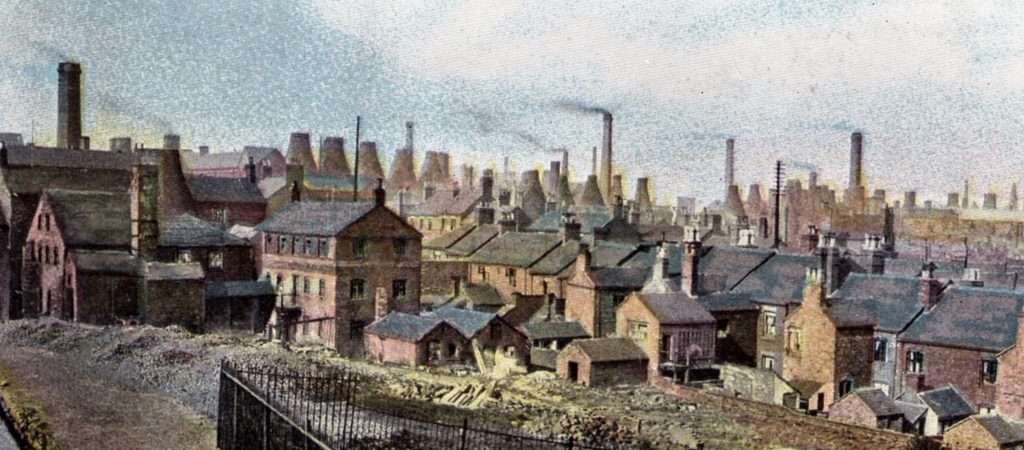
He notes that in Hanley there were 430 makers of white ware and other types of pottery, adding ‘The kilns are everywhere in this district.’ and to prove his point he includes an illustration of the skyline of the town. There were also large numbers of potteries in Stoke and other places, ‘where mostly the same kind of ware as that enumerated is made and also some simpler crockery.’ He then adds a picturesque and slightly comical tale. ‘When as it sometimes happens, many kilns are glazing with salt at the same time, there is such a thick smoke of salt in these towns, that people in the streets cannot see 6 feet ahead, which, however does not cause any difficulties. On the contrary, the smoke is considered so healthy that people who are ill come here from far away to breathe it.’
Of the pottery itself, he writes, ‘The crockery produced is mainly sent to London or other sea ports, from which much of it is exported to America and many other foreign countries.’
(Reference: R. R. Angerstein’s Illustrated Travel Diary 1753-1755, pp. 340-342)
John Wesley preaching to a crowd
Pelted in the Potteries
On 8 March 1760, the Reverend John Wesley, the founding father of Methodism, visited Burslem for the first of many visits to the region. He described Burslem as ‘a scattered town, on the top of a hill, inhabited almost entirely by potters’, a large crowd of whom had gathered to hear him at five in the evening. He noted that great attention sat on every face, but also great ignorance which he hoped he could banish.
The next day Wesley preached a second sermon in Burslem to twice the number of the day before. ‘Some of these seemed quite innocent of thought. Five or six were laughing and talking till I had near done; and one of them threw a clod of earth, which struck me on the side of the head. But it neither disturbed me nor the congregation.’ –
(Reference: John Wesley, Journal, 8-9 March 1760)
The First Cut
After receiving the royal assent two months earlier for construction of a canal connecting the rivers Trent and Mersey, on the morning of 26 July 1766, at a site just below Brownhills, pottery manufacturer Josiah Wedgwood cut the first sod of what would in time become the Trent and Mersey canal. James Brindley, the engineer who would oversee the canal’s construction, and numerous other dignitaries were present, many of whom would also cut a piece of turf, or wheel away a barrow of earth to mark the occasion. In the afternoon a sheep was roasted in Burslem market place for the benefit of the poorer potters in the town. A bonfire was also lit in front of Wedgwood’s house and many other events took place around the Potteries by way of celebration.
(Reference: Jean Lindsay, The Trent and Mersey Canal, pp.31-32)
News from the North
Extract of a Letter from Burslem, 14 August 1766,
‘As you often give me London News, I will give you some from this Country, which has of late made a Figure. This Neighbourhood has for many Years made Pots for Europe, and will still do so, though the King of Prussia has lately clapt 28 per Cent, upon them. Our Roads were so bad that nobody came to view the Place where the Flint Ware is made, but now we have Turnpikes upon Turnpikes, and our Potteries are as well worth seeing as the Stockport Silk-Mills, or the Bridgewater Navigation, which we intend to beat hollow by Lord Gower’s, now begun in our Meadows, and advancing apace towards Harecastle, on the other Side of which Multitudes of Men are at work, and before Christmas we shall have cut through the Hill, and made another Wonder of the World. There are already 100 Men employed on our Side, and 100 more will be added as soon as Wheelbarrows can be procured for them. Saturday last we had brave Sport at Earl Gower’s, where 100,000 Spectators were present at the Prison-Bars played in Trentham Park. Among them were the Dukes of Bedford and Bridgewater. The Prizes were Ten Carline Hats, with gold Loops and Buttons, given by the Earl. The Cheshire Men were active Fellows, but unluckily their Lot was to wear Plod Drawers, to distinguish them from their Antagonists, which made the Crowd oppose their getting the Honour of the Day. During this Game, my Friend Bucknall loft his Boy, about Eight Years of Age, who was suffocated by going aslant down a Sort of a Cave into an old Coalpit, the top of which was fallen in. The Man that ventured to fetch him out, found a Number of Birds, supposed to have dropped down there by the sulphurous Stench issuing from the Pit. We have much Hay, and Cheese is plenty, and Corn without Barn-room, nor do we want Money.
P. S. I have just seen a Hen, which laid Twelve Eggs only, from which she has brought up Twelve Cock Chickens, which is looked upon as somewhat remarkable.’ –
(Reference: Derby Mercury, Friday 29 August 1766, p.2)
In Praise of Mr Brindley
Extract of a Letter from Burslem in Staffordshire. dated September 5.
“Though our Stone Ware has been universally used, yet till our Turnpikes were made few People ever saw our Manufactories. But now they are gazed at as a Novelty. The Ladies go to Warburton’s to buy the Queen’s Sets of Cream-coloured Ware; and the Gentle-men come to view our Eighth Wonder of the World, the subterraneous Navigation, which is cutting by the great Mr. Brindley, who handles Rocks as easily as you would Plumb-Pyes, and makes the four Elements subservient to his Will. He is as plain a looking Man as one of the Boors of the Peak, or one of his own Carters; but when he speaks all Ears listen, and every Mind is filled with Wonder at the Things he pronounces to be practicable. He has cut a Mile through Bogs, which he binds up, embanking them with the Stones which he gets out of the other Parts of the Navigation, besides about a Quarter of a Mile into the Hill Yeldon; on the Side of which he has a Pump, which is worked by Water, and a Stove, the Fire of which sucks through a Pipe the Damps that would annoy the Men, who are cutting towards the Centre of the Hill. The Clay he cuts out, serves for Brick to arch the subterraneous Part, which we heartily wish to see finished to Wilden Ferry, when we shall be able to send Coals and Pots to London, and to different Parts of the Globe.— Another Mile is cut on the Cheshire Side of the Hill, and the Men intend to meet in the Middle by Christmas, when they are to have an Ox roasted whole, and an Hogshead of Ale.”
(Reference: Derby Mercury – Friday 18 September 1767, p.2)
Tunnel Vision
On 1 July 1772, an anonymous correspondent writing from Burslem related what he had seen the day before when he and some companions paid a visit to the first incarnation of the Harecastle Tunnel, situated between Tunstall and Kidsgrove and then under construction as part of James Brindley’s Trent and Mersey Canal.
‘Yesterday we took a walk to the famous subterraneous canal at Harecastle, which is now opened for a mile on one side of the hill, and more than half a mile on the other, of course the whole must be compleated in a short time. As it is not yet filled with water, we entered into it, one of the party repeating the beautiful lines in Virgil, which describe the descent of Æneas into the Elysian fields. On a sudden our ears were struck with the most melodious sounds. – Lest you should imagine us to have heard the genius or goddess of the mountain singing the praises of engineer Brindly, it may be necessary to inform you, that one of the company had advanced some hundred paces before, and there favoured us with some excellent airs on the German flute. You can scarcely conceive the charming effect of this music echoed and re-echoed along a cavern near two thousand yards in length.’
(Reference: Leeds Intelligencer, Tuesday 14 July 1772, p.3)
A Fungi to Be With
No age is free of stories of novelty fruit, veg or mushrooms:
‘A few days ago, a mushroom was got at Stoke-upon-Trent, in the county of Stafford, whose diameter was 5 inches, and 30 inches in circumference, it weighed 16 ounces. The above is very authentic.’
(Reference: Leeds Intelligencer, 5 September 1775, p.3)
All in a Spin
In 1781, there was the story of a curious weather phenomenon, a whirlwind or perhaps a mini tornado:
‘The following extraordinary phenomenon was lately observed here; at the latter end of last month, a field of hay belonging to Mr. J. Clark, near Burslem, was carried off by a whirlwind; the day when it happened was exceedingly calm, scarce a breath of air to be perceived. The people who were at work in the field observed, that in one part the hay began to be agitated in a small circle, at every wheel it increased in size and velocity, continually sucking more hay into its vortex; after a considerable time it began to ascend, taking along with it a silk handkerchief which hung rather loosely about the neck of one of the men who was at work; it continued ascending till entirely out sight, and in about an hour it began to descend, and continued to so for an hour’s space, alighting at, or within a few hundred yards of the place from whence it had been carried up, so that the owner lost but a very trifling quantity of his hay.’
(Reference: Hereford Journal, 23 August 1781, p.2)
A Tragic Accident
The following melancholy tale from the Potteries is related in a letter dated August 14 1785.
‘As Ellen Hulme, a poor woman of Lane End, was returning to her habitation late last night, with her infant, six weeks old, in her arm, she unfortunately stepped into a coal-pit, which shamefully lay open close to the road, and even with the track which led to the poor creature’s house. Her husband, whom she had been to fetch from an alehouse, immediately alarmed the neighbourhood, when her distressing cries were very distinctly heard from the bottom of the dreary pit every effort was attempted by the hardy colliers to fetch her up, but the damp prevailing very much, obliged them to use means to extract it, after which was found the mother with her infant upon her arms, both dead.’
(Reference: Sussex Advertiser, 22 August 1785, p.3)
A Hard Winter
During the harsh winter of 1794-1795, the better off inhabitants of Hanley and Shelton formed a committee which started a subscription list for the temporary relief the poor who were suffering great hardship during the cold weather. By February 1795 the committee had collected an impressive £150, enough to enable them to supply nearly 500 local families with meat, potatoes, and cheese. The Wedgwood family gave a liberal amount and through them a Mrs Crewe kindly added a welcome donation of a quantity of flannel clothing. The Marquis of Stafford aided the relief fund by ordering 100 tons of coal to be at the distribution of the committee.
A month later, in an issue of the Staffordshire Advertiser that noted that thermometers in Macclesfield had measured temperatures as low as -21° F (-29.4° C), the fearsome nature of the winter was highlighted dramatically by one small but rather macabre snippet of news: ‘Through the inclemency of the night of Saturday last [i.e.,14 March] a poor man perished betwixt Hanley and Bucknall. He unfortunately lost himself in attempting to cross the fields, and was found on Sunday standing upright in a snow drift, with his hand only above the surface.’
(Reference: Staffordshire Advertiser, 7 February 1795, p.3; 21 March 1795, p.3.)
Dashed to Pieces
‘A melancholy accident happened on Wednesday last at a coal-pit near Lane Delph, in the Pottery. A poor woman employed in drawing up the coal, was by some accident unfortunately thrown into the pit, and was literally dashed to pieces.’
(Reference: Derby Mercury, 30 June 1796, p.4).
Wild Fire
In late March or early April 1799, a dreadful accident happened in a pit at Lane End, the property of John Smith, Esq. Four men were blown up, and two them terribly burnt by what the colliers of the time described as ‘the wild fire’. The explosion was loud, and the concussion so great that nearby houses shook violently. Two of the men were not expected to recover, while the other two were thrown to a considerable distance, and left badly bruised. The reporter noted that their hats were blown to the distance of 70 yards from the mouth of the pit.
(Reference: Staffordshire Advertiser, Saturday, 6 April 1799, p.4)