Tag: drama

  • The World’s First Mid-Air Rescue

    On 9 July 1908, the Longton Park Fête was in full swing and as well as the numerous stalls, funfair rides and other amusements put on to beguile the crowds that flocked to the park, there was another attraction, a parachute descent was to be performed by Captain Auguste Gaudron’s team. Thrilling as this was in itself, spice would be added to the display by the descent being made not by men, but by two young women, an experienced parachutist, Elizabeth ‘Dolly’ Shepherd and a novice named Louie May. In fact, Louie May should have made her first jump the day before from a new large balloon known as the ‘Mammoth’, the biggest then in Britain. The balloon and its passengers had indeed gone up, but it had been too windy to make the jump and to console the disappointed crowd Captain Gaudron had announced that they would try again the next day. He added that they would be joined overnight by the famous Dolly Shepherd who was doing a jump elsewhere that day, but that tomorrow she and Louie would make a double descent. Sure enough, Dolly arrived in Longton later that night and though initially surprised that Louie’s jump had not gone ahead, she was happy to join her for her maiden descent. 

    Dolly Shepherd and Louie May

    This morning the day seemed perfect; the sun was out and there was no sign of the high wind that had spoilt the jump the day before. At Captain Gaudron’s request Dolly and Louie went out early and mingled with the spectators to drum up interest. This they could do without even trying. Dolly was an attractive brunette and Louie a pretty blue-eyed blonde and both of them were practically clad in – for the time – rather daring, masculine-looking blue knickerbocker suits styled loosely after a midshipman’s uniform, plus matching caps that certainly attracted a lot of attention. So too again did the Mammoth which Gaudron’s men now began filling with gas and this soon towered high over the park and stood waiting for its passengers.

    However, the weather again spoilt their plans, this time with a short but heavy downpour of rain that suddenly and rather unexpectedly caused the Mammoth to sag and then collapse. There were urgent cries from Gaudron’s team and announcements over a loudspeaker, “No smoking please. Gas is escaping.” The spectators moved back a safe distance and watched the balloon in dismay. Sensing the frustration of the onlookers, seemingly robbed of yet another chance to see the lady parachutists, Captain Gaudron now turned to Dolly and asked her if she had brought her smaller balloon with her from her previous performance. Luckily, she had left it at the train station, so a pony and trap were immediately sent to collect it while the Mammoth crumpled into an untidy heap and Gaudron’s men went in to check it over. The problem was soon identified as a faulty top valve that had been leaking and it had only needed the weight of the rain to cause its collapse. 

    All was not lost, though, for Dolly’s balloon, though much smaller in size was quite capable of lifting two people. There was no basket underneath, instead the parachute hung down beneath the balloon and the parachutist would be suspended at the bottom in a sling-like seat into which she was tied with a belt, whilst holding onto a trapeze bar. Keeping track of her altitude with an aneroid barometer on her wrist, once the correct height had been reached, the parachutist would then tug on a cord that would release the parachute via a simple mechanism. The mechanism would also cause a valve on the balloon to open, venting the gas and thus sending it back to earth. These ‘solo’ balloons were normally reserved for more advanced parachutists and it was unusual to send a first-timer up under them, maiden jumps usually being accomplished from a basket, but as that was no longer an option and with Dolly as a willing chaperone, Captain Gaudron felt confident enough to let Louie go up with her.

    When the balloon arrived it was immediately hooked up to the gas pipe and the canvas soon began to swell up into a large globular shape, the ground staff holding it down with ropes attached to the netting that covered the balloon. It was no hardship to rig it for two parachutes, one on either side to balance it up, though a second release mechanism had to be hastily improvised for Louie’s chute and this worked perfectly. Then the two women were carefully fastened into their slings and held onto their trapeze bars while the balloon was held suspended above them. With all of the delays it was now 8 p.m., and a huge crowd had gathered to watch. Captain Gaudron now gave the order, “Let go!”, the ropes were released, the two women ran forward to get under the balloon as it leapt into the air and were suddenly lifted off the ground, Dolly setting off with a jaunty wave of the silk Union Jack that she kept for such occasions.

    The plan was for the balloon to climb to a height of 4,000 feet before the two women pulled their release cords; they would then float to earth within view of the thousands of spectators. However, that height came and went and no descent was made. Instead the balloon kept on climbing higher and drifting out of sight. By this time the spectators as well as Captain Gaudron and his people, had realised that something had gone wrong. Alarmed, Gaudron soon set off in urgent pursuit of the errant balloon and its two passengers, leaving the crowds in Longton Park to slowly disperse and go home, troubled by the turn of events and anxiously awaiting news of the fate of the two female aeronauts.

    Something had indeed gone badly wrong. High in the sky above North Staffordshire away from the eyes of the assembled spectators, a scene of high drama was taking place, against which even the excitement and danger of a normal parachute drop paled into insignificance.

    Initially, the ascent to 4,000 feet had been trouble free and as Dolly later recalled, Louie had been delighted with the experience. When they did eventually reach the required height, Dolly as the more experienced parachutist called time and waited to see Louie release her chute and start her descent before she did the same. It was just as well that she did, for when Louie reached up and pulled on her release cord, nothing happened; the improvised mechanism that worked so well on the ground had jammed. Pulling herself over via a connecting rope, Dolly tried to release her companion’s parachute but to no avail and the balloon carried on ascending, passing through the cloud layer and into the clear sky above to a height of 11,000 feet. At this height the air was thin and it was getting cold and Dolly realised that the only way that they would both escape from their increasingly perilous situation would be to risk making the drop back to earth on her parachute. Using the connecting rope to pull them together once more, she now told her frightened companion what they needed to do. Painfully aware of the two mile drop below them, Dolly held them together while Louie carefully unfastened herself from her sling and the two women wrapped their arms and legs around each other tightly before letting the defective ‘chute swing away. Hoping that her own parachute release still worked, Dolly reached up and pulled the release cord and was rewarded instantly by the sight of the the balloon apparently leaping away from them as they plummeted earthward. For a few nerve-wracking seconds the parachute struggled to open, but as they exited the clouds and hit heavier air Dolly felt a familiar pull and looked up to see the parachute fully deployed above them, arresting their fall to what she hoped was a survivable speed.


    A wildly exaggerated newspaper illustration of the incident. Not only are details of the rescue incorrect but in reality Dolly and Louie’s knickerbocker suits were much more practical.

    Swinging down out of the evening sky on their single parachute, the two women now found themselves suspended over a vast tapestry of green fields, woods and little villages. The prevailing winds had taken them south-east of the Potteries in the direction of Uttoxeter. Dolly, though, was not so much concerned about where they were, but how to land safely, as with Louie restricting her movements, there was no way of steering to a softer landing spot and the ground was rushing up much faster than normal. As they neared the ground, for the first time in the entire episode Dolly felt a pang of fear and cried out in alarm, as they seemed to be heading directly for a road, the hard surface of which might prove fatal at this speed. Luck, though was on their side and moments later they thumped down into the soil of a farmer’s field,  Dolly hitting the ground first and falling backwards as Louie, still holding on tightly, landed on top of her. The impact felt like a hammer blow for both of them and Louie immediately jumped to her feet, crying that all her teeth were knocked out. In fact she was unharmed and when the initial shock had passed, the two of them burst into peals of hysterical laughter out of sheer relief at having survived such a terrifying but remarkable adventure. 

    Though Louie was fine, Dolly remained lying on her back and did not move. She felt that she had injured herself quite badly and that she needed to stay where she was until help arrived. Moments later a portly farmer appeared followed by his wife and children, then another farmer and his family, all of whom had seen the parachute coming down. They immediately offered to help Dolly to her feet but she begged them to leave her alone and call for a doctor. One of the farmers, Charles Hollins then took charge and a man was sent off to Shelton to get a doctor. The women now discovered that they had landed at Field Farm, three miles from the village of Leigh and 14 miles from Longton where they had begun their balloon ride.

    When the doctor eventually arrived he immediately appreciated that Dolly had sustained a serious back injury and had her carefully lifted into a door provided by Farmer Hollins in lieu of a stretcher. She was then transported back to the Hollins’ farmhouse where she would find herself laid up for the next 8 weeks. Here, under the doting care of the Hollins family and the watchful eyes of a couple of local physicians, who treated her with mild electrical therapy, Dolly made a remarkable recovery and to the surprise of many within a couple of months of her accident she was not only walking, but parachuting once more.

    Dolly continued with her parachuting career until 1912, when during one of her solo ascents, she claimed to have heard a voice telling her quite clearly not to come up again or she would be killed. Utterly convinced, once she had landed safely she announced to Captain Gaudron that she was giving up parachuting and immediately returned to London, where for a time she worked in her aunt’s shop. During World War One, Dolly served as an ambulance driver on the Western Front. Occasionally, she was called upon to use her driving skills to chauffeur army officers around the front; one of these she later married and finally settled down. True to her word, she never did another parachute jump.

    Decades later, though, in her twilight years, the old parachutist did mix with like-minded people once more. She was famous now not only for her pioneering achievements in parachuting, but also because she was a record holder, being officially recognised by the Guinness Book of Records, for making the world’s first mid-air rescue. As a result she was honoured by invites from the Parachute Regiment’s Red Devils and the RAF Falcons display teams and despite the ethereal warning from above not to go up again, in 1976, the elderly Dolly took advantage of her latter-day fame to take a ride up in an aeroplane with the Red Devils, to watch them perform a sky dive, but it was her last journey up into the clouds. Dolly Sedgwick, nee Shepherd, died in 1983, just a few weeks short of her 97th birthday. 

    As to what became of the other actor in that famous first mid-air rescue, Louie May, Dolly could not say. Captain Gaudron and Louie had returned to London during Dolly’s convalescence and she never saw her again. She later heard that Louie’s fiancé was livid when he discovered what she had been doing and that he had immediately spirited her away from the crazy world of parachuting and the dangerous company of Miss Dolly Shepherd.

    Reference: Dolly Shepherd, When the Chute Went Up, pp. 129-151: Uttoxeter Advertiser and Ashbourne Times 17 june 1908, p.8 and 1 July 1908, p.5.

  • Zeppelins Over the Potteries

    During the First World War, the action for the most part took place along a line of trenches stretching from the. Belgian coast, down to the Swiss border, where massed armies, huddled in their trenches, were launched in pointless attacks in the face of merciless machine gun and cannon fire. For the civilians back home the war was distant, though those left at home may have had relatives in the trenches, the Great War was an impersonal thing. True, foodstuffs were in short supply, and women took a great leap forward in society by going to work in the factories and on the farms, but the prospect of imminent death from enemy bombers, was still a generation away, or so it seemed. Then there came the Zeppelins. In a bold move, the Germans attempted to disrupt British life and industry, by sending over fleets of hydrogen-filled airships to drop bombs on anything they thought worthy of being destroyed. Two of these airships, at least, made it as far as North Staffordshire, and though the damage they did was insignificant, the authorities fell that they were such a threat to British morale, that the circumstances of the raids were not fully reported until a month after the war had ended.

    The first raiders came on the night of the 31 January 1916, Several cities throughout the Midlands were surprised to find airships over them, since few had thought that the area was within the radius of such craft. This was in the days before the blackout, and the major manufactories of the Midlands were a blaze of lights and fires, and in North Staffordshire, the glow was particularly noticeable from the pot banks and steel-works of Stoke on Trent, which were obscured only by a slight ground mist.

    A squadron of Zeppelins had crossed the coast that night. One attacked Walsall at 8.10 p.m., and later at 12,30 a.m. There, the Mayoress, Mrs. S. M. Slater, was fatally injured in a bomb blast. The Wednesbury Road Congregational Chapel was demolished by a bomb and other unspecified damage was done. At 8.30, another airship suddenly loomed out of the dark over Burton on Trent, and dropped a cluster of bombs, one of which fell on a mission house, where a clergyman’s wife was holding a service, and in the blast three of the congregation were killed and a forth fatally injured.

    Not long after the Zeppelin over Burton had begun its attack, engines were heard moving towards Trentham and the Potteries, and presently, the Zeppelin appeared, cruising slowly overhead. Its obvious target could be seen miles away, the light from the Stafford Coal and Iron Company’s blast furnaces. The raider circled the foundry like a vulture and dropped half a dozen bombs in close succession. However, these fell on the spoil banks between the colliery and the furnaces, where they made several large holes, but did no serious damage.

    German airship designer Count Zeppelin

    After that the elusive raider sneaked off. Its course was only a matter of speculation, though engines were heard over Hanley, then Wolstanton and as far west as Madeley, where it dropped a flare over open country. It’s raid, though it must have injected some excitement into the area, caused no harm and it must have used up its stock of bombs, or been searching for a secondary target.

    The second Zeppelin raid, though, was more dramatic, and took place during the night of 27 to 28 November 1916. It was a clear, dry night over the Midlands, there was the nip of an autumn frost in the air, perfect weather for an air raid. So, perhaps, at 10.45 p.m.. when the warning was received in the Potteries that Zeppelins had been sighted, few were surprised. The whole district was blacked out. and air raid precautions were put in place the special constabulary, the fire brigade and doctors and nurses were all alerted and went to their stations. Positive information was soon received that a raider was making for North Staffordshire, and at a few minutes before 1 a.m, the steady drone of aero engines was heard and the Zeppelin was sighted over Biddulph, slowly making towards the Kidsgrove-Goldenhill-Tunstall area of the Potteries. Then the bombs came crashing down.

    One unnamed witness, had been up late and was just going to bed at about 1 a.m., when he heard a ‘deep rumbling, long-sustained explosion’ and thought that there had been a serious colliery accident nearby. He went into another bedroom to ask if anyone else had heard the noise, when there were further explosions, two short sharp blasts, then another ‘accompanied by a rending sound’, then a series of four or five blasts in succession. The witness looked out of a bedroom window and caught sight of flashes off towards the Chesterton area, followed by the thudding boom of the detonations. The bombardment went on for about half an hour until the Zeppelin drew nearer to the witness’ house and dropped another bomb about half a mile away ‘that shook every brick and window in the house’, before it moved. The witness had counted 21 explosions.

    The first bomb blew a hole in a spoil bank at Birchenwood Colliery, Kidsgrove, while the second two landed not far off from the Goldendale Iron Works. The forth landed in Tunstall, impacting in the back yard of No. 6 Sun Street, and the explosion destroyed the sculleries and outhouses of Nos. 2, 4, 6 and 8, but shards hit other houses, as well as a nearby Roman Catholic church. Luckily, no one was killed and only one person was injured, a Mr Cantliffe of No. 8 Sun Street, who was hit in the chest by shrapnel, but he later made a full recovery in the North Staffordshire Infirmary. Had the raider circled in that area for a time, there is little doubt that there would have been a great deal of destruction and many more casualties, but the Zeppelin moved on, leaving Sun Street battered and bruised and in such a state that it would for days attract a horde of sightseers.

    The Zeppelin cruised over Tunstall and out across Bradwell Wood, where the burning mine hearths seem to have attracted the raider away from the areas of population. This area was just a mass of calcinating ironstone left to smoulder out in the open, but which obviously seemed to have given the impression of being an ironworks of some description. Certainly the Germans thought so, and the area was heavily bombed, watched from a distance by our nameless witness. Explosion after explosion reverberated over Chesterton, but the only damage done was to a shed that was knocked over and the closest that any other bomb got to the public, was when one of the last of these landed behind Bradwell Lane, Wolstanton. A later report summed it up succinctly as a ‘particularly futile’ attack on the area.

    As it had circled over Bradwell Wood and the area around Chesterton and Wolstanton for some time, illuminated in the flashes from the bombs, many locals had spotted the airship. But finally, spent of its bomb load, the raider turned south-east and was last sighted passing low over Blurton Farm coming from the direction of Hartshill. This was at 1.35 a.m., the Zeppelin then vanished into the dark at a ‘moderate speed’.

    There had been a number of bombing raids over Britain that night and many came to a grim end. Certainly the North Staffs raider never made it back to Germany. Lord French, reporting the fate of several of these Zeppelins in a communique, made special reference to the airship that had bombed the Tunstall area. It appeared that after leaving the North Midlands, the airship hail taken a direct route towards East Anglia, from where there was but a short stretch of sea separating her crew from their homeland. However, before she even reached the coast, the Zeppelin had been repeatedly attacked by aeroplanes of the Royal Flying Corps and by ground-based artillery. Perhaps she was damaged, since Lord French’s report noted that the last part of her journey was made at a very slow speed and the airship was unable to reach the coast before day was breaking. By the time she reached Norfolk, however, it seemed that the crew had managed to make repairs, and after running a gauntlet of coastal batteries, one of which claimed a hit, the Zeppelin was seen making off to the cast at a high speed and at an altitude of about 8,000 feet. But more planes came at her. About nine miles out at sea, the Zeppelin was attacked by four machines of the Royal Navy Air Service and further fire came from an armed trawler. Worried like a bear with terriers at her heels, the airship struggled on until gunfire ripped into her hydrogen filled body and she went crashing down in flames into the sea at about 6.45 a.m. No survivors were noted.

    Reference: Staffordshire Sentinel, Friday, 27 December 1918, p.4

  • Death of a Lady Artist

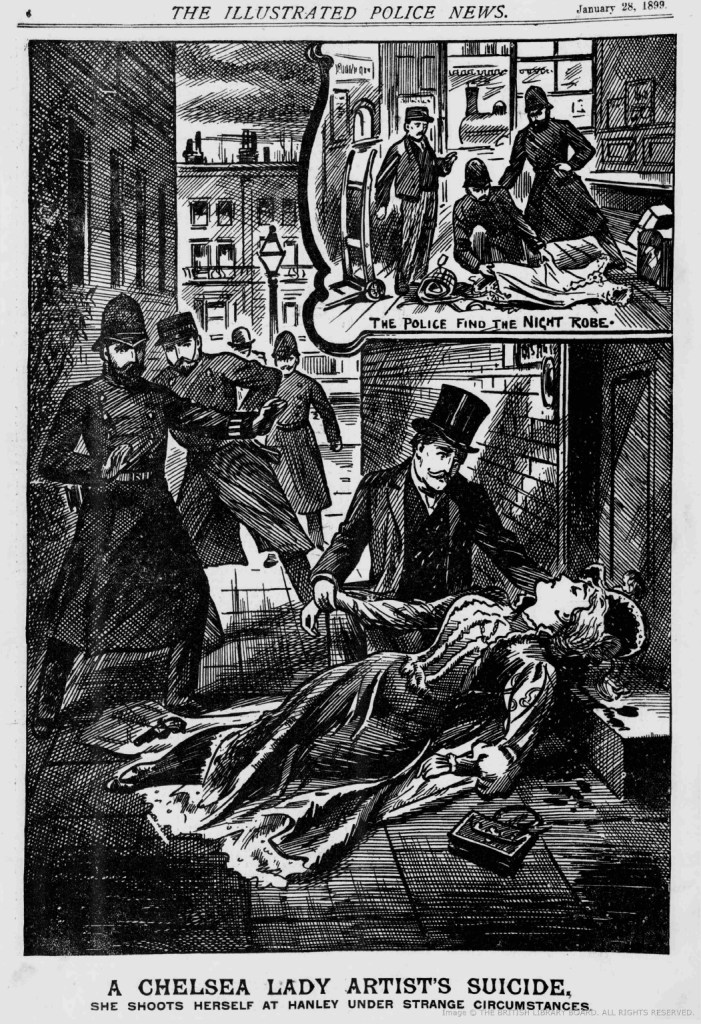
    Image reproduced with kind permission of The British
    Newspaper Archive (www.britishnewspaperarchive.co.uk)

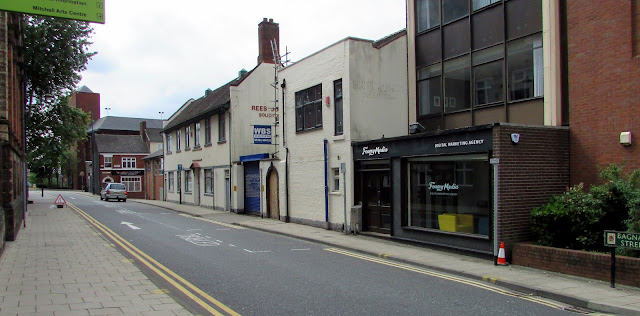
    Late in the evening of 18 January 1899, Mr Richard Smith of Stoke was walking along Bagnall Street, Hanley alongside the Victoria Hall, when he was startled by the sound of a gunshot nearby. There was no one else in sight, but he noticed that across the road, a door beside a small medical dispensary was standing part-way open. Peeking carefully through the opening into a dark passageway beyond he spotted a body lying on the floor a pistol in its hand. Alarmed, he dashed to the police office around the corner in the Town Hall and returned moments later accompanied by an inspector and several policemen. When they reached the passage they found 51 year old Dr John Craig who ran the dispensary examining the body of a woman who had clearly shot herself in the head. They could make out little more in the dark, but when the doctor announced that the woman was still breathing the police brought a stretcher and together they carried her across to the police parade room. Hardly had they got into the well-lit yard, though than Dr Craig let out a cry having recognised the woman before him. The man was visibly shocked and while a senior officer took him aside for questioning the police searched the injured woman for clues to her identity.Going through her pockets they found numerous items: some money, a few keys, a packet of arnica, a left luggage receipt from Stoke Station and several newspaper clippings, one of which carried a few lines from Tennyson’s poem, Sea Dreams.

    ……. he that wrongs his friend

    Wrongs himself more, and ever bears about

    A silent court of justice in his breast,’

    There were also receipts for recorded letters and a cryptic inscription on a visiting card that indicated a strong connection with Dr Craig. These along with the doctor’s own faltering statement soon identified the woman as Catherine Devine, a 43 year old artist from Chelsea. The doctor explained how he knew her and what he believed had just happened here and why. The lady herself, though, did not live to give an account of her actions, dying from her wound at 10 p.m., without regaining consciousness.

    Present-day Bagnall Street, Hanley.

    The full story of the connection between Catherine Devine and Dr John Craig came to light two days later in front of a packed court at the coroner’s inquest into her death. Here, Dr Craig revealed that he and Catherine had known one another for about 25 years, having first met in her home city of Edinburgh. It was there that John Craig had trained as a doctor, being licensed in 1869 and shortly afterwards he had married Ellen Macintyre a native of the Potteries, before moving to the area and setting up his practice in Hanley. His wife had given him a son and daughter, but in December 1874 she died at the age of 25, leaving him a widower with two young children on his hands.

    Among his late wife’s friends were Eliza and Catherine Devine of Edinburgh, daughters of a well-known and wealthy family of Scottish artists. Eliza had agreed to paint a posthumous portrait of Mrs Craig and whilst visiting their studio in 1876 to see how work progressed, Dr Craig had met and become so smitten with the younger sister Catherine, that he had been contemplating asking her to marry him. They corresponded for a time, but his marriage hopes had faded a short time later, when Catherine and several members of her family emigrated to New Zealand in 1878. Robbed of his potential bride the doctor had little choice but to get on with his life as a single parent and as the years passed he became very content with this state of affairs.

    Catherine remained in New Zealand and later Australia for eleven years, carving out a moderately successful career as an artist, but in 1889 she returned to Britain. Settling in a studio flat in Glebe Street, Chelsea, her skills soon saw her supplying artwork for several London fashion magazines and eventually holding an exhibition of her works. To this she invited several old friends including Dr Craig. This restarted their acquaintance and they corresponded intermittently for a few years until Catherine was invited to spend Christmas with the Craigs at their house at Mossley near Congleton. During this visit, Dr Craig innocently noted to Catherine in conversation that prior to her departure to New Zealand he had contemplated asking her to marry him, and was surprised when she immediately asked him why he could not ask her now? The doctor replied that time had altered his circumstances, that he was content and he now had no thought of marrying anyone. Catherine seemed to accept that at the time, but the remark had struck a chord with this brilliant but lonely woman and she soon started to obsess over the matter.

    Apparently oblivious to what he had started, Dr Craig extended another invitation for Catherine to stay once again a few months after this, but she soon upset the situation by again urging Dr Craig to marry her. He again refused and the next morning, whilst he was out, Catherine left the house under a cloud. Returning to find her gone, Dr Craig was left feeling very angry at her behaviour and that might have been the end of the matter, but a few months later he received a conciliatory letter from Catherine and he agreed to meet with her at her home in London when he visited the capital for Queen Victoria’s Jubilee in 1897. After watching the festivities he did indeed call on Catherine, prepared to let bygones be bygones, but when she again raised the subject of marriage he left in disgust and vowed never to visit her again.

    Catherine then began to bombard Dr Craig with a series of scathing letters on his conduct that were followed more often than not by apologetic letters or telegrams asking him to reply. The doctor did reply to some to try and calm her down, especially when she began to threaten to kill herself. However, staggered by the barrage of letters he began to receive and the increasingly erratic mood swings of his would-be paramour, Dr Craig started to burn many of the letters unopened.

    This state of affairs had carried on for the best part of a year, during which time Dr Craig had attempted to maintain his distance from Catherine. The death of her mother, though, in October 1898, seems to have made him sympathetically disposed towards her once more and shortly afterwards he met her again during a visit to London. He found her in a miserable state and recalled that she was in tears most of the time. Her one consolation was that she now wrung a promise from the doctor that if he would not marry her then he would marry no one else, an assurance he was happy to give. She also asked if she might be invited for Christmas once more if she avoided the question of marriage. Dr Craig told her that he and his daughter were in the process of moving into a house in Hanley adjoining his practice and would anyhow be in Northumberland visiting his mother over Christmas. He promised her, though, that once they had moved in after New Year, that she would be invited for a visit. Satisfied with this, Catherine parted amicably with Dr Craig and eagerly waited for the invitation to arrive.

    Sure enough a few weeks later a letter did come, but the news it contained flung Catherine back into a rage. Dr Craig wrote to her saying that due to the work needed on the new house and because his daughter would be going abroad for a while, he did not feel that he could accommodate Catherine before his daughter’s return in March; in effect, for the time being at least, she couldn’t come. Stung by what seemed like another heartless rejection, Catherine wrote a furious reply saying that he had deceived her, adding ominously that she could not go on like this. It was a threat she had voiced before, but this time after all of the mental agonies she had suffered over the past year, it seems that Catherine had finally snapped. In the notes discovered after her death it appears that she wrote more letters to Dr Craig, but, as before, finding himself pestered beyond belief, the doctor had once again begun to burn the letters unopened. He was thus completely unaware of what she now set out to do.

    Nor would he be the only one, as to most of her London friends the story of Catherine’s violent passion for Dr Craig would come as a great surprise, as she had displayed no outward signs of any great interest in men except as friends. All noted that she had been ill over the past year, stricken by a listlessness that her own physician, Dr Schorstein, put down to anaemia, but otherwise she seemed to be the same kindly, mild-mannered woman she had always been. As a result, none of them were aware – or could even have guessed – that Catherine spent early January 1899 preparing for her death, finishing a portrait of her doctor and wrapping up her affairs.

    On the morning of 18 January, Catherine paid a visit to her housekeeper, Mrs Stoner, who had injured her wrist several days before and she now made sure that the elderly lady had everything she needed. Catherine told her that she would be going to Staffordshire for a few days, joking that it would give Mrs Stoner a rest from her. Back in her flat, Catherine left a package with a letter in her writing desk laying the blame for what she was about to do squarely on Dr Craig. Then she dressed well, putting on a fashionable lady’s walking-out costume, collected a nightdress she had wrapped up in brown paper (the police speculated that she brought the nightdress with her to be used as her shroud), a travelling rug, an umbrella and her purse containing money and a few notes to give the police enough clues to discover her story. She also pocketed the small, silver five-shot revolver that she kept for personal protection. Catherine then sent for a cab to Euston Station to catch the 4 p.m. train to Stoke. As she left, Catherine waved goodbye to her housekeeper and that was the last time that anyone who knew her saw her alive and conscious; it thus became the job of the police to reconstruct her last hours for the benefit of the inquest.

    After a three hour journey north, the train arrived at Stoke Station at 7.14 p.m., and it appears that, after depositing most of her belongings at the left luggage office, Catherine had walked from Stoke into Hanley. Never having visited Dr Craig’s new house in Bagnall Street, she seems to have taken the better part of an hour locating it. Once she had, though, Catherine went into the gated entry where she removed her right glove to give her a better grip and taking out the pistol she placed the barrel against her right temple and pulled the trigger, inflicting the fatal wound.

    Because of Catherine’s accusations against him, Dr John Craig found himself being closely questioned at the coroner’s inquest in an effort to determine if he was in any way morally responsible for what had taken place. Indeed, the doctor feared so much for his reputation that he had employed a solicitor to sit in on the inquest to represent his interests in the proceedings. However, the coroner was satisfied with the explanation that Dr Craig had given to the inquest; nor did the police see any reason to pursue the matter any further. The jury thought likewise and quickly returned the verdict that Catherine Devine had committed suicide whilst of unsound mind.

    The final act in this tragic tale of missed opportunities and fatal obsession took place the day after the inquest, on Saturday 20 January, when the remains of Catherine Devine were interred at Hanley Municipal Cemetery. To avoid undue attention, the funeral took place a day earlier than advertised and the funeral cortège took a circuitous route to the cemetery for the same reason. Two of Catherine’s London friends, Miss Maud McCarthy and Dr Schorstein, who had appeared at the inquest, were the only mourners and not more than a dozen people stood around the grave in the pouring rain as the last rites were performed. As this was a suicide’s burial, there would be no headstone to mark her lonely plot, while the brass plate on the polished oak coffin bore only the simplest inscription.

    Catherine Devine
    Died Jan. 18 1899,
    Aged 43 years.

    Reference: Staffordshire Sentinel 19 – 23 January 1899. Numerous national and international papers January – March 1899.

  • The Curious Case of the Dwarf and the Bulldog

    Brummy and Physic battle it out. From James Greenwood’s Low Life Deeps (1876).

    In a detailed and lurid article published on 6 July 1874 in the Daily Telegraph, investigative journalist James Greenwood claimed that several days earlier on 24 June, during a brief stopover in the Potteries, he had hoped to find evidence of illegal organised dog fighting, but that he and a large crowd of onlookers had instead witnessed a brutal fight in a cellar in Shelton between a grizzled, muscular dwarf named Brummy and a ferocious bulldog named Physic, a battle that the man had barely won. The national scandal that resulted from this shocking article seriously embarrassed the area for a time and questions were even asked in Parliament.

    However, all was not quite as it seemed and once the initial furore had died down the tables were quickly turned on Mr Greenwood, as subsequent investigations by the police, the local authority, other newspapers and the RSPCA, not only highlighted the numerous glaring discrepancies in Greenwood’s tale, but more tellingly found no absolutely evidence whatsoever that such a fight had taken place. Rather than sticking rigidly to the story he had spun, Greenwood then started to back-peddle, changing or mitigating parts of the tale to excuse himself and explain why there was no proof to be found, all of which excited a great deal of derision from other papers. The upshot of it all was that within a few weeks it was widely concluded that Greenwood had simply made the story up, or adapted a dubious scrap of Staffordshire folklore that he may have heard during his stay in the area. Following the RSPCA’s investigation and the report they sent in to the government, the Home Secretary of the time came to the same conclusion and on 20 July wrote a reply to the Hanley Watch Committee, which stated that he was satisfied that the story of the fight was false.

    Greenwood had thus been called a liar at the highest level and Hanley’s good name was restored, but mud sticks, and the tale rankled with the people of the Potteries for a good while after. In 1907, Local author Arnold Bennett summed up the lingering ill-will towards the reporter and his tall tale in his short story ‘The Death of Simon Fuge’.

    ‘The only man who stands a chance of getting his teeth knocked down his throat here is the ingenious person who started the celebrated legend of the man-and-dog fight at Hanbridge. It’s a long time ago, a very long time ago; but his grey hairs wont save him from horrible tortures if we catch him. We don’t mind being called immoral, we’re above a bit flattered when London newspapers come out with shocking details of debauchery in the Five Towns, but we pride ourselves on our manners.’

    Reference: James Greenwood, Low Life Deeps; Staffordshire Sentinel, July 1874; numerous national newspapers and magazines July 1874.