Tag: diaries

  • Visiting Burslem’s Houses of Ill Fame

    The oldest profession in the world had its place in soft underbelly of the Regency Potteries. Prostitutes plied a regular trade usually around the local inns where there were rich pickings when the potters and miners rolled in with their wages. A brief memoir of the period reveals that then as now many of the local working girls were ordinary women driven to extremes by circumstances, the probable cause being abject poverty. A Short Memoir of Ann Sheldon, published in 1821, tells the story of the short life of a dedicated Burslem Sunday School teacher. Constructed around entries in Ann’s diary, it reveals her to have been a noble spirited young woman, who saw it as her Christian duty to visit the sick and try to save the fallen.
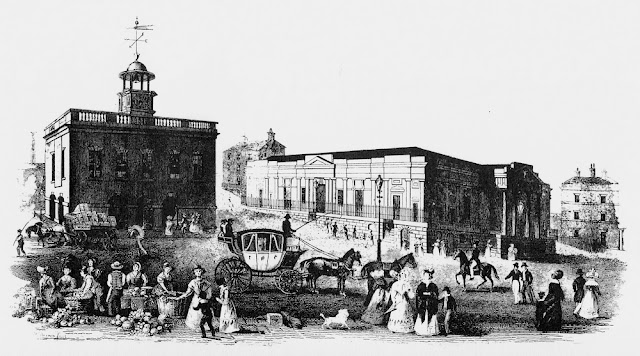
    Burslem town centre in the early 19th century.

    In April 1813 following a class, one of her class members asked Ann if she would visit a woman who was very ill. Accompanied by a fellow teacher ‘Miss B’, she went to see the woman whom she soon discovered to be a local prostitute. They found her to be, ‘a little better and very penitent.’ Ann continued : ‘she had been a very wicked woman for years, and is now little more than 30 years of age. Her parents died when she and her sister were young. As they advanced in years they got into bad company and lost their character. Masters would not employ them and they became common prostitutes.’ The woman, exhausted and frightened by her illness, told the two teachers that if she lived she was determined to leave her ‘wicked course of life.’

    After praying together they left her. The two young teachers had obviously been shocked by the interview and though the nature of the woman’s illness is never stated, the impression we are left with is that it was contracted as a result of her calling. Both came away from the house burning with a desire to save others from such a dangerous and degrading career.

    The next day, Ann and Miss B set out once more and found a woman to direct them to the ‘houses of ill fame’. They visited two buildings, but met with a mixed reception, made all the more galling no doubt, by the fact that at least two of the girls they encountered were old Sunday school scholars.

    In the first house ‘we found a young woman about seventeen years of age, who lived by herself, and was three years ago a Sunday scholar.’ The girl was unmoved by the teachers’ entreaties, Ann went back many times to invite her back to the school, but to no avail.

    There were two women in the other house: ‘we found a woman about twenty-seven years of age; who met in class about two years ago: we both spoke as close as possible for an hour and a half; they shed many tears and confessed they had a hell upon earth. There was another woman present, a companion in sin, who appeared to take no notice: – I said to her come down on your knees, and cry to the Lord, to have mercy upon your soul, before it is too late: we all bowed the knee before God, and found much liberty in prayer.’

    It is unknown whether Ann and Miss B efforts were successful. The biography remains silent on the matter. Ann herself died at a young age in 1819.

    Reference: John Tregortha (publisher) A Short Memoir of Ann Sheldon, Burslem 1821

  • Diary of a Bad Boy

    On the morning of Wednesday 8 April 1908, the curious adventures of Moses Newell a somewhat grimy but innocent-looking 13 year old boy, were related to the Magistrates Mr J. P. Pratt and Mr P. Elliott at Fenton Police Court when he was brought before them on the charge of stealing a purse containing 11s, 4½d that belonged to his mother who lived at 17 Park Lane, Fenton.

    Newell had left home on the previous Saturday and nothing had been seen of him until early that morning when he had been discovered sleeping in an ash pit behind Clarence Street, Fenton. Of the stolen money only 1s, 4d was found on him along with a small diary, some cigarettes and a few other items. The magistrates were left in no doubt as to the boy’s guilt or about what he had been doing with the money over the last four days, as the guileless youngster had been good enough to keep an account of his crime and his subsequent adventures in his diary, which were read out to the court. It was an exacting record of nothing less than a sustained eating and spending tour of the Potteries towns.

    Saturday – Left home at dinner-time, having stolen a purse containing 11s, 4½d. Went to Hanley market, and had a twopenny potato pie, a cup of tea and a penny cake. Bought a purse and then two ha’penny books. Went into another cake shop and had another cup of tea, and stopped there until the theatre was open. Went to the Theatre Royal “Fourpenny Rush,” came back to Fenton, and slept in ashpit.


    Sunday – Went to Longton and into cake shop. Had two penny herrings, a pen’orth of bread, a pint of tea. Cost me 4½d altogether. Went into icecream shop, and had a pen’orth of icecream, a ha’penny “cornet,” a penny drink, and then a wafer and another pen’orth of icecream, and a penny drink with icecream in it. On Sunday afternoon went into same cake shop, and had two-pen’orths of Yorkshire pudding and a cup of tea. Came back to the icecream shop and had some more icecream, and stayed playing. Went back to ashpit.


    Monday – Got up at a quarter to seven, walked to Hanley, bought a ha’penny book, went on car to Burslem. Bought a purse. Went into cake shop, but they had nothing ready. Walked round the stalls, and had a pen’orth of toffee. Went into cake shop. Had a cup of tea. I fetched some coal for her and she gave me a penny, and I had another cup of tea and some sandwich. Bought two ha’penny books – “Dick Turpin” and “Robin Hood.” Went to Longton again. Cost me threepence going and threepence to go to the theatre. I had a bottle of “pop,” two oranges, and I paid for another boy threepence to go in and gave him twopence. He bought some “fags” and fetched me some.


    Tuesday – Got up about seven. Got a car and went to Longton cake shop. Had two-pen’orth of meat, two-pen’orth of bread, and a pint of tea. I stopped in the cake shop until dinner-time. Had a penny bowl of soup and another pint of tea. Got a car to Hanley and thought I would go to theatre, but did not. I got a car again and went to Burslem. Went in another cake shop. Bought a penny bowl of soup, ha’porth of bread. I had a pen’orth of tea and went to Drill Hall (Poole’s entertainment), and paid twopence to go in. Bought a pen’orth of chocolate, ha’penny wafer, ha’penny glass of “beer,” and had another pen’orth of chocolate. When I came out I had a penny bottle of “burdock.” Got on the car to Hanley, and came to Fenton and got in the ashpit again.’

    On the morning of Wednesday 8 April, though, young Newell’s spending spree came to an inglorious end when he was woken by a woman throwing ashes on him. Newell told the court that at first he thought it was a cat and then he thought it ‘as a fowl pecking him.’ The woman got hold of him and pulled him out of the ashpit and gave the boy a cup of tea. The authorities soon learned of his discovery and he was subsequently arrested by PC Ford for the theft of the purse.

    After hearing the excerpts from Newell’s diary the magistrates remanded the boy for a week in order that a home might be found for him. A week later on 15 April, he was brought before Magistrates Mr Harold Wright and Mr A. Edwards at Longton on the charge of having wandered abroad without proper guardianship. His mother Fanny Williamson said that the lad was beyond control and that whenever he did something wrong he stayed away from home. The previous September and October he had disappeared for two months and could not be found. He had eventually come back, but had been away since then. On Saturday he ‘had been found in the pigeon place’, but later that day he had again absconded, this time with his mother’s purse and money. The woman was evidently at her wit’s end with the boy and the Stipendiary Magistrate Mr Wright said that the best thing to do was to send him to Werrington Industrial School until he was 16 years old. 

    Little is known of Moses Newell’s later life, though after serving his sentence he moved out of the area; at the age of 16, in the 1911 census, he was recorded as working as a servant on a farm in Ruthin, Wales. Neither the Medal Rolls nor the Commonwealth War Graves records for World War One list his name, so this artful dodger seems to have managed to slip away again.

    Reference: Staffordshire Sentinel, 8 April and 15 April 1908.