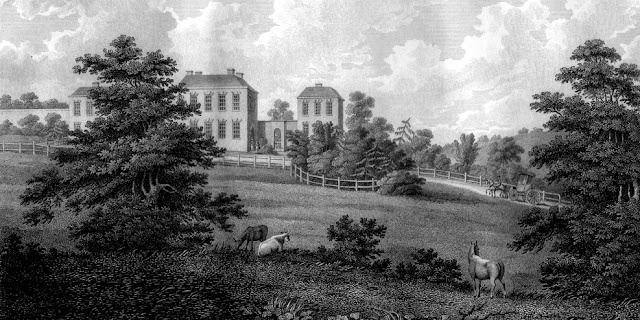
Smithfield Hall c. 1794. Detail of an engraving by W. C. Wilson after an illustration by E. Dayes. The field in the foreground may be where Theophilus Smith attacked Peter Wainwright. (Author’s collection)
During a visit to Liverpool, a financially insecure pottery manufacturer, Theophilus Smith of Tunstall, asked one of his creditors, a merchant named Peter Wainwright, to return to the Potteries with him for a meeting. Very early in the morning of 21 June 1800, after travelling most of the way back to Tunstall, Smith stopped their carriage near to his home Smithfield Hall and said to Mr Wainwright, that as he wished to avoid being seen that they should proceed the remaining short distance across the fields on foot.
The two men were seemingly on good terms and had enjoyed a pleasant ride despite the distance, but as they crossed the field in the half-light before dawn, suddenly and without warning Smith drew a gun from his pocket. Thinking that the desperate potter was about to shoot himself, Wainwright pounced on the man, wrestled the gun out of his hand and threw it away. The crisis seemed to be over, but moments later as they continued their walk, Smith drew another pistol and fired at Mr Wainwright, but missed. The two men fought and Smith was thrown to the ground and begged forgiveness of his would-be victim. Evidently stunned by events, Wainwright relented and even let Smith get up and go to collect a coat he had left behind after leaving the coach, never thinking that Smith may have another pistol hidden there, which he produced as they neared his home and shot Wainwright through the body just below the stomach. Though badly wounded Peter Wainwright again fought back, but Smith then drew a knife, lashing out, and the merchant received numerous cuts to his hands and jawline before he finally threw his attacker off. Smith then retreated to his house, leaving the badly injured man to stagger several hundred yards to a neighbouring cottage for help. Doctors were called who at first despaired of his wounds, but against the odds Mr Wainwright survived, though he spent several weeks lodged in a gentleman’s house, recovering from his wounds and the shock of his ordeal.
The alarm was immediately raised and constables raced to Smithfield Hall to arrest Theophilus Smith, but he had already fled his home and 50 guineas were offered for his capture. This was achieved a few weeks later in London where Smith was arrested without incident in his lodgings by the Bow Street Runners. Sent for trial at Stafford, Smith was easily found guilty and sentenced to hang, but he cheated the hangman when on New Years Day 1801, whilst in the hospital at Stafford Gaol and having by some means got his hands on a couple of pistols, he shot and wounded his wife who was visiting him, then shot himself through the head, dying instantly. It has been suggested that this final act and Smith’s earlier attack on Mr Wainwright were because he suspected that Wainwright and his wife were lovers, though there seems to be no clear evidence to support this.
So ended the mysterious affair of Theophilus Smith, at least for the protagonist, and it turned out his was the only death to result from his sudden murderous mania, as Mary Smith like Peter Wainwright before her recovered from her wounds. By the end of February 1801, it was reported that she was well enough to leave Stafford and she seems to have returned to her family in Whitchurch, Shropshire. Before the year was out both Smithfield Hall and the Smithfield estate were sold to John Breeze, who renamed both ‘Greenfield’ to disassociate them from the stigma of Smith’s crimes. What happened to Mary Smith after that is unclear. If there ever had been any romantic association between her and Peter Wainwright it was never rekindled.
After recovering from his severe injuries Mr Wainwright had returned to Liverpool, but he did not long remain in Britain. Many years previously, before the War of Independence, he had settled in the American colonies and had stayed on there for some time as a successful tobacco merchant. In 1790, he had married another English emigrant, Elizabeth Mayhew, before returning to Britain in the early 1790s prior to the birth of their first child. Now, perhaps, the shock of the attack and the ill rumours it had promoted had made him reconsider the move and in either late 1801 or 1802, Wainwright returned with his wife and children to the United States of America, settling in near his wife’s family in Boston, where he continued to trade successfully for many years. Their children would stay on and prosper in the New World, but he and his wife eventually moved back to Britain, she dying in 1829 and Peter on 10 January 1841, aged 81.
Reference:Staffordshire Advertiser, 12 July 1800, p.3; 19 July 1800, p.4; 2 August 1800, p.3; 3 January 1801, p.4; The Annual Register 1800, Vol. 42; Bury and Norwich Post, Wednesday, 25 February 1801, p.2.
In early March 1783, the local economy was in decline and people were going hungry. A poor harvest the year before plus the knock-on economic effects of the American War of Independence had caused food to become scarce and prices to rise sharply and a number of food riots broke out in Newcastle and the Potteries as a result. The most serious of these took place around the canal at Etruria and may well have been started by some of Josiah Wedgwood’s workers.
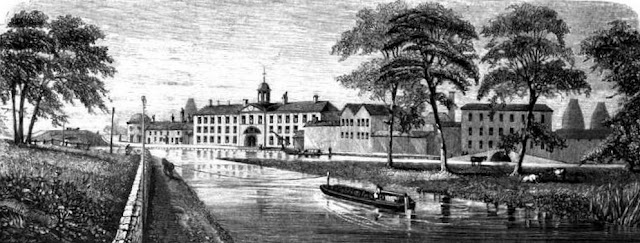
A view of Wedgwood’s Etruria works from across the canal. From The Life of Josiah Wedgwood (1865) by Eliza Meteyard.
There had been some trouble in Newcastle for several days and the rioters there seem to have joined or inspired the riot that broke out at Etruria on Friday 7 March. The trouble started when a barge carrying much-needed supplies of cheese and flour moored up at Etruria where the food was to be off-loaded before being distributed around the Potteries. However, at the last moment the barge’s owners decided to send the boat on to Manchester. Within a short time of this decision shop owners in Hanley and Shelton heard the news and they in turn informed their angry customers. They had probably heard about the barge’s departure from some of Wedgwood’s own workers, certainly that suspicion was voiced in a letter written by Josiah Wedgwood junior, son of the famous potter. Later that same day Josiah junior wrote to his father (who was then in London on business) describing how when the news spread about the departing barge, several hundred men women and children had quickly gathered and chased after it along the canal, finally catching up with it at Longport. Believing that the boat had been sent away to increase the scarcity of provisions and thus up the prices even more, the crowd were in a black mood and not to be trifled with, so when they found that the bargee would not pull the boat over one of the crowd leapt aboard to tackle him. The boatman immediately cut the tow rope and slashed at the man with his knife and voices from the crowd on the towpath called out “Put him in the canal.” A ducking may well have been the man’s fate had not another bargee come to his rescue and he had been able to escape onto another craft, albeit leaving his own barge in the hands of the mob as he did so.
The captured boat was then hauled it back to Etruria in triumph and by late afternoon was tied up alongside Wedgwood’s Etruria works where the crowd unloaded the cargo into the factory’s crate shop. Most of the rioters then went home meaning to return the next day for distribution of the goods. In the meantime a few men were set as guards. At about 7.30 that evening four of these sauntered up to Etruria Hall and asked for something to eat and drink while they were on watch. Another of the Wedgwood children, Josiah’s older brother, 17 year old John went to them and stood talking with them for a time then too did their mother Sarah Wedgwood, who also spoke with them for a while before the men went off. The nervousness of the Wedgwood household at this point is, evident in young Josiah’s hasty missive to his father, but the family were not bothered any further that evening and at breakfast the next day things were still quiet.
On the Saturday morning the crowd gathered back at the canal side and some of the goods seized the day before were sold off at what were considered by the crowd to be more reasonable prices. One of the letters states that this was at two-thirds the normal price, while sometimes the goods were given away. The meagre proceeds were then handed over to the disgruntled owners of the captive barge. The authorities meanwhile had taken steps to deal with the rioters. An express message had been sent to Lichfield asking for some companies of the Staffordshire Militia to come to their aid. Closer at hand, though, were a company of the Carmarthen Militia who that day had arrived in Newcastle on their way back to Wales. Due to the troubles in Newcastle itself and now in Etruria, the commanding officer was asked if he could help in dealing with the rioters. He agreed, and the force put itself at the disposal of the local magistrates who now had the job of quelling the disturbances.
Some justices went to meet with the mob still gathered around the captured boat, but the Militia were kept at a distance while the officials tried to settle matters peacefully. Here the letters are at odds with one another, one stating that all efforts to get the mob to disperse, including getting the master potters (whose workers formed the bulk of the mob) to try and influence them, but to no avail, while the other letter states that the magistrates’ efforts were a success and that the mob agreed to leave, providing the boat was left where it was. Judging by the fact that several days later the mob was demanding the return of the boat the latter seems the most likely state of affairs, but the details still remain confused.
Nothing of great significance seems to have happened on the Sunday, though some of the local manufacturers and officials held a crisis meeting at Newcastle to discuss how best to calm the situation down and deal with the mob. A subscription was entered into perhaps to placate the rioters, Josiah Wedgwood’s son John was present at the meeting and donated £10 to the fund. But after the quiet Sunday, Monday saw a return to the stand-off of previous days as the mob gathered at Etruria once more. This time they were in a far more bullish mood and sent messengers to the magistrates outlining their demands, namely to have the boat delivered back to them and its contents sold there.
After a quiet Sunday, Monday saw a return to the stand-off as the mob gathered once more, this time outside Billington’s (probably the premises of Richard Billington, who carted coals for Wedgwood and rented 38 acres of the Etruria estate), where there was a meeting of the master potters and several officials. These included John Wedgwood in his father’s stead, Dr Falkener of Lichfield, Mr Ing and Mr John Sneyd of Belmont (a neighbour of the Wedgwoods), who harangued the mob on their bad behaviour and the detrimental effect it would have on the price of corn, as too did John Wedgwood and Major Walter Sneyd of the Staffordshire Militia. The latter was there at the head of a detachment of the Staffordshire Militia, who stood by ready if needed. The masters and officials though still hoped that the rioters would listen to reason and a generous subscription was again raised, John Wedgwood giving £20 this time. The mob, though, did not accept this graciously remarking caustically that the money would not have been provided had they not caused trouble and made the manufacturers sit up and pay attention. They continued calling for the boat to be returned to them and the corn to be sold on fairly. Their demands became so loud and threatening that the Riot Act was read out and the mob was told that if they did not disperse to their homes in an hour’s time, that the Militia would be ordered to fire on them. The crowd, though, were defiant, jeering that the militia men dared not fire on them and that if they did then the rioters would attack and destroy Keele Hall, the ancestral home of the Sneyd family of Major Sneyd was the current heir. According to some accounts the rioters also put their women and children at the front confident that the soldiers could not fire on them.
Despite this, after the hour had passed, the chief magistrate Dr Falkener was apparently on the verge of ordering the nervous militiamen to fire, when two of the rioters accidently fell down and made him pause and consider his actions. One of the Sneyds, huzzaring as he did so, got about 30 of the men to follow him, intending perhaps to charge the mob, but his effort was thwarted by women in the crowd who called out, “Nay, nay, that wunna do, that wunna do.” and embarrassed by the mocking cries the militiamen baulked, turned back and left the crowd alone. Unable or unwilling to take firm action, the officials agreed that the corn taken in the boat should be sold on at a fair price. And for now that was that and the crowd had their way. The magistrates, though, were now determined to make the leaders of the riot pay for the trouble they had caused and to bring the disturbances to an end once and for all.
Two of the ringleaders of the mob had been quickly identified as Stephen Barlow and Joseph Boulton. According to report, Barlow was born in Hanley Green, was aged about 38 and seems to have had a chequered history prior to the riots, having apparently served in the Staffordshire Militia, but had been drummed out for bad behaviour. He may also have had previous with the law as records show that four years earlier at the Epiphany Assizes at Stafford of 1779, one Stephen Barlow was in court for some unspecified crime he had committed in Penkridge. At some point he had married and by 1783 was the father of four small children and was living in Etruria. The authorities certainly knew where to look for him and that night after the riot, magistrates and constables converged on his house. On hearing the men at the door, Barlow quit his bed naked and attempted to escape by climbing up the chimney. He probably would have got away except that in his haste he dislodged some bricks and when his pursuers came out to see what was happening they caught sight of him hiding on the roof behind the chimney stack. When he was brought down, Barlow refused to get dressed and though it was a cold night suffered himself to be transported stark naked all the way from Etruria to Newcastle. After subsequently being taken to Stafford Gaol, Stephen Barlow was held there until his trial.
So too was Joseph Boulton, but he remains a shadowy figure in this drama as nothing seems to be known of his background. Beyond noting that two ringleaders had been captured at home that night and sent to Stafford gaol, his name was not mentioned in contemporary newspapers, though John Wedgwood who was at Stafford to witness the trial wrote to his father in London and noted that the man had been acquitted by the court. Stephen Barlow, on the other hand was not so lucky. The judge in summing up at the trial on 15 March, detailed Barlow’s offence and laid out the law regarding riots in the clear and clinical manner of the Riot Act. “That all persons to the number of twelve or more, who remain in any place in a tumultuous manner after proclamation has been made for the space of one hour, subject themselves to an indictment for capital felony.” In other words, the death sentence.
The message this sent out was clear, namely those hundreds who had assembled and been involved in the rioting on 10 March, most of whom had since either fled the area or had thus far escaped detection, were just as guilty as Barlow and could expect the same treatment if caught and convicted. Barlow meanwhile was sentenced to death without a quibble and on Monday 17 March 1783, exactly a week after the riot, at Sandyford near Stafford, he was escorted to the gallows by a body of militia and there he was hung by the neck until he was dead. His body was then returned to the Potteries and buried locally two days later.
It had been a startlingly quick chain of events which did indeed have the desired effect quelling any further disturbances, but it perhaps shocked many law-abiding citizens too, disturbed by such arbitrary use of the law. Looking back from over half a century later even local historian John Ward – who as a solicitor and witness to the Pottery Riots of 1842 had very little sympathy with rioters – seems to have been taken aback by this blatant show trial. Writing about Stephen Barlow, he noted that he ‘became a victim rather to the public safety, than to the heinousness of his crime.’ According to some accounts Barlow was not the only victim, as more than one paper reported briefly that following the execution, Barlow’s wife hung herself in despair.
Reference: John Ward, The Borough of Stoke-Upon-Trent, pp. 445-446; Ann Finer and George Savage (Eds.), The Selected Letters of Josiah Wedgwood p.268: Correspondence of Josiah Wedgwood, Vol. 3, pp. 8-9; Derby Mercury, Thursday 13 March 1783, p.3; Cumberland Pacquet and Ware’s Whitehaven Advertiser, Tuesday 25 March 1783, p.3; Manchester Mercury, Tuesday 25 March 1783, p.1; Kentish Gazette, Saturday 29 March 1783, p.3; Northampton Mercury, Monday 24 March 1783, p.3; Stamford Mercury, Thursday 27 March 1783, p.2; Ipswich Journal, Saturday 22 March 1783, p.1; Hereford Journal, Thursday 3 April 1783, p.3.
The Rough Fleet, an amorphous gang of street thugs under the leadership of John ‘Mad Jack’ Wilson were a terror to the locals, notably in and around Hanley, for many years at the very beginning of the 19th century. Born in 1787, Wilson was the eldest surviving son of David Wilson, a respectable pottery manufacturer who ran the Church Works, Hanley, which stood on ground between St John’s Church and what later became Hanley Deep pit, ground now given over to the swirl of roads and traffic islands where Town Road coming out of Hanley joins the Potteries Way. John Wilson was also the man who accidentally killed his brother and niece when he was firing off cannons to celebrate the Hanley Wakes in 1807 (see ‘An Awful and Melancholy Accident’ above). Maybe this family tragedy had in some way adversely affected him and set him on the criminal path he henceforth followed, but it is easy to look for excuses for bad behaviour and there is too little information on John Wilson’s early days to know for sure what started him on his criminal career; perhaps he had always been a bad lot who just got worse over time.
The approximate site of the Church Works just outside of the centre of Hanley Source: Google Earth
Concrete information on the early origins of the gang is likewise thin on the ground. Writing in the early 1840s and thus well within living memory of events, John Ward in his history The Borough of Stoke-upon-Trent, noted that ‘In the years 1808 and 1809 a gang of reckless young men, some of whom were respectably connected, carried on a system of nocturnal outrage, rather from a wanton and mischievous spirit, than for the sake of plunder, which greatly annoyed and terrified the peaceable community. They obtained the name of The Rough Fleet, from their daring and buccaneering-like exploits’. This may have been when they started their reign of terror, but if so it seems that they continued causing trouble and dodging any real justice for the better part of a decade before the gang’s chief members were finally brought to book.
Between 1816 and 1818, The Staffordshire Advertiser noted that the gang or its individual members were involved in several brushes with the courts for assaults, riotous behaviour and attempted shootings. At the Swan Inn in Hanley’s Market Square in early 1816, John Wilson was confronted in the bar by one outraged local, potter John Sheridan of Cobridge, who accused him of threatening his life and shooting at him, describing Wilson as ‘the terror of the neighbourhood’ and ‘the Captain of the banditti’. Wilson took Sheridan to court for slander when the latter accused Mad Jack of murdering his own brother, but he lost the case perhaps as a result of the growing ill-feeling towards him and his confederates. Incidents continued to be reported through to early 1818, while in the same paper John Wilson’s financial fall was also chronicled. His father David Wilson had died suddenly in 1816 and as John was his heir, the Church Works and family business had passed to him. Little good he did with it, though, being more interested it seems with his incessant drinking, partying with his gang and trouble-making and by July 1817 he was declared bankrupt and as numerous notices in the papers showed, his pot bank and other properties quickly passed out of his hands.
The end for the gang followed shortly after this in early 1818, when as Ward put it, ‘several of them were ultimately prosecuted at the Sessions, and convicted of various misdemeanors, which at length broke up the lawless confederacy.’ It came about as the result of an attack on a local constable Ralph Barton, who was left wounded by the encounter. Eight members of the Rough Fleet including John Wilson, were arraigned on a charge of riot and assault at the March Assizes at Stafford, being committed to Stafford gaol in June with the case being deferred until October; and it was there, doubtless much to the relief of the locals, that they finally got their comeuppance.
‘John Wilson, Samuel Shelley, Thomas Shufflebottom, John Clews, Henry Brereton, John Wallbank, Wallace Lockett, and Samuel Earnest, were convicted of riot, and of assaulting a constable in the execution of his office at Hanley. These prisoners are part of a corps too well known in the Potteries by the name of the Rough Fleet. Wilson (the Captain) was sentenced to eighteen months’ imprisonment; Shelley (Lieutenant) to ten months; and the other six to four months; each of them to find security for a year longer. The three first-named pleaded guilty.’
Following this conviction as Ward noted, the Rough Fleet seems to have been broken and it disappeared from the streets of the Potteries. Certainly that infamous title does not seem to crop up in any further stories in the contemporary press, save as a bad memory and the fates of its former members remain unknown.
Reference: John Ward, The Borough of Stoke-upon-Trent (1843) p. 369; Staffordshire Advertiser 16 March 1816, p.4; 5 July 1817, p.4; 18 October 1817, p.4; 31 January 1818, p.4; 21 March 1818, p.4; 13 June 1818, p.4; 24 October 1818, p.4.
The oldest profession in the world had its place in soft underbelly of the Regency Potteries. Prostitutes plied a regular trade usually around the local inns where there were rich pickings when the potters and miners rolled in with their wages. A brief memoir of the period reveals that then as now many of the local working girls were ordinary women driven to extremes by circumstances, the probable cause being abject poverty. A Short Memoir of Ann Sheldon, published in 1821, tells the story of the short life of a dedicated Burslem Sunday School teacher. Constructed around entries in Ann’s diary, it reveals her to have been a noble spirited young woman, who saw it as her Christian duty to visit the sick and try to save the fallen.
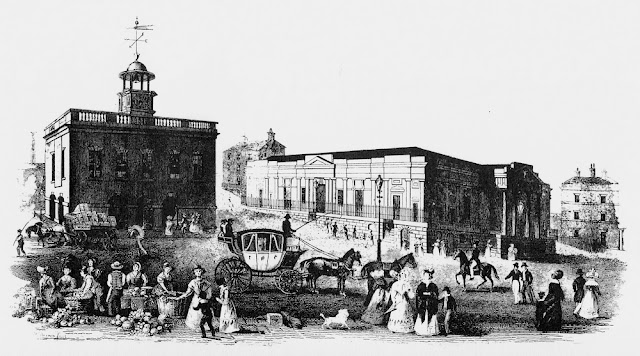
Burslem town centre in the early 19th century.
In April 1813 following a class, one of her class members asked Ann if she would visit a woman who was very ill. Accompanied by a fellow teacher ‘Miss B’, she went to see the woman whom she soon discovered to be a local prostitute. They found her to be, ‘a little better and very penitent.’ Ann continued : ‘she had been a very wicked woman for years, and is now little more than 30 years of age. Her parents died when she and her sister were young. As they advanced in years they got into bad company and lost their character. Masters would not employ them and they became common prostitutes.’ The woman, exhausted and frightened by her illness, told the two teachers that if she lived she was determined to leave her ‘wicked course of life.’
After praying together they left her. The two young teachers had obviously been shocked by the interview and though the nature of the woman’s illness is never stated, the impression we are left with is that it was contracted as a result of her calling. Both came away from the house burning with a desire to save others from such a dangerous and degrading career.
The next day, Ann and Miss B set out once more and found a woman to direct them to the ‘houses of ill fame’. They visited two buildings, but met with a mixed reception, made all the more galling no doubt, by the fact that at least two of the girls they encountered were old Sunday school scholars.
In the first house ‘we found a young woman about seventeen years of age, who lived by herself, and was three years ago a Sunday scholar.’ The girl was unmoved by the teachers’ entreaties, Ann went back many times to invite her back to the school, but to no avail.
There were two women in the other house: ‘we found a woman about twenty-seven years of age; who met in class about two years ago: we both spoke as close as possible for an hour and a half; they shed many tears and confessed they had a hell upon earth. There was another woman present, a companion in sin, who appeared to take no notice: – I said to her come down on your knees, and cry to the Lord, to have mercy upon your soul, before it is too late: we all bowed the knee before God, and found much liberty in prayer.’
It is unknown whether Ann and Miss B efforts were successful. The biography remains silent on the matter. Ann herself died at a young age in 1819.
Reference: John Tregortha (publisher) A Short Memoir of Ann Sheldon, Burslem 1821
On the morning of Wednesday 8 April 1908, the curious adventures of Moses Newell a somewhat grimy but innocent-looking 13 year old boy, were related to the Magistrates Mr J. P. Pratt and Mr P. Elliott at Fenton Police Court when he was brought before them on the charge of stealing a purse containing 11s, 4½d that belonged to his mother who lived at 17 Park Lane, Fenton.
Newell had left home on the previous Saturday and nothing had been seen of him until early that morning when he had been discovered sleeping in an ash pit behind Clarence Street, Fenton. Of the stolen money only 1s, 4d was found on him along with a small diary, some cigarettes and a few other items. The magistrates were left in no doubt as to the boy’s guilt or about what he had been doing with the money over the last four days, as the guileless youngster had been good enough to keep an account of his crime and his subsequent adventures in his diary, which were read out to the court. It was an exacting record of nothing less than a sustained eating and spending tour of the Potteries towns.
‘Saturday – Left home at dinner-time, having stolen a purse containing 11s, 4½d. Went to Hanley market, and had a twopenny potato pie, a cup of tea and a penny cake. Bought a purse and then two ha’penny books. Went into another cake shop and had another cup of tea, and stopped there until the theatre was open. Went to the Theatre Royal “Fourpenny Rush,” came back to Fenton, and slept in ashpit.
Sunday – Went to Longton and into cake shop. Had two penny herrings, a pen’orth of bread, a pint of tea. Cost me 4½d altogether. Went into icecream shop, and had a pen’orth of icecream, a ha’penny “cornet,” a penny drink, and then a wafer and another pen’orth of icecream, and a penny drink with icecream in it. On Sunday afternoon went into same cake shop, and had two-pen’orths of Yorkshire pudding and a cup of tea. Came back to the icecream shop and had some more icecream, and stayed playing. Went back to ashpit.
Monday – Got up at a quarter to seven, walked to Hanley, bought a ha’penny book, went on car to Burslem. Bought a purse. Went into cake shop, but they had nothing ready. Walked round the stalls, and had a pen’orth of toffee. Went into cake shop. Had a cup of tea. I fetched some coal for her and she gave me a penny, and I had another cup of tea and some sandwich. Bought two ha’penny books – “Dick Turpin” and “Robin Hood.” Went to Longton again. Cost me threepence going and threepence to go to the theatre. I had a bottle of “pop,” two oranges, and I paid for another boy threepence to go in and gave him twopence. He bought some “fags” and fetched me some.
Tuesday – Got up about seven. Got a car and went to Longton cake shop. Had two-pen’orth of meat, two-pen’orth of bread, and a pint of tea. I stopped in the cake shop until dinner-time. Had a penny bowl of soup and another pint of tea. Got a car to Hanley and thought I would go to theatre, but did not. I got a car again and went to Burslem. Went in another cake shop. Bought a penny bowl of soup, ha’porth of bread. I had a pen’orth of tea and went to Drill Hall (Poole’s entertainment), and paid twopence to go in. Bought a pen’orth of chocolate, ha’penny wafer, ha’penny glass of “beer,” and had another pen’orth of chocolate. When I came out I had a penny bottle of “burdock.” Got on the car to Hanley, and came to Fenton and got in the ashpit again.’
On the morning of Wednesday 8 April, though, young Newell’s spending spree came to an inglorious end when he was woken by a woman throwing ashes on him. Newell told the court that at first he thought it was a cat and then he thought it ‘as a fowl pecking him.’ The woman got hold of him and pulled him out of the ashpit and gave the boy a cup of tea. The authorities soon learned of his discovery and he was subsequently arrested by PC Ford for the theft of the purse.
After hearing the excerpts from Newell’s diary the magistrates remanded the boy for a week in order that a home might be found for him. A week later on 15 April, he was brought before Magistrates Mr Harold Wright and Mr A. Edwards at Longton on the charge of having wandered abroad without proper guardianship. His mother Fanny Williamson said that the lad was beyond control and that whenever he did something wrong he stayed away from home. The previous September and October he had disappeared for two months and could not be found. He had eventually come back, but had been away since then. On Saturday he ‘had been found in the pigeon place’, but later that day he had again absconded, this time with his mother’s purse and money. The woman was evidently at her wit’s end with the boy and the Stipendiary Magistrate Mr Wright said that the best thing to do was to send him to Werrington Industrial School until he was 16 years old.
Little is known of Moses Newell’s later life, though after serving his sentence he moved out of the area; at the age of 16, in the 1911 census, he was recorded as working as a servant on a farm in Ruthin, Wales. Neither the Medal Rolls nor the Commonwealth War Graves records for World War One list his name, so this artful dodger seems to have managed to slip away again.
Reference: Staffordshire Sentinel, 8 April and 15 April 1908.


 Potted Histories