
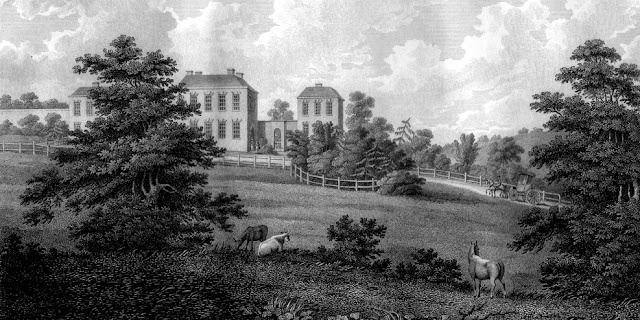
The field in the foreground may be where Theophilus Smith attacked Peter Wainwright.
(Author’s collection)
During a visit to Liverpool, a financially insecure pottery manufacturer, Theophilus Smith of Tunstall, asked one of his creditors, a merchant named Peter Wainwright, to return to the Potteries with him for a meeting. Very early in the morning of 21 June 1800, after travelling most of the way back to Tunstall, Smith stopped their carriage near to his home Smithfield Hall and said to Mr Wainwright, that as he wished to avoid being seen that they should proceed the remaining short distance across the fields on foot.
The two men were seemingly on good terms and had enjoyed a pleasant ride despite the distance, but as they crossed the field in the half-light before dawn, suddenly and without warning Smith drew a gun from his pocket. Thinking that the desperate potter was about to shoot himself, Wainwright pounced on the man, wrestled the gun out of his hand and threw it away. The crisis seemed to be over, but moments later as they continued their walk, Smith drew another pistol and fired at Mr Wainwright, but missed. The two men fought and Smith was thrown to the ground and begged forgiveness of his would-be victim. Evidently stunned by events, Wainwright relented and even let Smith get up and go to collect a coat he had left behind after leaving the coach, never thinking that Smith may have another pistol hidden there, which he produced as they neared his home and shot Wainwright through the body just below the stomach. Though badly wounded Peter Wainwright again fought back, but Smith then drew a knife, lashing out, and the merchant received numerous cuts to his hands and jawline before he finally threw his attacker off. Smith then retreated to his house, leaving the badly injured man to stagger several hundred yards to a neighbouring cottage for help. Doctors were called who at first despaired of his wounds, but against the odds Mr Wainwright survived, though he spent several weeks lodged in a gentleman’s house, recovering from his wounds and the shock of his ordeal.
The alarm was immediately raised and constables raced to Smithfield Hall to arrest Theophilus Smith, but he had already fled his home and 50 guineas were offered for his capture. This was achieved a few weeks later in London where Smith was arrested without incident in his lodgings by the Bow Street Runners. Sent for trial at Stafford, Smith was easily found guilty and sentenced to hang, but he cheated the hangman when on New Years Day 1801, whilst in the hospital at Stafford Gaol and having by some means got his hands on a couple of pistols, he shot and wounded his wife who was visiting him, then shot himself through the head, dying instantly. It has been suggested that this final act and Smith’s earlier attack on Mr Wainwright were because he suspected that Wainwright and his wife were lovers, though there seems to be no clear evidence to support this.
So ended the mysterious affair of Theophilus Smith, at least for the protagonist, and it turned out his was the only death to result from his sudden murderous mania, as Mary Smith like Peter Wainwright before her recovered from her wounds. By the end of February 1801, it was reported that she was well enough to leave Stafford and she seems to have returned to her family in Whitchurch, Shropshire. Before the year was out both Smithfield Hall and the Smithfield estate were sold to John Breeze, who renamed both ‘Greenfield’ to disassociate them from the stigma of Smith’s crimes. What happened to Mary Smith after that is unclear. If there ever had been any romantic association between her and Peter Wainwright it was never rekindled.
After recovering from his severe injuries Mr Wainwright had returned to Liverpool, but he did not long remain in Britain. Many years previously, before the War of Independence, he had settled in the American colonies and had stayed on there for some time as a successful tobacco merchant. In 1790, he had married another English emigrant, Elizabeth Mayhew, before returning to Britain in the early 1790s prior to the birth of their first child. Now, perhaps, the shock of the attack and the ill rumours it had promoted had made him reconsider the move and in either late 1801 or 1802, Wainwright returned with his wife and children to the United States of America, settling in near his wife’s family in Boston, where he continued to trade successfully for many years. Their children would stay on and prosper in the New World, but he and his wife eventually moved back to Britain, she dying in 1829 and Peter on 10 January 1841, aged 81.
Reference:Staffordshire Advertiser, 12 July 1800, p.3; 19 July 1800, p.4; 2 August 1800, p.3; 3 January 1801, p.4; The Annual Register 1800, Vol. 42; Bury and Norwich Post, Wednesday, 25 February 1801, p.2.
 Potted Histories
Leave a comment