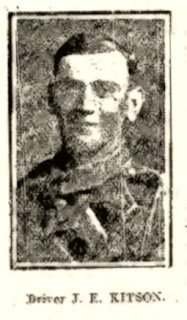
John Edward Kitson was born at Coseley, near Dudley, Staffordshire in 1897, the eldest of two children born to Edward and Florence Kitson. His father was a police constable at first in the Dudley and Handsworth regions, but it seems that promotion to sergeant saw him move north to the Potteries, perhaps before John was 10 years old. Here the family prospered and his father would eventually rise to the rank of Chief Inspector at Burslem Police Station. In the 1911 census, the family was living in Shelton New Road, Newcastle and barring service in World War One, John Kitson would remain in the area for the rest of his life.
The Great War started late in 1914 and by early 1915 John Edward Kitson had joined the army. As 31331 Gunner J. E. Kitson, Royal Field Artillery, he arrived in France in March 1915 and from April 1916, he served as a driver for X/9 Medium Trench Mortar Battery, part of the divisional artillery attached to the 9th Scottish Division. Though never promoted, he proved a brave soldier, being wounded in action at least four times, seeing service on the Somme and at the Battle of Passchendaele. Gunner Kitson finished his war by winning the Military Medal in 1918 for gallantry in the field. Hospitalised in Britain after his final wound, he did not return to the front to see out the war, being discharged from the army on 8 July 1918.
After the war he married a local woman, Doris Hudson, they settled in Sneyd Green where they brought up five children. Kitson worked as a civil servant for the Ministry of Labour, but this seems to have been an anti climax after his wartime adventures which prompted him to leave an interesting anecdote of his service during the war and a record of how his injuries had affected his life afterwards. The stories were colourful enough to warrant syndication on papers as far afield as Australia and New Zealand.
‘A WAR HORSE’ ‘ALMOST HUMAN.’
‘Mr. J. E. Kitson. of Hanley, Staffordshire, in England, sent to the “Daily Mail” the following remarkable stories of his war horse: – During 1916 and 1917 I had a charger named Tommy. He was nothing short of human, and many an entertainment was given by him to the troops. Once, when we were being shelled he got loose from his peg, and coming to me, gripped my shoulder In his mouth and “led” me away. A minute later a shell fell at the very spot where I had been standing. His favourite trick was to wait until I had given him a thorough grooming, then sit down like a dog. open his mouth, and “laugh” and roll. This usually happened when the Inspecting officer was just coming round the lines. Luckily, the officer knew Tommy. Another time, when I was riding him at a gallop my tin hat fell off. Tommy at once stopped, turned. and picked it up and “handed” It to me. Just as I had put the hat on a piece of shrapnel struck it a glancing blow. He brought me in when I was badly gassed, I was unconscious on his back. A few weeks later he also entered hospital, and was sent into retirement.’
The Mercury (Hobart, Tasmania) 2 July 1931, p.12
‘MAN WHO REFUSES TO DIE’
‘Mr J. E. Kitson, of Hanley Road, Sneyd Green, Hanley, Stoke-on-Trent, is known to his family and friends as the man who refuses to die. Doctors have repeatedly told him he has only a few years to live – but he fools them all. It all started during the war, when a piece of shell pierced his neck and killed a comrade behind him. Mr Kitson recovered, but doctors gave him just five years of life.
The five years went by; then two years later he collapsed at work. This time he was given just seven months more. But after five months he got fed up with being a sick man and returned to work.
Two years ago he collapsed again, was rushed to hospital and put on the danger list. Two hours later he was normal again and walked out of the hospital the next day.
Doctors are perplexed about Mr Kitson, but he doesn’t mind. He says he will live to be 100.’
Cairns Post (Queensland, Aus.) 15 March 1939, p.9
John Edward Kitson certainly defied his doctors by many years, but did not carry on going as long as he predicted and he died on 13 July 1953 in Stoke-on-Trent, Staffordshire, when he was 56 years old.
During the First World War, the action for the most part took place along a line of trenches stretching from the. Belgian coast, down to the Swiss border, where massed armies, huddled in their trenches, were launched in pointless attacks in the face of merciless machine gun and cannon fire. For the civilians back home the war was distant, though those left at home may have had relatives in the trenches, the Great War was an impersonal thing. True, foodstuffs were in short supply, and women took a great leap forward in society by going to work in the factories and on the farms, but the prospect of imminent death from enemy bombers, was still a generation away, or so it seemed. Then there came the Zeppelins. In a bold move, the Germans attempted to disrupt British life and industry, by sending over fleets of hydrogen-filled airships to drop bombs on anything they thought worthy of being destroyed. Two of these airships, at least, made it as far as North Staffordshire, and though the damage they did was insignificant, the authorities fell that they were such a threat to British morale, that the circumstances of the raids were not fully reported until a month after the war had ended.
The first raiders came on the night of the 31 January 1916, Several cities throughout the Midlands were surprised to find airships over them, since few had thought that the area was within the radius of such craft. This was in the days before the blackout, and the major manufactories of the Midlands were a blaze of lights and fires, and in North Staffordshire, the glow was particularly noticeable from the pot banks and steel-works of Stoke on Trent, which were obscured only by a slight ground mist.
A squadron of Zeppelins had crossed the coast that night. One attacked Walsall at 8.10 p.m., and later at 12,30 a.m. There, the Mayoress, Mrs. S. M. Slater, was fatally injured in a bomb blast. The Wednesbury Road Congregational Chapel was demolished by a bomb and other unspecified damage was done. At 8.30, another airship suddenly loomed out of the dark over Burton on Trent, and dropped a cluster of bombs, one of which fell on a mission house, where a clergyman’s wife was holding a service, and in the blast three of the congregation were killed and a forth fatally injured.
Not long after the Zeppelin over Burton had begun its attack, engines were heard moving towards Trentham and the Potteries, and presently, the Zeppelin appeared, cruising slowly overhead. Its obvious target could be seen miles away, the light from the Stafford Coal and Iron Company’s blast furnaces. The raider circled the foundry like a vulture and dropped half a dozen bombs in close succession. However, these fell on the spoil banks between the colliery and the furnaces, where they made several large holes, but did no serious damage.
German airship designer Count Zeppelin
After that the elusive raider sneaked off. Its course was only a matter of speculation, though engines were heard over Hanley, then Wolstanton and as far west as Madeley, where it dropped a flare over open country. It’s raid, though it must have injected some excitement into the area, caused no harm and it must have used up its stock of bombs, or been searching for a secondary target.
The second Zeppelin raid, though, was more dramatic, and took place during the night of 27 to 28 November 1916. It was a clear, dry night over the Midlands, there was the nip of an autumn frost in the air, perfect weather for an air raid. So, perhaps, at 10.45 p.m.. when the warning was received in the Potteries that Zeppelins had been sighted, few were surprised. The whole district was blacked out. and air raid precautions were put in place the special constabulary, the fire brigade and doctors and nurses were all alerted and went to their stations. Positive information was soon received that a raider was making for North Staffordshire, and at a few minutes before 1 a.m, the steady drone of aero engines was heard and the Zeppelin was sighted over Biddulph, slowly making towards the Kidsgrove-Goldenhill-Tunstall area of the Potteries. Then the bombs came crashing down.
One unnamed witness, had been up late and was just going to bed at about 1 a.m., when he heard a ‘deep rumbling, long-sustained explosion’ and thought that there had been a serious colliery accident nearby. He went into another bedroom to ask if anyone else had heard the noise, when there were further explosions, two short sharp blasts, then another ‘accompanied by a rending sound’, then a series of four or five blasts in succession. The witness looked out of a bedroom window and caught sight of flashes off towards the Chesterton area, followed by the thudding boom of the detonations. The bombardment went on for about half an hour until the Zeppelin drew nearer to the witness’ house and dropped another bomb about half a mile away ‘that shook every brick and window in the house’, before it moved. The witness had counted 21 explosions.
The first bomb blew a hole in a spoil bank at Birchenwood Colliery, Kidsgrove, while the second two landed not far off from the Goldendale Iron Works. The forth landed in Tunstall, impacting in the back yard of No. 6 Sun Street, and the explosion destroyed the sculleries and outhouses of Nos. 2, 4, 6 and 8, but shards hit other houses, as well as a nearby Roman Catholic church. Luckily, no one was killed and only one person was injured, a Mr Cantliffe of No. 8 Sun Street, who was hit in the chest by shrapnel, but he later made a full recovery in the North Staffordshire Infirmary. Had the raider circled in that area for a time, there is little doubt that there would have been a great deal of destruction and many more casualties, but the Zeppelin moved on, leaving Sun Street battered and bruised and in such a state that it would for days attract a horde of sightseers.
The Zeppelin cruised over Tunstall and out across Bradwell Wood, where the burning mine hearths seem to have attracted the raider away from the areas of population. This area was just a mass of calcinating ironstone left to smoulder out in the open, but which obviously seemed to have given the impression of being an ironworks of some description. Certainly the Germans thought so, and the area was heavily bombed, watched from a distance by our nameless witness. Explosion after explosion reverberated over Chesterton, but the only damage done was to a shed that was knocked over and the closest that any other bomb got to the public, was when one of the last of these landed behind Bradwell Lane, Wolstanton. A later report summed it up succinctly as a ‘particularly futile’ attack on the area.
As it had circled over Bradwell Wood and the area around Chesterton and Wolstanton for some time, illuminated in the flashes from the bombs, many locals had spotted the airship. But finally, spent of its bomb load, the raider turned south-east and was last sighted passing low over Blurton Farm coming from the direction of Hartshill. This was at 1.35 a.m., the Zeppelin then vanished into the dark at a ‘moderate speed’.
There had been a number of bombing raids over Britain that night and many came to a grim end. Certainly the North Staffs raider never made it back to Germany. Lord French, reporting the fate of several of these Zeppelins in a communique, made special reference to the airship that had bombed the Tunstall area. It appeared that after leaving the North Midlands, the airship hail taken a direct route towards East Anglia, from where there was but a short stretch of sea separating her crew from their homeland. However, before she even reached the coast, the Zeppelin had been repeatedly attacked by aeroplanes of the Royal Flying Corps and by ground-based artillery. Perhaps she was damaged, since Lord French’s report noted that the last part of her journey was made at a very slow speed and the airship was unable to reach the coast before day was breaking. By the time she reached Norfolk, however, it seemed that the crew had managed to make repairs, and after running a gauntlet of coastal batteries, one of which claimed a hit, the Zeppelin was seen making off to the cast at a high speed and at an altitude of about 8,000 feet. But more planes came at her. About nine miles out at sea, the Zeppelin was attacked by four machines of the Royal Navy Air Service and further fire came from an armed trawler. Worried like a bear with terriers at her heels, the airship struggled on until gunfire ripped into her hydrogen filled body and she went crashing down in flames into the sea at about 6.45 a.m. No survivors were noted.
Reference: Staffordshire Sentinel, Friday, 27 December 1918, p.4



 Potted Histories