Tag: Stoke

  • Dandy Dogs and the Mad Cat Artist

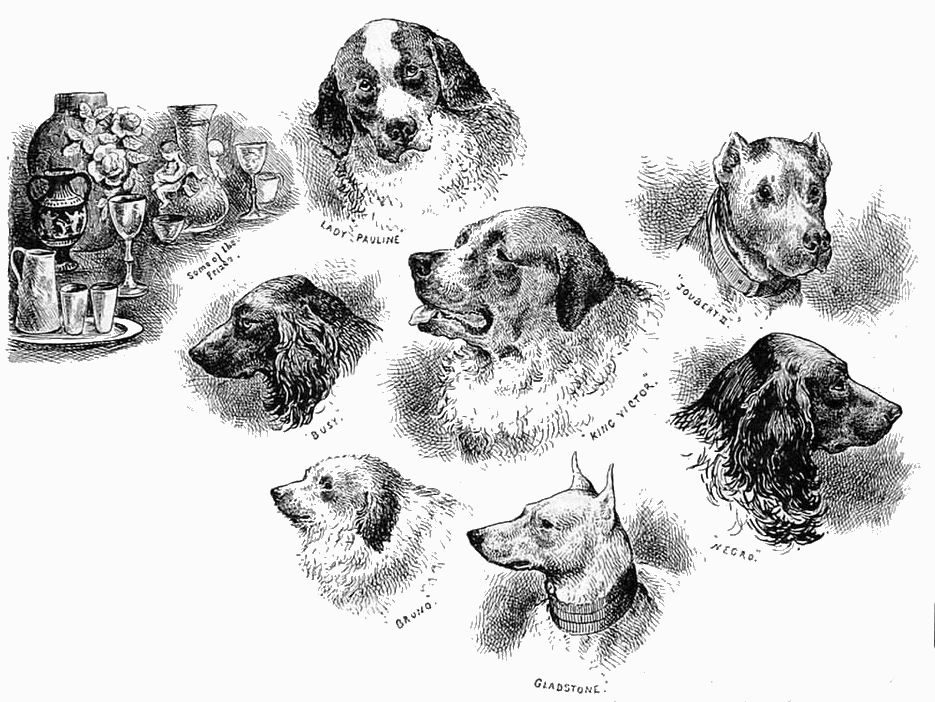
    Some of the prize winning animals at the 1885 Hanley dog show.

    When he paid a visit to the Potteries in the summer of 1874, journalist James Greenwood noted that Hanley was a town full of dogs:


    ‘Tykes of all ages, sizes, and complexions sprawl over the pavements, and lounge at the thresholds of doors, and sit at the windows, quite at their ease, with their heads reposing on the window-sill, hob-and-nob with their biped “pal,” who cuddles his four-footed friend lovingly round the neck with one arm, while his as yet unwashed mining face, black and white in patches as the dog’s is, beams with that satisfaction which con­tent and pleasant companionship alone can give.’

    How accurate a portrait of the town this was is open to debate as Greenwood immediately went on to write the infamous story of the ‘man and dog fight’ that scandalised the area, a tale that ultimately backfired on him when it became pretty obvious that he had concocted the whole story. Yet there is plenty of evidence to suggest at least in the comment above that Greenwood was not being untruthful and the locals were indeed keen pet owners and dog fanciers. A dog and poultry show was regularly held in Hanley from 1865 into the 1870s and in October 1883 Hanley hosted a major dog show organised by the North Staffordshire Kennel Club. This proved so successful that in February 1885 a second exhibition took place. This was larger and much more widely reviewed by the press, attracting not only local but national and even international attention.

    Held over two days 24th and 25th February in the old covered market in Hanley, there were 774 entries for the show and there could have been more but for a lack of space. Most of the major show breeds were present in large numbers. There were 170 fox terriers; 74 St Bernards; 27 mastiffs; 22 pointers; 18 setters; 88 collies; 34 bull dogs; 20 bull terriers; 48 dachshunds; 18 pugs; and six bloodhounds. Add to this the more obscure dogs and hounds, some from abroad, plus some champion dogs including five mastiffs who had secured honours at the prestigious Crystal Palace shows, and you had you had a major treat for dog lovers from across Britain. Anticipating a good turnout both the North Staffordshire and London and North Western Railways issued cheap tickets for those wanting to attend the show.
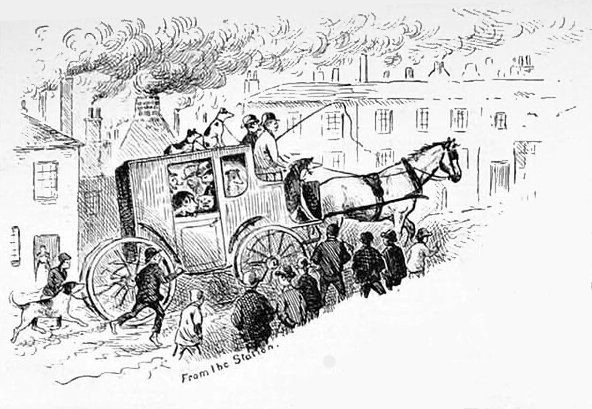

    Providing a series of illustrations for The Illustrated Sporting and Dramatic News, was Louis Wain, the artist who in later life went mad and spent his latter years painting numerous pictures of sinister anthropomorphic cats. At the time of the Hanley dog show, however, he was still quite sane and penned a series of fine dog portraits and whimsical side illustrations. The most amusing sketch showed a carriage trundling its way up the bank from Stoke Station up into Hanley, bringing with it a fine collection of prize pooches, large and small, riding in or on top, or running behind the coach, evidently much to the astonishment of onlookers.
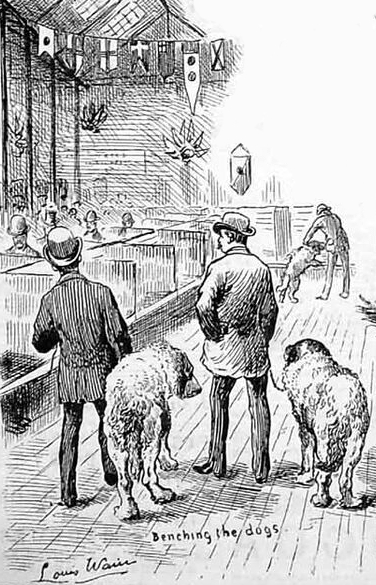
    Another of Wain’s illustrations showed that once in the market hall the various dogs were housed in a series of pens ready for the viewing of the general public and while they waited on the judges to do their rounds. There were a few problems. A reviewer in the same paper that carried Wain’s illustrations noted that quite a few of the dogs on show still bore evidence of a mange epidemic that had recently swept the country. Most were over the disease and the worst effects they showed were rather patchy coats, but a few displayed signs that their condition was still ‘alive’, much to the reviewer’s alarm. The entry of such obviously infected dogs he put down to the laxness of the ‘honorary veterinary surgeon’ and the inconsiderate nature of some owners. This was all the more surprising as one of the Kennel Club’s rules stated quite forcefully that no dog suffering from mange or any other infectious disease would be allowed to compete or be entitled to receive a prize.
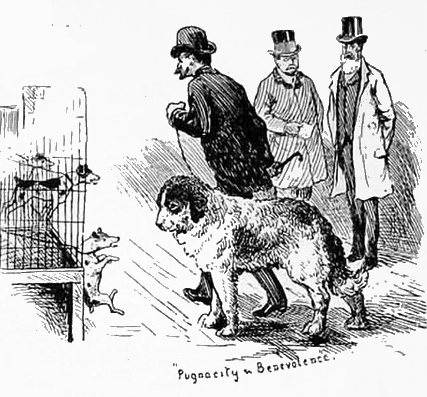
    The writer also suggested that the chains holding the dogs in their pens were in many cases far too long. Some of the dogs were fierce or excitable and in their frenzy apt to fall over the edge of their bench and with the smaller dogs in danger of hanging themselves. Wain illustrated the point with a picture showing a placid St Bernard face to face with a group of irate terriers, one of whom had taken just such a tumble and was in danger of throttling itself. The long chains also allowed more mischief as some of the animals were able to get around the partitions and engage in scraps with their surprised neighbours.

    In the long run, though, these were minor issues in what turned out to be a very successful and well organised show. And as can be seen from Louis Wain’s fine illustrations, despite the ravages of the mange epidemic there were still many handsome dogs on hand to pick up the numerous prizes. So popular did the exhibition prove that another show was organised early the next year and the competition carried on through the latter years of the 19th century expanding into a dog and cat show by the late 1890s.

    References: The Illustrated Sporting and Dramatic News, 7 March 1885 pp. 607, 617, 623.  James Greenwood, Low Life Deeps, pp. 16-17


    Pictures: Author’s collection.
  • Cannons from the Crimea

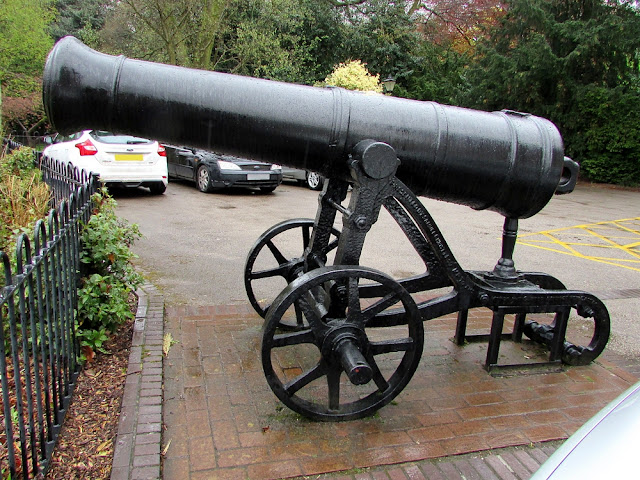
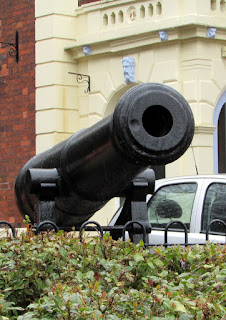
    Standing outside of the Brampton Museum in Newcastle-under-Lyme is a large black-painted cannon, mounted on a cast-iron limber. This was one of thousands of similar pieces of war booty brought back from the Crimea, following the fall of the Russian citadel of Sevastopol in 1855. In that city the Allied armies had discovered a large ordnance depot filled with 4,000 damaged or obsolete guns and these along with many of the guns captured during the fighting were later used as ballast on the merchantmen and troopships when they were bringing the army home. The Crimean War (1854-1856), had been a horrendous and utterly pointless conflict and perhaps as part of a wider public relations exercise to calm the national anger at the lives lost and at just how badly the war had been run, these cannon were freely distributed to towns and cities around the country.

    Newcastle’s cannon, weighing 2.8 tons is a 36 pounder made in 1840, and was presented to the Borough in 1857 by its then MP Samuel Christy. It was originally situated in Stubbs Walks, opposite the Orme Girl’s School, Newcastle, where it stood until 1965, when it was moved to its current location. Such was the fate of most of these retired instruments of war and in the latter half of the nineteenth century it was no unusual thing to find a large, defunct piece of Russian artillery decorating a municipal park or fronting some grand civic building anywhere in Britain. Today, though, they are not so common; time and necessity have seen many of the others scattered or scrapped over the years and such seems to have been the case with a couple of cannons that came to the Potteries, no trace of which now seems to exist.

    Newcastle’s impressive Russia cannon in situ. The carriage was mass-produced at the Royal Armouries in Woolwich.

    In his autobiography Past Years, Potteries-born scientist Oliver Lodge, mentioned a close encounter with a Russian cannon in his youth. Lodge recalled that at a very young age his father took him from their home in Penkhull down the steep hill to Stoke where peace celebrations marking the end of the Crimean War were taking place. A captured Russian cannon had been placed in front of the Wheatsheaf Hotel and Mr Lodge told his son to wait by the cannon until he came back for him. Looking up at the monstrous artillery piece, young Oliver wondered what they were going to do with the gun, half fearing but half hoping that they were going to fire it. However, nothing so exciting happened, instead the local dignitaries made several speeches before they all set off for lunch. Oliver’s father went with them, minus his boy, and afterwards in the evening he went home having completely forgotten about Oliver. Only after returning home and being asked by his wife where their son was did he suddenly remember and went dashing off back down the bank to find the lad still obediently standing by the gun, utterly unconcerned at being left alone for several hours after everyone else had departed. 

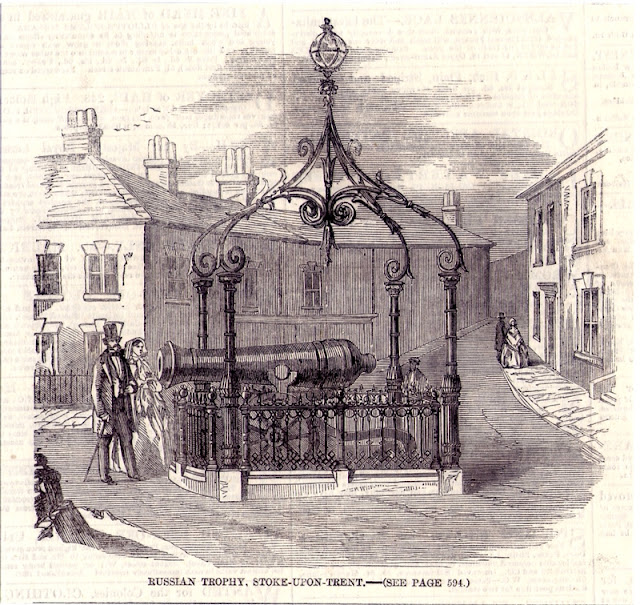
    The Victoria History of Staffordshire notes that a Russian cannon was presented to the town by W. T. Copeland in 1857 and erected opposite the Wheatsheaf Hotel in 1858, as per Lodge’s memoirs. In 1858, the Illustrated London News carried an interesting illustration of what was called Stoke-upon-Trent’s ‘Russian trophy’, along with some background information.


    ‘RUSSIAN TROPHY AT STOKE-UPON-TRENT.’ 

    ‘We give a representation of the Russian Trophy as mounted and in closed at Stoke-upon-Trent a few weeks ago. The gun is placed on a stone platform, as shown in the Illustration, in which the Royal arms, in Minton’s tiles, is inserted. On the stone parapet an ornamental railing of a handsome pattern is placed, and at each angle of the square of the platform a pillar in cast iron rises, to carry the wrought-iron scrollwork, which was manufactured by Mr. Haslam, of Derby, and is an excellent specimen of the old art of ironworking, now so ex­tensively superseded by the process of casting. All the ironwork is coloured in imitation of Florentine bronze, and richly gilt in the more decorative parts of the design. The whole is surmounted by a large globe lamp, which forms the principal feature of the construction, as the erection, being placed at the junction of three streets, requires a prominent and well adapted mode of lighting. The trophy was in­augurated by Mr. Alderman Copeland, one of the members for the borough, who also defrayed the expenses connected with mounting the piece. The work was designed and carried out under Mr. Edgar, architect.’

    Longton also received a gun, but even less is known about that one. There is a brief note in the Staffordshire Sentinel in 1867 that reads: ‘The same committee reported a resolution, in accordance with a suggestion from the Council, to remove the Russian cannon from the front of the Town Hall to the space within the railings at the front of the Court House… The proceedings were approved, and the recommendation adopted.’ In his Sociological History of Stoke-on-Trent, E. J. D. Warrilow includes a photograph of Longton Court House with the cannon situated behind the railings as described, but a second photo taken in 1950 shows that the gun had been removed. It was resited to Queen’s Park, Longton, where it stood in front of the clock tower. However, it has long since vanished and its current whereabouts are unknown.


    Stoke’s gun was also later moved, to a site in Hill Street by the old town hall in about 1874, but what finally happened to this and Longton’s cannon is unknown. The most likely scenario is that the valuable metal was sacrificed to the war effort early in World War Two, and ironically perhaps went on to become part of a more modern arsenal. 


    Contrast this sad end with that of the Newcastle gun which has achieved a certain status in the area. Between 1919 to 1942, during its time in Stubb’s Walks, the cannon was joined by a World War One training tank as a companion, but the tank was sent to be scrapped during World War Two. When the Crimean gun was shifted from its original site in 1965 some feared that it too was destined to be melted down and contractors arrived to find that some of the pupils from the Orme Girl’s School had hung a notice on the gun – ‘Hands off our cannon’. They need not have worried. Today, the cannon points out over the Brampton Park, providing a striking and novel photo opportunity to visitors to the town’s museum. 

    Reference: Oliver Lodge, Past Years: An Autobiography (Cambridge, 1931) pp. 22-23. E. J. D. Warrillow, A Sociological History of Stoke-on-Trent, p.385, Illustrated London News, 12 June 1858, Staffordshire Sentinel, 6 July 1867, Victoria History of Staffordshire Vol. VIII., p.180.

    Website: Crimean Cannon International Database

  • A Titanic Engineer

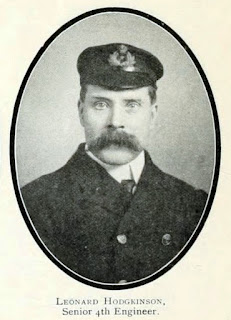
    Stoke-on-Trent’s best known connection with the Titanic disaster is of course the ship’s venerable skipper, Captain E. J. Smith, but a less well-known Potteries-born sailor who also perished in the Titanic disaster was Senior Fourth Engineer Leonard Hodgkinson. At the time of his death he was 46 years old, and like Captain Smith had spent most of his adult life at sea, albeit in a far different environment to that of his much more famous shipmate. As a member of the ship’s engineering staff, his working life was one spent for the most part in noisy, hot engine rooms, with little view of sea or sky save when he was off duty.

    Leonard was born at 20 North Street, Stoke-upon-Trent, on 20 February 1866, the second son and fifth child of potter’s presser John Hodgkinson and his wife Caroline nee Steele. Educated at St Thomas’ School, Stoke, before the age of 15, Leonard was apprenticed as an engine fitter with Messrs Hartley, Arnoux and Fanning, in Stoke. Once his apprenticeship was done, Leonard left the Potteries sometime in the 1880’s and took up a position with Messrs Lairds of Birkenhead, lodging with his elder sister Rose, her husband Henry Mulligan and their children, who had settled in Liverpool sometime after their marriage in 1877. It was in Liverpool that Leonard met his wife-to-be, Sarah Clarke. The couple were married in West Derby, Liverpool on 14 February 1891 and within a few years the couple had three children.

    North Street, Stoke-upon-Trent

    Leonard was now a seagoing marine engineer. He served for five years with the Beaver Line, whose ships sailed from Liverpool to Quebec and Montreal. In 1894, though, the Beaver Line went into liquidation and it may have been at this point that Leonard left and joined Rankin, Gilmour and Co., Ltd, which firm he also served with for five years, earning his first class certificate in the process. He may also have served with the Saint Line of ships which were owned by Rankin and Co., most of which carried the ‘Saint -’ title. Leonard’s final position with the company was as chief engineer aboard a ship with just such a title, the Saint Jerome.

    For a few years between 1901 and 1905, Leonard quit the sea and set himself up in business ashore as a mechanical engineer, but in May 1905, he returned to his old line of work, joining the White Star Line, serving first as assistant engineer on the Celtic, later earning promotion to fourth and then third engineer.

    According to family lore, Leonard Hodgkinson was keen to serve on as many vessels as possible before retirement, so was doubtless pleased after what appears to have been a six year stint aboard the Celtic, to be transferred over to the glamorous new Olympic (the Titanic’s elder sister) when that ship came on-line in June 1911. Here he was briefly bumped back down to assistant engineer, but soon earned promotion to fourth engineer once again. Perhaps more troublesome for him and his family was the fact that the Olympic was to sail from Southampton. There is no indication that the whole Hodgkinson family moved to Southampton at this time, though it is a possibility, but if not, then Leonard had to put up at lodgings in between journeys and perhaps only got to see his family on a few occasions when he could make the journey back to Liverpool.

    It was in early 1912, that Leonard travelled to Belfast where he joined the staff under Chief Engineer Joseph Bell, who were involved in getting the Olympic’s younger sister Titanic up and running. On 2 April he was signed onto the ship’s books for the delivery trip from Belfast to Southampton and on 6 April he was signed on once again in Southampton, now as senior fourth engineer.

    A White Star engineer at work.

    As senior fourth engineer, Leonard Hodgkinson was the highest ranking of the five fourth engineers aboard the Titanic, one of whom was a specialist in charge of the ship’s refrigeration equipment. Whilst at sea their duties involved checking that the adjustments and routine maintenance of the ship’s machinery were carried out. They dealt with any minor problems as they arose, answered any orders rung down via the ship’s telegraphs and ensured that everything ran as smoothly as possible. As officers it was also their duty to supervise the firemen, trimmers and greasers who worked with them down in the bowels of the ship.

    How Leonard’s days passed aboard the Titanic prior to its fateful collision is unknown, as too are his deeds on the night in question, as no accounts seem to exist noting him. If the story is to be believed, though, his fate and that of the 1500 other people who perished on the Titanic was foreseen by one of his relatives back in the Potteries, none of whom had any idea that Leonard was aboard the Titanic. According to the story she later told, two days before the disaster, Leonard’s 14 year old niece, Rose May Timmis, the daughter of Leonard’s elder sister Agnes, was sleeping in the same bed as her grandmother Caroline Hodgkinson (Leonard’s mother) when she had a nightmare. Rose dreamt that she was standing by a road in Trentham Park looking out over the lake, when a large ship steamed into sight. Suddenly the ship went down at one end and she could hear screams. Rose herself woke up with a yell that frightened her grandmother awake. When the frightened girl related her dream her grandmother snapped, “No more suppers for you, lady; dreams are a pack of daft.”

    After a while, Rose drifted back to sleep once more, only to find herself dreaming the same scene and as before when she heard the people screaming she did the same. She recalled that her grandmother was furious with her this time. A few days later, though, the news of the disaster broke and the family learnt that Leonard had been aboard the Titanic and that he and the other 34 engineering officers aboard had perished with the ship. Though several bodies from the engineering department were recovered in the following weeks, Leonard’s was not one of them.

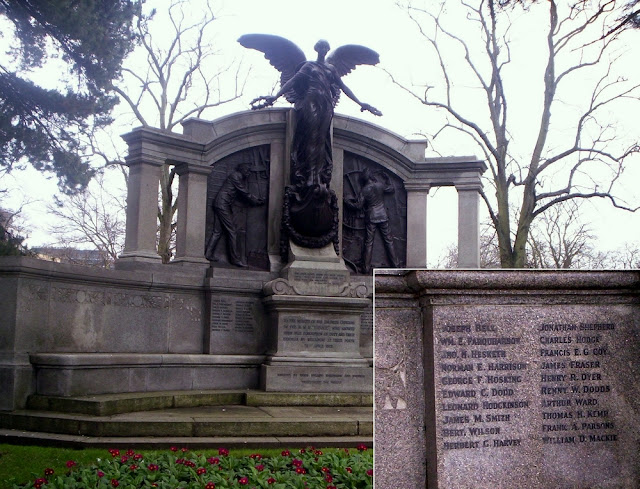
    Though Leonard’s body was never found, he is remembered in several memorials, most notably on the Engineers Memorial, East Park, Southampton, the Titanic and Engineers memorial, Liverpool; the Glasgow Institute of Marine Engineers memorial; and the Institute of Marine Engineers Memorial in London. There is also a brass memorial plaque in the church of St Faithful, in Crosby, Liverpool, dedicated to the memory of the Chief Engineer and his Engine Room staff.

    The Titanic Engineers Memorial, Southampton

    Leonard Hodgkinson was not the only member of his family to go to sea. His son Leonard Stanley also became a marine engineer with White Star and later Cunard. He served on the transatlantic run most of his career, mainly on RMS Majestic before the war and later on the Queen Mary and the Queen Elizabeth.


    Website: Encyclopedia Titanica

  • Thomas Cooper Sparks the Pottery Riots

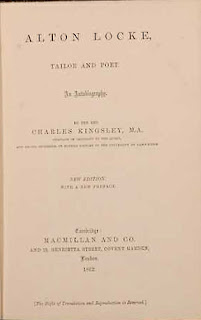
    One of the least known literary associations with Staffordshire, is that of Charles Kingsley’s novel Alton Locke. Tailor and Poet, which was published in 1851. The story of the rise and fall of a self-taught working man who is eventually imprisoned for rioting, is based upon a real person and a real incident. The person was the Chartist leader, Thomas Cooper, who was arrested and sentenced to two years in prison, for the events he had prompted in the Staffordshire Potteries.

    Thomas Cooper was born in Leicester to a working class family and from an early age displayed a precocious intelligence, the development of which was only limited by the fact that most of his lessons were self-taught. Occasionally, he had been known to immerse himself so deeply into his studies that the sheer mental effort he put forth ended on one occasion, at least, in him being physically ill. He worked at various jobs, mostly as a teacher, lay preacher and journalist, but eventually, appalled by the conditions endured by many factory and workshop workers, he became a convinced Chartist, a member of that Victorian working class movement which supported the introduction of a People’s Charter, which called for fair representation for the working population. The Charter’s six points demanded votes for all men at 21, annual general elections, a secret ballot, constituencies regulated by size of population, the abolition of property qualifications for MP’s and the payment of MP’s. Most of these points eventually became laws of the land and form a part of the state we live in today, but none of these things came into being until the latter half of the nineteenth century, long after the Chartist movement itself had collapsed.

    There were two bodies of the Chartist movement, the physical and the moral-force Chartists, who sought to bring about social change by revolutionary or evolutionary means. In his early days, Cooper was a supporter of the former faction. He was a fire and brimstone type of preacher, who like all great orators could move people with his speeches. This power comes through in Cooper’s autobiography, which is widely regarded as one of the finest working class ‘lives’ written during the Victorian age. The book, though written in Cooper’s later years after he had become a convinced moral-force Chartist, tends to carefully skate around his fiery physical-force youth and he presents himself as a far more reasonable man than he actually was in August 1842, when he arrived in the Potteries. Only by bearing in mind, that Cooper at this time advocated revolution of sorts, do the events he inspired in the Potteries make sense. Though he says in his book that he proclaimed, ‘Peace, law and order’, the resulting riots that left one man dead, dozens wounded or injured and many buildings burnt or ransacked, indicated that he said more than he was letting on.

    Cooper arrived in the Potteries, after a tour of several major towns and cities in the Midlands, and here he was to make a number of speeches before moving on to Manchester. The area was in the grip of a wage dispute. In June, 300 Longton miners whose wages had been drastically cut had gone on strike. By July, the strike had expanded to all of the pits in north Staffordshire, and hundreds of miners were on the streets, begging for money, and with the pits being closed, the potteries through lack of coal, could not fire their kilns and were also closed. By early August, the dispute had attracted widespread attention, certainly the Chartists expressed sympathy for the miners’ action, but contrary to later claims that the subsequent riots were Chartist inspired, it was mostly miners and not Chartists who did the rioting. The Potteries were a powder keg, ready to explode and Cooper’s arrival, as he himself admitted was ‘the spark which kindled all into combustion’.

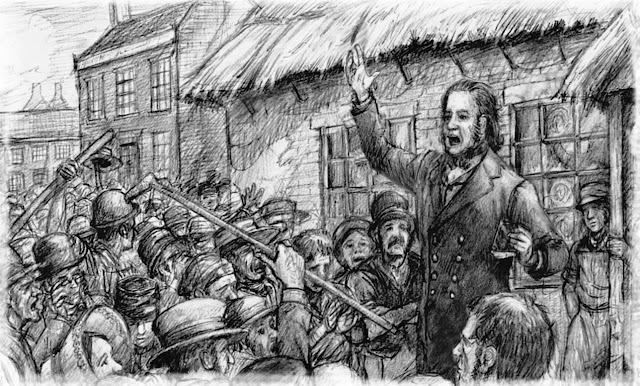
    Thomas Cooper addresses the crowd at Crown Bank, Hanley

    Standing on a chair in front of the Crown Inn, a low thatched building at Crown Bank in Hanley, on Sunday, 14 August, Cooper addressed a crowd of upwards of 10,000 people, delivering a brilliant Chartist speech to his audience. He look for his text the sixth commandment, ‘Thou shalt do no murder’. Throwing his net wide, he drew on examples of kings and tyrants from history, such as Alexander, Caesar and Napoleon, who had violated this commandment against their own people, even as their own government would be prepared to do. The next day, he addressed an equally sizeable crowd and moved a motion, ‘That all labour cease until the People’s Charter becomes the law of the land’.

    What followed, Cooper later regretted. As the crowd dispersed. rioting started around the Potteries towns in all except Tunstall and the borough town of Newcastle. Police stations were attacked, magistrate’s houses ransacked and burned, as were Hanley Parsonage and Longton Rectory. By the 16th, the chaos had lasted a day and a night, but on that day, the most famous, or infamous incident of the uprising occurred, what is known locally as ‘the battle of Burslem’. Following the rioting in Stoke, Shelton, Hanley and Longton, a great crowd moved towards Burslem, there to meet a crowd coming from Leek. Here, though, the authorities played their hand, when a troop of mounted dragoons stopped the crowd from Leek. The magistrate in charge read the Riot Act, then tried to reason with the men, but when it was clear that they were bent on trouble, the soldiers were ordered to fire. One man from Leek was killed and many injured, the crowd was routed and the disturbances ended overnight, but for many weeks afterwards, the Potteries were full of troops and vengeful magistrates arresting rioters and Chartist leaders.

    Cooper, horrified at the events he had unleashed, had tried to escape, but he was arrested and eventually tried and sentenced to two years in Stafford Gaol, on charges of arson and rioting. Here, he spent his time profitably, learning Hebrew and writing his book, The Purgatory of Suicides. On leaving prison, though, his views were found to differ considerably from the new mainstrean in Chartist thought, and he became increasingly a moral-force activist and remained so for the rest of his life.

    It was in the two or three years after leaving prison, that Cooper was interviewed by the Rev. Charles Kingsley, whose Christian Socialist movement had inherited many of the Chartist beliefs. Kingsley had sought out several old Chartists and educated working men on whom he wished to base the life of the major character in the novel he was preparing. Thomas Cooper, was obviously the chief amongst these, certainly his autobiography, written many years after Kingsley had published Alton Locke, shows many striking similarities between Cooper’s life and that of his fictional alter ego. The riot that Alton inspires in the book, for which he too is committed to the prison, takes place in the countryside, amongst agricultural labourers, but behind it there is the faintest echo of the struggle in the Potteries, that one historian has considered the nearest thing to a popular revolution that the Victorian age saw.

    After 1845, Thomas Cooper turned his talents mainly to writing, but he also lectured on subjects such as history, literature and photography. In this capacity, he made a number of return visits to the Potteries, to the place where on that day many years before, he had ‘caught the spirit of the oppressed and discontented’, in seeking to establish the basis of a democratic society.

    Reference: Charles Kingsley, Alton Locke. Tailor and Poet (1851); Thomas Cooper, Life of Thomas Cooper, written by Himself, (1872).

  • Chariots of Fire… in the Potteries

    On 14 July 1923, a so-called Triangular Contest track meet between Scotland, England and Ireland was held at the Victoria football ground, Stoke. Here at the first bend in a 440 yard race, the noted Scottish runner and future Olympic gold medallist, Eric Liddell, tripped over the legs of the English runner J. J. Gillies, falling off the track. By the time he was back on his feet the other runners were 20 yards away and moving fast but Liddell moved up the field with such speed that he finally gained the lead. Though pressured by Irish National University runner Sean Lavin, Liddell held onto the lead and won the race before collapsing, utterly spent, from what the Sentinel called his ‘almost superhuman effort’. Gillies meantime, had been disqualified for ‘boring’ – i.e., pushing other competitors in order to try to get them out of the way. The basic details of the race were later adapted into one of the most dramatic scenes in the film Chariots of Fire, in which Liddell is accidentally knocked down by a French competitor, but against all odds still manages to win. However, this scene was filmed at the more picturesque Goldenacre Stadium, the playing fields of George Heriot’s School in Edinburgh.


    Reference: Staffordshire Sentinel  14 July 1923.