Tag: news

  • The Great Storm of 1872

    Being situated in such a hilly region, widespread flooding is a rarity in Stoke-on-Trent, but occasionally chance extremes of weather have briefly put parts of the area under water. One startling weather event occurred on the afternoon of Sunday, 7 July 1872, when what the Staffordshire Advertiser described as ‘a thunderstorm of great severity’, struck the Potteries. Though it only lasted an hour and a half, it was so fierce that it left in its wake many dozens of flooded or damaged properties and a somewhat shell-shocked populace. Considering the violence of the storm and the damage it caused, remarkably few people were injured, though it seems there were many close calls.

    It had been cloudy all day, but in the afternoon the sky began to grow much darker presaging a storm, the light becoming so dim that newspapers could only be read near to windows or by candle or gas light. The dark clouds then gave way to ones with a strange yellow tint to them and it was then that it started to rain, not in drops, but as a veritable deluge driven in by a fierce wind and accompanied by loud claps of thunder and multiple bolts of lightning. In Hanley there was one very alarming event when a bolt of lightning passed through the Primitive Methodist school room in Frederick Street (now Gitana Street), entering by one window and out through another. The only damage was a scorched paint board on the front of the building, but the room had been full of children when the lightning shot through and these now fled the room in panic. They had to descend a flight of stairs to get out of the building and while none had been injured by the lightning, several now fell and were trampled underfoot and bruised in the crush, though none of them seriously. 

    During a service at Shelton Church, it rained so heavily that water forced its way through the roof and poured down into the building in streams. Buckets had to be brought to catch the water and the noise produced during the saying of the litany is said to have made for a very curious sound. Elsewhere in town, the lobbies of Bethesda Chapel in Old Hall Street were flooded, so too were numerous houses in town, notably in Nelson Place where part of the road nearby carrying a tramway was washed away. In Hanover Street, the downpour lifted stones up out of the road and deposited them at the bottom of Hope Street, where a heap big enough to fill two barrows was collected. The bottom end of Hope Street itself flooded, filling the cellars with up to a foot of water, floating heavy beer barrels in a brewery and boxes of live chickens in one house. The damage done to yards and gardens was tremendous. Nor were the local pot banks immune. The Cauldon Place works were flooded, though no serious damage was caused. Hanley’s satellite villages were likewise hard hit. At Basford a lightning bolt shot down a chimney and blew away a portion of a mantle shelf in one of the rooms; Etruria saw dozens of properties flooded, as too did Bucknall, where the water rushing down the roads and through the houses quickly threw the Trent into spate, causing it to overflow. This caused enormous damage on the low-lying ground of the neighbouring Finney Gardens where Bucknall Park now stands, some of the walks, plants and flowers being washed away by the sudden inundation. 

    Probably in no other part of the Potteries were the effects the storm so severe than in Burslem. Reporters on the scene shortly afterwards noted that even the oldest inhabitants had never before witnessed such a tempest, one stating that the rain ‘came down in bucketfuls’. The rain here was particularly heavy and for more than an hour the thunder and lightning was incessant and at one point the wind rose to a terrible pitch causing major damage in several places. On the Recreation Ground (where the old Queens Theatre now stands), Snape’s Theatre, a temporary structure of wood and canvas which had been constructed for the town’s wakes week, was in a matter of minutes blasted to smithereens. A number of the thickest supports were splintered like matchwood and many of the rafters and seats were destroyed, while the canvas roof was torn to shreds as the wind hit it. Mr Snape was a veteran travelling showman, well liked in the district and there was a great deal of local sympathy for him over his losses. In the aftermath of the storm a fund was set up, subscriptions to which would hopefully help him in repairing the serious losses he had sustained. 
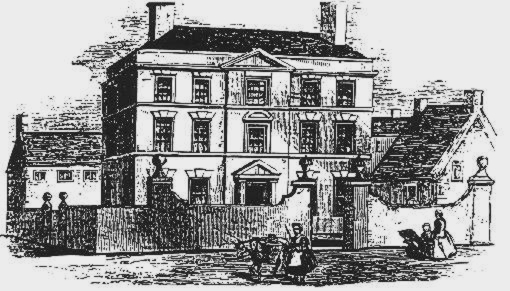
    The Big House, Burslem

    Just down the road from where Snape’s Theatre was taking a battering, part of an eight-foot tall wall between a timber Yard and the Big House was knocked down by the wind and rain, the accumulated flood water then rushed through the ground floor of the Big House with great force, blowing the front door open and then pouring in a stream down the turnpike road. 

    At the Roebuck Inn in Wedgwood Place, the violence of the rainstorm split some of the roof tiles, causing a mass of water to cascade into the upper rooms, then down the stairs and out through the front doors. The Town Hall too received a soaking, the basement of which was flooded to a depth of three feet, which caused no end of problems for the hall keeper and his wife who had the job of clearing it all out. Likewise the row of houses in Martin’s Hole – literally a hole or hollow near the Newcastle Road, where the roofs of the houses were on a level with the road – ‘presented a truly pitiable appearance’, the buildings being flooded to a depth of four and a half feet, ruining food stores and furniture and forcing the luckless inhabitants to seek shelter on the upper floor. 

    Almost everywhere else it was the same story with only slight variations. Longport received a severe visitation with most of the houses flooded to several feet. At Middleport the canal overflowed adding to the chaos. At Tunstall, water poured into the police station and several houses doing much damage. In Smallthorne numerous houses were flooded and smaller items of furniture were flushed out of the doors and sent floating down the street. At Dresden as well as the numerous flooded properties, the road at the lower end of the village was split apart by the storm, leaving it looking for all the world as if it had been heavily ploughed, which made it impassable to traffic and men had to be brought in to make repairs. In Stoke, Fenton and Dresden as in Burslem, many householders were forced briefly to live upstairs as their ground floors filled up, sometimes as high as the ceiling. Longton too suffered torrential rain and likewise had some flooding, but saw much less material damage, though at one pot bank the downpour extinguished the fires in their kilns. 

    Then the storm passed, leaving the Potteries in a battered state that it would take several days to recover from. That evening another storm broke overhead, but this turned out to be a much less severe event and caused no more serious problems.

    Reference: Birmingham Daily Post, Tuesday 9 July 1872, p.5; Staffordshire Advertiser, Saturday 13 July 1872, p.5.
  • What the Potteries Gave to Basketball

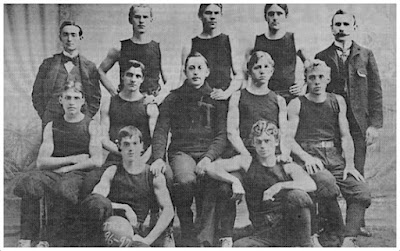
    The Trenton basketball team 1896-97. Fred Cooper is bottom left with
    the ball, his friend Al Bratton is bottom right.

    In 1896, Frederick Cooper, a distant American cousin of mine, earned himself a place in the history books through the simple act of accepting a fee. Several years earlier, a dynamic new game called basketball had been invented that was gaining a strong following in the various YMCAs on America’s east coast. Fred, already a keen sportsman had like many others quickly warmed to the game, becoming the star player and captain of the highly successful Trenton YMCA team that for the previous three years had dominated the emerging leagues. At first the new game had been played for fun and entertainment, but the groundswell of support soon saw seats being sold for popular teams and inevitably the money trickled back to the players that the crowds wanted to see. The result was that in 1896 Fred was the first to accept payment for a game and in doing so became the world’s first professional basketball player.

    Though he would make his name in the United States, Fred Cooper was actually born at 21 Bethesda Street, Shelton on 25 March 1874, the fifth of seven children – six boys and one girl – born to Thomas Cooper and Ann, nee Simpson. Fred’s father, Thomas, had started out as a working potter but over the years had moved into small scale pottery manufacture. However, in the mid-1880s, in the wake of what was later described in Fred’s obituary as ‘some business reverses’, Thomas and Ann decided to emigrate and join their eldest child, William who was already settled in the States, working at the Greenwood Pottery in Trenton, New Jersey. The Coopers left Britain early in 1886, travelling as steerage passengers (i.e. 3rd class) aboard the SS England, arriving at New York on 27 May 1886, from where they made the relatively short journey south west across the state to Trenton. As it turned out, Thomas would only enjoy his new home in America for a few years, dying in 1891 at the age of 56, but his wife and children settled into their new lives and over time became valued members of the local community.

    Trenton, New Jersey, USA

    On arriving in the States, Fred and his younger brother Albert, or ‘Al’ as he became best known, had been enrolled in the Centennial School where they soon got involved in sports and stood out as skilled footballers, a game their father had taught them. Fred especially proved to be an all-round sportsman, also taking up baseball, competitive running and later becoming a fine billiards player and a good bowler. His successes, though were at first eclipsed by his older brother, Arthur, who back in Britain had been such a skilled footballer that in the early to mid 1880s he played for Stoke F.C.’s junior team, Stoke Swifts. Arthur seems to have stayed behind for a year after the rest of the family emigrated, perhaps to help the Swifts in their attempt to win the junior league cup. Once this was over though, in 1887, he too took a ship to the States, but not before being presented with a handsome medallion by his team mates and the club. Once in the States, Arthur’s success had continued, and it was not long before he was picked as a member of the All-America soccer team.

    While his brother’s career blossomed, Fred left school and found work as a sanitary-ware presser at one of Trenton’s pot banks, a job he would do for the better part of three decades. He continued to pursue his love of sport in his spare time through the local YMCA, which acted as a youth club for boys and young men of religious families like the Coopers. Here he found a kindred spirit in another keen footballer named Al Bratton, with whom he seems to have formed a winning partnership, not only on the football pitch, but also when the two of them decided to try their hand at the new game of basketball that was sweeping through the YMCA branches. Only a few years had passed since Canadian-born training instructor James Naismith had dreamt up the indoor game to placate a group of YMCA trainees at the School for Christian Workers, Springfield, Massachusetts, who had been chafing at their inactivity during the long winter months. Though rough-hewn at first, with early games resembling pitched battles between oversized teams, basketball proved an immediate hit and when Naismith published an article on the game it was quickly taken up by YMCA branches along America’s east coast. Soon, matches were drawing sizeable crowds and more and more teams sprang up, one of which was Trenton YMCA.

    Fred Cooper and Al Bratton first joined the Trenton YMCA basketball team for the 1893-94 season and had an immediate and lasting impact on how the game was played. In those early days, basketball was a game of individual dribblers working their way through the opposition before attempting a shot at the basket, a method that favoured heavy-set players who could push their way through the field. According to one of basketball’s early chroniclers, Cooper and Bratton changed this, creating a more fluid game by drawing on their footballing skills to develop a system of short, swift passes between them on the run, a style of play that completely unbalanced opposing teams.

    ‘The Trenton system of passing was definite. It meant to carry the ball to the opponent’s basket in order that a goal might be scored, and time and again I have seen Cooper and Bratton in those early days, pass the ball back and forth between them – no one else touching it – and score against all the efforts of the entire opposing team. I have seen them do this trick away from home and witnessed the spectators rise en masse and cheer the brilliant exhibition in spite of the fact that it was being done by invading players.’

    For the next three seasons, the Trenton YMCA dominated the game in New Jersey and eastern Pennsylvania by which time Fred was the team captain and unofficial coach. Despite his refinements to the game, rough play characterised basketball in those free-wheeling and largely unregulated years, with physical injuries being an all too common feature of play, both on and off the court. Not only was there brawling between players, but partisan crowds took whatever opportunities came their way to try and injure or discomfort the rival team and as a result fighting between players and spectators was not unusual. Though the YMCA had quickly lauded Naismith’s new game for promoting a useful spirit of ‘muscular Christianity’ – a healthy body breeding a healthy mind – the rough-housing and unsportsmanlike behaviour drew the Association’s displeasure and increasingly basketball teams deserted the YMCA gyms, or were ousted by outraged officials and had to find other venues to play in.

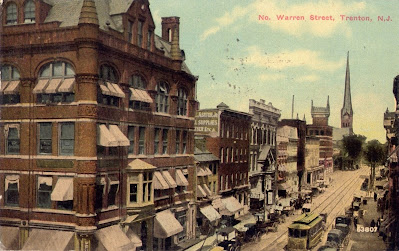
    Warren Street, Trenton, with the Masonic Temple nearest the camera.

    Such seems to have been the case at the Trenton YMCA. Unspecified ‘trouble in the gymnasium’, followed by a string of disagreements between the branch secretary and the YMCA team saw the basketball players shifting their base to the Masonic Temple, a large building in downtown Trenton. Here the team made use of the large reception room on the top floor, where a 12 feet high mesh fence with gates at either end was built enclosing the court. This ‘cage’ was a new innovation, built to stop the ball going out of play so readily and prevent some of the troubles caused by resultant clashes with spectators. The Trenton team were the first to employ this device and though its use eventually fell out of favour, its early employment coined the term ‘cager’ as a snappy way to refer to a basketball player, a term that is apparently still in use today.

    It was in this cage that Fred Cooper and his team mates made history by playing what is presumed to be the first professional basketball game on 7 November 1896, against Brooklyn YMCA. The game had been advertised in a local paper three days earlier (another first) and provisions were made for a sizeable crowd, raised seating being built around the court. Seats were priced at 25c, standing room cost 15c. Nor would the organisers be disappointed by the turn out, ‘a large and fashionable audience’ of 700 turning up to watch.

    The Trenton team came out smartly dressed in red sleeveless tops, black knickerbockers and stockings and white ankle shoes. There were seven in each team, two forwards, a centre, two side centres and two defenders. This was before the days of the tall men in basketball, all of them being average sized, Fred himself was only 5 feet, 7 inches tall. In accordance with the practice of the time, the home team supplied the referee and the visitors chose the umpire.

    The game started with seven minutes of ‘fierce playing’ before Newt Bugbee, one of Trenton’s side centres scored the first goal. Fred did not disappoint either, leading the scoring by gaining six points for three baskets, while a player named Simonson scored Brooklyn’s only point with a free throw three minutes before the game finished. Trenton’s team played the full 40 minutes, while Brooklyn had one substitution. The final score was a 16-1 victory for Trenton.

    Following the game, Trenton’s manager hosted a supper for both teams at the Alhambra Restaurant, where the Trenton players received their historic payment. There has been some disputing the amount actually paid to the players after the various expenses were deducted, but the accepted version of events was that quoted in Fred’s obituary in 1955. ‘All the players collected $15  each, but Fred Cooper was the captain and manager (sic) and was paid off first. Thus he became the first professional basketball player in the world. He was proud of this distinction all his life.’

    Many versions of the story add that Fred as the captain was also paid a dollar more than his compatriots, which if true also made him the game’s first highest paid player. Also, the ‘professional’ status is perhaps somewhat fuzzy as he still worked as a potter; semi-professional, might be more accurate. That argument aside, it started a trend that would lead to the fully professional game seen today.

    As they had with the new swift style of play and Trenton’s ‘cage’, other teams quickly followed Trenton down the professional route. This in turn led to the formation in 1898 of the first professional league, the National Basketball League, which Trenton under Fred Cooper’s captaincy promptly dominated, winning the first two NBL titles. By this time the team had been joined by Fred’s younger brother, Albert. Tall and handsome and as skilled as his brother, Al Cooper proved to be an accomplished goal scorer and easily the best player in the new league.

    Despite their successes, during the first few NBL seasons, Fred was growing disillusioned with the Trenton team. His brother Al and Harry Stout, Trenton’s top scorer did not get along, while the team’s co-owners had also had a falling out. Keen for a fresh start, at the beginning of the 1900-1901 season, he quit the Trenton squad to coach a new team in nearby Burlington. The result, though, was embarrassing. Though Fred was an excellent coach, his new team lacked Trenton’s pool of of talented players, the result being that Burlington lost its first eight games before Fred gave up. He was immediately snapped up to coach the Bristol team, before going on to coach at Princeton University between 1904-1906. It was not until 1910 that Fred returned to coach the struggling Trenton Eastern Basketball League team and did so successfully, winning the EBL title the following year. He was replaced as the coach the next year, but returned to coach Trenton one more time ten years later. His last stint as a team coach was at Rider College in the 1920s.

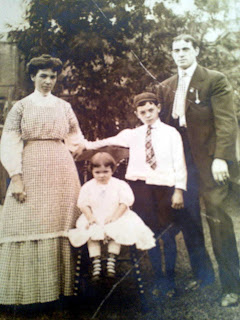
    Fred and Catherine and their eldest children
    Thomas and Mabel.
    Photo courtesy of Susan Corrigan.

    Alongside his sporting career, Fred enjoyed a happy family and social life. In 1901, he had married Catherine Carr and the couple had three children. Like his siblings he was an active member of the Trenton community, becoming in time a church elder, and a member of various local and national patriotic orders and Masonic lodges. As noted earlier he had worked for many years as a sanitary-ware presser at the Enterprise Pottery, which generously allowed him time off for his coaching duties, but he quit his job in 1922, when on the strength of his sporting career, he was offered a position as a director of local sports grounds, a posting that eventually led to him becoming head of the city recreation department.

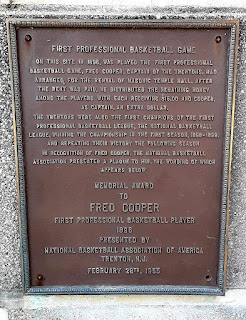
    Fred Cooper died in January 1955 at the age of 80, being buried in Greenwood Cemetery, Trenton. The local paper gave him a fulsome obituary, while the National Basketball Association,  heir to the early leagues that Fred and others had helped to forge, did not forget its pioneering sportsman. In February 1955, the NBA presented the city of Trenton with a bronze plaque in honour of Fred and his ground-breaking professional match, which was placed on the site of Trenton’s old Masonic Temple.

    The memorial plaque to the first professional match.
    Photo courtesy of Grace Cooper


    Reference: Robert W. Peterson, Cages to Jump Shots: Pro Basketball’s Early Years (New York, 1990) pp. 32-37.  Obituary, Trenton Evening Times, 7 January 1955. 

    Family information courtesy of Grace Cooper and Susan Corrigan.

    Website: Pro Basketball Encyclopedia.

  • Soprano: The Musical Career of Lily Lonsdale

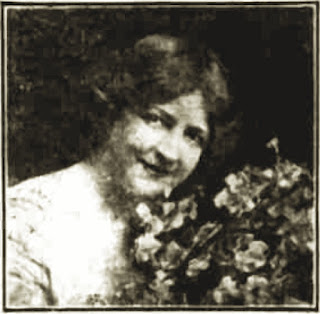
    Elizabeth Longsdale, alias Lily Lonsdale

    Born in Pitts Hill, Tunstall in 1878, Elizabeth Longsdale came from a musical family, her father William was a potter, but served as the choir master at Christ Church, Tunstall, and several other family members such as her brother Wilson, would make their names locally as singers. It was Elizabeth, though, who under the alliterative stage name of Lily Lonsdale, would become the most famous, carving a notable career in the music halls of Britain and abroad.

    Elizabeth started her singing career as a soloist at local concerts and enjoyed a spell with the North Stafford Amateur Operatic Society before turning professional when she joined Thomas Tomkinson’s Gypsy Children. This was a local choir turned concert party that was composed of talented children and adolescents that had gained quite a following in the Potteries. The troupe served as a training ground for several local performers who later went onto greater things, most notably Gertrude Mary Astbury who as Gertie Gitana would become one of the best know stars of the music halls. Elizabeth (now billed as ‘Lily Lonsdale’) shone just as brightly, impressing audiences with her beautiful, well-modulated voice and garnering great praise. By 1897, the troupe had moved beyond the Potteries and began touring the Midlands and Wales, performing in various venues like theatres and town halls, supported by parents and helpers who assisted with logistics and costumes.

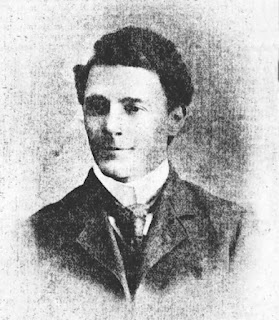
    Ernie Myers

    By mid 1899, Lily now in her early 20s was getting too old for child roles, and she was also romantically involved with Ernie Myers, a comedian from the troupe. However, her initial attempts for a career shift suffered a setback. After leaving the Royal Gipsy Children, she joined a rival troupe, Leon Vint’s Globe Choir, but soon had to resign due to vocal strain. This set her at odds with Vint, who after first agreeing to let her go then changed tack and took Lily and her sister Agnes to court for breech of contract. However, once in court, the judge deemed that Vint had acted unfairly and that the contract was far too heavily-weighted in his favour and as a result he ruled in Lily and her sister’s favour and they went on their way unhindered, leaving Vint with the costs for his bully-boy behaviour. Lily made a brief return to the ranks of the Royal Gypsy Children, but following the unexpected death in late January 1900 of Thomas Tomkinson the troupe’s founder, she and Ernie decided to set out on their own, securing an agent and booking early performances on the music hall circuit; they married in Liverpool in April 1901 whilst on tour. Shortly afterwards they were put on the so-called Moss and Thornton tour, taking in a series of theatres and musical halls across Ireland, northern England and Scotland.

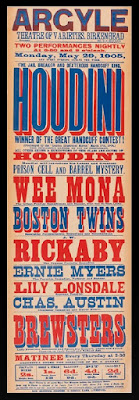
    In 1901, Lily took a short break to have their son, Jacob William, but hard economics often meant that family life came second to their performing careers. Leaving their son with Lily’s mother, they resumed a busy schedule of public performances across Britain, building their careers. They used their stage names and normally performed separately, with Ernie as a popular ‘patter’ comedian telling amusing stories and Lily as a classical soprano singer, though occasionally she took on comedy roles in sketches opposite her husband. They shared the stage with various entertainers, including conjurors, ventriloquists, impressionists, acrobats, marksmen, puppeteers, clowns, jugglers, dancers and performing animals as well as other comedians and singers. An undoubted highlight of their careers was performing on the same bill as the famous American escapologist Harry Houdini in 1905, when he was on a tour of Britain.

    The demands of travel and performing were tough; they worked six nights a week, with Lily often singing multiple songs per show, and she and Ernie were constantly in search of fresh material. During winters, they performed in pantomimes together, with Ernie playing the villain in “Aladdin” and Lily as the princess.

    By 1911, their careers were going well and the couple lived comfortably in Derby with their daughter Lillian May and son Jack who were cared for by Lily’s mother. In August of that year, they were invited to perform in South Africa but returned by December. Their routine continued until 1914 when they travelled back to South Africa. Sadly, Ernie fell ill and died on the ship before reaching port, leaving Lily heartbroken and reliant on support from the theatre community in Cape Town. After Ernie’s funeral she stayed on to complete her contract, then she returned to Britain to support her family amid the challenges of the Great War.

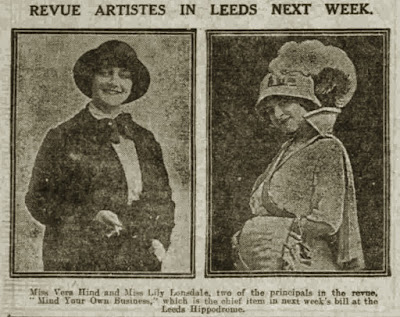
    Despite wartime difficulties, Lily found work in successful and topical revues like Mind Your Own Business and My Son Sammy, and whilst on tour the theatre company would often lay on special performances for wounded soldiers in hospitals, which proved very popular. Her career flourished through the war and after, but away from the limelight her mother’s declining health was a worry. In May 1920, Lily suffered a nervous breakdown due to exhaustion and stress, and shortly afterwards her mother passed away, leading to another break from performances.

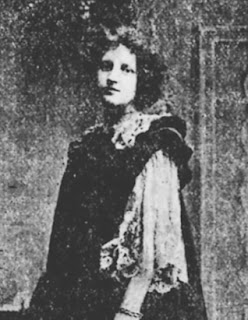
    Lily pictured in her obituary

    Over the next five years, Lily remained active but by her late 40s, probably as a result of her arduous lifestyle, her health began to suffer. Her career ended suddenly in August 1928 when she collapsed on stage in Wolverhampton. Although she finished her performance, she was taken to the hospital and she never really recovered. Lily died on 2 March 1929, aged 49, at the Derbyshire Royal Infirmary. There were short obituaries to the singer in the Sentinel and in a couple of Derby papers over the next couple of days, but that was the limit of the press coverage. She was buried at Derby’s Nottingham Road Cemetery four days later.

    Reference: Staffordshire Sentinel, 8 March 1929.

  • The Sneyd Colliery Disaster

    At 7.50 am, on 1 January 1942, a devastating explosion took place 800 yards below ground at No 4 pit of Sneyd Colliery, Smallthorne. In normal times the pit would not have been working on New Years Day, the miners considering it unlucky, but because of the demand for coal during the war, work had gone on as normal and a full shift was on duty at the mine when the explosion occurred. The blast was contained to one coalface in the 7-foot Banbury Seam of No. 4 pit. All other workings were unaffected by the explosion, but the thump was felt throughout the mine, some men in the pit noted that the flow of air changed direction, while on the surface people felt a bump and all the lights flickered. Everyone knew something major had happened and when a frantic telephone call from the pit bottom informed them that an explosion had occurred, for the safety of all, work was stopped and the miners were quickly evacuated from the unaffected parts of No. 4 pit as well as from the neighbouring No. 2 pit.

    The Sneyd Mines Rescue Team sprang into action immediately after the blast and venturing down they rescued a handful of men from the pit bottom, but also found the first bodies. Teams were soon arriving from other local collieries including Chatterley Whitfield, Black Bull, Hanley Deep and Shelton; in total nine local mines rescue teams became involved in what soon turned from a rescue to a recovery effort. Beyond the mine, news of the explosion soon spread by word of mouth through the local community. Families and friends horrified by the reports they were hearing dashed up to the colliery to wait at the Hot Lane gate for news of their loved ones, but for many it would be the worst news. The bodies of 16 men were brought out that first day, but the rescue operations had to be postponed due to the presence of afterdamp and it was announced at that point that there was now no hope of finding anyone else alive. Up top, everyone came in to help, first aid staff were on duty at the ambulance room, the mine managers directed the rescue operation and the Inspectorate of Mines soon had staff on site to help out and assess the damage. Other staff did their bit too, the pit’s chief telephonist Mabel Caine was reported to have stayed at her post almost continuously for five days and nights, fielding thousands of phone calls and refusing all attempts to get her to take a long break.

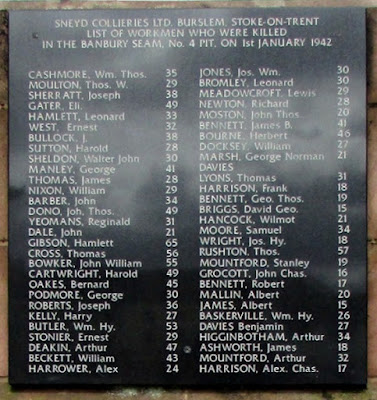
    On 5 January even before all the bodies had been recovered, nearly 80% of the workforce got back to work, but it was not until 10 January that the last bodies were recovered. The list of the dead was sobering, as of the 61 men and boys working on the face that morning, 57 had lost their lives in the blast, most being killed in the initial explosion, while two later died in hospital. The two youngest, David George Briggs from Stanfields and Albert James from Burslem were both aged 15, while the oldest Hamlett Gibson, from Cobridge was 65. There were many sad stories to be told of those who were lost. A Mrs Bennett of Moorland Road, Burslem, suffered a double bereavement, losing her 41 year old husband James and 17 year old son Robert, both of whom had been working on haulage; the family had only recently moved down from Scotland. Mr and Mrs W. F. Harrison of Cobridge lost two teenage sons, Frank aged 18 and Alexander Charles aged 17. Joseph Sherratt aged 38 from Porthill was one of two firemen who were missing. Married with two children and a third on the way, only hours before he had been enjoying a party with his children and some of their friends and had laid on a puppet show of ‘Sinbad the Sailor’ to amuse them. He had not been superstitious about working on New Year, but his wife had and handed him a silver three penny piece for luck. Another haulage worker from Burslem, William Docksey aged 27, had been at the pit for 10 years, He had a brother working elsewhere in the mine who immediately joined the rescue team in an effort to find William. And David Briggs one of the youngsters mentioned earlier, had enjoyed a brief moment of local fame only a short while before, when he was photographed with the Minister of Food, Lord Woolton, eating one of the first sandwiches to be served by the new central depot for providing sandwiches for the miners of North Staffordshire.

     Four survivors had been pulled out of the pit, who by sheer luck or their more sheltered position in the mine, had escaped serious injury or death. One was Ernest Stone of Burslem in charge of the telephone at the pit bottom, whose call had alerted those up top to what had happened. He had been seated in a recessed area off the main road when the explosion occurred and thus avoided the worst of the blast. When the first rescuers arrived, though very dazed, he stayed at his post for three hours refusing to go up until he was finally overcome with dizziness. Another equally lucky was George Read of Burslem, the chief hooker in charge of loading and unloading tubs into the cages at the pit bottom. Like Mr Stone he was in an area off the main roadway and likewise escaped the worst of the blast. After a day at home getting over the shock of what had happened, he returned to the pit to help in the recovery effort. Thomas Gibbons from Burslem aged 64, was not so lucky. He was working near to the pit bottom operating a compressed air machine that drew tubs from the Banbury seam when the explosion occurred. Hit by a tremendous blast of hot air, he was hurled against a wall and fainted. Coming to a short while later in complete darkness and covered in dust only his intimate knowledge of the mine saved him. Working out where he was, Thomas crawled along the passage to where it branched off from the Bambury seam to the return of the Holly Lane branch. After crawling along for another 200 yards he was discovered by some Holly Lane miners who gave him some water and got him transported to the surface, from where he went to hospital. The fourth ‘survivor’ had not actually been in that part of the pit, but had initially been listed with the missing. Mr J. Bailey from Hanley, had only started at the pit the day before and swapped his heavy hand lamp for a helmet lamp with another man that morning. This was later discovered by the rescue teams who presumed Mr Bailey was a victim, though he had already been evacuated from the mine with the other 600 men. The mix-up was only discovered when he later wandered into the Burslem Miner’s Hall to correct the mistake after finding that he had been listed as a victim.

    In the immediate aftermath of the disaster a fund was set up to which many members of the public, collieries and companies gave money, while the proceeds of many local performances were also donated and money came in from abroad, even from as far away as soldiers serving in Iceland; over £17.000 was eventually collected and shared out amongst those who had lost a relative, the shares being determined by how many dependents the victims left behind. Families had been devastated by the disaster, many losing their main or only breadwinner. The disaster left 32 widows and 35 fatherless children, while of the 24 unmarried men 13 left grieving mothers and fathers and 8 left mothers who were already widowed.

    The question everyone wanted answered, was what had caused this appalling accident? The subsequent inquiry headed by Sir Henry Walker, concluded that the most likely cause was that tubs used to move the coal out of the mine had derailed and damaged an electric cable. Sparks from the cable had then ignited coal dust in the air and caused an explosion. Some writers have since disagreed with this explanation, and have advanced other perfectly valid theories, though after all this time any kind of definitive explanation of what happened is not possible as the mine is no more and all the witnesses are long dead.

    Sneyd Colliery continued working through the war, but from the late 1950s onwards it was slowly swallowed up by a larger neighbour. Major reconstruction work at Wolstanton Colliery saw an underground connection made to Sneyd and from that point on coal gradually started being brought to the surface at Wolstanton. Coal ceased being raised at Sneyd in July 1962 and though for a time the shafts there were still used for sending miners down, eventually all the men were transferred to Wolstanton Colliery. The No. 4 shaft, however, remained open as a spare entry for the northern area of the expanded colliery until the final closure of Wolstanton in 1985.

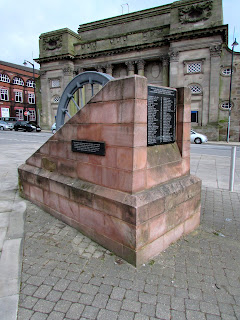
    The Sneyd Colliery explosion has the dubious honour of being the last major pit disaster in the Potteries and it cast a long shadow in the city’s collective memory. A memorial comprising a pit wheel set in bricks was unveiled in Burslem town centre in 2007. It lists all 57 names of the dead on a plaque and carries another praising the mines rescue teams that worked so hard to bring out the bodies.

    Reference: Evening Sentinel, 1 January 1942, p. 1; 2 January, p.1; 5 January, p.1; 10 January, p.1.