Tag: Crimean War

  • Into the Valley of Death

    In 1975, a small article appeared in the Evening Sentinel noting that at the battle of Balaclava during the Crimean War, 1358 Private George Turner* of the 11th Hussars, born in Burslem, had been mortally wounded during the Charge of the Light Brigade. According to his records, Turner was indeed from Burslem, and had worked locally as a crate maker until at the age of 18 he had enlisted in the 11th Hussars at Coventry on 24th September 1847. As the paper noted, he was probably the only man from the Potteries to have taken part in that famous but suicidal military action, when on 25th October 1854, a force of nearly 670 light cavalrymen were mistakenly launched in a frontal attack on an extended line of Russian cannon, infantry and cavalry at the end of a valley, that were further supported by other batteries on either side. The results of this colossal blunder were predictable, with some 110 British soldiers being killed and 160 wounded in the attack, a 40 percent casualty rate, while over 300 horses were killed. 

    Richard Caton Woodville’s famous painting of the Charge of the Light Brigade. Lord Cardigan on the far left of picture is dressed as the commander of the 11th Hussars.
    Source: Wikimedia Commons

    The 11th Hussars, resplendent in their black fur shakos, blue and gold braided jackets and crimson trousers, formed half of the second rank of the Light Brigade, though that did not spare them and they took a severe mauling from the Russian cannons as the Brigade closed on the enemy line. Private Turner was one of those struck down well before they got there, hit on the left arm by a cannonball, his injury being witnessed by Sergeant Major George Loy Smith of his company, who was riding nearby. Loy Smith later wrote ‘… before we had gone many hundred yards Private Turner’s arm was struck off close to the shoulder and Private Ward was struck full in the chest.’ Another Private named Young had received a similar injury to Turner and Loy Smith told him to turn his horse around and go back to their own lines, ‘… I had hardly done speaking to him, when Private Turner fell back, calling out to me for help. I told him too, to go back to the rear.’

    The rest of the brigade rode on down the valley and through the line of cannons where they briefly caused havoc in the rear of the Russian line before exhaustion, the decimation of their ranks and Russian reinforcements forced them to retreat. Turner meantime, must have ridden, or been carried back down the valley to the British lines, bandaged up and with others was then placed aboard a transport ship bound for the military hospital at Scutari in Turkey. However, he never made it, his wound was too severe; Private George Turner aged 25 years old died aboard ship on 28th October and was probably buried at sea. 

    There was no mention of the fate of Private Turner in the local papers at the time and it took 120 years for his story to finally make the pages of the Sentinel. It was related by Mr W. R. Baker of Endon, who added, ‘I ask your readers to spare a moment’s thought to his memory now when tradition has little meaning and patriotism is an outmoded word I make no apology for thinking that he should not be entirely forgotten.’ 

    There existed, though, another poignant addendum to Turner’s sad tale. Seven months after the battle of Balaclava, the Light Brigade had passed again over the same ground, now deserted of enemy troops and here the upper part of a sabre scabbard, all twisted and mangled, was picked up by Sergeant Major Loy Smith and it became part of his collection of memorabilia. When the collection was put on display in Sheffield in 1981, a card attached to the scabbard’s remains read, ‘This belonged to Private Turner, K.I.A.’

    *Despite my best efforts, I have yet to find a trace of a George Turner in the local civil records who fits the available data, raising the possibility that the name is an alias.

    Reference: Evening Sentinel, 25 October 1975, p.4; George Loy Smith, A Victorian RSM: From India to the Crimea, p. 132.

    My thanks to Mr Philip Boys for kindly providing me with background information on Private Turner contained in ‘Lives of the Light Brigade: The E. J. Boys Archive’. 
  • Cannons from the Crimea

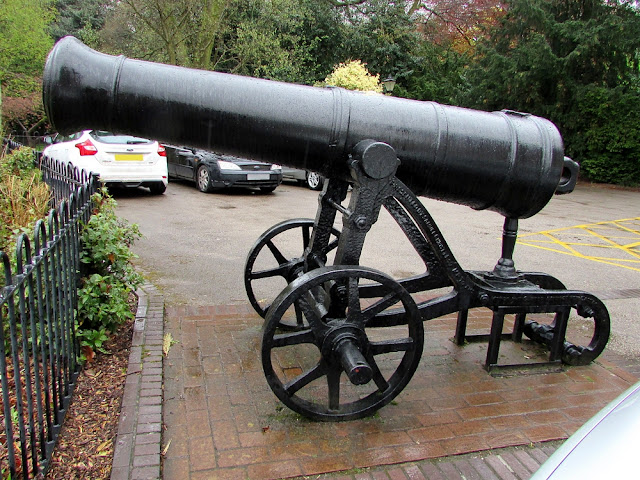
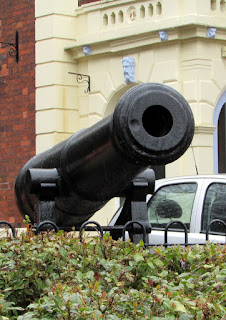
    Standing outside of the Brampton Museum in Newcastle-under-Lyme is a large black-painted cannon, mounted on a cast-iron limber. This was one of thousands of similar pieces of war booty brought back from the Crimea, following the fall of the Russian citadel of Sevastopol in 1855. In that city the Allied armies had discovered a large ordnance depot filled with 4,000 damaged or obsolete guns and these along with many of the guns captured during the fighting were later used as ballast on the merchantmen and troopships when they were bringing the army home. The Crimean War (1854-1856), had been a horrendous and utterly pointless conflict and perhaps as part of a wider public relations exercise to calm the national anger at the lives lost and at just how badly the war had been run, these cannon were freely distributed to towns and cities around the country.

    Newcastle’s cannon, weighing 2.8 tons is a 36 pounder made in 1840, and was presented to the Borough in 1857 by its then MP Samuel Christy. It was originally situated in Stubbs Walks, opposite the Orme Girl’s School, Newcastle, where it stood until 1965, when it was moved to its current location. Such was the fate of most of these retired instruments of war and in the latter half of the nineteenth century it was no unusual thing to find a large, defunct piece of Russian artillery decorating a municipal park or fronting some grand civic building anywhere in Britain. Today, though, they are not so common; time and necessity have seen many of the others scattered or scrapped over the years and such seems to have been the case with a couple of cannons that came to the Potteries, no trace of which now seems to exist.

    Newcastle’s impressive Russia cannon in situ. The carriage was mass-produced at the Royal Armouries in Woolwich.

    In his autobiography Past Years, Potteries-born scientist Oliver Lodge, mentioned a close encounter with a Russian cannon in his youth. Lodge recalled that at a very young age his father took him from their home in Penkhull down the steep hill to Stoke where peace celebrations marking the end of the Crimean War were taking place. A captured Russian cannon had been placed in front of the Wheatsheaf Hotel and Mr Lodge told his son to wait by the cannon until he came back for him. Looking up at the monstrous artillery piece, young Oliver wondered what they were going to do with the gun, half fearing but half hoping that they were going to fire it. However, nothing so exciting happened, instead the local dignitaries made several speeches before they all set off for lunch. Oliver’s father went with them, minus his boy, and afterwards in the evening he went home having completely forgotten about Oliver. Only after returning home and being asked by his wife where their son was did he suddenly remember and went dashing off back down the bank to find the lad still obediently standing by the gun, utterly unconcerned at being left alone for several hours after everyone else had departed. 

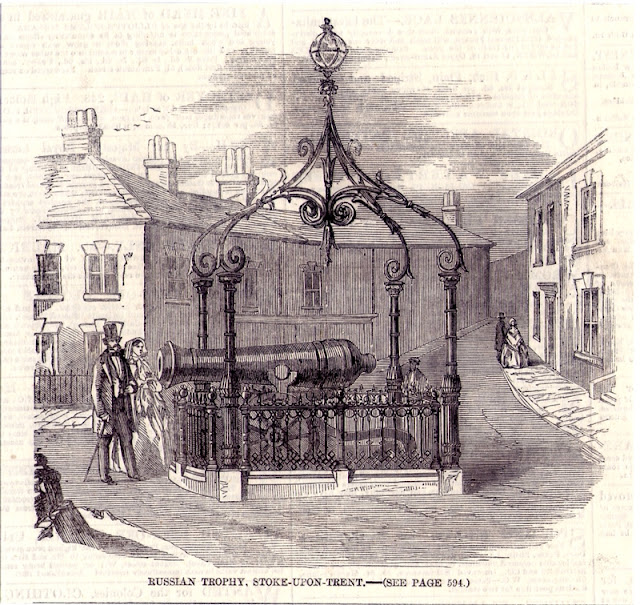
    The Victoria History of Staffordshire notes that a Russian cannon was presented to the town by W. T. Copeland in 1857 and erected opposite the Wheatsheaf Hotel in 1858, as per Lodge’s memoirs. In 1858, the Illustrated London News carried an interesting illustration of what was called Stoke-upon-Trent’s ‘Russian trophy’, along with some background information.


    ‘RUSSIAN TROPHY AT STOKE-UPON-TRENT.’ 

    ‘We give a representation of the Russian Trophy as mounted and in closed at Stoke-upon-Trent a few weeks ago. The gun is placed on a stone platform, as shown in the Illustration, in which the Royal arms, in Minton’s tiles, is inserted. On the stone parapet an ornamental railing of a handsome pattern is placed, and at each angle of the square of the platform a pillar in cast iron rises, to carry the wrought-iron scrollwork, which was manufactured by Mr. Haslam, of Derby, and is an excellent specimen of the old art of ironworking, now so ex­tensively superseded by the process of casting. All the ironwork is coloured in imitation of Florentine bronze, and richly gilt in the more decorative parts of the design. The whole is surmounted by a large globe lamp, which forms the principal feature of the construction, as the erection, being placed at the junction of three streets, requires a prominent and well adapted mode of lighting. The trophy was in­augurated by Mr. Alderman Copeland, one of the members for the borough, who also defrayed the expenses connected with mounting the piece. The work was designed and carried out under Mr. Edgar, architect.’

    Longton also received a gun, but even less is known about that one. There is a brief note in the Staffordshire Sentinel in 1867 that reads: ‘The same committee reported a resolution, in accordance with a suggestion from the Council, to remove the Russian cannon from the front of the Town Hall to the space within the railings at the front of the Court House… The proceedings were approved, and the recommendation adopted.’ In his Sociological History of Stoke-on-Trent, E. J. D. Warrilow includes a photograph of Longton Court House with the cannon situated behind the railings as described, but a second photo taken in 1950 shows that the gun had been removed. It was resited to Queen’s Park, Longton, where it stood in front of the clock tower. However, it has long since vanished and its current whereabouts are unknown.


    Stoke’s gun was also later moved, to a site in Hill Street by the old town hall in about 1874, but what finally happened to this and Longton’s cannon is unknown. The most likely scenario is that the valuable metal was sacrificed to the war effort early in World War Two, and ironically perhaps went on to become part of a more modern arsenal. 


    Contrast this sad end with that of the Newcastle gun which has achieved a certain status in the area. Between 1919 to 1942, during its time in Stubb’s Walks, the cannon was joined by a World War One training tank as a companion, but the tank was sent to be scrapped during World War Two. When the Crimean gun was shifted from its original site in 1965 some feared that it too was destined to be melted down and contractors arrived to find that some of the pupils from the Orme Girl’s School had hung a notice on the gun – ‘Hands off our cannon’. They need not have worried. Today, the cannon points out over the Brampton Park, providing a striking and novel photo opportunity to visitors to the town’s museum. 

    Reference: Oliver Lodge, Past Years: An Autobiography (Cambridge, 1931) pp. 22-23. E. J. D. Warrillow, A Sociological History of Stoke-on-Trent, p.385, Illustrated London News, 12 June 1858, Staffordshire Sentinel, 6 July 1867, Victoria History of Staffordshire Vol. VIII., p.180.

    Website: Crimean Cannon International Database