Tag: Burslem

  • Little Gypsy Girl

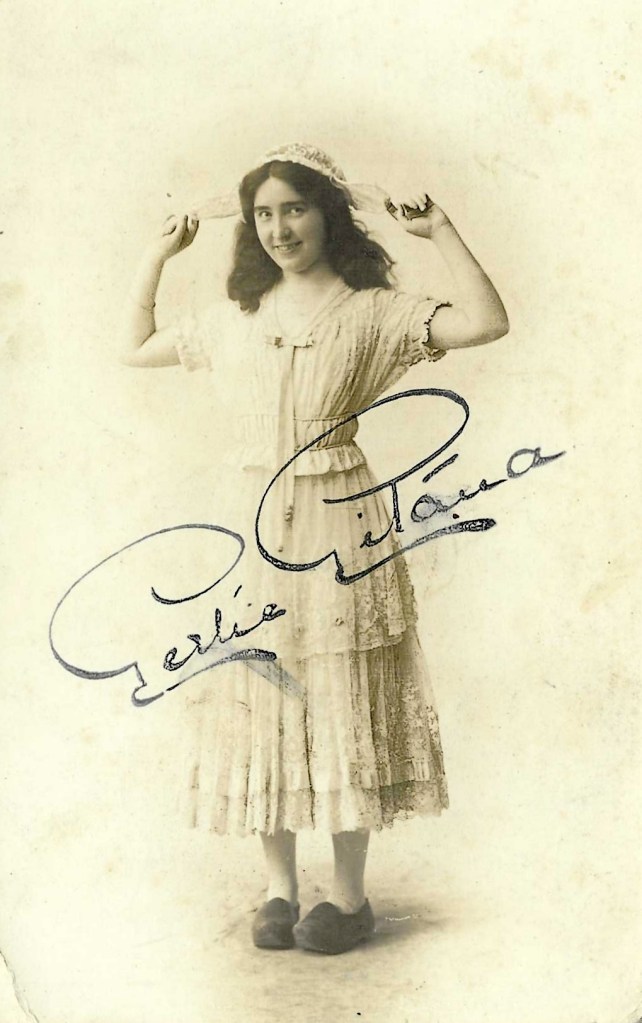
    A vintage black and white photograph of a young girl with dark hair, wearing a light-colored dress and holding a hat or scarf above her head, smiling at the camera. Her name, 'Gertie Gitana,' is beautifully signed below her image.
    Gertrude Astbury, known as Gertie Gitana, captured in a charming early publicity photograph.

    Of all the famous names who have hailed from the Potteries, few in their lifetime gave more honest, unalloyed pleasure than Gertrude Astbury, who as ‘Gertie Gitana’ became a darling of the music halls prior to World War One. Her talent and staying power were considerable. In her prime, her name on the bill was enough to ensure a full house, and even in the twilight years of her career, she was still able to command a large audience.

    Gertrude Mary Astbury, the eldest child of pottery turner William Astbury and Lavinia nee Kilkenny, a teacher at St Peter’s R. C. School in Cobridge, was born on 28 December 1887 at 7 Shirley Street, Longport, but the family lived at various addresses after that. When in 1954 the City Council decided to rename Frederick Street, behind the Theatre Royal in Hanley, as Gitana Street in her honour, Gertie wrote a letter to The Sentinel saying that she was very proud of the honour noting that ‘Gitana-street is adjacent to the theatre stage is appropriate.’ She then added, ‘I don’t think anyone knows of it, but it may be of some slight interest to mention that I actually lived in Frederick-street; my mother had a small shop there. I was three years old when we moved there and we were there for two or three years.’ There is no official evidence to support this story, but at the time of the 1891 census, Gertie was certainly living with her grandparents in Bucknall New Road, Hanley, while her parents and brother James lived in Burslem. Perhaps the family moved to Fredrick Street after the census was taken?

    From a very early age, Gertie proved to be something of a musical prodigy. Apparently as a toddler she delighted in putting on performances for her dolls and by the age of four she had been enrolled into Thomas Tomkinson’s Gypsy Children as a male impersonator, singer and comedienne and was soon earning star billing as ‘Little Gitana’ (the Spanish word for a female gypsy). The tale told of her discovery is that she was seen dancing in the street (arguably in Frederick Street, Hanley) by two girls attached to the troupe who befriended her. She then went along to one of the rehearsals and began copying the moves. Thomas Tomkinson noticed her and recognising her ability, applied to her parents to let her join the troupe. Once in the line-up and out touring with the show first around the Potteries, then through Wales, Gertie honed her skills and there was no doubting her burgeoning talent and her performances were regularly singled out for praise in press reports. In 1896, her career was given a helping hand by two music hall veterans, James and Mabel Wignall, known professionally as Jim and Belle O’Connor, who took her away from the Gypsy Children and under their wing. Though the O’Connors were apparently somewhat protective of their young charge, it was not in any sinister way and Gertie always referred to them affectionately as ‘Uncle and Auntie.’ It was thanks to them that at only eight years of age, Gertie made her music hall debut at the Tivoli in Barrow-in-Furnace, where she sang the song, ‘Dolly at Home.’ Two years later at the age of ten, she had a major billing at The Argyle in Birkenhead, and her first London appearance came in 1900. 

    By the age of 15, Gertie was earning over £100 per week, much more than her father earned in a year. At the age of 17, she topped the bill for the first time at The Ardwick Empire at Manchester. From late 1903 onwards, though often still appearing as Little Gitana, she was also being referred to increasingly as Gertie Gitana, the stage name she would adopt for the rest of her career. As she grew into womanhood, though, her skills and repertoire expanded and as well as singing she entertained by tap dancing, yodelling, and playing the saxophone, a relatively new instrument developed in the States and which at that time was something of a novelty in Britain. Her music hall repertoire of songs over her career included ‘All in a Row’, ‘A Schoolgirl’s Holiday’, ‘We’ve been chums for fifty years’, ‘When the Harvest Moon is Shining’, ‘Silver Bell’,  ‘Queen of the Cannibal Isles’, ‘You do Look Well in Your Old Dutch Bonnet’, ‘Never Mind’, ‘When I see the Lovelight Gleaming’, and most famously ‘Nellie Dean’ which she first sang in 1907. It was a song her younger brother James had heard in the United States and was an instant success for Gertie, becoming her signature tune. Her first gramophone recordings, dating from 1911–1913 (some of which can be heard online), were made in London on the Jumbo label.

    Vintage portrait of Gertie Gitana, the famous music hall performer, holding a saxophone.

    During the Great War, like many music hall performers Gertie turned her talents to entertaining the war wounded in hospitals or raising funds for the injured and she gained a following with the men in the trenches as a forces sweetheart. After the war, she appeared in pantomime, most notably as the principal boy in Puss in Boots, or as Little Red Riding Hood, and Cinderella. One amusing incongruous tale from this period is that she was reputed to have said the line in Cinderella, ‘Here I sit, all alone, I think I’ll play my saxophone’, before removing the instrument from the stage chimney and bashing out a tune*. Two musical shows were specially written for her: Nellie Dean and Dear Louise, and in 1928, despite initial opposition from the O’Connors, Gertie married her leading man in the latter, dancer Don Ross. Don was as ambitious and driven as his wife and would later prove to be quite the impresario, bringing over one of the first Vaudeville strip-tease artists after a visit to the States, running a three-ring circus and organising variety shows; he later became King Rat of the Grand Order of Water Rats and founder and first president of the British Music Hall Society.

    The autobiography of Gertie’s friend and fellow performer Ted Ray

    After the shows had run their course, Gertie returned to the variety scene, working for some time in partnership with blackface performer G. H. Elliott and an up-and-coming comedian Ted Ray, who liked her immensely. In his autobiography, Ray described both Elliott and Gertie as charming and courteous professionals, who never let their acts devolve into smut and no matter what their moods or what else was going on in their lives, never let an audience down or turned in a sub-par performance. 

    However, determined to retire at 50, by her own design Gertie’s career was now winding down. Made rich by her tireless work over the years (“No gutters for Gertie.” she sometimes commented wryly on her wealth) she was able to retire in 1938, but the old trouper could not be kept down and ten years later she made a short but very successful comeback with other old music hall stars in the show Thanks for the Memory produced by her husband. The show was the centrepiece of the Royal Command Performance in 1948. Her final appearance was on 2 December 1950 at the Empress Theatre, Brixton. She retired completely after that and spent her remaining years quietly, though she increased her fortune by speculating successfully on the stock market. On her death she left just over £23,584 in her will, equivalent to £484,727.62 in 2024.

    Gertrude Ross, nee Astbury, alias Gertie Gitana, died of cancer on 5 January 1957 in Hampstead, London, aged 69, and was buried in Wigston Cemetery, Wigston Magna, Leicestershire, where her husband had been born. Some lines from her most famous song, ‘Nellie Dean’ are engraved on the gravestone.

    By all reports, Gertie, though no pushover after years toughing it in showbiz, was an incredibly good natured and generous woman, well-liked not only by her legion of fans, but also by her fellow performers who felt her loss. After her death her friend, comedian Ted Ray, wrote ‘She was the most gentle, loveable person I ever met… A perfect artiste in every sense of the word. I place her among the immortals.’ In his book My Old Man, former Prime Minister John Major, recalled how years later his father (who trod the boards as part of the act ‘Drum and Major’) expressed similar sentiments about Gertie. Her death made the TV and radio news of the time, papers including the Sentinel, carried glowing obituaries to the star and memorials were mooted, though the only one of note at the time was a memorial bench that was unveiled in Edinburgh. In the Potteries memorials to Gertie Gitana have for the most part been fleeting. The Gertie Gitana pub (later The Stage Door) has come and gone, likewise Gitana’s pub in Hartshill and today few save die-hard local historians or music hall enthusiasts remember her. But her name lives on in Gitana Street, an honour that never ceased to delight and surprise her. As her husband Don Ross recalled, on the day she died Gertie was fading away, but talking with him about this and that when unbidden she suddenly brightened up and said, ‘Fancy them naming that street in Hanley after me.’

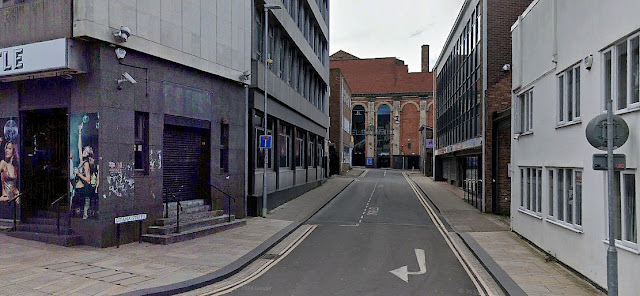
    Modern day Gitana Street, Hanley.
    Source, Google Earth.

    *Comedian Roy Hudd in his foreword to Ann Oughton’s biography of Gertie Gitana, recalled asking Don Ross in later years if Gertie really had used the amusing ‘… I think I’ll play my saxophone’ line in Cinderella, but Don neither confirmed nor denied it.

    Reference: Ann Oughton, Thanks for the Memory, passim;Ted Ray, Raising the Laughs, pp. 86-87; Evening Sentinel 15 February 1954 . 

  • The Great Storm of 1872

    Being situated in such a hilly region, widespread flooding is a rarity in Stoke-on-Trent, but occasionally chance extremes of weather have briefly put parts of the area under water. One startling weather event occurred on the afternoon of Sunday, 7 July 1872, when what the Staffordshire Advertiser described as ‘a thunderstorm of great severity’, struck the Potteries. Though it only lasted an hour and a half, it was so fierce that it left in its wake many dozens of flooded or damaged properties and a somewhat shell-shocked populace. Considering the violence of the storm and the damage it caused, remarkably few people were injured, though it seems there were many close calls.

    It had been cloudy all day, but in the afternoon the sky began to grow much darker presaging a storm, the light becoming so dim that newspapers could only be read near to windows or by candle or gas light. The dark clouds then gave way to ones with a strange yellow tint to them and it was then that it started to rain, not in drops, but as a veritable deluge driven in by a fierce wind and accompanied by loud claps of thunder and multiple bolts of lightning. In Hanley there was one very alarming event when a bolt of lightning passed through the Primitive Methodist school room in Frederick Street (now Gitana Street), entering by one window and out through another. The only damage was a scorched paint board on the front of the building, but the room had been full of children when the lightning shot through and these now fled the room in panic. They had to descend a flight of stairs to get out of the building and while none had been injured by the lightning, several now fell and were trampled underfoot and bruised in the crush, though none of them seriously. 

    During a service at Shelton Church, it rained so heavily that water forced its way through the roof and poured down into the building in streams. Buckets had to be brought to catch the water and the noise produced during the saying of the litany is said to have made for a very curious sound. Elsewhere in town, the lobbies of Bethesda Chapel in Old Hall Street were flooded, so too were numerous houses in town, notably in Nelson Place where part of the road nearby carrying a tramway was washed away. In Hanover Street, the downpour lifted stones up out of the road and deposited them at the bottom of Hope Street, where a heap big enough to fill two barrows was collected. The bottom end of Hope Street itself flooded, filling the cellars with up to a foot of water, floating heavy beer barrels in a brewery and boxes of live chickens in one house. The damage done to yards and gardens was tremendous. Nor were the local pot banks immune. The Cauldon Place works were flooded, though no serious damage was caused. Hanley’s satellite villages were likewise hard hit. At Basford a lightning bolt shot down a chimney and blew away a portion of a mantle shelf in one of the rooms; Etruria saw dozens of properties flooded, as too did Bucknall, where the water rushing down the roads and through the houses quickly threw the Trent into spate, causing it to overflow. This caused enormous damage on the low-lying ground of the neighbouring Finney Gardens where Bucknall Park now stands, some of the walks, plants and flowers being washed away by the sudden inundation. 

    Probably in no other part of the Potteries were the effects the storm so severe than in Burslem. Reporters on the scene shortly afterwards noted that even the oldest inhabitants had never before witnessed such a tempest, one stating that the rain ‘came down in bucketfuls’. The rain here was particularly heavy and for more than an hour the thunder and lightning was incessant and at one point the wind rose to a terrible pitch causing major damage in several places. On the Recreation Ground (where the old Queens Theatre now stands), Snape’s Theatre, a temporary structure of wood and canvas which had been constructed for the town’s wakes week, was in a matter of minutes blasted to smithereens. A number of the thickest supports were splintered like matchwood and many of the rafters and seats were destroyed, while the canvas roof was torn to shreds as the wind hit it. Mr Snape was a veteran travelling showman, well liked in the district and there was a great deal of local sympathy for him over his losses. In the aftermath of the storm a fund was set up, subscriptions to which would hopefully help him in repairing the serious losses he had sustained. 

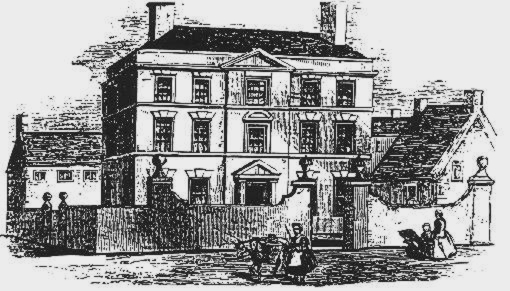
    The Big House, Burslem

    Just down the road from where Snape’s Theatre was taking a battering, part of an eight-foot tall wall between a timber Yard and the Big House was knocked down by the wind and rain, the accumulated flood water then rushed through the ground floor of the Big House with great force, blowing the front door open and then pouring in a stream down the turnpike road. 

    At the Roebuck Inn in Wedgwood Place, the violence of the rainstorm split some of the roof tiles, causing a mass of water to cascade into the upper rooms, then down the stairs and out through the front doors. The Town Hall too received a soaking, the basement of which was flooded to a depth of three feet, which caused no end of problems for the hall keeper and his wife who had the job of clearing it all out. Likewise the row of houses in Martin’s Hole – literally a hole or hollow near the Newcastle Road, where the roofs of the houses were on a level with the road – ‘presented a truly pitiable appearance’, the buildings being flooded to a depth of four and a half feet, ruining food stores and furniture and forcing the luckless inhabitants to seek shelter on the upper floor. 

    Almost everywhere else it was the same story with only slight variations. Longport received a severe visitation with most of the houses flooded to several feet. At Middleport the canal overflowed adding to the chaos. At Tunstall, water poured into the police station and several houses doing much damage. In Smallthorne numerous houses were flooded and smaller items of furniture were flushed out of the doors and sent floating down the street. At Dresden as well as the numerous flooded properties, the road at the lower end of the village was split apart by the storm, leaving it looking for all the world as if it had been heavily ploughed, which made it impassable to traffic and men had to be brought in to make repairs. In Stoke, Fenton and Dresden as in Burslem, many householders were forced briefly to live upstairs as their ground floors filled up, sometimes as high as the ceiling. Longton too suffered torrential rain and likewise had some flooding, but saw much less material damage, though at one pot bank the downpour extinguished the fires in their kilns. 

    Then the storm passed, leaving the Potteries in a battered state that it would take several days to recover from. That evening another storm broke overhead, but this turned out to be a much less severe event and caused no more serious problems.

    Reference: Birmingham Daily Post, Tuesday 9 July 1872, p.5; Staffordshire Advertiser, Saturday 13 July 1872, p.5.

  • Into the Valley of Death

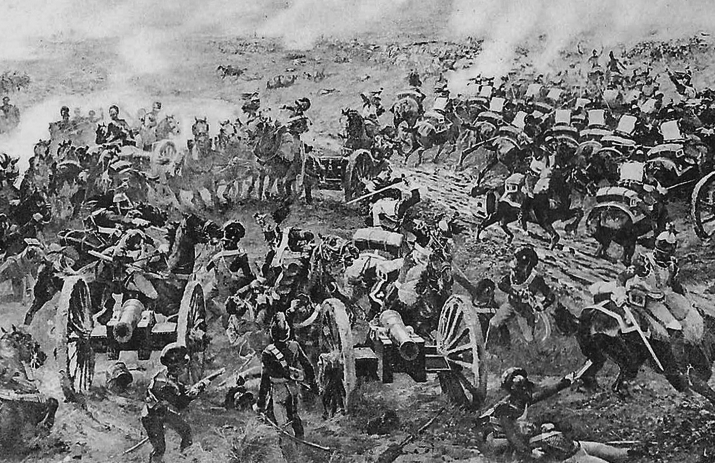
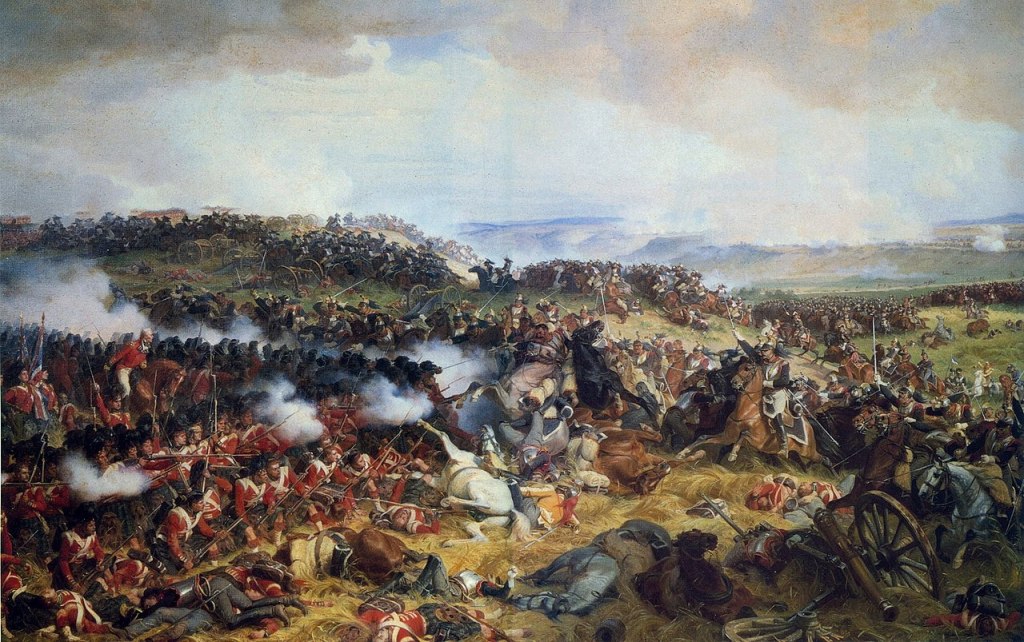
    In 1975, a small article appeared in the Evening Sentinel noting that at the battle of Balaclava during the Crimean War, 1358 Private George Turner* of the 11th Hussars, born in Burslem, had been mortally wounded during the Charge of the Light Brigade. According to his records, Turner was indeed from Burslem, and had worked locally as a crate maker until at the age of 18 he had enlisted in the 11th Hussars at Coventry on 24th September 1847. As the paper noted, he was probably the only man from the Potteries to have taken part in that famous but suicidal military action, when on 25th October 1854, a force of nearly 670 light cavalrymen were mistakenly launched in a frontal attack on an extended line of Russian cannon, infantry and cavalry at the end of a valley, that were further supported by other batteries on either side. The results of this colossal blunder were predictable, with some 110 British soldiers being killed and 160 wounded in the attack, a 40 percent casualty rate, while over 300 horses were killed. 

    Richard Caton Woodville’s famous painting of the Charge of the Light Brigade. Lord Cardigan on the far left of picture is dressed as the commander of the 11th Hussars.
    Source: Wikimedia Commons

    The 11th Hussars, resplendent in their black fur shakos, blue and gold braided jackets and crimson trousers, formed half of the second rank of the Light Brigade, though that did not spare them and they took a severe mauling from the Russian cannons as the Brigade closed on the enemy line. Private Turner was one of those struck down well before they got there, hit on the left arm by a cannonball, his injury being witnessed by Sergeant Major George Loy Smith of his company, who was riding nearby. Loy Smith later wrote ‘… before we had gone many hundred yards Private Turner’s arm was struck off close to the shoulder and Private Ward was struck full in the chest.’ Another Private named Young had received a similar injury to Turner and Loy Smith told him to turn his horse around and go back to their own lines, ‘… I had hardly done speaking to him, when Private Turner fell back, calling out to me for help. I told him too, to go back to the rear.’

    The rest of the brigade rode on down the valley and through the line of cannons where they briefly caused havoc in the rear of the Russian line before exhaustion, the decimation of their ranks and Russian reinforcements forced them to retreat. Turner meantime, must have ridden, or been carried back down the valley to the British lines, bandaged up and with others was then placed aboard a transport ship bound for the military hospital at Scutari in Turkey. However, he never made it, his wound was too severe; Private George Turner aged 25 years old died aboard ship on 28th October and was probably buried at sea. 

    There was no mention of the fate of Private Turner in the local papers at the time and it took 120 years for his story to finally make the pages of the Sentinel. It was related by Mr W. R. Baker of Endon, who added, ‘I ask your readers to spare a moment’s thought to his memory now when tradition has little meaning and patriotism is an outmoded word I make no apology for thinking that he should not be entirely forgotten.’ 

    There existed, though, another poignant addendum to Turner’s sad tale. Seven months after the battle of Balaclava, the Light Brigade had passed again over the same ground, now deserted of enemy troops and here the upper part of a sabre scabbard, all twisted and mangled, was picked up by Sergeant Major Loy Smith and it became part of his collection of memorabilia. When the collection was put on display in Sheffield in 1981, a card attached to the scabbard’s remains read, ‘This belonged to Private Turner, K.I.A.’

    *Despite my best efforts, I have yet to find a trace of a George Turner in the local civil records who fits the available data, raising the possibility that the name is an alias.

    Reference: Evening Sentinel, 25 October 1975, p.4; George Loy Smith, A Victorian RSM: From India to the Crimea, p. 132.

    My thanks to Mr Philip Boys for kindly providing me with background information on Private Turner contained in ‘Lives of the Light Brigade: The E. J. Boys Archive’. 

  • The Sneyd Colliery Disaster

    At 7.50 am, on 1 January 1942, a devastating explosion took place 800 yards below ground at No 4 pit of Sneyd Colliery, Smallthorne. In normal times the pit would not have been working on New Years Day, the miners considering it unlucky, but because of the demand for coal during the war, work had gone on as normal and a full shift was on duty at the mine when the explosion occurred. The blast was contained to one coalface in the 7-foot Banbury Seam of No. 4 pit. All other workings were unaffected by the explosion, but the thump was felt throughout the mine, some men in the pit noted that the flow of air changed direction, while on the surface people felt a bump and all the lights flickered. Everyone knew something major had happened and when a frantic telephone call from the pit bottom informed them that an explosion had occurred, for the safety of all, work was stopped and the miners were quickly evacuated from the unaffected parts of No. 4 pit as well as from the neighbouring No. 2 pit.

    The Sneyd Mines Rescue Team sprang into action immediately after the blast and venturing down they rescued a handful of men from the pit bottom, but also found the first bodies. Teams were soon arriving from other local collieries including Chatterley Whitfield, Black Bull, Hanley Deep and Shelton; in total nine local mines rescue teams became involved in what soon turned from a rescue to a recovery effort. Beyond the mine, news of the explosion soon spread by word of mouth through the local community. Families and friends horrified by the reports they were hearing dashed up to the colliery to wait at the Hot Lane gate for news of their loved ones, but for many it would be the worst news. The bodies of 16 men were brought out that first day, but the rescue operations had to be postponed due to the presence of afterdamp and it was announced at that point that there was now no hope of finding anyone else alive. Up top, everyone came in to help, first aid staff were on duty at the ambulance room, the mine managers directed the rescue operation and the Inspectorate of Mines soon had staff on site to help out and assess the damage. Other staff did their bit too, the pit’s chief telephonist Mabel Caine was reported to have stayed at her post almost continuously for five days and nights, fielding thousands of phone calls and refusing all attempts to get her to take a long break.

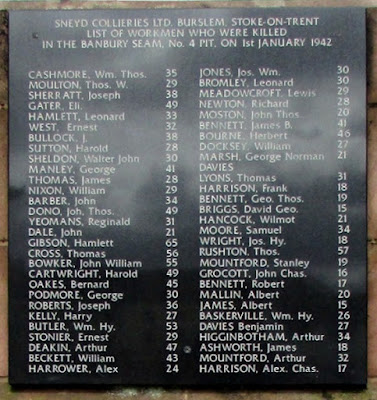
    On 5 January even before all the bodies had been recovered, nearly 80% of the workforce got back to work, but it was not until 10 January that the last bodies were recovered. The list of the dead was sobering, as of the 61 men and boys working on the face that morning, 57 had lost their lives in the blast, most being killed in the initial explosion, while two later died in hospital. The two youngest, David George Briggs from Stanfields and Albert James from Burslem were both aged 15, while the oldest Hamlett Gibson, from Cobridge was 65. There were many sad stories to be told of those who were lost. A Mrs Bennett of Moorland Road, Burslem, suffered a double bereavement, losing her 41 year old husband James and 17 year old son Robert, both of whom had been working on haulage; the family had only recently moved down from Scotland. Mr and Mrs W. F. Harrison of Cobridge lost two teenage sons, Frank aged 18 and Alexander Charles aged 17. Joseph Sherratt aged 38 from Porthill was one of two firemen who were missing. Married with two children and a third on the way, only hours before he had been enjoying a party with his children and some of their friends and had laid on a puppet show of ‘Sinbad the Sailor’ to amuse them. He had not been superstitious about working on New Year, but his wife had and handed him a silver three penny piece for luck. Another haulage worker from Burslem, William Docksey aged 27, had been at the pit for 10 years, He had a brother working elsewhere in the mine who immediately joined the rescue team in an effort to find William. And David Briggs one of the youngsters mentioned earlier, had enjoyed a brief moment of local fame only a short while before, when he was photographed with the Minister of Food, Lord Woolton, eating one of the first sandwiches to be served by the new central depot for providing sandwiches for the miners of North Staffordshire.

     Four survivors had been pulled out of the pit, who by sheer luck or their more sheltered position in the mine, had escaped serious injury or death. One was Ernest Stone of Burslem in charge of the telephone at the pit bottom, whose call had alerted those up top to what had happened. He had been seated in a recessed area off the main road when the explosion occurred and thus avoided the worst of the blast. When the first rescuers arrived, though very dazed, he stayed at his post for three hours refusing to go up until he was finally overcome with dizziness. Another equally lucky was George Read of Burslem, the chief hooker in charge of loading and unloading tubs into the cages at the pit bottom. Like Mr Stone he was in an area off the main roadway and likewise escaped the worst of the blast. After a day at home getting over the shock of what had happened, he returned to the pit to help in the recovery effort. Thomas Gibbons from Burslem aged 64, was not so lucky. He was working near to the pit bottom operating a compressed air machine that drew tubs from the Banbury seam when the explosion occurred. Hit by a tremendous blast of hot air, he was hurled against a wall and fainted. Coming to a short while later in complete darkness and covered in dust only his intimate knowledge of the mine saved him. Working out where he was, Thomas crawled along the passage to where it branched off from the Bambury seam to the return of the Holly Lane branch. After crawling along for another 200 yards he was discovered by some Holly Lane miners who gave him some water and got him transported to the surface, from where he went to hospital. The fourth ‘survivor’ had not actually been in that part of the pit, but had initially been listed with the missing. Mr J. Bailey from Hanley, had only started at the pit the day before and swapped his heavy hand lamp for a helmet lamp with another man that morning. This was later discovered by the rescue teams who presumed Mr Bailey was a victim, though he had already been evacuated from the mine with the other 600 men. The mix-up was only discovered when he later wandered into the Burslem Miner’s Hall to correct the mistake after finding that he had been listed as a victim.

    In the immediate aftermath of the disaster a fund was set up to which many members of the public, collieries and companies gave money, while the proceeds of many local performances were also donated and money came in from abroad, even from as far away as soldiers serving in Iceland; over £17.000 was eventually collected and shared out amongst those who had lost a relative, the shares being determined by how many dependents the victims left behind. Families had been devastated by the disaster, many losing their main or only breadwinner. The disaster left 32 widows and 35 fatherless children, while of the 24 unmarried men 13 left grieving mothers and fathers and 8 left mothers who were already widowed.

    The question everyone wanted answered, was what had caused this appalling accident? The subsequent inquiry headed by Sir Henry Walker, concluded that the most likely cause was that tubs used to move the coal out of the mine had derailed and damaged an electric cable. Sparks from the cable had then ignited coal dust in the air and caused an explosion. Some writers have since disagreed with this explanation, and have advanced other perfectly valid theories, though after all this time any kind of definitive explanation of what happened is not possible as the mine is no more and all the witnesses are long dead.

    Sneyd Colliery continued working through the war, but from the late 1950s onwards it was slowly swallowed up by a larger neighbour. Major reconstruction work at Wolstanton Colliery saw an underground connection made to Sneyd and from that point on coal gradually started being brought to the surface at Wolstanton. Coal ceased being raised at Sneyd in July 1962 and though for a time the shafts there were still used for sending miners down, eventually all the men were transferred to Wolstanton Colliery. The No. 4 shaft, however, remained open as a spare entry for the northern area of the expanded colliery until the final closure of Wolstanton in 1985.

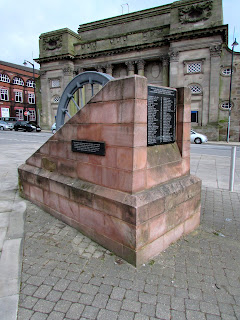
    The Sneyd Colliery explosion has the dubious honour of being the last major pit disaster in the Potteries and it cast a long shadow in the city’s collective memory. A memorial comprising a pit wheel set in bricks was unveiled in Burslem town centre in 2007. It lists all 57 names of the dead on a plaque and carries another praising the mines rescue teams that worked so hard to bring out the bodies.

    Reference: Evening Sentinel, 1 January 1942, p. 1; 2 January, p.1; 5 January, p.1; 10 January, p.1.

  • Visiting Burslem’s Houses of Ill Fame

    The oldest profession in the world had its place in soft underbelly of the Regency Potteries. Prostitutes plied a regular trade usually around the local inns where there were rich pickings when the potters and miners rolled in with their wages. A brief memoir of the period reveals that then as now many of the local working girls were ordinary women driven to extremes by circumstances, the probable cause being abject poverty. A Short Memoir of Ann Sheldon, published in 1821, tells the story of the short life of a dedicated Burslem Sunday School teacher. Constructed around entries in Ann’s diary, it reveals her to have been a noble spirited young woman, who saw it as her Christian duty to visit the sick and try to save the fallen.

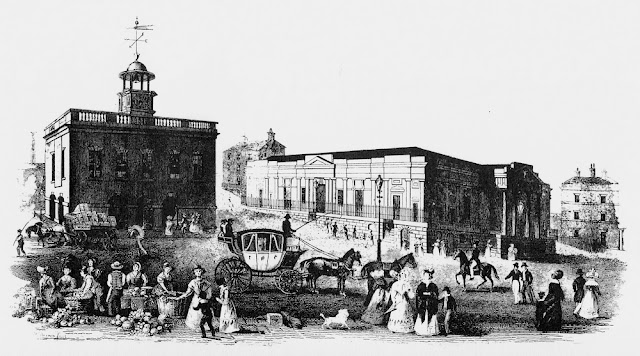
    Burslem town centre in the early 19th century.

    In April 1813 following a class, one of her class members asked Ann if she would visit a woman who was very ill. Accompanied by a fellow teacher ‘Miss B’, she went to see the woman whom she soon discovered to be a local prostitute. They found her to be, ‘a little better and very penitent.’ Ann continued : ‘she had been a very wicked woman for years, and is now little more than 30 years of age. Her parents died when she and her sister were young. As they advanced in years they got into bad company and lost their character. Masters would not employ them and they became common prostitutes.’ The woman, exhausted and frightened by her illness, told the two teachers that if she lived she was determined to leave her ‘wicked course of life.’

    After praying together they left her. The two young teachers had obviously been shocked by the interview and though the nature of the woman’s illness is never stated, the impression we are left with is that it was contracted as a result of her calling. Both came away from the house burning with a desire to save others from such a dangerous and degrading career.

    The next day, Ann and Miss B set out once more and found a woman to direct them to the ‘houses of ill fame’. They visited two buildings, but met with a mixed reception, made all the more galling no doubt, by the fact that at least two of the girls they encountered were old Sunday school scholars.

    In the first house ‘we found a young woman about seventeen years of age, who lived by herself, and was three years ago a Sunday scholar.’ The girl was unmoved by the teachers’ entreaties, Ann went back many times to invite her back to the school, but to no avail.

    There were two women in the other house: ‘we found a woman about twenty-seven years of age; who met in class about two years ago: we both spoke as close as possible for an hour and a half; they shed many tears and confessed they had a hell upon earth. There was another woman present, a companion in sin, who appeared to take no notice: – I said to her come down on your knees, and cry to the Lord, to have mercy upon your soul, before it is too late: we all bowed the knee before God, and found much liberty in prayer.’

    It is unknown whether Ann and Miss B efforts were successful. The biography remains silent on the matter. Ann herself died at a young age in 1819.

    Reference: John Tregortha (publisher) A Short Memoir of Ann Sheldon, Burslem 1821

  • Thomas Cooper Sparks the Pottery Riots

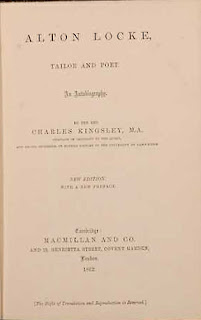
    One of the least known literary associations with Staffordshire, is that of Charles Kingsley’s novel Alton Locke. Tailor and Poet, which was published in 1851. The story of the rise and fall of a self-taught working man who is eventually imprisoned for rioting, is based upon a real person and a real incident. The person was the Chartist leader, Thomas Cooper, who was arrested and sentenced to two years in prison, for the events he had prompted in the Staffordshire Potteries.

    Thomas Cooper was born in Leicester to a working class family and from an early age displayed a precocious intelligence, the development of which was only limited by the fact that most of his lessons were self-taught. Occasionally, he had been known to immerse himself so deeply into his studies that the sheer mental effort he put forth ended on one occasion, at least, in him being physically ill. He worked at various jobs, mostly as a teacher, lay preacher and journalist, but eventually, appalled by the conditions endured by many factory and workshop workers, he became a convinced Chartist, a member of that Victorian working class movement which supported the introduction of a People’s Charter, which called for fair representation for the working population. The Charter’s six points demanded votes for all men at 21, annual general elections, a secret ballot, constituencies regulated by size of population, the abolition of property qualifications for MP’s and the payment of MP’s. Most of these points eventually became laws of the land and form a part of the state we live in today, but none of these things came into being until the latter half of the nineteenth century, long after the Chartist movement itself had collapsed.

    There were two bodies of the Chartist movement, the physical and the moral-force Chartists, who sought to bring about social change by revolutionary or evolutionary means. In his early days, Cooper was a supporter of the former faction. He was a fire and brimstone type of preacher, who like all great orators could move people with his speeches. This power comes through in Cooper’s autobiography, which is widely regarded as one of the finest working class ‘lives’ written during the Victorian age. The book, though written in Cooper’s later years after he had become a convinced moral-force Chartist, tends to carefully skate around his fiery physical-force youth and he presents himself as a far more reasonable man than he actually was in August 1842, when he arrived in the Potteries. Only by bearing in mind, that Cooper at this time advocated revolution of sorts, do the events he inspired in the Potteries make sense. Though he says in his book that he proclaimed, ‘Peace, law and order’, the resulting riots that left one man dead, dozens wounded or injured and many buildings burnt or ransacked, indicated that he said more than he was letting on.

    Cooper arrived in the Potteries, after a tour of several major towns and cities in the Midlands, and here he was to make a number of speeches before moving on to Manchester. The area was in the grip of a wage dispute. In June, 300 Longton miners whose wages had been drastically cut had gone on strike. By July, the strike had expanded to all of the pits in north Staffordshire, and hundreds of miners were on the streets, begging for money, and with the pits being closed, the potteries through lack of coal, could not fire their kilns and were also closed. By early August, the dispute had attracted widespread attention, certainly the Chartists expressed sympathy for the miners’ action, but contrary to later claims that the subsequent riots were Chartist inspired, it was mostly miners and not Chartists who did the rioting. The Potteries were a powder keg, ready to explode and Cooper’s arrival, as he himself admitted was ‘the spark which kindled all into combustion’.

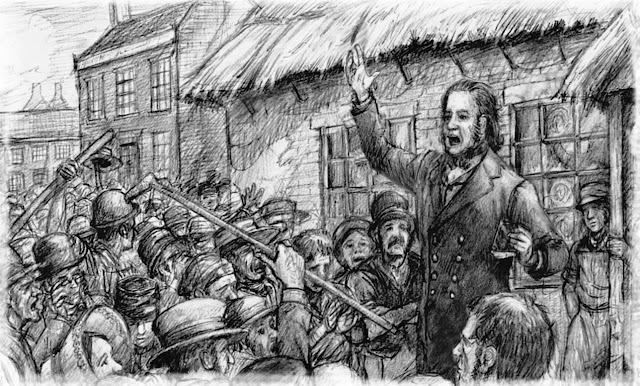
    Thomas Cooper addresses the crowd at Crown Bank, Hanley

    Standing on a chair in front of the Crown Inn, a low thatched building at Crown Bank in Hanley, on Sunday, 14 August, Cooper addressed a crowd of upwards of 10,000 people, delivering a brilliant Chartist speech to his audience. He look for his text the sixth commandment, ‘Thou shalt do no murder’. Throwing his net wide, he drew on examples of kings and tyrants from history, such as Alexander, Caesar and Napoleon, who had violated this commandment against their own people, even as their own government would be prepared to do. The next day, he addressed an equally sizeable crowd and moved a motion, ‘That all labour cease until the People’s Charter becomes the law of the land’.

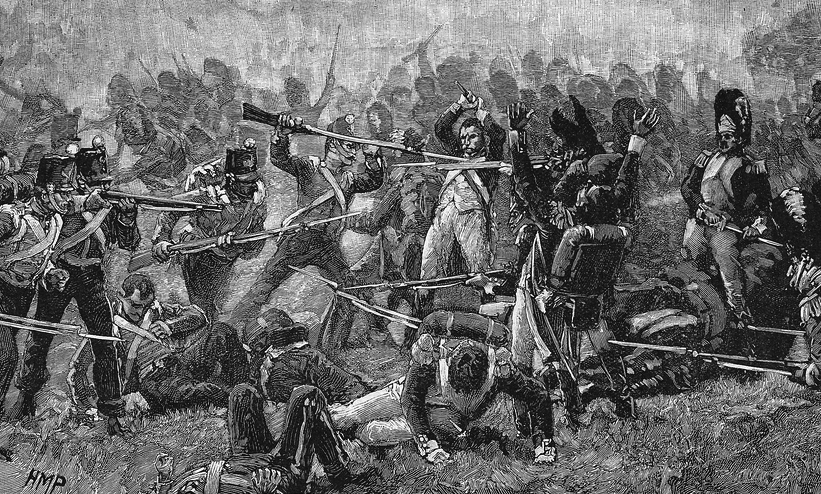
    What followed, Cooper later regretted. As the crowd dispersed. rioting started around the Potteries towns in all except Tunstall and the borough town of Newcastle. Police stations were attacked, magistrate’s houses ransacked and burned, as were Hanley Parsonage and Longton Rectory. By the 16th, the chaos had lasted a day and a night, but on that day, the most famous, or infamous incident of the uprising occurred, what is known locally as ‘the battle of Burslem’. Following the rioting in Stoke, Shelton, Hanley and Longton, a great crowd moved towards Burslem, there to meet a crowd coming from Leek. Here, though, the authorities played their hand, when a troop of mounted dragoons stopped the crowd from Leek. The magistrate in charge read the Riot Act, then tried to reason with the men, but when it was clear that they were bent on trouble, the soldiers were ordered to fire. One man from Leek was killed and many injured, the crowd was routed and the disturbances ended overnight, but for many weeks afterwards, the Potteries were full of troops and vengeful magistrates arresting rioters and Chartist leaders.

    Cooper, horrified at the events he had unleashed, had tried to escape, but he was arrested and eventually tried and sentenced to two years in Stafford Gaol, on charges of arson and rioting. Here, he spent his time profitably, learning Hebrew and writing his book, The Purgatory of Suicides. On leaving prison, though, his views were found to differ considerably from the new mainstrean in Chartist thought, and he became increasingly a moral-force activist and remained so for the rest of his life.

    It was in the two or three years after leaving prison, that Cooper was interviewed by the Rev. Charles Kingsley, whose Christian Socialist movement had inherited many of the Chartist beliefs. Kingsley had sought out several old Chartists and educated working men on whom he wished to base the life of the major character in the novel he was preparing. Thomas Cooper, was obviously the chief amongst these, certainly his autobiography, written many years after Kingsley had published Alton Locke, shows many striking similarities between Cooper’s life and that of his fictional alter ego. The riot that Alton inspires in the book, for which he too is committed to the prison, takes place in the countryside, amongst agricultural labourers, but behind it there is the faintest echo of the struggle in the Potteries, that one historian has considered the nearest thing to a popular revolution that the Victorian age saw.

    After 1845, Thomas Cooper turned his talents mainly to writing, but he also lectured on subjects such as history, literature and photography. In this capacity, he made a number of return visits to the Potteries, to the place where on that day many years before, he had ‘caught the spirit of the oppressed and discontented’, in seeking to establish the basis of a democratic society.

    Reference: Charles Kingsley, Alton Locke. Tailor and Poet (1851); Thomas Cooper, Life of Thomas Cooper, written by Himself, (1872).

  • A Million to One Chance

    On the afternoon of Sunday 9 May 1943, 40 year old colliery maintenance worker Joseph Boulton of 12 Blake Street, Burslem, was engaged with others in recapping a winding rope at the top of No. 2 pit at the Sneyd Collieries, Burslem, when he overbalanced and fell backwards head first down the pit shaft. He turned several somersaults and in his headlong fall happened to see a wire guide rope glistening with oil from the light reflected from the top of the pit shaft which was rapidly disappearing from his view. Reaching out he grasped the guide rope first with one hand, then with the other, and succeeded also in wrapping his legs around it, the thick coating of grease preventing any serious injury from friction burns. In this way he slowed his descent and eventually came to a stop and stepped off at a pump inset about 300 yards from the top of the pit shaft. The pump attendant was not there, so Mr Boulton sat in the pump house and read an illustrated magazine until a manager Mr J Hebblethwaite, and other colliery officials, who had expected to find him dead at the pit bottom, found him with only slight burns to one hand and one leg. They were amazed to see the man and find that he was comparatively unhurt, but insisted on him receiving first-aid treatment at the ambulance room before he went home and went to bed.

    Describing his miraculous escape to reporters Mr Boulton said ‘A million-to-one chance saved my life.’

    Reference:Liverpool Daily Post 11 May 1943, p.3; Staffordshire Advertiser 15 May 1943, p.7